
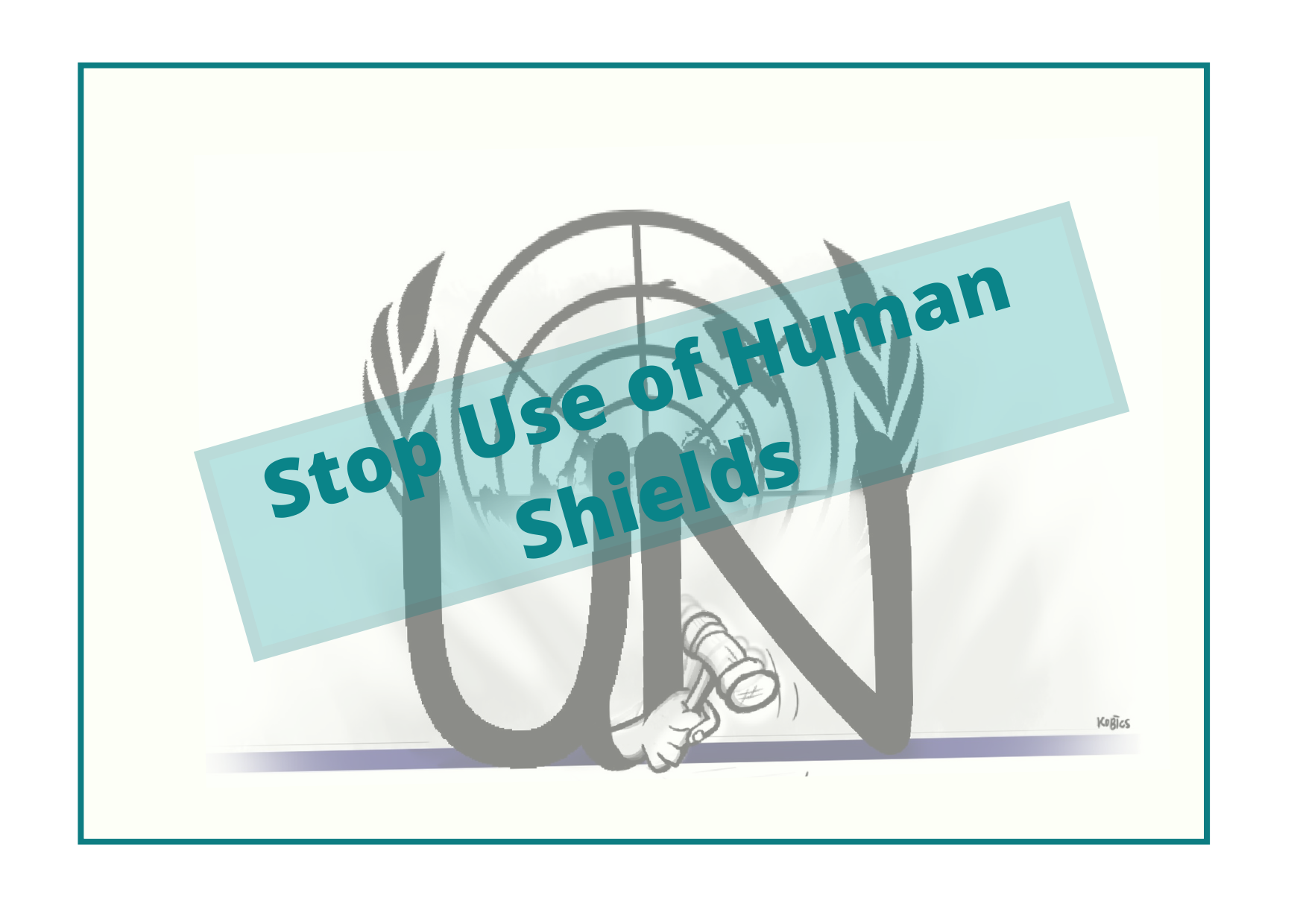
Human Shields = UN War Crimes
Jerusalem Institute of Justice- Submission to The Independent International Commission of Inquiry on the Occupied Palestinian Territory, including East Jerusalem, and Israel
Dear Honorable Commission,
We, the Jerusalem Institute of Justice, are a not-for-profit human rights organization, with Special Consultative Status at the UN Economic and Social Council, fighting to promote human rights, defend democracy, and improve the overall quality of life for Israelis and Palestinians alike. Due to our hope of ever-lasting peace in the region, we find it of the utmost importance to address your call for submissions of relevant information and documentation to the mandate of the Commission.
The attached report concerning Hamas’s actions during Protective Edge Operation (the 2014 Gaza war) was filed by our organization at the Office of the Prosecutor at the International Criminal Court (ICC) in The Hague on the 6th of March 2017. We argued that a full investigation of crimes committed within the Palestinian territories should be pursued, and a case should be lodged, against Ismail Haniyeh, head of the political wing of Hamas, for his role in the commission of war crimes during the 2014 Gaza war. Following this communication, and others, an investigation of the “Situation in Palestine” was commenced by the Chief Prosecutor of the ICC on the 3rd of March 2021. The submission of this report is in accordance with the COI’s mandate to collect evidence and information of abuses of international human rights law and identify those responsible.
There were two primary war crimes committed by Hamas militants during the war within the Gaza strip. First, they consistently used civilians for military protection and purposes, placing the Gazan population in grave danger as “human shields.” This was done by firing rockets and mortars from densely populated areas, by encouraging (and sometimes forcing) civilians to remain in potential military targets, and by storing rockets in schools, hospitals, mosques, and other civilian structures. Second, the rockets Hamas used during the war are inherently indiscriminate under international law, and were therefore unlawful to use. These rockets are unable to be controlled, and therefore could not accurately be fired at lawful military targets.
These heinous crimes reoccurred during the most recent Gaza conflict in May 2021– Hamas fired more than 4,360 rockets and mortars from residential areas. Of those, approximately 680 misfired and fell into the Gaza Strip, killing Palestinians and damaging Palestinian property, and 3,570 of the remaining rockets struck Israeli towns and cities. Thirteen Israelis were killed, and hundreds were injured. These war crimes are also considered criminal activity pursuant to Article 8 of the Rome Statute of the International Criminal Court – “War Crime of Using Protected Persons as Shields”.
We urge the commission to look into these violations of Human Rights committed by Hamas and include them in their report due to be presented in the Human Rights Council’s June regular session.
Yours sincerely,
Flavia Sevald, CEO,
Jerusalem Institute of Justice,

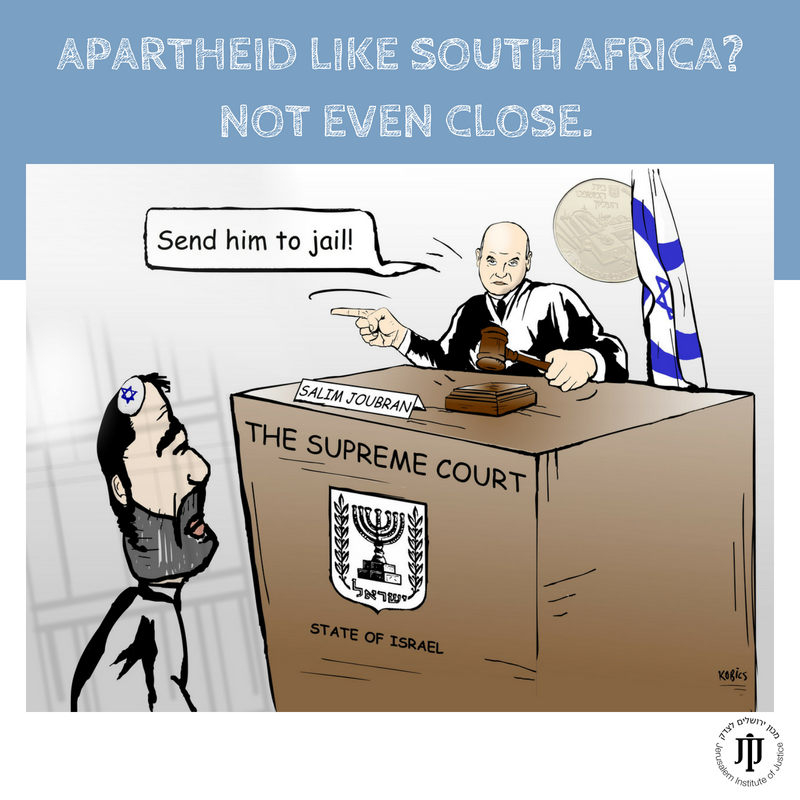
THE “APARTHEID” NONSENSE
“The people who are talking about apartheid[1] in Israel are talking nonsense.” So declared a black South African pastor who, after an accident, found himself hospitalized in Israel alongside Palestinian Muslims and Jews, all receiving equal care.
Characterizing Israel as an apartheid state is a charge frequently heard from the numerous churches, religious organizations, and NGOs that endorse the BDS movement. It often appears explicitly in their official documents and resolutions. The “apartheid state” mischaracterization is one of the presupposed assumptions underlying the BDS movement, a complete fiction that is uncritically accepted by many of its followers as well as many naïve church-goers.
Other religious leaders in the BDS movement are not naïve but simply dishonest and cynical ideologues who want to bring down Israel the same way economic tactics succeeded in bringing down the old South Africa in the 1990s. More to the point, they really don’t want to change Israel. Their real agenda is to eliminate Israel entirely. Author Gerald Steinberg writes, “The attempt to label Israel as an illegitimate ‘apartheid state’ is the embodiment of the new anti-Semitism that seeks to deny the Jewish people the right of equality and self-determination among the nations.”
Kenneth Meshoe, a black member of the South African parliament, states emphatically, “I know that nothing is happening in that country [Israel] that can be compared to apartheid in South Africa.” Meshoe, who was born in Pretoria under apartheid, speaks from experience. “We know what apartheid really was. What we suffered in South Africa is not being suffered by anyone in Israel…. Non-Jews in Israel have everything that we non-whites in apartheid South Africa never shared with the white South Africans.”
Meshoe adds, “The charge that Israel is an apartheid state is a lie about Israel, and it is a lie about the real apartheid.” To those who propagate the slander, he says, “You are damaging the chance for peace in the Middle East and… you are destroying the memory of the real apartheid.” As Gerald Steinberg puts it, “In reality, the analogy and rhetoric are absurd, and they demean black victims of the real apartheid.” He points out, too, that “the ‘Zionism is apartheid’ propaganda is also used to justify Palestinian terrorist attacks and the efforts to deny Israelis the basic human right of self-defense….”[2]
The comparison between apartheid South Africa and Israel is ridiculous, a case of apples and oranges. As Harvard Law professor Alan Dershowitz says, “Israel is not like South Africa in any way.” Yet the “apartheid” slander persists, facts notwithstanding, because it is a useful propaganda theme for the purpose of demonizing and delegitimizing Israel as well as denying Israel’s right to exist.
Author and journalist Benjamin Pogrund was born in Cape Town in the 1930s and left South Africa only after being forced out for his critical journalism. Since then he has lived more than a dozen years in Israel. He writes, “I am acutely aware of Israel’s problems and faults, but it is nothing like South Africa before 1994.” He cites “pass laws” that limited where blacks were allowed to live and work, torture and detention without trial by the security police, and starvation and malnutrition in the rural areas.
In apartheid South Africa, any black who needed medical treatment and was fortunate enough to find a white doctor willing to treat him had to enter the clinic or hospital through the back door and get inferior treatment. There is no such discrimination in Israeli medical facilities.
In Israel there are non-Jewish judges, teachers, professors, even members of Knesset, as well as others holding high positions in all professions and occupations. In apartheid South Africa, non-whites were systematically banned from all such opportunities. They were deprived of the right to vote and choose their own leaders. Israeli citizens, both Jews and Palestinians, have these civil rights in full.
Blacks under apartheid were the overwhelming majority of the population of South Africa. Yet they were not citizens and they lived under severe restrictions. Even the basic right to life was trampled on. The government disrespected their human rights so much that blacks could be killed for protesting against its policies. In Israel, on the other hand, Arabs are a minority, but they have equal rights as citizens.
“Zionism and the revival of national sovereignty in the Jewish homeland are not manifestations of European colonialism, in contrast to the white settlers… who created Johannesburg and Pretoria,” writes Steinberg. And while black labor was exploited in slavery-like conditions under apartheid, in contrast, Palestinians are dependent on Israeli employment….”
As black South African parliament member Kenneth Meshoe observes, there would have been no need for armed struggle in South Africa, and no need for Nelson Mandela to go to prison, if conditions under apartheid had been comparable to the human rights situation in Israel. In addition to the right to vote, Mandela fought for fundamental rights including freedom of movement and travel, freedom to live where one chooses, freedom of access to medical facilities, and the right to education. In Israel, those rights are already in effect for all Israeli citizens without discrimination.
From its beginning, the Zionist movement has held an egalitarian mentality, rejecting social class hierarchy structures. The idea was that no one, no social elite, was above doing useful labor. Otherwise, said Ben Gurion, “this will not be our homeland.” That egalitarian ideal has continued to shape Israeli society and culture. It stands in stark contrast to the racially oppressive and brutal, rights-denying character of apartheid. The two models of society could hardly be more opposite.
There is a caveat, though, when it comes to the West Bank and Gaza, the Palestinian territories as differentiated from Israel per se. Those areas have their own governing authorities whereby they manage their own affairs. In fact, they don’t just want their own separate state. Disputing Israel’s right to exist, they advocate Israel’s destruction and refuse to give up terrorism. As a result of this hostile intransigence, Israel cannot take the self-destructive step of extending citizenship to the Palestinians in the territories, which would amount to de-facto annexation. But the fact that the territories are governed separately from Israel does not imply by any stretch of the imagination that Israel is an apartheid state.
Benjamin Pogrund, after acknowledging some of Israel’s faults, writes: “But from my perspective, there is none of the institutionalized racism, the intentionality that underpinned apartheid in South Africa. So why does the BDS movement insist otherwise?” His conclusion: “For them to propagate this analogy in the name of human rights is cynical and manipulative. Their aims would eliminate Israel.”[3]
[1] Apartheid, of course, is an Afrikaans word meaning racial segregation. But it denotes a whole system of brutal oppression.
[2] Steinberg, Gerald, “The Apartheid Propaganda,” Jerusalem Post, 24 August 2004.
[3] Pogrund, Benjamin. “Why Israel Is Nothing Like Apartheid South Africa.” New York Times Op-Ed, 31 March 2017.
Apartheid: What it is and what it isn’t
By Nikki Golomb.
“For the purpose of the present Convention, the term "the crime of apartheid", which shall include similar policies and practices of racial segregation and discrimination as practised in southern Africa, shall apply to the following inhuman acts committed for the purpose of establishing and maintaining domination by one racial group of persons over any other racial group of persons and systematically oppressing them…”
UN International Convention on the Suppression and Punishment of the Crime of Apartheid
Apartheid, the Dutch word for separation, was the official system of political, economic, social, and cultural oppression of the Black majority in South Africa from 1948 until 1991. Although different forms of racism and discrimination still exist around the world today, the specific methods of oppression exercised by the South African government during this time are unique to the system of apartheid. The United Nations Apartheid Convention (cited above) lists several methods of oppression indicative of apartheid, thus defining it as a distinct system of legislative discrimination.
A common misconception among the anti-Israel community is that Israel is an apartheid state. In order to dispel this misunderstanding, it is important to recognize two facts: first, that Arab Israelis and Jewish Israelis are equal under Israeli law; and second, that Palestinians living in the West Bank and Gaza are not Israeli citizens, and thus are not subject to Israeli law.
First, let us explore the rights of Arab Israelis. In order to do this, it is important to recognize the difference between societal discrimination and legal discrimination. Societal discrimination, for example, would explain that Arab Israelis are likely to receive a poorer education when compared to Jewish Israelis due to Arabs being viewed by some as second-class citizens, economic factors which make it difficult for Arab families to pay for private education, and a history of discrimination of which the effects are still being felt today. Lawful discrimination, on the other hand, would imply the legalization of forced school segregation based on ethnicity, as well as substandard educational materials and resources provided to Arab schools. While it is true that state religious (Jewish) schools and Arab and Druze schools exist, they are meant to cater toward each individual group’s cultural needs and are provided with uniform subject matter and appropriate funding; furthermore, the majority of Israeli students attend public (mixed) schools [source]. In terms of higher education, Arab Israelis make up 14.4% of Bachelor Degree students; 10% of Master Degree students; 6% of PhD candidates; and 35% of medical school students at the Technion [source]. While South Africa under apartheid gave Black citizens an inferior education, Israel provides equal education for all of its citizens, regardless of ethnicity. Arab Israelis additionally enjoy the right to vote, the right to form political parties, freedom of expression, and all other rights granted to all Israeli citizens.
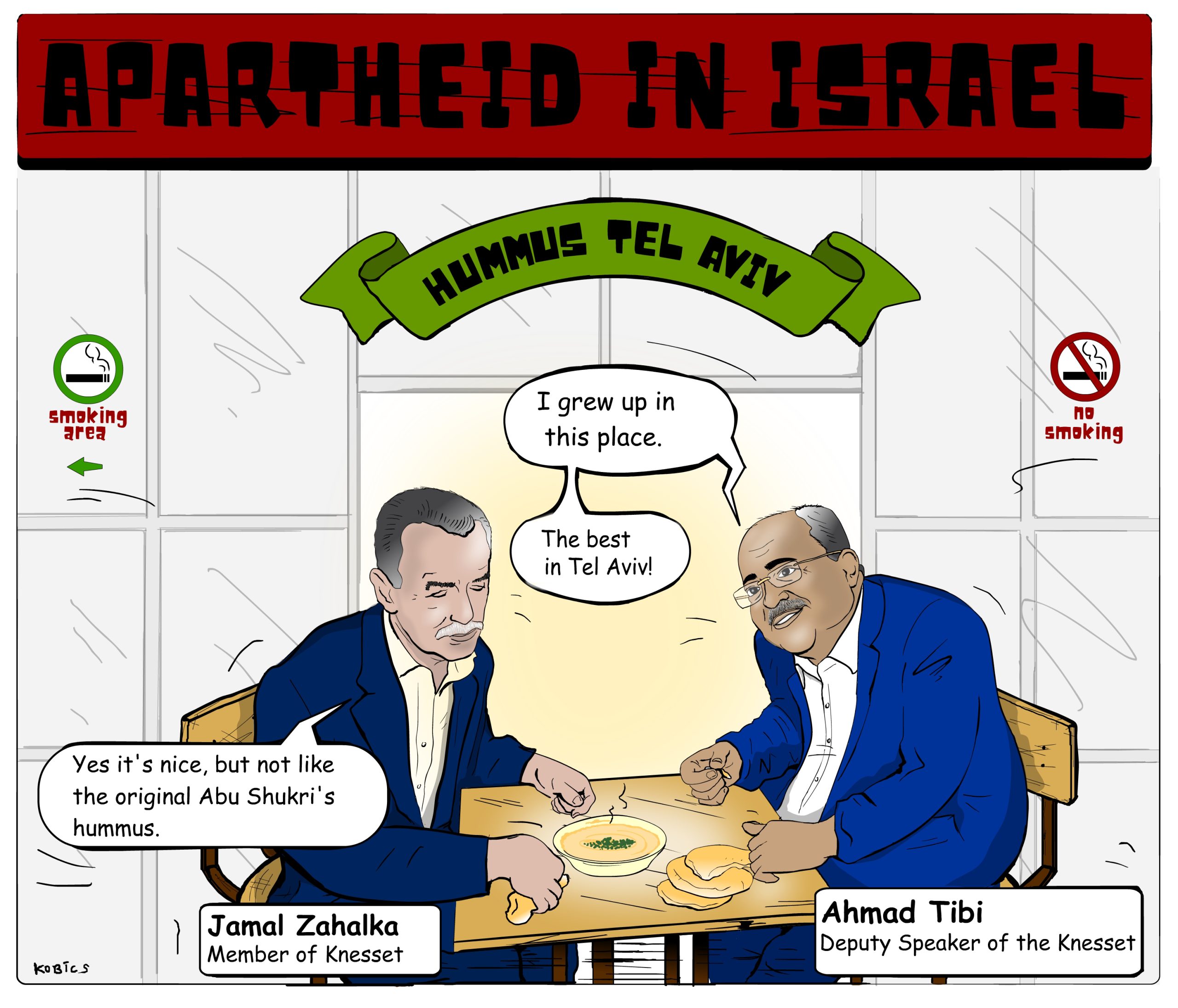
Arab Israelis also have many prominent positions in Israeli society, a phenomenon which would be downright impossible, let alone illegal, under apartheid. Seventeen Arab Israelis were elected to serve in the current Israeli Knesset, comprising 14% of all Members of Knesset. An Arab Justice serves on the Israeli Supreme Court, and 52 of Israel’s 672 Judges are Arab. Arab Israelis additionally work as professors, doctors, journalists, and other high-power positions throughout Israeli society. While these numbers do not reflect complete equality (in which, theoretically, Arabs would make up 19% of these workers, as they comprise 19% of the population of Israel), it again highlights the important distinction between social discrimination and legal segregation. Israel cannot be an apartheid state, because all of its citizens are treated equally under the law.
Now we can look at the more complex issue of Palestinian rights. While it is true that Palestinians living in the West Bank and the Gaza Strip cannot vote in Israeli elections, do not have access to Israeli education, and are not represented in the Knesset, this is because of the simple fact that they are not Israeli citizens. Just as I, an American Jew, cannot vote in Israeli elections because I am not an Israeli citizen, neither can a Palestinian. Since the Oslo Accords in 1993, Palestinians are subject to their own governments; and though these governments (the Palestinian Authority in the West Bank, and Hamas in Gaza) are anything but just, Israel has no governmental authority in those territories. Israel cannot be an apartheid state on the grounds of the rights of Palestinians simply because the Israeli government is in no position to grant or deny Palestinians civil and political rights.
With regards to what many refer to as the “apartheid wall,” the Security Fence along the border of Israel and the West Bank is actually a fence that is less than 5% wall. Although security checkpoints are an inconvenient reality that create difficulties for Palestinians when they enter Israel, they are necessary in order to protect the lives of all Israeli citizens. The fence, which was built during the second Intifada, stopped hundreds of terror attacks a day during the height of its success. While many Palestinians feel it is degrading and it is not a perfect solution by any means, it is a necessity in order to ensure the security of Israeli citizens. Just as you and I must go through border control when entering a different country, those wishing to enter Israel from the West Bank must also endure a security checkpoint. This is not apartheid – it is national security.
Discrimination is, like in all countries around the world, a problem in Israel which is being addressed. However, it is not the legalized system of oppression that many claim it to be. Arab Israelis have full rights under Israeli law, and Palestinians are subject to their own laws and policies. While the methods of protecting national security are not perfect and social equality has not yet been realized, calling Israel a state of apartheid is both factually inaccurate and offensive to the Black South Africans who lived through true apartheid. In order to truly advocate for the rights of those in and around Israel, it is vital to do so using all the facts and correct terminology. It is impossible to fight against something which does not exist, and it is a waste of time and energy to do so when there are real problems that must be addressed.