

Indoctrination of Children- Policy Proposal to the ICC
Summary of Input to the Office of the Prosecutor at the International Criminal Court
To Renew the Policy Paper on Crimes Against or Affecting Children
For the full report, press here
The Jerusalem Institute of Justice has submitted its substantive input to the Office of the Prosecutor of the International Criminal Court as part of their public consultation aimed at updating the policy paper concerning crimes against or affecting children. The primary objective of this public consultation, in which our organization actively engages, is to enhance the effectiveness of investigations and prosecutions pertaining to crimes committed against or adversely impacting children. JIJ actively works to raise awareness and combat the utilization of children in hostilities, highlighting the significance of addressing indoctrination as a means of exerting psychological pressure on children to join armed groups.
The Rome Statute of the International Criminal Court does not explicitly define the actions of conscripting, enlisting, or using children in hostilities. Instead, the scope of these activities is determined by referencing relevant treaties, principles of international law, and general legal principles derived from national legal systems, all in line with internationally recognized human rights standards. The ICC Trial Chamber I acknowledged that children under 15 are typically unable to give genuine and informed consent when enlisting. Given the interpretive nature of the Rome Statute, indoctrination can be considered within the purview of enlisting or conscripting as it involves imposing prescribed beliefs, inhibiting critical evaluation, and fostering violence normalization. Indoctrination plays a significant role in exerting psychological pressure on children to join armed groups or forces, and its methods can range from formal education to military-oriented summer camps, mass media, and online networks.
The involvement of children as combatants in conflict situations not only jeopardizes their own well-being and development but also poses a threat to the prospects of peace and stability in affected regions. Children exposed to violence during their formative years are at risk of becoming agents of violence themselves, hindering their potential as contributors to lasting peace. Conflict-affected children suffer enduring mental and physical trauma, with child soldiers experiencing even greater levels of violence as witnesses and perpetrators. This trauma can manifest in various disorders, impacting their mental health, behavior, and education. The consequences of children's trauma extend beyond their individual experiences, profoundly shaping communities and societies. Transgenerational effects are observed, with former child soldiers more likely to exhibit violent behavior and trauma potentially being passed down to their children, perpetuating a cycle of violence and contributing to ongoing conflicts. Recognizing the broader impact and intergenerational nature of child soldiering highlights the urgent need to address this issue as a means to break the cycle of violence and promote sustainable peace.
For the full report, press here

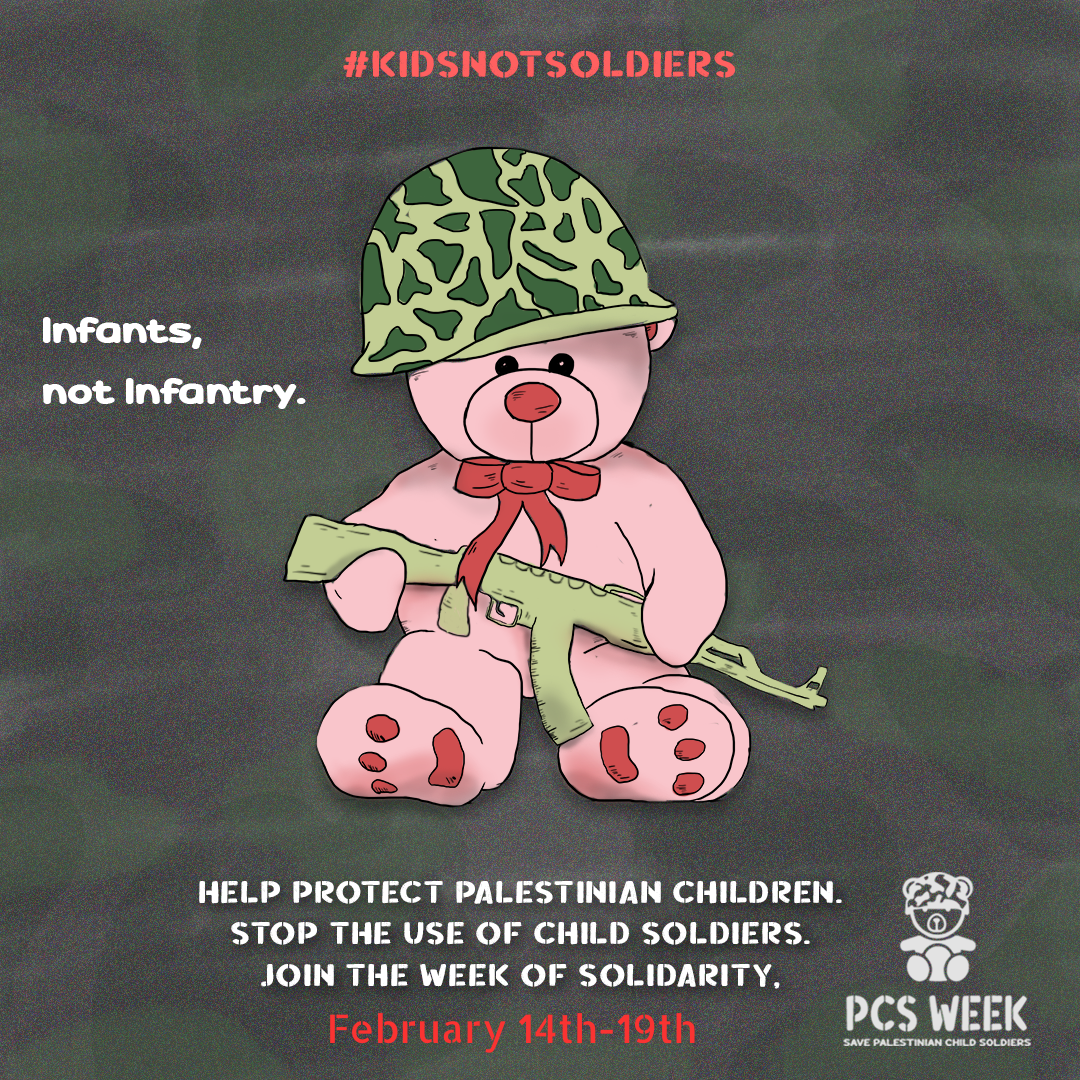
KIDS NOT SOLDIERS
Battlefield experiences have a tendency to remain with us throughout our life. Nearly 20 years have passed and I still recall like it happened yesterday, the face of that small helpless Palestinian girl the combatant, her uncle, gripped in one hand. In his other hand, he was holding an automatic rifle, shooting at me and my unit. I do not know her name or what happened to her. What I do know is that she was a victim. A victim of tragic life circumstances. He was the relative of a wanted terrorist from Gaza. When my unit and I arrived to arrest his cousin, he left the house clutching the girl and firing at us. He knew that she was his only chance to escape.
This experience will surely stick with me, but it also tells a broader story and highlights a worrying phenomenon.
The Palestinian systematic and widespread use of children, as young as ten, to take an active part in hostilities against Israel has become an alarming reality. Innocent Palestinian children serve as human shields and fulfill a wide range of military duties. From supporting the home front to active participation in hostilities. Their involvement is dependent upon the current need and upon their maturity and set of skills.
The roots of this phenomenon of exploiting young children in combat are based on institutional and widespread indoctrination. A well-structured brainwashing system for toddlers, as young as three, prepares the ground for an effective and well-oiled mechanism of targeting, recruiting and training children. This mechanism is maintained by a scheme of financial incentives for the children and their families.
Behind this cynical exploitation of the weakest in society, stand prominent Palestinian leaders, who see human rights as irrelevant. They are the planners and the executers of this despicable strategy.
Creating an entire generation of children educated on the values of hatred and martyrdom will perpetuate the Israeli-Palestinian conflict. Long-standing incitement and assuring world fame for those who murder Israelis, will bring more and more children to choose a violent path and lower the motivation (which is not high anyway) to promote a peaceful solution to the Israeli-Palestinian conflict. This perverse education system is also shaping the future generations of Palestinian leadership.
A simple profit-loss analysis reveals that the only ones who profit from the use of children for militia purposes, is the Palestinian leadership, whether by increasing their fighting forces or for the purpose of creating false propaganda in the case of the unfortunate death of children.
Theoretically, the tools to fight the growing use of children for militia purposes, are available. Among them we find, progressive legal codifications and designated tribunals to prosecute those responsible. Along with intergovernmental organizations, civil society organizations and designated international conventions to address this issue. And yet, as long as the political motivation of those involved continues to blur the boundaries between good and evil, ignores the facts on the ground and refuses to acknowledge the existence of this phenomena propagated by Palestinian leadership, a prolonged struggle lies ahead.
As of today, unfortunate and surprising as it may sound, the United Nations International Children’s Emergency Fund (UNICEF) refuses to recognize the use of children by the Palestinian leadership as weapons of war. UNICEF simply shows no real commitment to put aside political interests and protect the real victims.
The international community must be the voice for Palestinian children. It must sharply and clearly condemn any use of children for combat purposes. UNICEF, for its part, must acknowledge and condemn the Palestinian leadership.
No one promised us that this struggle would be short or easy, but we see some positive signs coming from the direction of the International Criminal Court in The Hague (ICC). The fact that along with the ICC’s political and controversial determination to investigate Israelis, the ICC also expressed its intensions to investigate Hamas for criminal acts against the Palestinian civilian population; such as murder and torture, as well as using them as human shields, is a step in the right direction. I’m proud to say that the efforts of the Jerusalem Institute of Justice, succeeded to convince the ICC to accept the legal and evidentiary infrastructure we presented to it, calling for the investigation into Hamas’ war crimes and holding Palestinian leaders responsible.
This week, as we are observing Palestinian Child Soldiers week, we take the opportunity to raise awareness, stand in solidarity with Palestinian children and join the call on UNICEF to demand Hamas, Palestinian Islamic Jihad, PFLP and the PLO to operate in accordance with the 2007 Paris Principles and end the systemic indoctrination and use of Palestinian children in military efforts of any type.
Adv. Uri Morad
Dir. International Law & Public Diploma
Jerusalem Institute of Justice