
When Sanctions Fail
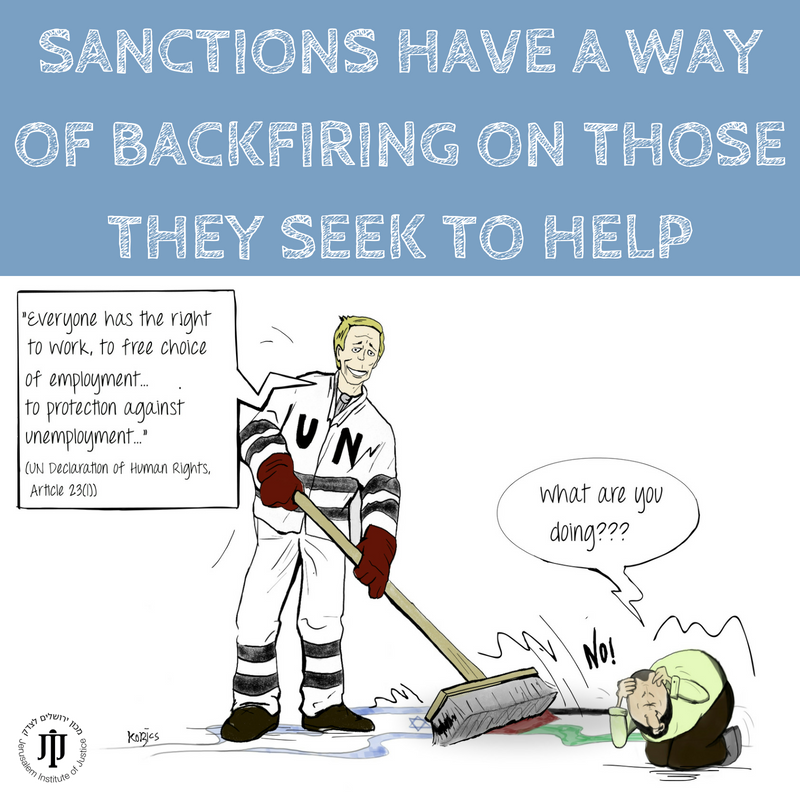
The United Nations Human Rights Council announced its intention to publish a blacklist of 150 private companies, including those who do business in the disputed territories beyond the Green Line in Israel. In doing so, the Council plans to condemn the companies for acting against international law. This condemnation is supposed to tarnish the companies’ reputations politically in order to force them out of these territories. This move is said to help the Palestinians in the area; but according to numerous studies on the effects of sanctions, it is more likely to harm them economically.
A recent study of 68 cases where sanctions were imposed shows that in the end there is an expansion of inequality with a damaging impact on the sanctioned economies. For example, Yemen, which was sanctioned for ten years, experienced an increase both in poverty and in polarization due to inequality. The results can still be seen today in the sewage that runs through its streets.
Another case study of sanctions, done between the years 1982-2011, also reveals their negative effects on poverty. The research shows that the poverty gap widened from 5.89% before sanctions to 13.26% afterwards – an increase of 7.37%! Furthermore, there was a 22.39% increase in death rates. Poverty spreads as sanctions intensify.
This data clearly shows the potential for devastating economic damage to Palestinians as the result of applying sanctions to Israeli companies in the disputed territories, and the effects of sanctions are long-term.
Over the years, the economy of the Palestinian Authority (PA) has developed a high dependency on international aid. Prior to the first Intifada (1987) there was a level of only 5% unemployment, with many Palestinians able to find work. Today, that percentage has dramatically risen to approximately 43%, with 58% unemployment among the young people of Gaza. Even amongst the employed there is a high percentage living under the poverty line. The political conflict has caused a worsening of economic conditions, which has led to increased dependency of the PA on foreign aid.
The World Bank recommends the development of the private sector in order to boost Palestinian economic growth. However, this strategy contradicts the interests of the PA, which receives most of its funding from international aid. The funding is given to the leaders of the PA, who use it for terrorism, anti-Zionist propaganda and for fattening the stomachs of the elite (there is a wide gap between rich and poor). In contrast, Palestinians who work for Israeli private-sector companies are able to make a comfortable living without dependency on foreign aid. Clearly, sanctions on Israeli companies prevent this by leading to an increase in Palestinian unemployment.
The consequence of all this is unnecessary human suffering. Sanctions cause a deepening of inequality, a widening of the poverty gap, an increase of social polarity, and more. Furthermore, these effects are long-term. Considering the political reality for individuals in these areas, it is reasonable to believe that massive harm has already been caused. It may well be that the economic reality of poverty and unemployment in everyday life has been contributing to the worsening of the conflict. Considering this perspective, it becomes apparent that the sanctions are targeted not at stabilizing the area, but rather at delegitimizing Israel.

When Does Criticism of Israel Become Anti-Semitism?
By Nikki Golomb.
As a Jewish-American university student, I have been faced with the impossible task of determining when a professor, a student group, or an event has gone too far in criticism of Israel as a Jewish democracy. Is this legitimate criticism of Israel as an imperfect state, or is it holding Israel to an unfair standard of perfection? Is this criticism of Israel as a Jewish nation, or a political state? Is this anti-Semitism masked as anti-Zionism, a more “acceptable” form of criticism? And if so, where do we draw the line?
Anti-Israel rhetoric is often referred to as the “new anti-Semitism.” Classical anti-Semitism – such as the blood libel, Nazi symbolism and graffiti, and destruction of Jewish tombstones – are easy to identify, illegal, and largely socially unacceptable. Anti-Israel speech, on the other hand, is much more palatable to the public. However, anti-Israel rhetoric is often used as a more “acceptable” form of anti-Jewish sentiment, as the only Jewish state is held to a higher standard than any other country in the world.
There is a very fine line between legitimate political criticism of Israel and anti-Semitism. Many of us know all too well that recognizing the line is not only very difficult, but also vital in order to not infringe upon free speech while also condemning hate speech. However, Israel is not perfect, and thus denouncing any criticism of Israel as anti-Semitism ignores the political challenges faced within Israel and also holds Israel to a different standard than other countries. So how do we know when to speak up against anti-Semitism?
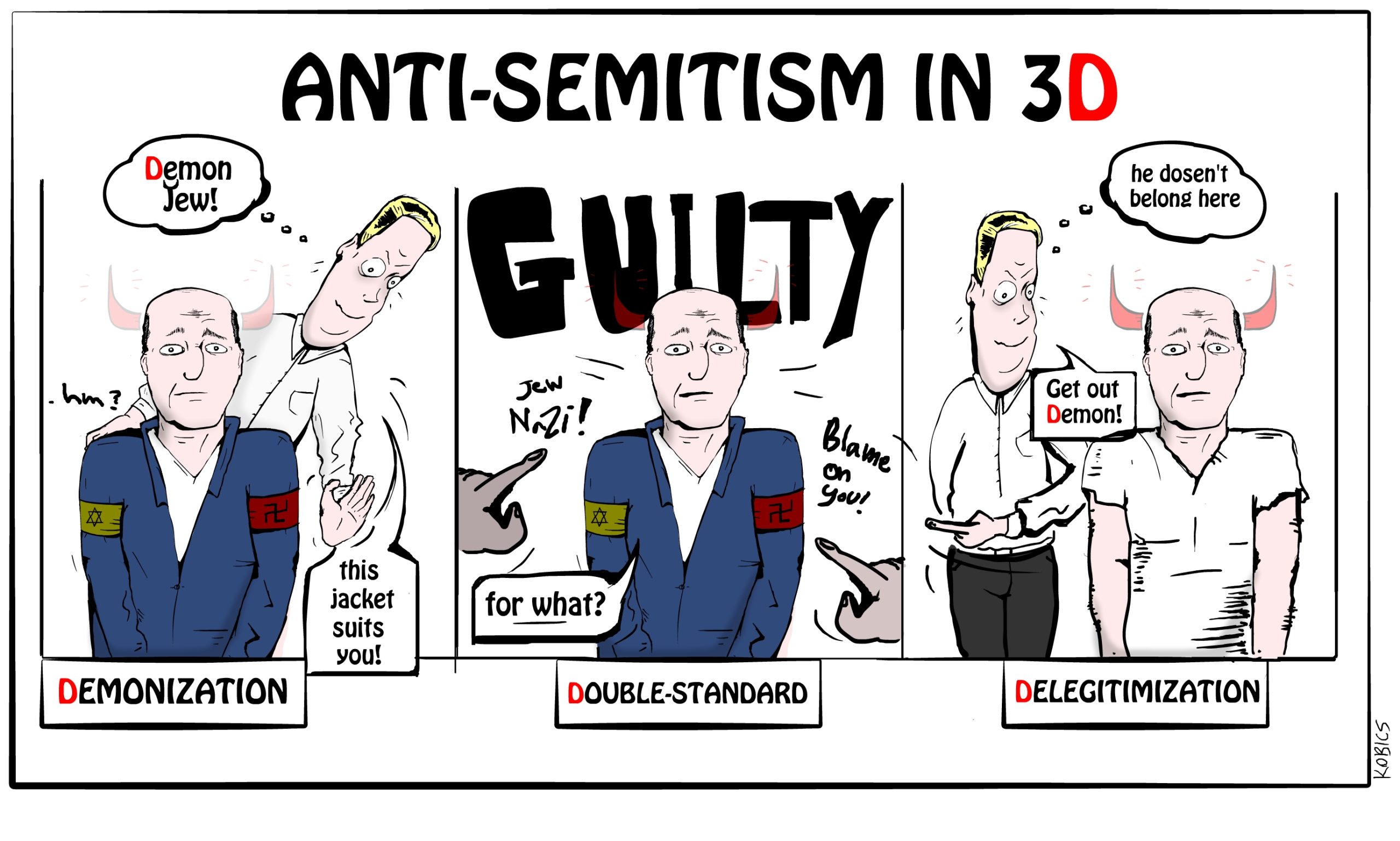
Natan Sharansky, Chairman of the Executive for the Jewish Agency for Israel and human rights activist, proposed what he calls the “3-D test” to differentiate between legitimate criticism of Israel and anti-Semitism. This test dictates that if a statement or action demonizes Israel, holds Israel to a double standard, or delegitimizes Israel (the “3 Ds”), it is in fact anti-Semitic.
Demonization
Demonization, the first of the 3 Ds, is relatively easy to identify as it has been a marker of anti-Semitism for centuries. Depicting Jews as the embodiment of evil (i.e. “Jews have horns” or “Jews are the devil”) is one of the oldest forms of anti-Semitism. Today, demonization of Israel includes comparing Israel to Nazi Germany, equating Palestinian refugee camps with concentration camps, or depicting Israeli political leaders as the devil.
Demonization of Israel is clear anti-Semitism, with a shift of focus from Jews as individuals to the Jewish nation. When criticism of Israel is focused on its nature as a Jewish state, when its policies are blown out of proportion, and when criticism reflects anti-Jewish sentiment that has persisted for centuries, anti-Semitism is the culprit.
Double Standard
Discriminatory laws holding Jews to a different standard than other citizens have also existed for centuries. From empires imposing additional taxes on Jews, to outright denying the right to Jewish practice, to more recent ghettoization, Jews have been subject to different laws than their neighbors.
The same is happening today, at the international level. Of the 2017-2018 UNGA resolutions condemning countries, 20 of the resolutions were against Israel – and six against the rest of the world combined. Furthermore, since the establishment of the UN Human Rights Council, about 50% of its resolutions concerning specific countries have been against Israel. No other country has received such treatment. Singling out Israel for condemnation while ignoring massive human rights abuses in other parts of the world is holding Israel to a double standard. Expecting Israel and Israeli organizations to adhere to a higher standard of human rights singles out Israel as the only Jewish state, and is thus an expression of anti-Semitism.
Delegitimization
Delegitimization is slightly harder to identify, but just as important. It refers to any action or comment delegitimizing Israel as a Jewish democracy, or denying Israel’s right to exist as one. It can be accusing Israel of colonialism, ethnic cleansing, and apartheid; or it can be claiming that Israel was established illegally and on lands that it has no right to own, thus delegitimizing Israel’s very right to exist at all.
Dozens of Muslim states and Christian states exist, yet there is only one Jewish state. Denying its right to exist is inherently anti-Semitic because it discriminates against Israel based on its nature as a Jewish state. Making false claims of ethnic cleansing or apartheid delegitimizes Israel by implying that it is founded on racism and discrimination and thus has no right to sovereignty. The same argument can be made of the claim that Israel has no legal, historical, or cultural right to the land; however, making these claims is anti-Semitic because it nullifies Jewish history, nationalism, and right to self-determination.
Discussion and Conclusion
Expressing disapproval for specific Israeli policies is a legitimate form of criticism. Arguing against political action, the way one does with regards to other countries, is not only acceptable but also healthy – no positive progress can be made without open dialogue and political discussion. However, when one (or more) of the “3 Ds” become present and that criticism crosses the line into anti-Semitism, nothing productive can happen. No positive change can happen when the criticism is based on anti-Jewish arguments. When someone demonizes Israel, holds it to a double standard, or delegitimizes it, their tactics must be called out for what they are. This is the only way to ensure that anti-Semitism is recognized and stopped, and legitimate criticism is taken seriously so as to promote progress.