
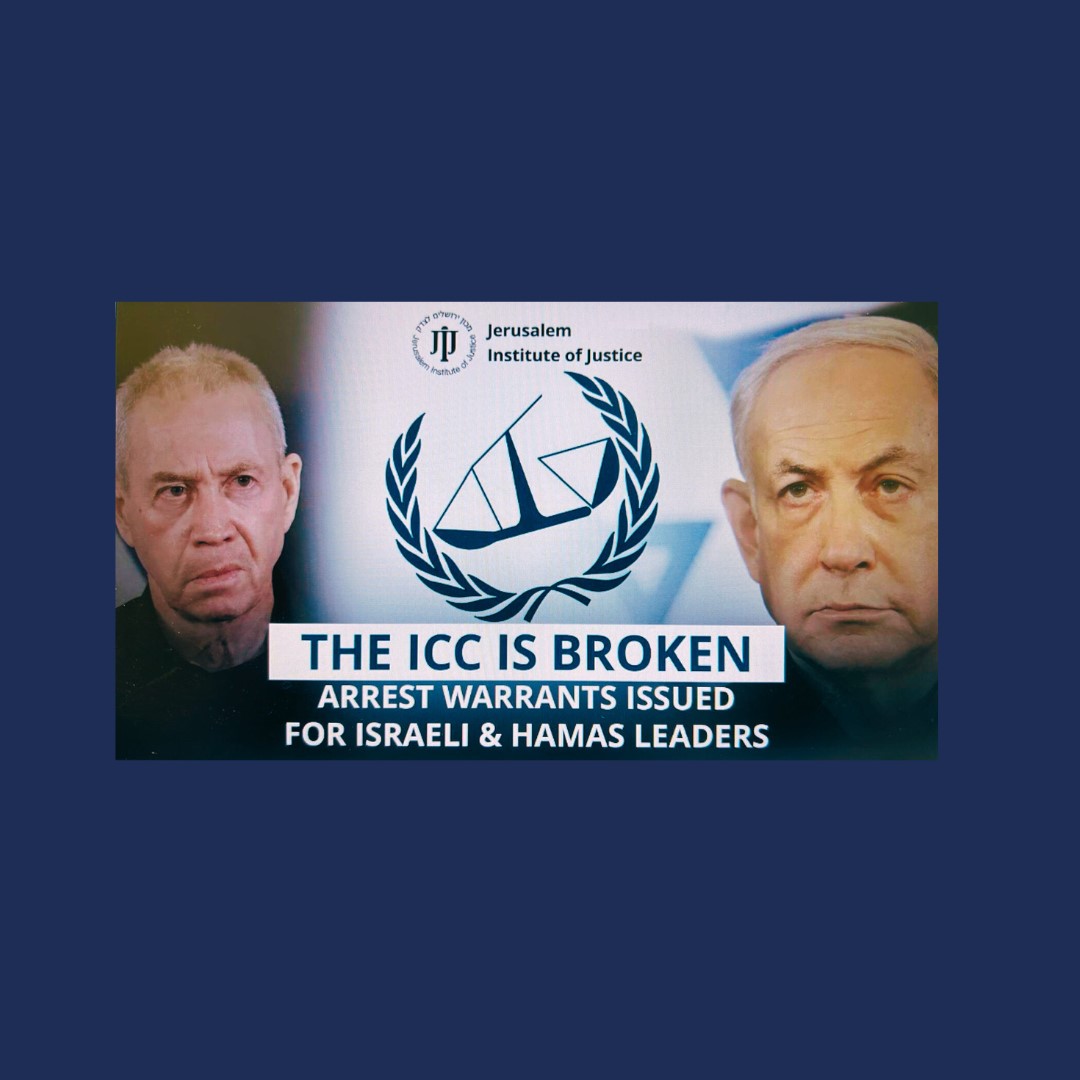
Response to ICC Prosecutor’s Request for Arrest Warrants for Hamas & Israeli Leaders
The Jerusalem Institute of Justice welcomes the ICC Prosecutor’s request for the issuance of
arrest warrants for Hamas’ leaders Yahya Sinwar, Mohamed Deif, and Ismail Haniyeh. We
are disappointed that Hamas’ leaders were not charged with the crime of genocide, despite
constantly expressing their fervent intent to exterminate all Israeli nationals and Jews, and
live streaming the evidence of how they brought this intent to action on October 7th.
We are appalled that the Prosecutor intentionally delayed this maneuver, seeking to pair it
with a request for arrest warrants for Israeli leaders Benjamin Netanyahu and Yoav Gallant.
If the Pre-Trial Chamber approves of this linkage, it will draw a false moral equivalence
between the parties to this conflict.
Since its establishment, the ICC has refrained from pursuing democratically elected officials
whose armies are engaged in wars of self-defense. It is fundamentally reckless to break from
this precedent for the first time when the democratic officials in question are the leaders of
the world’s only Jewish state, and at a time of rising global antisemitism. This development
will only serve to validate the claims of Hamas’ sympathizers across the globe, inspiring
more frequent and more violent attacks on Jewish people across the Diaspora.
The State of Israel has demonstrated that it is able and willing to investigate its own soldiers
and officials for any alleged violations of international law, including international
humanitarian law. Consequently, and in accordance with the principle of complementarity,
one of the most basic principles of the ICC, the Court should refrain from interfering.
The Prosecutor’s case against Israel rests on charges of “starvation” in seeming ignorance of
the fact that unprecedented levels of aid have entered Gaza since October 7th, including
400,000 tons of donated food.
Jerusalem Institute of Justice has sought the arrest of Hamas’ leaders through repeated
requests to the ICC’s Office of the Prosecutor since 2017, highlighting their systematic use of
torture, indoctrination of children, recruitment of child soldiers, and the abuse of civilians as
human shields. If they had been arrested for those crimes years ago, perhaps October 7th
never would have happened.
Despite today’s disappointing developments, we remain committed to pursuing justice for the
survivors and victims of Hamas’ atrocities, including through continued engagement with the
Office of the Prosecutor.

Everything you should know about the Israel Judicial Reform
Israel’s proposed judicial reform has sparked significant societal controversy, revealing the ongoing tension between the Executive and Judiciary branches. Supporters of the reform argue that it will enhance democracy in Israel. At the same time, opponents fear that it will undermine the democratic principles of checks and balances, granting too much power to the Executive branch and potentially endangering minority and human rights. The debate over the reform has created a deep divide within Israeli society.
In this lecture and the attached report, we explore the four components of the proposed reform, give you an overview of the current situation, and explain what changes the reform would like to bring about. We also examine the arguments presented by supporters and opponents of the reform.
https://www.youtube.com/watch?v=ZT129G9vgn0&t=29s
An Examination of Israel's Judicial Reform
Israel's proposed judicial reform has sparked significant societal controversy, revealing the ongoing tension between the Executive and Judiciary branches. Supporters of the reform argue that it will enhance democracy in Israel. At the same time, opponents fear that it will undermine the democratic principles of checks and balances, granting too much power to the Executive branch and potentially endangering minority and human rights. The debate over the reform has created a deep divide within Israeli society.
In the attached report, we explore the four components of the proposed reform, give you an overview of the current situation, and explain what changes the reform would like to bring about. We will also examine the arguments presented by supporters and opponents of the reform.
Examining the Israeli Judicial Reform
https://www.youtube.com/watch?v=ZT129G9vgn0
Israel's proposed judicial reform has sparked significant controversy within society, revealing the ongoing tension between the Executive and Judiciary branches. Supporters of the reform argue that it will enhance democracy in Israel, while opponents fear that it will undermine the democratic principles of checks and balances, granting too much power to the Executive branch and potentially endangering minority rights and human rights. The debate over the reform has created a deep divide within Israeli society. In this lecture, we explore the four components of the proposed reform, provide an overview of the current situation, and explain what changes the reform seeks to bring about. We will also examine the arguments presented by both supporters and opponents of the reform.
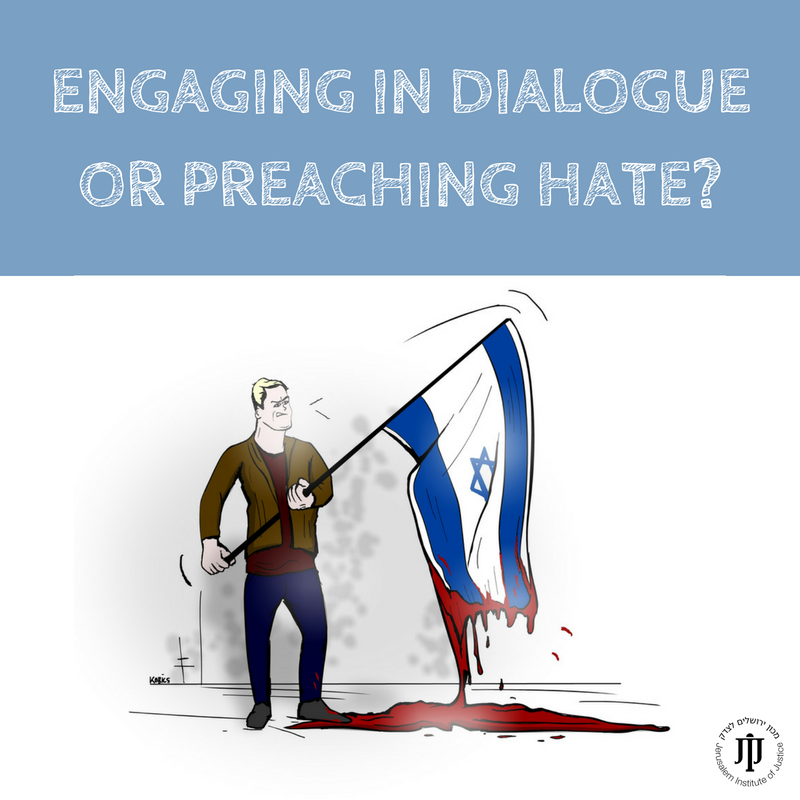
The Cynical Exploitation of Israeli Democracy
In 1990, Nelson Mandela was released from Victor Verster Prison in Cape Town after spending twenty-seven years behind bars. His only crime was that of rebelling against the white minority that subjugated his people by denying them the right to vote, to acquire land and to protest.
Similar regimes of oppression exist today in Iran, which executes political dissidents; in the West Bank, where being homosexual is a criminal offence; and in Saudi Arabia, which practices gender apartheid. As of yet, the international community has failed to put as much pressure on these regimes as it did on Pretoria, partly because it has been preoccupied with turning the nation-state of the Jewish people into a pariah. The United Nations, for example, has passed more resolutions condemning Israel than the other nations of the world combined. It is impossible to consider these figures and not come to the conclusion that the international community’s double-standard against Israel is blatant and morally bankrupt; much worse is that it has been aided in this endeavor by so-called human rights activists within Israel.
About a year ago, two members of the Israeli Knesset — Aida Touma Suleiman and Mossi Raz — hosted an event in parliament titled: “54 years - Between Occupation and Apartheid.” The event, funded by the Israeli taxpayer, quickly descended into an anti-Zionist hate festival, filled with lies about the so-called apartheid system imposed upon Palestinians in the “occupied territories and within Israel.”
Of course, Raz and Suleiman had every right to host the event. In fact, that they were able to host it serves as a testament to the health of Israel’s thriving democracy. Former Israeli Prime Minister Menachem Begin put it most succinctly: “Without an opposition, there can be no democracy; without it, the essence of human liberty is in danger.” But I also reserve the right to express what I think about those who cynically exploit the seat of Israeli democracy as a means of delegitimizing the Jewish state — and it’s not much.
The hypocrisy of the Knesset members, especially Suleiman, an Arab-Israeli representative in the Knesset, is nothing short of astonishing. She does not speak Yiddish and may not be familiar with the term ‘chutzpah’, but her behavior suggests she is full of it. Israel is a vibrant democracy where Arabs benefit from affirmative action policies, teach in Israeli universities and enjoy equal rights to their Jewish counterparts. This includes the right to serve on the Supreme Court, to vote and to elect members to the Knesset; some of whom oppose Israel’s right to exist and denounce her as an apartheid state.
To be sure, what is true of Israel is not necessarily true of the disputed territories. Israel withdrew from Gaza in 2005 and was consequently met with heavy rocket fire from Hamas militants. She maintains control over the West Bank only due to Palestinian rejectionism — that is, the inability of Palestinian leaders to accept a two-state solution that leaves Israel’s existence as a Jewish and democratic state in-tact.
In 2000, Yasser Arafat balked at a generous offer of statehood on 97% of the West Bank, with its capital in Jerusalem and a large compensation package for Palestinian refugees displaced during wars started by Israel’s neighbours. This drew opprobrium even from Arab leaders, including Prince Bandar of Saudi Arabia who described the rejection as “a crime against the Palestinian people, in fact against the entire region.” Likewise, in 2008 Olmert offered the Palestinians a deal which would have granted them sovereignty over even more territory, only to be met with no response from Arafat’s successor, Mahmoud Abbas.
Had these offers been accepted, there would be no roads restricted to Israelis or civilian settlements in the West Bank; the so-called accoutrement of Israeli apartheid. These policies are controversial, if not disagreeable. But to wage the ‘apartheid’ libel against Israel’s settlement enterprise and security precautions in the disputed territories — those which exist only due to Palestinian intransigence — is to egregiously misuse the term and minimize the horrors of the actual anti-apartheid struggles that took place in South Africa. One of the most celebrated proponents of this struggle — Martin Luther King Jr — once venerated Israel as “one of the great outposts of democracy in the world.” He would be dismayed with Suleiman exploiting his life mission to support her anti-Israel bigotry.
by Joe Beare, JIJ Intern

Is “Jewish Democracy” an Oxymoron?
By Nikki Golomb.
There’s a phrase I have heard over and over again throughout my life: “Put two Jews in a room and you’ll get three opinions.” Once, however, I heard an amended version: “Put two Israelis in a room and you’ll get three opinions, a new political party, and probably an invitation to Shabbat dinner.” The more I’m learning about Israeli politics, however, the more I’m realizing it is less of a joke and more of a commentary on the complexity of Israeli politics and social life.
Israel prides itself as being both the only true democracy in the Middle East, as well as the only Jewish state in the world. Some people, however, do not believe that Israel can be both Jewish and democratic; they say that mixing religion with politics inherently makes it undemocratic. However, this argument ignores the many other democracies with a state religion; for example, nobody questions the democratic integrity of Christian states such as the UK, Greece, Costa Rica, or Denmark (among others). Other countries additionally have religiously-affiliated political parties, even though the country itself does not have a national religion. Despite the mixing of religion and politics, these countries remain internationally recognized democratic states.
Taking this into consideration, the question thus becomes whether Judaism in particular is incompatible with democracy. In order to answer this, one must look at the Torah and Jewish values. The Torah states that an acceptable political system must be “rooted in popular consent and involving the people in governance,” a significant characteristic of democracy. It additionally documents the creation of a modern justice system under Moses, who established a multi-tiered court system after the Exodus from Egypt. Although there are no direct references to democracy in the Torah, values such as equality, justice, and rule of the people which are vital to democratic institutions are emphasized, meaning Judaism and the nature of democracy are not inherently incompatible. Jewish values additionally tell us that all people are created b’tzelem Elokim – in the image of G-d. This belief equalizes all people, regardless of religion, ethnicity, nationality, etc. and demands that everyone is treated with the same respect and dignity. The value of tzedek, or justice, also has clear implications on democratic life by further emphasizing the importance of establishing a just society.
Others argue that while Judaism and democracy are not inherently contradictory, the ways they manifest themselves in Israel do not represent true democracy. According to the Jerusalem Center for Public Affairs, there are two vital aspects of democracy: 1) self-governance, or the meaningful participation of citizens in the political system, and 2) plurality, or the ability of everybody to live according to their own beliefs and coexist in society. Both of these features are represented in the Israeli political system. Israel has a parliamentary system of government, called the Knesset; Members of Knesset are voted upon by the people, and all citizens have the right to vote regardless of religion, ethnicity, or any other identity. All citizens are also eligible to run for government, or create their own political party; both Arabs and Haredi Jews, for instance, have their own political parties and are also represented in other parties. In terms of pluralism, it is no question that various ethnic and religious groups coexist in Israel. Jews and Arabs alike have the right to vote; receive state-funded education; and are represented as Members of Knesset, judges, and other high-power positions. Many organizations exist, including JIJ, which work to promote pluralism in Israeli society. This would not be possible in a nondemocratic country or exclusively ethnic nation-state.
It is true that Israel, like every other country, is not perfect. Discrimination exists, representation can and should be improved, and conflict between religion and government remain a hot political topic. The “perfect” balance has not yet been found. However, this does not take away from the Jewishness or democracy of the state. Christian democracies exist with little to no questioning of whether they can be both religious and democratic. Those who claim that a “Jewish democracy,” on the other hand, is an oxymoron either do not have a complete understanding of Jewish and/or democratic values, or do not know how Israel’s political system works. Jewish values influence the political environment, yet Israel meets every requirement of a democratic nation. Once we accept that Israel is both Jewish and democratic, we can better understand the political nature of the government and work within the system to create positive political and social change.
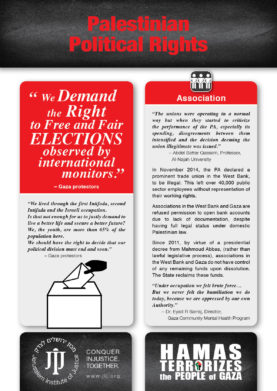
Political Rights Offenses Under the Palestinian Authority
Assessing the implementation of the International Covenant on Civil and Political Rights
For the full report click, here.
In this report, the Jerusalem Institute of Justice (JIJ) examines political rights and freedoms in the West Bank and Gaza under the Palestinian Authority (PA). Through comprehensive research and interviews with residents and workers in the West Bank and Gaza, this report aims to illuminate the current situation with regard to political rights for Palestinians in these territories. After the State of Palestine achieved “non-member observer state” status from the UN General Assembly in 2012, President Mahmoud Abbas signed and acceded to multiple international humanitarian and human rights treaties and conventions, thus rendering the State of Palestine accountable for the upholding certain rights. This report deals with three major rights: the freedom of assembly, the freedom of association, and electoral rights.
Freedom of Assembly
A part of international law, the UN’s International Bill on Human Rights guarantees the right to freedom of assembly. On April 2, 2014, the State of Palestine became a signatory to the International Covenant on Civil and Political Rights 1976 (ICCPR). However, it appears that the application of these laws does not always uphold these rights.
In Gaza, two forms of domestic law in the West Bank currently govern the right to Freedom of Assembly: Palestinian Basic Law and Public Meeting Law No. 12 of 1998. Under the PA, individuals are required to provide permits for demonstrations. Demonstrations that are against PA policies are often dispersed. While a broad range of non-governmental organizations operate freely in the West Bank, many Hamas-affiliated civic associations have been shut down for political reasons.
Under Article 2 of Public Meetings Law No. 12 of 1998, a public assembly is defined as any public gathering of 50 or more persons in a public open space (Art. 1). The statute goes on to provide restrictions to this right, such as the need for a 48-hour written notice of the assembly to be submitted to the Director of Police (Art. 3), for the notice to be signed by at least three organizers of the assembly, and for notification of the time, place, and purpose of the meeting (Art.4).
The Executive Bill issued by the late President Yasser Arafat, limited the right of assembly by giving the police the right to “disperse and end any meeting upon determination [by the police] that the meeting is not following its stated purpose or objective.” Furthermore, the Executive Bill outlined requirements that organizers of meetings take account for the provisions set out in Presidential Decree No. 3 of 1998 concerning the “perpetuation of national unity and incitement prevention.” This makes it more difficult for Palestinians to exercise their right to freedom of assembly, and leaves considerable room for abuse of executive power. The executive power is indeed oftentimes abused due to a lack of separation of power between the executive, legislative, and judicial branches.
Generally speaking, when it comes to secret or indoor meetings, there is no interference in the West Bank, though in Gaza Hamas commonly breaks up private meetings in homes, thus violating the Basic Law.
Public assemblies tend to have more restrictions, especially when the issue addressed by the assembly proves to be political. In certain instances, the authority will not only be present with security forces, but also will even ban the assembly altogether – a blatant violation of the right of assembly guaranteed by the Basic Law and the Public Meetings Law.
The Public Meetings Law No. 12, and specifically its accompanying restrictions under the Executive Bill, have become an excuse for Hamas security forces to ban, attack and forcibly disperse many assemblies and public meetings. This has often been carried out with the use of disproportionate force, and with reports of police using clubs and stun grenades. An international call for accountability has been met with the appointing of committees that look into incidents of excessive and unjustified force. Although in some occasions disciplinary action was taken against offending officers, it seems that the motive originated from a desire to pacify the people rather than to search for long-term change in the effort to uphold the right to Freedom of Assembly.
Freedom of Association
Freedom of Association refers specifically to individual and workers’ rights to form associations or organizations, trade unions, non-governmental organizations, and charities, among others. The right to freedom of association is guaranteed under both the ICCPR and the UDHR. In terms of domestic law, the West Bank and Gaza, under the split governance of Hamas and Fatah respectively, have distinct legislation governing the right to freedom of association, though this right is accounted for under the Palestinian Basic Law of 2003, which currently serves as a temporary constitution. However, this freedom is regularly violated when it involves any form of political discussion.
In the West Bank and Gaza, the Law of Charitable Associations and Community Organizations No. 1 of 2000 (hereafter Associations Law), and the Palestinian Labor Law No. 7 of 2000 (hereafter Labor Law) also govern the right of association. This right can be best assessed when split into two categories: Charitable Associations and Community Organizations, and Trade Unions.
A series of administrative directives and decisions undermine the effective implementation of the protection of freedom of association. Firstly, under the Associations Law all associations must be registered with the authorities in order to carry out their activities. In theory this is only to notify the authority of the existence of a charity, which is considered legal within two months of submitting the application, with or without a response from the authorities. In practice, however, the registration system has become a licensing process, which is funneled through the Ministry of Interior, giving it undue power. This extends to funding and finance, as the Ministry of Interior may scrutinize the allocation and raising of funds, possibly allowing for inappropriate government intervention in NGO activities.
The Monetary Authority has issued instructions to banks in the West Bank and Gaza, that associations must present certification of legal status to the bank when wishing to open an account. This leaves many associations and organizations unable to open an account, despite having legal status by virtue of the two-month time lapse, as many have not received any formal documentation from the Ministry of Interior. Therefore, from a legal standpoint, many associations with legal status are prevented from carrying out their activities due to restrictive administrative decisions (or complete lack of decision) from the Ministry of Interior. Additionally, it has been reported that authorities in the West Bank may refuse to allow the opening of organizations registered in Gaza, and vice-versa, though the law does not allow this.
Another issue lies in the case of the dissolution of an organization, wherein the funds are transferred to the Palestinian National Authority public treasury. This amendment clearly opens the door to corruption and the misuse of funds by government officials with political motives.
Such government control is excessive. This abuse of power is especially noticeable when comparing freedom of association in other nations such as the US and the UK.
International and domestic laws also ensure the protection of workers’ rights. However, the PA has banned all Union of Public Employees activities. This effectively deprives public sector employees in the West Bank from being represented by their elected representatives and from undertaking any collective bargaining or any form of dialogue with their employer, the Palestinian government. However, in 2013, Hamas introduced a new Trade Unions Law No. 2 of 2013 to replace the former 1954 Egyptian Law for Trade Unions. As progressive this might seem, the new Trade Unions Law has been said to place severe restrictions on the exercise of the freedom of association and assembly. Unfortunately, the specifics of this cannot be commented upon, as the Trade Unions Law itself is only available in Arabic.
Electoral Rights
The right to take part in political life is enshrined in the Universal Declaration of Human Rights under Article 21, which states that the will of the people shall be expressed in periodic and genuine elections. General Comment No. 25 on the ICCPR also states that electoral rights ensure that individuals may freely determine their political status and choose the form of their government or constitution. Additionally, the 2003 Basic Law covers the right to vote under Article 26 (3) and (4). However, no general elections have taken place in the Palestinian Authority since 2006. This general election followed the presidential election of Mahmoud Abbas in 2005, one year earlier. The laws governing this area stipulate that general and presidential elections should be held every four years – the reality is quite different.
Local elections in the West Bank and Gaza have a rather tumultuous history. The first local elections took place in 2004-2005 under Local Elections Law No. 10 of 2005 and were carried out in five rounds of elections. The next elections were due to take place in 2010, but were postponed indefinitely after the Central Elections Commission (CEC) for Palestine (the body governing elections) announced that it would not be possible to conduct voter registration in Gaza and Jerusalem.
The disruptions to local and general elections in the West Bank and Gaza are undoubtedly a result of the Hamas-Fatah political divide. Following Hamas’ victory in the 2006 legislative elections, tensions rose between the two factions with Hamas later seizing control of the Gaza Strip in 2007. There have been multiple attempts at reconciliation between the two parties but the relationship has continued to deteriorate.
Abbas’ term as president should have ended in 2009, yet this year marks his tenth year as President of the Palestinian Authority with no presidential elections in sight. As with Freedom of Assembly, this is an issue with the separation of powers. The legislature is not separate from the executive branch, whose political division is causing the continuous violation of the Palestinian right to vote. Given that the separation of powers is a fundamental principle of democratic society, this should be of great concern to the international community.
The State of Palestine acceded to the International Covenant on Civil and Political Rights in April of 2014 and as such, is obligated to uphold the human freedoms documented therein. These rights are fundamental rights in international law and treaties, and should be accorded such significance. As it stands currently, the Palestinian Authority and Hamas are making little effort to protect and promote these rights of the Palestinian people and are thus in violation of international law.