
LETTER TO THE EUROPEAN UNION - STOP FUNDING HAMAS
Date: October 25, 2023
To:
Ms. Ursula von der Leyen
President of the European Commission
European Commission, 1049 Brussels, Belgium
Dear Mrs. von der Leyen
We, the undersigned, have borne witness to the horrific acts of terrorism perpetrated by Hamas, an EU-designated terrorist organization, against innocent nationals of Israel, Austria, Estonia, France, Germany, Ireland, Italy, Latvia, Lithuania, Portugal, Spain and other EU member states. We grieve in solidarity with the nearly 200 families whose beloved infants, toddlers, teenagers, and grandmothers are still held hostage by an organization that live streamed its propensity for torture, rape, and beheadings.
We appreciate your recent visit to southern Israel and your condemnation of the terrorismcarried out by Hamas, describing it as 'the most heinous assault against Jews since theHolocaust.' We also welcomed EU Commissioner Oliver Varhelyi’s declaration on October 9ththat the EU would place its entire 691 million euro Palestinian development portfolio underreview before issuing new payments.
We were bewildered when this decision was inexplicably reversed just five hours later, at a timewhen Hamas terrorists were still butchering Israeli civilians in Kfar Aza and Kibbutz Be’eri. Equallytroubling is the recent decision of the Commission to triple its funding to Gaza withoutestablishing any effective controls to ensure the money does not end up in the hands of Hamasonce again.
We support the provision of humanitarian aid to the innocent Palestinian civilians in Gaza whoare also suffering under the oppressive rule of Hamas. However, Hamas presents a cynicalobstacle to this support, as it has mastered four primary modes of converting humanitarianassistance into material support for terrorism:
- First, Hamas extracts “taxes” from humanitarian shipments at border crossings.
- A portion of the shipments of donated goods are routinely confiscated by Hamas and re-soldfor a profit on the black market.
- Donor commodities (such as fuel) that do manage to arrive at their intended destination(such as UNRWA facilities) remain ripe for confiscation by Hamas whenever they seek toresupply their militia, as occurred on October 16th.
- Finally, Hamas and the Palestinian Islamic Jihad have advertised their propensity fordismantling humanitarian infrastructure (including water and sewage pipes) to repurposeinto rockets, a significant percentage of which fall short of their targets, landing in Gaza,killing countless civilians, and endangering humanitarian workers.
In accordance with the above, it is clear that currently all funds sent as humanitarian aid to Gazaare misappropriated for the purpose of inflicting even graver harm on the civilian population inthe Gaza Strip and in Israel.
A clear example of financial misappropriation of the European humanitarian aid is the case of anEU grant of €699,236 (2017-2019) that was allocated to the Palestinian organizations: Union ofPalestinian Women’s Committees (UPWC), Defense for Children International – Palestine (DCI-P),Health Work Committees (HWC), Bisan Center, and Land Research Center (LRC). Theseorganizations have ties to the Popular Front for the Liberation of Palestine (PFLP) terrorist group.In December 2019, the Israel Security Agency arrested a 50-person terror network operating inthe West Bank, allegedly responsible for a bomb attack that resulted in the death of a teenager inAugust 2019. Among those arrested were three senior employees of NGOs that werebeneficiaries of this EU grant, including Walid Hanatsheh (Abu Ras), HWC’s finance andadministration manager; Ubai Aboudi, Bisan’s Executive Director; and Iteraf Hajaj (Rimawi), whoserved as Bisan’s Executive Director in 2017
As the European Parliament stated in its resolution 2023/2899(RSP) of October 19th, 2023 “theEU budget must continue to provide support for building peace and stability in the region,combating hate and fundamentalism and promoting human rights.”
The European Union has established procedures and mechanisms to ensure that its financial aidreaches the intended recipients. However, it has not effectively implemented these measureswhen it comes to the funds provided to Palestinian civilians. In fact, the European Parliament'slatest resolution called again upon the European Commission to conduct a comprehensive reviewof all EU financial assistance to the Palestinians to guarantee that no EU funds are used, eitherdirectly or indirectly, to finance terrorism. Likewise, we support the call of the aforementionedlegislative body for the immediate and unconditional release of all hostages taken by the terroristgroup Hamas and the return of the bodies of deceased hostages.
We strongly call the member states of the European Union to monitor the allocation of funds forhumanitarian aid to prevent diversion to Hamas and other armed groups in the Gaza Strip, and totake all necessary steps to ensure the release of all hostages currently held captive in the GazaStrip.

Enough is Enough: Say NO to Funding Terrorism
By Yesica Goblirsch
Funding Terror
August 23rd, 2017 should have been an enjoyable day for Rina Shnerb, when she and her family decided to hike at a spring near Dolev in Israel. Horrifically, during their hike, a bomb detonated, killing seventeen-year-old Rina and injuring her father and brother. This tragic incident should have never occurred.
It was a terror cell of the Popular Front for the Liberation of Palestine (PFLP), a terrorist organization, designated as such by the EU, the US, Canada, and Israel, that planned the attack and detonated the bomb that murdered Rina Shnerb and injured her father and brother. In fact, it was Samer Arbid, an accountant for the Union of Agricultural Work Committees (UAWC) who commanded the PFLP terror cell that planned and detonated the bomb that slew Rina. Why does this matter? The UAWC, that holds strong ties to BDS (Boycott, Divest and Sanctions) and is affiliated with the PFLP, was directly financed by the Netherlands. This is only one example of the improper use of European-funded Palestinian organizations.
The Netherlands is not the sole culprit in funding terror activities. The European Union, Belgium, Germany, France and the United Kingdom all have directly or indirectly funded terror-linked organizations. Like the UAWC, the Al-Haq, Addameer and many other organizations, enjoy stable, multi-year funding from Europe while holding strong ties to the PFLP.
You might wonder, how organizations like the UAWC manage to continue to receive funding from the European Union and aforementioned member states. They “whitewash” themselves, deflecting attention to emphasize human rights rather than illicit activities. These funds in fact are supporting illegal and nefarious activities. This reality demands that accountability measures and protocols to stop terror financing be strengthened and improved in order to prevent future tragedies. Terrorism must be condemned in all circumstances.
Accountability
The European Union and its member states, who directly or indirectly fund terror and/or BDS activities, need to be held accountable. Where there is a lack of accountability, integrity and transparency, there is greater room for error and for the abuse and misuse of funds. Not just any funds, but taxpayer funds. It is not fair to taxpayers to have their tax dollars inadvertently or directly inflict or cause violence. They have the right to know how their tax dollars are spent and must hold their respective governments accountable. Any citizen with a genuine heart and love for their country would denounce terror funding in any form.
In light of tragedies like these, the EU needs to hold organizations accountable to reveal sub-granting parties and partners. To disclose how funds received are spent, and to renounce ties to terrorism. Organizations that refuse to comply with these requirements should have their funding frozen until the EU and its member states respond accordingly. These proposed requirements are not unreasonable but are imperative.
Rina Shnerb’s premature demise could have been prevented. Tragedies like Rina’s will be repeated if these organizations continue to receive funding without stipulations. Thus, it is essential that we resolve to do whatever it takes to make sure it does not happen again. The European Union has the tools to better ensure that NGOs do not receive funds due to “whitewashing” themselves. The EU countries need to make an effort to inform themselves how their donations are being used. One way to encourage this, is for European taxpayers to hold their governments accountable. They must demand disclosures, transparency and that their leaders actively shun the funding of terrorism and violence.
Terror financing is unacceptable and there is no excuse for not holding organizations with ties to terrorism accountable. We need to learn from tragic experiences and bring about positive change. Terrorism in its entirety is wrong. Enough is enough, it is time to draw a line and say no to funding terrorism.
The Transparent Jew
In 2018, just a few days after my arrival to Europe from Israel, I sat in my teenage bedroom and recalled the countless incidents overseas in which I had lied about my nationality. I started laughing at myself, mildly concerned by how I easily conformed to a different culture, and even more surprised by how quickly my chameleon identity was accepted. I thought to myself, it’s better to laugh than to cry. For the first time, I was able to acknowledge that I had been raised to hide my heritage when I was outside my safe space. Doing so, I decided to no longer conceal my Jewish-Israeli identity.
In my new country, I had hoped to perfect my response to the simple question “where are you from?”. My ideal reply would be short and succinct, one I could pull off and use to secure a harassment-free encounter - nevertheless, it was impossible, and every attempt was to be located somewhere between awkward to disingenuous.
King Solomon was right when he declared, “There is nothing new under the sun”. Unfortunate as it may be, the Jewish necessity to cover its ethno-religious identity dates back in time to the Roman exile - when Jews suffered huge losses and humiliation as their ancestral homeland was colonized, erasing the Jewish identity of the land. Consciously or unconsciously, the destruction of the Jewish temple and the renaming of the land had severe repercussions on the Jewish identity, remaining until today.
Since then, two thousand years of Jewish people “pray[s] to be back in Zion, for the messiah to come and rebuild the temple.”- The eagerness to return to the homeland they came from has never diminished. This is the essence of Zionism, the liberation and restoration of the Jewish identity, that was severely colonized and morphed by countless foreign entities throughout history.
Does this Zionism, (which would later become a political movement) represent the solution our ancestors yearned for - an independent Jewish nation that is capable of both rediscovering its identity while eliminating the inherent hatred within those that had colonized it? In a utopian world - indeed, but not within the society I witnessed.
The creation of Israel is the most successful indigenous liberation in history; it is the hammer that broke the famous, self-tailored, “comfortable” Jewish character - weak and quiet Jews that are easily trampled and find themselves at the mercy of the majority. The founding of the State of Israel generated strong and empowered Jews that pursued their indigenous right to self-determination in their ancestral homeland.
Paradoxically, the United Nations is the organization which defines indigenous rights, along with the unofficial-leadership of the P5 - which are collectively known for enjoying a colonial history. The UN consistently fails to preserve Jewish rights as they don’t address the contemporary rise of Antisemitism on both sides of the political map. Nor has it brought justice to the hundreds of thousands of Mizrahi Jews, whose assets were confiscated by Arab governments while they were persecuted and forced to exile(1). It routinely
promotes state-based resolutions against Israel (18 in 2019) while ignoring the actions of China, Hamas, Venezuela, Qatar, Pakistan, and others(2). It continues popularizing anti-Israel propaganda, mainly without any concrete data - just like its false accusations against Israel for promoting gender-based violence in the Palestinian territories.
This flourishing prejudice fostered by the UN and many of its members, comes into practice in different expressions. These range from anti-Semitic attacks, to harassment on the street and to various forms of discrimination. But all roads lead to Rome, or as I stated previously, to the Jewish identity crisis in the diaspora. As part of my personal decolonization process I had to get rid of my habit of lying about my nationality. So, I faced three words that unfold western prejudice: “I am Israeli”. Very quickly I realized that not only are Jews a target, but so are Israelis. This raises the question: in their eyes, what does it even mean to be Israeli?
In Europe, I‘ve been spat on, barked at, questioned, boycotted, and discriminated against - only for exposing one, if not the most essential component of my identity: my nationality. In fact, most people decided for themselves that I am a Jew, a Zionist, a baby-killer, an ex-military officer, and a murderer based on my passport. I wish this was an over-exaggeration. During my time in Europe, almost every reference to the Holocaust or to Judaism was hijacked by political debates and comparisons, mostly based on media-information and history revisionists – even in the academic sphere.
Many Europeans are swept by the anti-Zionist narratives, and I can easily sort them into two groups (which have a tendency to overlap): those that stand against Israel’s actions, and those who deny it’s right to exist. Therefore, not everything about anti-Zionism is anti-Semitic. Israel is not a perfect country and its Jewish characteristic doesn’t grant it immunity from criticism. However, why are Israel’s current political actions equated with the ancient Zionist movement? We can clearly see that many of the modern anti-Zionist narratives are based on anti-Semitic assumptions and prejudices. The border between legitimate political criticism and anti-Semitism is very thin. But claims that consciously erase, or at least ignore, the origins of Judaism and the indigenous status of the Judeans in the land of Israel are inherently anti-Semitic. We can conclude that every type of delegitimization of Israel’s right to exist is anti-Semitic, regardless of how it manifests, and it is the basic premise of this article.
Anti-Zionism creates the dichotomy between “the good Jews” – the minority that doesn’t believe in Israel’s right to exist (e.g “Neturei Karta”) and “the bad Jews” – which are the 95% of Jews that do believe in Israel’s right to exist(3). Europeans (and quite frankly, far too many people in general) are taught that Zionism is “evil and racist”, without being informed that Jews are Zionists because of the violent racism they have survived. I have no desire or intention to be the “good Jew” these anti-Semites like to tokenize for their own agenda. It is no wonder that the majority of anti-Zionists I have met were from the left side of the political map. They identify themselves with the progressive social values of the left: supporting gender equality and other liberal values that the “good Jews” publicly stand against. This is not a coincidence, it is a known counterfeit tactic used by the left to legitimize anti-Semitism in the name of anti-Zionism.
It is important to highlight that Israel is not a perfect state, nor does it claim to be one - but its roots date back more than 3700 years of Judean civilization and so, it is time that the world abandon the myth of Jews with trembling knees. “We paid for it. We fought for it. We died for it. We will stand by our principles. We will defend them. And, when necessary, we will die for them again” (Prime Minister Menachem Begin Z”L, 1982)
My journey in Europe, which has yet to end, has brought me to the conclusion that I am a transparent Jew. Solely based on my Israeli nationality, everyone thinks they know everything about me, from the grocer to my professors. I have no other identity behind which to hide. I promised myself and my Jewish ancestors that I will not adopt a false identity just to fit the European world. And now, I pay the price. This decision to proudly stand as an Israeli woman has already affected my friendships. I’ve faced academic discrimination and I’ve experienced tremendous fear about publicly displaying any Jewish symbols, whether it be speaking Hebrew in the metro or wearing my Star of David necklace.
It was George Steiner in his book “In Bluebeard’s Castle” who argued that the image of Western culture as self-evidently superior and as the embodiment of almost the sum total of intellectual and moral power is a racially tinged absurdity(4). Maybe, just maybe, western powers should redirect their attention in discussions about the Middle East and Judean indigenous history. Instead of assuming to know all of the complexities and conflicts of the region, my European neighbors should not embrace their deeply inherited superior essence nor should they forget their thriving colonial history, in which they exploited indigenous people.
I am sitting in my teenage bedroom again, recalling my personal decolonization odyssey and the identity liberation we as a community embark upon, and I don’t regret any passage of it.
By Shai Emanuel Yamin
------------------------------------------
1 "One Year Later — The Answer To "Where Are Your Jews?" - UN Watch". UN Watch, 2018,
https://unwatch.org/one-year-later-answer-jews/.
2 "2019-2020 UN General Assembly Resolutions Singling Out Israel – Texts, Votes, Analysis - UN
Watch". UN Watch, 2019, https://unwatch.org/2019-un-general-assembly-resolutions-singling-outisrael-
texts-votes-analysis/.
3 Weiss, Barri. "American Liberalism In Danger". Tablet Magazine, 2020, https://www.tabletmag.com/sections/news/articles/stop-being-shocked
4 Steiner, George. In Bluebeard's Castle. YALE UNIVERSITY PRESS: NEW HAVEN , 1971

The Tide Rises the Tide Falls
Two occurrences in the sphere of international relations between Israel and the EU caused confusion and consternation to many who follow this field.
On the one hand, on Tuesday morning, December 3rd, The European Union Court of Justice ruled that products made in Israel must be labelled as such and may not be marketed as products made in Israel. “Foodstuffs originating in the territories occupied by the State of Israel must bear the indication of their territory of origin, accompanied, where those foodstuffs come from an Israeli settlement within that territory, by the indication of that provenance”, the court (the EU’s highest legal authority) announced in a press release[1].
The decision was widely condemned by Israel and pro-Israel figures and advocacy groups, with Israel’s Foreign Ministry rejecting the ruling, Israel’s Foreign Ministry rejected the ruling, saying it set a “double standard” that unfairly singles out Israel when there are dozens of territorial disputes worldwide. “The European Court of Justice’s ruling is unacceptable both morally and in principle,” said Foreign Minister Israel Katz. “I intend to work with European foreign ministers to prevent the implementation of this gravely flawed policy.” The pro-settler Yesha Council also denounced the court ruling, as did Eugene Kontorovich, a professor of international law and the director of International Law at the Jerusalem-based Kohelet Policy Forum, and Gerald Steinberg, a political science professor and the head of NGO Monitor, a Jerusalem-based watchdog group critical of pro-Palestinian nonprofits.
Meanwhile, the Palestinian Authority and pro-Palestine groups welcomed the ruling, with Saeb Erekat releasing an official statement[2] welcoming the ruling. Hanan Ashrawi, a senior Palestinian official, welcomed the ruling as a “first step” and encouraged Europe to ban settlement products altogether. “If they do not allow these illegal products to enter European soil, then that would really serve the cause of justice,” she said. Human Rights Watch and Oxfam released similar sentiments.
Experts and diplomats started wondering on the possible effect this might have on EU-Palestinian Authority relations, and EU-Israel relations, with some seeing this as pushback against The United States’ recent declaration that Israeli settlements on the West Bank are “not inconsistent with” international law.
But mere hours later, a different tune was heard, as over a dozen countries abruptly changed their voting pattern at the United Nations in Israel’s favor, opposing an annual resolution that has passed every year since 1977 mandating a special “Division for Palestinian Rights” inside the UN Secretariat traditionally critical of the Jewish state. Of the 13 countries that changed their voting habits, 11 were from the EU – specifically Germany, the Czech Republic, Austria, Bulgaria, Denmark, Estonia, Greece, Lithuania, the Netherlands, Romania and Slovakia. 2 more EU countries (Malta and Cyprus) voted for the resolution, with 14 (among them France, the UK, Spain and Italy) continuing to abstain, as per the status quo until now.
Suddenly, Israel’s Foreign Ministry was congratulating its EU allies and itself, Foreign Minister Israel Katz stating that: “I am pleased that a significant group of countries has decided today to make heard a clear moral stance against discrimination toward Israel at the UN. This is an important step in the long struggle against the bias toward Israel at the UN. What particularly stands out is the change in the position of several European Union states, and I hope that the remaining EU members will adopt this position soon.” Yinam Cohen, the director of the UN Political Affairs Department at the Foreign Ministry, said that the voting “marks a significant first step in the long way to change the bias against Israel in the UN.”
So what is going on here? How is it that in the morning, the EU was anti-Israel and pro-Palestine, and by evening, it was pro-Israel and anti-Palestine?
The key is differentiating between the formal legal proceedings invoked by the EU Court of Justice and the diplomatic efforts of the EU attaches. If one reads the Court’s decision, it seems to be a fair legal decision based on honest interpretation of existing rules and resolutions. It’s a legal Decision based on legal standards, not necessarily affected by recent politics (specifically, it seems to depend on a notice from 2015). As such, even if all the judges were pro-Israel, they could not have come to a different legal decision. What matters, however, is how the ruling will be enforced. The real origin of the produce is not always easy to identify, experts say, and the European Commission said it is up to individual EU countries to ensure that labels are correct and that the origin of settlement produce made known in a way that is “not misleading to the consumer.” Furthermore, EU Commission Spokeswoman Mina Andreeva explicitly stated that Israel has a special trading relationship with the EU, with products originating in its internationally recognized borders benefiting from preferential tariff treatment. “This situation will remain unchanged,” she said. “The EU does not support any form of boycott or sanctions against Israel.”
In contrast, countries in the EU recognizing the implicit bias of the UN against Israel and changing their voting habits in consequence of this is diplomatically significant. Indeed, it may indicate a sea change in terms of Israel’s foreign policy. Germany’s decision in May to fight the anti-Israel bias at the UN, announced by Heiko Maas, and The Czech’s Republic working hard inside the EU forums to generate change regarding voting patterns on Israel at the UN were cited as developments leading to the change by Yinam Cohen. Furthermore, the effect of the recent decisions by the United States, both regarding West Bank Settlements and the Golan Heights cannot be discounted. It may be that the tide is beginning to turn in favor of Israel in international relations.
[1] https://curia.europa.eu/jcms/upload/docs/application/pdf/2019-11/cp190140en.pdf
[2] https://www.nad.ps/en/media-room/press-releases/dr-saeb-erekat-ruling-european-court-justice-labeling-israeli-settlement

EU's Schizoprenic Position On Hamas
An Evaluation of European Policy towards Hamas
In 2017, the European Court of Justice ruled on an appeal by the European Council and set forth that Hamas will remain on the list of terror organizations. This appears to indicate that the European Union (EU) is convinced of the terrorist nature of Hamas, de-legitimizes the organization and tries to prevent its funding. However, the EU's position concerning Hamas is not so clear-cut. Firstly, the EU faces challenges implementing the prevention of funding to Hamas due to its own provision of humanitarian aid to the Gaza Strip, which often implicitly benefits Hamas who maintain effective control over the area. More interestingly, the EU's political response is often highly critical of Israel when addressing the blockade of the Gaza Strip and the hostilities there.
This criticism is an attempt to transfer responsibility from Hamas to Israel. It is important to understand that these political responses by the EU implicitly consolidate Hamas' rule and in a sense, they become a source of legitimacy for the organization. Moreover, the EU's response should be understood in a broader framework, in which it legitimizes Hamas as an organization fighting a legitimate struggle for the Palestinian people, without condemning its methods and practices of terrorism. The EU should acknowledge the responsibility Hamas has in creating the humanitarian crisis in the Gaza Strip. The rule of a terrorist organization over the Gaza Strip is problematic, both for the local population and for Israel. Therefore, the EU should problematize the rule of Hamas, and implement measures that will either put pressure on Hamas to abandon its terrorist identity, or that will lead to the complete removal of Hamas from control over the Gaza Strip.
Read full report
Downloads
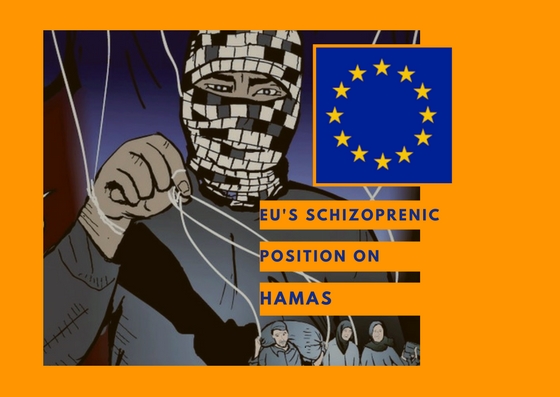
The EU’s Schizophrenic Position on Hamas
An Evaluation of European Policy towards Hamas
Read Full Report
In July 2017, the European Court of Justice (ECJ) ruled that Hamas was rightly put on the list of terror organizations between July 2011 and July 2014. This judgment was a response to the appeal of the European Council against a decision by the General Court, which had ruled that Hamas should not have been on the list during that time. Even though the Advocate General had provided an advisory opinion stating the ECJ should take the same position as the General Court, the ECJ eventually decided in favor of the European Council. While these deliberations were taking place, there was another case pending concerning Hamas' request to be removed from the list from March 26, 2015. This report will analyze the practical implications of the listing of Hamas as a terror organization and present it in perspective to the broader European policy towards the Gaza Strip.
In 2017, the European Court of Justice ruled on an appeal by the European Council and set forth that Hamas will remain on the list of terror organizations. This appears to indicate that the European Union (EU) is convinced of the terrorist nature of Hamas, de-legitimizes the organization and tries to prevent its funding. However, this report shows that the EU's position concerning Hamas is not so clear-cut. Firstly, the EU faces challenges implementing the prevention of funding to Hamas due to its own provision of humanitarian aid to the Gaza Strip, which often implicitly benefits Hamas who maintain effective control over the area. More interestingly, the EU's political response is often highly critical of Israel when addressing the blockade of the Gaza Strip and the hostilities there.
This latest report shows that this criticism is an attempt to transfer responsibility from Hamas to Israel. It is important to understand that these political responses by the EU implicitly consolidate Hamas' rule and in a sense, they become a source of legitimacy for the organization. Moreover, the report shows that the EU's response should be understood in a broader framework, in which it legitimizes Hamas as an organization fighting a legitimate struggle for the Palestinian people, without condemning its methods and practices of terrorism. This report will counter this underlying assumption and urges the EU to acknowledge the responsibility Hamas has in creating the humanitarian crisis in the Gaza Strip. The main argument is that the rule of a terrorist organization over the Gaza Strip is problematic, both for the local population and for Israel. Therefore, it proposes that the EU should problematize the rule of Hamas, and implement measures that will either put pressure on Hamas to abandon its terrorist identity, or that will lead to the complete removal of Hamas from control over the Gaza Strip.
Standing up for European Principles On Human Rights
Now More Than Ever:
Summary: Decision Action Still Needed
Four years ago, an audit by the European Court of Auditors (ECA) noted serious irregularities in funds distributed to the Palestinian Authority, especially aid grants remitted to ‘workers’ in Gaza who could not show evidence of employment. Transparency International reported widespread irregularities and likely corruption throughout the payment system in a 2016 report.
Overall, while some modest improvements have been noted, decisive EU action to mandate adequate accounting checks and, where necessary, impose appropriate penalties for non-compliance remains essential.
The 2012 ECA Report on Aid to Workers in Gaza
In late 2012, the European Court of Auditors conducted an on-site study in Israel to verify the aid distribution mechanism from the EU through PEGASE to the Palestinian Authority (PA). PEGASE describes itself as:
"… the European Union’s mechanism to support the Palestinian people through implementation of … the PA’s own Single Treasury Account (STA) or via direct payments to eligible companies and individuals in full transparency, co-operation and agreement with the PA."
This illustration from the 2013 ECA report depicted the steps to be carried out by the PEGASE process:
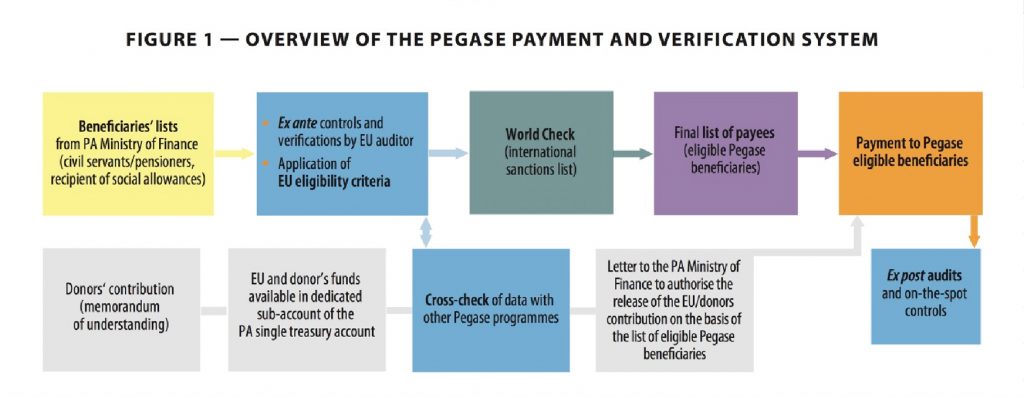
In a key finding, the ECA report stated that:
"Pegase DFS has contributed to essential public services, but the audit found that in Gaza a considerable number of civil servants were being paid without going to work and providing a public service due to the political situation in Gaza. The Commission and the EEAS have not sufficiently addressed this problem."
Consequently, the ECA advised the EU to forge an agreement with the PA to cease civil servant payments in Gaza and transfer these to the West Bank, as well as to “apply conditionality to the future Pegase DFS, specifically by linking it to concrete progress by the PA on civil service reform.”
The EU Commission agreed to the latter recommendation on conditionality. However, the EU did not then accept the proposal to sever payments to civil service workers in Gaza. Nevertheless, in February 2017, the decision was taken to shift funding of Gaza public employees in favor of direct aid to poor families. The Communication officer of the EU Commission, Shadi Othman, positioned this to the Palestinian media as a minor change in procedure. In a separate interview, Othman opposed the conditionality provisions of the ECA recommendations as a form of ‘blackmail’ against the Palestinian people.
The 2016 Transparency International Report
On Illicit Enrichment of Palestinian Public Officials
Transparency International is a global NGO leading the fight against governmental corruption. Sweden sponsored, though it did not necessarily concur with the conclusions reached in their report titled “Asset Declarations in Palestine: Illicit Enrichment and Conflicts of Interest of Public Officials.”
The report observed that more than US$160 billon is believed to have been stolen by regime officials over the years in Egypt, Libya, Tunisia and Yemen alone. Subsequently, international standards for declaring and tracking asset accumulation by public officials have been defined and, sometimes, adopted by affected countries. This has included organizations like the Palestinian Authority. Even so, the report contains scathing criticism of the gulf between formal adoption and on-the-ground practices.
Not a single standard of the ten outlined below have been implemented effectively - some not at all - by the PA:
- Creation of a legal basis for detecting illegal enrichment and conflicts of interest (a law passed in 2002 was later revised to exclude many government officials, including judges).
- Declaration of all income, gifts, loans and sales of property by those entering public service (the current regulations are ambiguous, creating the potential for hiding illicit funds in non-reportable categories).
- All officials should be required to declare assets (judiciary officials, at high risk of illicit activities, are excluded; family members are included but do not, in practice, declare).
- Asset declarations must be submitted when assuming office (no statistics on compliance, but it is believed the majority of required declarations are never submitted; the provision seems to be “toothless”).
- Asset declaration must be verified (no law in place, no evidence that even a single case has been brought against an official in non-compliance).
- An oversight body will conduct asset verification, with access to public databases (created, without dedicated staff, training or procedures).
- Formal operation will occur between the oversight body and prosecution, police and finance intelligence (not established).
- Asset declarations will be visible and accessible to the public (not implemented).
This table illustrates the categorization of assets subject to declaration, showing which items must be declared. As mentioned above, some categories are ambiguous and can be flexibly ‘interpreted’ by those making asset declarations:
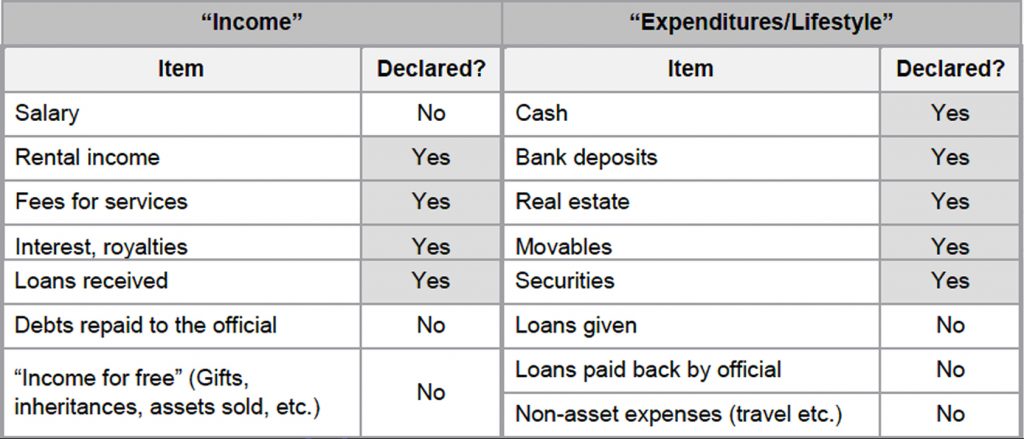
The 2016 Transparency International report concluded by stating that “Palestine has fallen behind international standards on asset declaration” and by offering a series of reform proposals.
Conclusion: The More Things Change …
A proverbial French expression notes that ‘the more things change, the more they remain the same.’ Regrettably, this applies to EU funding of PA activities. While we commend the efforts of the ECA and Transparency International to shed continued light on the lack of substantive accountability by the PA, it falls to the EU to take the decisive action required for permanent reform.
Conditionality - the formal linkage between change in PA behavior and aid distribution to Palestinians - must include measurable criteria for each standard of financial accountability. Enforcement, including sanctions where needed, must be applied without reference to PA complaints. The EU can, through this method alone, offer genuine help to the Palestinian people who are the hoped-for recipients of financial aid that today, as in the past, too often finds its ways into the private bank accounts of a corrupt political and legal class.