
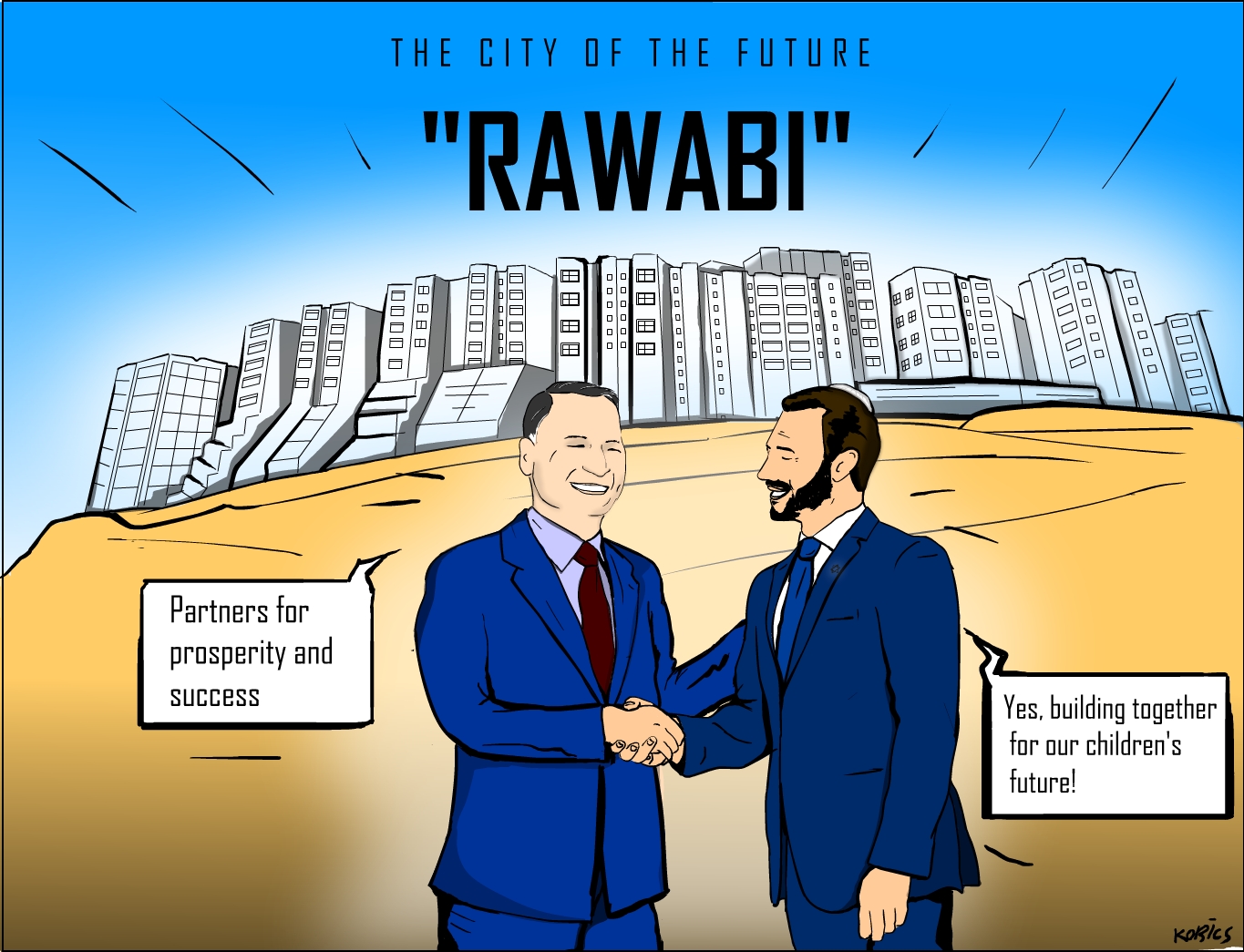
THE CITY OF THE FUTURE
By Nikki Golomb.
Palestinian-American businessman and entrepreneur Bashar al-Masri is making history – by building the first modern Palestinian city. Rawabi, the name of the city and the Arabic word for “hills”, is envisioned to become a modern, hi-tech, and comfortable city in a region devastated by poverty and poor infrastructure. Though the city is still in the process of being built, the first residents moved to Rawabi in August 2015. Despite political and economic challenges, it has already created 6,000 new jobs in construction and engineering, and estimated to produce another 5,000 in retail, health, and more.
Al-Masri has worked closely with Israeli contractors, advisers, and companies to import necessary materials. Furthermore, Rawabi is modeled off of Israeli city Modi’in, an Israeli city which was also meticulously planned. Al-Masri continues to visit Modi’in for ideas, and draws inspiration from Israel’s modern and hi-tech atmosphere. His work with Israelis is groundbreaking, and the unique partnerships he has created inspire optimism with regards to Israeli-Palestinian business relations and the future of intercultural cooperation.
Surprisingly, al-Masri wasn’t always open to working with Israelis. He was jailed eight times as a teenager for throwing rocks and organizing demonstrations, was involved in the first intifada, and was a close acquaintance of Yasser Arafat. Although he still refuses to work with Israeli settlers in the West Bank, he has had positive experiences working with Israeli businessmen and women and has only kind things to say. Israeli workers and companies have worked with al-Masri to help him create the new city and, despite political and economic challenges, continue to provide technology and other material supplies in addition to advisement and consultation.
Despite this great success and the promising new Palestinian city, however, al-Masri has faced substantial backlash from Palestinians. They accuse him of supporting Israel’s “occupation, colonization and apartheid against the Palestinian people,” and even go so far as to say that creating a modern, comfortable Palestinian city undermines the daily struggles they are facing. The Boycott Divestment and Sanctions National Committee (BNC), the leading organization of the BDS movement, has condemned Rawabi as “normalization” of anti-Palestinian Israeli policies and claims that it undermines the Palestinian fight for freedom and justice. Al-Masri disagrees, instead arguing that building Rawabi will not only improve the lives of Palestinians, but also prevent Israelis from settling there. (It should be noted, however, that Rawabi is located in Area A and is thus under Arab control where Israelis are not allowed to live.) He also points out that the Palestinian Authority has provided no funding towards the establishment of Rawabi; the PA, he believes, should view it as a priority and invest in Rawabi by building a school, clinic, or other public infrastructure, yet he has not received any financial support from them whatsoever.
Bashar al-Masri’s project is groundbreaking in two endeavors: first, by creating the first Palestinian city to be planned from the very beginning, and second, by establishing significant business ties between Palestinians and Israelis. Israel has helped in nearly every stage of the creation of Rawabi, despite it being an entirely Palestinian city. Instead of viewing this as a hand outstretched for peace, however, the anti-Israel movement has just added this Palestinian city to its list of projects presumed to revoke the rights of Palestinians. Yet this could not be further from the truth. Rawabi is creating jobs exclusively for Palestinians, providing a comfortable and affordable living situation, and improving the overall quality of life for Palestinians. Modernization does not equal Westernization, nor does working with Israelis equate to denying Palestinians their rights. When the PA and critics realize this, we can expect to see a positive change in Israeli-Palestinian relations, as well as better lives for Palestinians who are struggling.


Start-Up Nation
By Nikki Golomb.
From everyday technological advances such as Waze and the USB flash drive, to medical technology like the PillCam and ReWalk (a wearable exoskeleton that enables paralyzed people to walk), and everything in between, Israel is constantly releasing new hi-tech inventions. In fact, in terms of innovations, Israel is second in the world only to Silicon Valley; fourth in the world in the number of patents per person; and first worldwide in the quality of scientific research institutions. But what makes Israel, a small country with constant security concerns and limited natural resources, so tech-savvy that it has been gifted with this flashy nickname?
In a book that explores the unique and somewhat surprising culture from such a small and young state, authors Saul Singer and Dan Senor attempt to answer this question.
Part of this entrepreneurial spirit can be attributed to the Israeli Defense Forces (IDF). Military R&D, Singer and Senor explain, inspires innovations that impact daily life. It establishes a culture that promotes innovation, creativity, and boldness. IDF culture, born of the compulsory military service in Israel, additionally creates generations of young citizens with unparalleled experience in leadership, teamwork, risk-taking, national pride, and, of course, technology. Following their military service, many Israelis spend months or even years traveling the world, exploring other cultures and ways of life. And what better way is there to come up with new ideas than to leave one’s comfort zone and see how things work around the world?
Furthermore, as a country of immigrants Israel is already full of people who are risk-takers by nature. Common stereotypes of Israelis, olim and sabras alike, include words like brazen, independent, adventure-seeking, and confident. Traits such as these are vital to not only the technology sector, but to professionalism and organizational structure in general. Israeli business culture reflects the overall society, in that it can be perceived as one giant family. This encourages direct and honest communication styles, which may not be acceptable business etiquette in other countries. However, this informal professional culture inspires a respectable level of deviation from the norm. It is not considered rude or unacceptable to ask difficult questions, challenge the traditional way of doing things, or propose new and out-of-the-box ideas; in fact, it is highly encouraged.
Israeli culture additionally cannot be totally separated from Jewish values, such as a strong focus on learning and the tendency to question everything. Exploring new possibilities, asking questions, and the continued drive to learn are vital to the kind of start-up culture found in Israel. Innovations – regardless of whether or not they are technology-related – are born from those who are not afraid to take risks, those who are confident in their abilities and want to make a difference. While ideas are an important part of innovation, it’s the following through on the ideas that really counts.
Interestingly, the country of Israel itself is a “start-up” in many ways. A country that strongly encourages immigration, the only Jewish state in the world, and the prevalence of dozens of political parties are only some of the things that make Israel so unique. The idea to establish Israel was a bold proposal, first in the late 19th century when Theodor Herzl popularized the idea with his theatrical and assertive personality, in a time when the Jews were seen as a small and weak community living under constant threat of antisemitism; then again when David Ben-Gurion advocated for socialism and the expansion of the working class, and his will to “make the desert bloom”. Bold ideas combined with the willpower and audacity to follow through with them is what makes a start-up what it is, whether it be a small hi-tech company or an entire country.
Today, kibbutzim and farms decorate the desert land; palm trees grow next to WeWork buildings, where entrepreneurship and professional creativity flourish. Israel is a “start-up nation” in many senses; not only is the country itself a start-up, but her culture promotes prosperity of ideas, innovations, and modernity. Assertiveness, lack of conformity to the norm, and the desire to be a “light unto the nations” pervade the Israeli consciousness in a way that stimulates cutting-edge thinking and action.
In short, the explanation for Israel’s success as a tech hub, innovation center and “start-up nation” can be boiled down to one word: chutzpah.