
If You Can't Win the Game, Change the Rules
"There will be no advance and separate peace with the Arab world without the Palestinian process and Palestinian peace" – Former US Secretary of State John Kerry, (04/12/16)[1]
In the following piece we will explain how the validity of the above outdated perception has diminished. There has been an on-going shift in Israel's long-established paradigm concerning peacemaking in the Israeli-Palestinian conflict. A major milestone in this shift was the signing of the Abrahamic Accords in September, 2020 and the following peace agreements with the United Arab Emirates and Bahrain.
In the past decade or so, Israel has been actively changing the pre-existing concept that claimed that for the country to have diplomatic relations with the Arab world, it must first reach peace with the Palestinians. The new paradigm demonstrates that Israel does not have to establish a lasting agreement with the Palestinians to broker relations with the rest of the Arab world. Even more so, Israel is in a position of strength when approaching the negotiation table with the Palestinians, while being backed by the moderate Arab states.
Since the founding of the modern State of Israel, the Arab world had refused to grant it any form of recognition. The first Arab state to break away from this consensus was Egypt which signed a peace treaty with Israel in March, 1979. The only other Arab country to follow Egypt's example, until recent years, was Jordan in October, 1994. Yet, there have been a number of Arab states that have formed some level of diplomatic relations with Israel without signing a peace treaty: Morocco between 1994 and 2000,[2] Tunisia between 1996 and 2000,[3] and Oman between 1996 and 2000 as well.[4] These diplomatic ties were severed upon the eruption of the Second Intifada.
The Second Intifada (Palestinian armed uprising) started as an outcome of the failure of the 2000 Camp David Summit, during which the Israeli representatives went to great lengths to accommodate Palestinian demands. There have been additional efforts at brokering peace with the Palestinians since then, e.g. former Israeli Prime Minister Olmert's peace plan presented in 2008, but each one has been met with increasing opposition.
The great leap towards peace from the Gulf Cooperation Council (GCC) has been led by the UAE and Bahrain who both signed peace treaties with Israel on the 15th of September, 2020 together with the Abrahamic Accords.[5] The undisclosed relations between the UAE and Israel during the past 20 years were led by the Israeli Ministry of Foreign Affairs which helped broker economic agreements between Israeli and Emirati companies.[6] At the same time, the countries had secret security relations in an effort to contain Iran's aggression in the region. Israel and the UAE share two main enemies: on the one hand, Iran and its axis of resistance in the region, and on the other, the Muslim Brotherhood and Sunni extremism. Strategically, the UAE have been anxious since the alleged Iranian attack in Saudi Arabia in September, 2019 and threats released by Iranian-backed Houthi rebels in Yemen to launch missiles on the UAE.[7]
It is interesting to look at the polarized Palestinian and Arab League's reactions to the different peace agreements. The Palestinian Authority announced on the 18th of August, 2020, following the joint Israeli-UAE announcement on normalizing relations, that they consider it a "stab in the back" and they totally reject it. Shortly afterward, the Palestinians recalled their ambassadors to the UAE and Bahrain.[8] The Arab League in turn refused to accept the addition of a statement condemning the peace agreements, as requested by the Palestinians, at the Arab League Summit on the 9th of September, 2020.[9] Palestinian leaders have realized that the Arab world is rather accepting of the idea of normalizing relations with Israel. This realization led the Palestinian government sending their ambassadors back to the UAE and Bahrain on the 18th of November, 2020.[10] We are seeing the beginning of the ripple effect of the new diplomatic strategy.
Following the Abrahamic Accords, Israel and Sudan announced normalization of relations between them on the 23rd of October, 2020. This was another major milestone because in contrast to the UAE and Bahrain who were never in real conflict with Israel, Sudan actually took part in fighting against Israel in the 1948 War of Independence and the Six-Day war in 1967.[11] The peace with Sudan is also very symbolic because it was at the Arab League Summit in Khartoum, shortly after the Six-Day War, that the Arab States agreed on the famous three No's: No to recognizing Israel, No to negotiating with Israel and No to peace with Israel.
The latest development in the region is the US-brokered peace agreement between Israel and Morocco which was made possible after the US announced that it "recognizes Moroccan sovereignty over the entire Western Sahara territory."[12] These renewed relations are another attempt at gathering regional support for the US-Israel backed opposition to the Iranian regime. Also, the new Israeli-Moroccan alliance was only made possible thanks to the Arab Gulf states’ embrace of Israel. The Palestinian government for the first time, changed their approach and did not release a statement of condemnation as they had done in previous cases.
"No Arab state, no moderate Sunni state, no one will have open relations with Israel…as long as the Palestinian problem isn't solved." – Former PM of Israel Ehud Olmert, (22/01/20)[13]
Olmert, who has led peace talks with the Palestinians as mentioned earlier, could not have been more wrong in this statement. Four Arab states have formalized open relations with Israel, and we expect this trend to continue.
We hope these peace treaties will bring about real peace, economic prosperity and friendship between the citizens of Israel and the people of the moderate Arab states.
-------------------------------------------------------------------------------------------------------------------------------
[1] https://2009-2017.state.gov/secretary/remarks/2016/12/264824.htm
[2] https://mitvim.org.il/en/publication/israel-the-second-largest-moroccan-diaspora-in-the-world/
[3] https://www.regthink.org/articles/normalization-between-israel-and-tunisia
[4] https://www.jpost.com/Opinion/Israels-renewed-affair-with-Oman-57141
[5] https://www.inss.org.il/publication/abraham-accord-behind-the-scenes/
[6] https://www.haaretz.co.il/news/politics/.premium-1.9083879
[7] https://www.ynet.co.il/article/ryObszQMw#autoplay
[8] https://www.ynet.co.il/news/article/SJqcIkmqv
[9] https://www.haaretz.co.il/news/politics/1.9142202
[10] https://www.ynet.co.il/news/article/SJqcIkmqv
[11] https://www.atlanticcouncil.org/blogs/new-atlanticist/experts-react-sudan-and-israel-reach-historic-peace-agreement/
[12] https://edition.cnn.com/2020/12/10/politics/trump-israel-morocco/index.html
[13] https://www.inn.co.il/news/447227

Apartheid: What it is and what it isn’t
By Nikki Golomb.
“For the purpose of the present Convention, the term "the crime of apartheid", which shall include similar policies and practices of racial segregation and discrimination as practised in southern Africa, shall apply to the following inhuman acts committed for the purpose of establishing and maintaining domination by one racial group of persons over any other racial group of persons and systematically oppressing them…”
UN International Convention on the Suppression and Punishment of the Crime of Apartheid
Apartheid, the Dutch word for separation, was the official system of political, economic, social, and cultural oppression of the Black majority in South Africa from 1948 until 1991. Although different forms of racism and discrimination still exist around the world today, the specific methods of oppression exercised by the South African government during this time are unique to the system of apartheid. The United Nations Apartheid Convention (cited above) lists several methods of oppression indicative of apartheid, thus defining it as a distinct system of legislative discrimination.
A common misconception among the anti-Israel community is that Israel is an apartheid state. In order to dispel this misunderstanding, it is important to recognize two facts: first, that Arab Israelis and Jewish Israelis are equal under Israeli law; and second, that Palestinians living in the West Bank and Gaza are not Israeli citizens, and thus are not subject to Israeli law.
First, let us explore the rights of Arab Israelis. In order to do this, it is important to recognize the difference between societal discrimination and legal discrimination. Societal discrimination, for example, would explain that Arab Israelis are likely to receive a poorer education when compared to Jewish Israelis due to Arabs being viewed by some as second-class citizens, economic factors which make it difficult for Arab families to pay for private education, and a history of discrimination of which the effects are still being felt today. Lawful discrimination, on the other hand, would imply the legalization of forced school segregation based on ethnicity, as well as substandard educational materials and resources provided to Arab schools. While it is true that state religious (Jewish) schools and Arab and Druze schools exist, they are meant to cater toward each individual group’s cultural needs and are provided with uniform subject matter and appropriate funding; furthermore, the majority of Israeli students attend public (mixed) schools [source]. In terms of higher education, Arab Israelis make up 14.4% of Bachelor Degree students; 10% of Master Degree students; 6% of PhD candidates; and 35% of medical school students at the Technion [source]. While South Africa under apartheid gave Black citizens an inferior education, Israel provides equal education for all of its citizens, regardless of ethnicity. Arab Israelis additionally enjoy the right to vote, the right to form political parties, freedom of expression, and all other rights granted to all Israeli citizens.
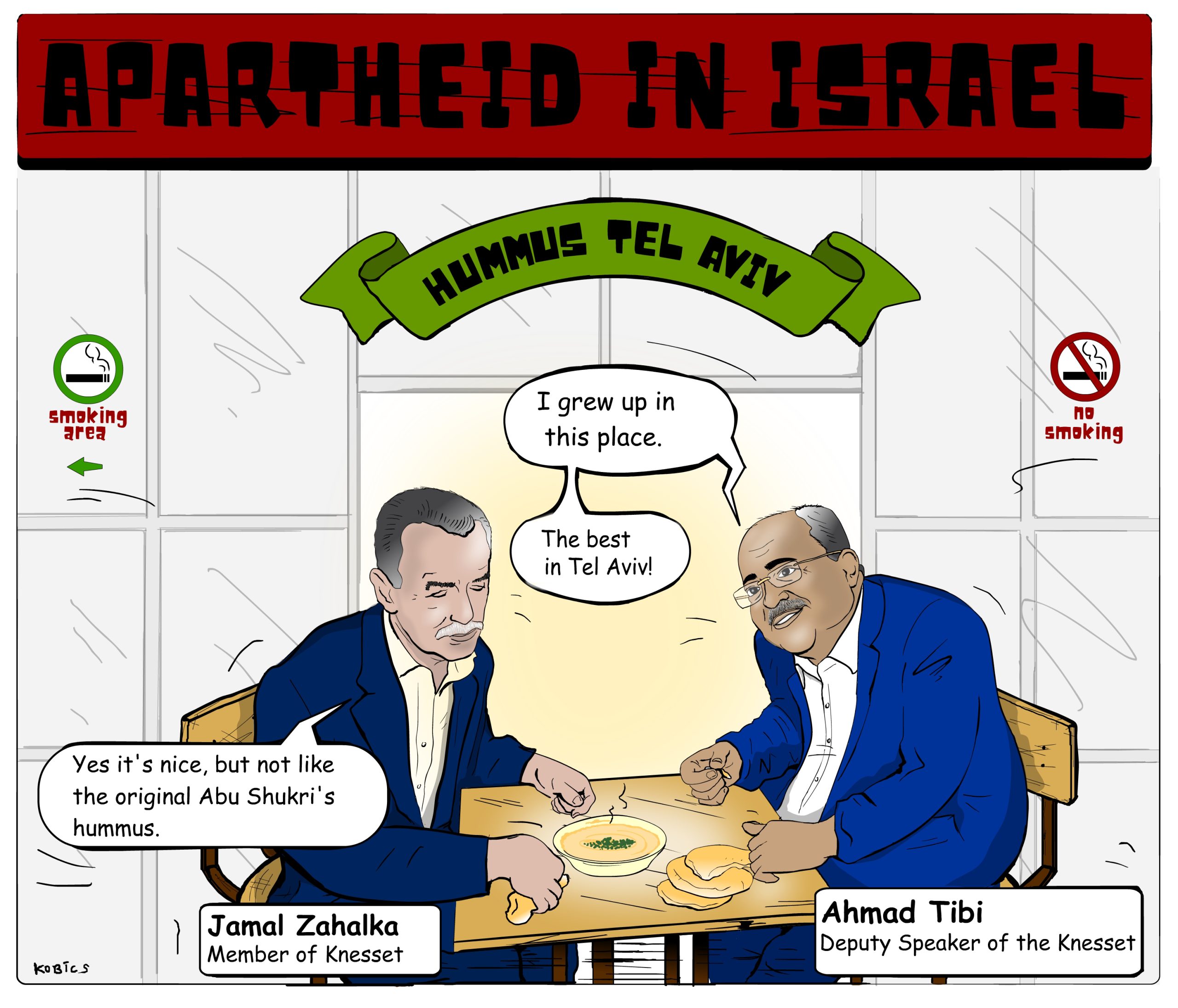
Arab Israelis also have many prominent positions in Israeli society, a phenomenon which would be downright impossible, let alone illegal, under apartheid. Seventeen Arab Israelis were elected to serve in the current Israeli Knesset, comprising 14% of all Members of Knesset. An Arab Justice serves on the Israeli Supreme Court, and 52 of Israel’s 672 Judges are Arab. Arab Israelis additionally work as professors, doctors, journalists, and other high-power positions throughout Israeli society. While these numbers do not reflect complete equality (in which, theoretically, Arabs would make up 19% of these workers, as they comprise 19% of the population of Israel), it again highlights the important distinction between social discrimination and legal segregation. Israel cannot be an apartheid state, because all of its citizens are treated equally under the law.
Now we can look at the more complex issue of Palestinian rights. While it is true that Palestinians living in the West Bank and the Gaza Strip cannot vote in Israeli elections, do not have access to Israeli education, and are not represented in the Knesset, this is because of the simple fact that they are not Israeli citizens. Just as I, an American Jew, cannot vote in Israeli elections because I am not an Israeli citizen, neither can a Palestinian. Since the Oslo Accords in 1993, Palestinians are subject to their own governments; and though these governments (the Palestinian Authority in the West Bank, and Hamas in Gaza) are anything but just, Israel has no governmental authority in those territories. Israel cannot be an apartheid state on the grounds of the rights of Palestinians simply because the Israeli government is in no position to grant or deny Palestinians civil and political rights.
With regards to what many refer to as the “apartheid wall,” the Security Fence along the border of Israel and the West Bank is actually a fence that is less than 5% wall. Although security checkpoints are an inconvenient reality that create difficulties for Palestinians when they enter Israel, they are necessary in order to protect the lives of all Israeli citizens. The fence, which was built during the second Intifada, stopped hundreds of terror attacks a day during the height of its success. While many Palestinians feel it is degrading and it is not a perfect solution by any means, it is a necessity in order to ensure the security of Israeli citizens. Just as you and I must go through border control when entering a different country, those wishing to enter Israel from the West Bank must also endure a security checkpoint. This is not apartheid – it is national security.
Discrimination is, like in all countries around the world, a problem in Israel which is being addressed. However, it is not the legalized system of oppression that many claim it to be. Arab Israelis have full rights under Israeli law, and Palestinians are subject to their own laws and policies. While the methods of protecting national security are not perfect and social equality has not yet been realized, calling Israel a state of apartheid is both factually inaccurate and offensive to the Black South Africans who lived through true apartheid. In order to truly advocate for the rights of those in and around Israel, it is vital to do so using all the facts and correct terminology. It is impossible to fight against something which does not exist, and it is a waste of time and energy to do so when there are real problems that must be addressed.