
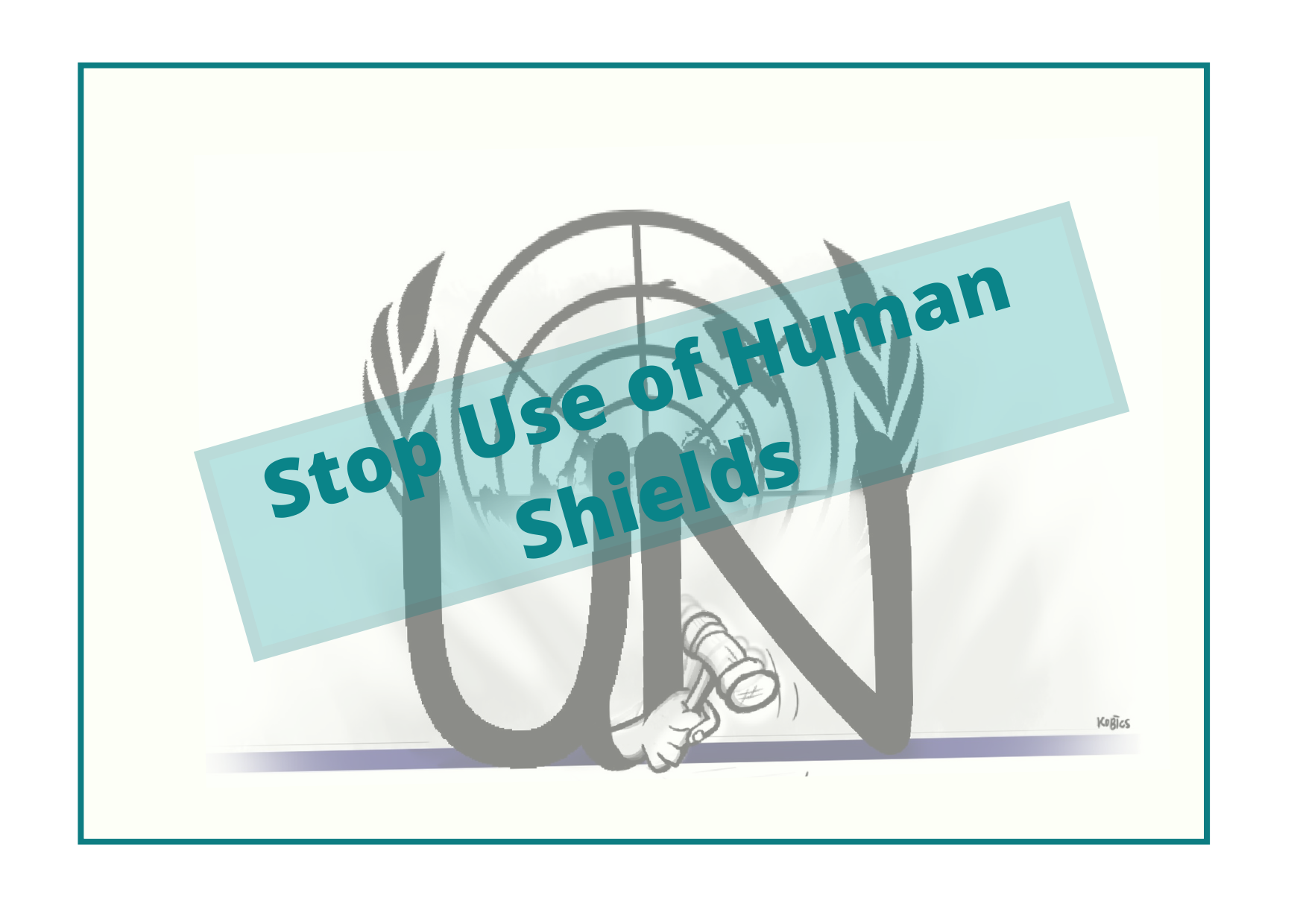
Human Shields = UN War Crimes
Jerusalem Institute of Justice- Submission to The Independent International Commission of Inquiry on the Occupied Palestinian Territory, including East Jerusalem, and Israel
Dear Honorable Commission,
We, the Jerusalem Institute of Justice, are a not-for-profit human rights organization, with Special Consultative Status at the UN Economic and Social Council, fighting to promote human rights, defend democracy, and improve the overall quality of life for Israelis and Palestinians alike. Due to our hope of ever-lasting peace in the region, we find it of the utmost importance to address your call for submissions of relevant information and documentation to the mandate of the Commission.
The attached report concerning Hamas’s actions during Protective Edge Operation (the 2014 Gaza war) was filed by our organization at the Office of the Prosecutor at the International Criminal Court (ICC) in The Hague on the 6th of March 2017. We argued that a full investigation of crimes committed within the Palestinian territories should be pursued, and a case should be lodged, against Ismail Haniyeh, head of the political wing of Hamas, for his role in the commission of war crimes during the 2014 Gaza war. Following this communication, and others, an investigation of the “Situation in Palestine” was commenced by the Chief Prosecutor of the ICC on the 3rd of March 2021. The submission of this report is in accordance with the COI’s mandate to collect evidence and information of abuses of international human rights law and identify those responsible.
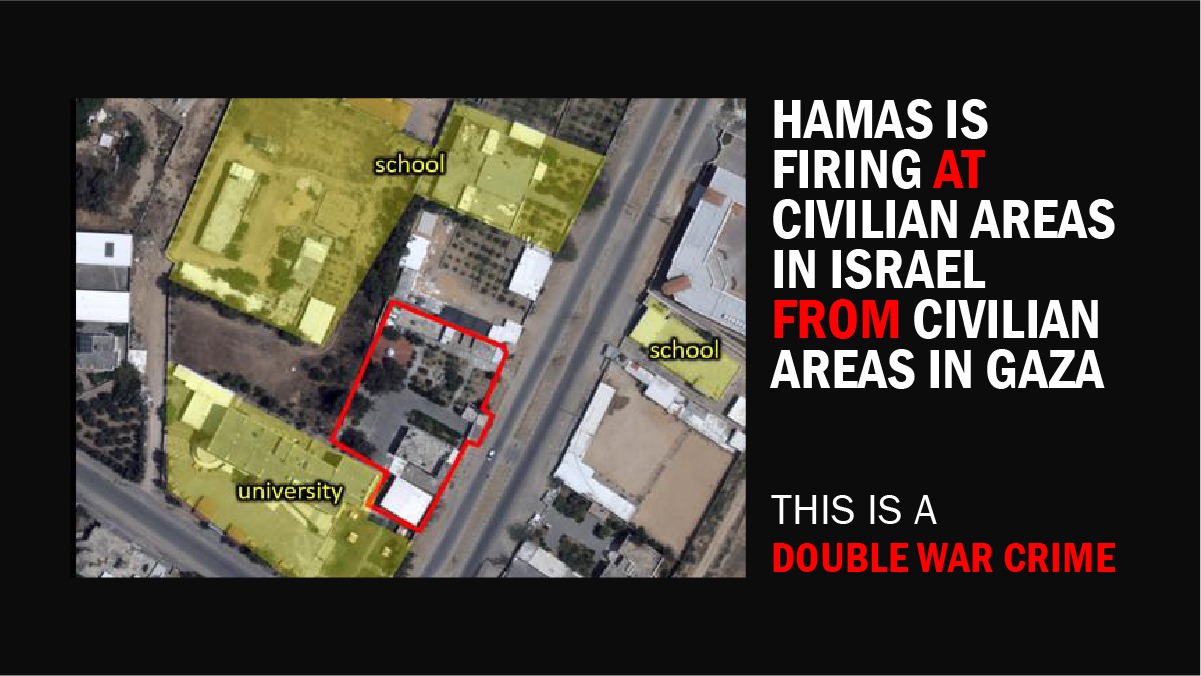
There were two primary war crimes committed by Hamas militants during the war within the Gaza strip. First, they consistently used civilians for military protection and purposes, placing the Gazan population in grave danger as “human shields.” This was done by firing rockets and mortars from densely populated areas, by encouraging (and sometimes forcing) civilians to remain in potential military targets, and by storing rockets in schools, hospitals, mosques, and other civilian structures. Second, the rockets Hamas used during the war are inherently indiscriminate under international law, and were therefore unlawful to use. These rockets are unable to be controlled, and therefore could not accurately be fired at lawful military targets.
These heinous crimes reoccurred during the most recent Gaza conflict in May 2021– Hamas fired more than 4,360 rockets and mortars from residential areas. Of those, approximately 680 misfired and fell into the Gaza Strip, killing Palestinians and damaging Palestinian property, and 3,570 of the remaining rockets struck Israeli towns and cities. Thirteen Israelis were killed, and hundreds were injured. These war crimes are also considered criminal activity pursuant to Article 8 of the Rome Statute of the International Criminal Court – “War Crime of Using Protected Persons as Shields”.
We urge the commission to look into these violations of Human Rights committed by Hamas and include them in their report due to be presented in the Human Rights Council’s June regular session.
Yours sincerely,
Flavia Sevald, CEO,
Jerusalem Institute of Justice,


Your Worst Enemy is Your Best Teacher
by JIJ intern
The Israeli-Palestinian conflict involves two peoples, the Jews and the Palestinians. The two groups often have two competing narratives, two contrasting histories, two sets of terminologies and even two different maps (Ipfatid, 2021). This contributes to a zero-sum mindset in which voices on each side view the other groups’ perspective as an existential threat.
Unfortunately, the international community often takes advantage of both parties distress by sharing incomplete, inaccurate or outdated information on the Israeli-Palestinian conflict. This usually accentuates the divide between Palestinians and Jews (Ipfatid, 2021).
In order to move past this divide, I believe that Israelis and Palestinians, Jews and Arabs, must find common ground between their respective narratives. Luckily, important peace-builders, such as Yossi Klein-Halevi, New York Times best-selling author of Letters to my Palestinian Neighbour, are actively working toward integrating each group’s national narrative in an effort to achieve a lasting, warm peace (Klein-Halevi, 2021).
In Klein-Halevi’s brilliant talk on YouTube titled Israeli and Palestinian Narratives, he breaks down the strengths and the weaknesses of each party’s narrative (JBS, 2015). For the Palestinians, there is the advantage of being the majority presence in Israel/Palestine prior to 19th century Zionist immigration. Meanwhile, for the Jews there is the advantage of identity: a consistent story linking the Jewish people to the land of Israel for 3,500 years.
The more the conflict between the two parties has intensified, the more each side has learned to compensate for deficits in their own story through the other group’s narrative (JBS, 2015). For instance, Zionist immigration to the Land of Israel starting in the 19th century allowed Jews to no longer be a minority within the Holy Land. Meanwhile, in the 19th century, the Palestinians did not have a distinct national identity. To compensate for this lack, Palestinians cultivated a national identity separate from the broader Arab and Muslim world (JBS, 2015).
That being said, the friction between Jewish presence in the Holy Land and a distinct Palestinian identity is often at the heart of the divide between the two parties. There are people on both sides of the conflict that declare the other group is an illegitimate, foreign interloper with no rights to live or self-determinate in this land (Behan, 2021).
Despite this sentiment, in some ways both parties have already succeeded in their national aspirations: there is now a large Jewish presence in the Land of Israel and there is also a distinct Palestinian national identity. Given that the Jews and the Palestinians, whether it was unintentionally or purposefully, learned from each other how to strengthen their own national movements, this may present a potential pathway to conflict resolution: recognizing similarities (JBS, 2015).
Bridging the gap between both parties’ national narratives may involve acknowledging the commonalities between Jewish and Palestinian aspirations. This includes recognizing the legitimacy of both peoples’ identities and recognizing the right for both peoples to live in this land (Behan, 2021).
Finally, this includes acknowledging that both sides have at times experienced the Israeli-Arab conflict as victims. Israelis often see themselves as a minority within the broader Arab and Muslim world, most of which has historically sought to destroy the Jewish state. Meanwhile, Palestinians usually perceive themselves as a marginalized population resisting a well-established country (Ipfatid, 2021). Ultimately, to move forward there must be a willingness from both Jews and Palestinians to humanize, empathize and integrate each other’s national narratives on the conflict (JBS, 2015).
References
Behan, Daniel (2021, March 16). Palestinians and Ashkenazi Jews: Co-Indigenous To The Same Land. Retrieved February 1, 2021, from https://blogs.timesofisrael.com/ palestinians-and-ashkenazi-jews-co-indigenous-to-the-same-land/ [@ipfatid] (2021, June 2).
Why is Approaching the Israeli-Palestinian Conflict With Nuance So Difficult [infographic]. Instagram. https://www.instagram.com/ipfatid/ [JBS] (2015, April 14).
Yossi Klein Halevi: Israeli and Palestinian Narratives [Video]. Youtube. YouTube.com/watch?v=_bLOfHov7IY&t=399s Klein-Halevi, Yossi (2021, November 23).
To The Students Who Walked Out on Palestinian Israeli Dialogue. Retrieved February 1, 2021, from israel.com/to-the-students-who-walkedout-on-palestinian-israeli-dialogue/?fbclid=IwAR1Ks61fQ8HhWDKnpwZ2ACVEhJ9eOxnCGfJE_mxkDUGGvvBMypUJ0KAqc

Evicting Zionism
By Emma Rosenau.
In April of 2019, I visited Emory University in Atlanta, Georgia. I had committed to go to school there and was going for accepted students’ day to meet my future classmates. Sitting in the hotel with my mom, we saw a post in an Emory Facebook group. Jewish and non-Jewish students alike had woken up to flyers posted on the doors of their dorm rooms. They read “EVICTION NOTICE. We regret to inform you that your suite is scheduled for demolition in three days.” (Emory Students for Justice in Palestine, 2019) At the bottom of the notice in small print the flyer states, “THIS IS NOT A REAL EVICTION NOTICE. This is intended to draw attention to the reality that Palestinians confront on a regular basis” (Emory Students for Justice in Palestine, 2019). I was shocked, I had thought that Emory was an open-minded, welcoming community with a large Jewish population (a little less than 20% of students at Emory are Jewish). Now, my first experience on campus was witnessing the Jewish community protest the flyers that were a part of Students for Justice in Palestine’s (SJP) ‘Israeli Apartheid Week.’
The university’s response was bleak. They had approved the posting of the flyers in communal spaces but said that the only rule that had been broken was that they were hung in unapproved areas (on students’ doors). The flyers were viewed as a form of free expression; despite the mental toll it took on Jewish students. SJP’s “free expression of ideas” quickly crossed into the realm of antisemitism. The flyer demonizes Israel when writing that “Palestinian homes are destroyed as a part of the state of Israel’s ongoing attempts to ethnically cleanse the region of its Arab inhabitants and maintain an exclusively ‘Jewish’ character of the state” (Students for Justice in Palestine, 2019)
There is a fine line between legitimate criticism of Israel and antisemitism, and it can be distinguished by using the 3D test, a guide created by Israeli politician, Natan Sharansky. The 3D’s are demonization, delegitimization and double standards. These flyers perfectly fit into demonization of Israel: they imply that Israel is an evil state trying to accomplish ethnic cleansing of Arab citizens. A claim like this is not only wildly inaccurate, but it is also dangerous to the Jewish community. Israel has never engaged in mass-murder or ethnic cleansing and its Arab neighbors have always been the one to initiate conflict. Immediately upon the creation of Israel in 1948, neighboring Arab states began a war in an effort to destroy Israel, and hostilities have continued ever since. Since its founding, Israel has never been motivated by the destruction of the Palestinian people, rather its goal has been simple: defend its existence.
To imply that Israel is ethnically cleansing Palestinians puts Jews around the world in danger. Many people are unable to separate the Jewish people from the Israeli government, thus resulting in an increase in antisemitism worldwide when fighting breaks out in the Middle East involving Israel. In May of 2021, Europe saw an almost 500% increase in antisemitic attacks as a result of many people claiming that Israel was ethnically cleansing Palestinians during the unrest between Israel and the terrorist organization, Hamas (Community Security Trust). The false claims of ethnic cleansing demonizes Israel in the eyes of the rest of the world, thus putting all Jews at risk.
Emory University does not have a working definition of antisemitism and as a result, SJP was not held accountable for their harmful and antisemitic flyers. The university even told Jewish leaders on campus that they agreed the demonization on the flyers was antisemitic, but without a working definition of antisemitism, there was no path towards disciplining the creators of the flyers.
Two years later, Emory still has not adopted any working definition of antisemitism, but not for lack of trying from Jewish student leaders. Members of EIPAC (Emory Israel Public Affairs Committee – the university chapter of AIPAC) and other student leaders have spent the last two years working on proposals to urge the university to adopt the IHRA working definition of antisemitism, which states:
“Antisemitism is a certain perception of Jews, which may be expressed as hatred toward Jews. Rhetorical and physical manifestations of antisemitism are directed toward Jewish or non-Jewish individuals and/or their property, toward Jewish community institutions and religious facilities” (IHRA).
These flyers are not the only act of antisemitism that has occurred on Emory’s campus in the last two years. Many Jewish students face antisemitism on a regular basis and until Emory University adopts the IHRA definition of antisemitism, its Jewish students will remain susceptible to normalized acts of antisemitism similar to these eviction notices.
Works Cited
“CST Stands against Anti-Jewish Hate – Blog.” CST, cst.org.uk/news/blog/2021/05/19/cst-stands-against-anti-jewish-hate.
Emory Students for Justice in Palestine. Eviction Notice. 2019
“Working Definition of Antisemitism.” IHRA, www.holocaustremembrance.com/resources/working-definitions-charters/working-definition-antisemitism.
Guardian of the Walls
The recent 11 day conflict between Israel and Hamas was named "Operation Guardian of the Walls" by Israel. Hamas has named it the "Sword of Jerusalem." Hamas, a terrorist organization was waiting for the right opportunity to ignite the region and enter a violent confrontation with Israel. Its leaders were interested in declaring publically, that they have control over all affairs regarding Jerusalem. The matter of the evacuation of families from the Sheikh Jarrah neighborhood in East Jerusalem (in accordance with the ruling of the Israeli court), along with the perceived weakness of the President of the Palestinian Authority, Mahmoud Abbas, provided Hamas with the appropriate pretext. Thus, on May 10, on the day Israel celebrates the unification of Jerusalem, Hamas initiated a missile attack on Jerusalem. For Israel, this attack turned into an opportunity to critically undermine the terrorist threat posed by Hamas and militant groups operating in Gaza.
Israel made it clear that it will not tolerate being fired upon. And to have rockets launched at its capital, Jerusalem, was unacceptable!
The political echelon in Israel set three goals for Operation Guardian of the Walls:
- - Increasing Israeli military deterrence capabilities
- - Destruction of terrorist infrastructure, elimination of the rocket manufacturing and launching capacities of Hamas
- - Separating Hamas from any affairs related to Jerusalem
A review of the results of Operation Guardian of the Walls reveals a partial success. Israeli military deterrence capabilities have been restored through the almost total destruction of rocket production capacity in the Gaza Strip and critical damage to the "Gaza Metro," Hamas' tunnel network. Hamas was the first to ask for a ceasefire. As for the third goal that Israel set, the severance of Hamas' connection to Jerusalem, it seems that unfortunately, Israel has failed here. Hamas, succeeded in framing the national and political narrative in which it operated, linking the fate of the Gaza Strip to that of East Jerusalem and the West Bank. Hamas made it clear to Israel and the entire world that it has no problem sacrificing Gaza, and its two million citizens, to gain Jerusalem. This was confirmed in a speech given by Ismail Haniyeh, the head of the Hamas political bureau, from his seat in Qatar, in which he states that Hamas is fighting not for the Gaza Strip, but for Jerusalem.
Hamas' most notable achievement was without a doubt, the ability to create additional battle fronts for Israel. From the northern border with Lebanon and by igniting internal conflicts in Israel's cities, leading to unprecedented attacks by Israeli Arabs on Jews which in turn led Israeli nationalists to reciprocate. This phenomenon carried beyond the borders of Israel when Palestinians and Muslims brutally attacked Jews in New York and Los Angeles, London and France. However, Hamas's attempts to light up the West Bank were fortunately, not successful.
The main lesson that Israel must learn from this last round of conflict lies precisely in the goal that Israel did not set for itself. Israel did not define the issue of hasbara (Israeli diplomacy) as a clear goal and perhaps as a result it failed miserably. It honestly must be said; Israel has not been able to withstand the flood of anti-Israel, pro-Palestinian messaging spread on social media. Israel failed to reveal Hamas's true face and its desire to deliberately harm uninvolved civilians on both sides of the conflict. Israel has also failed to show the world how the IDF operates in an impressively surgical way, using advanced technological means to avoid harming civilians. Non-functioning hasbara damaged Israel, this is exhibited by the lack of political support given to it by European countries. The pressure that rose from social media, exploded onto the streets and then returned to social media, accelerated the political timeframe that Israel had to achieve its goals. Israel's strengths and supremacy in every military parameter had a negative effect on its hasbara efforts.
In order to change the balance of power in the field of hasbara, Israel must establish, as soon as possible, a single body entrusted with the task of creating a coherent and uniform narrative.
For Israel’s Prime Minister, Benjamin Netanyahu and his government, Operation Guardian of the Walls was also an opportunity to strengthen ties with the new Biden administration. Biden, who was under pressure from European countries and the UN to compel Israel to end the operation after five days of fighting, conducted eight phone calls with Netanyahu. Netanyahu certainly understood the message and decided to end this round, making the appropriate political gesture to Biden. Israel needs the United States by its side on other fronts. The Iranian threat is perhaps the most prominent of them.
The entrance into an agreement of ceasefire at 2:00am Friday morning was only made possible by Biden's demand to Egyptian President Al Sisi that he guarantees that the violent factions in Gaza stop the rocket fire. The strategic alliance between Israel and the United States is certainly one of the most important in Israel's foreign relations. The United States by stopping three attempts of the UN Security Council to condemn Israel, has once again proven that despite disagreements on certain issues, it stands by Israel.
Operation Guardian of the Walls in numbers:
- - 11 days of fighting
- - 12 Israelis killed
- - 4,000 + rockets fired at Israel, 90% of them intercepted by the IDF
- - 5 senior Hamas and Islamic Jihad commanders killed
- - 680 rockets launched by Hamas misfired hitting Gazan civilians
- - 200 + Gazan civilians killed
- - 20 terrorist operatives killed by Hamas fire
- - 100 + kilometers of terrorism tunnels demolished
- - 100 + terrorist operatives eliminated
- - Over two million Gazan civilians held hostage by the terrorist organization Hamas
- - One Iron Dome system
By Adv. Uri Morad

Chronicle of a Predetermined Decision
The decision of the Chief Prosecutor of the International Criminal Court in The Hague to launch a “comprehensive criminal investigation” of “alleged war crimes” committed in what has been named the "situation in Palestine" is dramatic but not surprising. The writing was on the wall, written in large Gothic font. The decision was made somewhere in 2015, when the Chief Prosecutor, Ms. Fatou Bensouda, accepted Palestine's request to join as a member state of the court.
The motives for Bensouda’s decision were probably political and as a result, answers from the political field are now needed. Let us not be mistaken, Israel has a long list of weighty legal arguments in her defense, but unfortunately, these will not rescue her from the current situation. Any attempt to fend off political interests with legal arguments, however strong, is doomed to fail.
At this time, it is essential for Israel to have political backing from the US and to encourage the positive winds blowing from England, as this is an hour for politics and diplomacy.
This kind of pressure was recently exerted with great success by the United States, where a series of resolute statements and decisions from the former National Security Adviser John Bolton and Secretary of State Mike Pompeo were able to thwart the ICC’s intention to investigate war crimes that US forces allegedly committed on Afghanistan's soil. Incidentally, the ICC's decision to reject the motion to investigate the alleged war crimes came immediately after the denial of entry into the United States of the Chief Prosecutor and an explicit threat to use the American Service-Members' Protection Act, better known as the "The Hague Invasion Law," which gives the president a free hand to take all necessary measures in order to release American soldiers, if the ICC decides to order their imprisonment. In addition, the law prohibits any cooperation or transfer of evidentiary materials to the ICC.
The broad American defense umbrella was kindly offered to Israel as well. The sand in Israel’s hourglass started draining on Friday and will last for several months. Within this time, the Chief Prosecutor, Ms. Fatou Bensouda, will receive the opinion of the pre-trial court regarding its legal position on the issue of the court's jurisdiction to investigate the “situation in Palestine”. The court's legal position does not oblige by law, but it can outline the limits and scope of the investigation, since these arise from a determination regarding the territory in which the court may exercise its authority.
The Jerusalem Institute of Justice, a legal research institute operating in the international legal arena, has recognized and anticipated the decision of the ICC and has worked hard to ensure that the ICC investigates the real criminals who are directly responsible for committing war crimes in our region, the Hamas terrorist organization. Our efforts have borne fruit. The ICC accepted the legal and evidentiary infrastructure we presented to it and stated that it intends to investigate, inter alia, the criminal use of the Palestinian civilian population as human shields, as well as victims of murder and torture.
It is important to clarify that the ICC in its decision to investigate Israel, clearly deviates from its given mandate. This mandate does not involve the criminal investigation of leaders from countries with a self-reliant, independent, and reliable judicial mechanism. Past experience shows that Israel and specifically the IDF are able to conduct self-examination and critique of their actions. Wherever Israel recognizes a potential deviation from the morality and values that characterize the IDF in its activity (in the myriad of complex challenges that it faces), it is still able to ask and answer tough questions when needed.
Adv Uri Morad,
Director of the of International Law & Public Diplomacy Department
Irredeemable and Flawed
By Rachel Rosen.
"There is no doubt that we [UNRWA] have contributed to one of the most remarkable human development processes and significantly advanced several key sustainable development goals for Palestine refugees...”
The United Nations Relief Works Agency for Palestinians, or UNRWA, is a UN agency that purports to provide humanitarian aid to Palestinian refugees. A simple click on their website will bring forth an array of quotes and pictures of children happily reaping the benefits of UNRWA services, such as engaging in art projects and sports competitions at UNRWA schools. According to UNRWA Commissioner-General Pierre Krahenbuhl, "There is no doubt that we [UNRWA] have contributed to one of the most remarkable human development processes and significantly advanced several key sustainable development goals for Palestine refugees...” If UNRWA is in fact providing essential humanitarian aid to refugees however, then what are the issues with this agency that have caused the US to stop funding it?
Unlike the United Nations High Commissioner on Refugees (UNHCR), the UN program which gives aid to refugees from all over the world, UNRWA is dedicated to helping Palestinians alone. Even more striking is the fact that UNRWA created a new definition of refugees that applies only to Palestinians, including not only those who were displaced after the 1948 and 1967 wars, but also their descendants. While UNRWA is commonly depicted as a humanitarian agency that provides educational, health, and welfare services to displaced Palestinians across the Middle East, it is in fact stewing a false hope among Palestinians that they will return to an Arab State of Palestine, and thus erase the State of Israel.
What does UNRWA accomplish? What are the issues it causes?
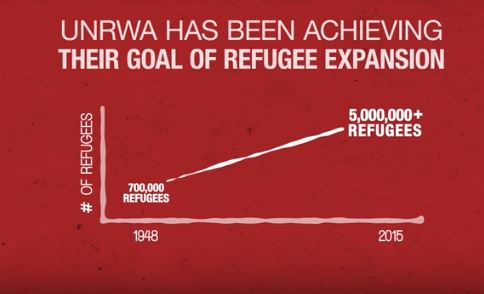
UNRWA’s definition of refugee has exponentially increased the Palestinian refugee population. While it originally aided 750,000 people, today UNRWA serves 5 million people. Consequently, many Palestinians, have acquired citizenship in other states, in Jordan in particular. Only the return of refugees and their descendants to their homes could remove their refugee status. Several Arab states, such as Lebanon and Syria, do not want to fully integrate Palestinians in an effort to not deny them their right to return to modern-day Israel. According to Einat Wilf, UNRWA expert and former Member of Kennest, this has focused Palestinian national identity on the right of return and on eliminating the modern State of Israel.
The educational system funded by UNRWA is especially problematic. UNRWA schools indoctrinate students in the West Bank and Gaza with violent, hateful ideologies. Students are taught that Israel has no right to exist, that Palestine and Israel cannot coexist, and that the Land of Israel should only contain an Arab Palestinian state. The Center for Near East Policy Research found that textbooks in UNRWA schools were filled with anti-Semitic and anti-Israel statements. These instructional materials promote the deligitmization and demonization of Israel and Jews and advocate for a violent struggle for liberation of 1948 Palestinian borders.
The UNRWA definition of Palestinian refugee status and its support for a biased education system does not contribute to peace efforts between Palestinians and Israelis, but rather, perpetuates the conflict. Refugee status is passed on from generation to generation. This ensures that many Palestinian children attend UNRWA schools where they are indoctrinated with hateful, anti-Israel, anti-peace beliefs. Hamas leaders put these beliefs into practice in UNRWA facilities by training children to become terrorists and by using these spaces for terrorist operations- such as digging tunnels under schools or storing weapons in hospitals.
Why has the US stopped funding it?
The defunding of UNRWA is one out of several steps the Trump Administration is taking to strengthen Israel. The US was the largest single donor to UNRWA, giving more than $350 million in 2017. After, however, Palestinian Authority President Mahmoud Abbas refused to enter US-led peace talks with Israel, the US froze $125 million in aid. The decision was made at a meeting between Jared Kusher and Mike Pompeo, however, many other leaders- including President Trump and National Security Advisor John Bolton- were supportive. Trump stated, “...With Palestinians no longer willing to talk peace, why should we make any of these massive future payments to them?” Abbas’s refusal to engage in peace talks stems from the fact that Palestinians do not see the US as a fair, peace-making body. In moving the US embassy from Tel Aviv to Jerusalem, he claims that the Trump administration alienated Palestinians from the peace process.
Both US and Israeli leaders view UNRWA as a means of deepening Palestinian problems. Their alienation from the peace process is not the fault of the US, but rather can largely be attributed to their own neglect to work towards coexistence. US leaders tend to point to the issue of how UNRWA defines refugee, while their Israeli counterparts discuss the existential threat that UNRWA poses to Israel. According to National Security Advisor John Bolton,
“UNRWA is a failed mechanism. It violates standard international law on the status of refugees. UNRWA’s program is the only one in history based on the assumption that refugee status is hereditary... it is long overdue that we have taken steps to reduce funding.”
US Ambassador to the UN, Nikki Haley, affirmed Bolton’s point, claiming that in order for UNRWA to receive US dollars, the number of refugees will need to be changed to an accurate count. Heather Nauert, State Department spokeswoman, called on Israeli Prime Minister Benjamin Netanyahu to support the US decision to withdraw funding from UNRWA, describing the program as an “irredeemably flawed operation” that is based on an “unsustainable” business model. The Prime Minister’s office affirmed Netanyahu’s support for the US’s “critical attitude towards UNRWA” and claimed that “practical steps need to be taken in order to change the fact that UNRWA is being used to entrench the Palestinian refugee problem instead of solving it.” The hawkish view of Israeli leaders is reflected in statements made by former and current Israeli ambassador to the UN, Ron Proser and Danny Danon, in which they describe how UNRWA-funded facilities are used for terrorist activities. Proser describes UNRWA schools as a “hotbed of incitement” against Israel, Jews, and the West, while Danon points to UNRWA’s adoption of a unilateral political position and the anti-peace rhetoric in course materials taught at UNRWA schools.
What are the solutions to UNRWA?
The largest problem with abolishing UNRWA is addressing who would provide humanitarian aid to poor Palestinians in Gaza and the West Bank. Several solutions have been suggested that seek to reform who controls UNRWA and who oversees where funds get allocated. One solution would be to transfer UNRWA’s responsibilities to the UNHCR. If UNRWA operated under the UNHCR, it would to adopt the UNHCR rules and regulations, ensuring that Palestinian refugees were treated the same as all other refugees around the world. This would revoke the unique refugee status of Palestinians. Another solution would be to put UNRWA under the sole control of the Palestinian Authority, thus terminating its affiliation with the UN and UN funding. A third solution on the table is increasing UNRWA’s transparency in order to ensure that its budget and equipment are used for the correct purposes and to ensure that educational programs are supervised. In a statement to the Foundation for the Defense of Democracies, Haley stated, “UNRWA can stay there, and we will be a donor if it reforms what is does... If it goes and makes sure that they’re not doing those teachings in textbooks, if they actually change the number of refugees to an accurate account. We will look back partnering with them.” She noted that the administration is seeking to bring resolutions to the UN that will hold Hamas accountable for human rights abuses in Gaza, such as the use of children as human shields.
Unlikely End, Unjustified Means
Unemployment, poverty and the meaning of sanctions in the Israeli-Palestinian conflict
There are those who say that the end justifies the means, and there are those who oppose that notion. But when the declared end is not even achieved, any justification of the means falls flat.
In the previous article we dealt with the outcomes of sanctions policy on poor areas in general, with particular attention to sanctions in the disputed territories in the Israeli-Palestinian conflict. We looked at the probable economic and social harm to the individuals affected by this policy as well as their society in general. In this article we show the impact of the sanctions on daily life, in both the short run and the long run.
It is well known that unemployment causes massive harm to affected populations. This damage begins with the individual but spreads to the surrounding society. The individual experiences loss of his ability to pay for housing, food, bills, medical care, etc. as a result of lack of income. This situation has a variety of implications, even in developed countries. Tent cities in the USA are an example of this principle. Individuals who suffer unemployment also report feelings of stress, anxiety, and depression, made worse when the unemployed person is responsible for a family. This was shown by research done during the time of the US sub-prime breakdown, when banks offered easy access to money that later triggered the mortgage crisis.
Unemployment also affects the afflicted society by preventing it from reaching its economic potential. In the short run, the workers are not creating economic gains that would fulfill their potential contribution to that society. In the long run,* the unemployed look for any job that will feed themselves and their families, which makes them accept jobs not fitted to their skills and creates a loss of human capital in those skills. This problem intensifies during long terms of unemployment, as the quality of work within their original skills and abilities deteriorates.
In search of income, people in economic distress often fall into criminal activity in order to make a living. This dependency has been encouraged and exploited by terrorist organizations in the West Bank and Gaza, who offer money to those in need, thereby recruiting them for the advancement of terrorism.
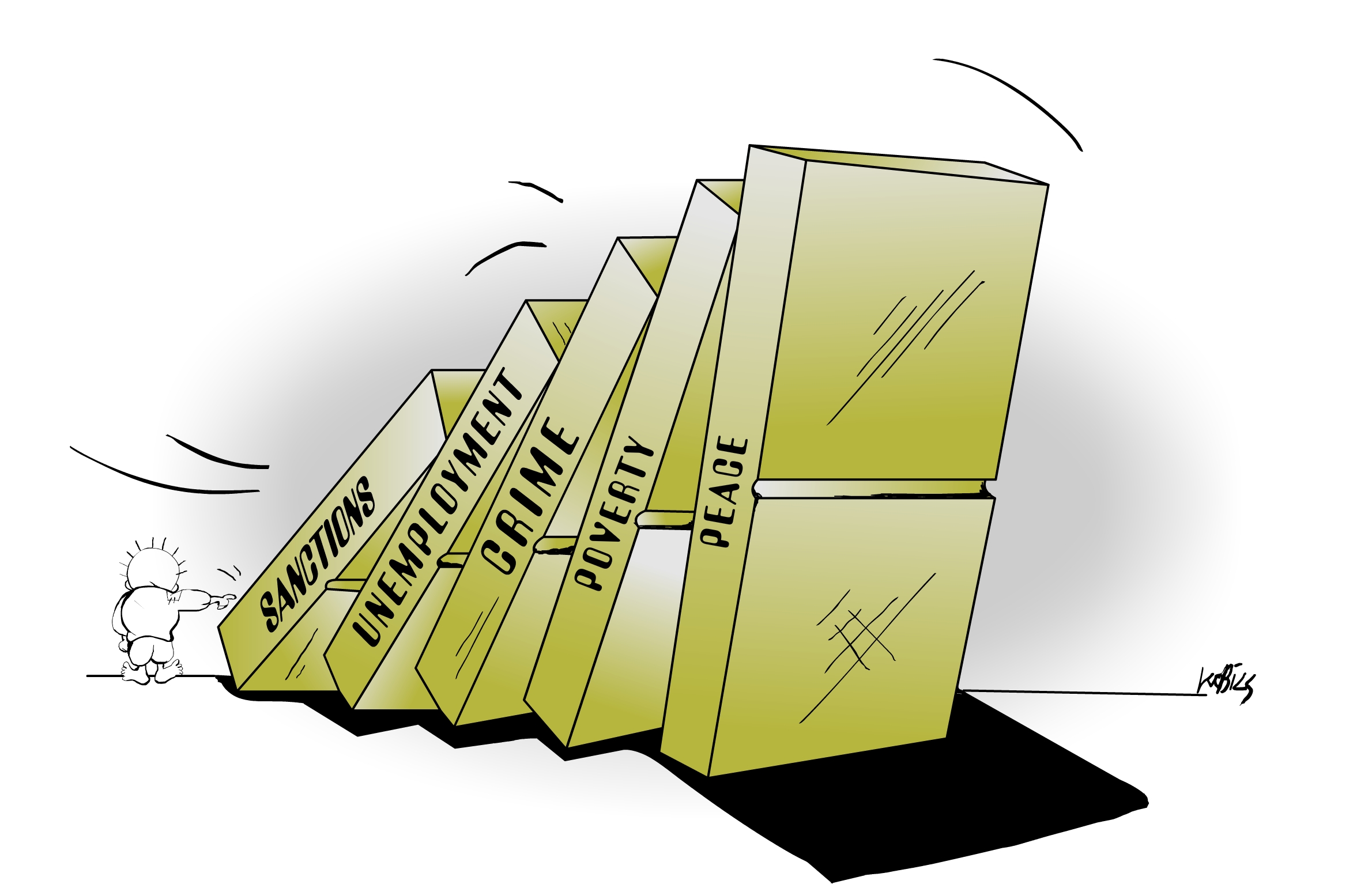
Thus, in addition to unemployment, sanctions cause poverty, widen inequality, and increase crime in the affected societies; all of which causes more tension that can lead to more violence. A definite connection was found in research regarding these effects of sanctions imposed upon multi-ethnic societies.
This research should serve as an alarm bell concerning sanctions implemented against the disputed territories: it points to potentially catastrophic results that can easily lead to increased violence. It is important to note that the territories are already experiencing a complex reality of political tension between ethnic groups, increasing the likelihood that sanctions would only make that tension worse.
There are two more reasons why these sanctions are not likely to achieve their declared goals. Firstly, 65-95% of the sanctions imposed worldwide to date have failed. Secondly, the Israeli-Palestinian conflict is not primarily an economic dispute. It is based on many years of political, religious and historical disputes, which sanctions would not resolve.
In short, sanctions as a means will not only cause harm; they will also fail to achieve the end which supposedly justifies that means.
* Anderton, Alain (2006). Economics (Fourth ed.). Ormskirk: Causeway.