None Of Whose Business?
By John Hyrcanus.
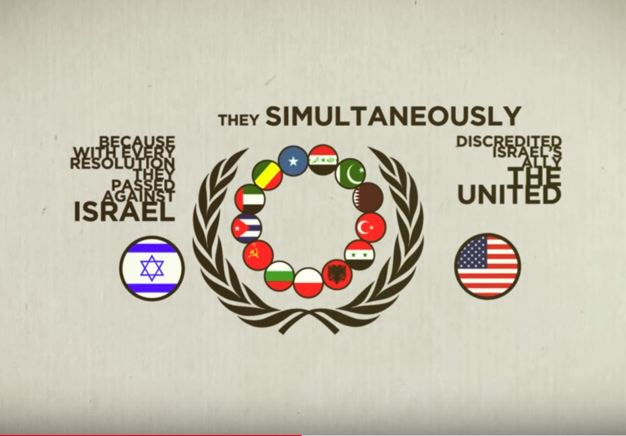
Trying to decide who is ‘up’ and who is ‘down’ after the U.N’s recent condemnation of America’s decision to move its embassy from Tel Aviv to Jerusalem seems a futile exercise. A more consequential issue may be emerging with long-term implications for America, the United Nations and the Middle East - “when does a sovereign nation’s independent action become the legitimate business (that is, concern) of the U.N.?”
To be specific, “is it the rightful business of the U.N. to pass institutional judgment on America’s sovereign decision about her own embassy?”
By a 128-9 vote, the General Assembly condemned America’s embassy decision. This followed almost immediately upon America’s veto of an otherwise unanimous Security Council resolution last week to the same effect. These votes certainly reveal long-held convictions of the United Nations.
The U.N. has never claimed formal, supra-sovereign authority to oversee the internal affairs of Israel, but has frequently spoken and, where allowed, acted as though it is entitled to do so - especially where Jerusalem is concerned. Typically, the U.N. appeals to its self-proclaimed responsibility to serve as an ‘unbiased’ trustee of the city’s sacred religious sites.
A parallel position had remained largely hidden until now. This holds that Jerusalem’s status as Israel’s capital is somehow ‘open’, even though the city’s status has been legally, politically and militarily resolved on Israel’s behalf, repeatedly, for more than a century.
These unwarranted U.N. assertions show how last week’s vote of condemnation was a wholly political, not legal, event. This may be why Prime Minister Netanyahu, using the harshest possible language, described the United Nations itself as a “house of lies” in advance of the vote.
U.N. ambassador Nikki Haley had warned Assembly members in advance that any intrusion into United States sovereignty would provoke a specific and individually-tailored American response. Member nations either judged this an empty threat or reasoned that any consequences would be less serious than appearing to ratify, by implication, this statement of historic fact: “Jerusalem has always been the national capital of the Jewish people.”
The Administration has already matched actions to words. The U.S. will reduce its contribution to the U.N. budget next year by 285 million dollars. Reductions of direct aid to other nations who joined the vote will be weighed separately.
America’s embassy policy in Israel falls far outside any legitimate ‘business’ oversight of the United Nations. America’s recognition of Jerusalem as Israel’s capital neither contradicts nor repudiates any U.N. statute. If America’s decision implies rogue rejection of a tacit U.N. insistence on keeping Jerusalem’s status open, then an open airing of ‘rights’ is long overdue.
In accord with international law, history and tradition, the location of Israel’s capital does not come under the determination of America or the U.N. The United States will move its embassy from Tel Aviv to Jerusalem for the sufficient reason that Israel has always declared Jerusalem to be her national capital.

Jerusalem of Gold – and the US Embassy
By Nikki Golomb.
Throughout his presidential campaign, President Trump promised that when elected, he would move the US embassy from Tel Aviv to Jerusalem despite both international pressure and domestic precedent opposed to such a move. Since being elected, his stance has changed several times on the issue; this week, however, he made the official announcement that the United States a) recognizes Jerusalem as the capital city of Israel, and b) will move the embassy from Tel Aviv (where it is currently located) to Jerusalem.
Why is the move controversial? What are the immediate reactions? And what does this announcement mean for future international relations, particularly within the Middle East?
The Past
Jerusalem is probably one of the most, if not the most, contested lands in the world. It is a holy city for Judaism, Islam, and Christianity, and thus control over the land has been the cause of conflict and war for millennia. The Jewish people have considered it to be the spiritual capital for 3000 years and, more recently, the political capital of the Jewish State for several decades. Yet although Israel declared Jerusalem as its capital city in a 1950 Knesset vote, many countries – as well as IGOs such as the United Nations and the European Union – decline to recognize Jerusalem as the de jure capital. This has clear implications on the international legitimacy of Israel, as its jurisdiction over its own self-proclaimed capital is disputed. It is a very unique situation that a country declares a city to be its capital city and other countries deny this fact; one might question why foreign states have a say in what the capital of Israel is, yet this is the reality in which we are living.
In 1995, the United States Congress passed the Jerusalem Embassy Act in order to begin “initiating and funding the relocation of the Embassy of the United States in Israel from Tel Aviv to Jerusalem, no later than May 31, 1999,” as well as recognize Jerusalem as the capital of Israel. However, each US president (including Trump) has signed a waiver declining to implement it on the grounds that the Act is a “Congressional infringement on the executive branch’s constitutional authority over foreign policy.” As a result, the US has effectively refrained from making a definitive statement on Israel’s jurisdiction over Jerusalem – until today.
The Present
Both Israelis and Palestinians want Jerusalem as the capital of their respective sovereign nation. As such, the issue of jurisdiction over the holy city is one of the most contentious negotiation topics in Israeli-Palestinian peace talks. Refusing to acknowledge Israel’s right to Jerusalem as its capital allows states to remain “neutral” and thus maintain relations with both Israel and the Palestinian Authority.
Even those countries which do recognize Jerusalem as the capital of Israel have their embassies in Tel Aviv in order to avoid conflict. Though this may seem trivial, the symbolic meaning is anything but. All around the world, foreign embassies are located in the respective country’s capital city. Recognizing Jerusalem as Israel’s capital without treating it as such is only a surface-level show of solidarity, and does not truly support Israel’s right to self-determination. However, due to the tensions surrounding Jerusalem, no country chooses to house its embassy there. Doing so would send the message that control over Jerusalem, one of the major points of conflict in Israeli-Palestinian negotiations, is undeniably and nonnegotiably Israel’s.
Even before Washington made the official announcement to recognize Jerusalem as Israel’s capital and move its embassy, the United States faced both domestic and international backlash. Now that President Trump has publicly declared the intended policy change, opponents accuse him of upending decades-long political precedent in the US and throwing the Middle East into unknown turmoil, while supporters are saying, “Well, it’s about time.”
The Future
The United States historically has been one of the main mediators in Arab-Israeli negotiations (for example, the Camp David Accords, Oslo Accords, Camp David Summit, and Israeli-Jordanian peace treaty were all either mediated by or signed in Washington). Publicly recognizing Jerusalem as the capital of the State of Israel necessarily establishes a bias in favor of Israel in the event of future negotiations, should the US continue to mediate these talks. As a result, many Palestinians, Arabs, and other supporters of Palestinian self-determination oppose Trump’s recent announcement as it could create further challenges in the peace process to come.
Most of these challenges stem from the United States’ reputation in the region. Washington may no longer be viewed as a neutral party, causing possibly irreparable damage to relations in the region. Furthermore, it perpetuates the narrative that “the US is at war with Islam and has no respect for Muslim and Arab perspectives.” In a region already experiencing backlash to globalization and Western cultural imperialism, the implications of Trump’s announcement may damage cultural relations in addition to political ones.
The announcement additionally is expected to increase violence and extremism in the region. Senior Palestinian Authority advisor Mahmoud Al-Habbash announced, with PA President Mahmoud Abbas by his side, that Trump’s announcement “would mean total destruction of the peace process... The whole world will pay a price for any change or harm to the political reality of Jerusalem." Hamas additionally called for a revival of the intifada should Washington follow through on its plans.
Yet many Jews – both in Israel and the diaspora – do not see the significance of this announcement. Jerusalem has been the capital of the Jewish people for 3000 years; Washington’s decision to declare its support changes nothing, and nor does the refusal of other states to make the same recognition. Jerusalem always has been and always will be the spiritual capital of the Jewish nation, and no government has the ability to take this away. However, we cannot ignore the inevitable political implications, both short-term and long-term, that the United States’ policy change will have. It is only a matter of time before we begin to see what these effects will be.
Petition to the International Association of Prosecutors
Petition to the International Association of Prosecutors
The Hague, September 2017
Dear members of the IAP Executive Committee and the Senate, dear members of the IAP,
In the run-up to the annual conference and general meeting of the International Association of Prosecutors (IAP) in Beijing, China, the undersigned civil society organisations urge the IAP to live up to its vision and bolster its efforts to preserve the integrity of the profession.
Increasingly, in many regions of the world, in clear breach of professional integrity and fair trial standards, public prosecutors use their powers to suppress critical voices.
In China, over the last two years, dozens of prominent lawyers, labour rights advocates and activists have been targeted by the prosecution service[1]. Many remain behind bars, convicted or in prolonged detention for legal and peaceful activities protected by international human rights standards, including the Universal Declaration of Human Rights. Azerbaijan is in the midst of a major crackdown on civil rights defenders, bloggers and journalists, imposing hefty sentences on fabricated charges in trials that make a mockery of justice[2]. In Kazakhstan, Russia and Turkey many prosecutors play an active role in the repression of human rights defenders, and in committing, covering up or condoning other grave human rights abuses[3].
Patterns of abusive practices by prosecutors in these and other countries ought to be of grave concern to the professional associations they belong to, such as the IAP. Upholding the rule of law and human rights is a key aspect of the profession of a prosecutor, as is certified by the IAP’s Standards of Professional Responsibility and Statement of the Essential Duties and Rights of Prosecutors, that explicitly refer to the importance of observing and protecting the right to a fair trial and other human rights at all stages of work[4].
Maintaining the credibility of the profession should be a key concern for the IAP. This requires explicit steps by the IAP to introduce a meaningful human rights policy. Such steps will help to counter devaluation of ethical standards in the profession, revamp public trust in justice professionals and protect the organisation and its members from damaging reputational impact and allegations of whitewashing or complicity in human rights abuses.
For the second year in a row, civil society appeals to the IAP to honour its human rights responsibilities by introducing a tangible human rights policy. In particular:
We urge the IAP Executive Committee and the Senate to:
- introduce human rights due diligence and compliance procedures for new and current members, including scope for complaint mechanisms with respect to institutional and individual members, making information public about its institutional members and creating openings for stakeholder engagement from the side of civil society and victims of human rights abuses[5].
We call on individual members of the IAP to:
- raise the problem of a lack of human rights compliance mechanisms at the IAP and thoroughly discuss the human rights implications before making decisions about hosting IAP meetings;
- identify relevant human rights concerns before travelling to IAP conferences and meetings and raise these issues with their counterparts from countries where politically-motivated prosecution and human rights abuses by prosecution authorities are reported by intergovernmental organisations and internationally renowned human rights groups.
Supporting organisations:
Africa Network for Environment and Economic Justice, Benin
Anti-Corruption Trust of Southern Africa, Kwekwe
Asian Forum for Human Rights and Development (FORUM-ASIA)
Asia Justice and Rights, Jakarta
Asia Indigenous Peoples Pact, Chiang Mai
Asian Human Rights Commission, Hong Kong SAR
Asia Monitor Resource Centre, Hong Kong SAR
Association for Legal Intervention, Warsaw
Association Humanrights.ch, Bern
Association Malienne des Droits de l'Homme, Bamako
Association of Ukrainian Human Rights Monitors on Law Enforcement, Kyiv
Associazione Antigone, Rome
Barys Zvozskau Belarusian Human Rights House in exile, Vilnius
Belarusian Helsinki Committee, Minsk
Bulgarian Helsinki Committee, Sofia
Canadian Human Rights International Organisation, Toronto
Center for Civil Liberties, Kyiv
Centre for Development and Democratization of Institutions, Tirana
Centre for the Development of Democracy and Human Rights, Moscow
Center for the Judiciary Watch of the People’s Solidarity for Participatory Democracy (PSPD), Seoul
China Human Rights Lawyers Concern Group, Hong Kong SAR
Civil Rights Defenders, Stockholm
Civil Society Institute, Yerevan
Citizen Watch, St. Petersburg
Collective Human Rights Defenders “Laura Acosta” International Organization COHURIDELA, Toronto
Comunidad de Derechos Humanos, La Paz
Coordinadora Nacional de Derechos Humanos, Lima
Destination Justice, Phnom Penh
East and Horn of Africa Human Rights Defenders Project, Kampala
Equality Myanmar, Yangon
Faculty of Law - University of Indonesia, Depok
Fair Trials, London
Federation of Equal Journalists, Almaty
Former Vietnamese Prisoners of Conscience, Hanoi
Free Press Unlimited, Amsterdam
Front Line Defenders, Dublin
Foundation ADRA Poland, Wroclaw
German-Russian Exchange, Berlin
Gram Bharati Samiti, Jaipur
Helsinki Citizens' Assembly Vanadzor, Yerevan
Helsinki Association of Armenia, Yerevan
Helsinki Foundation for Human Rights, Warsaw
Human Rights Center Azerbaijan, Baku
Human Rights Center Georgia, Tbilisi
Human Rights Embassy, Chisinau
Human Rights House Foundation, Oslo
Human Rights Information Center, Kyiv
Human Rights Matter, Berlin
Human Rights Monitoring Institute, Vilnius
Human Rights Now, Tokyo
Human Rights Without Frontiers International, Brussels
Hungarian Civil Liberties Union, Budapest
IDP Women Association "Consent", Tbilisi
IMPARSIAL, the Indonesian Human Rights Monitor, Jakarta
Index on Censorship, London
Indonesian Legal Roundtable, Jakarta
Institute for Criminal Justice Reform, Jakarta
Institute for Democracy and Mediation, Tirana
Institute for Development of Freedom of Information, Tbilisi
International Federation for Human Rights (FIDH)
International Partnership for Human Rights, Brussels
International Service for Human Rights, Geneva
International Youth Human Rights Movement
Jerusalem Institute of Justice, Jerusalem
Jordan Transparency Center, Amman
Justiça Global, Rio de Janeiro
Justice and Peace Netherlands, The Hague
Kazakhstan International Bureau for Human Rights and Rule of Law, Almaty
Kharkiv Regional Foundation Public Alternative, Kharkiv
Kosovo Center for Transparency, Accountability and Anti-Corruption - KUND 16, Prishtina
Kosova Rehabilitation Center for Torture Victims, Prishtina
Lawyers for Lawyers, Amsterdam
Lawyers for Liberty, Kuala Lumpur
League of Human Rights, Brno
Macedonian Helsinki Committee, Skopje
Masyarakat Pemantau Peradilan Indonesia (Mappi FH-UI), Depok
National Coalition of Human Rights Defenders, Kampala
Netherlands Helsinki Committee, The Hague
Netherlands Institute of Human Rights (SIM), Utrecht University, Utrecht
NGO "Aru ana", Aktobe
Pakistan Rural Workers Social Welfare Organization (PRWSWO), Bahawalpur
Pen International, London
Philippine Human Rights Advocates (PAHRA), Manila
Promo-LEX Association, Chisinau
Protection International, Brussels
Protection of Rights Without Borders, Yerevan
Public Association Dignity, Astana
Public Association "Our Right", Kokshetau
Public Fund "Ar.Ruh.Hak", Almaty
Public Fund "Ulagatty Zhanaya", Almaty
Public Verdict Foundation, Moscow
Regional Center for Strategic Studies, Baku/ Tbilisi
Socio-Economic Rights and Accountability Project (SERAP), Lagos
Stefan Batory Foundation, Warsaw
Suara Rakyat Malaysia (SUARAM), Petaling Jaya
Swiss Helsinki Association, Lenzburg
Transparency International Anti-corruption Center, Yerevan
Transparency International Austrian chapter, Vienna
Transparency International Česká republika, Prague
Transparency International Deutschland, Berlin
Transparency International EU Office, Brussels
Transparency International France, Paris
Transparency International Greece, Athens
Transparency International Greenland, Nuuk
Transparency International Hungary, Budapest
Transparency International Ireland, Dublin
Transparency International Italia, Milan
Transparency International Moldova, Chisinau
Transparency International Nederland, Amsterdam
Transparency International Norway, Oslo
Transparency International Portugal, Lisbon
Transparency International Romania, Bucharest
Transparency International Secretariat, Berlin
Transparency International Slovenia, Ljubljana
Transparency International España, Madrid
Transparency International Sverige, Stockholm
Transparency International Switzerland, Bern
Transparency International UK, London
UNITED for Intercultural Action the European network against nationalism, racism, fascism and in support of migrants, refugees and minorities, Budapest
United Nations Convention against Corruption Civil Society Coalition
Villa Decius Association, Krakow
Vietnam's Defend the Defenders, Hanoi
Vietnamese Women for Human Rights, Saigon
World Organisation Against Torture (OMCT)
Zimbabwe Lawyers for Human Rights, Harare
[1] As documented by a number of internationally renowned human rights organisations, including Human Rights Watch and the ICJ. See, for example, the HRW World Report 2017, China and Tibet, available at: https://www.hrw.org/world-report/2017/country-chapters/china-and-tibet; China: call for action at UN on lawyers and other human rights defenders, available at: https://www.icj.org/wp-content/uploads/2017/02/UN-HRC34-China-JointLetter-Advocacy-2017.pdf
[2] The Functioning of the Judicial System in Azerbaijan and its Impact on the Fair Trial of Human Rights Defenders, Helsinki Foundation for Human Rights and Netherlands Helsinki Committee 2016, available at: http://www.defendersorviolators.info/judiciary-in-azerbaijan.
[3] See, for example: Human Rights and the Professional Responsibility of Judges and Prosecutors in the Work of CCJE and CCPE. Observations to the CCJE-CCPE Joint Report on “Challenges for Judicial Independence and Impartiality in the Member States of the Council of Europe”, Netherlands Helsinki Committee and Helsinki Foundation for Human Rights 2017, available at: https://www.nhc.nl/assets/uploads/2017/06/20170331-Observations-to-CCJE-CCPE-Report.pdf
[4] Standards of Professional Responsibility and Statement of the Essential Duties and Rights of Prosecutors adopted by the International Association of Prosecutors on 23 April 1999.
[5] See, for example, Options for Promoting Human Rights Compliance by the International Association of Prosecutors, policy brief, October 2016.