
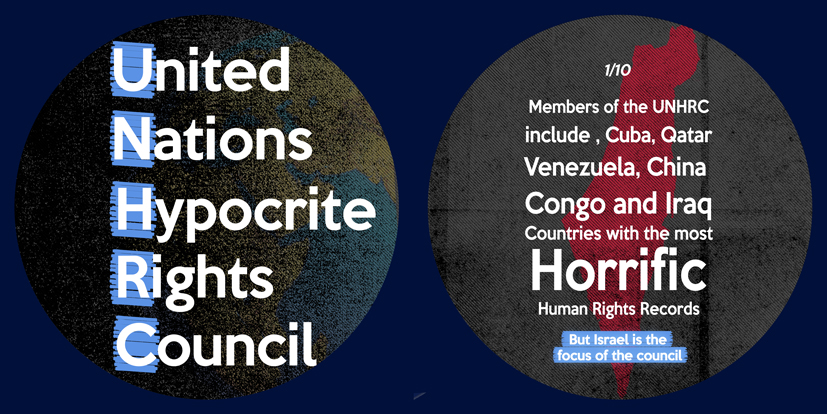
Human Rights Council - Political Bias
The UN Human Rights Council “database” of business enterprises
On 24 March 2016, at its 31st session, the Human Rights Council (HRC) adopted resolution 31/36 entitled “Israeli settlements in the Occupied Palestinian Territory, including East Jerusalem, and in the occupied Syrian Golan”.[1] Paragraph 17 (OP 17) of this resolution requests the United Nations High Commissioner for Human Rights (OHCHR) produce a database of all business enterprises engaged in certain Israeli settlement activity in the occupied Palestinian territory, or the "Blacklist".
While local and international business activity in disputed or occupied territories is widespread, and involves some of the world’s largest companies, Resolution 31/36 represents the only known UN effort to produce a “database” of such activity in respect of one situation. The fact that such business activity is so ubiquitous and rarely criticized demonstrates that it is not viewed as raising legal or human rights issues, while the desire to establish a database only with respect to business activity in Israeli settlement communities points to the political bias of the body that initiated this process.
OP17 was adopted despite the strong opposition of the US, EU and Israel. It is the product of a specific discriminatory HRC agenda item, the organization's only country-specific agenda item, which reflects ongoing and well documented institutional bias against Israel in the HRC. The Council is widely criticized as a deeply politicized body, whose agenda is often dictated by the world’s worst human rights violators, and whose legitimacy and credibility in the human rights arena has been fundamentally undermined as a result.
Israel, together with the United States and numerous other leading States, have expressed, consistent opposition to the database and its publication, and have conveyed this position in their public and private communications. Israel has no intention of cooperating with this illegitimate exercise for the following reasons:
- Lack of authority to produce database: The production of a “database” exceeds the mandate of the OHCHR, which has neither the competence nor the capacity to engage in this action. The responsibility for ensuring compliance of business enterprises with relevant laws, or for promoting any relevant non-binding guidelines with respect to business practices, rests exclusively with the States in which the relevant enterprises are domiciled or operating.
- Lack of authority to communicate to companies: The HRC and OHCHR are bodies mandated to deal with State conduct in the human rights field and they have no legal or other authority over business enterprises.
- Lawfulness of business activity: Business activity in areas of Judea and Samaria (West Bank) under Israeli jurisdiction in accordance with existing Israeli-Palestinian agreements, is entirely lawful. Indeed, the notion that business enterprises are even subject to international law, international humanitarian law, and international human rights law is highly questionable and has been rejected by Courts in leading national jurisdictions.
- Blacklist: The creation of a database, and certainly its publication in any form, amounts to an effort to produce a blacklist of companies that are not engaged in any wrongdoing, and with the potential of causing commercial, reputational and legal harm. By engaging in this action, the OHCHR is allowing itself to become an instrument of those engaged in an illegitimate, discriminatory and political motivated agenda.
Furthermore, the methodology of the OHCHR is entirely devoid of transparency, and the information upon which it has based its communication has been drawn from partial, unverifiable and unknown sources, including politically-motivated actors, who responded voluntarily to the OHCHR’s calls. The OHCHR also lacks the requisite competence or capacity to verify independently the information it has received. While Resolution 31/36 requires a database of “all” business enterprises, the process adopted makes the database flawed from its inception and inevitably renders the list the partial, selective and discriminatory in nature
It is important to note that the database initiative is not legal or quasi-legal in nature, and does not, in and of itself, carry with it legal consequences. The process lacks due process and procedural safeguards to ensure that the list will not contain unauthoritative or inappropriately verified information. Furthermore, cooperation by companies with the database initiative may entail potential legal consequences, liability, financial risk and reputational harm. As is known, relevant domestic legislation and anticipated legislative proposals in various jurisdictions prohibit companies from discriminating in their business practices, including laws that specifically pertain to discriminatory practices with respect to Israel or territory subject to Israeli jurisdiction. This pertains, for example, to companies that are domiciled in the US, are subsidiaries of US-domiciled companies, or that do business in the US. In this context, dozens of U.S. State laws currently bar granting contracts to, or pension-fund investment in, companies that boycott Israel or territories under its jurisdiction. Moreover, such cooperation might raise issues under existing relevant US federal legislation.
The UN Human Rights Council “database” of business enterprises
On 24 March 2016, at its 31st session, the Human Rights Council (HRC) adopted resolution 31/36 entitled “Israeli settlements in the Occupied Palestinian Territory, including East Jerusalem, and in the occupied Syrian Golan”.[1] Paragraph 17 (OP 17) of this resolution requests the United Nations High Commissioner for Human Rights (OHCHR) produce a database of all business enterprises engaged in certain Israeli settlement activity in the occupied Palestinian territory, or the "Blacklist".
While local and international business activity in disputed or occupied territories is widespread, and involves some of the world’s largest companies, Resolution 31/36 represents the only known UN effort to produce a “database” of such activity in respect of one situation. The fact that such business activity is so ubiquitous and rarely criticized demonstrates that it is not viewed as raising legal or human rights issues, while the desire to establish a database only with respect to business activity in Israeli settlement communities points to the political bias of the body that initiated this process.
OP17 was adopted despite the strong opposition of the US, EU and Israel. It is the product of a specific discriminatory HRC agenda item, the organization's only country-specific agenda item, which reflects ongoing and well documented institutional bias against Israel in the HRC. The Council is widely criticized as a deeply politicized body, whose agenda is often dictated by the world’s worst human rights violators, and whose legitimacy and credibility in the human rights arena has been fundamentally undermined as a result.
Israel, together with the United States and numerous other leading States, have expressed, consistent opposition to the database and its publication, and have conveyed this position in their public and private communications. Israel has no intention of cooperating with this illegitimate exercise for the following reasons:
- Lack of authority to produce database: The production of a “database” exceeds the mandate of the OHCHR, which has neither the competence nor the capacity to engage in this action. The responsibility for ensuring compliance of business enterprises with relevant laws, or for promoting any relevant non-binding guidelines with respect to business practices, rests exclusively with the States in which the relevant enterprises are domiciled or operating.
- Lack of authority to communicate to companies: The HRC and OHCHR are bodies mandated to deal with State conduct in the human rights field and they have no legal or other authority over business enterprises.
- Lawfulness of business activity: Business activity in areas of Judea and Samaria (West Bank) under Israeli jurisdiction in accordance with existing Israeli-Palestinian agreements, is entirely lawful. Indeed, the notion that business enterprises are even subject to international law, international humanitarian law, and international human rights law is highly questionable and has been rejected by Courts in leading national jurisdictions.
- Blacklist: The creation of a database, and certainly its publication in any form, amounts to an effort to produce a blacklist of companies that are not engaged in any wrongdoing, and with the potential of causing commercial, reputational and legal harm. By engaging in this action, the OHCHR is allowing itself to become an instrument of those engaged in an illegitimate, discriminatory and political motivated agenda.
Furthermore, the methodology of the OHCHR is entirely devoid of transparency, and the information upon which it has based its communication has been drawn from partial, unverifiable and unknown sources, including politically-motivated actors, who responded voluntarily to the OHCHR’s calls. The OHCHR also lacks the requisite competence or capacity to verify independently the information it has received. While Resolution 31/36 requires a database of “all” business enterprises, the process adopted makes the database flawed from its inception and inevitably renders the list the partial, selective and discriminatory in nature
It is important to note that the database initiative is not legal or quasi-legal in nature, and does not, in and of itself, carry with it legal consequences. The process lacks due process and procedural safeguards to ensure that the list will not contain unauthoritative or inappropriately verified information. Furthermore, cooperation by companies with the database initiative may entail potential legal consequences, liability, financial risk and reputational harm. As is known, relevant domestic legislation and anticipated legislative proposals in various jurisdictions prohibit companies from discriminating in their business practices, including laws that specifically pertain to discriminatory practices with respect to Israel or territory subject to Israeli jurisdiction. This pertains, for example, to companies that are domiciled in the US, are subsidiaries of US-domiciled companies, or that do business in the US. In this context, dozens of U.S. State laws currently bar granting contracts to, or pension-fund investment in, companies that boycott Israel or territories under its jurisdiction. Moreover, such cooperation might raise issues under existing relevant US federal legislation.
The potential legal consequences, liability, financial risk and reputational harm is not merely a theoretical possibility, as the Airbnb case which unfolded from late 2018 to April 2019 exemplified. In this case Airbnb announced its intention to delist an estimated 200 listings of Israeli properties in Judea and Samaria. The company announced in April 2019 that his policy will not be implemented as part of settlement reached with all lawsuits that were brought by hosts and potential hosts and guests who objected to the policy on grounds of discrimination. This policy was not only attacked in the courts as it landed Airbnb on the top ten antisemitic events of 2018 by the Wiesenthal Center, led to US State investment boards to add the company to their blacklists as well as a host of leading political figures, including State Governors and American Vice President Mike Pence. All this not only led the company to abandon its policy, it also led to the company stating that "Airbnb has always opposed the BDS movement"[2]. This case exemplifies the risk the potential risk stated above.
The potential legal consequences, liability, financial risk and reputational harm is not merely a theoretical possibility, as the Airbnb case which unfolded from late 2018 to April 2019 exemplified. In this case Airbnb announced its intention to delist an estimated 200 listings of Israeli properties in Judea and Samaria. The company announced in April 2019 that his policy will not be implemented as part of settlement reached with all lawsuits that were brought by hosts and potential hosts and guests who objected to the policy on grounds of discrimination. This policy was not only attacked in the courts as it landed Airbnb on the top ten antisemitic events of 2018 by the Wiesenthal Center, led to US State investment boards to add the company to their blacklists as well as a host of leading political figures, including State Governors and American Vice President Mike Pence. All this not only led the company to abandon its policy, it also led to the company stating that "Airbnb has always opposed the BDS movement"[2]. This case exemplifies the risk the potential risk stated above.
[1]https://www.ohchr.org/EN/HRBodies/HRC/RegularSessions/Session31/Pages/DatabaseHRC3136.aspx
[2] https://news.airbnb.com/update-listings-disputed-regions/

My Encounter with Hatred: A Student in London
The first time the BDS movement caught my attention was on April 27, 2017. The date is etched into my mind because up until that day, I’d always thought of anti-Zionism as the ‘pet hate’ of the Jewish community, the enemy that we need in order to justify ourselves and to make excuses for ‘security measures’. Like Jews of many generations, I preferred to focus on the challenges of day-to-day living and not look at the totally irrational hatred being spread against me and my people. The basic rationale of my thinking was that Jew-hatred and Zionist-hatred doesn’t make sense, therefore it can’t be such a big problem.
On April 27, 2017 that changed.
I had been accepted to start studying in one of the major London universities and was at the university to make inquiries regarding my enrollment. My head was held high because I was proud to have the opportunity to be educated in this well-reputed institution. As I walked through the campus, I was intrigued to hear the sound of drums and people shouting. Slightly surprised but being compulsively inquisitive, I drew near to see the meaning of the rowdiness in civilized London. It didn’t take long to recognize – the Palestinian flags and chants immediately flooded my mind with memories of having stones hurled at me while on duty in the West Bank and pictures of one of my soldiers who got hit by a massive rock in the chest while overseeing a demonstration.
Taken by surprise, I walked amongst the protestors. Seeing people from a whole range of ethnic backgrounds, I attempted to fathom what was going on behind the aggressive shouts. “From the river to the sea, Palestine will be free!” and “Israel is a fascist state!” were chanted by the sea of protestors. What was the meaning of all this? It turned out that the protest was against the Israeli Ambassador’s speaking on the university campus – as this invitation was seen to be ‘provocative’. They wanted the university to boycott the speaker because the speaker represented Israel, which they saw as being an evil occupier. It was chilling to think that in the middle of London, people were openly advocating for the end of the State of Israel, ‘from the river to the sea’.
Even though I found it difficult to hold my resolve together amidst those who were in essence denying my identity as an Israeli, I have always been taught of the importance of listening to the other side and to be willing to admit when I am wrong. So, I stuck around and wandered between the protestors, asking them what they knew about the conflict and trying to understand why they were so worked up. Most of the answers I got were that the Palestinians are being butchered by the Israelis and that we all need to do everything we can to fight the ‘evil occupation’. These 19 and 20-year-olds who had been educated that Israel is an evil-colonialist venture, seemed surprised when I told them I had just finished my service in the IDF as an Officer in a Combat Unit and that I was a relatively normal human being, not thirsty for Palestinian blood. When asked if I’d given my testimony to “Breaking the Silence” – an organization of former IDF soldiers who testify to having been forced to commit violations against Palestinians – I responded that I hadn’t because I didn’t have any violations to report: my commanders were men of integrity, amongst the most moral people I know, and I had always taught my troops to have value for all human life – Jew, Arab and everyone else.
Sadly, the protestors didn’t seem to care very much for talking, the atmosphere wasn’t one for talking or thinking – rather, one of being joined together in the anti-Israel mob. As I politely approached individuals to ask them questions about the implications of their demands on the Jewish people, I was angrily brushed aside. It reminded me of drunk fans cursing a referee at a football match or scenes from Gladiator at the Colosseum – the chants and drum beats working up ‘anti-emotion’ against Israel and her Ambassador.
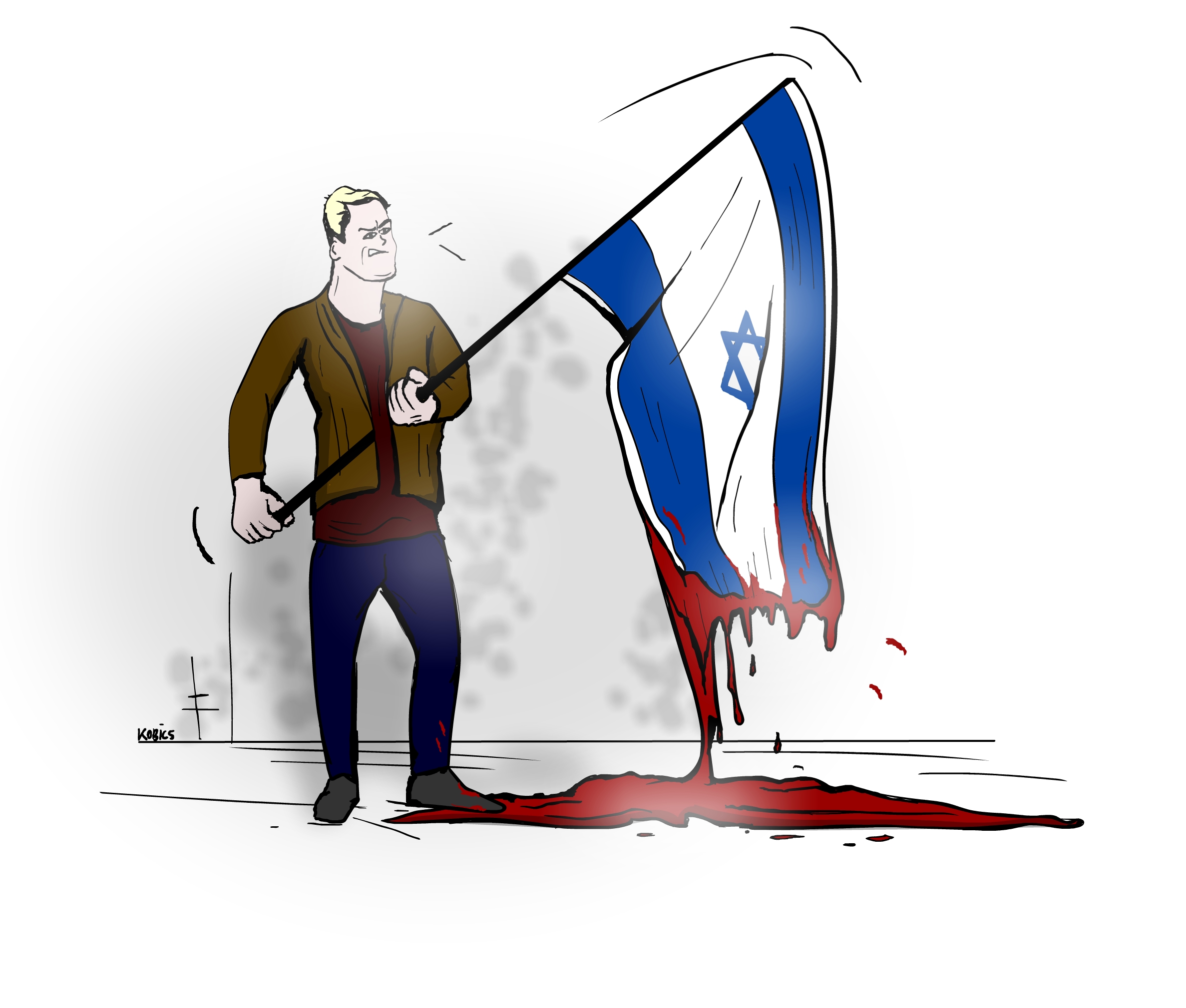
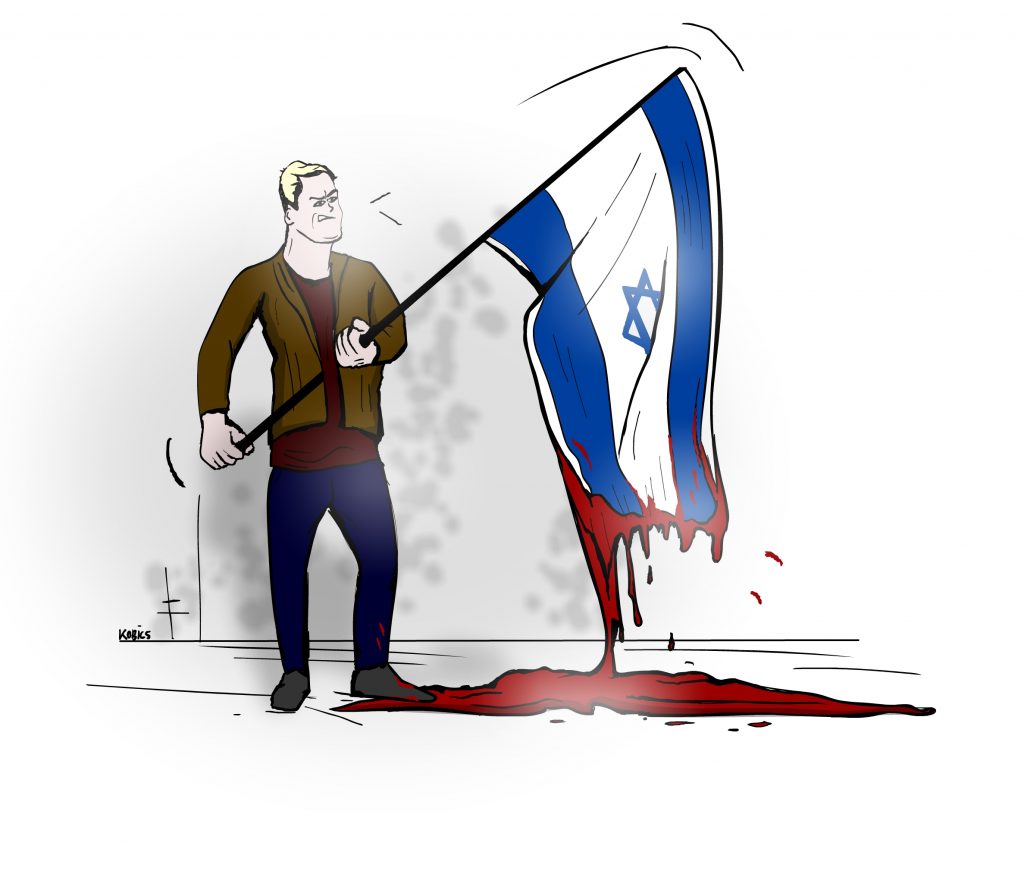
The hardest part of the protest for me was seeing the protestors take an Israeli flag, dipping it in red paint and waving it around. The Israeli flag is designed to remind one of the Jewish prayer shawl, and to me it represents the hope of the Jewish people for sovereignty. This blatant desecration of the flag cut me to the heart. I don’t hate Palestinians, and I would never desecrate a Palestinian flag. I don’t agree with all of the policies of the Israeli government, and I sincerely desire peace. When people I know in Israel try to delegitimize the rights of the Palestinian people, I speak up. What good can come of desecrating my flag – making it look like it’s dipped in blood? I wanted to scream and shout and let out all the scorn and insult that this caused me, but I realized that I was helpless. I could do nothing. Letting out my anger would only be adding gasoline to the flame of hatred against me and my nation.
After the protest, I was left with a lot to process. Emotionally and mentally drained, I left the campus to do some serious soul-searching. Why so much hatred? Why is the BDS movement so intent on drowning out other voices (my voice)? They say that I’ve been brainwashed, even though I’m willing to try and listen to them. Could it be that they are brainwashed? Should determining who is right or wrong in a conflict be decided in a shouting match? Is the populistic mob-like behavior I experienced in London the way forward?
After these experiences I was challenged to read a book by Ilan Pappe and Noam Chomsky explaining the BDS movement claims, and as a result I have become more aware than before of the need for personal and Israeli self-criticism. But alongside this, I have become concerned about the BDS movement, the amount of irrational hatred it is spreading, and its means of achieving it. Two wrongs do not make a right. Trying to prevent dialogue and attempting to drown out voices is not going to bring justice, reconciliation, or hope – it is merely going to make people hate more. I’m only 26, but I’ve seen enough hatred in my life. I hope most people will agree with me that we don’t need any more hatred in our world.
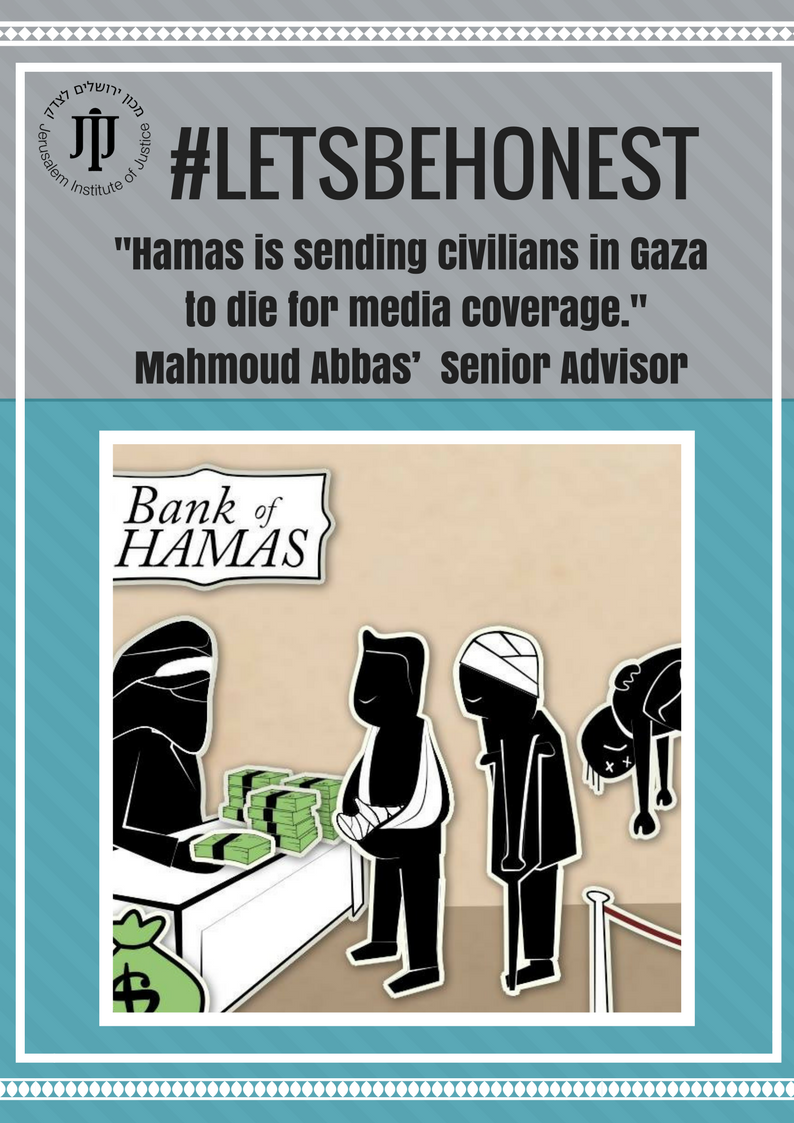
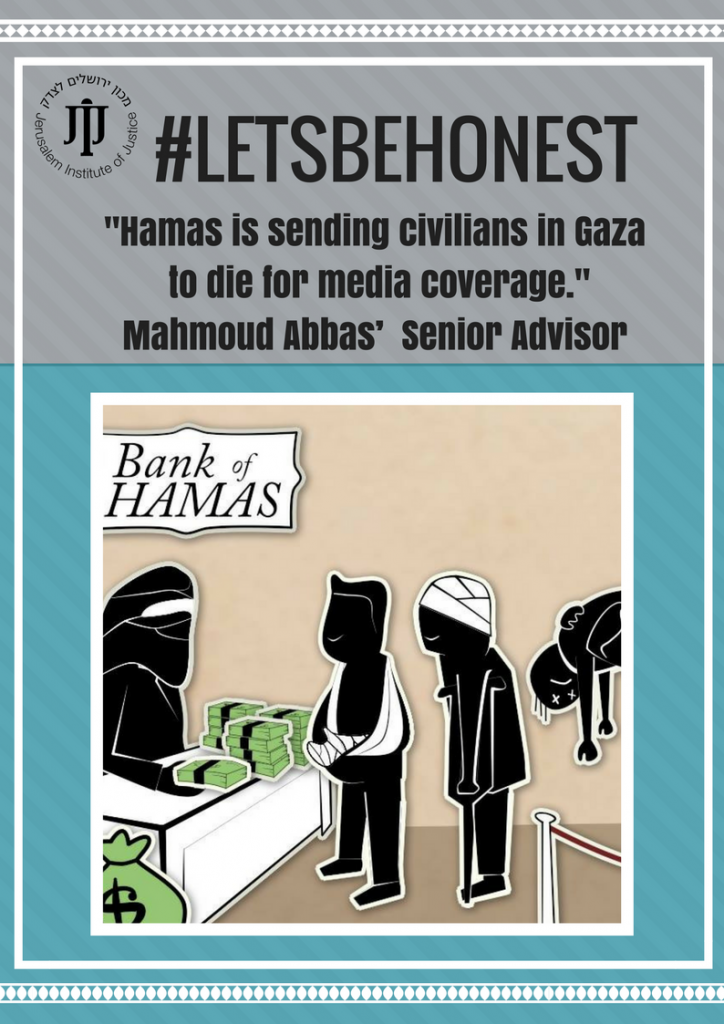
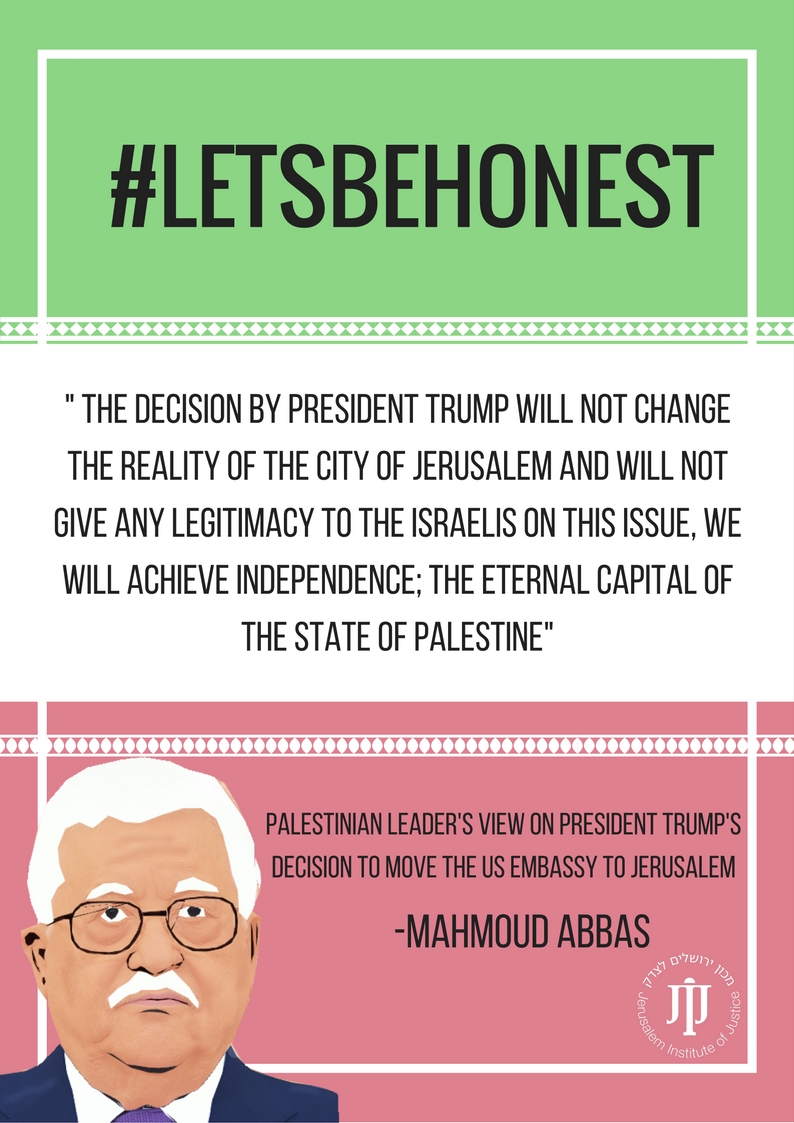
Quotes form Abbas: Following Trump's Declaration
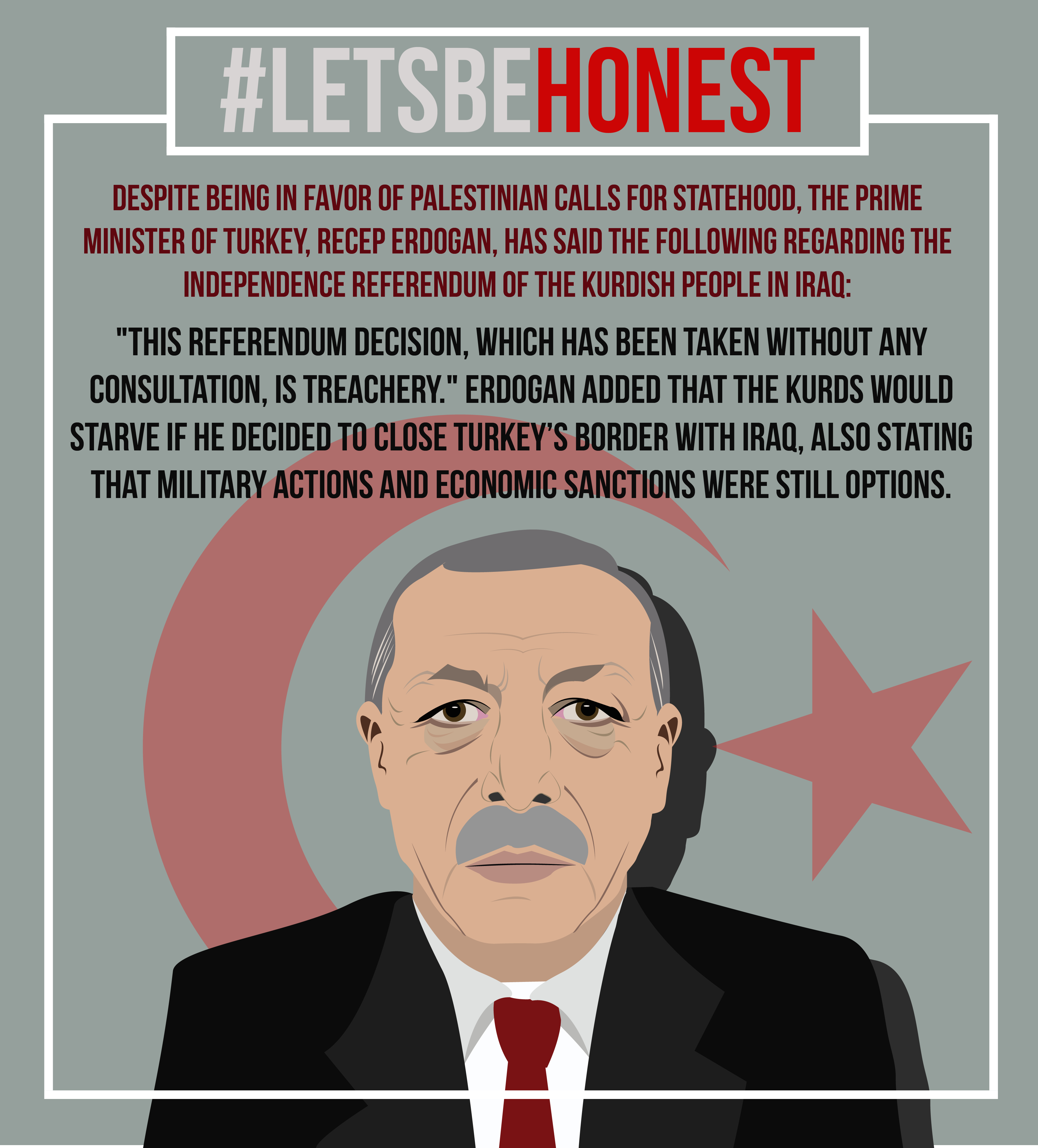
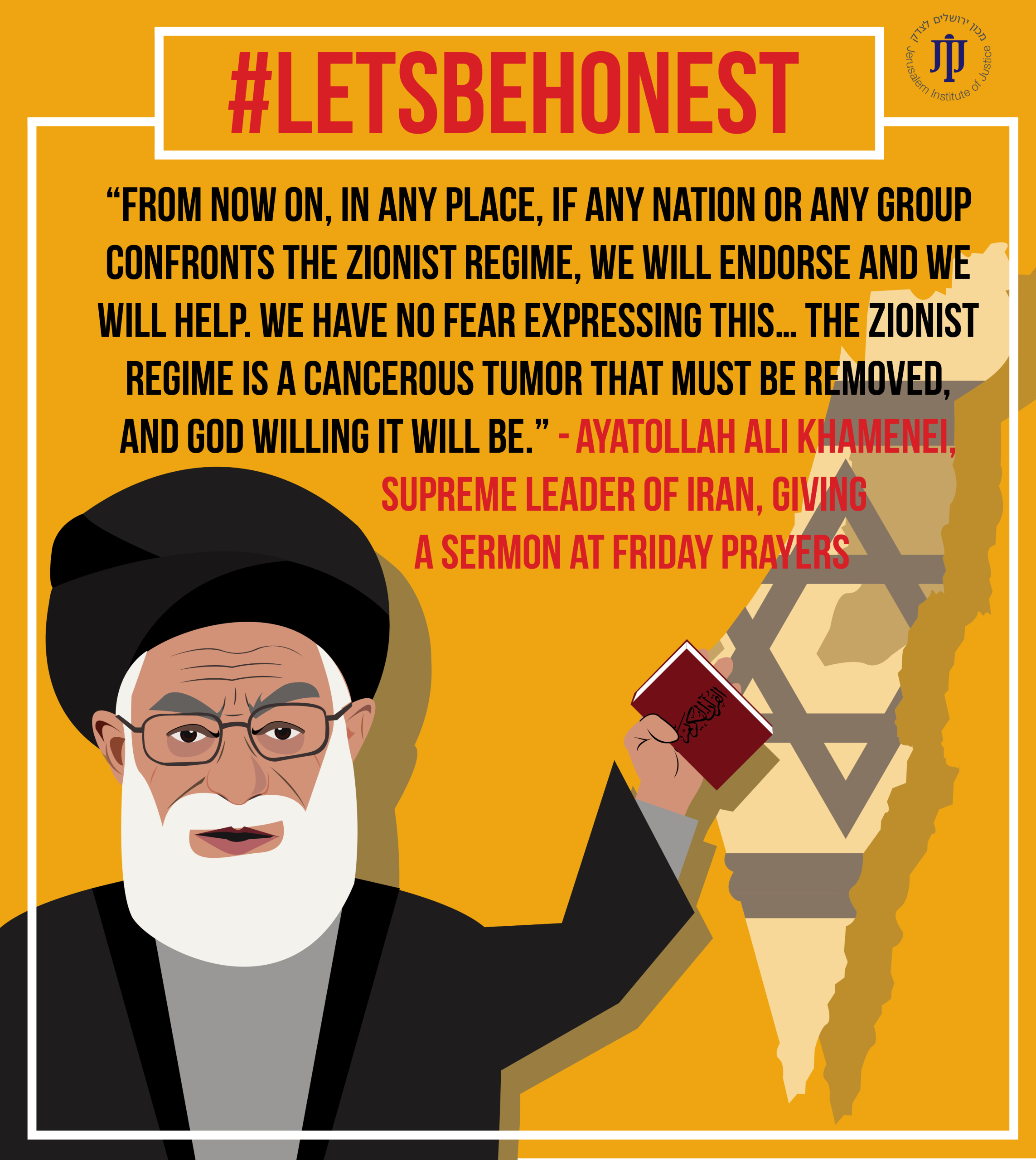
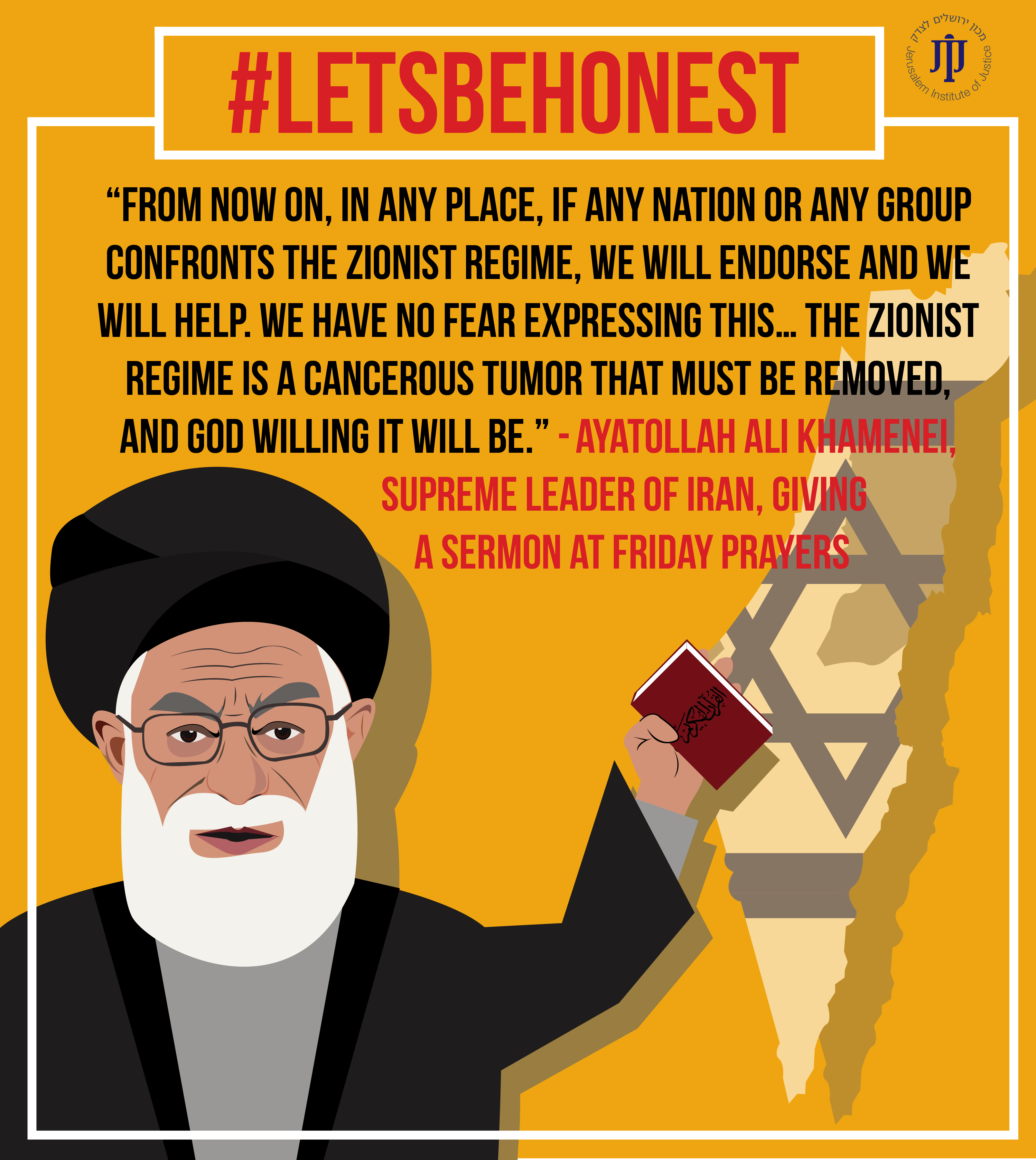
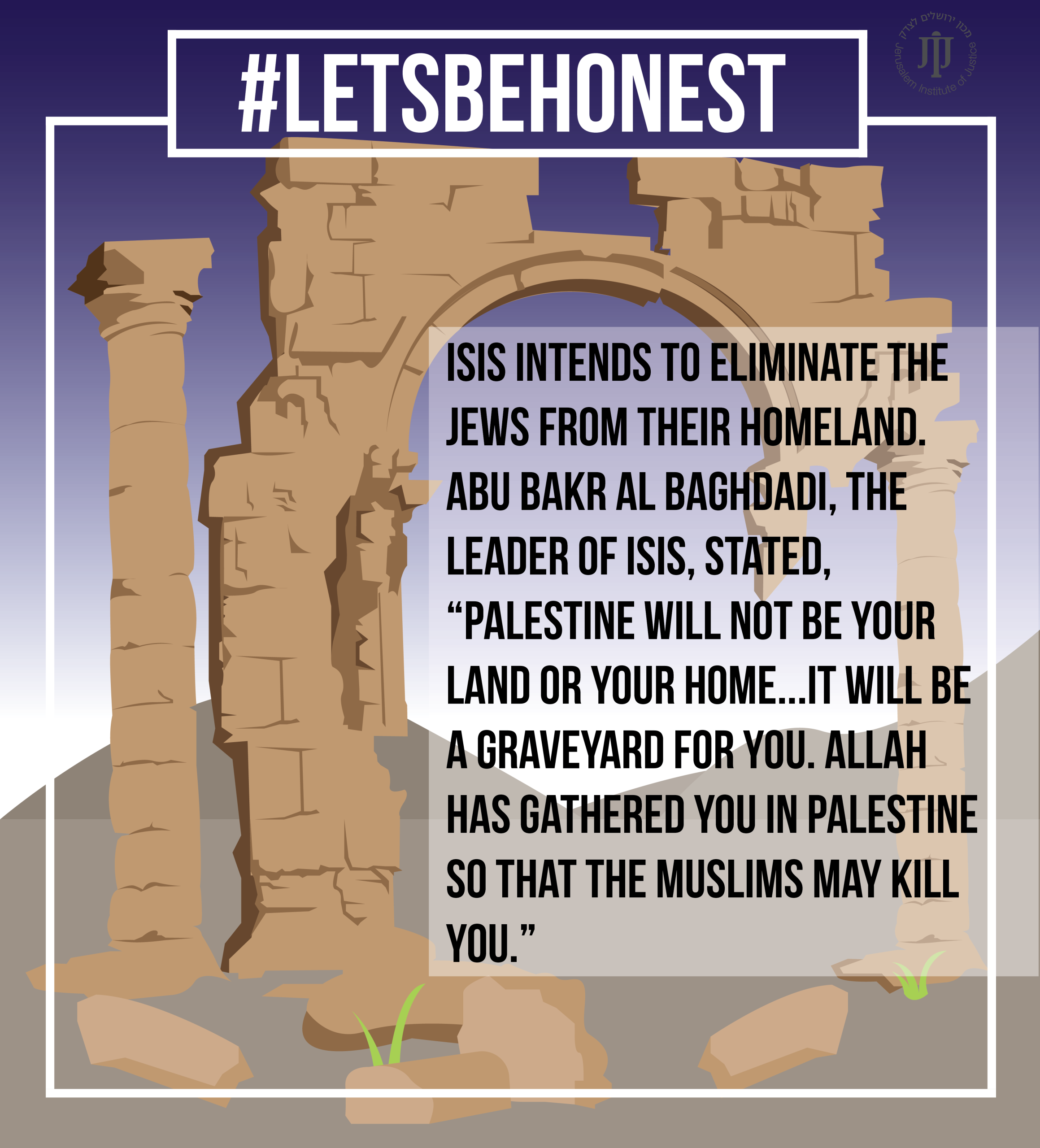
LetsBeHonest attempts to bring truth into our world of cluttered reality. What's the truth in the Middle East? Following Trump's declaration we see outrage and threats coming from our neighboring nations.
Download
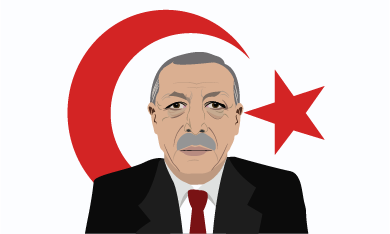
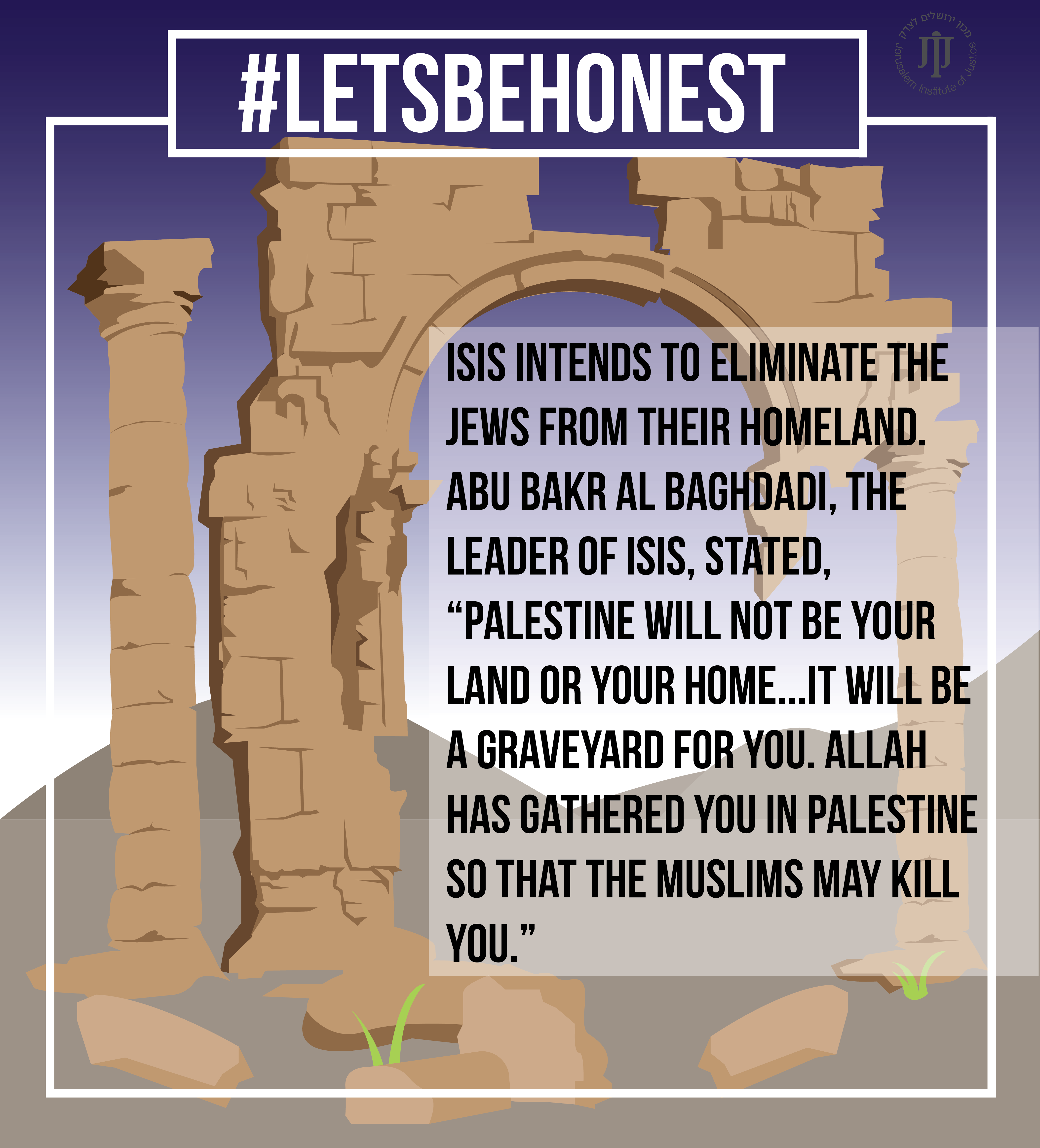

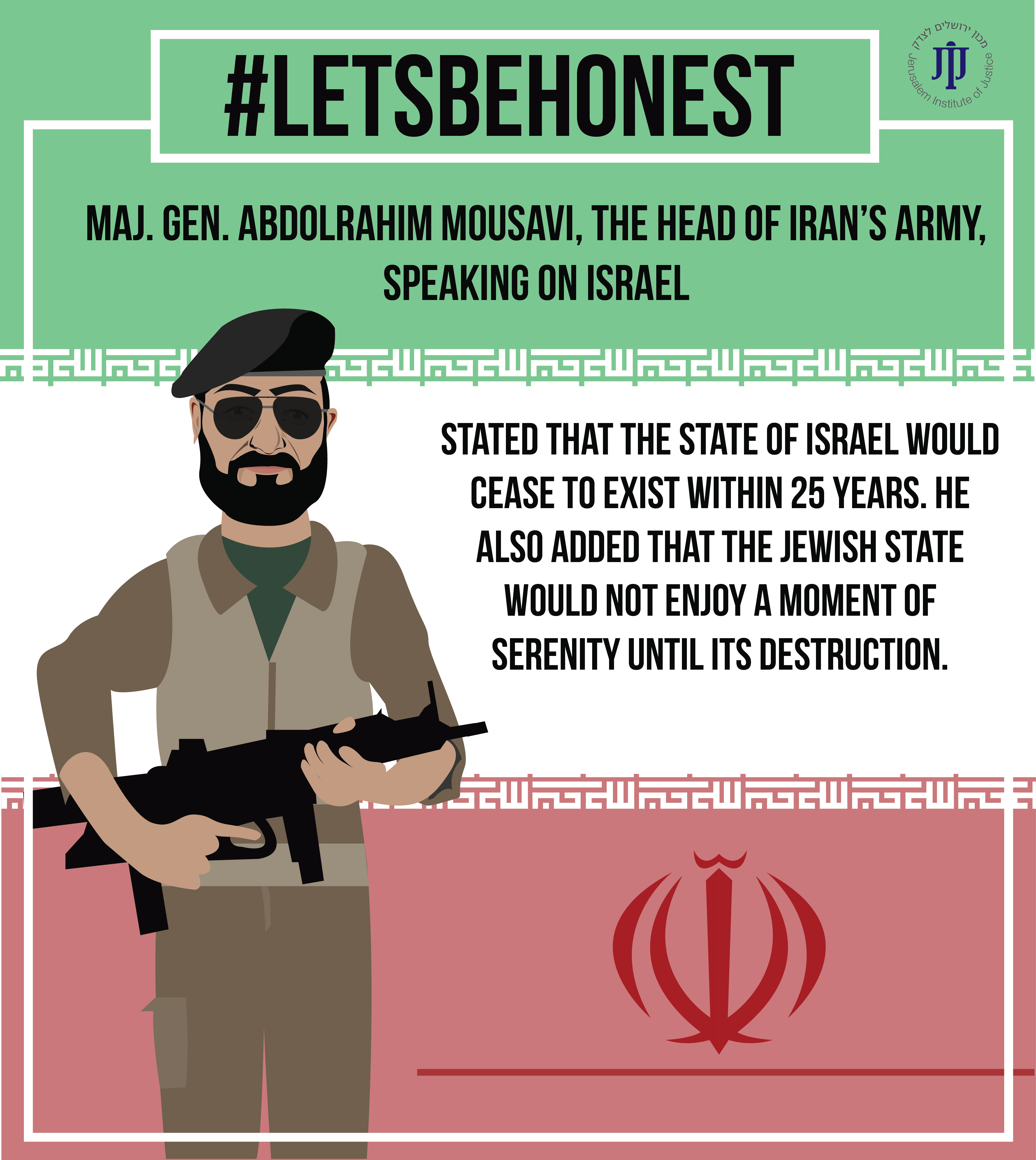
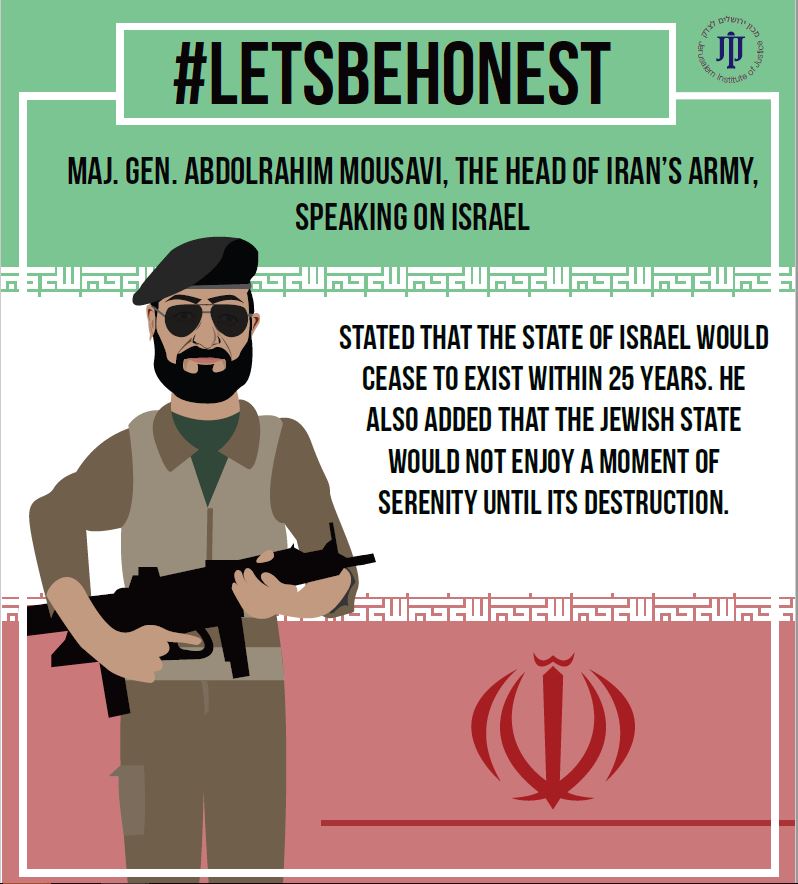
Israel would cease to exist within 25 years
This visual displays the hatefull rhetoric that the leader of Iran's military espouses to the world regarding the State of Israel's continuity, safety, and peace.
Download
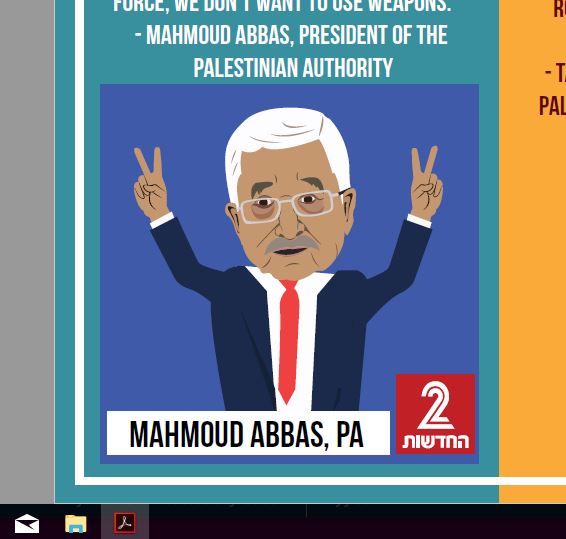
We will kill you with rocks
"We don't want to use terror against Israel." or "We will persue you with car rammings and kill you with rocks."? Which statement is true?
The #LetsBeHonest Campaign seeks to expose the duplicitous claims spoken by Arab leaders to the West and exposes their true intentions toward peace.