

From Media Consumer to Content Creator
Ben Solomon reflects on his transformative journey as an intern at JIJ, where he tackled Israel's biggest challenges—Hamas, Hezbollah, Iran, and lawfare—through reading, debating, and writing. Dive into his story and discover the building blocks of effective Israel advocacy
My most rewarding experience at JIJ was producing and recording a series of 15-minute lectures on the central challenges facing Israel (Hamas, Hezbollah, Iran, and lawfare). Before coming to JIJ, I considered myself an informed consumer of media about Israel. Creating content, however, is much harder than consuming it. As I went about producing material of my own, I realized how little I had previously known about the threats facing Israel and the realities of the Middle East.
How did I go about overcoming this knowledge deficit to produce original content for viewers in Israel and the Diaspora? By reading, by debating, and by writing.
Read
Israel has a vibrant and diverse English-language press. Almost every day, I would spend time reading live blogs in the Times of Israel and current affairs in the Jerusalem Post. To expose myself to different perspectives, I viewed op-eds in Israel Hayom and Ynetnews. The perspectives which I saw in these outlets made me appreciate the thought processes driving Israel’s decision making.
Beyond news articles, my understanding of Israel improved tremendously from reading books. For modern Israeli history, I recommend reading Yossi Klein Halevi, Michael Oren, and Daniel Gordis. All three have written highly accessible books which deal with Israel’s achievements in war and in peace. Historical background makes it much easier to understand Israel’s contemporary dilemmas.
Besides books, I advise digging into the treasure trove of audiovisual resources available online. To understand events from decades ago, I would watch old documentaries and political speeches. For up-to-date analyses of events, I turned to podcasters like Dan Senor and Ezra Klein. The content is accessible – you just need to seek it out.
Debate
Once I read a lot about Israel, I started to form my own opinions about difficult topics, such as the breakdown of peace negotiations, international hostility toward Israel, and strategies for confronting Iran. The best way for me to test these opinions was by defending them against competing viewpoints. I regularly entered Uri’s office ( JIJ's director of International Law and Policy) in the middle of the day, where I could spend 30 minutes or more trying to make sense of current affairs. The office space at JIJ is very open, without the hierarchical separations of an American workspace.
These discussions also took place outside the confines of the office. I loved arguing with Israeli friends and family to see whether my emerging views could withstand other people’s ingrained opinions. When I travelled outside Tel Aviv for Shabbats or excursions, I tried to learn as much as possible about the dividing lines within Israeli society.
As I talked to more and more people about Israel, I found myself enthralled by the diversity of opinions within the country. Israel is certainly not the caricature of “apartheid” and “genocide” presented on college campuses and at the United Nations. But nor is it a straightforward or homogenous society. It is, instead, the melting pot of an ancient people, unified in its desire for the blessings of peace, but divided over how to achieve that end.
Write
During my first month at JIJ, I remember being nervous to commit my ideas to writing. I had already read several books and spent plenty of time exposing myself to the viewpoints of other people. But at the same time, I was reluctant to take the leap from being a consumer to a producer of information.
The way that I overcame this writer’s block was by introducing frameworks for content delivery: the “Five Pillars of Hamas” or the “Seven Front War.” Once I had established these frameworks, I could fill them with material to support an overall argument. Sub-dividing lectures into different chapters made it much easier to package them for social media.
One of the real challenges of writing about Israel is making it accessible for a non-specialist audience. It is easy to get caught in the weeds of international law, such as the details of past United Nations resolutions or jurisdictional questions at the International Criminal Court. While I enjoyed trying to grapple with these technicalities, I focused my public outreach on presenting a bigger picture viewpoint of Israel’s predicament.
The final challenge of the lecture series was turning long scripts into interesting videos. Given my lack of confidence with the teleprompter, I decided to commit the scripts to memory. I found memorization to be a challenging but highly worthwhile exercise; it pushed me to see the value in every sentence and to clarify the connections between them.
Conclusion
As I look back on the last five months, I am grateful to have contributed to JIJ’s mission of international advocacy for the Jewish state. I feel equipped with the tools to effectively advocate for Israel back home.
In reflecting on my own contribution to JIJ, I would add this: the internship is what you make of it. You will make the most meaningful contribution by working on projects which reflect your skill set and interests. In my case, I was naturally drawn to a project which enabled me to lecture about geopolitics. But JIJ is not a one-size-fits-all model; the internship is flexible enough to accommodate your personal strengths.
Whatever projects you end up working on, I believe that the three fundamentals of reading, debating, and writing will be applicable. These are the indispensable building blocks of Israel advocacy.

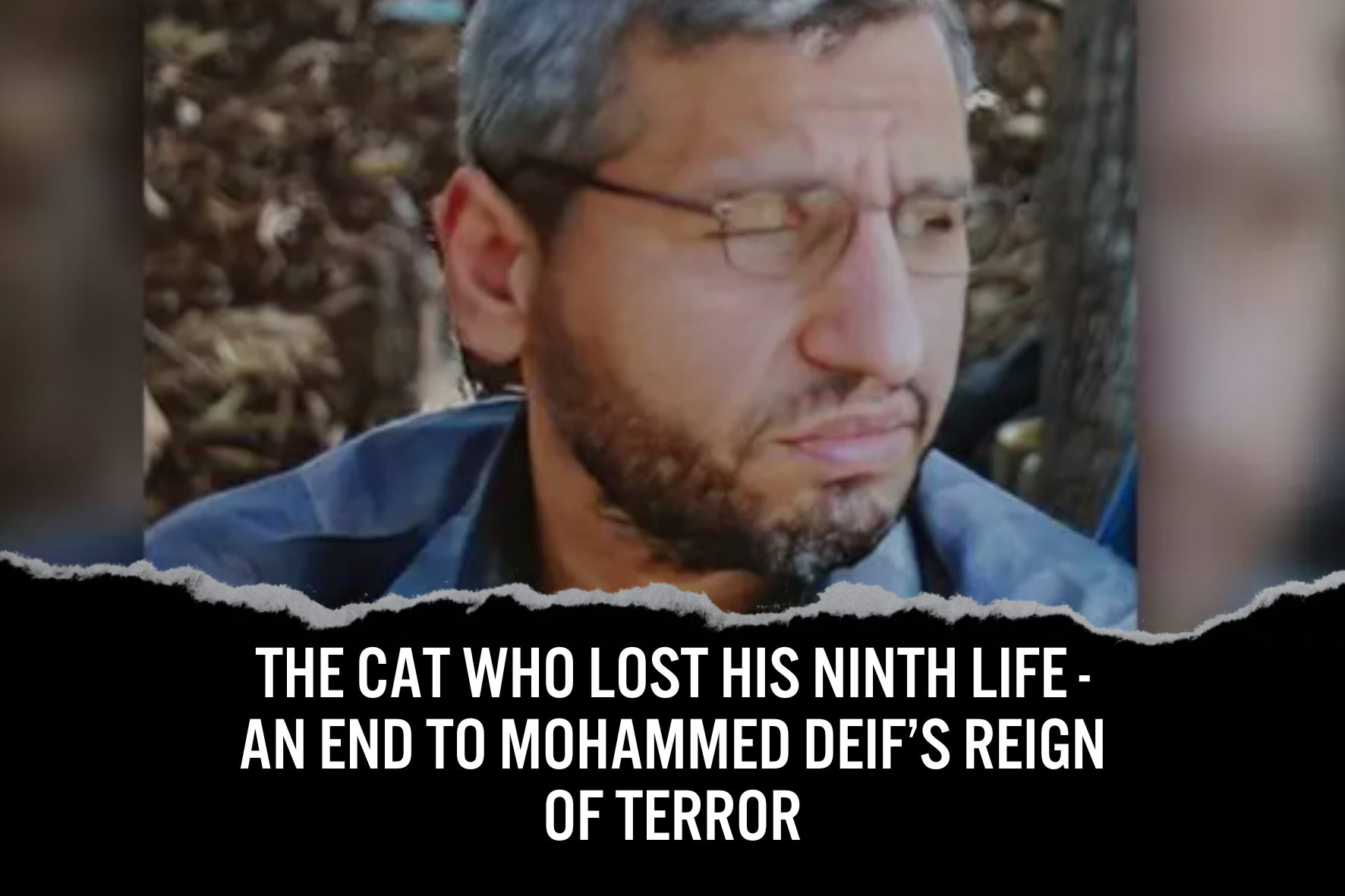
The Cat Who Lost His 9th Life
An End to Mohammed Deif’s Reign of Terror
Mohammed Diab Ibrahim al-Masri, more commonly known as Mohammed Deif, was a Hamas terrorist who is credited for being the mastermind behind the October 7th Hamas terrorist attacks. Deif is a figure synonymous with terror and violence and served as the leader of the Izz al-Din al-Qassam Brigades (IQB) which is the military wing of Hamas. Deif orchestrated numerous attacks against Israel, leaving a trail of destruction and loss in his wake.
Deif's tenure as the head of the al-Qassam Brigades, which began in 2002, was characterized by a series of deadly attacks. Even prior to gaining this position, Deif masterminded several suicide bombings in 1996 that killed over 50 Israelis civilians. Since his reign of terror began, he was instrumental in developing Hamas' capabilities, including rocket attacks and tunnel warfare. His strategies took the brutal, inhumane, and despicable atrocities being committed by Hamas to an even more dangerous level.
Deif's ability to evade capture and assassination earned him the nickname "the cat with nine lives." Since 1995, he had been the top target on Israel's most wanted list, surviving at least seven targeted killing attempts. Despite sustaining severe injuries, including the loss of an eye, Deif evaded death and continued to lead Hamas' military operations from the shadows.
In recent developments, there were allegations that Mohammed Deif may have been killed in an Israeli airstrike. On July 12th, 2024, Israeli fighter jets targeted a compound in the Al-Mawasi/Khan Younis area which was believed to be housing Deif and other high-ranking Hamas officials. While Israeli authorities had indicated "increasing signs" that Deif was killed in the operation, Hamas denied the claims and there was no definitive proof. Just over a week later, the IDF confirmed on July 21st that Deif was in fact killed in the attack.
Deif's actions did not go unnoticed on the international stage. Prior to his death, he had been designated a Specially Designated Global Terrorist by the U.S. Department of State and added to the European Union's terrorist blacklist. In May 2024, the International Criminal Court (ICC) applied for arrest warrants for Deif and other Hamas leaders, citing charges of extermination, murder, and other war crimes.
Mohammed Deif's legacy is one of relentless violence and strategic terrorism. His actions caused immense suffering and have perpetuated the cycle of violence in the Israeli-Palestinian conflict. The unfortunate reality of the situation is that Deif’s death simply means he will be replaced by another terrorist as hateful and dangerous as him. As long as figures like Deif remain in positions of power, the prospects for peace in the region remain bleak. His story is a stark reminder of the devastating impact of Hamas’s heinous and barbaric crimes. The ongoing struggle for stability and security in the Middle East will only continue without a unified front opposing terrorism and extremism.
By Kevin Bina – JIJ Intern
to read the Article with the Foot-Notes
Op-ed Mohammaed Deif