

The Cat is Out of the Bag
The Gaza Voice, a recorded podcast released on May 21st 2020 contains Boycott Divestment Sanctions (BDS) co-founder Omar Barghouti saying, “If the refugees return to their homes [in Israel] as the BDS movement calls for, if we bring an end to Israel’s apartheid regime and if we end the occupation on lands occupied in 1967, including Jerusalem, what will be left of the Zionist regime? That’s the question. Meaning, what will the two states be based on?”[1]
The organization claims to advocate for Israeli political reform and the improvement of Palestinian human rights, not the elimination of the State of Israel. But Barghouti hints here at exactly that. He reveals what could be the underlying intentions of BDS’s three official goals. [2]
We interpret Barghouti’s statement as the following: if BDS successfully achieves the goals it built its platform on, Israel will no longer exist. To answer Barghouti’s rhetorical question, not much will be left of the “Zionist regime”. Answering the three objectives essentially erases what Israel has built over the past 72 years, which includes its normalized relations with the neighboring Arab countries. This contradicts Barghouti’s reference to “two states”, as in having a two state solution. Barghouti understands this, as he reveals in this segment of the twenty-minute podcast.
It should be noted this rhetoric isn’t a shocking revelation. Barghouti has previously stated that Jews cannot have their own state in Palestine. [3] However, what is important about this recent quote is that it reminds the listener of the movement to disrespect the right to self-determination and ultimately delegitimize the state of Israel. The argument that BDS is less impactful toward Israel than it claims to be is irrelevant here; [4] the focus is on the fact that Barghouti continues to preach an unrealistic and undesirable approach when facing a country that has already solidified, built itself up, and is now thriving.
Why unrealistic and undesirable? The organization, with Barghouti as one of its international representatives, goes further than confronting politics and human rights. It questions the existence of a legitimate state and hints at its eventual downfall. It’s dangerous territory to cross into, and it’s something that individual supporters and affiliated groups (NGOs and others) of BDS should understand.
Barghouti continues by saying, “There won’t be any Zionist State like the one we are talking about (present day Israel)… and the Palestinian minority will become a Palestinian majority in the state that today is called Israel.”
Well, what would it mean if Israel did not exist? What would we lose? To name a few basic things: the lack of a Jewish home which was deemed necessary by the United Nations after an extensive history of persecution and incontestable anti-Semitism that is prevalent until this day. It would mean losing the “Start-Up Nation”; the loss of a greenhouse constantly bearing the fruit of an incredible number of innovations and developments that benefit the whole world. It would mean the loss of a home not only for Jews, but for Christians, Druze, and other Arab populations as well.
Thank you Barghouti for revealing that BDS’s end goal is to eliminate Israel.
[1] https://soundcloud.com/user-742784347/bds
[2] https://bdsmovement.net/call
[3] https://www.nytimes.com/2019/07/27/world/middleeast/bds-israel-boycott-antisemitic.html
[4] https://www.brookings.edu/blog/order-from-chaos/2018/01/26/how-much-does-bds-threaten-israels-economy/

Getting BDS Right
This past week, the founder of the BDS movement, Omar Barghouti, was denied entrance into the United States.
Barghouti’s chief allies claimed this amounted to a gross human rights violation. Others charge the Trump administration for failing to uphold press freedoms. Some American Jewish leaders, notably Peter Beinart, argued that providing a platform for Barghouti’s views would have demonstrated the maturity and vitality of Judaism.
Here is how Barghouti himself characterized the move: “Israel is not merely continuing its decades-old system of military occupation, apartheid, and ethnic cleansing. It is increasingly outsourcing its outrageous McCarthyite repression to the U.S., and to xenophobic, far right cohorts across the world.”
To weigh their criticisms, right or wrong, we have to get BDS itself right.
Omar Barghouti is a Qatari who grew up in Egypt, moved to Israel, and then styled himself a Palestinian. He belongs to a wealthy, politically connected Arab clan that includes two cousins active in explicit anti-Israel terrorism.
Barghouti has written books in Arabic which deny any ancient Jewish claims to the Land; repudiate decades of international law which gave sovereignty to Israel alongside similar grants of sovereignty for other Arab states; and ignore the absolute rejection by Palestinians of multiple Israeli offers to share peace within the Land. He believes Jews in Israel never had, and so do not have, even today, any rights to collective self-determination, and has often stated that “no Palestinian can ever accept a Jewish state in Palestine.” Interviewed after the visa denial, Barghouti repeated the baseless charge on which he founded BDS: “Since its creation, Israel has always been an apartheid state.”
The American action may well have arisen from conviction that Barghouti is, at root, an anti-Semite working slyly by stages towards the elimination of Israel. This accords with his life history, BDS strategy and numerous public statements. It would hardly represent a novel interpretation by the Trump administration. Many have charged Barghouti with antisemitism over the years. His scheduled NYC workshop included one main speaker recently fired by CNN, hardly a conservative outlet, as an anti-Semite. The other has stalwartly defended Ilhan Omar against all-too-credible charges of antisemitism.
The novelty, even shock that Barghouti experienced over his rejection, comes from this President’s continued determination to act upon pronouncements which have often served as mere diplomatic posturing for past administrations. This decision may also be connected with the recent appointment of Elan Carr as the face of U.S. opposition to BDS and growing antisemitism world-wide.
Some have suggested another reason the American government has refused comment on Barghouti’s visa denial. They, as well as the Israelis, may suspect he planned other activities along the way similar to the ones which led to criminal tax evasion charges in 2017.
In any case, the visa denial could not have stemmed from the obvious delusion that this would somehow suppress, successfully, the speech rights of Omar Barghouti, let alone from some absurd, hypocritical right-wing ‘fear’ of free speech. Undoubtedly, and this must have been anticipated, his trip has received far more public attention, even sympathy, than if he had traveled physically. Notably, those condemning the American position have not commented on Barghouti’s virtual presence at the same panels for which he was scheduled. Some of these critics have been central participants to these discussions.
For Barghouti, this could become a case of ‘be careful what you wish for, lest it happen’. He has always craved the media spotlight, which has now been turned up brighter than ever before. Naturally, he has wasted no time in reframing his finely-honed narrative to include this unexpected embarrassment. However, first Israel, and now America, has put Barghouti on public notice that they are also watching his actions, on- and off-stage, with ever-increasing attention. The latter may finally be getting BDS right.
Omar Barghouti: A Man with Two Faces
By Nikki Golomb.
In 2005, Omar Barghouti founded the infamous boycott, divest, and sanction (BDS) movement; a movement which on its surface appears to promote the rights of Palestinians by pursuing economic, academic, and cultural boycotts of Israel. Beneath the surface, however, it becomes clear that this movement’s true goal is to bring an end to the State of Israel and replace it with a sovereign Palestinian state.
BDS is an extremist, anti-Zionist movement masked as human rights activism. It should thus come as no surprise that Barghouti also aims to portray himself with the same kind of mask. However, if we take a closer look at his actions and beliefs, we see a very different picture. Who, then, is the man behind the movement?
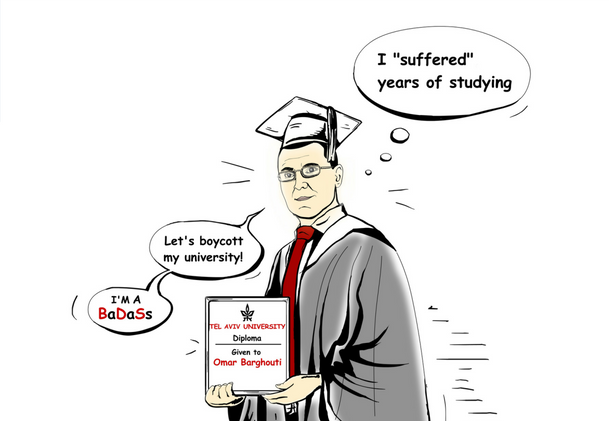
Omar Barghouti was born in Qatar to Palestinian parents, grew up in Egypt, and received a master’s degree from Columbia University before marrying an Arab-Israeli woman and gaining permanent residency status in Israel. He has since received a second master’s degree as well as a PhD from Tel Aviv University in ethics. The irony of this is almost laughable, given that a founding principle of the BDS movement is an academic boycott of Israeli institutions, scholars, and studies. He has enjoyed invaluable benefits from Israeli academic institutions, yet actively promotes boycotting those very institutions. When questioned about this hypocrisy, Barghouti cites personal matters and refuses to comment any further. He also conveniently does not mention that despite a petition among TAU students to remove him from the university, the university allowed him to complete his degrees. It should also be noted that there are 12 universities in the West Bank, one in East Jerusalem, and nine in Gaza. Yet instead of choosing to support any of these Palestinian academic institutions, as would be expected of a Palestinian nationalism activist, he received not one but two degrees from an Israeli university.
BDS, Barghouti claims, is a “non-violent human rights movement that seeks freedom, justice and equality for the Palestinian people” and is against the oppressive Israeli regime, not against individuals. However, the BDS movement boycotts Israeli individuals based on their nationality, and Barghouti himself refuses to work with Israelis – even those sympathetic to his cause. A true activist puts the movement above his own personal bias. Yet Barghouti goes so far as to say that Palestinians who engage with Israelis are “clinically delusional,” once again undermining his own movement by placing more significance in his personal prejudice than in achieving the goals of his movement.
In addition, Barghouti has publicly expressed disapproval for a two-state solution, instead favoring a single Palestinian state with a Jewish minority presence. He believes that a Jewish state and a Palestinian one are incompatible. Even though the BDS movement claims to not advocate for any particular solution, the nature of the movement and the intentions of its founder suggest otherwise. While BDS appears to support one people’s self-determination, the heart of the movement aims to destroy that of another. Implicit in the movement’s advocacy is Barghouti’s personal goal of the elimination of the Jewish state.
Finally, Barghouti is vocal about making false claims of Israeli apartheid, violence against Palestinian children, colonization, and more. At the same time he denies violence and persecution against Jews in Arab states. Furthermore, the BDS movement portrays only one side of the conflict by refusing to even acknowledge the other perspective. By boycotting Israeli academics and culture, and by refusing to teach that there are two or more sides to every story, the BDS movement promotes a culture which values a narrow-minded outlook over balanced learning. Barghouti himself is hypocritical by spreading false information for the purposes of “education” while standing behind a movement which denies the opportunity to question this information.
Truly progressive and open-minded education does not present only one side of the story. Omar Barghouti and the BDS movement use dangerous tactics to delegitimize and ultimately destroy the Jewish state while hiding behind a mask of human rights advocacy. True activism, however, should not need such a mask. If Barghouti practiced what he preached, BDS would be more compelling. The need for him to completely shut down the other side’s perspective, to hide his hypocritical actions, and to use soft language to cover up an extremist ideology show the flaws, as well as the hypocrisy, in his arguments. Hiding behind a mask of human rights advocacy does not take away from his true intentions. The sad irony in all this is that the boycotting of Israeli businesses in the territories actually hurts the Palestinians themselves more than Israelis because it causes Palestinian unemployment!
In order to effectively promote human rights, we must promote all human rights. Palestinian self-determination cannot come at the expense of that of the Jews. We must find a way to support the rights and dignity of all people. Only then can we hope for a future of peace.