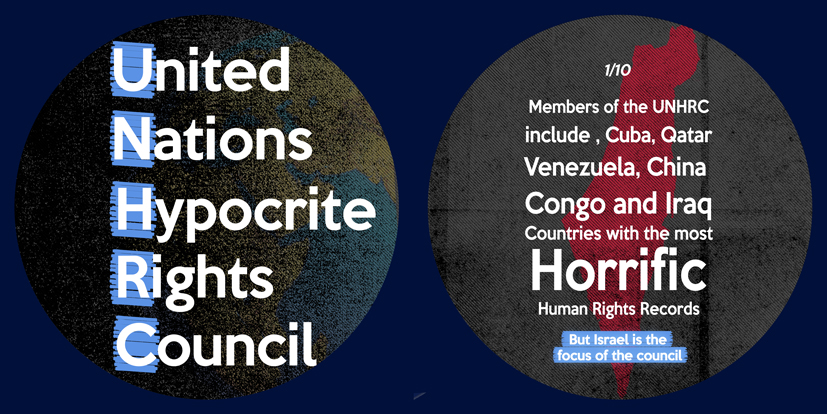
Human Rights Council - Political Bias
The UN Human Rights Council “database” of business enterprises
On 24 March 2016, at its 31st session, the Human Rights Council (HRC) adopted resolution 31/36 entitled “Israeli settlements in the Occupied Palestinian Territory, including East Jerusalem, and in the occupied Syrian Golan”.[1] Paragraph 17 (OP 17) of this resolution requests the United Nations High Commissioner for Human Rights (OHCHR) produce a database of all business enterprises engaged in certain Israeli settlement activity in the occupied Palestinian territory, or the "Blacklist".
While local and international business activity in disputed or occupied territories is widespread, and involves some of the world’s largest companies, Resolution 31/36 represents the only known UN effort to produce a “database” of such activity in respect of one situation. The fact that such business activity is so ubiquitous and rarely criticized demonstrates that it is not viewed as raising legal or human rights issues, while the desire to establish a database only with respect to business activity in Israeli settlement communities points to the political bias of the body that initiated this process.
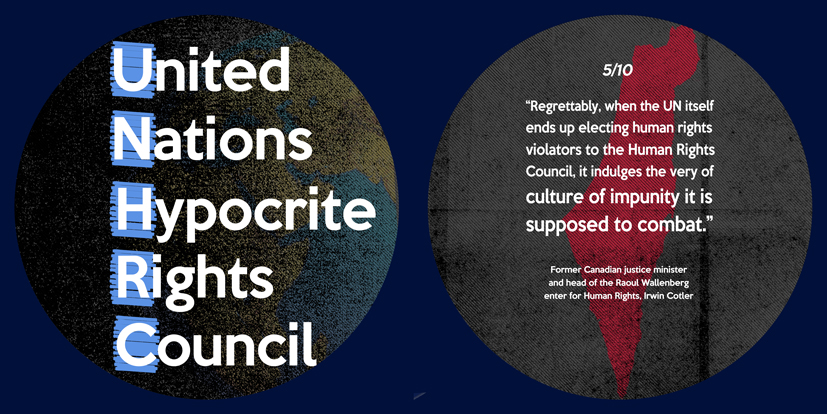
OP17 was adopted despite the strong opposition of the US, EU and Israel. It is the product of a specific discriminatory HRC agenda item, the organization's only country-specific agenda item, which reflects ongoing and well documented institutional bias against Israel in the HRC. The Council is widely criticized as a deeply politicized body, whose agenda is often dictated by the world’s worst human rights violators, and whose legitimacy and credibility in the human rights arena has been fundamentally undermined as a result.
Israel, together with the United States and numerous other leading States, have expressed, consistent opposition to the database and its publication, and have conveyed this position in their public and private communications. Israel has no intention of cooperating with this illegitimate exercise for the following reasons:
- Lack of authority to produce database: The production of a “database” exceeds the mandate of the OHCHR, which has neither the competence nor the capacity to engage in this action. The responsibility for ensuring compliance of business enterprises with relevant laws, or for promoting any relevant non-binding guidelines with respect to business practices, rests exclusively with the States in which the relevant enterprises are domiciled or operating.
- Lack of authority to communicate to companies: The HRC and OHCHR are bodies mandated to deal with State conduct in the human rights field and they have no legal or other authority over business enterprises.
- Lawfulness of business activity: Business activity in areas of Judea and Samaria (West Bank) under Israeli jurisdiction in accordance with existing Israeli-Palestinian agreements, is entirely lawful. Indeed, the notion that business enterprises are even subject to international law, international humanitarian law, and international human rights law is highly questionable and has been rejected by Courts in leading national jurisdictions.
- Blacklist: The creation of a database, and certainly its publication in any form, amounts to an effort to produce a blacklist of companies that are not engaged in any wrongdoing, and with the potential of causing commercial, reputational and legal harm. By engaging in this action, the OHCHR is allowing itself to become an instrument of those engaged in an illegitimate, discriminatory and political motivated agenda.
Furthermore, the methodology of the OHCHR is entirely devoid of transparency, and the information upon which it has based its communication has been drawn from partial, unverifiable and unknown sources, including politically-motivated actors, who responded voluntarily to the OHCHR’s calls. The OHCHR also lacks the requisite competence or capacity to verify independently the information it has received. While Resolution 31/36 requires a database of “all” business enterprises, the process adopted makes the database flawed from its inception and inevitably renders the list the partial, selective and discriminatory in nature
It is important to note that the database initiative is not legal or quasi-legal in nature, and does not, in and of itself, carry with it legal consequences. The process lacks due process and procedural safeguards to ensure that the list will not contain unauthoritative or inappropriately verified information. Furthermore, cooperation by companies with the database initiative may entail potential legal consequences, liability, financial risk and reputational harm. As is known, relevant domestic legislation and anticipated legislative proposals in various jurisdictions prohibit companies from discriminating in their business practices, including laws that specifically pertain to discriminatory practices with respect to Israel or territory subject to Israeli jurisdiction. This pertains, for example, to companies that are domiciled in the US, are subsidiaries of US-domiciled companies, or that do business in the US. In this context, dozens of U.S. State laws currently bar granting contracts to, or pension-fund investment in, companies that boycott Israel or territories under its jurisdiction. Moreover, such cooperation might raise issues under existing relevant US federal legislation.
The UN Human Rights Council “database” of business enterprises
On 24 March 2016, at its 31st session, the Human Rights Council (HRC) adopted resolution 31/36 entitled “Israeli settlements in the Occupied Palestinian Territory, including East Jerusalem, and in the occupied Syrian Golan”.[1] Paragraph 17 (OP 17) of this resolution requests the United Nations High Commissioner for Human Rights (OHCHR) produce a database of all business enterprises engaged in certain Israeli settlement activity in the occupied Palestinian territory, or the "Blacklist".
While local and international business activity in disputed or occupied territories is widespread, and involves some of the world’s largest companies, Resolution 31/36 represents the only known UN effort to produce a “database” of such activity in respect of one situation. The fact that such business activity is so ubiquitous and rarely criticized demonstrates that it is not viewed as raising legal or human rights issues, while the desire to establish a database only with respect to business activity in Israeli settlement communities points to the political bias of the body that initiated this process.
OP17 was adopted despite the strong opposition of the US, EU and Israel. It is the product of a specific discriminatory HRC agenda item, the organization's only country-specific agenda item, which reflects ongoing and well documented institutional bias against Israel in the HRC. The Council is widely criticized as a deeply politicized body, whose agenda is often dictated by the world’s worst human rights violators, and whose legitimacy and credibility in the human rights arena has been fundamentally undermined as a result.
Israel, together with the United States and numerous other leading States, have expressed, consistent opposition to the database and its publication, and have conveyed this position in their public and private communications. Israel has no intention of cooperating with this illegitimate exercise for the following reasons:
- Lack of authority to produce database: The production of a “database” exceeds the mandate of the OHCHR, which has neither the competence nor the capacity to engage in this action. The responsibility for ensuring compliance of business enterprises with relevant laws, or for promoting any relevant non-binding guidelines with respect to business practices, rests exclusively with the States in which the relevant enterprises are domiciled or operating.
- Lack of authority to communicate to companies: The HRC and OHCHR are bodies mandated to deal with State conduct in the human rights field and they have no legal or other authority over business enterprises.
- Lawfulness of business activity: Business activity in areas of Judea and Samaria (West Bank) under Israeli jurisdiction in accordance with existing Israeli-Palestinian agreements, is entirely lawful. Indeed, the notion that business enterprises are even subject to international law, international humanitarian law, and international human rights law is highly questionable and has been rejected by Courts in leading national jurisdictions.
- Blacklist: The creation of a database, and certainly its publication in any form, amounts to an effort to produce a blacklist of companies that are not engaged in any wrongdoing, and with the potential of causing commercial, reputational and legal harm. By engaging in this action, the OHCHR is allowing itself to become an instrument of those engaged in an illegitimate, discriminatory and political motivated agenda.
Furthermore, the methodology of the OHCHR is entirely devoid of transparency, and the information upon which it has based its communication has been drawn from partial, unverifiable and unknown sources, including politically-motivated actors, who responded voluntarily to the OHCHR’s calls. The OHCHR also lacks the requisite competence or capacity to verify independently the information it has received. While Resolution 31/36 requires a database of “all” business enterprises, the process adopted makes the database flawed from its inception and inevitably renders the list the partial, selective and discriminatory in nature
It is important to note that the database initiative is not legal or quasi-legal in nature, and does not, in and of itself, carry with it legal consequences. The process lacks due process and procedural safeguards to ensure that the list will not contain unauthoritative or inappropriately verified information. Furthermore, cooperation by companies with the database initiative may entail potential legal consequences, liability, financial risk and reputational harm. As is known, relevant domestic legislation and anticipated legislative proposals in various jurisdictions prohibit companies from discriminating in their business practices, including laws that specifically pertain to discriminatory practices with respect to Israel or territory subject to Israeli jurisdiction. This pertains, for example, to companies that are domiciled in the US, are subsidiaries of US-domiciled companies, or that do business in the US. In this context, dozens of U.S. State laws currently bar granting contracts to, or pension-fund investment in, companies that boycott Israel or territories under its jurisdiction. Moreover, such cooperation might raise issues under existing relevant US federal legislation.
The potential legal consequences, liability, financial risk and reputational harm is not merely a theoretical possibility, as the Airbnb case which unfolded from late 2018 to April 2019 exemplified. In this case Airbnb announced its intention to delist an estimated 200 listings of Israeli properties in Judea and Samaria. The company announced in April 2019 that his policy will not be implemented as part of settlement reached with all lawsuits that were brought by hosts and potential hosts and guests who objected to the policy on grounds of discrimination. This policy was not only attacked in the courts as it landed Airbnb on the top ten antisemitic events of 2018 by the Wiesenthal Center, led to US State investment boards to add the company to their blacklists as well as a host of leading political figures, including State Governors and American Vice President Mike Pence. All this not only led the company to abandon its policy, it also led to the company stating that "Airbnb has always opposed the BDS movement"[2]. This case exemplifies the risk the potential risk stated above.
The potential legal consequences, liability, financial risk and reputational harm is not merely a theoretical possibility, as the Airbnb case which unfolded from late 2018 to April 2019 exemplified. In this case Airbnb announced its intention to delist an estimated 200 listings of Israeli properties in Judea and Samaria. The company announced in April 2019 that his policy will not be implemented as part of settlement reached with all lawsuits that were brought by hosts and potential hosts and guests who objected to the policy on grounds of discrimination. This policy was not only attacked in the courts as it landed Airbnb on the top ten antisemitic events of 2018 by the Wiesenthal Center, led to US State investment boards to add the company to their blacklists as well as a host of leading political figures, including State Governors and American Vice President Mike Pence. All this not only led the company to abandon its policy, it also led to the company stating that "Airbnb has always opposed the BDS movement"[2]. This case exemplifies the risk the potential risk stated above.
[1]https://www.ohchr.org/EN/HRBodies/HRC/RegularSessions/Session31/Pages/DatabaseHRC3136.aspx
[2] https://news.airbnb.com/update-listings-disputed-regions/


Unlikely End, Unjustified Means
Unemployment, poverty and the meaning of sanctions in the Israeli-Palestinian conflict
There are those who say that the end justifies the means, and there are those who oppose that notion. But when the declared end is not even achieved, any justification of the means falls flat.
In the previous article we dealt with the outcomes of sanctions policy on poor areas in general, with particular attention to sanctions in the disputed territories in the Israeli-Palestinian conflict. We looked at the probable economic and social harm to the individuals affected by this policy as well as their society in general. In this article we show the impact of the sanctions on daily life, in both the short run and the long run.
It is well known that unemployment causes massive harm to affected populations. This damage begins with the individual but spreads to the surrounding society. The individual experiences loss of his ability to pay for housing, food, bills, medical care, etc. as a result of lack of income. This situation has a variety of implications, even in developed countries. Tent cities in the USA are an example of this principle. Individuals who suffer unemployment also report feelings of stress, anxiety, and depression, made worse when the unemployed person is responsible for a family. This was shown by research done during the time of the US sub-prime breakdown, when banks offered easy access to money that later triggered the mortgage crisis.
Unemployment also affects the afflicted society by preventing it from reaching its economic potential. In the short run, the workers are not creating economic gains that would fulfill their potential contribution to that society. In the long run,* the unemployed look for any job that will feed themselves and their families, which makes them accept jobs not fitted to their skills and creates a loss of human capital in those skills. This problem intensifies during long terms of unemployment, as the quality of work within their original skills and abilities deteriorates.
In search of income, people in economic distress often fall into criminal activity in order to make a living. This dependency has been encouraged and exploited by terrorist organizations in the West Bank and Gaza, who offer money to those in need, thereby recruiting them for the advancement of terrorism.
Thus, in addition to unemployment, sanctions cause poverty, widen inequality, and increase crime in the affected societies; all of which causes more tension that can lead to more violence. A definite connection was found in research regarding these effects of sanctions imposed upon multi-ethnic societies.
This research should serve as an alarm bell concerning sanctions implemented against the disputed territories: it points to potentially catastrophic results that can easily lead to increased violence. It is important to note that the territories are already experiencing a complex reality of political tension between ethnic groups, increasing the likelihood that sanctions would only make that tension worse.
There are two more reasons why these sanctions are not likely to achieve their declared goals. Firstly, 65-95% of the sanctions imposed worldwide to date have failed. Secondly, the Israeli-Palestinian conflict is not primarily an economic dispute. It is based on many years of political, religious and historical disputes, which sanctions would not resolve.
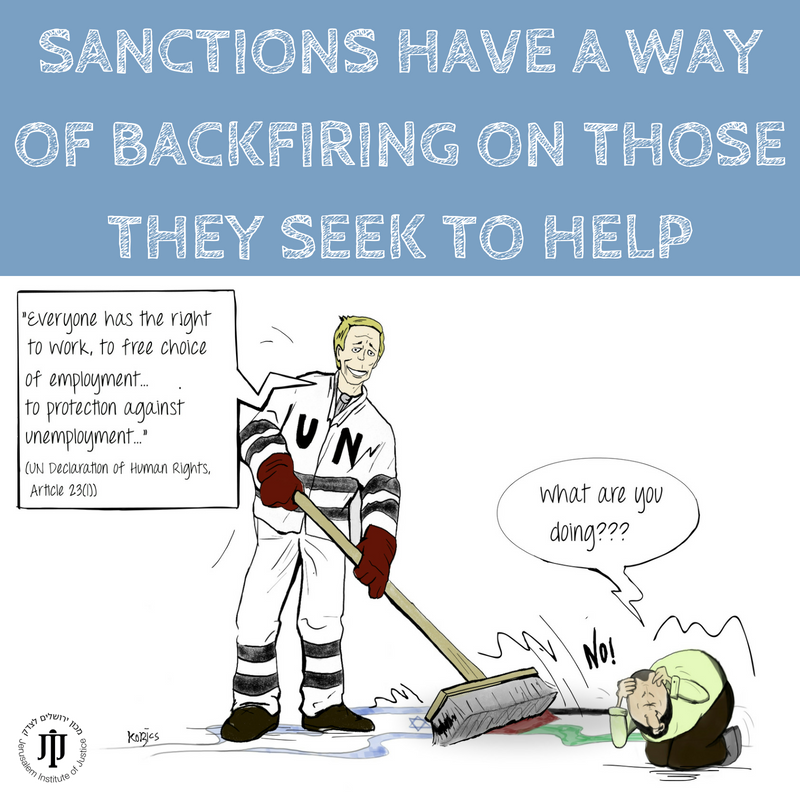
In short, sanctions as a means will not only cause harm; they will also fail to achieve the end which supposedly justifies that means.
* Anderton, Alain (2006). Economics (Fourth ed.). Ormskirk: Causeway.
When Sanctions Fail
The United Nations Human Rights Council announced its intention to publish a blacklist of 150 private companies, including those who do business in the disputed territories beyond the Green Line in Israel. In doing so, the Council plans to condemn the companies for acting against international law. This condemnation is supposed to tarnish the companies’ reputations politically in order to force them out of these territories. This move is said to help the Palestinians in the area; but according to numerous studies on the effects of sanctions, it is more likely to harm them economically.
A recent study of 68 cases where sanctions were imposed shows that in the end there is an expansion of inequality with a damaging impact on the sanctioned economies. For example, Yemen, which was sanctioned for ten years, experienced an increase both in poverty and in polarization due to inequality. The results can still be seen today in the sewage that runs through its streets.
Another case study of sanctions, done between the years 1982-2011, also reveals their negative effects on poverty. The research shows that the poverty gap widened from 5.89% before sanctions to 13.26% afterwards – an increase of 7.37%! Furthermore, there was a 22.39% increase in death rates. Poverty spreads as sanctions intensify.
This data clearly shows the potential for devastating economic damage to Palestinians as the result of applying sanctions to Israeli companies in the disputed territories, and the effects of sanctions are long-term.
Over the years, the economy of the Palestinian Authority (PA) has developed a high dependency on international aid. Prior to the first Intifada (1987) there was a level of only 5% unemployment, with many Palestinians able to find work. Today, that percentage has dramatically risen to approximately 43%, with 58% unemployment among the young people of Gaza. Even amongst the employed there is a high percentage living under the poverty line. The political conflict has caused a worsening of economic conditions, which has led to increased dependency of the PA on foreign aid.
The World Bank recommends the development of the private sector in order to boost Palestinian economic growth. However, this strategy contradicts the interests of the PA, which receives most of its funding from international aid. The funding is given to the leaders of the PA, who use it for terrorism, anti-Zionist propaganda and for fattening the stomachs of the elite (there is a wide gap between rich and poor). In contrast, Palestinians who work for Israeli private-sector companies are able to make a comfortable living without dependency on foreign aid. Clearly, sanctions on Israeli companies prevent this by leading to an increase in Palestinian unemployment.
The consequence of all this is unnecessary human suffering. Sanctions cause a deepening of inequality, a widening of the poverty gap, an increase of social polarity, and more. Furthermore, these effects are long-term. Considering the political reality for individuals in these areas, it is reasonable to believe that massive harm has already been caused. It may well be that the economic reality of poverty and unemployment in everyday life has been contributing to the worsening of the conflict. Considering this perspective, it becomes apparent that the sanctions are targeted not at stabilizing the area, but rather at delegitimizing Israel.