

Your Worst Enemy is Your Best Teacher
by JIJ intern
The Israeli-Palestinian conflict involves two peoples, the Jews and the Palestinians. The two groups often have two competing narratives, two contrasting histories, two sets of terminologies and even two different maps (Ipfatid, 2021). This contributes to a zero-sum mindset in which voices on each side view the other groups’ perspective as an existential threat.
Unfortunately, the international community often takes advantage of both parties distress by sharing incomplete, inaccurate or outdated information on the Israeli-Palestinian conflict. This usually accentuates the divide between Palestinians and Jews (Ipfatid, 2021).
In order to move past this divide, I believe that Israelis and Palestinians, Jews and Arabs, must find common ground between their respective narratives. Luckily, important peace-builders, such as Yossi Klein-Halevi, New York Times best-selling author of Letters to my Palestinian Neighbour, are actively working toward integrating each group’s national narrative in an effort to achieve a lasting, warm peace (Klein-Halevi, 2021).
In Klein-Halevi’s brilliant talk on YouTube titled Israeli and Palestinian Narratives, he breaks down the strengths and the weaknesses of each party’s narrative (JBS, 2015). For the Palestinians, there is the advantage of being the majority presence in Israel/Palestine prior to 19th century Zionist immigration. Meanwhile, for the Jews there is the advantage of identity: a consistent story linking the Jewish people to the land of Israel for 3,500 years.
The more the conflict between the two parties has intensified, the more each side has learned to compensate for deficits in their own story through the other group’s narrative (JBS, 2015). For instance, Zionist immigration to the Land of Israel starting in the 19th century allowed Jews to no longer be a minority within the Holy Land. Meanwhile, in the 19th century, the Palestinians did not have a distinct national identity. To compensate for this lack, Palestinians cultivated a national identity separate from the broader Arab and Muslim world (JBS, 2015).
That being said, the friction between Jewish presence in the Holy Land and a distinct Palestinian identity is often at the heart of the divide between the two parties. There are people on both sides of the conflict that declare the other group is an illegitimate, foreign interloper with no rights to live or self-determinate in this land (Behan, 2021).
Despite this sentiment, in some ways both parties have already succeeded in their national aspirations: there is now a large Jewish presence in the Land of Israel and there is also a distinct Palestinian national identity. Given that the Jews and the Palestinians, whether it was unintentionally or purposefully, learned from each other how to strengthen their own national movements, this may present a potential pathway to conflict resolution: recognizing similarities (JBS, 2015).
Bridging the gap between both parties’ national narratives may involve acknowledging the commonalities between Jewish and Palestinian aspirations. This includes recognizing the legitimacy of both peoples’ identities and recognizing the right for both peoples to live in this land (Behan, 2021).
Finally, this includes acknowledging that both sides have at times experienced the Israeli-Arab conflict as victims. Israelis often see themselves as a minority within the broader Arab and Muslim world, most of which has historically sought to destroy the Jewish state. Meanwhile, Palestinians usually perceive themselves as a marginalized population resisting a well-established country (Ipfatid, 2021). Ultimately, to move forward there must be a willingness from both Jews and Palestinians to humanize, empathize and integrate each other’s national narratives on the conflict (JBS, 2015).
References
Behan, Daniel (2021, March 16). Palestinians and Ashkenazi Jews: Co-Indigenous To The Same Land. Retrieved February 1, 2021, from https://blogs.timesofisrael.com/ palestinians-and-ashkenazi-jews-co-indigenous-to-the-same-land/ [@ipfatid] (2021, June 2).
Why is Approaching the Israeli-Palestinian Conflict With Nuance So Difficult [infographic]. Instagram. https://www.instagram.com/ipfatid/ [JBS] (2015, April 14).
Yossi Klein Halevi: Israeli and Palestinian Narratives [Video]. Youtube. YouTube.com/watch?v=_bLOfHov7IY&t=399s Klein-Halevi, Yossi (2021, November 23).
To The Students Who Walked Out on Palestinian Israeli Dialogue. Retrieved February 1, 2021, from israel.com/to-the-students-who-walkedout-on-palestinian-israeli-dialogue/?fbclid=IwAR1Ks61fQ8HhWDKnpwZ2ACVEhJ9eOxnCGfJE_mxkDUGGvvBMypUJ0KAqc

The Transparent Jew
In 2018, just a few days after my arrival to Europe from Israel, I sat in my teenage bedroom and recalled the countless incidents overseas in which I had lied about my nationality. I started laughing at myself, mildly concerned by how I easily conformed to a different culture, and even more surprised by how quickly my chameleon identity was accepted. I thought to myself, it’s better to laugh than to cry. For the first time, I was able to acknowledge that I had been raised to hide my heritage when I was outside my safe space. Doing so, I decided to no longer conceal my Jewish-Israeli identity.
In my new country, I had hoped to perfect my response to the simple question “where are you from?”. My ideal reply would be short and succinct, one I could pull off and use to secure a harassment-free encounter - nevertheless, it was impossible, and every attempt was to be located somewhere between awkward to disingenuous.
King Solomon was right when he declared, “There is nothing new under the sun”. Unfortunate as it may be, the Jewish necessity to cover its ethno-religious identity dates back in time to the Roman exile - when Jews suffered huge losses and humiliation as their ancestral homeland was colonized, erasing the Jewish identity of the land. Consciously or unconsciously, the destruction of the Jewish temple and the renaming of the land had severe repercussions on the Jewish identity, remaining until today.
Since then, two thousand years of Jewish people “pray[s] to be back in Zion, for the messiah to come and rebuild the temple.”- The eagerness to return to the homeland they came from has never diminished. This is the essence of Zionism, the liberation and restoration of the Jewish identity, that was severely colonized and morphed by countless foreign entities throughout history.
Does this Zionism, (which would later become a political movement) represent the solution our ancestors yearned for - an independent Jewish nation that is capable of both rediscovering its identity while eliminating the inherent hatred within those that had colonized it? In a utopian world - indeed, but not within the society I witnessed.
The creation of Israel is the most successful indigenous liberation in history; it is the hammer that broke the famous, self-tailored, “comfortable” Jewish character - weak and quiet Jews that are easily trampled and find themselves at the mercy of the majority. The founding of the State of Israel generated strong and empowered Jews that pursued their indigenous right to self-determination in their ancestral homeland.
Paradoxically, the United Nations is the organization which defines indigenous rights, along with the unofficial-leadership of the P5 - which are collectively known for enjoying a colonial history. The UN consistently fails to preserve Jewish rights as they don’t address the contemporary rise of Antisemitism on both sides of the political map. Nor has it brought justice to the hundreds of thousands of Mizrahi Jews, whose assets were confiscated by Arab governments while they were persecuted and forced to exile(1). It routinely
promotes state-based resolutions against Israel (18 in 2019) while ignoring the actions of China, Hamas, Venezuela, Qatar, Pakistan, and others(2). It continues popularizing anti-Israel propaganda, mainly without any concrete data - just like its false accusations against Israel for promoting gender-based violence in the Palestinian territories.
This flourishing prejudice fostered by the UN and many of its members, comes into practice in different expressions. These range from anti-Semitic attacks, to harassment on the street and to various forms of discrimination. But all roads lead to Rome, or as I stated previously, to the Jewish identity crisis in the diaspora. As part of my personal decolonization process I had to get rid of my habit of lying about my nationality. So, I faced three words that unfold western prejudice: “I am Israeli”. Very quickly I realized that not only are Jews a target, but so are Israelis. This raises the question: in their eyes, what does it even mean to be Israeli?
In Europe, I‘ve been spat on, barked at, questioned, boycotted, and discriminated against - only for exposing one, if not the most essential component of my identity: my nationality. In fact, most people decided for themselves that I am a Jew, a Zionist, a baby-killer, an ex-military officer, and a murderer based on my passport. I wish this was an over-exaggeration. During my time in Europe, almost every reference to the Holocaust or to Judaism was hijacked by political debates and comparisons, mostly based on media-information and history revisionists – even in the academic sphere.
Many Europeans are swept by the anti-Zionist narratives, and I can easily sort them into two groups (which have a tendency to overlap): those that stand against Israel’s actions, and those who deny it’s right to exist. Therefore, not everything about anti-Zionism is anti-Semitic. Israel is not a perfect country and its Jewish characteristic doesn’t grant it immunity from criticism. However, why are Israel’s current political actions equated with the ancient Zionist movement? We can clearly see that many of the modern anti-Zionist narratives are based on anti-Semitic assumptions and prejudices. The border between legitimate political criticism and anti-Semitism is very thin. But claims that consciously erase, or at least ignore, the origins of Judaism and the indigenous status of the Judeans in the land of Israel are inherently anti-Semitic. We can conclude that every type of delegitimization of Israel’s right to exist is anti-Semitic, regardless of how it manifests, and it is the basic premise of this article.
Anti-Zionism creates the dichotomy between “the good Jews” – the minority that doesn’t believe in Israel’s right to exist (e.g “Neturei Karta”) and “the bad Jews” – which are the 95% of Jews that do believe in Israel’s right to exist(3). Europeans (and quite frankly, far too many people in general) are taught that Zionism is “evil and racist”, without being informed that Jews are Zionists because of the violent racism they have survived. I have no desire or intention to be the “good Jew” these anti-Semites like to tokenize for their own agenda. It is no wonder that the majority of anti-Zionists I have met were from the left side of the political map. They identify themselves with the progressive social values of the left: supporting gender equality and other liberal values that the “good Jews” publicly stand against. This is not a coincidence, it is a known counterfeit tactic used by the left to legitimize anti-Semitism in the name of anti-Zionism.
It is important to highlight that Israel is not a perfect state, nor does it claim to be one - but its roots date back more than 3700 years of Judean civilization and so, it is time that the world abandon the myth of Jews with trembling knees. “We paid for it. We fought for it. We died for it. We will stand by our principles. We will defend them. And, when necessary, we will die for them again” (Prime Minister Menachem Begin Z”L, 1982)
My journey in Europe, which has yet to end, has brought me to the conclusion that I am a transparent Jew. Solely based on my Israeli nationality, everyone thinks they know everything about me, from the grocer to my professors. I have no other identity behind which to hide. I promised myself and my Jewish ancestors that I will not adopt a false identity just to fit the European world. And now, I pay the price. This decision to proudly stand as an Israeli woman has already affected my friendships. I’ve faced academic discrimination and I’ve experienced tremendous fear about publicly displaying any Jewish symbols, whether it be speaking Hebrew in the metro or wearing my Star of David necklace.
It was George Steiner in his book “In Bluebeard’s Castle” who argued that the image of Western culture as self-evidently superior and as the embodiment of almost the sum total of intellectual and moral power is a racially tinged absurdity(4). Maybe, just maybe, western powers should redirect their attention in discussions about the Middle East and Judean indigenous history. Instead of assuming to know all of the complexities and conflicts of the region, my European neighbors should not embrace their deeply inherited superior essence nor should they forget their thriving colonial history, in which they exploited indigenous people.
I am sitting in my teenage bedroom again, recalling my personal decolonization odyssey and the identity liberation we as a community embark upon, and I don’t regret any passage of it.
By Shai Emanuel Yamin
------------------------------------------
1 "One Year Later — The Answer To "Where Are Your Jews?" - UN Watch". UN Watch, 2018,
https://unwatch.org/one-year-later-answer-jews/.
2 "2019-2020 UN General Assembly Resolutions Singling Out Israel – Texts, Votes, Analysis - UN
Watch". UN Watch, 2019, https://unwatch.org/2019-un-general-assembly-resolutions-singling-outisrael-
texts-votes-analysis/.
3 Weiss, Barri. "American Liberalism In Danger". Tablet Magazine, 2020, https://www.tabletmag.com/sections/news/articles/stop-being-shocked
4 Steiner, George. In Bluebeard's Castle. YALE UNIVERSITY PRESS: NEW HAVEN , 1971
When Does Criticism of Israel Become Anti-Semitism?
By Nikki Golomb.
As a Jewish-American university student, I have been faced with the impossible task of determining when a professor, a student group, or an event has gone too far in criticism of Israel as a Jewish democracy. Is this legitimate criticism of Israel as an imperfect state, or is it holding Israel to an unfair standard of perfection? Is this criticism of Israel as a Jewish nation, or a political state? Is this anti-Semitism masked as anti-Zionism, a more “acceptable” form of criticism? And if so, where do we draw the line?
Anti-Israel rhetoric is often referred to as the “new anti-Semitism.” Classical anti-Semitism – such as the blood libel, Nazi symbolism and graffiti, and destruction of Jewish tombstones – are easy to identify, illegal, and largely socially unacceptable. Anti-Israel speech, on the other hand, is much more palatable to the public. However, anti-Israel rhetoric is often used as a more “acceptable” form of anti-Jewish sentiment, as the only Jewish state is held to a higher standard than any other country in the world.
There is a very fine line between legitimate political criticism of Israel and anti-Semitism. Many of us know all too well that recognizing the line is not only very difficult, but also vital in order to not infringe upon free speech while also condemning hate speech. However, Israel is not perfect, and thus denouncing any criticism of Israel as anti-Semitism ignores the political challenges faced within Israel and also holds Israel to a different standard than other countries. So how do we know when to speak up against anti-Semitism?
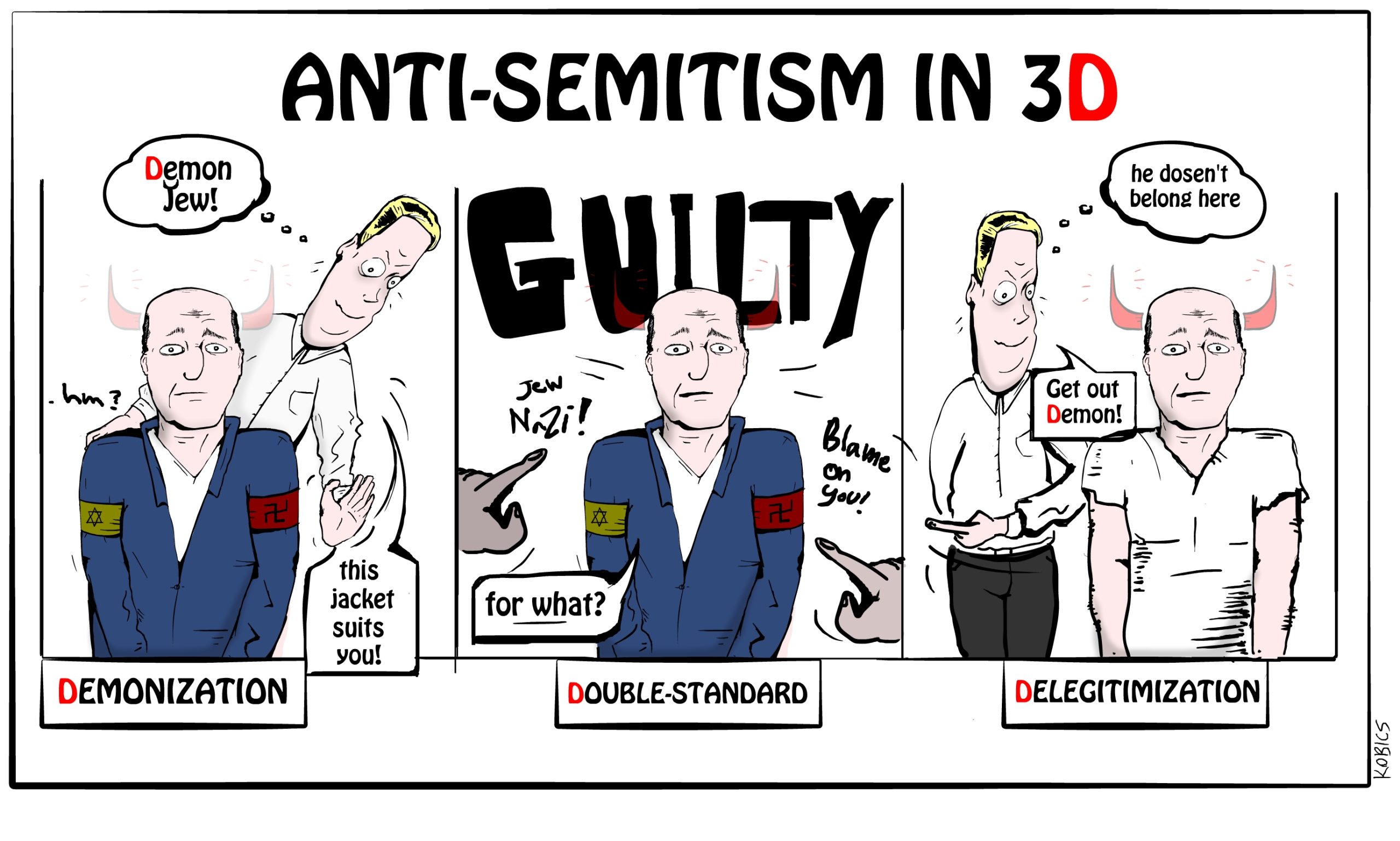
Natan Sharansky, Chairman of the Executive for the Jewish Agency for Israel and human rights activist, proposed what he calls the “3-D test” to differentiate between legitimate criticism of Israel and anti-Semitism. This test dictates that if a statement or action demonizes Israel, holds Israel to a double standard, or delegitimizes Israel (the “3 Ds”), it is in fact anti-Semitic.
Demonization
Demonization, the first of the 3 Ds, is relatively easy to identify as it has been a marker of anti-Semitism for centuries. Depicting Jews as the embodiment of evil (i.e. “Jews have horns” or “Jews are the devil”) is one of the oldest forms of anti-Semitism. Today, demonization of Israel includes comparing Israel to Nazi Germany, equating Palestinian refugee camps with concentration camps, or depicting Israeli political leaders as the devil.
Demonization of Israel is clear anti-Semitism, with a shift of focus from Jews as individuals to the Jewish nation. When criticism of Israel is focused on its nature as a Jewish state, when its policies are blown out of proportion, and when criticism reflects anti-Jewish sentiment that has persisted for centuries, anti-Semitism is the culprit.
Double Standard
Discriminatory laws holding Jews to a different standard than other citizens have also existed for centuries. From empires imposing additional taxes on Jews, to outright denying the right to Jewish practice, to more recent ghettoization, Jews have been subject to different laws than their neighbors.
The same is happening today, at the international level. Of the 2017-2018 UNGA resolutions condemning countries, 20 of the resolutions were against Israel – and six against the rest of the world combined. Furthermore, since the establishment of the UN Human Rights Council, about 50% of its resolutions concerning specific countries have been against Israel. No other country has received such treatment. Singling out Israel for condemnation while ignoring massive human rights abuses in other parts of the world is holding Israel to a double standard. Expecting Israel and Israeli organizations to adhere to a higher standard of human rights singles out Israel as the only Jewish state, and is thus an expression of anti-Semitism.
Delegitimization
Delegitimization is slightly harder to identify, but just as important. It refers to any action or comment delegitimizing Israel as a Jewish democracy, or denying Israel’s right to exist as one. It can be accusing Israel of colonialism, ethnic cleansing, and apartheid; or it can be claiming that Israel was established illegally and on lands that it has no right to own, thus delegitimizing Israel’s very right to exist at all.
Dozens of Muslim states and Christian states exist, yet there is only one Jewish state. Denying its right to exist is inherently anti-Semitic because it discriminates against Israel based on its nature as a Jewish state. Making false claims of ethnic cleansing or apartheid delegitimizes Israel by implying that it is founded on racism and discrimination and thus has no right to sovereignty. The same argument can be made of the claim that Israel has no legal, historical, or cultural right to the land; however, making these claims is anti-Semitic because it nullifies Jewish history, nationalism, and right to self-determination.
Discussion and Conclusion
Expressing disapproval for specific Israeli policies is a legitimate form of criticism. Arguing against political action, the way one does with regards to other countries, is not only acceptable but also healthy – no positive progress can be made without open dialogue and political discussion. However, when one (or more) of the “3 Ds” become present and that criticism crosses the line into anti-Semitism, nothing productive can happen. No positive change can happen when the criticism is based on anti-Jewish arguments. When someone demonizes Israel, holds it to a double standard, or delegitimizes it, their tactics must be called out for what they are. This is the only way to ensure that anti-Semitism is recognized and stopped, and legitimate criticism is taken seriously so as to promote progress.
Is “Jewish Democracy” an Oxymoron?
By Nikki Golomb.
There’s a phrase I have heard over and over again throughout my life: “Put two Jews in a room and you’ll get three opinions.” Once, however, I heard an amended version: “Put two Israelis in a room and you’ll get three opinions, a new political party, and probably an invitation to Shabbat dinner.” The more I’m learning about Israeli politics, however, the more I’m realizing it is less of a joke and more of a commentary on the complexity of Israeli politics and social life.
Israel prides itself as being both the only true democracy in the Middle East, as well as the only Jewish state in the world. Some people, however, do not believe that Israel can be both Jewish and democratic; they say that mixing religion with politics inherently makes it undemocratic. However, this argument ignores the many other democracies with a state religion; for example, nobody questions the democratic integrity of Christian states such as the UK, Greece, Costa Rica, or Denmark (among others). Other countries additionally have religiously-affiliated political parties, even though the country itself does not have a national religion. Despite the mixing of religion and politics, these countries remain internationally recognized democratic states.
Taking this into consideration, the question thus becomes whether Judaism in particular is incompatible with democracy. In order to answer this, one must look at the Torah and Jewish values. The Torah states that an acceptable political system must be “rooted in popular consent and involving the people in governance,” a significant characteristic of democracy. It additionally documents the creation of a modern justice system under Moses, who established a multi-tiered court system after the Exodus from Egypt. Although there are no direct references to democracy in the Torah, values such as equality, justice, and rule of the people which are vital to democratic institutions are emphasized, meaning Judaism and the nature of democracy are not inherently incompatible. Jewish values additionally tell us that all people are created b’tzelem Elokim – in the image of G-d. This belief equalizes all people, regardless of religion, ethnicity, nationality, etc. and demands that everyone is treated with the same respect and dignity. The value of tzedek, or justice, also has clear implications on democratic life by further emphasizing the importance of establishing a just society.
Others argue that while Judaism and democracy are not inherently contradictory, the ways they manifest themselves in Israel do not represent true democracy. According to the Jerusalem Center for Public Affairs, there are two vital aspects of democracy: 1) self-governance, or the meaningful participation of citizens in the political system, and 2) plurality, or the ability of everybody to live according to their own beliefs and coexist in society. Both of these features are represented in the Israeli political system. Israel has a parliamentary system of government, called the Knesset; Members of Knesset are voted upon by the people, and all citizens have the right to vote regardless of religion, ethnicity, or any other identity. All citizens are also eligible to run for government, or create their own political party; both Arabs and Haredi Jews, for instance, have their own political parties and are also represented in other parties. In terms of pluralism, it is no question that various ethnic and religious groups coexist in Israel. Jews and Arabs alike have the right to vote; receive state-funded education; and are represented as Members of Knesset, judges, and other high-power positions. Many organizations exist, including JIJ, which work to promote pluralism in Israeli society. This would not be possible in a nondemocratic country or exclusively ethnic nation-state.
It is true that Israel, like every other country, is not perfect. Discrimination exists, representation can and should be improved, and conflict between religion and government remain a hot political topic. The “perfect” balance has not yet been found. However, this does not take away from the Jewishness or democracy of the state. Christian democracies exist with little to no questioning of whether they can be both religious and democratic. Those who claim that a “Jewish democracy,” on the other hand, is an oxymoron either do not have a complete understanding of Jewish and/or democratic values, or do not know how Israel’s political system works. Jewish values influence the political environment, yet Israel meets every requirement of a democratic nation. Once we accept that Israel is both Jewish and democratic, we can better understand the political nature of the government and work within the system to create positive political and social change.

Nikki Haley's for Human Rights!
How Nikki Haley’s Background and Beliefs Helped Foster Her Zionist Spirit
In the midst of the continuous storm of anti-Semitism and anti-Israel resolutions that have been produced by the United Nations over the last few decades, there is a light that is shining more brightly now than ever before. Nimrata “Nikki” Haley, the 29th US Ambassador to the UN, is the strong voice advocating for Israel and demanding the bias and hatred towards Israel from other countries must stop immediately. Born to Sikh Indian parents in South Carolina, Haley credits them with first instilling in her a sense of pride and gratitude about living in America. “Well, I am the daughter of Indian parents who reminded my brothers, my sister and me every day how blessed we were to live in this country,” said Haley in an interview at the 2017 AIPAC Convention.
After graduating Clemson University with a BA in Accounting, Haley went to work for her mother’s clothing company, Exotica International. After being involved in numerous executive boards in her community and town, Haley was elected to the South Carolina House of Representatives in January of 2005. She continued this role until January 2011, where she was elected the first female governor of South Carolina. In November of 2016, she was appointed by president-elect Donald Trump to be the 29th United States Ambassador to the UN; she was confirmed in January 2017.
During her career in politics, Haley’s strong Zionistic and pro-Israel stance have been a major focus of hers. While Haley was governor of South Carolina, she signed into law a bill to stop efforts of the Boycott, Divestment and Sanctions (BDS) movement. This legislation was the first of its kind on a statewide level. Haley also stated during the announcement of that bill, that "nowhere has the UN’s failure been more consistent and more outrageous than in its bias against our close ally Israel". As Ambassador, Haley has been extremely outspoken about the UN’s blatant bias against Israel and has been extremely vocal in her personal support and her representing the United States supporting Israel. This is a welcome change for many from the stance of former US Ambassador, Samantha Power, and the US’ decision to abstain from the voting of Resolution 2334.
Samantha Power, who was the 28th US Ambassador under the Obama administration, famously abstained from voting on Resolution 2334 in December 2016, which declared that the Israeli settlement building in the West Bank and East Jerusalem was illegal and violated international law. Power told the 15-member U.N. Security Council, “Israeli settlement activity in territories occupied in 1967 undermines Israel’s security, harms the viability of a negotiated two-state outcome, and erodes prospects for peace and stability in the region." It came as a surprise to many that the US would seemingly go against an ally by refusing to vote against the resolution, especially coming from the woman who said “I will stand up for Israel and work tirelessly to defend it” in her Senate confirmation hearing; the resolution passed with 14 votes for and one abstention, the US. Haley later called the decision to abstain “one of the lowest points in our country….when [Power] abstained, the entire Security Council, and the entire audience, got up and applauded, and Israel was sitting there….watching that. Think about what we just did to a friend. You don’t ever applaud in the Security Council. That never happens. It happened that day.”
Haley has unequivocally and steadfastly supported Israel as the voice of the United States to the UN; she has called the UN out on their bias towards Israel dozens of times, especially when the UN named Israel the country with the most human rights violations in March 2017, beating out Iran, Syria, Libya and North Korea. “You know, basically what it comes down to is I'm not there to play,” said Haley during the 2017 AIPAC Conference. “And what I wanted to make sure of was that the United States started leading again. And leading isn't saying and doing things when it's comfortable. Leading is saying and doing things when it's not comfortable.”
When pressed about how she came to have such a strong stance on Israel and how she became so outspoken about defending Israel, Haley said, “[T]he truth is, I have seen so many similarities between the Israeli culture and the Indian culture. We're very close-knit. We love our families. We have a strong work ethic. We believe in professionalism and philanthropy and giving back. It's very true. So that's all the good things.” India and Israel have shared many similarities in values and members of each country frequently visit the other. Around 40,000 Israelis, many of whom have just finished their required military service visit India annually and around 34,000 Indians visit Israel annually. According to a 2009 international study commissioned by the Israeli Foreign Ministry, the greatest level of sympathy towards Israel from a member of the international community can be found in India, with 58% of Indian respondents showing sympathy towards Israel. In 2015, opinion polls showed 70% of Indians had favorable views of Israel.
Others wonder if perhaps Haley’s conversion to Christianity helped further foster her Zionist feelings. When Haley wed her husband, Michael Haley, who was a Christian, they did both a Sikh and Christian ceremony. Haley said about her choice to convert to Christianity, “We chose Christianity because of the way we wanted to live our life and raise our children — it had nothing to do with me thinking there was anything wrong with the way I was raised, and everything to do with the fact that I am moving forward in my life and had to find a path I felt was right for me.” Many Christians do believe in Israel’s right to exist; these Christians are called “Christian Zionists.” Some Christian Zionists believe that the gathering of the Jews in Israel is a prerequisite for the Second Coming of Jesus. Christian Zionists interpret the prophetic texts as describing inevitable future events, and these events primarily involve Israel, meaning the descendants of Jacob, which are the Jewish people. These prophecies are seen as requiring the presence of Jewish people in the Holy Land; this requirement is sometimes interpreted as being fulfilled by the contemporary state of Israel.
Haley has not made a public comment on whether her Christian views have helped cultivate her support for Israel even more, but whatever Haley’s reasoning, there is no doubt Israel and the American Jews are thankful for Haley’s voice and for tossing her hat into the UN’s ring. “For anyone that says you can't get anything done at the U.N.,” Haley says, “they need to know there's a new sheriff in town.”