

Three Strikes for Starmer
Three Strikes for Starmer
When Sir Keir Starmer ascended to the leadership of the UK Labour Party in 2020, he promised a decisive break from Jeremy Corbyn. Hamas and Hezbollah would no longer be considered ‘friends’, anti-Semitism would no longer be tolerated, and Israel would no longer be demonized.
Over the last four years, Starmer made significant progress on these fronts. He purged Corbyn from the Labor Party, adopted the recommendations of the Equality and Human Rights Commission’s investigation into anti-Semitism,[1] and affirmed Israel’s right to self-defense.
The Anglo-Jewish community responded constructively to these changes. Where British Jews voted for the Conservatives over Corbyn by a six-to-one margin in 2017, Starmer attracted support from a plurality of Anglo-Jewish voters.[2] This reflected voting patterns across the British electorate, enabling Labour to return to power after 14 years in opposition.
Since Labour assumed power in July, however, the Party has taken three troubling decisions on Israel. In isolation, any one of these decisions could be dismissed as a blip on the radar. In their totality, they suggest a failure to root out the ideological undercurrents of Corbynism.
UNRWA
The first warning sign appeared on July 19, when Foreign Secretary Danny Lammy agreed to restore £21 million in funding for the United Nations Relief and Works Agency (UNRWA). In announcing this decision, Lammy parroted UNRWA’s assertion that they ‘meet the highest standards of neutrality.’[3]
Such a claim is not credible. Israel has produced substantive evidence showing that UNRWA facilities have been systematically used as command centers and storage facilities for Hamas.[4] It has identified 42 employees of UNRWA who assisted Hamas on October 7, and it has alleged that over 10% of their workers are affiliated with terrorist groups.[5] Last month, UNRWA fired nine of its employees for their involvement in the October 7 massacre.
Lammy sidestepped this evidence by focusing on the UN-commissioned Colonna report from April 2024. But this report did not support the Foreign Secretary’s claim of neutrality. Instead, it found that alleged breaches of neutrality by UNRWA ‘escalated significantly’ after October 7. Referring to anti-Semitic educational content as a ‘grave violation of neutrality’, it noted that 3.85% of textbook pages in Palestinian schools contain concerning material.[6]
ICC
On July 26, the Labour Government made its second move against Israel. It dropped a pre-trial submission challenging the International Criminal Court’s (ICC) jurisdiction over Israeli Prime Minister Benjamin Netanyahu and Defence Minister Yoav Gallant.
In June, the Sunak Government had responded to ICC Prosecutor Karim Khan’s application for arrest warrants against Israel’s leaders by requesting permission to comment on ‘outstanding jurisdictional issues.’ The Government wanted the Court to address the implications of the Oslo Accords, which deny criminal jurisdiction to the Palestinian Authority over Israeli nationals.[7] The Court agreed to accept submissions from the UK and other interested parties until August 6.
By dropping the UK’s request for comment, the Starmer Government weakens pressure on the Court to address an important pre-trial question. It advances Prosecutor Khan’s unprecedented attempt to target the elected leaders of a democratic state, and it signals moral cowardice in the face of the ICC’s efforts to equate Hamas terrorists with leaders bound by the rule of law.
Export Licenses
On September 2, Labour completed its trifecta of measures against Israel. Secretary Lammy announced that the UK would suspend 30 of its 350 arms export licenses to Israel.[8] Coming on the same day as the funerals of six murdered hostages, the announcement provoked opposition in Israel and America.
Though the Foreign Secretary emphasized that ‘this is not an arms embargo’, his decision to block export licenses represents a clear departure from his predecessor. In December 2023, then Foreign Secretary Lord David Cameron concluded that Israel is ‘committed to comply with International Humanitarian Law.’ Following five legal assessments, Cameron reiterated his stance in April 2024, rejecting calls to suspend export licenses.[9]
Though Britain does not account for a large share of Israel’s arms imports, these restrictions will affect the supply of drones, jets, and other aircraft. Coming just weeks after the UK dropped its challenge to the ICC, the decision reflects a troubling pattern of one-sided measures against Israel’s legitimate right to self-defense.
Conclusion
Starmer deserves credit for confronting rampant anti-Semitism in the Labour Party. He has repudiated the sordid legacy of Corbyn and worked to regain the trust of British Jews.
It seems, however, that his foreign policy has privileged the concerns of a loud left flank over the defense of a democratic ally. In just two months, Labour has departed from the Conservatives on three issues. Each of these actions has hurt Israel’s security while exacerbating the divide between British and American policy. To maintain good will at home and abroad, Starmer is due for a course correction.
Written by Ben Solomon
JIJ Intern
Click Here To read the full article including notes

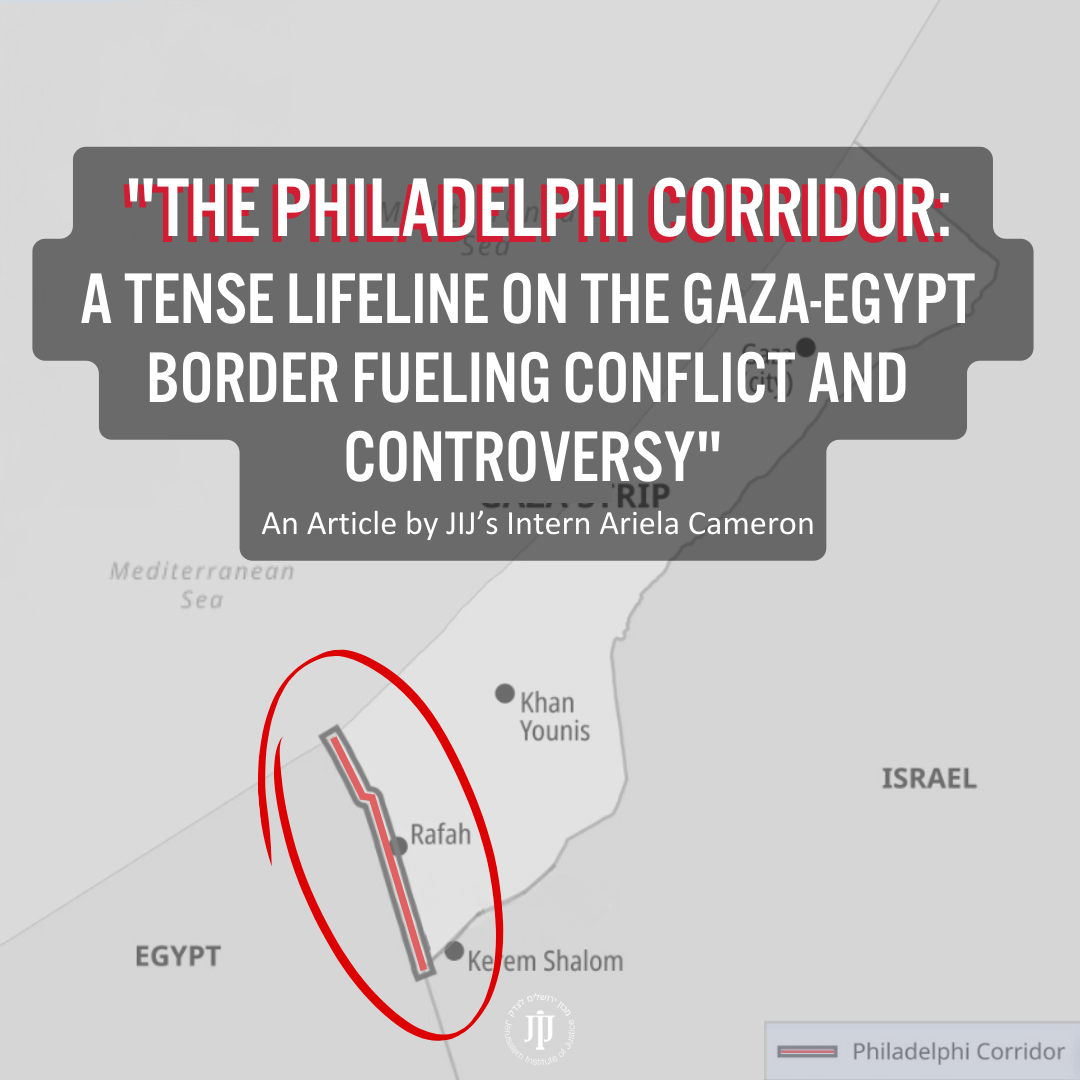
Philadelphi Corridor: The Critical Strip Shaping Gaza's Future Amid Tensions and Negotiations
The Philadelphi Corridor, running along the Gaza-Egypt border, is a focal point of intense
debate. It plays a critical role as a vital conduit for essential supplies and materials into Gaza,
acting both as an air bridge for resupply and a checkpoint for movement in and out of the
territory. During the Swords of Iron War, Israel's control of this corridor has been viewed by
the Western world as worsening the isolation of Gazans, who are already displaced for their
safety.
The corridor’s significance is underscored1 by its’ role in transporting essential supplies,
including food and weapons. Currently controlled by the Israeli Defence Forces (IDF), its
management raises concerns about its effects on aid from Iran and Iraq and its role in
smuggling. "That control is critical … some areas are wide enough for trucks, which have been
used to smuggle weapons and personnel into Gaza."2 This corridor can significantly impact the
humanitarian situation and potentially cause chaos if used for smuggling. If controlled by
Hamas, it remains a persistent issue for Israel.
Hamas, elected to the Palestinian Parliament in 2006, has clashed with Fatah and the
Palestinian Authority (PA), which both support a two-state solution that Hamas opposes. The
corridor's control limits Hamas' access to weapons and supplies from Egypt, giving Israel
leverage to weaken Hamas and influence negotiations. However, the Western world
disapproves of this control and is urging Israeli leaders and the IDF to withdraw military
personnel before finalizing a deal.
Egypt has cautioned Israel against taking actions that could drive Gazans to cross the border or
jeopardise the significant peace agreement between the two nations established in 19793. In
response, Israel plans to relinquish partial control of the corridor as part of a hostage deal with
Hamas, aiming to preserve its alliance with Egypt. This move alleviates pressure on Prime
Minister Netanyahu and shifts responsibility to Hamas leaders like Yahya Sinwar. By agreeing
to the terms set out by the US, Israel disrupts Hamas’s supply chain and affects Western
perceptions of the situation.
Recently, the US has been facilitating talks for a ceasefire and hostage return, focusing on “how
to advance hostage negotiations”4. Netanyahu has indicated that the IDF will stay within the
corridor. The US supports the IDF’s strategic aims due to its alliance with Israel, but
maintaining control of the corridor does not help in retrieving hostages. Despite public pressure
for a quick resolution, Israel views the corridor as vital for strategy and negotiations, rejecting
a full military withdrawal. Prominent figures like Antony Blinken advocate for a swift
resolution to ensure safety. As of August 24th, 2024, President Biden and Prime Minister
Netanyahu have reached an agreement on the corridor. Despite differing views, they have
informally agreed to a military withdrawal as per request from Egypt and Hamas6.
Written by Ariela Cameron
Jerusalem Institute of Justice Intern
To Read the Article with the notes- Click Here
Philadelphi Corridor: The Critical Strip Shaping Gaza's Future Amid Tensions and Negotiations
The Philadelphi Corridor, running along the Gaza-Egypt border, is a focal point of intense
debate. It plays a critical role as a vital conduit for essential supplies and materials into Gaza,
acting both as an air bridge for resupply and a checkpoint for movement in and out of the
territory. During the Swords of Iron War, Israel's control of this corridor has been viewed by
the Western world as worsening the isolation of Gazans, who are already displaced for their
safety.
The corridor’s significance is underscored1 by its’ role in transporting essential supplies,
including food and weapons. Currently controlled by the Israeli Defence Forces (IDF), its
management raises concerns about its effects on aid from Iran and Iraq and its role in
smuggling. "That control is critical … some areas are wide enough for trucks, which have been
used to smuggle weapons and personnel into Gaza."2 This corridor can significantly impact the
humanitarian situation and potentially cause chaos if used for smuggling. If controlled by
Hamas, it remains a persistent issue for Israel.
Hamas, elected to the Palestinian Parliament in 2006, has clashed with Fatah and the
Palestinian Authority (PA), which both support a two-state solution that Hamas opposes. The
corridor's control limits Hamas' access to weapons and supplies from Egypt, giving Israel
leverage to weaken Hamas and influence negotiations. However, the Western world
disapproves of this control and is urging Israeli leaders and the IDF to withdraw military
personnel before finalizing a deal.
Egypt has cautioned Israel against taking actions that could drive Gazans to cross the border or
jeopardise the significant peace agreement between the two nations established in 19793. In
response, Israel plans to relinquish partial control of the corridor as part of a hostage deal with
Hamas, aiming to preserve its alliance with Egypt. This move alleviates pressure on Prime
Minister Netanyahu and shifts responsibility to Hamas leaders like Yahya Sinwar. By agreeing
to the terms set out by the US, Israel disrupts Hamas’s supply chain and affects Western
perceptions of the situation.
Recently, the US has been facilitating talks for a ceasefire and hostage return, focusing on “how
to advance hostage negotiations”4. Netanyahu has indicated that the IDF will stay within the
corridor. The US supports the IDF’s strategic aims due to its alliance with Israel, but
maintaining control of the corridor does not help in retrieving hostages. Despite public pressure
for a quick resolution, Israel views the corridor as vital for strategy and negotiations, rejecting
a full military withdrawal. Prominent figures like Antony Blinken advocate for a swift
resolution to ensure safety. As of August 24th, 2024, President Biden and Prime Minister
Netanyahu have reached an agreement on the corridor. Despite differing views, they have
informally agreed to a military withdrawal as per request from Egypt and Hamas6.
Written by Ariela Cameron
Jerusalem Institute of Justice Intern
To Read the Article with the notes- Click Here
Amicus Brief- Challenging ICC's Prosecutor’s Request to Issue Arrest Warrants for Israeli Leaders
On August 6, the Jerusalem Institute of Justice legal team, submitted its Written Observations to the International Criminal Court on the unresolved matters of jurisdiction with respect to the ‘Situation in Palestine' case.In our submission, we've challenged the ICC's jurisdiction to issue arrest warrants against Israeli citizens, questioned the classification of "Palestine" as a state, and asserted that the Gaza Strip is not under occupation.
The Jerusalem Institute of Justice submitted its reservations to the International Criminal Court (ICC) , stating that the tribunal may not exercise its authority over Israeli citizens, in light of the Oslo Accords, which were signed between the State of Israel and the Palestine Liberation Organization (PLO) and regulated the jurisdiction in these territories.
This submission follows a request by the ICC prosecutor to issue arrest warrants against Prime Minister Benjamin Netanyahu and Defense Minister Yoav Gallant for their alleged responsibility for war crimes and crimes against humanity. Representing survivors of the Hamas massacre on October 7, the JIJ seeks to challenge the tribunal’s attempt to exert authority over Israeli citizens, contrary to the Oslo Accords. In the documents filed, the JIJ’s legal experts dispute the classification of “Palestine” as a state and argue that the Gaza Strip is not under occupation.
The Jerusalem Institute of Justice shares the ICC’s commitment to fight impunity for serious violations of international law. At the same time, this goal cannot be realized at the expense of circumventing existing legal frameworks. We call on the tribunal to refrain from making unilateral decisions that could damage the peace process.
JIJ unequivocally argued that the Oslo Accords, which govern relations between Israel and the Palestinians, constitute a binding and central legal document recognized internationally. According to these agreements, the Palestinian Authority has no criminal jurisdiction over Israeli citizens and cannot transfer powers it does not possess to the ICC.
The JIJ also noted that in its 2021 decision, the tribunal declared it could not determine whether Palestine was a state. The Chief Prosecutor’s current classification of the conflict, both as an international conflict and as a non-international conflict, stems from uncertainty in the law and its interpretation by the tribunal. This situation affects the types of crimes investigated and creates an imbalance in the application of the law between the different parties.
For an entity to be considered a state and for the conflict to be classified as an international conflict, it must meet four conditions: a permanent population, a defined territory, an effective government, and the ability to engage in international relations. The JIJ argues that Palestine does not meet these conditions, and its unilateral declaration of statehood contravenes the Oslo Accords and is therefore illegal under international law.
The second option for recognizing the conflict as an international confrontation is to acknowledge the occupation. In this respect, JIJ argues that Israel withdrew from the Gaza Strip in 2005 and does not control it, a necessary element for being considered an occupier. Thus, Israel’s current military actions in Gaza are characterized as a response to active hostilities of Hamas, not an occupation.
JIJ emphasizes the need to respect existing agreements and the rules of international law and warns against any modifications, deviations, or reinterpretations of these agreements by the tribunal. The Institute further notes that, to ensure a clear and fair legal framework in Israeli-Palestinian relations and to prevent unilateral decisions that could jeopardize the peace process, the tribunal must uphold what the parties agreed to in the Oslo Accords and the boundaries defined therein.
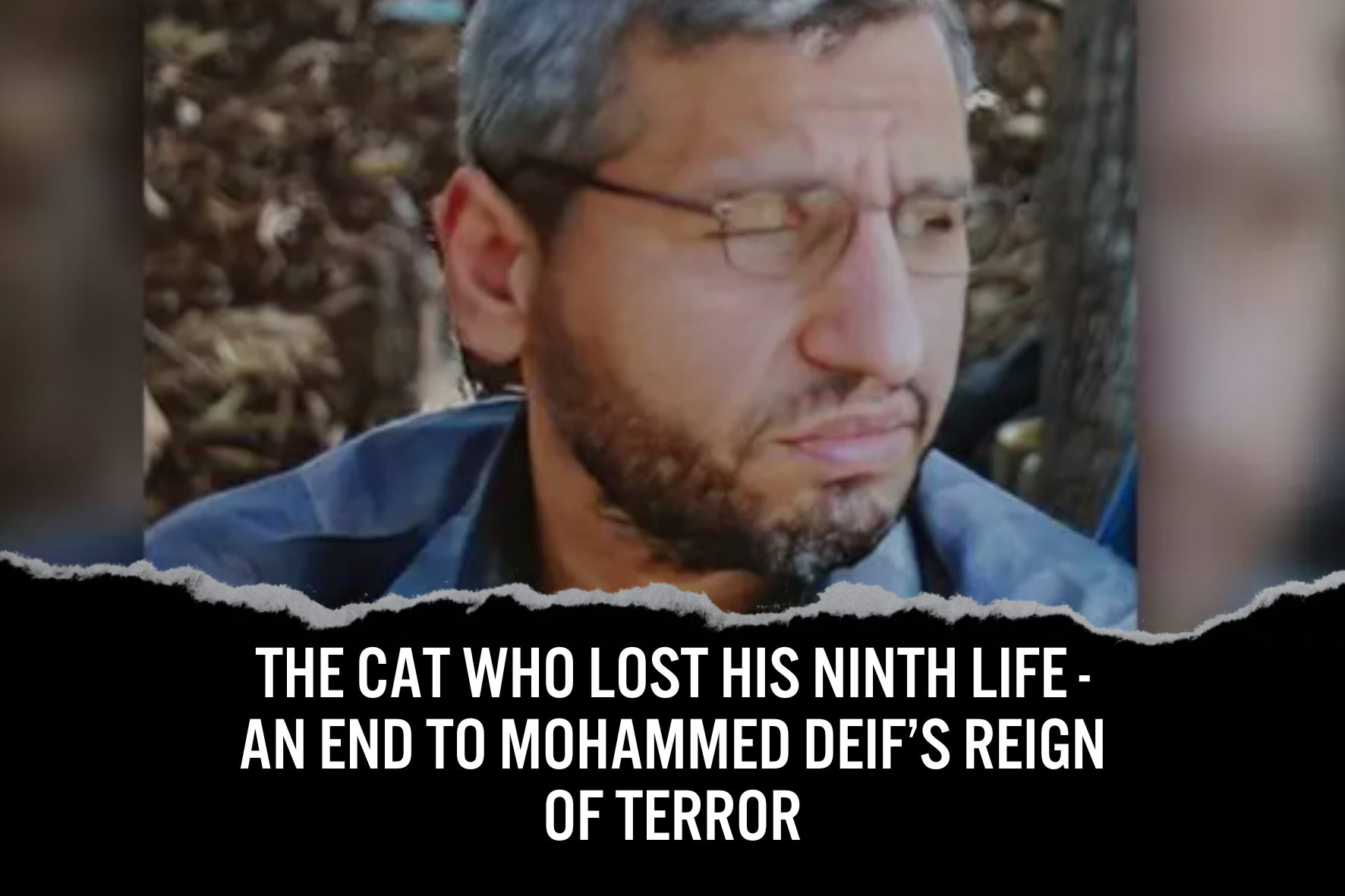
The Cat Who Lost His 9th Life
An End to Mohammed Deif’s Reign of Terror
Mohammed Diab Ibrahim al-Masri, more commonly known as Mohammed Deif, was a Hamas terrorist who is credited for being the mastermind behind the October 7th Hamas terrorist attacks. Deif is a figure synonymous with terror and violence and served as the leader of the Izz al-Din al-Qassam Brigades (IQB) which is the military wing of Hamas. Deif orchestrated numerous attacks against Israel, leaving a trail of destruction and loss in his wake.
Deif's tenure as the head of the al-Qassam Brigades, which began in 2002, was characterized by a series of deadly attacks. Even prior to gaining this position, Deif masterminded several suicide bombings in 1996 that killed over 50 Israelis civilians. Since his reign of terror began, he was instrumental in developing Hamas' capabilities, including rocket attacks and tunnel warfare. His strategies took the brutal, inhumane, and despicable atrocities being committed by Hamas to an even more dangerous level.
Deif's ability to evade capture and assassination earned him the nickname "the cat with nine lives." Since 1995, he had been the top target on Israel's most wanted list, surviving at least seven targeted killing attempts. Despite sustaining severe injuries, including the loss of an eye, Deif evaded death and continued to lead Hamas' military operations from the shadows.
In recent developments, there were allegations that Mohammed Deif may have been killed in an Israeli airstrike. On July 12th, 2024, Israeli fighter jets targeted a compound in the Al-Mawasi/Khan Younis area which was believed to be housing Deif and other high-ranking Hamas officials. While Israeli authorities had indicated "increasing signs" that Deif was killed in the operation, Hamas denied the claims and there was no definitive proof. Just over a week later, the IDF confirmed on July 21st that Deif was in fact killed in the attack.
Deif's actions did not go unnoticed on the international stage. Prior to his death, he had been designated a Specially Designated Global Terrorist by the U.S. Department of State and added to the European Union's terrorist blacklist. In May 2024, the International Criminal Court (ICC) applied for arrest warrants for Deif and other Hamas leaders, citing charges of extermination, murder, and other war crimes.
Mohammed Deif's legacy is one of relentless violence and strategic terrorism. His actions caused immense suffering and have perpetuated the cycle of violence in the Israeli-Palestinian conflict. The unfortunate reality of the situation is that Deif’s death simply means he will be replaced by another terrorist as hateful and dangerous as him. As long as figures like Deif remain in positions of power, the prospects for peace in the region remain bleak. His story is a stark reminder of the devastating impact of Hamas’s heinous and barbaric crimes. The ongoing struggle for stability and security in the Middle East will only continue without a unified front opposing terrorism and extremism.
By Kevin Bina – JIJ Intern
to read the Article with the Foot-Notes
Op-ed Mohammaed Deif
Jerusalem Institute of Justice - Statement in Response to ICJ Advisory Opinion
On Friday, July 19, the International Court of Justice (ICJ) issued its Advisory Opinion on the "Legal Consequences Arising from the Policies and Practices of Israel in the Occupied Palestinian Territory, Including East Jerusalem".
The Jerusalem Institute of Justice expresses disappointment with the Court’s treatment of the numerous complex issues surrounding the Israeli-Palestinian conflict. The ICJ advisory opinion is both factually and legally flawed, wrongfully applying the laws of belligerent occupation and the laws on the use of force. While the Court asserted that it was not called upon to pronounce on Israel’s historical ties to the territory, it nonetheless has chosen to completely disregard that these ties exist. Moreover, the opinion does not acknowledge Israel’s legitimate security concerns. Instead, it prescribes that Israel must completely withdraw from what it designates as the Occupied Palestinian Territories.
We maintain that these intricate political, legal, cultural, and religious issues can only be effectively addressed through peace negotiations. By addressing these controversies in a superficial and sweeping manner, the Court has potentially undermined the pursuit of a negotiated solution. Despite its non-binding nature, this opinion carries serious implications for Israel and the broader conflict resolution process.
We emphasize that the State of Israel possesses a robust and independent legal system that diligently applies international humanitarian and human rights law to the unique aspects of the Israeli-Palestinian conflict, and one that ensures that allegations of breaches of international law are investigated.
In conclusion, we believe that the ICJ’s opinion, in its current form, ignores the complex and nuanced nature of the Israeli-Palestinian conflict. Achieving lasting peace and resolving these challenging issues requires a commitment to direct negotiations, mutual understanding, and a recognition of the legitimate concerns and claims of the parties involved.
ECHOES OF DENIAL - OCT. 7TH ATROCITIES & RISING ANTISEMITISM- Report
The October 7, 2023, atrocities committed by Hamas against Israeli civilians were among the most documented terror attacks in history. Despite overwhelming evidence, including livestreamed videos and numerous survivor testimonies, a disturbing p.attern of distortion and denial of these events has emerged. This report examines the denial of the October 7 atrocities, links such denial to rising antisemitism, and reviews the current legal frameworks addressing atrocity denial. It also discusses the necessity and promotes the adoption of new legislation against such denial and provides recommendations for international cooperation to combat this dangerous phenomenon
Israel's Humanitarian Aid Efforts in Gaza: Addressing Allegations of Starvation as a Method of War
The ongoing conflict in Gaza has sparked intense international scrutiny, with serious allegations leveled against Israel regarding its treatment of Palestinian civilians. Among the most grave accusations are claims that Israel is deliberately using starvation as a weapon of war. This article aims to examine these allegations in light of Israel's documented humanitarian aid efforts and the complex realities on the ground in Gaza, providing a comprehensive analysis of the current situation and its historical context. The gravity of the allegations has drawn attention from international legal bodies. The International Court of Justice (ICJ) as well as the International Criminal Court (ICC) have consistently placed Israel under unfair scrutiny for a starvation crisis that does not exist.
In its provisional measures order, the ICJ highlighted the severe humanitarian situation in Gaza and the potential for irreparable harm due to lack of access to essential resources. The court stated:
"The catastrophic humanitarian situation in the Gaza Strip is at serious risk of deteriorating further. In view of the fundamental values sought to be protected by the Genocide Convention, the Court considers that the plausible rights in question in these proceedings, namely the right of Palestinians in the Gaza Strip to be protected from acts of genocide and related prohibited acts [under the] Convention … are of such a nature that prejudice to them is capable of causing irreparable harm".[1]
Similarly, the International Criminal Court (ICC) has expressed concern over the situation. In a statement, the ICC Prosecutor Karim A.A. Khan KC said:
"My Office is actively investigating any alleged war crimes in the region, including those related to the deprivation of essential resources such as food and water. The use of starvation of civilians as a method of warfare is a war crime in international armed conflicts".[2]
These quotes illustrate the fact that these international legal bodies have been subjecting Israel to unfair biases that are not consistent with the statistics provided below regarding Israel’s humanitarian aid deliveries and coordinations.
Since the outbreak of the conflict on October 7, 2023, Israel has been working to facilitate the entry of humanitarian aid into Gaza. According to COGAT (Coordination of Government Activities in the Territories), the Israeli body responsible for coordinating aid, over 18,000 trucks carrying humanitarian aid have entered Gaza through the Rafah and Kerem Shalom crossings as of June 2024.[3] Additionally, an average of 200-250 aid trucks are entering Gaza daily.[4] The aid includes food, water, medical supplies, and other essential items.
Despite the complex security concerns and logistical challenges, Israel opened a third humanitarian aid route into northern Gaza in May 2024, known as the Western Erez crossing, aimed at increasing the flow of aid into the region.[5] This effort was part of a coordinated initiative with the U.S. government to enhance aid delivery routes to the Gaza Strip, particularly to its northern areas.
Contrary to allegations of deliberate starvation, the amount of food entering Gaza appears to be sufficient for the population. A study by Columbia University professors found that 250 truckloads of food per day is sufficient to feed the entire Gazan population of 2.2 million people.The study concluded that each Gazan was provided with approximately 3,374 kilocalories per day, while only 2,100 kilocalories are needed. This amount is almost identical to the 2.36 kg of food per day that the UN's Food and Agriculture Organization estimates the average individual consumes in North America. [6]
These figures suggest that the food supply entering Gaza is more than adequate to meet the nutritional needs of the population.
It is important to note that the situation in Gaza was already dire prior to October 7th, 2023. The region already had limited economic opportunities and access to resources. According to the United Nations Relief and Works Agency (UNRWA), before the current conflict: Unemployment in Gaza stood at 45% (one of the highest rates in the world), 80% of the population relied on
international aid, and 90-95% of the water from the coastal aquifer was unfit for human consumption.[7] [8]
These pre-existing conditions have undoubtedly exacerbated the current humanitarian crisis, making it even more challenging to address the population's needs. Between the amount of aid that Israel has provided since October 7th and the amount of resources Gaza lacked prior to October 7th, claims that Israel is using starvation as a method of war are baseless and egregious.
Reports indicate that Hamas has been interfering with aid distribution within Gaza. According to various sources, including the United Nations:
Jordanian Aid Convoy Hijacking:
On May 2, 2024, Hamas hijacked a major humanitarian aid shipment from the Jordan Hashemite Charity Organization. The aid, which had transited through Israel’s newly-opened Erez crossing, was seized by Hamas after the Jordanian military unloaded it inside Gaza. The U.S. State Department condemned the act, noting that the aid was eventually recovered by the United Nations, but the incident marked a significant case of aid diversion by Hamas.[9] [10]
Drone Footage of Aid Theft:
The Israel Defense Forces (IDF) released drone footage showing Hamas operatives hijacking aid trucks, beating civilians, and transporting the stolen supplies to a Hamas stronghold. The footage depicted men loading humanitarian supplies onto a pickup truck and using force against civilians. This visual evidence highlighted the systematic nature of Hamas's interference with aid distribution.[11]
General Reports of Aid Diversion:
According to various reports, including those from the United Nations, Hamas has been consistently hijacking aid trucks entering Gaza. These reports indicate that Hamas militants often divert supplies intended for civilians to their fighters or sell them on the black market. This practice has been a significant obstacle to effective aid distribution within Gaza.[12]
The types of aid being stolen reportedly include: food supplies, medical equipment and medicines, fuel (which is critical for powering hospitals and water desalination plants), and building materials. This interference significantly complicates the humanitarian situation, making it more difficult to ensure aid reaches those most in need.
Not only do the aforementioned findings indicate that Israel is actively trying to provide sufficient humanitarian aid to Gaza, recent reports from the Famine Review Committee (FRC) of The Integrated Food Security Phase Classification (IPC) state that the available evidence does not support the notion that there is a famine in Gaza. The IPC is a multi-partner initiative that works to classify the severity and magnitude of food insecurity and malnutrition across the globe. The IPC is used by governments, UN agencies, NGOs, and other stakeholders to inform decision-making for better food security policy and programming. In March, 2024, the FRC reported that “Famine is now projected and imminent in the North Gaza and Gaza Governorates and is expected to become manifest during the projection period from mid-March 2024 to May 2024.”[13] This report was used in the ICJ’s statement in March telling Israel to improve humanitarian aid into Gaza.[14] However, the FRC has now stated in their June report that “the available evidence does not indicate that famine is currently occurring.”[15] Following this update from the FRC, Arif Husain, the chief economist at the UN World Food Programme, commented on the situation in a press briefing. Husain stated that there is a lack of reliable and supported evidence to confirm the sentiment that Israel is intentionally starving Palestinians. He stated there are currently no proven statistics pertaining to deaths by starvation in Gaza and added “It's not even a matter of being available. I don't think that they are even collected."[16] This exemplifies the fact that misinformation about Israel is rampant. Israel has remained committed to providing Gaza civilians humanitarian aid and yet cannot escape the false allegations of causing a genocide through the utilization of starvation as a method of warfare.
While the humanitarian situation in Gaza remains challenging, the data on aid deliveries and food supplies facilitated by Israel contradicts allegations of deliberate starvation or the use of hunger as a weapon of war. The evidence suggests that Israel is making significant efforts to provide humanitarian assistance to Gaza's civilian population, despite the ongoing conflict.
The complexities of aid distribution within Gaza, including the reported interference by Hamas, highlight the need for a more nuanced understanding of the situation. As the conflict continues, it is crucial for all parties to prioritize the protection of civilians and ensure that humanitarian aid reaches those in need efficiently and effectively.
This article was written by Kevin Bina, a rising senior at the University of Pennsylvania studying Philosophy, Politics, and Economics. Bina is currently serving as an International Law and Diplomacy Intern at The Jerusalem institute of Justice
Read the full Article with the Foot-notes:
https://jij.org/wp-content/uploads/2024/07/Article-Israels-Humanitarian-Aid-Efforts-in-Gaza-1.pdf
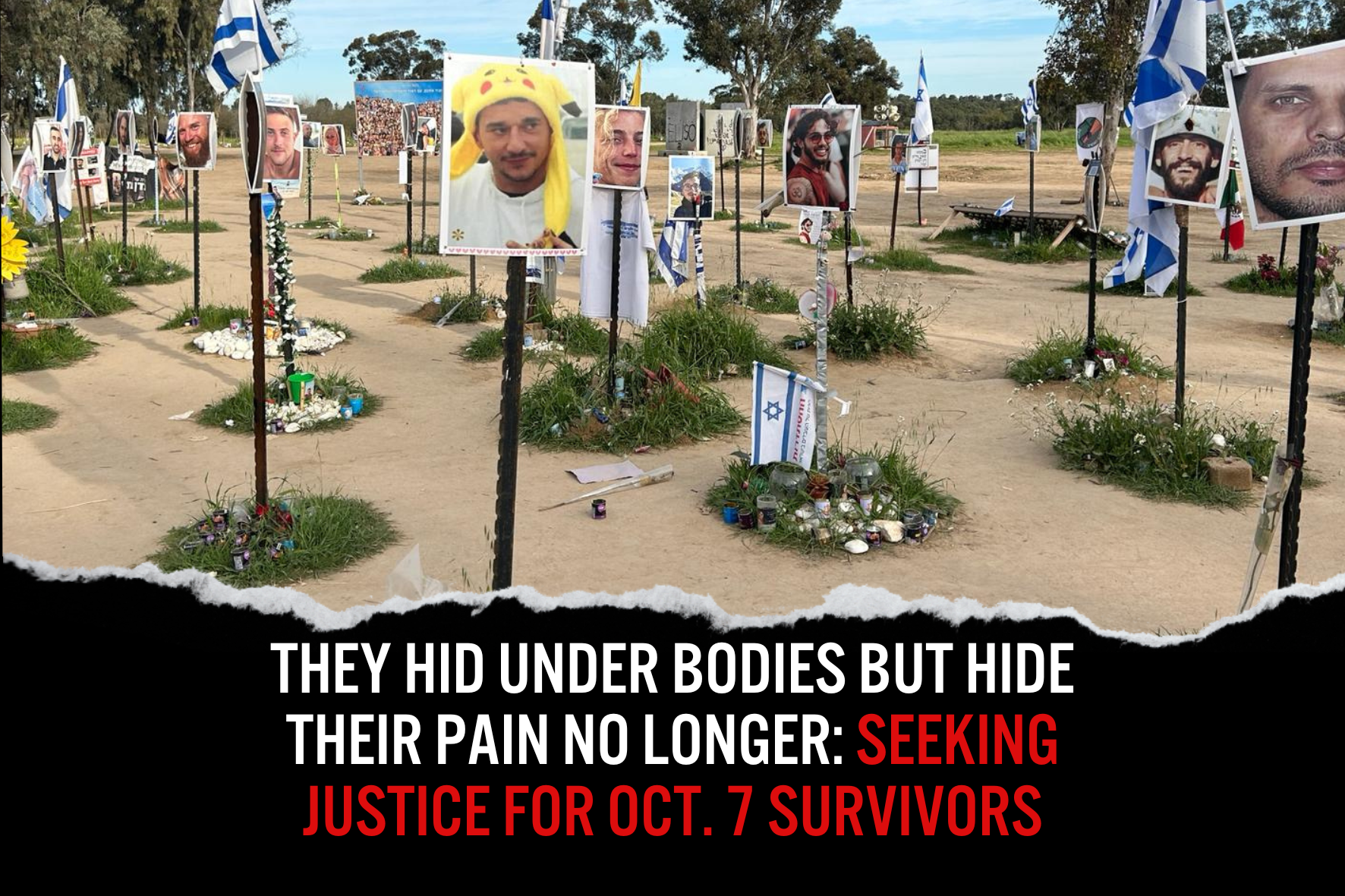
Seeking justice for Oct. 7 survivors
‘I can’t explain how heavy a body becomes when it is dead,” she shared with preternatural calm. It was my first meeting with Yuval Raphael, a 23-year-old with a clear sense of mission, and an undeniable presence.
Despite the pain she carried, her motivation and focus were obvious, especially in her expressive eyes. As she spoke, everyone in the room was captivated by her unwavering voice, which hinted at both readiness and a profound sense of purpose.
Yuval survived the Supernova massacre by hiding in the far corner of the public bomb shelter just outside of Kibbutz Be’eri. We met in February. Four months had passed since October 7 and she was finally ready to tell her story to a team of lawyers and human rights advocates.
For the past seven months, the media spotlight has intensely highlighted the suffering of hostages and victims of Hamas’s sexual violence. However, it’s vital to acknowledge the thousands of survivors who are also struggling, and deserve recognition and justice. From the onset of this conflict, the Jerusalem Institute of Justice (JIJ) has dedicated itself to supporting these Israelis, focusing on their recovery and restitution as a crucial part of our nation’s path forward. Their stories and their healing are fundamental to the fabric of our community.
Approximately 50 festival attendees sought shelter with Yuval, thinking that the small concrete structure would provide safety from the constant barrage of rockets. Instead, this small shelter became their tomb, as the terrorists strafed the inside with bullets at regular intervals and threw grenades. During their first infiltration, Yuval became trapped under the dead body of another young woman. There she would stay for 8 hours, playing dead.
“Every time we [those who were still alive] raised our heads, we couldn’t understand why there were less and less people in the bomb shelter. We thought the terrorists were taking the dead bodies. We didn’t realize it was because of the grenades, blowing up their bodies.” Of the 50 people who sought shelter with Yuval, only 12 survived long enough to be rescued – not by the IDF, but by the father of Nitzan, another young woman hiding in the bomb shelter.
IN MARCH, Yuval joined the JIJ legal team at the UN Headquarters in Geneva, where she engaged extensively with a broad array of ambassadors from around the world, testifying before diplomats of various nations. As she told her story yet again, this time before a distinguished audience, I was haunted by the parallels to my own experience in Gaza in the summer of 2001.
I was 19 years old, stationed in Gaza as a Givati combat soldier. This was well before Israel’s 2005 Disengagement, a time when our military bases, strung like vigilant sentinels along the Gazan border, were the linchpin of security. These outposts were more than just strategic positions: They were our frontline defense – critical for overseeing border crossings, curtailing the flow of arms, and swiftly countering threats.
On a hot summer night, two terrorists penetrated our base, killing my friend Tzachi, along with my commander and his medic. I was 300 meters away and heard about the attack on the radio. My friends who witnessed their murder directly stood inside the first circle of trauma and have struggled ever since to reach the normal milestones of adulthood.
My first brush with Hamas came 23 years ago when I was 19, two weeks before the 9/11 attacks in America. Since then, Hamas’s leaders have amassed a combined net worth of $11 billion. They came for Yuval when she was 23, leaving shrapnel under her skin, and a mind full of nightmares. Hamas leaders have vowed to do this again. As Hamas spokesperson Ghazi Hamad stated, “We must teach Israel a lesson, and we will do it again and again. The Al-Aqsa flood [October 7] is just the first time, and there will be a second, a third, a fourth.”
THE HARROWING experiences recounted by survivors like Yuval Raphael underscore the urgent need for accountability and justice. Initiatives such as legal action against the perpetrators of Hamas are not only crucial for providing closure and restitution to the survivors, but also for upholding the principles of international law.
At a time when the International Court of Justice draws a skewed moral equivalency between an unprovoked slaughter initiated by the leaders of a terrorist organization and the defensive actions of a democratic country, and when the chief prosecutor of the International Criminal Court announces plans to issue arrest warrants against Israeli leaders despite Israel’s strong and independent legal system, it is even more crucial that the voices of the victims are recognized and heard.
By holding accountable those responsible for heinous acts of terrorism, we not only honor the resilience of the survivors, but also send a clear message that such atrocities will not be tolerated. It is imperative that we support efforts to pursue justice, whether through domestic legal mechanisms or international institutions like the International Criminal Court in The Hague, in order to break the cycle of violence and build a safer, more just world for future generations.
The writer serves as the director of international law and public diplomacy at the Jerusalem Institute of Justice, an Israeli organization with special consultative status at the United Nations. The institute has represented survivors of terrorism, human trafficking and discrimination for 20 years. Before attending law school and joining the Israel Bar Association, the writer served as a combat soldier in the IDF.
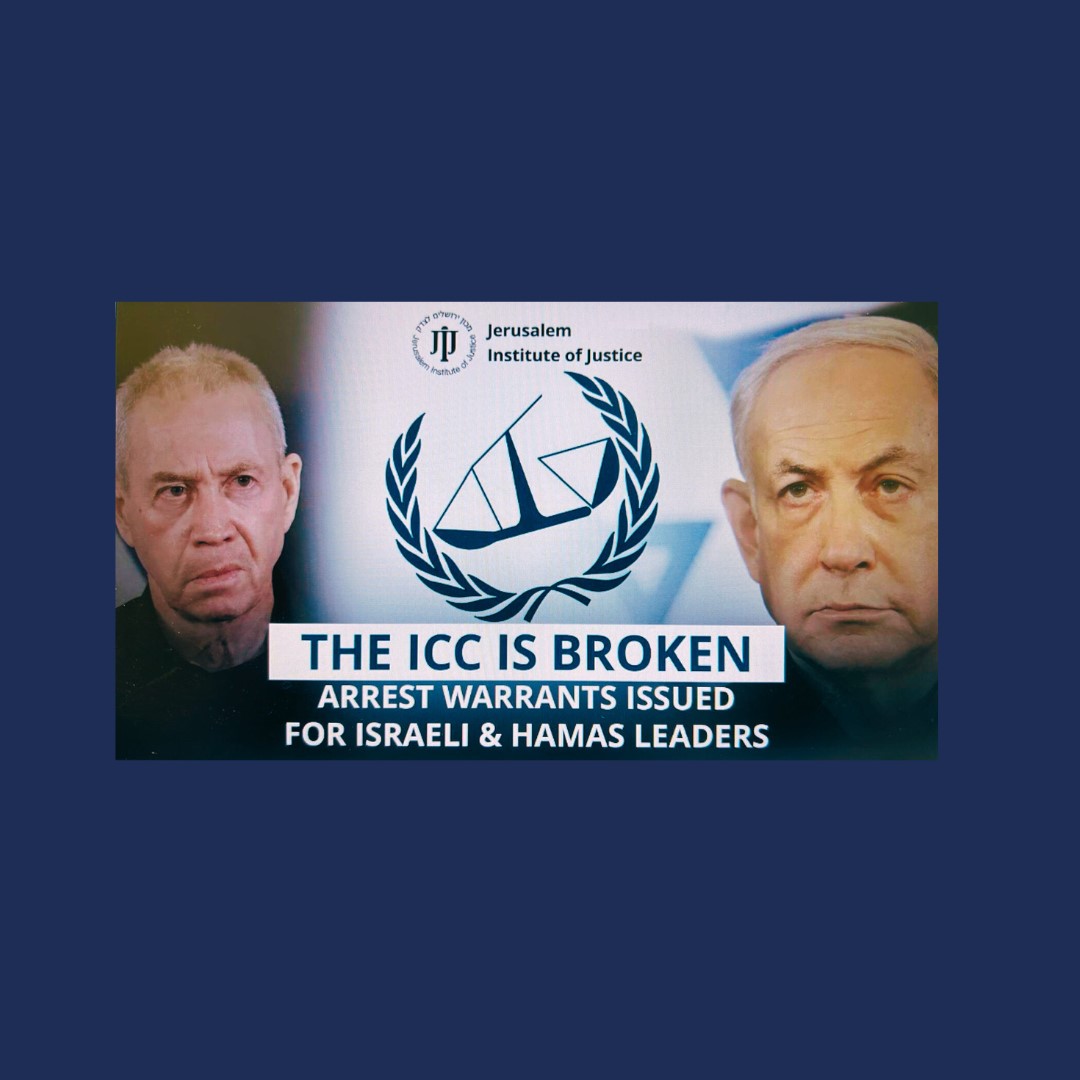
Response to ICC Prosecutor’s Request for Arrest Warrants for Hamas & Israeli Leaders
The Jerusalem Institute of Justice welcomes the ICC Prosecutor’s request for the issuance of
arrest warrants for Hamas’ leaders Yahya Sinwar, Mohamed Deif, and Ismail Haniyeh. We
are disappointed that Hamas’ leaders were not charged with the crime of genocide, despite
constantly expressing their fervent intent to exterminate all Israeli nationals and Jews, and
live streaming the evidence of how they brought this intent to action on October 7th.
We are appalled that the Prosecutor intentionally delayed this maneuver, seeking to pair it
with a request for arrest warrants for Israeli leaders Benjamin Netanyahu and Yoav Gallant.
If the Pre-Trial Chamber approves of this linkage, it will draw a false moral equivalence
between the parties to this conflict.
Since its establishment, the ICC has refrained from pursuing democratically elected officials
whose armies are engaged in wars of self-defense. It is fundamentally reckless to break from
this precedent for the first time when the democratic officials in question are the leaders of
the world’s only Jewish state, and at a time of rising global antisemitism. This development
will only serve to validate the claims of Hamas’ sympathizers across the globe, inspiring
more frequent and more violent attacks on Jewish people across the Diaspora.
The State of Israel has demonstrated that it is able and willing to investigate its own soldiers
and officials for any alleged violations of international law, including international
humanitarian law. Consequently, and in accordance with the principle of complementarity,
one of the most basic principles of the ICC, the Court should refrain from interfering.
The Prosecutor’s case against Israel rests on charges of “starvation” in seeming ignorance of
the fact that unprecedented levels of aid have entered Gaza since October 7th, including
400,000 tons of donated food.
Jerusalem Institute of Justice has sought the arrest of Hamas’ leaders through repeated
requests to the ICC’s Office of the Prosecutor since 2017, highlighting their systematic use of
torture, indoctrination of children, recruitment of child soldiers, and the abuse of civilians as
human shields. If they had been arrested for those crimes years ago, perhaps October 7th
never would have happened.
Despite today’s disappointing developments, we remain committed to pursuing justice for the
survivors and victims of Hamas’ atrocities, including through continued engagement with the
Office of the Prosecutor.