
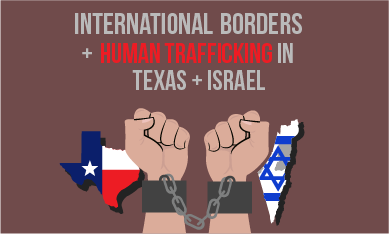
International Borders and Human Trafficking in Israel and Texas
Israel and Texas may not seem to have much in common upon initial thought. After all, the State of Texas is approximately 33 times the size of Israel, yet, both lands face human trafficking concerns due to their international borders. The Trafficking Victims Protection Act (TVPA) defines “severe human trafficking” as:
“sex trafficking in which a commercial sex act is induced by force, fraud, or coercion, or in which the person ... has not attained 18 years of age; or the recruitment, harboring, transportation, provision, or obtaining of a person for labor or services, through the use of force, fraud, or coercion ... A victim need not be physically transported from one location to another for the crime to fall within this definition.”
In Texas, the border with Mexico spans 1254 miles (2018 km) comprising the longest stretch of border with Mexico when compared to any other state. In comparison, Israel has 664 miles (1068 km) of border with 6 different border countries. Specifically, the Israel-Egypt border has a long history of human trafficking. This article explores both governments’ approaches to human trafficking and border security.
Texas
The State of Texas has battled with human trafficking across the Mexico border for decades. In fact, the U.S. Department of Justice estimates as many as one-quarter of all human trafficking victims pass through Texas. A University of Texas study found that there are 313,000 victims of human trafficking in Texas. Texas also houses the metroplex of Houston, which the Department of Justice has called the “most intense jurisdiction for trafficking in the U.S.”.
There are two primary factors that contribute to the issue of trafficking in Texas. The Mexico border, along with the major thoroughfares in Houston, the 4th largest city in the U.S., creates a prime environment for traffickers to smuggle humans into the United States. However, Texas has proven to be proactive in seeking to prosecute, prevent, and punish the crime of human trafficking. The U.S. Attorney Office for the Southern District of Texas, encompassing 44,000 square miles and 8.3 million people, “prosecutes more cases against defendants than any other United States Attorney Office nationwide.” Additionally, Texas has received a score of 94 and an “A” from Shared Hope International’s Protected Innocence Project report in 2016. Not surprisingly, Texas is not the only land faced with human trafficking concerns due to an international border.
Israel
Israel also experienced a major problem with human trafficking, especially in the 1990s when sex trafficking was rampant. Most victims of the sex trafficking epidemic were women from the Former Soviet Union who were exploited because of their poverty. A wake-up call came when the U.S. State Department placed Israel alongside Pakistan and Bahrain in Tier 3 of the annual Trafficking in Persons (TIP) Report in 2001. Tier 3 is the lowest possible level in the TIP Report and is an indication that a country is doing close to nothing to combat human trafficking within its borders. This spurred the Israeli authorities, along with anti-trafficking NGOs and advocates, to begin addressing the problem of trafficking. Between 2003 and 2005, Israel amended several laws to provide more support for trafficking victims, including legal representation and access to shelters. Israeli authorities also began to crack down on traffickers. As a result of their significant efforts to prevent and prosecute human trafficking, Israel was moved to Tier 2 of the TIP Report in 2002. The Knesset subcommittee on Combatting Human Trafficking and Prostitution chairwoman, Aliza Lavie, celebrated the improvements in the fight against modern-day slavery, however she noted that the progress “does not mean we can stop fighting.” Accordingly, a breakthrough in the fight against trafficking came with the construction of the southern border fence with Egypt.
Border Security by The Numbers
In 2013, Israel completed construction of a 150-mile (245 km) fence along its border with Egypt. The number of illegal crossers on the Israel-Egypt border dropped 99 percent after the construction of the fence, from more than 16,000 in 2011 to less than 20 in 2016. Israel spent $415 million ($2.9 million per mile) to construct the southern border fence and spends approximately $8.3 million annually ($58,000 per mile) to maintain the fence. For every 1.2 miles of fencing, Israel stations one person along its border with Egypt.
Although the United States does not have a complete border fence with Mexico, the U.S. has spent $2.3 billion to construct 654 miles of pedestrian and vehicle barrier fencing along the U.S.-Mexico border. Further, it costs the U.S. $50 to $55 million annually ($77,000 per mile) to maintain its 650 miles of fencing along the border with Mexico. This cost of maintenance is 33 percent more than Israel. Manpower is not neglected either, with approximately one person stationed for every 2.2 miles of the Mexico border. With these numbers in mind, a comparison of human trafficking in Texas and Israel is more easily understood.
Human Trafficking Today in Texas and Israel
In 2017, both the United States and Israel received a Tier 1 ranking in the U.S. Department of State’s TIP Report. Although Tier 1 is the highest level on the tier system, it does not mean there is no human trafficking in that country. Unfortunately, according to the Texas Department of Public Safety, the issue of trafficking is not going away any time soon. Notably, in the 2017 Texas Public Safety Threat Overview, trafficking is the fastest growing organized crime in Texas. Although Israel may no longer be a haven for sex traffickers, trafficking still exists. With the closed borders, traffickers now bring victims into Israel through the Ben Gurion International Airport in Tel Aviv. According to the Border Control Commissioner, over the past year and a half, 372 women have been stopped from entering through Ben Gurion Airport. Michal Yusupov, head of the Population Control Division, noted that the number of women attempting to enter Israel has increased in the past year. Even though all 372 women were prohibited from entering, it is likely that others have entered under the guise of tourism without being stopped. Even still, the 2017 TIP Report noted Israel’s “serious and sustained” efforts to eliminate trafficking. Some countries are now looking to Israel’s successful fight against trafficking to learn what strategies are most effective.
What Can Texas Learn From Israel
Reports supporting the building of a fence on the United States-Mexico border often use Israel’s success with the Israel-Egypt border fence as an example. Although the U.S., and especially Texas, can learn many important border security lessons from Israel due to the similarities in human trafficking, there are complications that are often forgotten in these reports. Take, for example, the sheer length of the U.S.-Mexico border which is drastic in comparison to the Israel-Egypt border. As previously mentioned, Israel’s border stretches approximately 150 miles, while just the Texas-Mexico border is over 1200 miles. Another complication arises from the fact that the U.S.-Mexico border runs alongside four states, all with varying opinions on border security. The bordering states of New Mexico and California both have laws that limit how local police interact with federal immigration agents—also known as sanctuary cities. The two other border states, Arizona and Texas, do not have such laws. This discrepancy makes a unified plan for border security difficult to draft and implement.
Despite the challenges, much progress can be made in U.S. border security based on Israel’s success when the beforementioned nuances are taken into consideration. For instance, technology has proven to be key in monitoring and capturing traffickers in Israel. Israel uses an array of technology including seismic sensors, radars, and balloons with cameras to reinforce its southern border fence. The Port Authority of Texas has taken note of Israel’s use of technology. In 2014, Texas contracted with an Israeli company, RADWIN, to use advanced cameras to monitor ports-of-entry into the United States. The modern tactic to combat human trafficking is combined governmental efforts and advanced technology. Texas may not be able to copy-cat Israel’s border fence; however, this does not mean the U.S. cannot use Israel as an example to find the most effective border security strategy unique to the Texas-Mexico border.

KNOW YOUR RIGHTS SEMINARS
Knowledge is power.
By bridging the communication gap between government and people, JIJ empowers minority populations to stand for their rights and fulfill their obligations under the law. The topics we cover in the seminars are proper NGO management and reporting to tax authorities, managing human resources, property tax exemptions, civil rights, immigration rights and general legal challenges.
These seminars are held several times a year, throughout the country addressing the needs of minority communities.
Would you like to host a Know your rights seminar? See our contact details below.
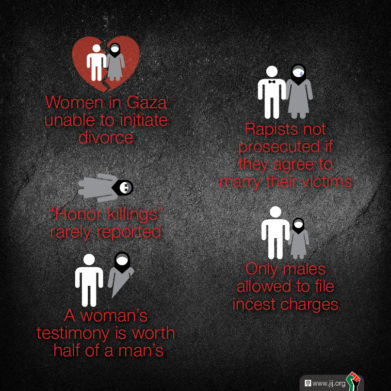
Gender Discrimination – Focus: Gaza
Gender discrimination in the Palestinian territories, especially in Gaza, is rampant. Male bias is present in every aspect of the personal, social and religious lives of everyday Palestinians. The discriminatory family and legal codes, which are grossly outdated, in addition to restrictions on physical integrity, civil liberties, resources and assets, along with blatantly accepted bias towards sons, provide justification and loopholes that inevitably lead to the poor, and often heinous, treatment of daughters, wives, mothers, sisters, nieces, etc.
According to the statistics found in the Social Inequality and Gender Index (SIGI) of the Organization for Economic Cooperation and Development (OECD), the Personal Status Law is adopted from Jordanian (1976 Personal Status Law, applicable in the West Bank) and Egyptian (unmodified 1954 Family Law, applicable in Gaza) religious laws; such laws were inspired by the Hanafi School of Islamic Jurisprudence and contain discriminatory provisions in marriage, child custody, divorce and inheritance.[1] As a result, according to the index scores of SIGI, the Palestinian Authority scores high-very high on the discrimination scale.
The legal age for marriage on the books in Gaza, is seventeen for females and eighteen for males, while there are reports that girls as young as nine and boys as young as twelve can be married if a judge deems it is in the child’s best interest (SIGI, Discriminatory Family Code). Additional reports indicate that fathers can, and do, marry off their daughters by withholding the child’s real age from the judge, often to “relieve financial burden”. Also, women cannot marry without permission from the closest paternal male relative and fathers are considered the natural guardians of children, while mothers are simply physical custodians (SIGI, Discriminatory Family Code). If divorced, mothers generally have physical custody of sons until the age of 10 and of daughters until the age of 12, however, if remarried the mother forfeits such rights. Christian women divorced from Muslim men are afforded even less rights if divorced. According to various reports, women who lost their husbands in conflict were threatened with losing custody of their children and being thrown out of their houses if they refuse to marry their late husband’s brother (SIGI, Discriminatory Family Code).
Restricted Physical Integrity
The most heartbreaking form of gender discrimination, comes in the form of “restricted physical integrity”. Realistically, a women’s body is not her own, it belongs to a male relative, to command and control as he wills. There are few protections in place to protect women from crimes against her person; the international community is still waiting for ratification drafted in 2011 to bring the legislation of the Palestinian Authority up to international standards (SIGI, Restricted Physical Integrity)..
Despite the high prevalence of domestic violence, and its exacerbation by poor living conditions, there are no laws against it, neither in Gaza or the West Bank. A substantial percentage of Palestinian women believe there are justifiable reasons for a husband to beat his wife, with only 39% believing there is no excuse. A large percentage of women claim to suffer violence from their husbands, physical and sexual, this is especially true in Gaza (SIGI, Restricted Physical Integrity). Of those, less than one percent of the victims filed police reports. Societal views of shame and honor keep victims silent having very few places or nowhere to turn to for help, and confidentiality of court proceedings is not guaranteed in domestic violence cases.
In Palestinian society it is taboo to speak of sexual abuse, especially incest, and the victim faces dire consequences and brings shame on herself and her family if she reports it.
There are laws against rape, which grossly lack proper protection and fail to even recognize spousal rape. The age of consent for sex is 18 and there is a minimum punishment for raping a minor, but lighter sentences may be given if the rapist can convince the court that he perceived the victim to be older than 16, which is in itself nonsensical since the legal age of consent is 18. According to various reports, rapists, in both Gaza and the West Bank, are released of all charges if they agree to “marry” their victims, and the victim’s families often pressure them to do so (SIGI, Restricted Physical Integrity).
Incest is not even considered sexual assault in the West Bank as the Jordanian Penal Code sights both the perpetrator and the victim as sharing blame, and that is regardless of the age of the child (SIGI, Restricted Physical Integrity). Women (and girls) are blamed for the sexual violence perpetrated against them and are thus forced to cover their bodies, to avoid being “seductive” even as small children.
Similarly, no laws are in place against sexual harassment, as “immoral advances” of either gender are mentioned in legislation without clarifying what that might be. In Palestinian religious society, even women's nature appearance is considered “provocative” and justification for rape (SIGI, Restricted Physical Integrity). It therefore should come as no surprise that women rarely report sexual harassment.
Female Genital Mutilation (FGM) reportedly takes place in Gaza, but the prevalence is unknown.
[1] OECD, SIGI,Gender Index, Palestinian Authority, available at http://www.genderindex.org/country/palestinian_authority, accessed Aug 20, 2016.
Children's Rights Abuses in the West Bank and Gaza
Executive Summary of Sons of Violence Report:
Violations of Children's Rights under the Palestinian Authority and Hamas
The Universal Declaration of Human Rights’ (UDHR) main principle is that all human beings have the right to life, liberty, and security of person, including the right to education, freedom from torture or cruel treatment and punishment, freedom to peacefully assemble, and freedom of thought, conscience, and religion.
With the recognition of Palestine as a non-member observer state to the United Nations (UN) in April 2014, the Palestinian Authority (PA) agreed to comply with 13 international conventions of human rights and humanitarian law. As such, the PA is obligated to comply with international human rights law (IHL) and implement all provisions laid out in the conventions. Complying with IHL requires Palestinian leadership (the PA and Hamas) to be bound by international laws protecting children’s rights.
In 1991, the Palestinian Liberation Organization (PLO), under Chairman Yasser Arafat, signed the United Nations Convention on the Rights of the Child (CRC); however, as the PLO was not a state, the PLO was unable to formally ratify the convention, thereby failing to have full legal impact in the territories. Despite this, the Palestinian National Authority (PNA) issued a report into the implementation of the CRC in the territories, which was received and reviewed by the CRC. This report examines the current violations of children’s rights in the West Bank and Gaza by the Palestinian government, and suggests that the PA and Hamas have failed to implement, nor do they intend to fulfill, their international promises. All information in this report was obtained through news sources, PA government materials, and interviews with individuals living and working in Gaza and the West Bank. All names have been withheld.
This report looks at Article 29 of Palestinian Basic Law, and how it applies to IHL and the CRC. It states that children have the right to:
- Comprehensive protection and welfare.
- Not to be exploited for any purpose … and not to be permitted to perform work that might damage their safety health or education.
- Protection from harmful and cruel treatment.
- Not to be subjected to beating or cruel treatment by their relatives.
- To be segregated… from adults, and be treated in a manner that is appropriate to their age and aims at their rehabilitation.
Palestinian Child Law No. 7 (2004) defines a child to be any human being under the age of 18, “including the unborn.” Palestinian law agrees with the CRC in the belief that young people under 18 years of age are considered more vulnerable and therefore require certain protections under the law.
With 47.5% (2014) of the Palestinian population under 18 years of age, the implementation of proper children’s rights protections is crucial. However, due to its foundations in traditional Sharia Law, Palestinian civil law lacks many of the democratic, secular, and egalitarian principles that are espoused by IHL and the CRC.
GENERAL PRINCIPLES
The Independent Commission for Human Rights (ICHR) monitored multiple cases of rights violations against children in 2015, reporting that large numbers of detainees in Palestinian jails were children between 16 and 17. Detainees were subjected to different forms of torture, including beating, kicking, punching, flogging, cold water dousing, and being forced to strip.
For young girls and women, honor killings are carried out when these girls are believed to have transgressed cultural norms (this includes issues of modesty, career choice, marriage, and relationships). Honor Killings, usually carried out by members of the girl’s family, do so in an attempt to restore the family’s reputation. Individuals in both the West Bank and Gaza confirm reports on the continuation of this practice, with one JIJ source explaining the prevalence of honor killings in Hebron (West Bank) where he heard of at least ten cases in 2014. Unfortunately, reliable data on the total number of child victims of honor killings is unavailable. This is, in part, due to the Palestinian government considering 15-year-old girls (West Bank) and 17-year-old girls (Gaza) as eligible for marriage, and therefore not victims. In the territories, Sharia Law dictates that those who reach puberty are considered adults and are thereby subject to the full force of the law. This directly contradicts the international definition of the ‘child’ as stated in the CRC, and as reiterated by Palestinian Basic Law.
CIVIL RIGHTS AND FREEDOMS
In the West Bank, many children are denied the right to legal existence. Under Palestinian law, extramarital sex is illegal, therefore women who give birth out of wedlock are punished. Honor killings play a role here, where families beat or kill girls or women who find themselves pregnant outside of marriage. Women are thus forced to give birth in secret in an effort to ensure their safety, abandoning their babies. One institution in the West Bank reports that on average 50 to 80 undocumented babies are born each year. The consequences: these children are denied a family name or an ID card, preventing them from establishing an identity in society.
An additional issue relates to the abandoned child’s religious identity. Regardless of where the child is found (Christian or Muslim communities), the child is automatically assumed to be Muslim. The implications of this are that, under Islamic Law, adoption is forbidden, therefore depriving ‘Muslim’ children the option of official adoption. These roadblocks to establishing legal identity and existence are in violation of the CRC; the PA fails to assist in the registration of these abandoned children, thus reneging on its obligations to protect the most basic of children’s rights.
Regarding access to information, the PA and Hamas fail to protect children with regards to information sharing and education. Instead, Palestinian leadership engages in indoctrination and incitement to violence through social networks, national TV children’s programs, basic education curriculums, and children’s magazines. Children in the territories are encouraged to become martyrs, to think of Jews as “barbaric monkeys,” and to spill blood in the name of the Koran. In addition, propaganda campaigns directed by both Fatah and Hamas promote and encourage child soldiers, with images depicting children dressed as soldiers, handling weapons, and promoting death and martyrdom. In many of these programs, the children are no older than 6 or 7 years of age, directly violating the CRC’s objectives of seeking to ensure safe and secure access to information that promotes the child’s “social, spiritual, and moral well-being, and physical and mental health.”

FAMILY ENVIRONMENT AND ALTERNATIVE CARE
According to the Ministry of Social Affairs (MoSA) in the West Bank and Gaza, the Ministry is entrusted with the care and protection of disadvantaged children, who include children with unknown parentage, those in social care institutions, and children with divorced or separated parents. MoSA’s guidelines for child care include the supervision of governmental and non-governmental children’s institutions, and the regulation of procedures for admission into institutional care. Yet, lack of resources leads to a lack of supervision and regulation.
Regarding foster care, with adoption being illegal under Islamic Law, MoSA is developing a ‘religiously acceptable’ foster care process called kafalah. Another roadblock to the system — foster care is only available for Muslim families in the West Bank, thus excluding non-Muslims from getting the help they need. Yet, despite legal requirements for foster care and foster families being outlined by MoSA, it has been found that there are no identifiable mechanisms in place to enforce routine and review of placement, and to ensure the wellbeing of the child.
Regarding issues of abuse and neglect, MoSA implements the National Child Care and Protection Protocol (2007) and defines conditions that place children at risk. These include violence, abuse, neglect, exploitation, incest, and assault — all of which are grounds for removal of a child from the family setting. However, according to Article 62 of the Jordanian Legal Code 1960, corporal punishment is deemed lawful “in the home,” with forms of discipline being permitted according to “general custom.” While Article 42 of Palestinian Child Law (2004) and Article 29 of the Amended Basic Law (2003) both state that children are to be protected from violence and abuse, these provisions fail to protect children in practice. A survey conducted by PCBS found that 9 in 10 children in the West Bank and Gaza reported being hit, beaten, or abused, with primary offenders identified as family members. Yet it is also significant to note that reporting abuse is an obstacle in and of itself: one JIJ source purports that, while it is required by law to report abuse when suspected, most refrain from involving police out of fear of the abuser exacting revenge on the child.
Regarding rape and sexual abuse against women and girls, reporting abuse is not easy and poses a threat to the women’s safety. Cultural taboos surrounding sex in Palestinian society make it difficult to acquire real statistics of rapes and sexual assaults, but it is believed that sexual violence within the family is not infrequent. According to one JIJ source, a girl 16 and under cannot seek help without a parent present, and there is no regard for confidentiality of a minor. Should the police take action, the victim faces a greater threat regarding her damaged reputation in her community, while the law commits the abuser only to a maximum of one day’s imprisonment.
BASIC HEALTH AND WELFARE
In its agreement to comply with the international conventions on human rights, the PA also acceded to the Convention on the Rights of Persons with Disabilities (2006), which holds that those persons with disabilities “must enjoy all human rights and fundamental freedoms.” Yet, it has been found that disabled children suffer from discrimination and degrading treatment in both the West Bank and Gaza. For example, one 2011 PCBS report found that 37.6% of children with disabilities 15 and up had never been enrolled in an educational institution, with 53.1% being reported as illiterate. According to a 2013 UNICEF report on the ‘state of the world’s children’, disabled children are regarded as “pitiable” and not as equal individuals. This is due largely to a “dominant perspective” that puts able-bodied individuals at a superior status than disabled individuals. This perspective is reflected in both national policy, regulations, and language used.
EDUCATION, LEISURE, and CULTURAL ACTIVITIES
Article 37 of Palestinian Child Law stipulates that every child has the right to be educated until the age of 18, and that the government should take all necessary measures to prevent school drop-outs. While the PA has attempted to provide a secure educational environment for children in the territories, they struggle to provide children with safe environments conducive to learning. Official Palestinian sources attribute high dropout rates to the low quality and weak promotion of education throughout the West Bank and Gaza, as well as to various cultural and societal factors that affect school enrollment.
Following the issue of violence against children, it has been found that the schooling system in the territories primarily uses violence to discipline students. A 2010 UNICEF report found that over 50% of students in West Bank schools were subjected to both physical and verbal abuse. The same study found that over 50% of teachers believed physical beatings were an “acceptable means of punishing students.” This phenomenon can be explained by the lack of educator skills and qualifications. PCBS reported in 2011 that only 29.3% of Palestinian teachers had Ministry of Education level qualifications. Also contributing to this issue is the fact that, as shared by professionals in the field, educators are simply “burned out.”
The issue of overcrowding also contributes to high dropout rates and, possibly, rates of abuse. One source explains how each of his classes in Gaza had nearly 50 students. Official Palestinian sources corroborate this claim, explaining how student numbers are increasing while classroom numbers are lacking, unable to absorb the many incoming students. Another source explains how teachers (according to his experience in Gaza) do not know how to “deal” with students in both government and UNRWA schools — teachers will “banish you…hurt you, they talk to you like you’re an animal.”
One factor that contributes to sexual harassment of girls is the government enforced gender-segregation of schools. All schools in Gaza are now gender-segregated at 9 years of age. Most government schools in the West Bank also enforce gender-segregation, with the exception of some private or UNRWA schools that remain coeducational. This separation has led to boys harassing female students, which some officials attribute to the lack of exposure to one another in safe, neutral environments.
A review of Palestinian school textbooks and curricula reveals a number of human rights violations. Recurring topics include the rejection of the State of Israel and denial of its right to exist, the demonization and incitement of violence against Jews, and a downplay of peace advocacy in favor of incitement. The hate speech and incitement to violence that educators run their classrooms with stands in stark contrast to the spirit of the CRC and IHL.
SPECIAL PROTECTION MEASURES
Article 93 of Palestinian Labor Law bans the employment of children under the age of 15 in the West Bank and Gaza, with children between the ages of 15 and 17 being permitted to work under certain controlled conditions. However, these laws are not carried out in practice, for child labor is still prevalent in the territories. For example, while the law includes children who work with relatives, many under age children are found to be working on family farms due to agriculture being a central aspect of Palestinian life. One 2010 report on Palestinian households shows that 4.1% of children between the ages of 5 and 11 worked for their families; 2.9% of this age group worked outside their household. To connect to the issue of school dropout rates, child employment is deemed a significant factor for students failing to attend school.
RECOMMENDATIONS
Regarding civil rights and freedoms, Palestinian leadership should ensure official registration and citizenship at birth and should step up their efforts in supporting institutions working with abandoned children. Furthermore, there should be an immediate cease to all promotion of martyrdom and incitement of violence through media and the education system. Finally, a just and effective punishment should be enforced on those who perpetrate honor killings.
Regarding family environment and alternative care, adoption practices and processes should be secularized, and religious freedom among children should be put into practice. MoSA should enforce a more efficient follow up care system for children in the foster system and ensure that the child’s rights are both protected and respected. Children should be protected from cruel and degrading punishment at home, in the workplace (if they are working), and at school through the development of protective legislation and installing penalties for use of corporal punishment. Moreover, the age of legal marriage should be raised to 18 so as to protect young girls and enable them to continue their studies in a healthy environment.
Regarding basic health and welfare, the rights of disabled children should be upheld and protected through developing educational programs and raising awareness on the subject of disability.
Regarding education, more classes should be opened to accommodate the increasing number of students and address the issue of overcrowding. Teachers should receive specialized training with information on education and discipline from a human rights perspective, in addition to having a selection criteria enforced for hiring education staff. All textbooks and curricula should be revised to remove message of incitement against Israel and the Jews. Finally, formal programming to foster gender equality should be implemented throughout all schools in the territories.
Regarding special protection measures, Palestinian leadership should establish a system that allows school personnel to report cases of children dropping out of school in favor of employment in an effort to promote learning and personal development of Palestinian children.