
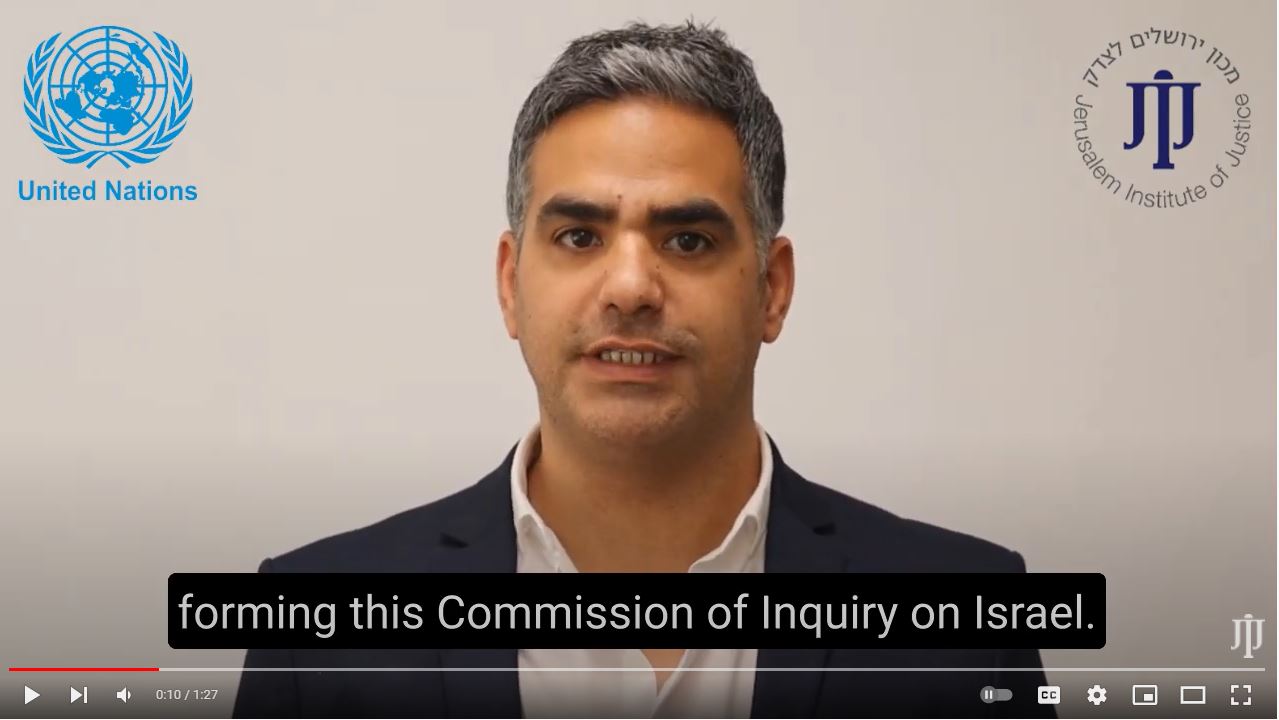
JIJ's oral statement at the 50th session of the UNHRC
https://www.youtube.com/watch?v=w8SAwlfw0D4
JIJ's Adv. Uri Morad, presented both oral and written reports at the 50th Session of the Human Rights Council. JIJ objects to the mandate of the Independent International Commission of Inquiry (COI) on the Occupied Palestinian Territory including East Jerusalem and Israel. We are standing for Israel and objecting to the vilification of the only democracy in the Middle East. We will not be silenced and we will not back down.

HRC 50th Session - Written Statement
Read Original Document
Mr. President,
We, the Jerusalem Institute of Justice, an Israeli NGO fighting to promote human rights, defend democracy, and improve the overall quality of life for Israelis and Palestinians alike, find it of the utmost importance to reject the so-called independent commission of inquiry named “The United Nations Independent International Commission of Inquiry on the Occupied Palestinian Territory, including East Jerusalem, and Israel (COI)”.
Israel-UN relations have known many lows throughout the years. From General Assembly resolution 3379 equating Zionism with racism, through the anti-Israel 2001 Durban World Conference against Racism which devolved into a vicious forum for Israel bashing and antisemitism, the UN has shown time and time again that its founding values of universality, impartiality, objectivity, and non-selectivity, are disregarded when it comes to the condemning of Israel. Let us be clear, this systematic campaign is done with the clear intention of delegitimizing the only democracy in the middle east.
The COI was formed in the wake of the 2021 Gaza Conflict, a conflict which erupted as a result of the indiscriminate firing of rockets and mortars by the Palestinian terrorist organizations in Gaza. The formation of this COI constitutes an escalation in the UN’s hostile approach towards Israel. If up until today the UN’s resolutions had more of a declarative nature, this COI was formed to prepare the ground for operative steps against Israel. This commission goes as far as to call upon third states to ignore Israel’s sovereignty and take action in regards to the Israeli-Palestinian conflict. Furthermore, the COI was tailor-made to enable the International Criminal Court to take legal action against Israel on the basis of the alleged Israeli breach of the Rome Statue.
It is enough to look at the COI’s mandate to grasp its prejudice towards Israel. The bias of the COI is especially evident in the terminology used in the text of the mandate, which designates the commission to “Investigate all underlying root causes of recurrent tensions, instability and protraction of conflict, including systematic discrimination and repression based on national, ethnic, racial or religious identity”. This kind of terminology has been put forth to prepare the ground for the commission’s expected false conclusion that Israel is an apartheid state. In addition, this terminology shows the commission will try to assign all the responsibility on the continuation of the conflict on Israel.
Furthermore, this commission of inquiry was assigned an extremely wide scope to investigate. Although the inquiry was formed as a response to the 2021 Gaza conflict, the scope of the investigation, as designated by its mandate, permits it to focus on issues related to the conflict since 1948. If this commission was formed as a response to the conflict in Gaza last year, why is it investigating the history of the conflict since 1948? Moreover, the terrorist organization Hamas is not mentioned even once in the resolution or the text of the mandate. This goes to show, once more, the minor role Hamas will be given in this commission’s report.[1]
This commission is of unprecedented measures. It has received an extremely large budget of millions of dollars, an unusually large staff of 18 permanent workers, and is also one of only 2 UN bodies ever created with an open-ended mandate. No other commission of inquiry has ever received a continuing mandate. Additionally, like any other “objective” UN inquiry on Israel, the choice of the inquisitors is intended to pre-determine the answer – even though this is in clear violation of UN rules. The Code of Conduct for Special Procedures Mandate-holders states very clearly that members of inquiries are required to follow to a specific code of conduct - they are supposed to uphold the highest standards of impartiality. “The work of the Council shall be guided by the principles of universality, impartiality, objectivity, and non-selectivity”.[2]
The three members of this Commission are anything but independent. The head of the Commission, Navi Pillay, was a key leader of the 2001 UN Durban World Conference against Racism which called Israel a racist state. Additionally, as United Nations High Commissioner for Human Rights during the 2008-9 and 2014 Gaza wars, Pillay played a pivotal role in promoting the Goldstone report and the outrageous slander that Israel targeted and murdered children. Since leaving office, she’s made a habit of promoting BDS and accusing Israel of apartheid. In a speech to the South African Department of International Relations and Cooperation’s seminar “The Year of Oliver Tambo and The Palestinian Struggle under Apartheid Rule, Pretoria, South Africa,” Pillay stated the following: “Apartheid is now being declared a crime against humanity in the Rome Statute, and it means the enforced segregation of people on racial lines, and that is what is happening in Israel.”[3] At the same event, Pillay also noted that she has met with members of the BDS campaign and that she hoped this “Palestinian struggle to end colonization”[4] will “catch on, as did the anti-apartheid movement.”[5] Is having an individual who has already accused Israel numerous times of being an apartheid state and who has publicly endorsed the BDS campaign lead this commission consistent with the UN’s own standard of impartiality?
In addition, the two other members of the committee, Miloon Kothari and Chris Sidoti, both hold anti-Israel extremism and Palestinian partisanship records. In 2002 Khotari issued a report claiming Israel was guilty of “ethnic cleansing” during the Second Intifada. In 2006 he claimed in a UN press release that the factors underlying the ongoing conflict between Israel and the Palestinians are the World Zionist Organization and Jewish National Fund’s colonization activities in the Jordan Valley. Chris Sidoti provides strategic guidance and advice to the Australian Centre for International Justice which works in partnership with the Palestinian Human Rights Organization Council. This Australian Centre issued a report in 2021 that calls on the Australian government to endorse BDS and the criminal prosecution of Israelis.[6] In conclusion, none of the three members of this so-called independent Inquiry meet the UN’s own rules of independence, impartiality, and objectivity.[7]
The result of this witch hunt is a foregone conclusion. This unfair commission of inquiry is expected to accuse Israel of being an apartheid state and thus target its legitimacy as a state. Therefore, we call on the Human Rights Council to revoke the resolution forming this commission. Alternatively, we recommend the removal of the three prejudiced judges heading the commission and that impartial judges be instated in their place.
Let us finish with, none other than, former Secretary General, Mr. Ban Ki-moon, who in a talk with Israeli students admitted the UN’s bias towards Israel saying the following:
“Unfortunately, because of the [Israeli-Palestinian] conflict, Israel’s been weighed down by criticism and suffered from bias — and sometimes even discrimination.”[8]
[1] https://www.ohchr.org/en/hr-bodies/hrc/co-israel/index
[2] https://ap.ohchr.org/documents/dpage_e.aspx?si=A/HRC/RES/5/2
[3]https://www.youtube.com/watch?v=6sIEfCf1Dhs&ab_channel=NTUInstituteofScience%26TechnologyforHumanity
[4] Ibid.
[5] https://www.youtube.com/watch?v=nF61qfb5J-k&ab_channel=Africa4Palestine
[6] Ibid.
[7] https://ap.ohchr.org/documents/dpage_e.aspx?si=A/HRC/RES/5/2
[8] https://www.timesofisrael.com/israel-faces-bias-at-un-ban-says/
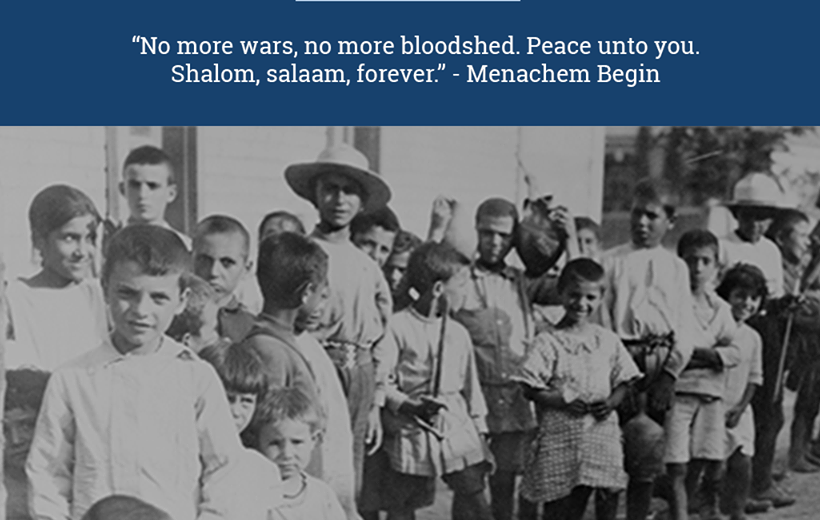
A Difficult Quest For Peace
A History of Public Opinion from 1967-2017
Fifty years ago, confronted with clear evidence of an impending Egyptian-led invasion, Israel's leaders gambled its national survival by launching a pre-emptive assault. What became known as the "Six Day War" has since become a signal historical event in the nation's history, and still shapes the collective consciousness of the Israeli people. Within less than a week, the tiny country's territory tripled.
The unsought Israeli control of East Jerusalem, the West Bank, the Golan Heights, the Gaza Strip, and the Sinai Desert brought urgent questions before the nation. Should Israel permanently annex one-or-more of these regions? Might they serve, instead, as critical bargaining pieces in a quest to persuade her enemies to abandon their dreams of Israel's destruction? What legal and ethical principles should guide the national debate?
Fifty years later, East Jerusalem has been integrated into Jerusalem's municipal borders. To meet critical security needs, the Golan Heights has been annexed into Israel. The Sinai Desert was returned to Egypt. Although Israel withdrew voluntarily from Gaza, the final status of Gaza and the West Bank remain undetermined. In other words, the questions posed by the miraculous outcome of the Six Day War remain unanswered.
The opinions of the Israeli people about these complex legal, ethical, political, and security issues have been measured, repeatedly, for five decades. Polling data makes up an overlooked, but vital, vector of national feedback during several crucial phases of the post-1967 era. Changing national convictions have influenced the decisions of political leaders, even as those leaders have, in turn, shaped public views.
This paper tracks the public's evolving response to the continuing conflict and, especially, to the indeterminate status of the territories. We conclude that the public showed a surprisingly sophisticated, if intuitive, grasp of the substantial risks tied to the most sweeping proposals and initiatives spanning 1967 to 2017. Our analysis will help anticipate, to some extent, the pathway which still lies ahead for the nation.
Download
Violations of Freedom of Expression and Freedom of the Press Under the Palestinian Authority and Hamas
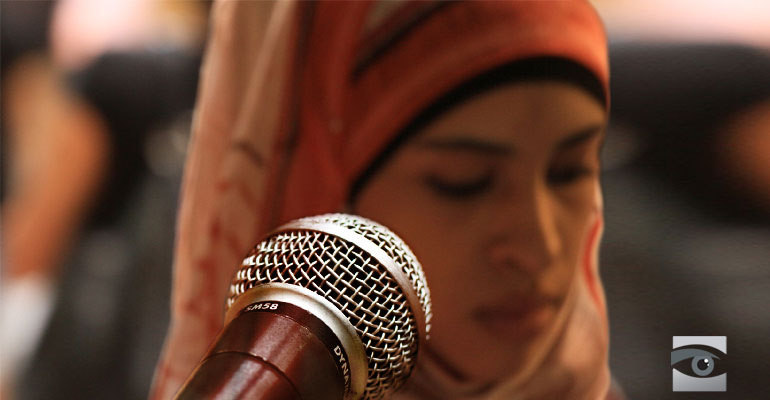
This report exposes the censorship on freedom of expression and freedom of press in the Palestinian territories. Journalists and citizens are restricted from speaking out on many topics, and areas such as politics and corruption are red line (forbidden) issues. The consequences of criticizing the reigning government can range on a spectrum from arbitrary arrest, torture and other abuses. Journalists are not protected by any body and therefore are constantly at risk.
While free press and speech are suppressed, hate speech and incitement of violence are common occurrences by Palestinian individuals and officials. Palestinian public bodies do not work to quell such actions, and in some ways political institutions encourage and sanction them. Even more so, journalists, religious leaders and government officials are at the core of spreading and promoting hate, antisemitism, and anti-Israel propaganda. With the rise in popularity of social media, the internet has become a main forum with which hate speech is circulated throughout the Palestinian community and disseminated world-wide.
Downloads
The Israeli Palestinian Conflict: 10 Myths Preventing Peace
https://www.youtube.com/watch?v=GdtGOY8T5XE
The Jerusalem Institute of Justice scripts the Israeli Palestinian conflict which is an often misunderstood political battleground where facts are mixed with opinion, preference, and prejudice. There's so much confusion around the conflict that we want to bring light to what is truth and what is myth. What issues are actually standing in the way of bringing peace between the Israelis and Palestinians? How does their fight over land complicate the conflict? And what role to political leaders like Yasser Arafat and Ehud Barak play along with organizations like UNRWA? These are questions we uncover in these 10 myths that are preventing peace in Palestine and Israel.