

53rd Session of the Human Rights Council - Agenda Item 7 - JIJ's Statement
https://www.youtube.com/watch?v=rUUKMJd_Chc
On the 10th of July, the UN Human Rights Council held a session on Item 7 of its agenda. This Item is defined as the “Human rights situation in Palestine and other occupied Arab territories.” This is, in fact, the only country-specific item on the agenda and has served as a pretext to issue a disproportionate amount of resolutions against Israel.
The Jerusalem Institute of Justice, which holds Special Consultative Status in the UN, has participated in this session. JIJ’s Human Rights, Law, and Research Officer, Carolina Grimberg Golijov, issued a statement opposing this item and calling upon the Council to respect its mandate and work for the protection of human rights.
Read the full transcript: JIJ's Oral Statement Transcript - 53rd HRC session -agenda item 7

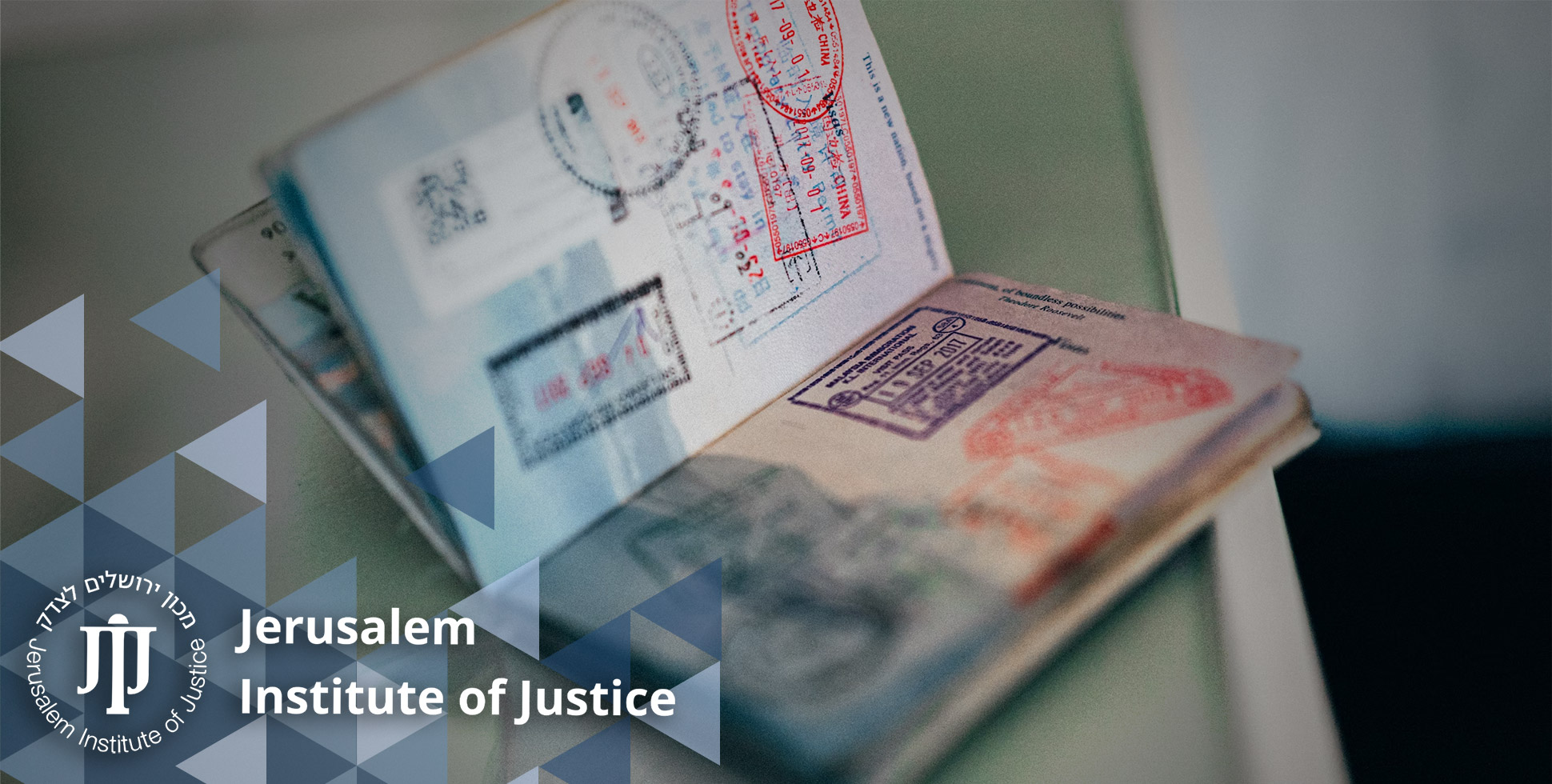
High Court of Justice, Challenging the Interior Ministry
|
|
|
High Court of Justice, Challenging the Interior Ministry
|
|
|
Examining the Israeli Judicial Reform
https://www.youtube.com/watch?v=ZT129G9vgn0
Israel's proposed judicial reform has sparked significant controversy within society, revealing the ongoing tension between the Executive and Judiciary branches. Supporters of the reform argue that it will enhance democracy in Israel, while opponents fear that it will undermine the democratic principles of checks and balances, granting too much power to the Executive branch and potentially endangering minority rights and human rights. The debate over the reform has created a deep divide within Israeli society. In this lecture, we explore the four components of the proposed reform, provide an overview of the current situation, and explain what changes the reform seeks to bring about. We will also examine the arguments presented by both supporters and opponents of the reform.
An appeal to the UN for Women's Rights
Article originally published at the Jerusalem post here
“Do not degrade your daughter by making her a prostitute, lest the land fall into prostitution and the land become full of depravity.” Leviticus 19:29
The fight for women's empowerment and equality is ongoing, and as we embrace technological advancements, we must remain vigilant of the risks that women face. The Jerusalem Institute of Justice (JIJ) calls for the United Nations Commission on the Status of Women to adopt the Nordic model in the fight against prostitution, as part of a broader strategy to tackle sex trafficking and prostitution in all its forms.
I am proud to lead an organization that for over 14 years, has been at the forefront of the battle against the sex trade in Israel. Developing policies, educating the public, and collaborating with communities and media platforms to promote the abolition of the sex trade. Our efforts have resulted in the adoption of the Nordic model in Israel, and today we urge the international community to follow suit.
As the 67th Session of the Commission on the Status of Women focuses on innovation and technological change, we must not forget the dangers that these advancements pose to women and girls. Internet prostitution has become a rising threat to their safety. Traffickers are increasingly using social media platforms like Facebook, Instagram, and Tinder as recruiting tools, driving the rise of prostitution. In Israel, Tinder is the most popular tool for finding persons engaged in the purchase and sale of sex.
Prostitution is a system that promotes violence, objectification, and degradation of women and men. The Nordic model fines those guilty of consuming prostitution, and it is classed as a civil offense. The law also provides education and support services to those in the sex trade. Decriminalizing the prostituted person acknowledges that the industry is not freely chosen, and that the prostituted person is the victim of economic and sexual exploitation at the hands of the procurer and buyer of sexual services.
This model's ultimate aim is to abolish the sex industry, and this can only be achieved by criminalizing the buyers of sex, as that will lead to a drastic reduction in demand. However, the evolution of internet prostitution requires governments to develop even more comprehensive strategy-based solutions to protect potential victims from predators. The Prohibition on Consuming Prostitution Act, passed by the Israeli Parliament in December 2018, presents a vision for a holistic approach that focuses not only on prohibiting paying for sex but also on educating the public about the dangers of the sex industry and by providing the opportunity for rehabilitation through governmental funding. The law also offers educational group sessions for the buyers aimed at changing their opinions and curbing recurrent infractions.
The Israeli law offers a blueprint for other countries to follow in the fight against prostitution. The rise of online prostitution through platforms like Onlyfans, which has emerged as the top platform worldwide for creators to sell erotic content, must be stopped. Masked as a social network that sells content and art, Onlyfans is just a simple way for sex to be sold for money on the internet. A third of users advertising explicitly sexual images on Twitter are underage.
The fight for women's rights and dignity is an ongoing battle that requires continuous effort and innovative strategies to overcome the challenges posed by technological advancements. The Jerusalem Institute of Justice's global call for the adoption of the Nordic model in the fight against prostitution and sex trafficking is a step in the right direction. It is time for governments worldwide to take action and work towards abolishing the sex industry and protecting the human rights of all individuals from violence, objectification, and exploitation.
Flavia Sevald, CEO
Jerusalem Institute of Justice

JUSTICE, THE BIBLE, AND US
Operating in the only democracy in the Middle East, the Jerusalem Institute of Justice uses the law to seek equality and fair treatment. Since the establishment of Israel in 1948, the country has been striving to find a balance between democratic values and its nature as a Jewish State.
We sometimes find a disparity between the law and political interests. For example, since the state’s beginnings, Jewish Ultra-Orthodox political factions have had a monopoly on matters of faith, deciding who is a Jew and who receives religious and civil rights. This creates huge challenges for other streams of Judaism and for those who profess any other faith, highlighting the need for the services provided by JIJ.
As an Israeli human and civil rights organization, JIJ draws its working principles from two monuments of thought. These are monuments that have decisively impacted western civilization. The first of course is the Bible, the second, which was written after the Holocaust, is the Universal Declaration of Human rights.
The Bible expresses God’s heart for the world, teaching us as it says in Micah 6:8, to walk humbly, pursue justice, love mercy, to have a proper regard for each person and to influence the development of a better society.
The rabbis in the Talmud say that the Torah begins and ends with justice. (Exodus Rabbah 30:19). But what is Justice? In Judaism, justice is the equal and right application of God’s law and morality for mankind.
In Hebrew, there is a clear connection between
- Justice-Tzedek,
- A righteous person- Tzadik,
- And acts of righteousness- Tzedakah
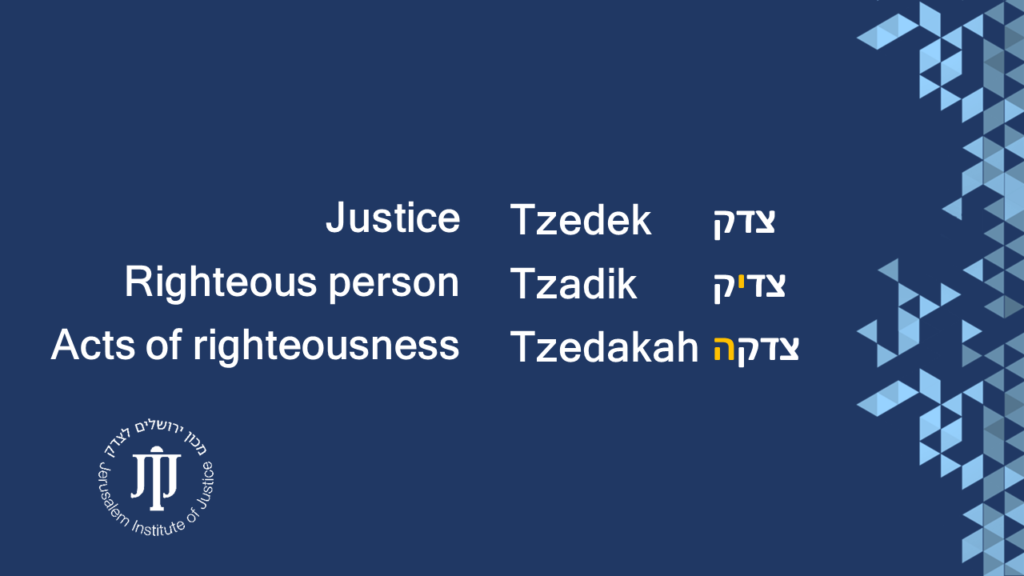
These terms are rooted in wisdom. The base of these words are three letters (tzadik, dalet and kuf) צ-ד-ק.
The only difference between the words is the addition of letters י(yud) and ה (heh) which both represent in Jewish tradition the full name of the Lord. Here we see the centrality of God in justice.
- To bring justice צדק,
- a godly person, צדיק,
- must perform godly acts, צדקה
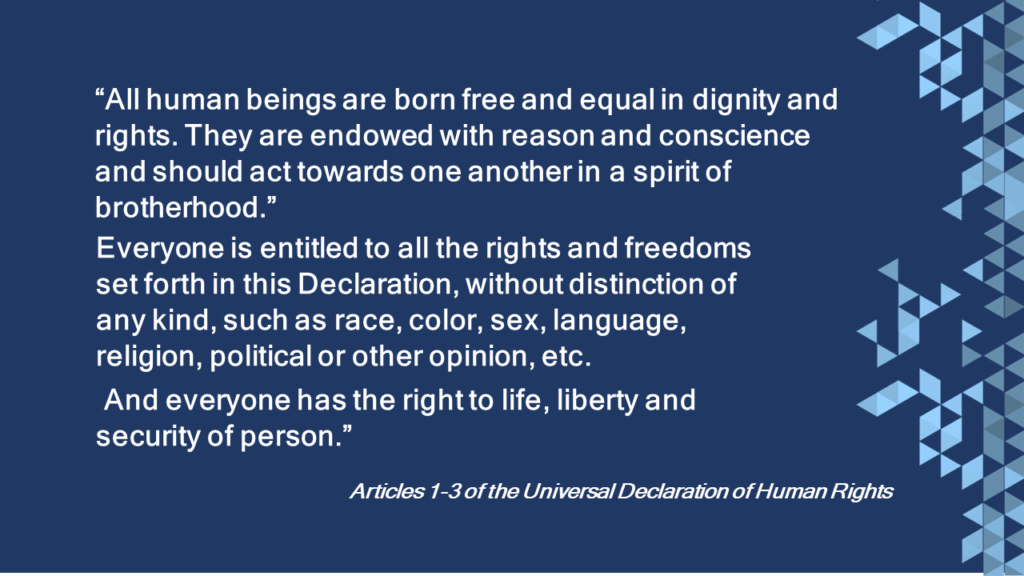
The Universal Declaration of Human Rights which was based on Judeo-Christian values, mirrors the principles of human dignity, our responsibility to each other and personal freedoms.
Part 2 – coming soon
Defunding Terror - Hamas
Jerusalem Institute of Justice is proud to sign on to this amicus brief, petitioning the US Supreme Court to hear the case in which National Westminster Bank transferred money that was knowingly going to the US designated terror organization, Hamas.
Amicus Brief Introduction:
The raison d’etre of the Palestinian Islamic Resistance Movement, known by its acronym “Hamas,” is—as explicitly stated in Hamas’ Charter of 1988 and often repeated by its leadership—the murder of Jews and the violent expulsion of #Jews from their biblical ancestral homeland, the Land of #Israel. Petitioners and their loved ones were injured or killed in Hamas’ pursuit of its goals. And Respondent National Westminster Bank PLC (NatWest) knowingly aided and abetted those goals, through its facilitation of financial transactions for Interpal, knowing of Interpal’s connections to Hamas, and the foreseeable consequences of those financial transactions.
Petition to the International Association of Prosecutors
Petition to the International Association of Prosecutors
The Hague, September 2017
Dear members of the IAP Executive Committee and the Senate, dear members of the IAP,
In the run-up to the annual conference and general meeting of the International Association of Prosecutors (IAP) in Beijing, China, the undersigned civil society organisations urge the IAP to live up to its vision and bolster its efforts to preserve the integrity of the profession.
Increasingly, in many regions of the world, in clear breach of professional integrity and fair trial standards, public prosecutors use their powers to suppress critical voices.
In China, over the last two years, dozens of prominent lawyers, labour rights advocates and activists have been targeted by the prosecution service[1]. Many remain behind bars, convicted or in prolonged detention for legal and peaceful activities protected by international human rights standards, including the Universal Declaration of Human Rights. Azerbaijan is in the midst of a major crackdown on civil rights defenders, bloggers and journalists, imposing hefty sentences on fabricated charges in trials that make a mockery of justice[2]. In Kazakhstan, Russia and Turkey many prosecutors play an active role in the repression of human rights defenders, and in committing, covering up or condoning other grave human rights abuses[3].
Patterns of abusive practices by prosecutors in these and other countries ought to be of grave concern to the professional associations they belong to, such as the IAP. Upholding the rule of law and human rights is a key aspect of the profession of a prosecutor, as is certified by the IAP’s Standards of Professional Responsibility and Statement of the Essential Duties and Rights of Prosecutors, that explicitly refer to the importance of observing and protecting the right to a fair trial and other human rights at all stages of work[4].
Maintaining the credibility of the profession should be a key concern for the IAP. This requires explicit steps by the IAP to introduce a meaningful human rights policy. Such steps will help to counter devaluation of ethical standards in the profession, revamp public trust in justice professionals and protect the organisation and its members from damaging reputational impact and allegations of whitewashing or complicity in human rights abuses.
For the second year in a row, civil society appeals to the IAP to honour its human rights responsibilities by introducing a tangible human rights policy. In particular:
We urge the IAP Executive Committee and the Senate to:
- introduce human rights due diligence and compliance procedures for new and current members, including scope for complaint mechanisms with respect to institutional and individual members, making information public about its institutional members and creating openings for stakeholder engagement from the side of civil society and victims of human rights abuses[5].
We call on individual members of the IAP to:
- raise the problem of a lack of human rights compliance mechanisms at the IAP and thoroughly discuss the human rights implications before making decisions about hosting IAP meetings;
- identify relevant human rights concerns before travelling to IAP conferences and meetings and raise these issues with their counterparts from countries where politically-motivated prosecution and human rights abuses by prosecution authorities are reported by intergovernmental organisations and internationally renowned human rights groups.
Supporting organisations:
Africa Network for Environment and Economic Justice, Benin
Anti-Corruption Trust of Southern Africa, Kwekwe
Asian Forum for Human Rights and Development (FORUM-ASIA)
Asia Justice and Rights, Jakarta
Asia Indigenous Peoples Pact, Chiang Mai
Asian Human Rights Commission, Hong Kong SAR
Asia Monitor Resource Centre, Hong Kong SAR
Association for Legal Intervention, Warsaw
Association Humanrights.ch, Bern
Association Malienne des Droits de l'Homme, Bamako
Association of Ukrainian Human Rights Monitors on Law Enforcement, Kyiv
Associazione Antigone, Rome
Barys Zvozskau Belarusian Human Rights House in exile, Vilnius
Belarusian Helsinki Committee, Minsk
Bulgarian Helsinki Committee, Sofia
Canadian Human Rights International Organisation, Toronto
Center for Civil Liberties, Kyiv
Centre for Development and Democratization of Institutions, Tirana
Centre for the Development of Democracy and Human Rights, Moscow
Center for the Judiciary Watch of the People’s Solidarity for Participatory Democracy (PSPD), Seoul
China Human Rights Lawyers Concern Group, Hong Kong SAR
Civil Rights Defenders, Stockholm
Civil Society Institute, Yerevan
Citizen Watch, St. Petersburg
Collective Human Rights Defenders “Laura Acosta” International Organization COHURIDELA, Toronto
Comunidad de Derechos Humanos, La Paz
Coordinadora Nacional de Derechos Humanos, Lima
Destination Justice, Phnom Penh
East and Horn of Africa Human Rights Defenders Project, Kampala
Equality Myanmar, Yangon
Faculty of Law - University of Indonesia, Depok
Fair Trials, London
Federation of Equal Journalists, Almaty
Former Vietnamese Prisoners of Conscience, Hanoi
Free Press Unlimited, Amsterdam
Front Line Defenders, Dublin
Foundation ADRA Poland, Wroclaw
German-Russian Exchange, Berlin
Gram Bharati Samiti, Jaipur
Helsinki Citizens' Assembly Vanadzor, Yerevan
Helsinki Association of Armenia, Yerevan
Helsinki Foundation for Human Rights, Warsaw
Human Rights Center Azerbaijan, Baku
Human Rights Center Georgia, Tbilisi
Human Rights Embassy, Chisinau
Human Rights House Foundation, Oslo
Human Rights Information Center, Kyiv
Human Rights Matter, Berlin
Human Rights Monitoring Institute, Vilnius
Human Rights Now, Tokyo
Human Rights Without Frontiers International, Brussels
Hungarian Civil Liberties Union, Budapest
IDP Women Association "Consent", Tbilisi
IMPARSIAL, the Indonesian Human Rights Monitor, Jakarta
Index on Censorship, London
Indonesian Legal Roundtable, Jakarta
Institute for Criminal Justice Reform, Jakarta
Institute for Democracy and Mediation, Tirana
Institute for Development of Freedom of Information, Tbilisi
International Federation for Human Rights (FIDH)
International Partnership for Human Rights, Brussels
International Service for Human Rights, Geneva
International Youth Human Rights Movement
Jerusalem Institute of Justice, Jerusalem
Jordan Transparency Center, Amman
Justiça Global, Rio de Janeiro
Justice and Peace Netherlands, The Hague
Kazakhstan International Bureau for Human Rights and Rule of Law, Almaty
Kharkiv Regional Foundation Public Alternative, Kharkiv
Kosovo Center for Transparency, Accountability and Anti-Corruption - KUND 16, Prishtina
Kosova Rehabilitation Center for Torture Victims, Prishtina
Lawyers for Lawyers, Amsterdam
Lawyers for Liberty, Kuala Lumpur
League of Human Rights, Brno
Macedonian Helsinki Committee, Skopje
Masyarakat Pemantau Peradilan Indonesia (Mappi FH-UI), Depok
National Coalition of Human Rights Defenders, Kampala
Netherlands Helsinki Committee, The Hague
Netherlands Institute of Human Rights (SIM), Utrecht University, Utrecht
NGO "Aru ana", Aktobe
Pakistan Rural Workers Social Welfare Organization (PRWSWO), Bahawalpur
Pen International, London
Philippine Human Rights Advocates (PAHRA), Manila
Promo-LEX Association, Chisinau
Protection International, Brussels
Protection of Rights Without Borders, Yerevan
Public Association Dignity, Astana
Public Association "Our Right", Kokshetau
Public Fund "Ar.Ruh.Hak", Almaty
Public Fund "Ulagatty Zhanaya", Almaty
Public Verdict Foundation, Moscow
Regional Center for Strategic Studies, Baku/ Tbilisi
Socio-Economic Rights and Accountability Project (SERAP), Lagos
Stefan Batory Foundation, Warsaw
Suara Rakyat Malaysia (SUARAM), Petaling Jaya
Swiss Helsinki Association, Lenzburg
Transparency International Anti-corruption Center, Yerevan
Transparency International Austrian chapter, Vienna
Transparency International Česká republika, Prague
Transparency International Deutschland, Berlin
Transparency International EU Office, Brussels
Transparency International France, Paris
Transparency International Greece, Athens
Transparency International Greenland, Nuuk
Transparency International Hungary, Budapest
Transparency International Ireland, Dublin
Transparency International Italia, Milan
Transparency International Moldova, Chisinau
Transparency International Nederland, Amsterdam
Transparency International Norway, Oslo
Transparency International Portugal, Lisbon
Transparency International Romania, Bucharest
Transparency International Secretariat, Berlin
Transparency International Slovenia, Ljubljana
Transparency International España, Madrid
Transparency International Sverige, Stockholm
Transparency International Switzerland, Bern
Transparency International UK, London
UNITED for Intercultural Action the European network against nationalism, racism, fascism and in support of migrants, refugees and minorities, Budapest
United Nations Convention against Corruption Civil Society Coalition
Villa Decius Association, Krakow
Vietnam's Defend the Defenders, Hanoi
Vietnamese Women for Human Rights, Saigon
World Organisation Against Torture (OMCT)
Zimbabwe Lawyers for Human Rights, Harare
[1] As documented by a number of internationally renowned human rights organisations, including Human Rights Watch and the ICJ. See, for example, the HRW World Report 2017, China and Tibet, available at: https://www.hrw.org/world-report/2017/country-chapters/china-and-tibet; China: call for action at UN on lawyers and other human rights defenders, available at: https://www.icj.org/wp-content/uploads/2017/02/UN-HRC34-China-JointLetter-Advocacy-2017.pdf
[2] The Functioning of the Judicial System in Azerbaijan and its Impact on the Fair Trial of Human Rights Defenders, Helsinki Foundation for Human Rights and Netherlands Helsinki Committee 2016, available at: http://www.defendersorviolators.info/judiciary-in-azerbaijan.
[3] See, for example: Human Rights and the Professional Responsibility of Judges and Prosecutors in the Work of CCJE and CCPE. Observations to the CCJE-CCPE Joint Report on “Challenges for Judicial Independence and Impartiality in the Member States of the Council of Europe”, Netherlands Helsinki Committee and Helsinki Foundation for Human Rights 2017, available at: https://www.nhc.nl/assets/uploads/2017/06/20170331-Observations-to-CCJE-CCPE-Report.pdf
[4] Standards of Professional Responsibility and Statement of the Essential Duties and Rights of Prosecutors adopted by the International Association of Prosecutors on 23 April 1999.
[5] See, for example, Options for Promoting Human Rights Compliance by the International Association of Prosecutors, policy brief, October 2016.