
THE ULTIMATE BONE OF CONTENTION
“Jerusalem is, without doubt, the ultimate bone of contention,” declares international law scholar Jacques Gauthier. He says that a title search in The Law of Nations shows that the Israeli ownership of Jerusalem is res judicata, decided law. (Gauthier, YouTube, “Who Owns Jerusalem?”)
“By denying a Jewish history and a Jewish Temple, the Palestinians are also denying Christianity its heritage. For without a Jewish Temple, the events of Jesus could not have taken place.” So writes author Barry Shaw. He notes that BDS churches subscribing to Replacement Theology have no problem with that. “Leaders of the Methodist, Anglican, and some Baptist churches fall in line with the Palestinian argument against Israel.” (Barry Shaw, Israel, Reclaiming the Narrative)
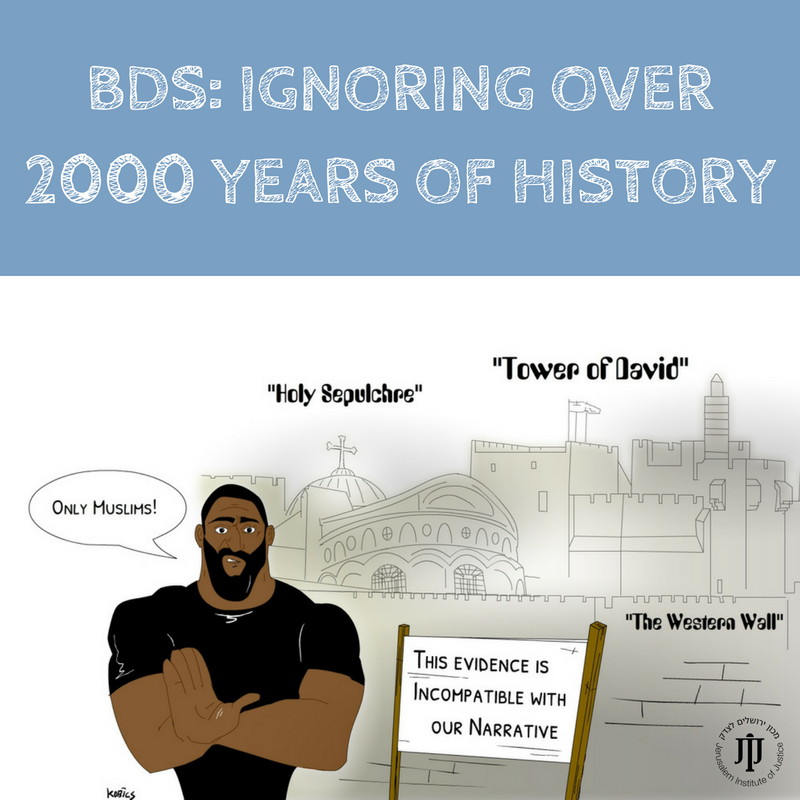
The Palestinians and their credulous followers in the BDS-supporting Western churches blatantly propagate the twin falsehoods that Israel has neither a legal claim nor a historical connection to Jerusalem. They use that line to promote the idea that Jerusalem should be divided or internationalized. Leftwing Israeli politician Shlomo Ben-Ami, a former foreign minister, revealed their deeper assumption: “At the deepest level, they are not ready to recognize that we have any kind of title here.” (Shaw, Reclaiming)
Let’s look at the Palestinian BDS claims in light of the legal and historical facts. In 2001 Ikrima Sabri, the Mufti of Jerusalem, audaciously lied to Die Welt, saying that “in the whole city, there is not even a single stone indicating Jewish history.”
In contrast, at various times plenty of Arab and Islamic sources have been more honest about it. In 1930 the Supreme Muslim Council in Jerusalem published a booklet called “A Brief Guide to al-Haram al-Sharif” (the Temple Mount). It states that the Temple Mount’s “identity with the site of Solomon’s Temple is beyond dispute.” Multiple similar examples can also be found. Even the Qur’an talks about Solomon’s construction of the first temple (34:13) and the destruction of the first two temples (17:7). (Bard, Mitchell, in “Myths and Facts”)
Recently we’ve seen attempts by BDS supporters to claim that the Jews have no authentic historical connection to Jerusalem. As Prime Minister Netanyahu quipped in his 2016 address to the United Nations, “That’s like saying that the Great Wall of China has no historical connection to the Chinese people.” The Palestinians are so fanatical about denying Israel’s historical connection to Jerusalem that they resort to destroying material evidence by massively excavating under the Temple Mount. Their BDS-aligned partners in Western religious circles go right along with this dishonest madness.
The Mandate for Palestine was passed in 1922 by the League of Nations and confirmed afterward by the United Nations. It has never been superseded. As an article of international law, it detailed what the boundaries were to be for Palestine as a Jewish national home. Those same legal boundaries continued to exist after the Jewish state succeeded the Mandate in 1948. Jerusalem is entirely within those boundaries. Therefore, quite simply, Jerusalem is within the boundaries of Israel.
At the end of the 1948 war, in which five Arab countries invaded Israel, Israel had control of western Jerusalem, while Jordan controlled eastern Jerusalem. However, Jordan had acquired that control by illegal aggression and continued to hold it illegally for 19 years until 1967 (during which time a ceasefire agreement was in effect). Jordan’s broader occupation and annexation of Judea and Samaria was also illegal. Moreover, in violation of the armistice agreement, Jordan refused during those years to allow Jews into eastern Jerusalem. Because of that, eastern Jerusalem became known in popular conception as “Arab” Jerusalem.
The outcome of the 1967 Six-Day War reinforced Israel’s claim to Jerusalem. Rejecting Prime Minister Eshkol’s peace offer to Jordan, King Hussein mounted an attack on Israel anyway. Of course, Israel defended itself, resulting in Jordan losing control of the West Bank and Jerusalem (gained by aggression in 1948). This victory allowed Israel to extend its jurisdiction and administration to eastern Jerusalem. Based on the principle that a state acting in self-defense has greater right to a territory than an aggressor attacking the territory, distinguished international lawyer and later president of the International Court of Justice, Stephen Schwebel, stated, “Israel has better title in the territory of what was Palestine, including the whole of Jerusalem.”
Ironically, the Palestinians insist on returning to the “1967 border,” the same ceasefire line that Jordan had insisted was temporary in 1949. Indeed, the armistice line was never a border; it was expressly temporary. But by an absurd stretch, the Palestinians base their claim on the premise that the real estate was Jordan’s and therefore it’s theirs – as if the Palestinians were identical to Jordan. Jordan and the Palestinians are in fact two different entities. The armistice agreement was between Israel and Jordan, two sovereign nations. It had nothing to do with the Palestinians. So there is no legal reason to divide Jerusalem.
The Qur’an makes no explicit reference to Jerusalem, and Muslims praying in Jerusalem turn their backs to the Temple Mount, facing Mecca. So why is the Palestinian national movement so adamant about displacing the Jews and establishing Islamic sovereignty over Jerusalem? As Barry Shaw observes, it’s not so much about their own claims, but about using their interpretation of Islam to further their political agenda: “It’s all about destroying Israel and planting their Palestinian flag over Jerusalem as a statement of conquest.” Sadly, that would appear to be just fine with the pro-BDS Christian denominations who are driven by their Replacement Theology with its implicit anti-Semitism.

Yom Yerushalayim: Significance for Freedom of Religion
On May 13, Israelis and Jews will celebrate Jerusalem Day, commemorating the reunification of Jerusalem under Israeli sovereignty during the Six Day War of 1967. For some, the day is a celebration of renewed access to the Western Wall and the rest of the Jewish Quarter of the Old City. For others, it is a more general celebration of success in the face of overwhelming odds.
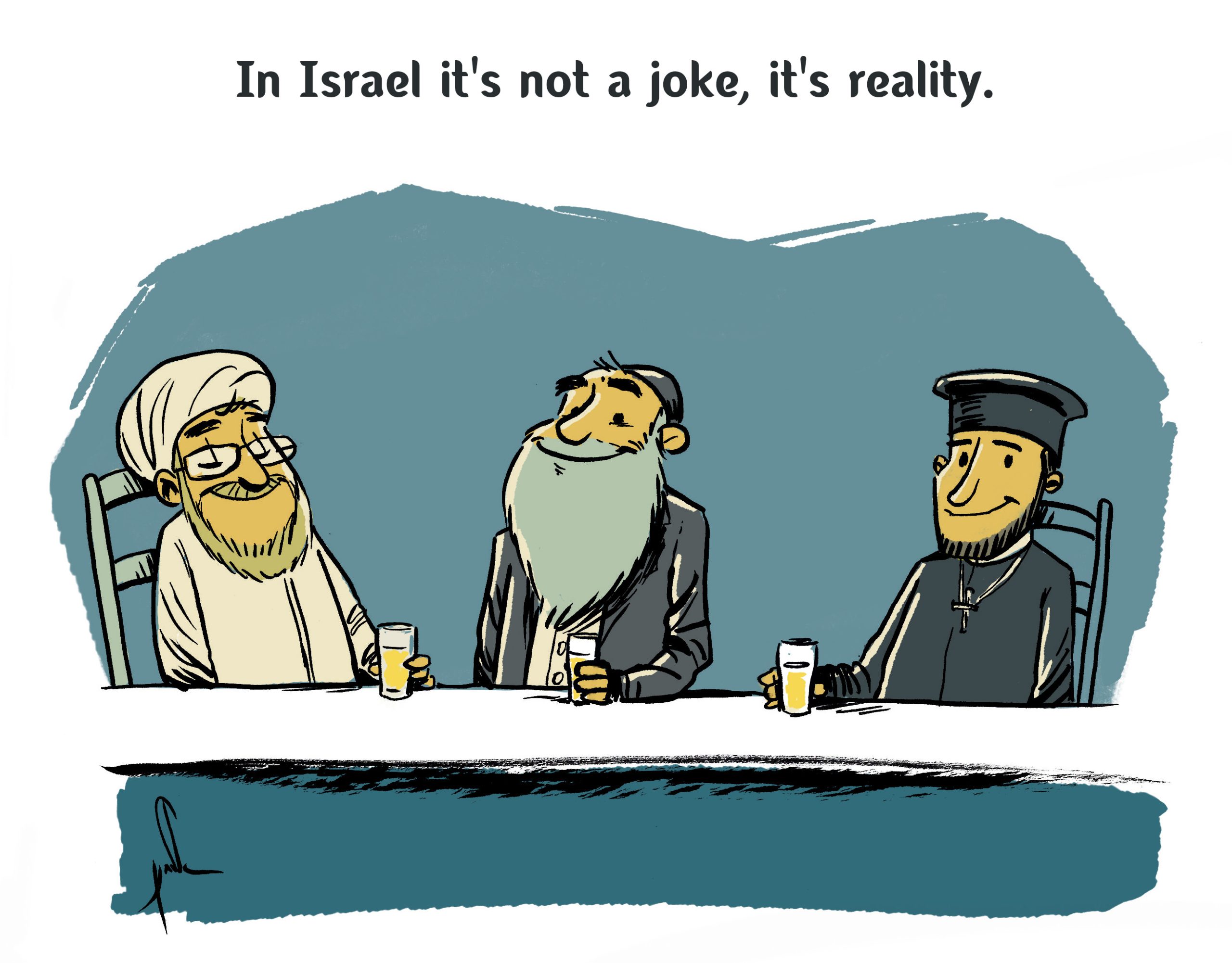
However, one of the most underappreciated outcomes of a united Jerusalem relates to freedom of religion. Throughout the historical periods of Jewish, Christian and Muslim rule, the great faiths erected monuments and places of worship unrivalled by other cities. The Hurva and Ohel Yitzhak Synagogues are a window into the city’s Jewish history, in the same way that the Churches of the Holy Sepulchre and St. Anne are to the city’s Christian heritage. Similarly, the Al-Aqsa Mosque and the Dome of the Rock are revered by Muslims worldwide and are a core component of the city’s Islamic heritage.
It is for this reason that the 1947 UN Partition Plan originally designated Jerusalem as corpus separatum (separated body), to be an international city that guaranteed access to adherents of the three Abrahamic faiths.
However, the cosmopolitan nature of the city today is very different to the atmosphere between 1948-1967.
Prior to 1967, Jordanian authorities severely limited freedom of religion in the city. Upon capturing the Jewish Quarter in 1948’s War of Independence, Transjordanian Arab Legion Major Abdullah el-Tell is said to have told his superiors: ‘For the first time in 1,000 years not a single Jew remains in the Jewish Quarter. Not a single building remains intact. This makes the Jews' return here impossible[1].’
Contrast this to the pronouncements of Prime Minister David Ben Gurion in 1948. When it appeared the Jewish forces were on the cusp of capturing the Old City of Jerusalem, he famously ordered the commander of Jerusalem, David Shaltiel, to ‘prepare a special force - loyal and obedient - …that will mercilessly use machine guns against every Jew – and especially against every Jewish soldier - who will attempt to rob or desecrate a Christian or Muslim holy place[2]’.
Between 1948 and 1967, the city was characterized by the repression of religious freedom and the destruction of minorities’ places of worship. All but two of the Old City’s 58 synagogues were destroyed under Jordanian rule[3]. Furthermore, Jordan’s King Hussein permitted the uprooting of thousands of tombstones at the Mount of Olives Cemetery for the construction of roads through the complex and even latrines for the Jordanian soldiers stationed there.
Even in recent decades, we can again see questionable respect for religious sites. The Solomon’s Stables structure existed under the Southeast corner of the Temple Mount and contained artefacts from eras as the First and Second Temple, Roman, Byzantine and Muslim periods[4]. However, the Israeli Islamic Movement decided in 1995-1996 to renovate the complex with the aim of converting it to a mosque[5]. With careless demolition procedures and without the official approval from relevant authorities, substantial irreversible damage was done to the Southern Wall of the city. As early as 2001, the Antiquities Authority discovered considerable swelling on the Wall, leading to the possibility that, along with the Eastern Wall, it could collapse[6].
The Temple Mount/Haram al-Sharif is another area that relies heavily on the guarantee of freedom of religion. Currently administered by the Jordanian funded waqf (Islamic trust), the complex is important in both historical and religious terms. Rather than infringe upon the right of access to Muslim adherents, the status quo agreement guarantees their access at the expense of Jewish adherents. While Jews have the right to enter the compound, they are forbidden from praying or carrying religious artefacts such as siddurim or kippot out of sensitivity for the Muslim sites there.
These Jerusalem-specific arrangements complement an extensive legislative regime aimed at protecting freedom of religion. The Protection of Holy Places Law of 1967 guarantees freedom of access to sacred places, protection against their desecration and even protection against violations of adherents’ feelings toward these places[7]. Furthermore, Israeli law does not prohibit changing one’s religion nor does it prohibit proselytizing (missionizing).
Thus, in celebrating Jerusalem Day, focus should not only be upon the unexpected victory of Israel’s military in 1967. It should be on the underlying heritage that unites the three Abrahamic religions, and the way in which Israel’s sovereignty over Jerusalem has safeguarded religious freedom.
[1] Zilhka, A. (1992), ‘History of the Israeli-Palestinian Conflict’ in E. W. Fernea and M. E. Hocking (eds.), The Struggle for Peace: Israelis and Palestinians, University of Texas Press, United States, p. 53
[2] Ankori, G. (2006), Palestinian Art, Reaktion Books, London, p. 26
[3] Jewish Telegraphic Agency Daily News Bulletin (1967), ‘Cabinet Report Says Jordan Destroyed 56 Old City Synagogues, Desecrated Cemetery’, November 2, p. 2, accessed March 7 2017, http://pdfs.jta.org/1967/1967-11-02_212.pdf
[4] Gonen, R. (2003), Contested Holiness: Jewish, Muslim and Christian Perspectives on the Temple Mount in Jerusalem, KTAV Publishing, United States, p. 167-169
[5] Shragai, N. (2012), ‘The Danger to Al-Aksa from Muslim Building Activity in Solomon’s Stables’, in Jerusalem Center for Public Affairs, The “Al-Aksa Is in Danger” Libel: The History of a Lie, accessed March 7 2017, http://jcpa.org/danger-to-al-aksa-from-muslim-building-in-solomons-stables/
[6] ibid
[7] The Israeli Knesset, Protection of Holy Places Law 5727 (1967), accessed March 7 2017, https://www.knesset.gov.il/laws/special/eng/HolyPlaces.htm
Restoration and Freedom
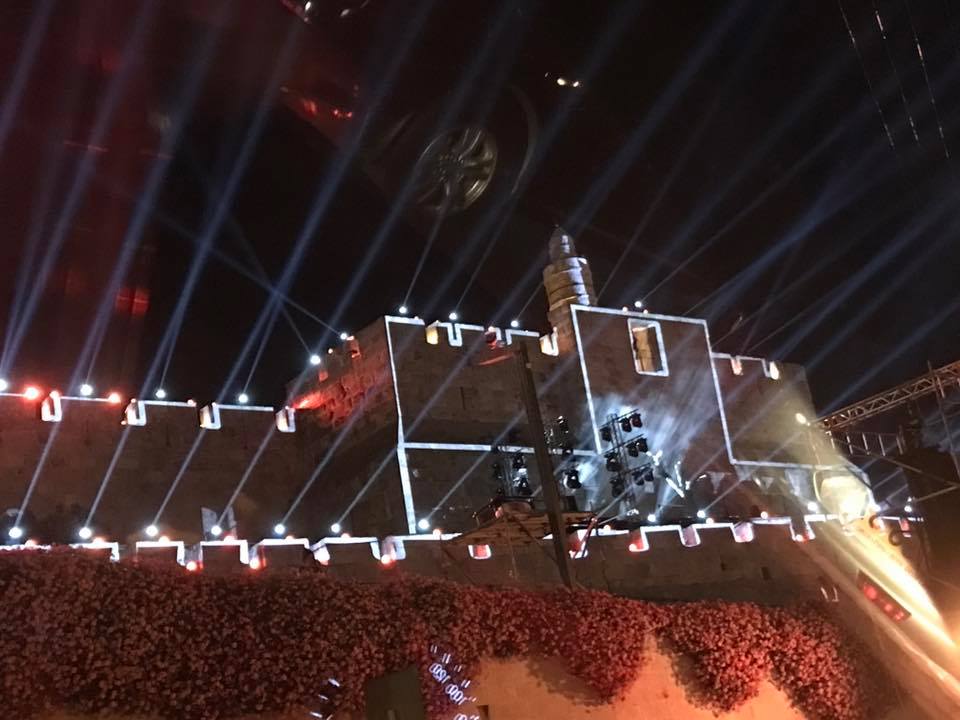
Jewish sovereignty was restored over all of Jerusalem, 50 years ago, in 1967. This restoration allowed peoples from all religions unfettered access to its Holy sites for the first time in approximately two millennia. We honor this occasion by celebrating "Jerusalem Day", today Wednesday, May 24th.
Historically, Jewish majority in the city of Jerusalem was established in the late 1880's. 100 years ago, Western Imperialistic powers led by General Allenby liberated the city of Jerusalem from the Islamic control of the Ottoman Empire, and thereafter, through the Balfour Declaration established that Palestine would be recognized as "a national home for the Jewish people".
In November, 1947, the UN General Assembly adopted a partition of Mandatory Palestine at the end of the British Mandate. The Partition Plan recommended a Special International Regime for the city of Jerusalem and the creation of independent Arab and Jewish States. This plan was never accepted by the Arab states and Jerusalem was under Jordanian control.
Under Jordanian occupation, Jerusalem was systematically Islamicized. No Jews were permitted to live in the city, and the Christian population dropped sharply from 25,000 to 9,000. Jordanian policy imposed the Arabic-language; included the destruction of dozens of synagogues; use of government-issued textbooks in Christian schools; a prohibition on the purchase of property by churches and a denial of church funding of social and medical services, including hospitals; and a total ban on visits to Jewish holy places by Jewish pilgrims.
The religious persecution continued until Jordan chose to join a coalition of Arab states and invade Israel in 1967. Israel's victory in the Six Day War resulted in the reunification of Jerusalem and freedom of worship was restored to members of all faiths.
Isaiah 62:6 - I have set watchmen upon thy walls, O Jerusalem, they shall never hold their peace day nor night: ye that make mention of the LORD, keep not silence...
Times and seasons are ultimately beyond our control. However, the Jerusalem Institute of Justice remains dedicated to confronting discrimination and exploitation by promoting human dignity to ethnic, religious and cultural minorities in Israel and throughout the Middle East. We hope and pray that this year restoration and freedom will come to many people in our region.
_______________________________________
Read more about JIJ: Click here
Browse our projects: Click here