
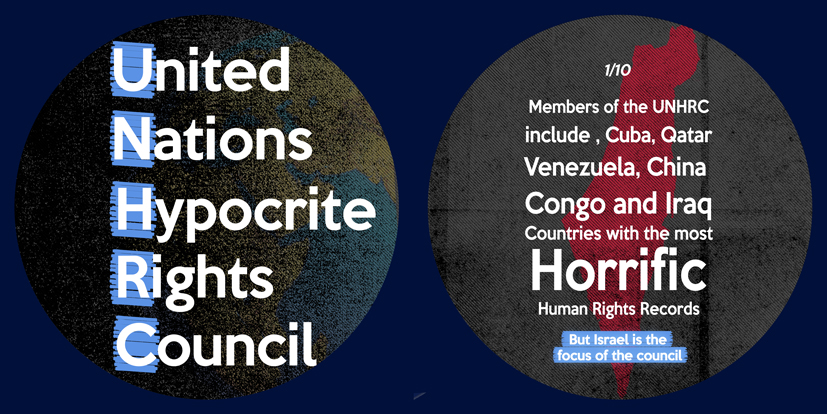
Human Rights Council - Political Bias
The UN Human Rights Council “database” of business enterprises
On 24 March 2016, at its 31st session, the Human Rights Council (HRC) adopted resolution 31/36 entitled “Israeli settlements in the Occupied Palestinian Territory, including East Jerusalem, and in the occupied Syrian Golan”.[1] Paragraph 17 (OP 17) of this resolution requests the United Nations High Commissioner for Human Rights (OHCHR) produce a database of all business enterprises engaged in certain Israeli settlement activity in the occupied Palestinian territory, or the "Blacklist".
While local and international business activity in disputed or occupied territories is widespread, and involves some of the world’s largest companies, Resolution 31/36 represents the only known UN effort to produce a “database” of such activity in respect of one situation. The fact that such business activity is so ubiquitous and rarely criticized demonstrates that it is not viewed as raising legal or human rights issues, while the desire to establish a database only with respect to business activity in Israeli settlement communities points to the political bias of the body that initiated this process.
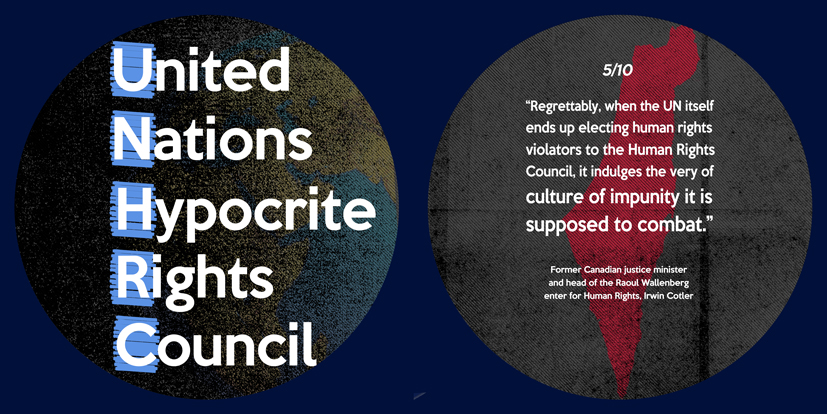
OP17 was adopted despite the strong opposition of the US, EU and Israel. It is the product of a specific discriminatory HRC agenda item, the organization's only country-specific agenda item, which reflects ongoing and well documented institutional bias against Israel in the HRC. The Council is widely criticized as a deeply politicized body, whose agenda is often dictated by the world’s worst human rights violators, and whose legitimacy and credibility in the human rights arena has been fundamentally undermined as a result.
Israel, together with the United States and numerous other leading States, have expressed, consistent opposition to the database and its publication, and have conveyed this position in their public and private communications. Israel has no intention of cooperating with this illegitimate exercise for the following reasons:
- Lack of authority to produce database: The production of a “database” exceeds the mandate of the OHCHR, which has neither the competence nor the capacity to engage in this action. The responsibility for ensuring compliance of business enterprises with relevant laws, or for promoting any relevant non-binding guidelines with respect to business practices, rests exclusively with the States in which the relevant enterprises are domiciled or operating.
- Lack of authority to communicate to companies: The HRC and OHCHR are bodies mandated to deal with State conduct in the human rights field and they have no legal or other authority over business enterprises.
- Lawfulness of business activity: Business activity in areas of Judea and Samaria (West Bank) under Israeli jurisdiction in accordance with existing Israeli-Palestinian agreements, is entirely lawful. Indeed, the notion that business enterprises are even subject to international law, international humanitarian law, and international human rights law is highly questionable and has been rejected by Courts in leading national jurisdictions.
- Blacklist: The creation of a database, and certainly its publication in any form, amounts to an effort to produce a blacklist of companies that are not engaged in any wrongdoing, and with the potential of causing commercial, reputational and legal harm. By engaging in this action, the OHCHR is allowing itself to become an instrument of those engaged in an illegitimate, discriminatory and political motivated agenda.
Furthermore, the methodology of the OHCHR is entirely devoid of transparency, and the information upon which it has based its communication has been drawn from partial, unverifiable and unknown sources, including politically-motivated actors, who responded voluntarily to the OHCHR’s calls. The OHCHR also lacks the requisite competence or capacity to verify independently the information it has received. While Resolution 31/36 requires a database of “all” business enterprises, the process adopted makes the database flawed from its inception and inevitably renders the list the partial, selective and discriminatory in nature
It is important to note that the database initiative is not legal or quasi-legal in nature, and does not, in and of itself, carry with it legal consequences. The process lacks due process and procedural safeguards to ensure that the list will not contain unauthoritative or inappropriately verified information. Furthermore, cooperation by companies with the database initiative may entail potential legal consequences, liability, financial risk and reputational harm. As is known, relevant domestic legislation and anticipated legislative proposals in various jurisdictions prohibit companies from discriminating in their business practices, including laws that specifically pertain to discriminatory practices with respect to Israel or territory subject to Israeli jurisdiction. This pertains, for example, to companies that are domiciled in the US, are subsidiaries of US-domiciled companies, or that do business in the US. In this context, dozens of U.S. State laws currently bar granting contracts to, or pension-fund investment in, companies that boycott Israel or territories under its jurisdiction. Moreover, such cooperation might raise issues under existing relevant US federal legislation.
The UN Human Rights Council “database” of business enterprises
On 24 March 2016, at its 31st session, the Human Rights Council (HRC) adopted resolution 31/36 entitled “Israeli settlements in the Occupied Palestinian Territory, including East Jerusalem, and in the occupied Syrian Golan”.[1] Paragraph 17 (OP 17) of this resolution requests the United Nations High Commissioner for Human Rights (OHCHR) produce a database of all business enterprises engaged in certain Israeli settlement activity in the occupied Palestinian territory, or the "Blacklist".
While local and international business activity in disputed or occupied territories is widespread, and involves some of the world’s largest companies, Resolution 31/36 represents the only known UN effort to produce a “database” of such activity in respect of one situation. The fact that such business activity is so ubiquitous and rarely criticized demonstrates that it is not viewed as raising legal or human rights issues, while the desire to establish a database only with respect to business activity in Israeli settlement communities points to the political bias of the body that initiated this process.
OP17 was adopted despite the strong opposition of the US, EU and Israel. It is the product of a specific discriminatory HRC agenda item, the organization's only country-specific agenda item, which reflects ongoing and well documented institutional bias against Israel in the HRC. The Council is widely criticized as a deeply politicized body, whose agenda is often dictated by the world’s worst human rights violators, and whose legitimacy and credibility in the human rights arena has been fundamentally undermined as a result.
Israel, together with the United States and numerous other leading States, have expressed, consistent opposition to the database and its publication, and have conveyed this position in their public and private communications. Israel has no intention of cooperating with this illegitimate exercise for the following reasons:
- Lack of authority to produce database: The production of a “database” exceeds the mandate of the OHCHR, which has neither the competence nor the capacity to engage in this action. The responsibility for ensuring compliance of business enterprises with relevant laws, or for promoting any relevant non-binding guidelines with respect to business practices, rests exclusively with the States in which the relevant enterprises are domiciled or operating.
- Lack of authority to communicate to companies: The HRC and OHCHR are bodies mandated to deal with State conduct in the human rights field and they have no legal or other authority over business enterprises.
- Lawfulness of business activity: Business activity in areas of Judea and Samaria (West Bank) under Israeli jurisdiction in accordance with existing Israeli-Palestinian agreements, is entirely lawful. Indeed, the notion that business enterprises are even subject to international law, international humanitarian law, and international human rights law is highly questionable and has been rejected by Courts in leading national jurisdictions.
- Blacklist: The creation of a database, and certainly its publication in any form, amounts to an effort to produce a blacklist of companies that are not engaged in any wrongdoing, and with the potential of causing commercial, reputational and legal harm. By engaging in this action, the OHCHR is allowing itself to become an instrument of those engaged in an illegitimate, discriminatory and political motivated agenda.
Furthermore, the methodology of the OHCHR is entirely devoid of transparency, and the information upon which it has based its communication has been drawn from partial, unverifiable and unknown sources, including politically-motivated actors, who responded voluntarily to the OHCHR’s calls. The OHCHR also lacks the requisite competence or capacity to verify independently the information it has received. While Resolution 31/36 requires a database of “all” business enterprises, the process adopted makes the database flawed from its inception and inevitably renders the list the partial, selective and discriminatory in nature
It is important to note that the database initiative is not legal or quasi-legal in nature, and does not, in and of itself, carry with it legal consequences. The process lacks due process and procedural safeguards to ensure that the list will not contain unauthoritative or inappropriately verified information. Furthermore, cooperation by companies with the database initiative may entail potential legal consequences, liability, financial risk and reputational harm. As is known, relevant domestic legislation and anticipated legislative proposals in various jurisdictions prohibit companies from discriminating in their business practices, including laws that specifically pertain to discriminatory practices with respect to Israel or territory subject to Israeli jurisdiction. This pertains, for example, to companies that are domiciled in the US, are subsidiaries of US-domiciled companies, or that do business in the US. In this context, dozens of U.S. State laws currently bar granting contracts to, or pension-fund investment in, companies that boycott Israel or territories under its jurisdiction. Moreover, such cooperation might raise issues under existing relevant US federal legislation.
The potential legal consequences, liability, financial risk and reputational harm is not merely a theoretical possibility, as the Airbnb case which unfolded from late 2018 to April 2019 exemplified. In this case Airbnb announced its intention to delist an estimated 200 listings of Israeli properties in Judea and Samaria. The company announced in April 2019 that his policy will not be implemented as part of settlement reached with all lawsuits that were brought by hosts and potential hosts and guests who objected to the policy on grounds of discrimination. This policy was not only attacked in the courts as it landed Airbnb on the top ten antisemitic events of 2018 by the Wiesenthal Center, led to US State investment boards to add the company to their blacklists as well as a host of leading political figures, including State Governors and American Vice President Mike Pence. All this not only led the company to abandon its policy, it also led to the company stating that "Airbnb has always opposed the BDS movement"[2]. This case exemplifies the risk the potential risk stated above.
The potential legal consequences, liability, financial risk and reputational harm is not merely a theoretical possibility, as the Airbnb case which unfolded from late 2018 to April 2019 exemplified. In this case Airbnb announced its intention to delist an estimated 200 listings of Israeli properties in Judea and Samaria. The company announced in April 2019 that his policy will not be implemented as part of settlement reached with all lawsuits that were brought by hosts and potential hosts and guests who objected to the policy on grounds of discrimination. This policy was not only attacked in the courts as it landed Airbnb on the top ten antisemitic events of 2018 by the Wiesenthal Center, led to US State investment boards to add the company to their blacklists as well as a host of leading political figures, including State Governors and American Vice President Mike Pence. All this not only led the company to abandon its policy, it also led to the company stating that "Airbnb has always opposed the BDS movement"[2]. This case exemplifies the risk the potential risk stated above.
[1]https://www.ohchr.org/EN/HRBodies/HRC/RegularSessions/Session31/Pages/DatabaseHRC3136.aspx
[2] https://news.airbnb.com/update-listings-disputed-regions/

None Of Whose Business?
By John Hyrcanus.
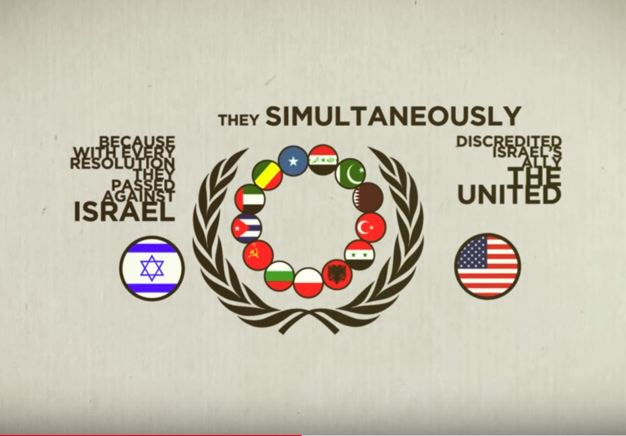
Trying to decide who is ‘up’ and who is ‘down’ after the U.N’s recent condemnation of America’s decision to move its embassy from Tel Aviv to Jerusalem seems a futile exercise. A more consequential issue may be emerging with long-term implications for America, the United Nations and the Middle East - “when does a sovereign nation’s independent action become the legitimate business (that is, concern) of the U.N.?”
To be specific, “is it the rightful business of the U.N. to pass institutional judgment on America’s sovereign decision about her own embassy?”
By a 128-9 vote, the General Assembly condemned America’s embassy decision. This followed almost immediately upon America’s veto of an otherwise unanimous Security Council resolution last week to the same effect. These votes certainly reveal long-held convictions of the United Nations.
The U.N. has never claimed formal, supra-sovereign authority to oversee the internal affairs of Israel, but has frequently spoken and, where allowed, acted as though it is entitled to do so - especially where Jerusalem is concerned. Typically, the U.N. appeals to its self-proclaimed responsibility to serve as an ‘unbiased’ trustee of the city’s sacred religious sites.
A parallel position had remained largely hidden until now. This holds that Jerusalem’s status as Israel’s capital is somehow ‘open’, even though the city’s status has been legally, politically and militarily resolved on Israel’s behalf, repeatedly, for more than a century.
These unwarranted U.N. assertions show how last week’s vote of condemnation was a wholly political, not legal, event. This may be why Prime Minister Netanyahu, using the harshest possible language, described the United Nations itself as a “house of lies” in advance of the vote.
U.N. ambassador Nikki Haley had warned Assembly members in advance that any intrusion into United States sovereignty would provoke a specific and individually-tailored American response. Member nations either judged this an empty threat or reasoned that any consequences would be less serious than appearing to ratify, by implication, this statement of historic fact: “Jerusalem has always been the national capital of the Jewish people.”
The Administration has already matched actions to words. The U.S. will reduce its contribution to the U.N. budget next year by 285 million dollars. Reductions of direct aid to other nations who joined the vote will be weighed separately.
America’s embassy policy in Israel falls far outside any legitimate ‘business’ oversight of the United Nations. America’s recognition of Jerusalem as Israel’s capital neither contradicts nor repudiates any U.N. statute. If America’s decision implies rogue rejection of a tacit U.N. insistence on keeping Jerusalem’s status open, then an open airing of ‘rights’ is long overdue.
In accord with international law, history and tradition, the location of Israel’s capital does not come under the determination of America or the U.N. The United States will move its embassy from Tel Aviv to Jerusalem for the sufficient reason that Israel has always declared Jerusalem to be her national capital.
UNITED NATIONS AND GENOCIDE
A Comparative Historical Assessment on the Ability of the UN
to Protect Populations from Genocide
The Jerusalem Institute of Justice conducted a report assessing the ability of the United Nations to protect populations from genocide. The document analyzes the legal obligations of the international order to protect populations from genocide, as well as the success the UN has had in doing so. The report is split into three sections: historical background, current assessment, and discussion and recommendations. JIJ took into consideration six case studies total, three historical instances of genocide and three current events. From these analyses, the report then draws a conclusion on whether the UN successfully protects populations from genocide. Finally, JIJ provides several recommendations for the UN and other intergovernmental organizations to improve the protection provided to vulnerable populations.
Historical Background
After providing the UN definition of genocide and the methodology used to conduct the report, JIJ explores in the document the significance of the Holocaust in the establishment of the United Nations and the creation of a body meant to protect vulnerable populations. The historical uniqueness of the Holocaust and the inability of the world to prevent it sparked the need for an international body to prevent and punish such crimes against humanity – and thus, the United Nations was born.
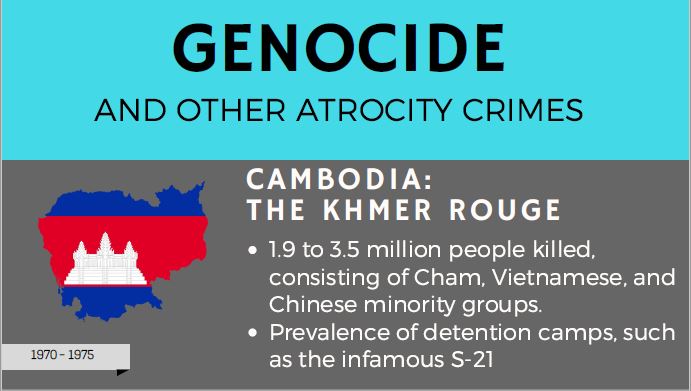
However, incidents of genocide that followed the establishment of the UN exposed the flaws in the organization’s ability to enforce preventative or protective measures. In fact, although the Convention on the Prevention and Punishment of the Crime of Genocide mandates that contracting parties make an effort “to prevent and to punish” genocide, there is no mention of counteracting it. Cambodia, Rwanda, and Yugoslavia – three countries which experienced a genocide after the establishment of the UN – were all addressed by the UN and had a peacekeeping force (PKF) sent before the tensions escalated into genocide. The PKF, however, were clearly unsuccessful. This was due partially to the narrow parameters the PKF were given to work, and partially to a lack of political will to engage. Because of complex regional and interstate conflicts, the UN was unable to gather a consensus to form a mandate strong enough to keep the violence from escalating. In other words, politics got in the way of protection of human rights and lives – all three times.
Current Assessment
Several current conflicts have been identified by the UN as either crimes against humanity or genocide. The conflicts analyzed in this report are Darfur, the Rohingya people in Myanmar, and ISIS and Syria. Once again, the UN has failed to label any of these as a genocide (except for ISIS’s violence against the Yazidi people), further demonstrating the lack of a political will to intercede, as labeling them as a genocide would obligate the UN to act. Instead, by recognizing the crimes against humanity, the international order is able to enforce weak mandates and sanctions that do not complicate international relations among permanent member-states of the United Nations, but also do nothing to stem the tide of violence in the regions. Furthermore, no action can be taken without a unanimous decision made by the permanent member-states of the UN. Because of the complicated relations among these states, unanimity is rare. History appears to be repeating itself, as politics are once again impeding the international order’s ability to protect populations from genocide.
Discussion and Recommendations
The report concludes with an analysis of the problems affecting the UN’s ability to protect from genocide. These problems include politicization and lack of political will. Politicization refers to the tendency of the UN to become so consumed in interstate politics that human rights abuses become a secondary issue. Despite the founding assumption that the global community has a responsibility to protect, the UN has struggled to achieve a collective will to intervene in genocide and other crimes against humanity due to politics. Lack of political will is related in that states do not believe intervention to be in their national interest, and as a result have no incentive to intervene. This again implies that politics, specifically domestic politics, supersede international human rights.
JIJ then offers a series of recommendations to the UN to better protect vulnerable populations. These recommendations, designed to address the problems analyzed in the report, cover a wide variety of possible solutions, from adding “counteracting” genocide to the language of the Convention to enforcing stricter human rights requirements of member-states. The recommendations also include demanding better accountability and challenging the notion that international human rights abuses are not of national interest, thus addressing the problem of politicization.
Should the UN (or other IGOs and human rights activists) adopt these recommendations, the international community would be better equipped to prevent, counteract, and punish genocide. Minimizing politicization, enforcing stronger mandates, encouraging states to intervene, and providing incentives for states to maintain a certain human rights standard are basic yet vital changes that can be made to improve the global response to genocide. Once we are able to look at the past and recognize where we went wrong, we will be able to address the problems that still exist today and, hopefully, work together towards a future of human rights and dignity for all.
Download

Nikki Haley's for Human Rights!
How Nikki Haley’s Background and Beliefs Helped Foster Her Zionist Spirit
In the midst of the continuous storm of anti-Semitism and anti-Israel resolutions that have been produced by the United Nations over the last few decades, there is a light that is shining more brightly now than ever before. Nimrata “Nikki” Haley, the 29th US Ambassador to the UN, is the strong voice advocating for Israel and demanding the bias and hatred towards Israel from other countries must stop immediately. Born to Sikh Indian parents in South Carolina, Haley credits them with first instilling in her a sense of pride and gratitude about living in America. “Well, I am the daughter of Indian parents who reminded my brothers, my sister and me every day how blessed we were to live in this country,” said Haley in an interview at the 2017 AIPAC Convention.
After graduating Clemson University with a BA in Accounting, Haley went to work for her mother’s clothing company, Exotica International. After being involved in numerous executive boards in her community and town, Haley was elected to the South Carolina House of Representatives in January of 2005. She continued this role until January 2011, where she was elected the first female governor of South Carolina. In November of 2016, she was appointed by president-elect Donald Trump to be the 29th United States Ambassador to the UN; she was confirmed in January 2017.
During her career in politics, Haley’s strong Zionistic and pro-Israel stance have been a major focus of hers. While Haley was governor of South Carolina, she signed into law a bill to stop efforts of the Boycott, Divestment and Sanctions (BDS) movement. This legislation was the first of its kind on a statewide level. Haley also stated during the announcement of that bill, that "nowhere has the UN’s failure been more consistent and more outrageous than in its bias against our close ally Israel". As Ambassador, Haley has been extremely outspoken about the UN’s blatant bias against Israel and has been extremely vocal in her personal support and her representing the United States supporting Israel. This is a welcome change for many from the stance of former US Ambassador, Samantha Power, and the US’ decision to abstain from the voting of Resolution 2334.
Samantha Power, who was the 28th US Ambassador under the Obama administration, famously abstained from voting on Resolution 2334 in December 2016, which declared that the Israeli settlement building in the West Bank and East Jerusalem was illegal and violated international law. Power told the 15-member U.N. Security Council, “Israeli settlement activity in territories occupied in 1967 undermines Israel’s security, harms the viability of a negotiated two-state outcome, and erodes prospects for peace and stability in the region." It came as a surprise to many that the US would seemingly go against an ally by refusing to vote against the resolution, especially coming from the woman who said “I will stand up for Israel and work tirelessly to defend it” in her Senate confirmation hearing; the resolution passed with 14 votes for and one abstention, the US. Haley later called the decision to abstain “one of the lowest points in our country….when [Power] abstained, the entire Security Council, and the entire audience, got up and applauded, and Israel was sitting there….watching that. Think about what we just did to a friend. You don’t ever applaud in the Security Council. That never happens. It happened that day.”
Haley has unequivocally and steadfastly supported Israel as the voice of the United States to the UN; she has called the UN out on their bias towards Israel dozens of times, especially when the UN named Israel the country with the most human rights violations in March 2017, beating out Iran, Syria, Libya and North Korea. “You know, basically what it comes down to is I'm not there to play,” said Haley during the 2017 AIPAC Conference. “And what I wanted to make sure of was that the United States started leading again. And leading isn't saying and doing things when it's comfortable. Leading is saying and doing things when it's not comfortable.”
When pressed about how she came to have such a strong stance on Israel and how she became so outspoken about defending Israel, Haley said, “[T]he truth is, I have seen so many similarities between the Israeli culture and the Indian culture. We're very close-knit. We love our families. We have a strong work ethic. We believe in professionalism and philanthropy and giving back. It's very true. So that's all the good things.” India and Israel have shared many similarities in values and members of each country frequently visit the other. Around 40,000 Israelis, many of whom have just finished their required military service visit India annually and around 34,000 Indians visit Israel annually. According to a 2009 international study commissioned by the Israeli Foreign Ministry, the greatest level of sympathy towards Israel from a member of the international community can be found in India, with 58% of Indian respondents showing sympathy towards Israel. In 2015, opinion polls showed 70% of Indians had favorable views of Israel.
Others wonder if perhaps Haley’s conversion to Christianity helped further foster her Zionist feelings. When Haley wed her husband, Michael Haley, who was a Christian, they did both a Sikh and Christian ceremony. Haley said about her choice to convert to Christianity, “We chose Christianity because of the way we wanted to live our life and raise our children — it had nothing to do with me thinking there was anything wrong with the way I was raised, and everything to do with the fact that I am moving forward in my life and had to find a path I felt was right for me.” Many Christians do believe in Israel’s right to exist; these Christians are called “Christian Zionists.” Some Christian Zionists believe that the gathering of the Jews in Israel is a prerequisite for the Second Coming of Jesus. Christian Zionists interpret the prophetic texts as describing inevitable future events, and these events primarily involve Israel, meaning the descendants of Jacob, which are the Jewish people. These prophecies are seen as requiring the presence of Jewish people in the Holy Land; this requirement is sometimes interpreted as being fulfilled by the contemporary state of Israel.
Haley has not made a public comment on whether her Christian views have helped cultivate her support for Israel even more, but whatever Haley’s reasoning, there is no doubt Israel and the American Jews are thankful for Haley’s voice and for tossing her hat into the UN’s ring. “For anyone that says you can't get anything done at the U.N.,” Haley says, “they need to know there's a new sheriff in town.”