

Human Shields = UN War Crimes
Jerusalem Institute of Justice- Submission to The Independent International Commission of Inquiry on the Occupied Palestinian Territory, including East Jerusalem, and Israel
Dear Honorable Commission,
We, the Jerusalem Institute of Justice, are a not-for-profit human rights organization, with Special Consultative Status at the UN Economic and Social Council, fighting to promote human rights, defend democracy, and improve the overall quality of life for Israelis and Palestinians alike. Due to our hope of ever-lasting peace in the region, we find it of the utmost importance to address your call for submissions of relevant information and documentation to the mandate of the Commission.
The attached report concerning Hamas’s actions during Protective Edge Operation (the 2014 Gaza war) was filed by our organization at the Office of the Prosecutor at the International Criminal Court (ICC) in The Hague on the 6th of March 2017. We argued that a full investigation of crimes committed within the Palestinian territories should be pursued, and a case should be lodged, against Ismail Haniyeh, head of the political wing of Hamas, for his role in the commission of war crimes during the 2014 Gaza war. Following this communication, and others, an investigation of the “Situation in Palestine” was commenced by the Chief Prosecutor of the ICC on the 3rd of March 2021. The submission of this report is in accordance with the COI’s mandate to collect evidence and information of abuses of international human rights law and identify those responsible.
There were two primary war crimes committed by Hamas militants during the war within the Gaza strip. First, they consistently used civilians for military protection and purposes, placing the Gazan population in grave danger as “human shields.” This was done by firing rockets and mortars from densely populated areas, by encouraging (and sometimes forcing) civilians to remain in potential military targets, and by storing rockets in schools, hospitals, mosques, and other civilian structures. Second, the rockets Hamas used during the war are inherently indiscriminate under international law, and were therefore unlawful to use. These rockets are unable to be controlled, and therefore could not accurately be fired at lawful military targets.
These heinous crimes reoccurred during the most recent Gaza conflict in May 2021– Hamas fired more than 4,360 rockets and mortars from residential areas. Of those, approximately 680 misfired and fell into the Gaza Strip, killing Palestinians and damaging Palestinian property, and 3,570 of the remaining rockets struck Israeli towns and cities. Thirteen Israelis were killed, and hundreds were injured. These war crimes are also considered criminal activity pursuant to Article 8 of the Rome Statute of the International Criminal Court – “War Crime of Using Protected Persons as Shields”.
We urge the commission to look into these violations of Human Rights committed by Hamas and include them in their report due to be presented in the Human Rights Council’s June regular session.
Yours sincerely,
Flavia Sevald, CEO,
Jerusalem Institute of Justice,

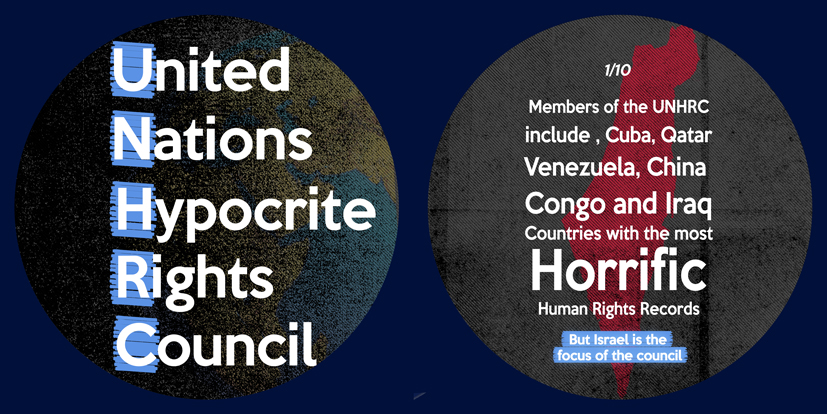
Human Rights Council - Political Bias
The UN Human Rights Council “database” of business enterprises
On 24 March 2016, at its 31st session, the Human Rights Council (HRC) adopted resolution 31/36 entitled “Israeli settlements in the Occupied Palestinian Territory, including East Jerusalem, and in the occupied Syrian Golan”.[1] Paragraph 17 (OP 17) of this resolution requests the United Nations High Commissioner for Human Rights (OHCHR) produce a database of all business enterprises engaged in certain Israeli settlement activity in the occupied Palestinian territory, or the "Blacklist".
While local and international business activity in disputed or occupied territories is widespread, and involves some of the world’s largest companies, Resolution 31/36 represents the only known UN effort to produce a “database” of such activity in respect of one situation. The fact that such business activity is so ubiquitous and rarely criticized demonstrates that it is not viewed as raising legal or human rights issues, while the desire to establish a database only with respect to business activity in Israeli settlement communities points to the political bias of the body that initiated this process.
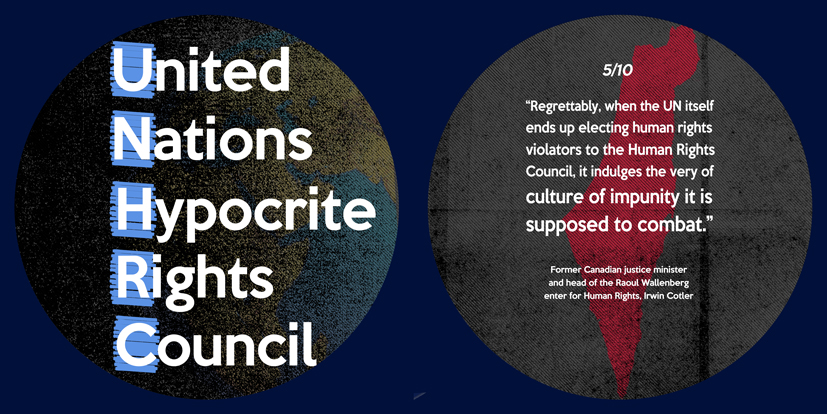
OP17 was adopted despite the strong opposition of the US, EU and Israel. It is the product of a specific discriminatory HRC agenda item, the organization's only country-specific agenda item, which reflects ongoing and well documented institutional bias against Israel in the HRC. The Council is widely criticized as a deeply politicized body, whose agenda is often dictated by the world’s worst human rights violators, and whose legitimacy and credibility in the human rights arena has been fundamentally undermined as a result.
Israel, together with the United States and numerous other leading States, have expressed, consistent opposition to the database and its publication, and have conveyed this position in their public and private communications. Israel has no intention of cooperating with this illegitimate exercise for the following reasons:
- Lack of authority to produce database: The production of a “database” exceeds the mandate of the OHCHR, which has neither the competence nor the capacity to engage in this action. The responsibility for ensuring compliance of business enterprises with relevant laws, or for promoting any relevant non-binding guidelines with respect to business practices, rests exclusively with the States in which the relevant enterprises are domiciled or operating.
- Lack of authority to communicate to companies: The HRC and OHCHR are bodies mandated to deal with State conduct in the human rights field and they have no legal or other authority over business enterprises.
- Lawfulness of business activity: Business activity in areas of Judea and Samaria (West Bank) under Israeli jurisdiction in accordance with existing Israeli-Palestinian agreements, is entirely lawful. Indeed, the notion that business enterprises are even subject to international law, international humanitarian law, and international human rights law is highly questionable and has been rejected by Courts in leading national jurisdictions.
- Blacklist: The creation of a database, and certainly its publication in any form, amounts to an effort to produce a blacklist of companies that are not engaged in any wrongdoing, and with the potential of causing commercial, reputational and legal harm. By engaging in this action, the OHCHR is allowing itself to become an instrument of those engaged in an illegitimate, discriminatory and political motivated agenda.
Furthermore, the methodology of the OHCHR is entirely devoid of transparency, and the information upon which it has based its communication has been drawn from partial, unverifiable and unknown sources, including politically-motivated actors, who responded voluntarily to the OHCHR’s calls. The OHCHR also lacks the requisite competence or capacity to verify independently the information it has received. While Resolution 31/36 requires a database of “all” business enterprises, the process adopted makes the database flawed from its inception and inevitably renders the list the partial, selective and discriminatory in nature
It is important to note that the database initiative is not legal or quasi-legal in nature, and does not, in and of itself, carry with it legal consequences. The process lacks due process and procedural safeguards to ensure that the list will not contain unauthoritative or inappropriately verified information. Furthermore, cooperation by companies with the database initiative may entail potential legal consequences, liability, financial risk and reputational harm. As is known, relevant domestic legislation and anticipated legislative proposals in various jurisdictions prohibit companies from discriminating in their business practices, including laws that specifically pertain to discriminatory practices with respect to Israel or territory subject to Israeli jurisdiction. This pertains, for example, to companies that are domiciled in the US, are subsidiaries of US-domiciled companies, or that do business in the US. In this context, dozens of U.S. State laws currently bar granting contracts to, or pension-fund investment in, companies that boycott Israel or territories under its jurisdiction. Moreover, such cooperation might raise issues under existing relevant US federal legislation.
The UN Human Rights Council “database” of business enterprises
On 24 March 2016, at its 31st session, the Human Rights Council (HRC) adopted resolution 31/36 entitled “Israeli settlements in the Occupied Palestinian Territory, including East Jerusalem, and in the occupied Syrian Golan”.[1] Paragraph 17 (OP 17) of this resolution requests the United Nations High Commissioner for Human Rights (OHCHR) produce a database of all business enterprises engaged in certain Israeli settlement activity in the occupied Palestinian territory, or the "Blacklist".
While local and international business activity in disputed or occupied territories is widespread, and involves some of the world’s largest companies, Resolution 31/36 represents the only known UN effort to produce a “database” of such activity in respect of one situation. The fact that such business activity is so ubiquitous and rarely criticized demonstrates that it is not viewed as raising legal or human rights issues, while the desire to establish a database only with respect to business activity in Israeli settlement communities points to the political bias of the body that initiated this process.
OP17 was adopted despite the strong opposition of the US, EU and Israel. It is the product of a specific discriminatory HRC agenda item, the organization's only country-specific agenda item, which reflects ongoing and well documented institutional bias against Israel in the HRC. The Council is widely criticized as a deeply politicized body, whose agenda is often dictated by the world’s worst human rights violators, and whose legitimacy and credibility in the human rights arena has been fundamentally undermined as a result.
Israel, together with the United States and numerous other leading States, have expressed, consistent opposition to the database and its publication, and have conveyed this position in their public and private communications. Israel has no intention of cooperating with this illegitimate exercise for the following reasons:
- Lack of authority to produce database: The production of a “database” exceeds the mandate of the OHCHR, which has neither the competence nor the capacity to engage in this action. The responsibility for ensuring compliance of business enterprises with relevant laws, or for promoting any relevant non-binding guidelines with respect to business practices, rests exclusively with the States in which the relevant enterprises are domiciled or operating.
- Lack of authority to communicate to companies: The HRC and OHCHR are bodies mandated to deal with State conduct in the human rights field and they have no legal or other authority over business enterprises.
- Lawfulness of business activity: Business activity in areas of Judea and Samaria (West Bank) under Israeli jurisdiction in accordance with existing Israeli-Palestinian agreements, is entirely lawful. Indeed, the notion that business enterprises are even subject to international law, international humanitarian law, and international human rights law is highly questionable and has been rejected by Courts in leading national jurisdictions.
- Blacklist: The creation of a database, and certainly its publication in any form, amounts to an effort to produce a blacklist of companies that are not engaged in any wrongdoing, and with the potential of causing commercial, reputational and legal harm. By engaging in this action, the OHCHR is allowing itself to become an instrument of those engaged in an illegitimate, discriminatory and political motivated agenda.
Furthermore, the methodology of the OHCHR is entirely devoid of transparency, and the information upon which it has based its communication has been drawn from partial, unverifiable and unknown sources, including politically-motivated actors, who responded voluntarily to the OHCHR’s calls. The OHCHR also lacks the requisite competence or capacity to verify independently the information it has received. While Resolution 31/36 requires a database of “all” business enterprises, the process adopted makes the database flawed from its inception and inevitably renders the list the partial, selective and discriminatory in nature
It is important to note that the database initiative is not legal or quasi-legal in nature, and does not, in and of itself, carry with it legal consequences. The process lacks due process and procedural safeguards to ensure that the list will not contain unauthoritative or inappropriately verified information. Furthermore, cooperation by companies with the database initiative may entail potential legal consequences, liability, financial risk and reputational harm. As is known, relevant domestic legislation and anticipated legislative proposals in various jurisdictions prohibit companies from discriminating in their business practices, including laws that specifically pertain to discriminatory practices with respect to Israel or territory subject to Israeli jurisdiction. This pertains, for example, to companies that are domiciled in the US, are subsidiaries of US-domiciled companies, or that do business in the US. In this context, dozens of U.S. State laws currently bar granting contracts to, or pension-fund investment in, companies that boycott Israel or territories under its jurisdiction. Moreover, such cooperation might raise issues under existing relevant US federal legislation.
The potential legal consequences, liability, financial risk and reputational harm is not merely a theoretical possibility, as the Airbnb case which unfolded from late 2018 to April 2019 exemplified. In this case Airbnb announced its intention to delist an estimated 200 listings of Israeli properties in Judea and Samaria. The company announced in April 2019 that his policy will not be implemented as part of settlement reached with all lawsuits that were brought by hosts and potential hosts and guests who objected to the policy on grounds of discrimination. This policy was not only attacked in the courts as it landed Airbnb on the top ten antisemitic events of 2018 by the Wiesenthal Center, led to US State investment boards to add the company to their blacklists as well as a host of leading political figures, including State Governors and American Vice President Mike Pence. All this not only led the company to abandon its policy, it also led to the company stating that "Airbnb has always opposed the BDS movement"[2]. This case exemplifies the risk the potential risk stated above.
The potential legal consequences, liability, financial risk and reputational harm is not merely a theoretical possibility, as the Airbnb case which unfolded from late 2018 to April 2019 exemplified. In this case Airbnb announced its intention to delist an estimated 200 listings of Israeli properties in Judea and Samaria. The company announced in April 2019 that his policy will not be implemented as part of settlement reached with all lawsuits that were brought by hosts and potential hosts and guests who objected to the policy on grounds of discrimination. This policy was not only attacked in the courts as it landed Airbnb on the top ten antisemitic events of 2018 by the Wiesenthal Center, led to US State investment boards to add the company to their blacklists as well as a host of leading political figures, including State Governors and American Vice President Mike Pence. All this not only led the company to abandon its policy, it also led to the company stating that "Airbnb has always opposed the BDS movement"[2]. This case exemplifies the risk the potential risk stated above.
[1]https://www.ohchr.org/EN/HRBodies/HRC/RegularSessions/Session31/Pages/DatabaseHRC3136.aspx
[2] https://news.airbnb.com/update-listings-disputed-regions/

UNdermining women’s Rights
Hillary Clinton, at the time First Lady of the United States, famously proclaimed at the 1995 United Nations Fourth World Conference on Women that “women’s rights are human rights.” Despite this declaration 23 years ago, the United Nations has a long way to go towards ensuring women’s rights are upheld across the world. Unfortunately, the current structure of the United Nations often obstructs women’s rights by favoring self-interested, geopolitical partisanship.
The United Nations Commission on the Status of Women is the body responsible for investigating and promoting gender equality. This organization focuses on issues of peace, violence against women, female political participation, and economic opportunity for women, among other areas. Member states can introduce and vote on resolutions, and are elected from different continents to ensure representation among distinct geographical regions.
In 2017, the United Nations Economic and Social Council, which oversees the Commission, elected Saudi Arabia to serve as a full member. Saudi Arabia’s place in the Commission on the Status of Women is notable because of its reputation as a country that regularly disregards women’s rights. The World Economic Forum’s 2017 Global Gender Gap Report ranked Saudi Arabia 138 out of 144 countries in terms of gender parity, highlighting the difference in opportunities afforded to men and women in the country. Saudi Arabian women are greatly underrepresented in political life, as there are no women serving on the High Court or Supreme Judicial Court. Furthermore, women’s testimonies are worth only half of a man’s in Saudi Arabian courts, posing legal challenges for women trying to defend their interests. The kingdom withheld the right to drive automobiles from its female citizens until 2018. Prior to this change in laws, it was the only country in the world with such a restriction. Given this context, Saudi Arabia’s membership in a commission meant to help women is not only ironic, but morally reprehensible.
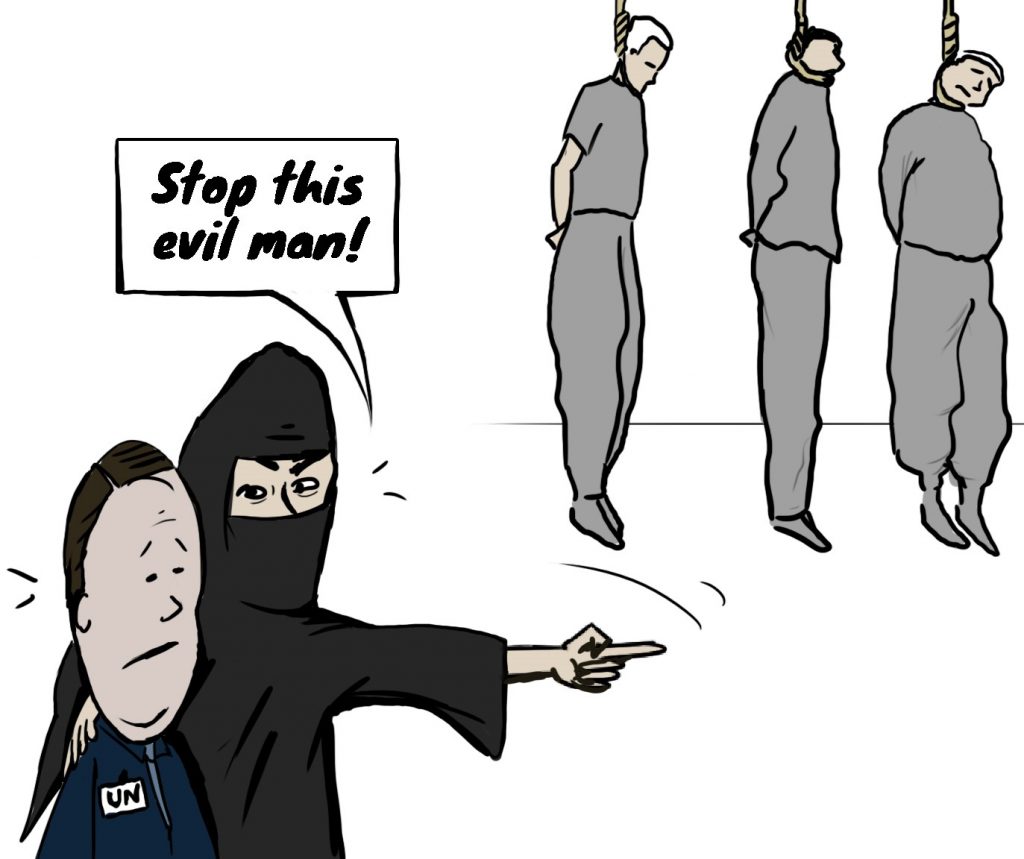
The presence of Saudi Arabia in this committee serves a political purpose. Through its membership in the Commission on the Status of Women, Saudi Arabia affects public opinion and condemns its geopolitical enemies, thus directing international attention and criticism away from its own anti-women agenda. In 2018, Saudi Arabia supported a resolution on supporting and aiding Palestinian women, which largely criticized Israel’s occupational role in Gaza and the West Bank. While there is merit to these conclusions, the Israeli-Palestinian conflict is far from the only instance of oppression against women in the Middle East region. However, this resolution was the only one focused on that region passed by the Commission on the Status of Women in 2018. In this manner, Saudi Arabia and partnering member states distract from the many other women’s rights abuses in the Middle East that they are responsible for.
Furthermore, the presence of member states in this body with such egregious women’s rights violations calls into question its legitimacy. If Saudi Arabia does not treat its female citizens with the equal rights and protections of its male citizens, what authority does it have to recognize and condemn similar abuses committed by other nations? How can such a council be trusted to resolve the very inequities that its members promote?
No country may have a perfect track record on women’s rights, but enabling a country that so clearly disregards its women to create policy on the topic is an affront towards the promotion of global gender equality. Of course, the gender imparities that women face globally, and the inherent flaws in the United Nations, are not resolved solely through the removal of Saudi Arabia from this commission. However, Saudi Arabia’s presence in this commission clearly does not advance the cause of women’s rights. Calling the United Nations’ methodology and authority into question is a necessary democratic means to ensure that all nations not protecting their female citizens are held accountable by this organization.
The United Nations serves a noble purpose in its mission statement to “work for the protection of all human rights for all people.” Such a commitment, however, is an empty promise given the United Nations’ support for noted women’s rights abusing nations, such as Saudi Arabia. Rather than empowering women, this institution often empowers women’s rights abusers. Criticism of the United Nations, and calling for greater accountability within the organization, protects the interests of women globally.
Letter to Nikki Haley
The Honorable Nikki Haley
U.S. Permanent Representative to the United Nations
United States Mission to the United Nations
799 United Nations Plaza
New York, NY 10017
Dear Ambassador Nikki Haley,
The Jerusalem Institute of Justice (JIJ) is a non-government organization located in the heart of Jerusalem, Israel. Our sole focus is the cultivation and defense of human rights, the rule of law, and true democracy for all people, both in Israel, and the Middle East as a whole. We regard ourselves as a bridge for the indomitable ambitions of the United States and Israel; for the values that both our countries have always shared.
Ambassador Haley, the entire JIJ team sincerely applauds your staunch support of Israel and human rights worldwide. The bias shown against Israel by the UN has long been at the forefront of our minds, but we are happy to see that your presence in the United Nations is developing a new narrative with a more balanced perspective on human rights. Your most recent proposal to condemn Hamas for the violence perpetuated at the Gaza border has reassured us that an unbiased voice of reason can, and will prevail at the UN General Assembly. The UN approves resolution after resolution to unjustly condemn Israel while Hamas's crimes fall on the deaf ears of the General Assembly. Your courage to stand up for justice by advocating for a narrative of symmetry, wherein Hamas’s atrocities can finally be denounced, inspired 62 countries to vote for justice. It is a triumph to see other countries beginning to stand up and recognize the truth, and your part in this cannot be overstated. Throughout the world, your denunciation of terrorism and your support for Israel is ringing true.
We would also like to point out, and praise, your recent courageous decision to leave the United Nations Human Rights Council. This action speaks volumes about true commitment to the global support of human rights. We stand behind you in the conviction that your departure may draw attention to the hypocrisy of Human Rights Council. We agree, wholeheartedly, with you that the council has developed a disquieting history of attacking Israel, while monumental human rights violations by countries including Saudi Arabia, Cuba, and Qatar have gone unaddressed. Your decision affirms the unbreakable bond between the United States and Israel. Hopefully, your actions will provoke the reorganization of the crucial Human Rights Council into a more effective and unbiased assembly.
The JIJ stands ready to aid you, Ambassador Haley, in whatever capacity we are able to. Our staff is constantly hard at work researching issues of human rights in the Middle East. We are currently focused on a UN project aiming to expose anti-Israel bias by deconstructing each resolution made against Israel, and responding with instances of the same injustice in other parts of the world that the UN conveniently ignores. Our research demonstrates the tremendous bias existing in past General Assembly resolutions against Israel. Last year alone, 21 resolutions were passed against Israel, while only 6 were passed towards the rest of the world combined. This is nothing short of a deep-seated prejudice that we cannot afford to ignore.
Once again, we here at the JIJ thank you for all that you do. If there is anything that the JIJ can do to support you and the excellent work you are accomplishing, please do not hesitate to contact us.
Sincerely,
The JIJ Team