
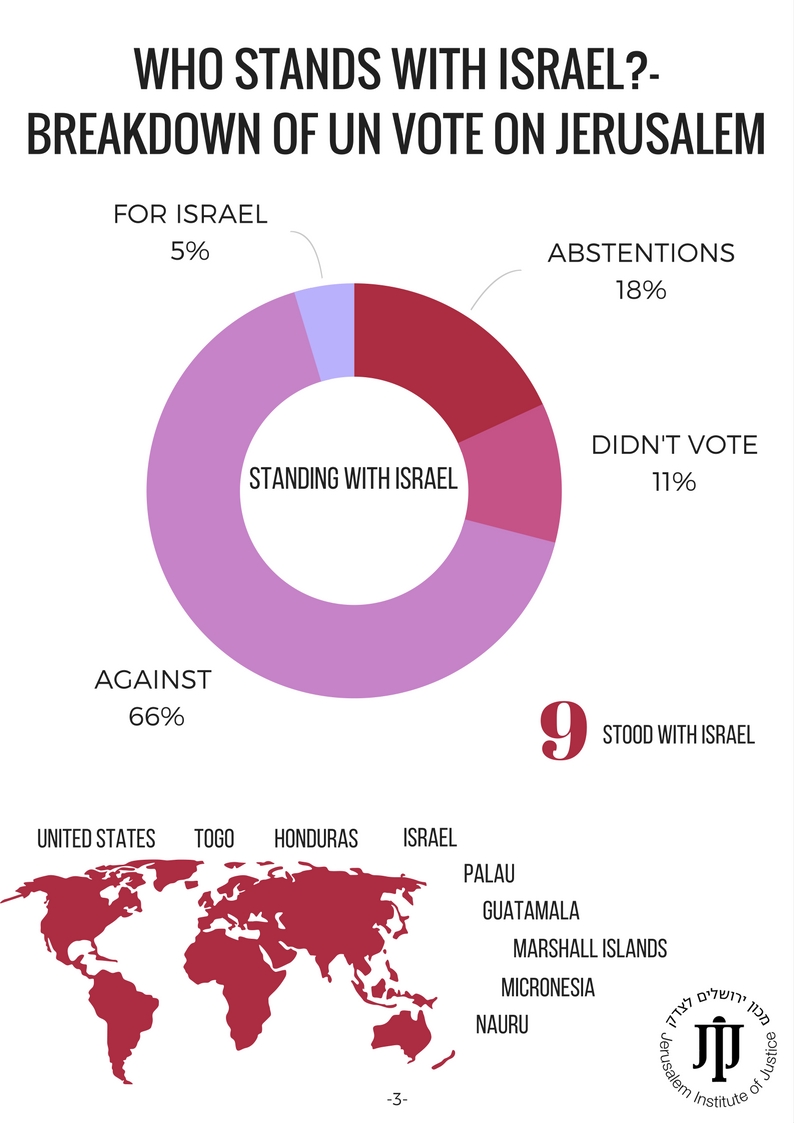
Who Stands with Israel?
Let's break down the numbers by looking at the UN vote that recently took place regarding Jerusalem. Sadly, the numbers point to a not-so-encouraging outcome.
Download

United Nations and Genocide
By Nikki Golomb.
The Jerusalem Institute of Justice conducted a report assessing the ability of the United Nations to protect populations from genocide. The document analyzes the legal obligations of the international order to protect populations from genocide, as well as the success the UN has had in doing so. The report is split into three sections: historical background, current assessment, and discussion and recommendations. JIJ took into consideration six case studies total, three historical instances of genocide and three current events. From these analyses, the report then draws a conclusion on whether the UN successfully protects populations from genocide. Finally, JIJ provides several recommendations for the UN and other intergovernmental organizations to improve the protection provided to vulnerable populations.
Historical Background
After providing the UN definition of genocide and the methodology used to conduct the report, JIJ explores in the document the significance of the Holocaust in the establishment of the United Nations and the creation of a body meant to protect vulnerable populations. The historical uniqueness of the Holocaust and the inability of the world to prevent it sparked the need for an international body to prevent and punish such crimes against humanity – and thus, the United Nations was born.
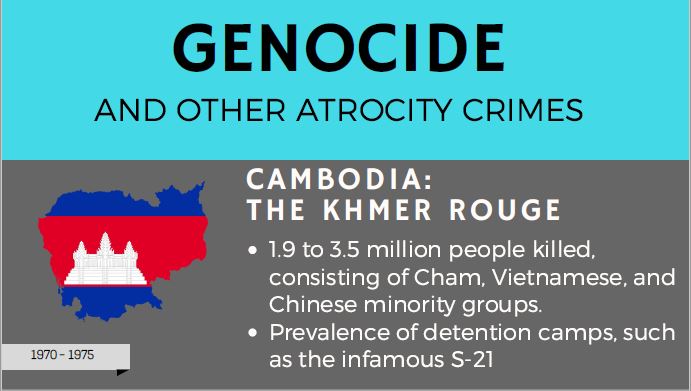
However, incidents of genocide that followed the establishment of the UN exposed the flaws in the organization’s ability to enforce preventative or protective measures. In fact, although the Convention on the Prevention and Punishment of the Crime of Genocide mandates that contracting parties make an effort “to prevent and to punish” genocide, there is no mention of counteracting it. Cambodia, Rwanda, and Yugoslavia – three countries which experienced a genocide after the establishment of the UN – were all addressed by the UN and had a peacekeeping force (PKF) sent before the tensions escalated into genocide. The PKF, however, were clearly unsuccessful. This was due partially to the narrow parameters the PKF were given to work, and partially to a lack of political will to engage. Because of complex regional and interstate conflicts, the UN was unable to gather a consensus to form a mandate strong enough to keep the violence from escalating. In other words, politics got in the way of protection of human rights and lives – all three times.
Current Assessment
Several current conflicts have been identified by the UN as either crimes against humanity or genocide. The conflicts analyzed in this report are Darfur, the Rohingya people in Myanmar, and ISIS and Syria. Once again, the UN has failed to label any of these as a genocide (except for ISIS’s violence against the Yazidi people), further demonstrating the lack of a political will to intercede, as labeling them as a genocide would obligate the UN to act. Instead, by recognizing the crimes against humanity, the international order is able to enforce weak mandates and sanctions that do not complicate international relations among permanent member-states of the United Nations, but also do nothing to stem the tide of violence in the regions. Furthermore, no action can be taken without a unanimous decision made by the permanent member-states of the UN. Because of the complicated relations among these states, unanimity is rare. History appears to be repeating itself, as politics are once again impeding the international order’s ability to protect populations from genocide.
Discussion and Recommendations
The report concludes with an analysis of the problems affecting the UN’s ability to protect from genocide. These problems include politicization and lack of political will. Politicization refers to the tendency of the UN to become so consumed in interstate politics that human rights abuses become a secondary issue. Despite the founding assumption that the global community has a responsibility to protect, the UN has struggled to achieve a collective will to intervene in genocide and other crimes against humanity due to politics. Lack of political will is related in that states do not believe intervention to be in their national interest, and as a result have no incentive to intervene. This again implies that politics, specifically domestic politics, supersede international human rights.
JIJ then offers a series of recommendations to the UN to better protect vulnerable populations. These recommendations, designed to address the problems analyzed in the report, cover a wide variety of possible solutions, from adding “counteracting” genocide to the language of the Convention to enforcing stricter human rights requirements of member-states. The recommendations also include demanding better accountability and challenging the notion that international human rights abuses are not of national interest, thus addressing the problem of politicization.
Should the UN (or other IGOs and human rights activists) adopt these recommendations, the international community would be better equipped to prevent, counteract, and punish genocide. Minimizing politicization, enforcing stronger mandates, encouraging states to intervene, and providing incentives for states to maintain a certain human rights standard are basic yet vital changes that can be made to improve the global response to genocide. Once we are able to look at the past and recognize where we went wrong, we will be able to address the problems that still exist today and, hopefully, work together towards a future of human rights and dignity for all.
4 times too much
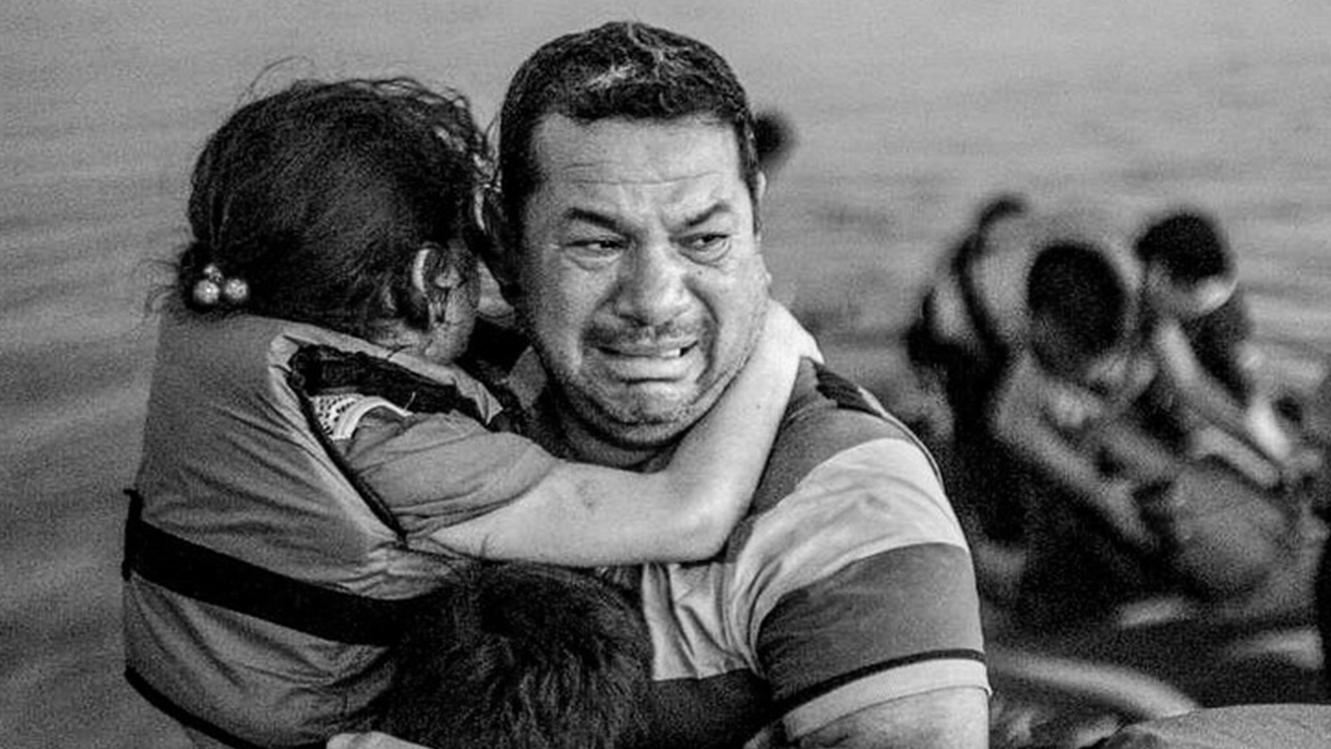
The U.N. faces the largest refugee crisis in its history. Sixty-eight million people need help. Why, then, does the U.N. give four times as much aid, annually, to each Palestinian refugee as it gives to refugees anywhere else in the world?
Here is another question.
Why does UNRWA, the agency that handles five million Palestinians, employ 30,000 people while the World Refugee Agency (UNHCR), which serves sixty-three million refugees, employs 10,000 people?
The answers: politics. And politics.
To make matters even worse, the two agencies duplicate efforts in the same regions. UNRWA clinics refuse to treat Syrian or Lebanese refugees, but will only treat Palestinians. So, UNHCR must maintain redundant clinics in the same places, while the desperate health needs of refugees in other world regions take the hit.
Ron Prosor, former Israeli ambassador to the U.N. and currently the head of the Abba Eban Institute for Diplomacy, will shortly present the U.N. a plan to consolidate the resources of both agencies. What could possibly prevent the long-overdue adoption of such a common-sense proposal?
Nothing but politics as practiced within the as-if world of UNRWA whose work, unlike UNHCR, expects and requires the number of Palestinian refugees to “expand without limit”.
How can such a political miracle take place?
Conveniently, it turns out that Palestinian refugees aren’t really refugees at all and never have been.
Refugees, by definition, are refugees from somewhere. Palestinians are not, as you may imagine, refugees from Israel because they would then be eligible to apply for asylum in countries like Egypt, Syria and Jordan. But those countries have refused to accept and resettle Palestinians within their own lands for more than seven decades, blaming Israel for their own hostility.
Nor, however, can Palestinians return, legally, to Israel. They are not refugees from that land. Besides, U.N. statutes stipulated Israel’s own sovereignty, which she confirmed by a heroic war of Independence, and completed by generous assimilation of mistreated Jewish refugees.
Until the Orwellian treatment of Palestinians ends, normalization of relations between them, Israel and even other Arab nations is impossible. Not Israel, but rather fellow-Arabs and a complicit UNRWA trap the Palestinian people within impossible legal and political contradictions.
Prosor’s plan will end the UNRWA fantasy. Unfortunately, this makes it all too likely that the consolidation of UNRWA and UNHCR will fail to pass muster at today’s United Fantasyland, a.k.a. the United Nations.
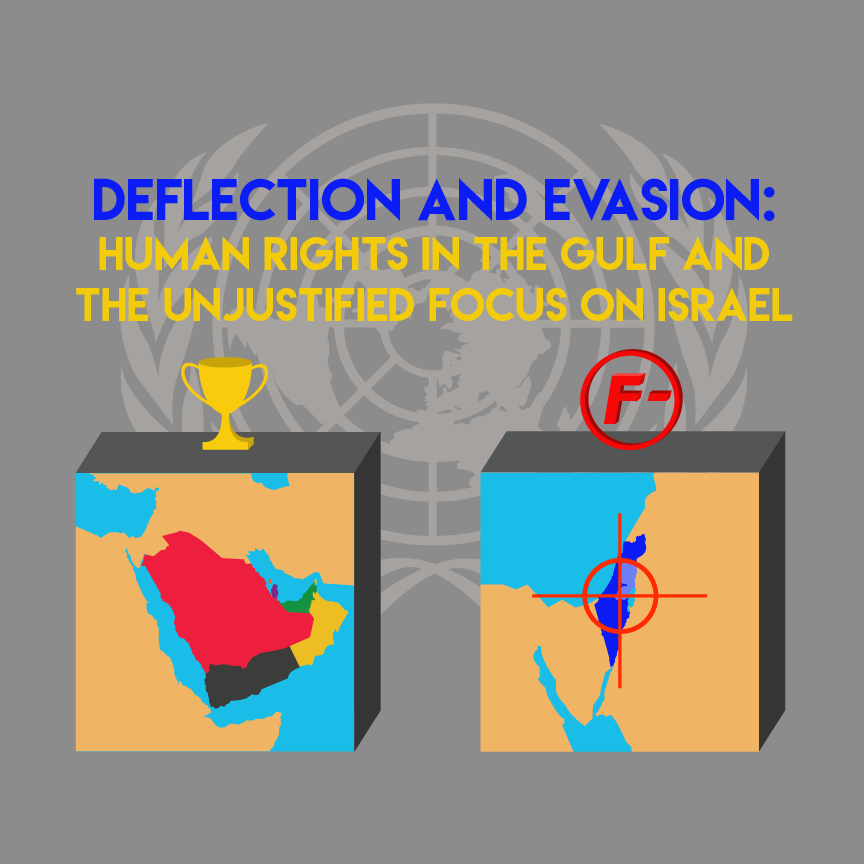
Deflection and Evasion: Human Rights in the Gulf
On March 15, 2006, the United Nations General Assembly established the United Nations Human Rights Council (hereafter UNHRC). This would replace the United Nations Commission on Human Rights, which had been heavily criticized for admitting to its membership the repressive regimes of countries such as China, Zimbabwe, Syria and Saudi Arabia.
So how far has the Council progressed? Surely after the upheaval and rebranding of an institution that had stood since 1946, a new wave of human rights advocacy and legitimacy would sweep the 193-member state organization.
Along with Qatar and the United Arab Emirates, the trusted old guard Saudi Arabia continues to enjoy a seat at the table.
At a time where the US is reportedly considering withdrawing its membership of the UNHRC due to its criticism of Israel, it behooves one to consider how Israel’s human rights record compares to that of Saudi Arabia, Qatar, and the UAE.
In regard to civil and political rights, otherwise termed as ‘the first wave' or 'first generation' of human rights, Israel boasts a significantly better record than that of its Gulf state counterparts. It does not practice the death penalty, with the last execution being that of Adolf Eichmann – the notorious Nazi convicted of war crimes, genocide, and crimes against humanity – in 1962. It is home to a diverse group of competing political parties, ranging from religious Zionist parties such as the Jewish Home Party to explicitly anti-Zionist parties such as Balad.
By contrast, due to the varying degrees to which their legal systems incorporate Sharia Law, these three Gulf nations all retain the practice of the death penalty for crimes as serious as murder to those as minor and dubious as apostasy, adultery and sodomy (homosexuality). Between January 1 2016 and July 27 2016, Saudi Arabia executed 108 people. In 2016, Freedom House rated the Kingdom’s political rights a score of 3/40 and their civil liberties a score of 7/60. Saudi citizens face criminal prosecution for political dissent, and the ban on political parties has virtually eliminated any opposition to the monarchy’s decrees. The most notable case is that of Saudi blogger Raif Badawi, who was sentenced to a flogging of 1000 lashes in 2014 for ‘insulting Islam’.
LGBT rights have rightly emerged as a preeminent concern for human rights activists. The Israeli legal system maintains strong protections for the rights of LGBT people. Consensual same-sex acts have been de facto legal since 1963 and formally legal since 1988. The concept of ‘sodomy’ has no legal validity or relevance within Israeli legal system. LGBT people are protected under the law from discrimination within society and the military, with violent crimes motivated by sexual orientation considered hate crimes and requiring double the punishment of regular violent crimes. Furthermore, same-sex couples are afforded extensive adoption rights.
The Gulf nations paint a very different picture of livability for LGBT people. Article 177 of the Dubai Penal Code states that consensual sodomy is punishable by up to 10 years in prison. Along with the near-identical Qatari policy, these procedures almost seem lenient when compared to that of Saudi Arabia. The Kingdom’s wahhabist ultra-conservatism views homosexuality as the ultimate deviancy, as well as what are perceived to be the related issues of transgender citizens and cross-dressing. The legal punishments for homosexual sex in Saudi Arabia include fines, prison sentences, floggings, chemical castration, torture and execution – often by beheading.
The Israeli-Gulf divide also occurs along the lines of women’s rights. Israel ranks 18th in the world in terms of gender equality according to the United Nations Development Program. Women are protected from discrimination under the law and have enjoyed prominent positions within Israeli society such as Prime Minister, President of the Supreme Court, Chairperson of the Reserve Bank and Major General. The Knesset’s Committee on the Status of Women has as its stated objectives: the prevention of discrimination, combatting violence against women, and promoting equality in politics, lifecycle events and education.
Conversely, women’s rights in Saudi Arabia are abysmal by international standards. The country ranked 134th globally in the World Economic Forum’s Global Gender Gap Report of 2015. Saudi law requires all women to have a male guardian in public and as such are not permitted to shop, conduct business or drive without a male companion. Saudi authorities also mandate draconian laws regarding the modesty of women’s clothing. Failure to comply with these laws can incur harassment from the Mutaween (religious police). Polygamy remains legal as does the marrying of child brides. In court, the testimony of one man equals that of two women. Domestic violence is a common occurrence, as is the denial of property and employment rights to women.
Although Israel defines itself as a Jewish and democratic state, it also guarantees freedom of religion to all its citizens. Christian, Muslim and Baha’i communities have jurisdiction over their own adherents in matters of marriage, divorce and burial. Synagogues, mosques, churches and khalwats (Druze prayer houses) can operate without fear of government intrusion or closure. Importantly, Israeli law does not prohibit leaving a religious group, otherwise known as ‘apostasy’.
In Qatar, the idea of religious freedom is at best illusory for its Muslim population. Under Articles 245-260 of the Qatari Law 11 of 2004, blasphemy and other insults or challenges to the doctrines of Islam are punishable by prison sentences, whilst the offence of apostasy is punishable by the death penalty. Apostasy is similarly punished in the UAE and Saudi Arabia. Saudi Arabia retains the more archaic beliefs of the Gulf trio, by prosecuting people for sorcery and witchcraft. It also tasks the Mutaween with enforcing Sharia law throughout the country. This involves reporting unrelated males and females who socialize, enforcing strict Islamic dress codes, enforcing Muslim dietary requirements, prohibiting people from proselytizing other religions and banning consumer products deemed to be un-Islamic.
As the nations of the world vote on 15 new members to the UNHRC at the convening of the General Assembly in September, two concerns should be at the forefront of their minds. Firstly, human rights are important and adherence to their norms requires constant introspection and critical self-examination. Their inalienability is an equalizer for people across the globe, be they rich or poor, black or white. They serve to allow people, among other things, the freedom to speak their mind and guard the dignity and liberty to which they are naturally entitled. Secondly, having a UNHRC characterized by hypocrisy ultimately undermines their principled mandate. Allowing repressive regimes like Qatar, the UAE and Saudi Arabia to deflect their horrendous records onto Israel is an exercise in evasion. Israel is an imperfect democracy; elevated by morality yet burdened with deficiencies. Nonetheless, we should set the bar higher than floggings, chemical castrations and beheadings.