
Child Soldiers in Gaza - FactSheet
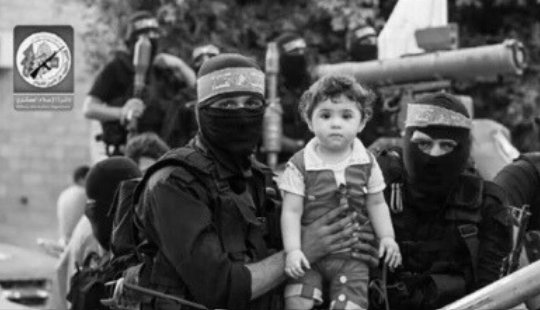
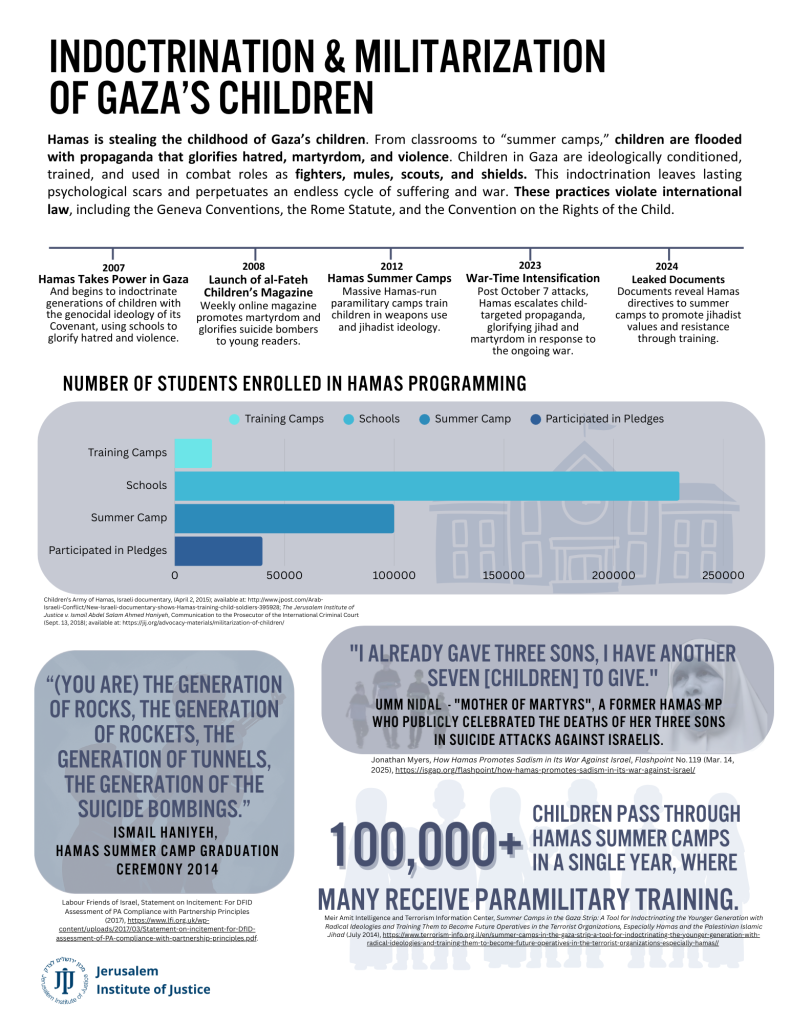
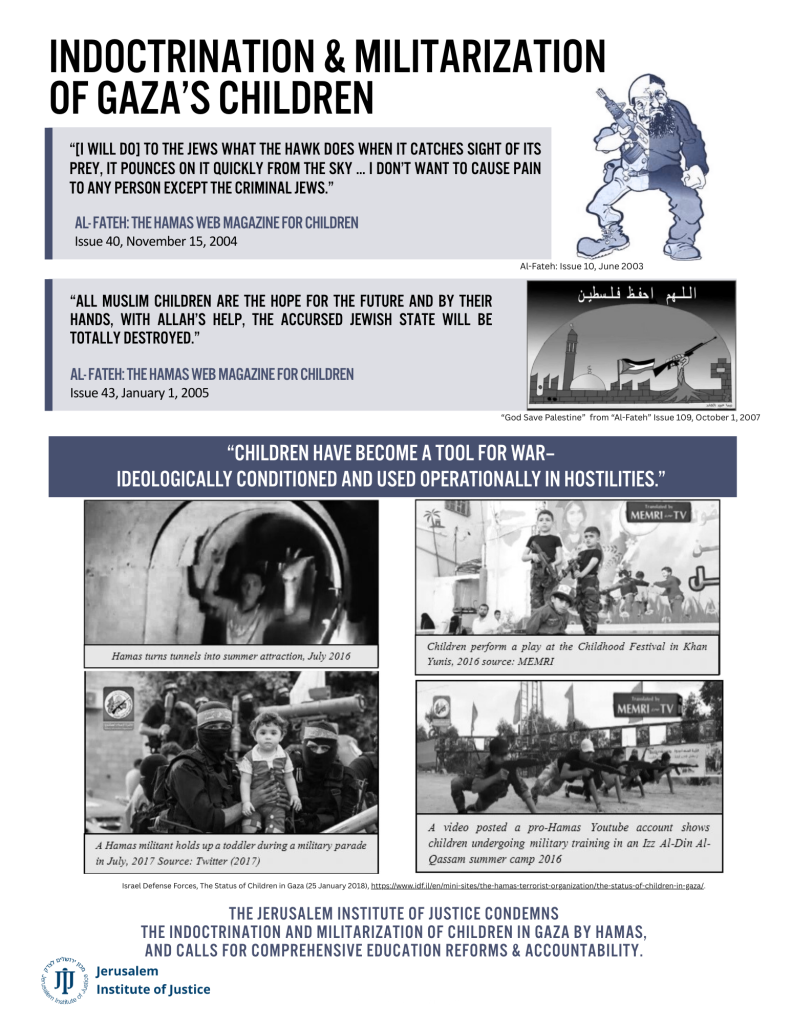
Indoctrination / Militarization of Gaza's Children
Through educational institutions, media, summer camps, and direct involvement in military operations, Hamas has created an environment where children are psychologically conditioned, trained, and, in many cases, recruited for armed conflict. These practices constitute grave violations of international humanitarian law (IHL), international criminal law (ICL), and international human rights law (IHRL). JIJ condemns the indoctrination and militarization of children by Hamas and calls for comprehensive education reforms and accountability. Download factsheet here.
Download

2025 - Echoes of Denial - FactSheet
The October 7th Atrocities and Rising Antisemitism
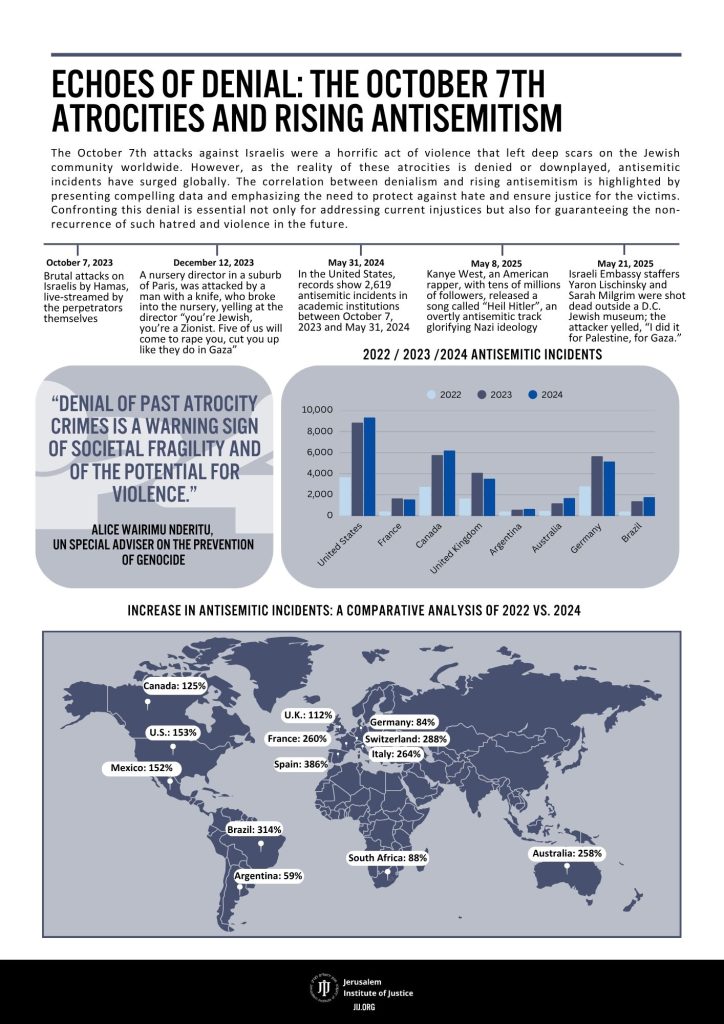
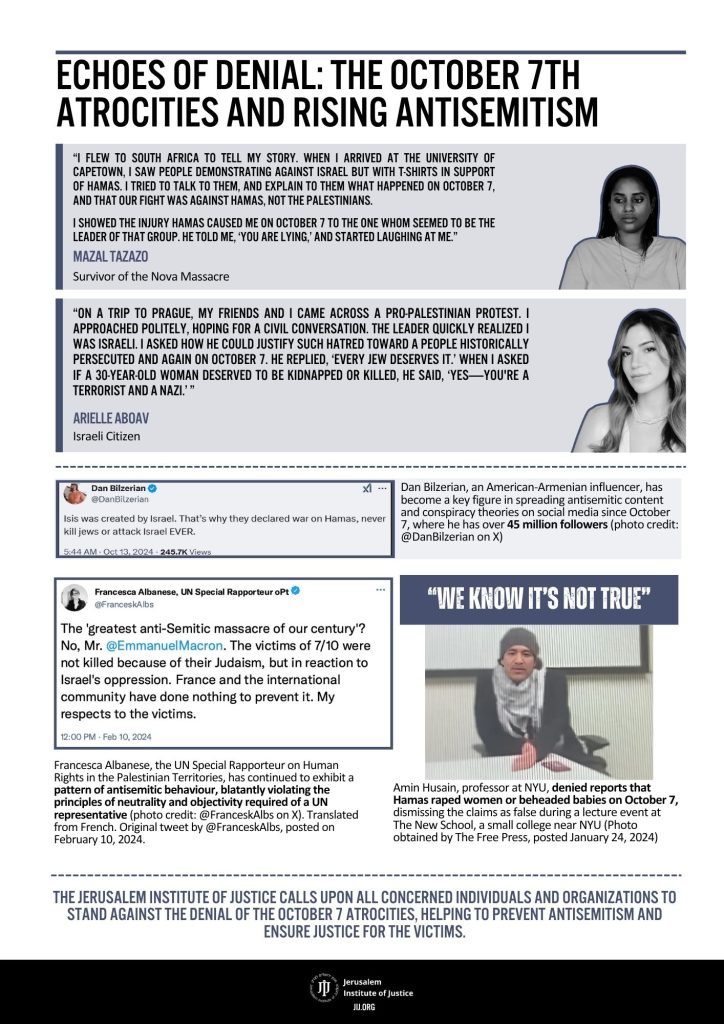
The October 7th attacks against Israelis were a horrific act of violence that left deep scars on the Jewish community worldwide. However, as the reality of these atrocities is denied or downplayed, antisemitic incidents have surged globally. The correlation between denialism and rising antisemitism is highlighted by presenting compelling data and advocating for legislation and resolutions that prohibit the denial of such events to protect against hate and ensure justice for the victims. Enacting such laws is vital not only for addressing current injustices but also for guaranteeing the non-recurrence of such hatred and violence in the future. Download factsheet here.
Download
2025 Report - ECHOES OF DENIAL - OCT. 7TH ATROCITIES & RISING ANTISEMITISM
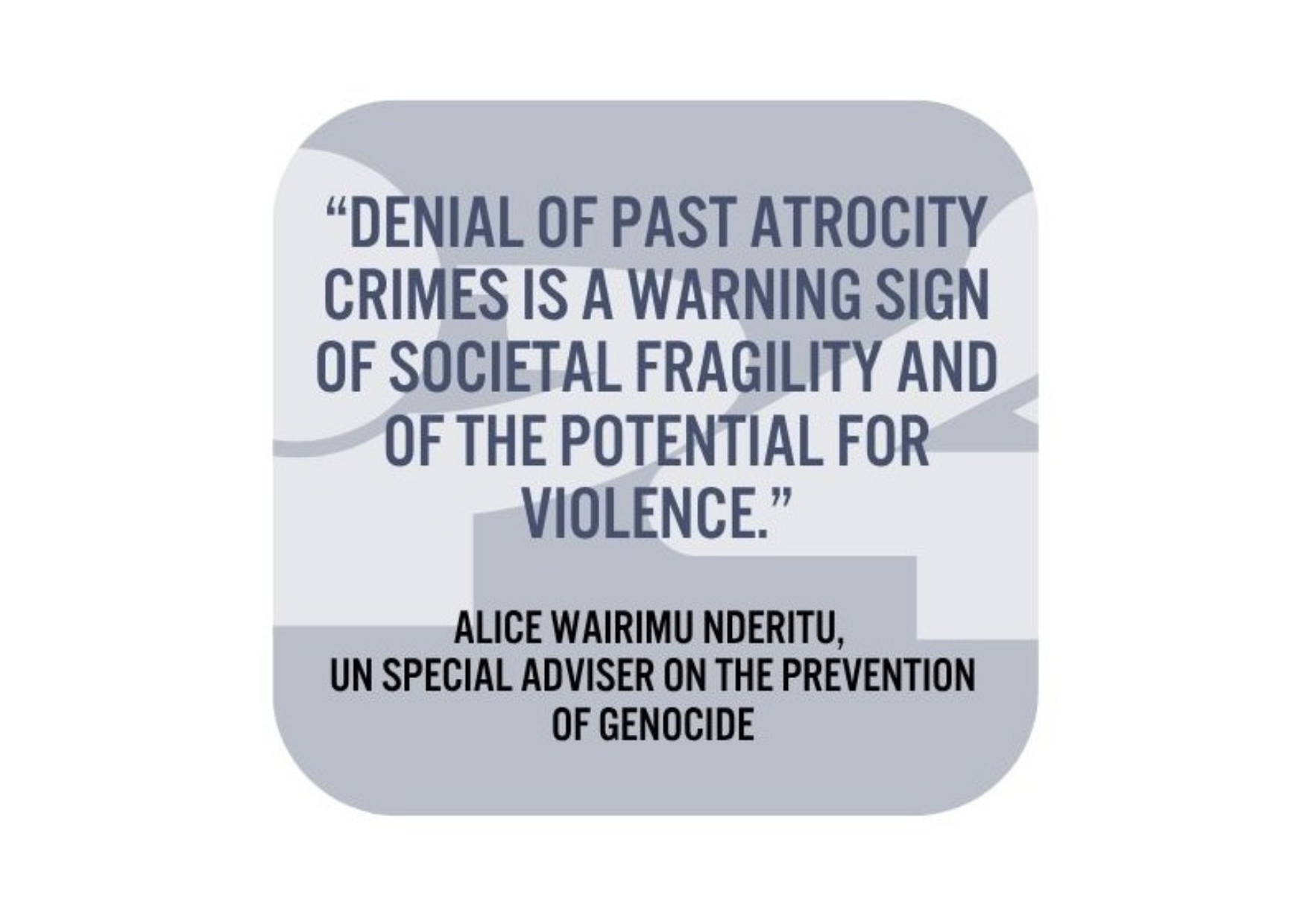
“Denial of atrocity crimes is a warning sign of societal fragility and the enduring presence of
the conditions that allowed this large-scale hatred and violence to erupt in the past.”
Alice Wairimu Nderitu, Under-Secretary General and Special
Adviser on Prevention of Genocide to the United Nations
Secretary General
The October 7, 2023, atrocities committed by Hamas against Israeli civilians were among the most documented terror attacks in history. Despite overwhelming evidence, including livestreamed videos and numerous survivor testimonies, a disturbing pattern of distortion and denial of these events has emerged. This report examines the denial of the October 7 atrocities, links such denial to rising antisemitism, and reviews the current legal frameworks addressing atrocity denial. It also discusses the necessity and promotes the adoption of new legislation against such denial and provides recommendations for international cooperation to combat this dangerous phenomenon.
From Terror to Triumph: Nova Festival Survivor Yuval Raphael to Represent Israel at Eurovision 2025
https://www.youtube.com/watch?v=Q3BELu4z6-U&t=184s
https://youtu.be/kaYR8o8uoXs
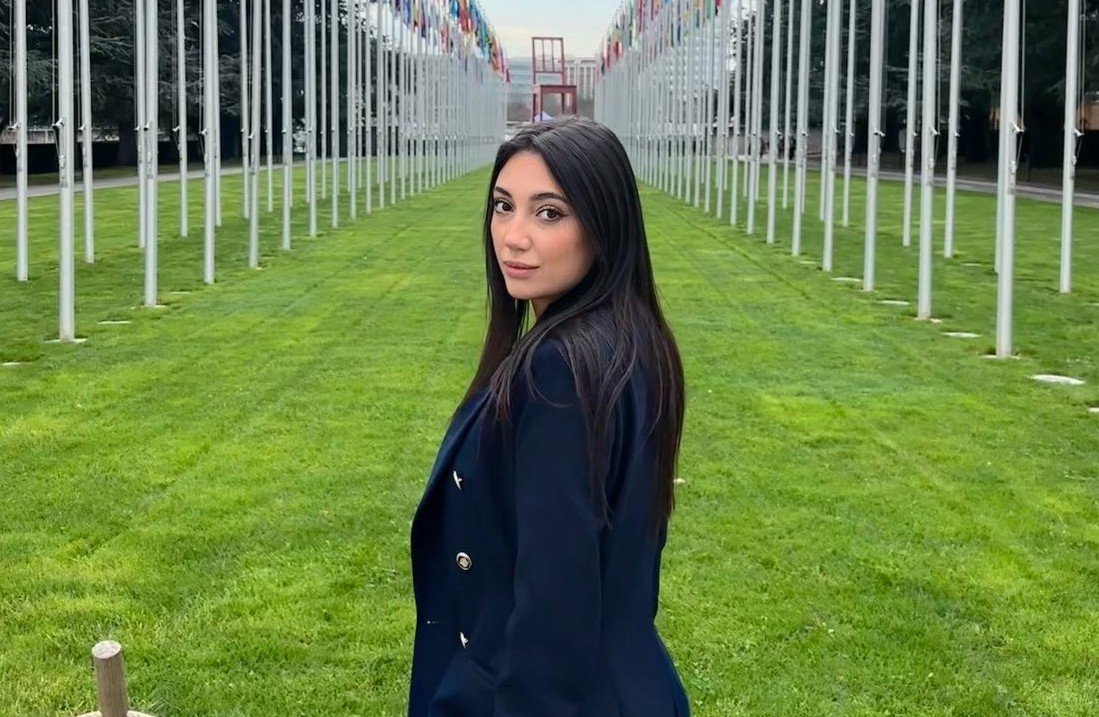
In a powerful testament to resilience and healing through art, Yuval Raphael, one of the survivors featured in the upcoming documentary SATURDAY October 7, has been selected to represent Israel at Eurovision 2025.
Many know Yuval's harrowing story from October 7th, 2023. That morning, she and her friends attended the Nova Music Festival near Re'im, Israel. When Hamas terrorists attacked, Yuval found herself trapped in a roadside bomb shelter with dozens of others. For eight horrifying hours, she had to play dead among the deceased as terrorists repeatedly returned to spray the shelter with gunfire and grenades.
Only 11 people in that shelter survived.
In the documentary, Yuval shares the devastating details of that day - the initial confusion as rockets filled the sky, the moment they realized terrorists had infiltrated the festival grounds, and the unbearable hours spent in silence, wondering if each breath would be her last.
Her testimony provides crucial firsthand evidence of the events of October 7th.
What makes her Eurovision selection particularly moving is that prior to competing on HaKokhav HaBa (The Next Star), Yuval had never performed professionally.
The 24-year-old from Ra'anana was known for being shy about her voice. Yet somehow, in the aftermath of unimaginable trauma, she found the courage not only to speak out about what happened, but to sing.
Yuval will perform a song featuring Hebrew lyrics, to be selected internally and announced in March 2025. The decision to reveal her selection early allows songwriters to create music that resonates with both her voice and her powerful story.
Her journey from surviving one of Israel's darkest days to representing her country on Europe's biggest musical stage serves as an inspiration. It reminds us that even in the wake of horror, the human spirit can find its voice - sometimes quite literally.
We look forward to supporting Yuval as she shares her artistry with the world at Eurovision 2025.
Her presence on that stage will represent not just Israel, but the triumph of hope over hatred, and the enduring power of music to heal. To learn more about the documentary SATURDAY October 7, visit https://saturdayoct7.com or click the button below.
Note: SATURDAY October 7 is currently being selected for film festivals all around the world and will then be released to the public later this year. The documentary features testimonies from seven survivors of the October 7th attacks, including Yuval Raphael, as they seek justice and work to ensure such atrocities never happen again.
Input to UN Special Rapporteur on Violence Against Women and Girls
Letter to the UN Special Rapporteur on Violence Against Women and Girls
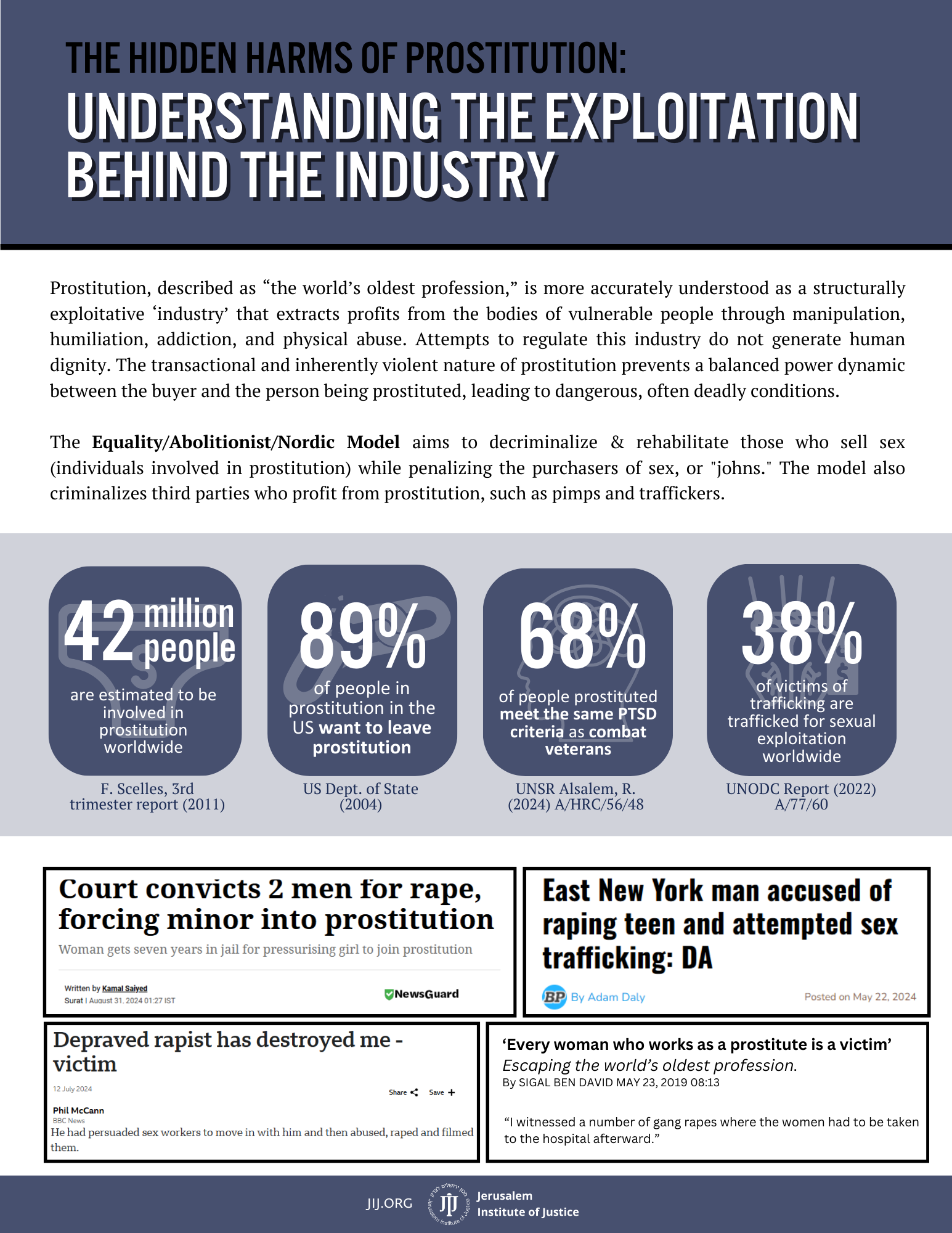
The Jerusalem Institute of Justice (JIJ) expresses its appreciation for Ms. Reem Alsalem's October 2024 Position Paper on exit programs for women in prostitution and submits input for her forthcoming UN report on sex-based violence. Israel's adoption of the Abolitionist/Nordic Model in 2018 marked a regional milestone in combatting prostitution, criminalizing the purchase of sex while supporting rehabilitative programs for victims. Despite increased public awareness and legal frameworks, enforcement remains weak, with online exploitation rising. JIJ urges stronger penalties, educational programs, and regulatory measures to combat the industry’s digital shift. It also calls for UN-led data analysis and a global exchange of best practices.
January 30th, 2025
Dear Ms. Reem Alsalem,
We deeply appreciate your October 2024 Position Paper on lessons learned from the
implementation of exit programs for women in prostitution. In support of your forthcoming report
to the UN Human Rights Council on new frontiers and emerging issues of the forms of sex-based
violence against women and girls, the Jerusalem Institute of Justice submits this input concerning
the rights of prostituted women and girls in Israel.
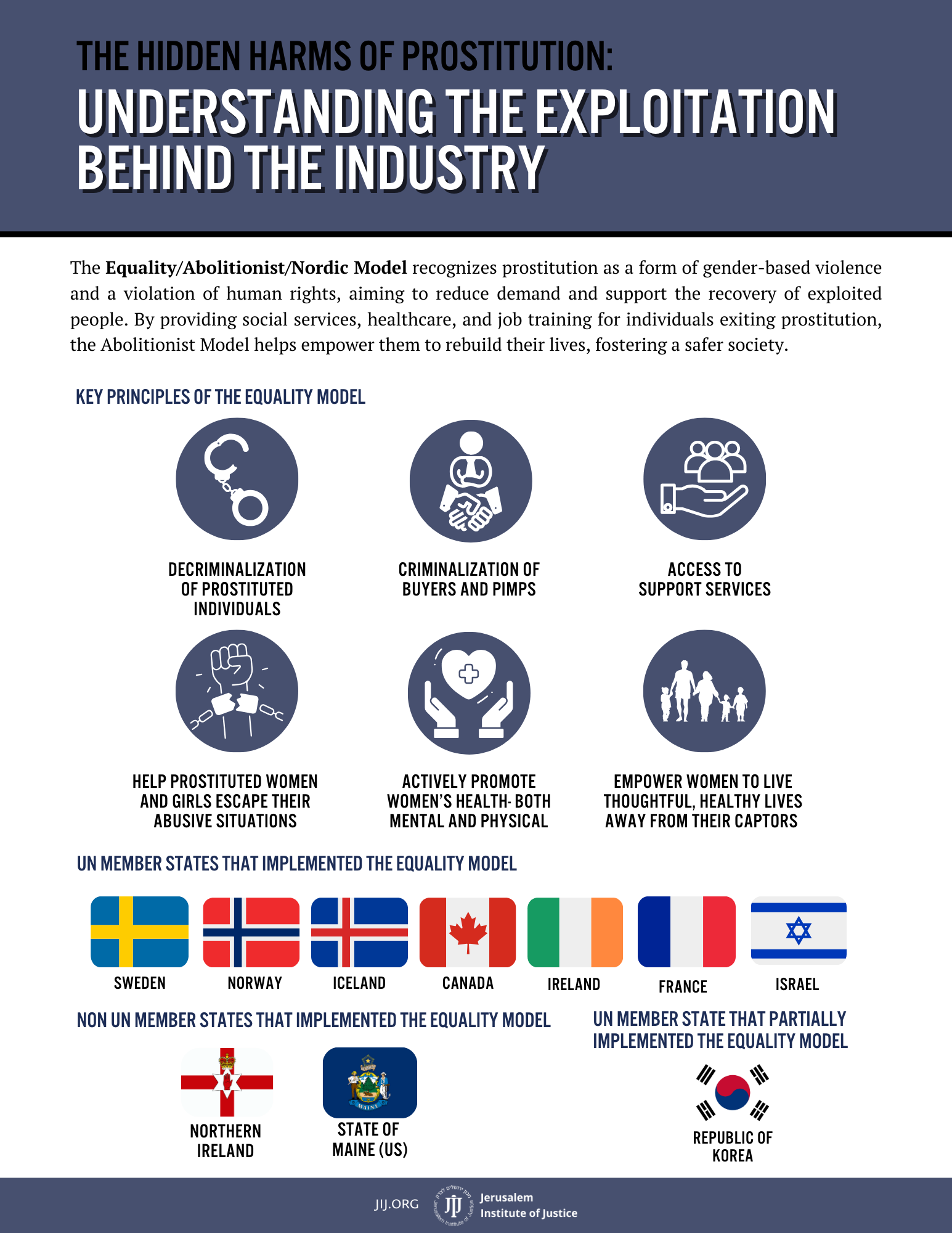
On December 31, 2018, the Israeli Knesset officially adopted the Prohibition on Consuming
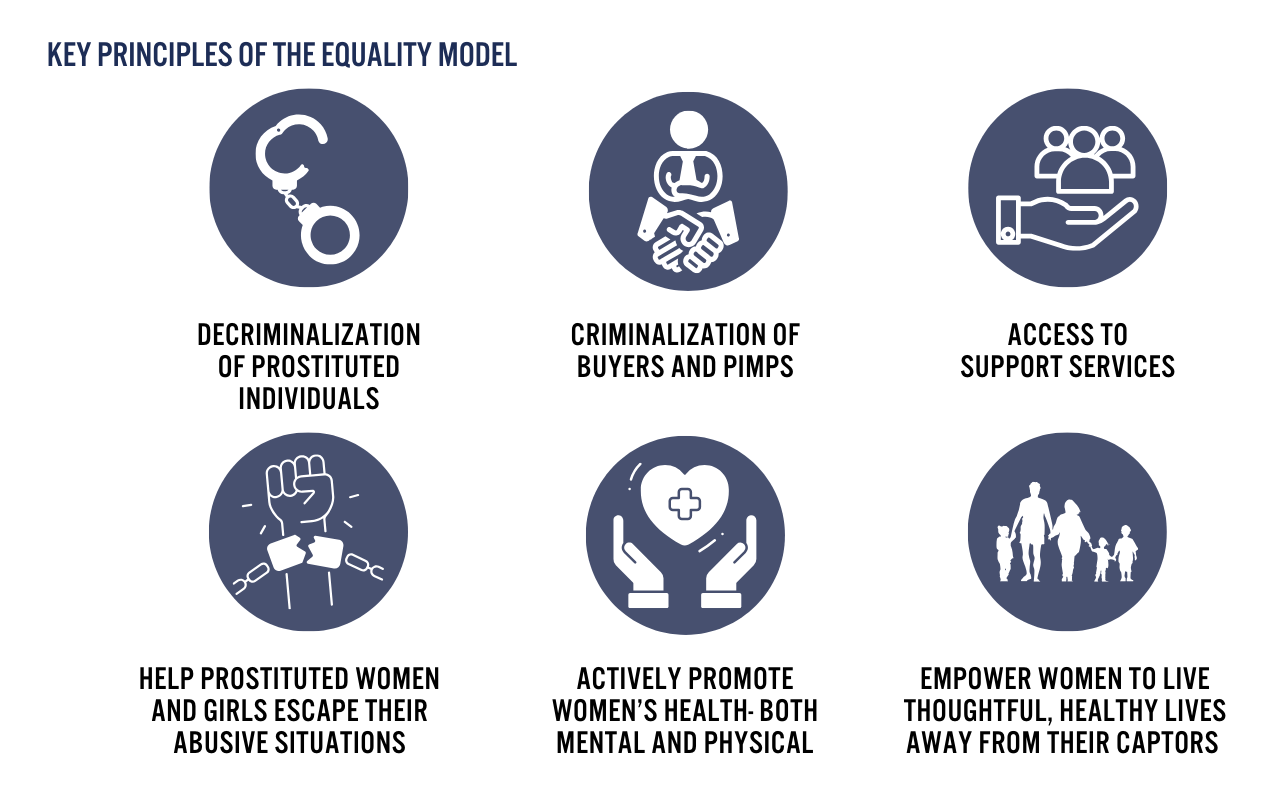
Prostitution Act. This law is based on the Abolitionist/Equality/Nordic Model which has been
implemented by Sweden, Norway, Iceland, Canada, Ireland, France, the Republic of Korea,
Northern Ireland, and the State of Maine in the United States. In adopting this law, Israel became
the first state in the Middle East region to adopt the Abolitionist model for combatting the
exploitation of women and girls in the prostitution industry.
As a core member of the Coalition Against Human Trafficking and Prostitution, a task force of 20
Israeli civil society organizations, the Jerusalem Institute of Justice (JIJ) led the effort to develop
and promote this legal framework within Israel. JIJ remains engaged in the law’s implementation
as a provider of pro bono legal services for trafficked women and girls. In 2024, we provided legal
aid to 9 women and girls exiting the prostitution industry, securing their rights to housing, debt
relief, and lawful immigration status.
Israel’s Approach to Punishing Consumers of Prostitution
The Israeli version of the Abolitionist Model defines consumption of prostitution as a civil offense
for which violators can be fined 2,000 NIS ($500 USD) for a first offense and 4,000 NIS ($1,000
USD) for subsequent violations. Serial offenders can be fined as much as 70,000 NIS ($20,000
USD) and face possible incarceration. Crucially, the law assumes that any woman found inside a
brothel is a victim of exploitation, and a man found in a brothel is an unlawful consumer, regardless
of his claims to the contrary.
The law offers violators the option, instead of paying a fine, of attending a series of educational
sessions given by the Adult Probation Service, whose objective is to change the offender’s
perspectives on the consumption of prostitution. The law also provides funding for the
rehabilitation of victims, and obligates the Ministries of Social Services and Homeland Security
to report annually to the Knesset Constitution Committee regarding the law’s implementation and
its effect on the rehabilitation of and assistance given to prostituted people.
The Challenges of Implementation
In 2016, Israel’s Welfare Ministry estimated there were 11,420-12,730 prostituted people driving
the country’s 1.2 billion NIS ($318 million USD) industry. According to that report, 71% of
prostituted women said they entered the sex trade out of financial desperation, and 76% said they
would leave the industry if they could.
The Israeli version of the Nordic Model is a five-year temporary order, which entered full
enforcement status at the height of the COVID pandemic. The pandemic severely limited
government and civil society efforts to inform and re-train police and criminal justice professionals
on the new legal framework.
A 2024 study found that the new law’s mass media and public education programs had succeeded
in transforming the Israeli public’s perceptions of the prostitution industry. While a 2016 survey
found that only 39% of Israelis viewed prostituted women as victims of abuse and exploitation, by
2024, 72% of Israelis agreed with this principle, and supported efforts to punish sex buyers.1
Unfortunately, due to a lack of criminal enforcement of this new law, consumption of prostitution
in Israel increased from 7% to 9% during the study period of 2021-2024.2 As reported by Israel’s
Ministry of Justice, only 5,104 fines have been issued to consumers of prostitution since the new
law went into effect.3
In 2025, JIJ and our Coalition partners are fighting to make this law permanent. As occurred in
2018 before the law’s initial passage, we are facing pressure and harassment from pro-prostitution
lobby groups, which seek to reframe prostitution as an act of “empowerment” and mischaracterize
the work and membership of the Coalition.
We are also challenged by the prostitution industry’s movement away from street corners and onto
the internet, including social media platforms like OnlyFans, and encrypted messaging platforms
like Telegram, which pimps in Israel use to lure women and girls from Russia, Belarus, and
Ukraine.
Recommendations
During the 69th session of the Commission on the Status of Women, and the 59th session of the
Human Rights Council, we urge you to:
- Call for civil and criminal penalties for all who profit from the sexual exploitation of
women and girls, whether in person or online;
- Call for UN Women to initiate a comprehensive survey and data analysis on the
implementation of the abolitionist/equality/Nordic model and its effect on victims and
perpetrators;
- Promote the use of precise, survivor-centered terminology, including “prostituted
women and children” rather than “sex workers,” in UN reports, educational materials, and
policy discussions, as recommended in your 2024 Position Paper;
- Call for member states to adopt the following educational programs to change social
perceptions of the prostitution industry:
- Mandatory educational programs for law enforcement, social service providers,
and judicial authorities on the realities of prostitution, including its ties to human
trafficking and organized crime. These programs should align with international
human rights principles and survivor-led advocacy;
- Public education initiatives that challenge the myths surrounding prostitution
and highlight the realities of coercion, exploitation, and harm. This should include
school-based curricula addressing the vulnerability of young women and girls to
commercial sexual exploitation;
- Regulatory measures requiring digital platforms (including social media and
encrypted messaging services) to warn users about the criminal implications of
advertising and purchasing sex, and to implement stricter policies against content
promoting the exploitation of women and girls;
- Convene a side event on Countering the Sexual Exploitation of Women and Girls through
Prostitution, gathering representatives of the 8 UN Member States that have adopted the
Abolitionist/Equality/Nordic Model (Sweden, Norway, Iceland, Canada, Ireland, France,
the Republic of Korea, and Israel) for the purpose of sharing best practices and challenges
to implementation.
In support of these recommendations, the Jerusalem Institute of Justice will be happy to participate
and facilitate inputs from Israeli survivors, advocates, and service providers.
With appreciation,
Flavia Sevald, CEO
1 https://brookdale-web.s3.amazonaws.com/uploads/files/RR-009.0-24_Heb_Report.pdf
2 https://www.jpost.com/israel-news/article-809634
3 https://www.unwomen.org/sites/default/files/2024-10/a-79-322-submission-israel-en.pdf
A New Rivalry?
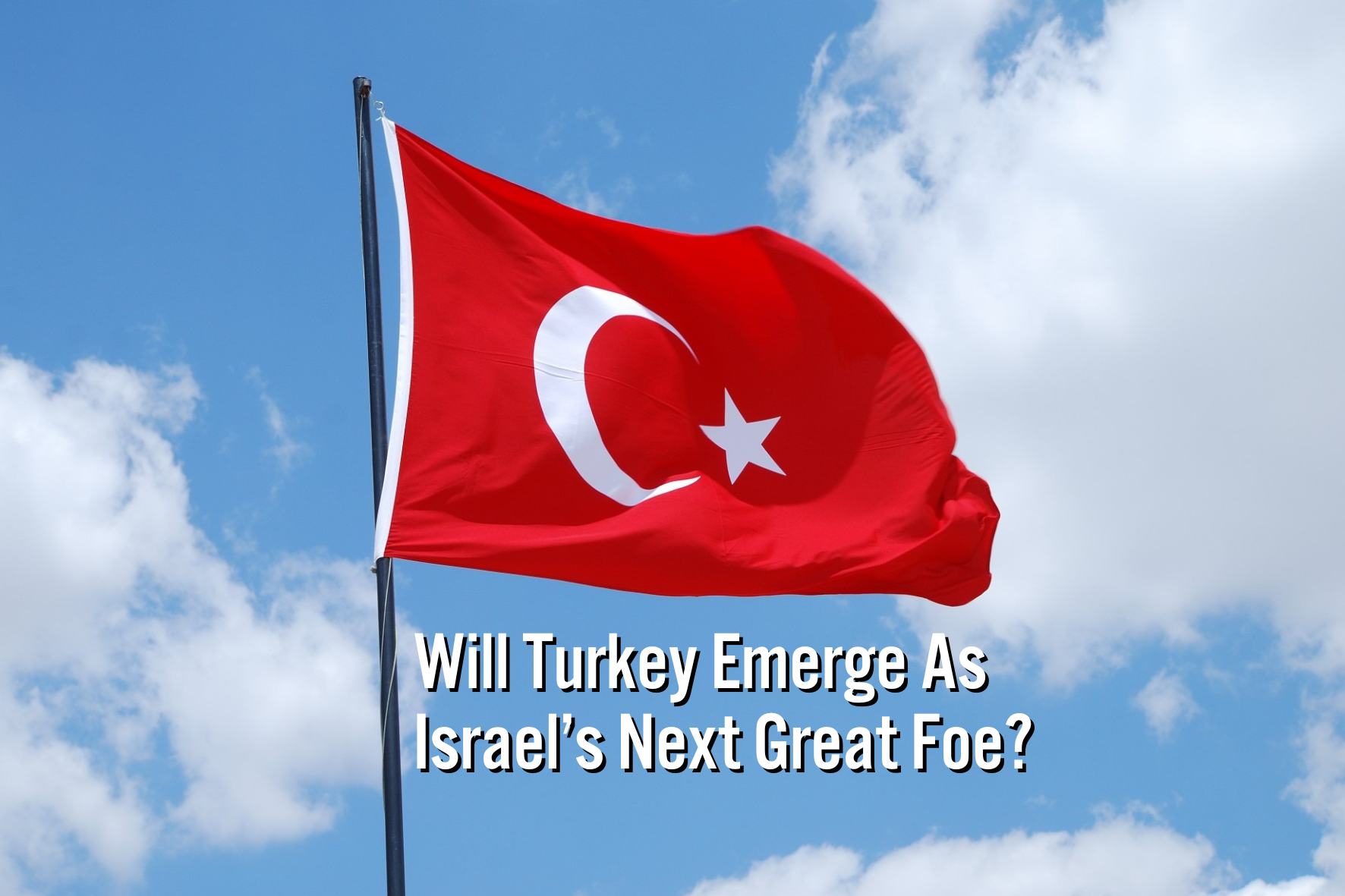
Will Turkey Emerge As Israel’s Next Great Foe?
Turkish-Israeli relations have always been in flux. Turkey was the first Muslim-majority country to recognise Israel, and the 1990s were characterised by strengthening relations[1]. However, relations began to deteriorate at the beginning of the 21st century, coinciding with the election of Erdogan and Turkey’s shift towards Islam and championing of the Palestinian issue. This deterioration reached its zenith after the 2010 Gaza Flotilla incident[2], with full diplomatic relations only restored over a decade later[3]. Following the 7th October, Turkish-Israeli relations have returned to rock-bottom, with Erdogan exclaiming that Turkey has “severed all relations with Israel”[4].
Concurrently, Bashar al-Asssad’s regime in Syria has fallen to Turkish-backed rebels, providing Erdogan the opportunity to reassert Turkish influence across a classical Ottoman region. This resembles Iran’s opportunities to restore influence across former Persian regions following the fall of Saddam in Iraq, which led to increased tensions with Israel. Given sunken Turkish-Israel relations, and Turkey’s newfound regional opportunities, will Turkey tread in Iran’s footsteps and emerge as Israel’s next great foe, a possibility hypothesised by the recent Nagel committee report[5], or is there reason to be optimistic about the future of the Turkish-Israeli relationship?
Mirroring Iran
Both Turkey and Iran envision a self-aggrandising destiny as a regional and global power, derived from nostalgia for their former empires. As such Turkey has strong contemporary interest in Syria. Turkey holds 3.2 million Syrian refugees[6] that Erdogan wishes to return as soon as possible due to the economic burden they have placed on Turkey. Erdogan also wants to eradicate Kurdish resistance in Syria, in contrast to Israel’s alignment with the Kurds, used to counter Iraqi and Iranian interests[7]. The Kurdish issue in Syria could become one point of contention between Israel and Turkey.
Another point of contention is Turkey’s strong relationship with the new Syrian regime, demonstrated by Turkish diplomats being the first foreign dignitaries to meet with the new Syrian leaders[8]. If Turkey begins to provide weapons to Syria, and Syria enters into a conflict with Israel, a possibility given the new Syrian regime’s Islamic terrorist origins and unresolved Syria-Israel border disputes, then Israel would be required to strike Turkish assets in Syria, analogous to Israel’s strikes against Islamic Revolutionary Guard Corps (IRGC) assets in Syria prior to Assad’s defeat, which led to direct Israel-Iran conflict. Hence, Turkey’s growing influence in Syria could precipitate a conflict between Israel and Turkey, mirroring the development of the Israel-Iran conflict.
Turkey’s domestic politics produces strong anti-Israel rhetoric. 84% of Turks, including 92% who voted for Erdogan, support Hamas in the current war[9], demonstrating strong domestic incentive for hostility towards Israel. Additionally, Erdogan is a strong supporter of the Muslim Brotherhood movement[10], of which Hamas is an offshoot, leading to strong Turkish support for Hamas, causing friction in Turkish-Israeli relations. Turkey’s domestic and ideological considerations have led to a deterioration in Turkish rhetoric regarding Israel, mirroring Iran’s anti-Israel hostility, which became a multiplier for Israel-Iran tensions, suggesting Turkish-Israeli relations may go the same way.
Moderating factors
Despite some of the similarities between Turkey and Iran, there are differences which can moderate Turkish-Israeli tensions. Unlike Iran, which is over 90% Shia[11], Turkey is 88% Sunni[12]. Therefore, whilst Iran, the centre of Shia thought, can exert influence across all Shia populations in the region, Turkey has to compete with other centres of Sunni power for regional influence, limiting Turkey’s ability to emulate Iran’s Shia crescent.
Unlike Iran, Turkey remains in the US security sphere and is a member of NATO. Thus, the US has incentive to moderate Turkish-Israeli tensions. Additionally, Israel and Turkey remain strategic partners to Azerbaijan, another country that can moderate Turkish-Israeli tensions.
In contrast to Iran’s consistent hostility towards Israel, Erdogan’s Israel policy has been characterised by flip-flopping, with periods of good and bad relations. Though, during periods of bad relations, trade relations have still been able to flourish. Hence, Turkey’s Israel policy could be interpreted more as short-term opportunism than a long-term anti-Israel plan that characterises Iranian policy.
Conclusion
Turkey has all the requisite attributes for mirroring Iran and becoming Israel’s next major foe. Turkey, like Iran, has ambitions to cultivate a sphere of influence across their former imperial regions, whilst spouting extreme anti-Israel rhetoric, and supporting Palestinian terrorist groups. Hence, Israel must prepare the necessary military capabilities in case a direct confrontation with Turkey does break out, as recommended by the Nagel committee report. However, unlike Iran, there are significant forces capable of moderating Turkish belligerence before Turkey reaches foe status. Erdogan has not committed to a consistent Israel policy through the years and has significant economic interest in maintaining a cordial relationship with Israel. Additionally, Israel has plenty of diplomatic avenues to shape Turkey’s behaviour in Israel’s favour. Israel can leverage its relationship with the US, NATO, and Azerbaijan, all partners of Turkey, in moderating tensions, as well as pursue ties with traditional Turkish adversaries like Greece and Cyprus to balance against Turkish power. The future of Turkish-Israel relations is not set in stone, but there is plenty of reason to be hopeful.
By: Eitan Litvin, JIJ Intern
[1] Tür, Ozlem. “Turkey and Israel in the 2000s-from cooperation to conflict.” Israel Studies, vol. 17, no. 3, 2012, pp. 45-66.
[2] “Timeline: Main Events in the Gaza Flotilla Affair.” Reuters, 2010, https://www.reuters.com/article/world/timeline-main-events-in-the-gaza-flotilla-affair-idUSTRE6562BN/. Accessed 21/01/2025.
[3] Obel, Ash. “Israel and Turkey to Restore Ambassadors in Full Renewal of Diplomatic Ties.” timesofisrael.com, 2022, https://www.timesofisrael.com/israel-and-turkey-to-restore-ambassadors-in-full-renewal-of-diplomatic-ties/. Accessed 21/01/2025.
[4] Soylu, Ragip. “Turkey Severs All Relations with Israel, Says Erdogan.” Middle East Eye, 2024, https://www.middleeasteye.net/news/turkey-severs-all-relations-israel-says-erdogan. Accessed 19/01/2025.
[5] Etzion, Udi. “Nagel Committee Warns Israel Must Prepare For Potential War with Turkey” The Jerusalem Post, 2025, https://www.jpost.com/israel-news/article-83636. Accessed 19/01/2025.
[6] “Overview | UNHCR Turkey.” UNHCR Turkey, 2025, www.unhcr.org/tr/en/ne-yapiyoruz/overview. Accessed 21/01/2025.
[7] Quitaz, Suzan. “The Historic Ties Between Israel and the Kurds of Iraq Will Continue.” Jerusalem Center for Public Affairs, 2023, https://jcpa.org/article/the-historic-ties-between-israel-and-the-kurds-of-iraq-will-continue/. Accessed 19/01/2025
[8] “Leader of New Syrian Government to Make First Foreign Visit to Türkiye.” Report News Agency, 2025, https://report.az/en/region/leader-of-new-syrian-government-to-make-first-foreign-visit-to-turkiye/. Accessed 19/01/2025.
[9] Dalmis, Ibrahim. “Public Opinion and Reaction to Israel’s War on Gaza after October 7 in Türkiye.” Insight Turkey, 2024, https://www.insightturkey.com/articles/public-opinion-and-reaction-to-israels-war-on-gaza-after-october-7-in-turkiye. Accessed 19/01/2025.
[10] Kenez, Levent. “Erdogan Still Maintains Close Ties with Muslim Brotherhood despite Reproachement with Sisi” Nordic Monitor, 2024, https://nordicmonitor.com/2024/09/erdogan-still-maintains-close-ties-with-muslim-brotherhood-despite-rapprochement-with-sisi/. Accessed 19/01/2025.
[11] “Iran - United State Department of State.” United States Department of State, 2023, https://www.state.gov/reports/2022-report-on-international-religious-freedom/iran/. Accessed 21/01/2025.
[12] “Turkey - United States Department of State.” United States Department of State, 2023, https://www.state.gov/reports/2022-report-on-international-religious-freedom/turkey/. Accessed 21/01/2025.
A New Rivalry?
Will Turkey Emerge As Israel’s Next Great Foe?
Turkish-Israeli relations have always been in flux. Turkey was the first Muslim-majority country to recognise Israel, and the 1990s were characterised by strengthening relations[1]. However, relations began to deteriorate at the beginning of the 21st century, coinciding with the election of Erdogan and Turkey’s shift towards Islam and championing of the Palestinian issue. This deterioration reached its zenith after the 2010 Gaza Flotilla incident[2], with full diplomatic relations only restored over a decade later[3]. Following the 7th October, Turkish-Israeli relations have returned to rock-bottom, with Erdogan exclaiming that Turkey has “severed all relations with Israel”[4].
Concurrently, Bashar al-Asssad’s regime in Syria has fallen to Turkish-backed rebels, providing Erdogan the opportunity to reassert Turkish influence across a classical Ottoman region. This resembles Iran’s opportunities to restore influence across former Persian regions following the fall of Saddam in Iraq, which led to increased tensions with Israel. Given sunken Turkish-Israel relations, and Turkey’s newfound regional opportunities, will Turkey tread in Iran’s footsteps and emerge as Israel’s next great foe, a possibility hypothesised by the recent Nagel committee report[5], or is there reason to be optimistic about the future of the Turkish-Israeli relationship?
Mirroring Iran
Both Turkey and Iran envision a self-aggrandising destiny as a regional and global power, derived from nostalgia for their former empires. As such Turkey has strong contemporary interest in Syria. Turkey holds 3.2 million Syrian refugees[6] that Erdogan wishes to return as soon as possible due to the economic burden they have placed on Turkey. Erdogan also wants to eradicate Kurdish resistance in Syria, in contrast to Israel’s alignment with the Kurds, used to counter Iraqi and Iranian interests[7]. The Kurdish issue in Syria could become one point of contention between Israel and Turkey.
Another point of contention is Turkey’s strong relationship with the new Syrian regime, demonstrated by Turkish diplomats being the first foreign dignitaries to meet with the new Syrian leaders[8]. If Turkey begins to provide weapons to Syria, and Syria enters into a conflict with Israel, a possibility given the new Syrian regime’s Islamic terrorist origins and unresolved Syria-Israel border disputes, then Israel would be required to strike Turkish assets in Syria, analogous to Israel’s strikes against Islamic Revolutionary Guard Corps (IRGC) assets in Syria prior to Assad’s defeat, which led to direct Israel-Iran conflict. Hence, Turkey’s growing influence in Syria could precipitate a conflict between Israel and Turkey, mirroring the development of the Israel-Iran conflict.
Turkey’s domestic politics produces strong anti-Israel rhetoric. 84% of Turks, including 92% who voted for Erdogan, support Hamas in the current war[9], demonstrating strong domestic incentive for hostility towards Israel. Additionally, Erdogan is a strong supporter of the Muslim Brotherhood movement[10], of which Hamas is an offshoot, leading to strong Turkish support for Hamas, causing friction in Turkish-Israeli relations. Turkey’s domestic and ideological considerations have led to a deterioration in Turkish rhetoric regarding Israel, mirroring Iran’s anti-Israel hostility, which became a multiplier for Israel-Iran tensions, suggesting Turkish-Israeli relations may go the same way.
Moderating factors
Despite some of the similarities between Turkey and Iran, there are differences which can moderate Turkish-Israeli tensions. Unlike Iran, which is over 90% Shia[11], Turkey is 88% Sunni[12]. Therefore, whilst Iran, the centre of Shia thought, can exert influence across all Shia populations in the region, Turkey has to compete with other centres of Sunni power for regional influence, limiting Turkey’s ability to emulate Iran’s Shia crescent.
Unlike Iran, Turkey remains in the US security sphere and is a member of NATO. Thus, the US has incentive to moderate Turkish-Israeli tensions. Additionally, Israel and Turkey remain strategic partners to Azerbaijan, another country that can moderate Turkish-Israeli tensions.
In contrast to Iran’s consistent hostility towards Israel, Erdogan’s Israel policy has been characterised by flip-flopping, with periods of good and bad relations. Though, during periods of bad relations, trade relations have still been able to flourish. Hence, Turkey’s Israel policy could be interpreted more as short-term opportunism than a long-term anti-Israel plan that characterises Iranian policy.
Conclusion
Turkey has all the requisite attributes for mirroring Iran and becoming Israel’s next major foe. Turkey, like Iran, has ambitions to cultivate a sphere of influence across their former imperial regions, whilst spouting extreme anti-Israel rhetoric, and supporting Palestinian terrorist groups. Hence, Israel must prepare the necessary military capabilities in case a direct confrontation with Turkey does break out, as recommended by the Nagel committee report. However, unlike Iran, there are significant forces capable of moderating Turkish belligerence before Turkey reaches foe status. Erdogan has not committed to a consistent Israel policy through the years and has significant economic interest in maintaining a cordial relationship with Israel. Additionally, Israel has plenty of diplomatic avenues to shape Turkey’s behaviour in Israel’s favour. Israel can leverage its relationship with the US, NATO, and Azerbaijan, all partners of Turkey, in moderating tensions, as well as pursue ties with traditional Turkish adversaries like Greece and Cyprus to balance against Turkish power. The future of Turkish-Israel relations is not set in stone, but there is plenty of reason to be hopeful.
By: Eitan Litvin, JIJ Intern
[1] Tür, Ozlem. “Turkey and Israel in the 2000s-from cooperation to conflict.” Israel Studies, vol. 17, no. 3, 2012, pp. 45-66.
[2] “Timeline: Main Events in the Gaza Flotilla Affair.” Reuters, 2010, https://www.reuters.com/article/world/timeline-main-events-in-the-gaza-flotilla-affair-idUSTRE6562BN/. Accessed 21/01/2025.
[3] Obel, Ash. “Israel and Turkey to Restore Ambassadors in Full Renewal of Diplomatic Ties.” timesofisrael.com, 2022, https://www.timesofisrael.com/israel-and-turkey-to-restore-ambassadors-in-full-renewal-of-diplomatic-ties/. Accessed 21/01/2025.
[4] Soylu, Ragip. “Turkey Severs All Relations with Israel, Says Erdogan.” Middle East Eye, 2024, https://www.middleeasteye.net/news/turkey-severs-all-relations-israel-says-erdogan. Accessed 19/01/2025.
[5] Etzion, Udi. “Nagel Committee Warns Israel Must Prepare For Potential War with Turkey” The Jerusalem Post, 2025, https://www.jpost.com/israel-news/article-83636. Accessed 19/01/2025.
[6] “Overview | UNHCR Turkey.” UNHCR Turkey, 2025, www.unhcr.org/tr/en/ne-yapiyoruz/overview. Accessed 21/01/2025.
[7] Quitaz, Suzan. “The Historic Ties Between Israel and the Kurds of Iraq Will Continue.” Jerusalem Center for Public Affairs, 2023, https://jcpa.org/article/the-historic-ties-between-israel-and-the-kurds-of-iraq-will-continue/. Accessed 19/01/2025
[8] “Leader of New Syrian Government to Make First Foreign Visit to Türkiye.” Report News Agency, 2025, https://report.az/en/region/leader-of-new-syrian-government-to-make-first-foreign-visit-to-turkiye/. Accessed 19/01/2025.
[9] Dalmis, Ibrahim. “Public Opinion and Reaction to Israel’s War on Gaza after October 7 in Türkiye.” Insight Turkey, 2024, https://www.insightturkey.com/articles/public-opinion-and-reaction-to-israels-war-on-gaza-after-october-7-in-turkiye. Accessed 19/01/2025.
[10] Kenez, Levent. “Erdogan Still Maintains Close Ties with Muslim Brotherhood despite Reproachement with Sisi” Nordic Monitor, 2024, https://nordicmonitor.com/2024/09/erdogan-still-maintains-close-ties-with-muslim-brotherhood-despite-rapprochement-with-sisi/. Accessed 19/01/2025.
[11] “Iran - United State Department of State.” United States Department of State, 2023, https://www.state.gov/reports/2022-report-on-international-religious-freedom/iran/. Accessed 21/01/2025.
[12] “Turkey - United States Department of State.” United States Department of State, 2023, https://www.state.gov/reports/2022-report-on-international-religious-freedom/turkey/. Accessed 21/01/2025.

From Media Consumer to Content Creator
Ben Solomon reflects on his transformative journey as an intern at JIJ, where he tackled Israel's biggest challenges—Hamas, Hezbollah, Iran, and lawfare—through reading, debating, and writing. Dive into his story and discover the building blocks of effective Israel advocacy
My most rewarding experience at JIJ was producing and recording a series of 15-minute lectures on the central challenges facing Israel (Hamas, Hezbollah, Iran, and lawfare). Before coming to JIJ, I considered myself an informed consumer of media about Israel. Creating content, however, is much harder than consuming it. As I went about producing material of my own, I realized how little I had previously known about the threats facing Israel and the realities of the Middle East.
How did I go about overcoming this knowledge deficit to produce original content for viewers in Israel and the Diaspora? By reading, by debating, and by writing.
Read
Israel has a vibrant and diverse English-language press. Almost every day, I would spend time reading live blogs in the Times of Israel and current affairs in the Jerusalem Post. To expose myself to different perspectives, I viewed op-eds in Israel Hayom and Ynetnews. The perspectives which I saw in these outlets made me appreciate the thought processes driving Israel’s decision making.
Beyond news articles, my understanding of Israel improved tremendously from reading books. For modern Israeli history, I recommend reading Yossi Klein Halevi, Michael Oren, and Daniel Gordis. All three have written highly accessible books which deal with Israel’s achievements in war and in peace. Historical background makes it much easier to understand Israel’s contemporary dilemmas.
Besides books, I advise digging into the treasure trove of audiovisual resources available online. To understand events from decades ago, I would watch old documentaries and political speeches. For up-to-date analyses of events, I turned to podcasters like Dan Senor and Ezra Klein. The content is accessible – you just need to seek it out.
Debate
Once I read a lot about Israel, I started to form my own opinions about difficult topics, such as the breakdown of peace negotiations, international hostility toward Israel, and strategies for confronting Iran. The best way for me to test these opinions was by defending them against competing viewpoints. I regularly entered Uri’s office ( JIJ's director of International Law and Policy) in the middle of the day, where I could spend 30 minutes or more trying to make sense of current affairs. The office space at JIJ is very open, without the hierarchical separations of an American workspace.
These discussions also took place outside the confines of the office. I loved arguing with Israeli friends and family to see whether my emerging views could withstand other people’s ingrained opinions. When I travelled outside Tel Aviv for Shabbats or excursions, I tried to learn as much as possible about the dividing lines within Israeli society.
As I talked to more and more people about Israel, I found myself enthralled by the diversity of opinions within the country. Israel is certainly not the caricature of “apartheid” and “genocide” presented on college campuses and at the United Nations. But nor is it a straightforward or homogenous society. It is, instead, the melting pot of an ancient people, unified in its desire for the blessings of peace, but divided over how to achieve that end.
Write
During my first month at JIJ, I remember being nervous to commit my ideas to writing. I had already read several books and spent plenty of time exposing myself to the viewpoints of other people. But at the same time, I was reluctant to take the leap from being a consumer to a producer of information.
The way that I overcame this writer’s block was by introducing frameworks for content delivery: the “Five Pillars of Hamas” or the “Seven Front War.” Once I had established these frameworks, I could fill them with material to support an overall argument. Sub-dividing lectures into different chapters made it much easier to package them for social media.
One of the real challenges of writing about Israel is making it accessible for a non-specialist audience. It is easy to get caught in the weeds of international law, such as the details of past United Nations resolutions or jurisdictional questions at the International Criminal Court. While I enjoyed trying to grapple with these technicalities, I focused my public outreach on presenting a bigger picture viewpoint of Israel’s predicament.
The final challenge of the lecture series was turning long scripts into interesting videos. Given my lack of confidence with the teleprompter, I decided to commit the scripts to memory. I found memorization to be a challenging but highly worthwhile exercise; it pushed me to see the value in every sentence and to clarify the connections between them.
Conclusion
As I look back on the last five months, I am grateful to have contributed to JIJ’s mission of international advocacy for the Jewish state. I feel equipped with the tools to effectively advocate for Israel back home.
In reflecting on my own contribution to JIJ, I would add this: the internship is what you make of it. You will make the most meaningful contribution by working on projects which reflect your skill set and interests. In my case, I was naturally drawn to a project which enabled me to lecture about geopolitics. But JIJ is not a one-size-fits-all model; the internship is flexible enough to accommodate your personal strengths.
Whatever projects you end up working on, I believe that the three fundamentals of reading, debating, and writing will be applicable. These are the indispensable building blocks of Israel advocacy.
What can JIJ do in a year?
2024 was our busiest and most impactful year since our founding 20 years ago
With your help, in 2024, JIJ provided FREE legal aid to 2,733 survivors of terrorism, human trafficking, and discrimination, including:
- 32 wounded Israeli soldiers
- 40 survivors of human trafficking
- 17 survivors of the October 7th massacre
- 68 families seeking Israeli citizenship or residency
- 112 refugees from Ukraine, Russia, and Eritrea
- 120 Israeli families displaced from their homes on the Gaza & Lebanon borders
How does JIJ do all of this in one year? With you, our amazing supporters. Thank you!
Our media presence grew & our team appeared on:




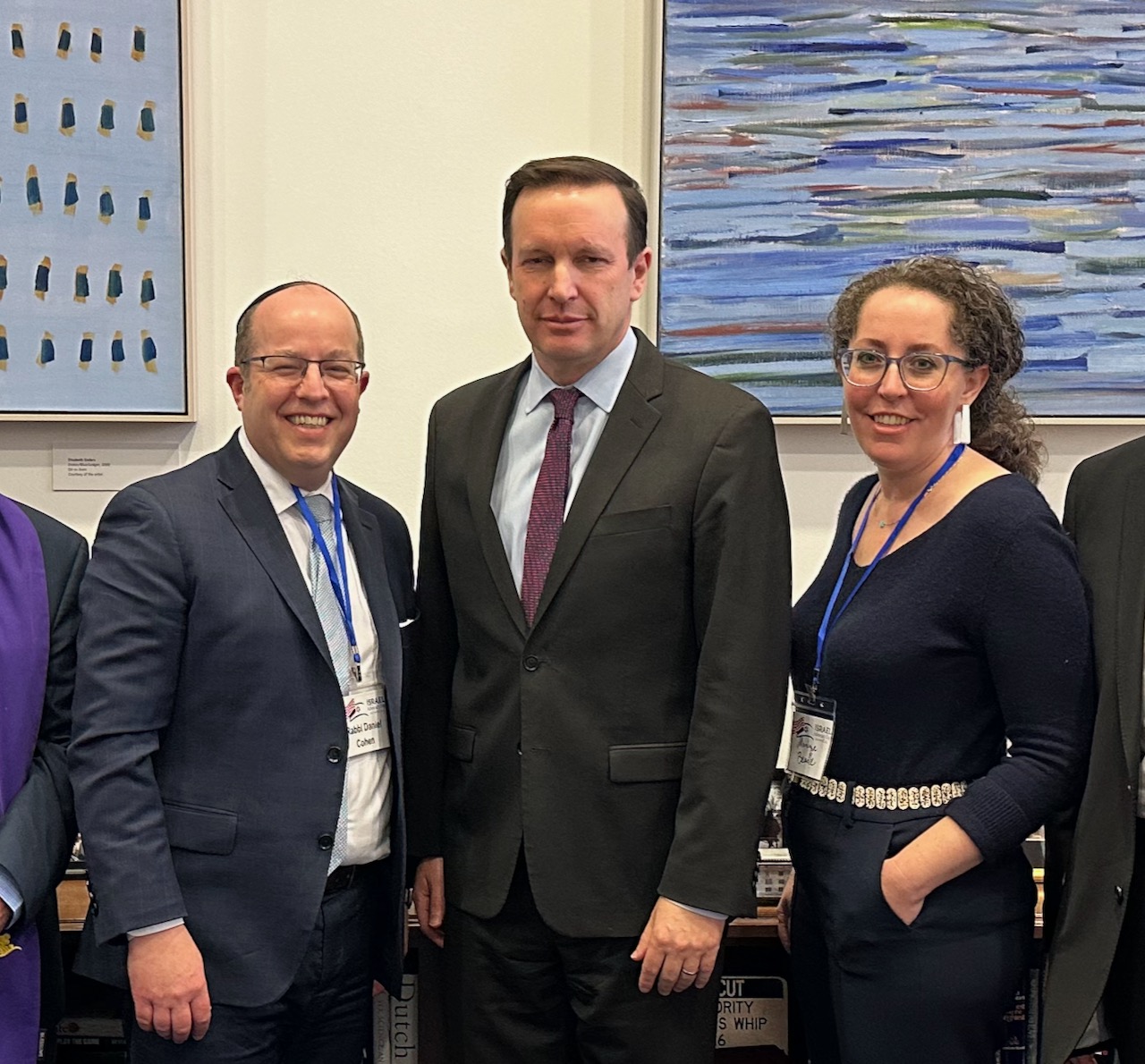
We met personally with dozens of global leaders, including Israel’s First Lady Michal Herzog, United Nations SRSG Pramila Patten, & US Senators Chris Murphy, Richard Blumenthal, & John Fetterman.
We shared our research, forensic evidence, and legal analysis with diplomats from 30 countries.
January - June
JIJ held a series of free “ Know Your Rights” seminars for:
- 120 Israeli families who became suddenly homeless, unemployed, or disabled as a result of the war
- 57 Ukrainian & Russian refugee families
- 9 of these families receive Israeli citizenship through the Law of Return
- 500 wounded soldiers
Gathered 84 political & religious leaders in the U.S. for a private screening of unedited, uncensored footage of the October 7th massacre recovered from the bodies of Hamas terrorists and compiled by the IDF.
Drafted an urgent petition to Stop Funding UNRWA & persuaded key members of the Senate Foreign Relations Committees to enact a 1-year ban on US funding to UNRWA.
Hosted UN diplomats from 18 countries to hear testimony from Yuval Raphael a survivor of the Oct. 7th massacre. Yuval went to the Nova Festival to dance all night with her friends. At dawn, Hamas invaded, and she sought refuge in a roadside bomb shelter, which became a tomb when terrorists found them.
Launched the Survivors Seeking Justice project, and filmed detailed video testimonies of 17 survivors of the Oct. 7th massacre.
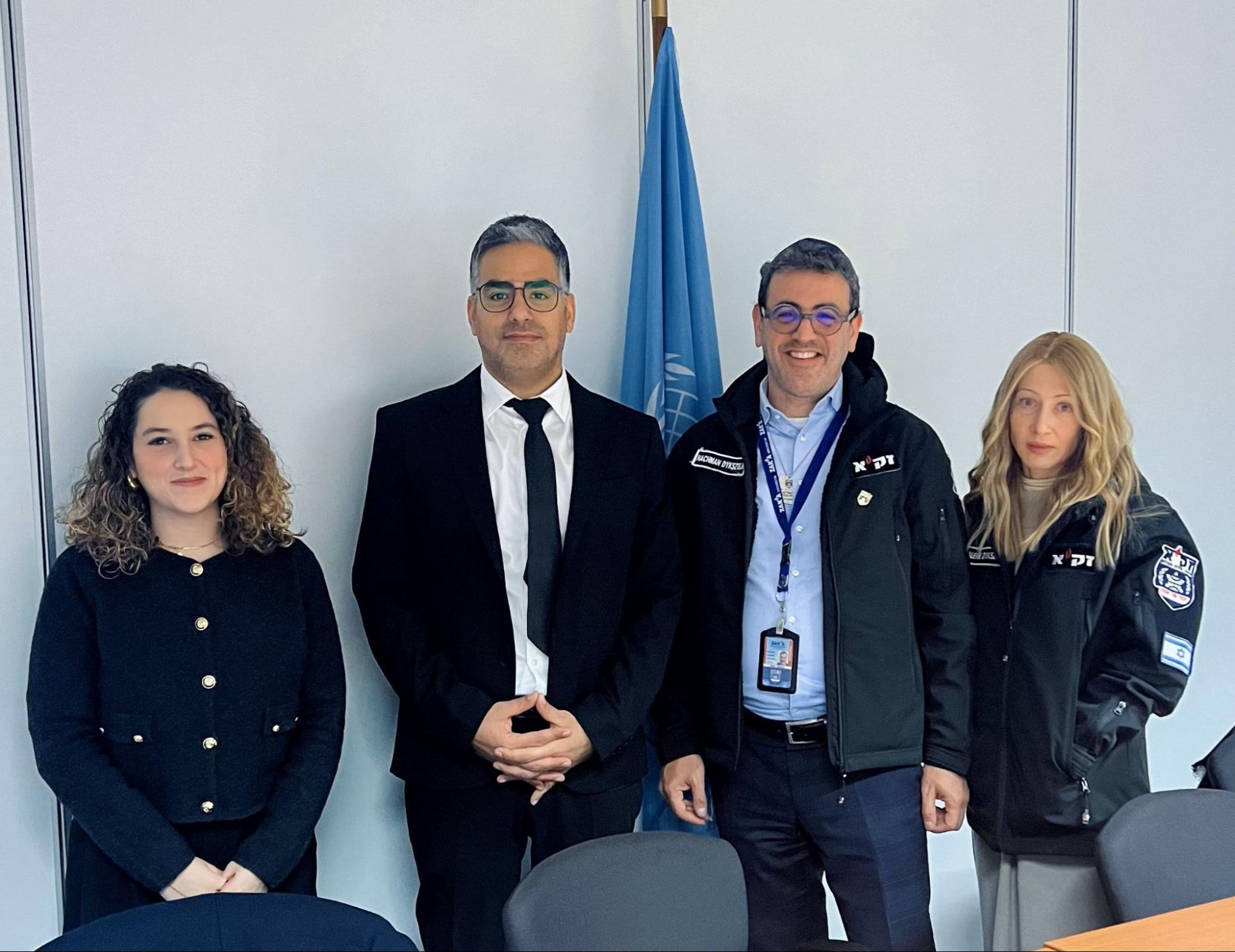
JIJ lawyers presented forensic evidence & first responder testimony to senior UN officials. This proof confirmed a pattern of sexual violence perpetrated by Hamas on Oct. 7th and stopped the rape deniers in their tracks.
July-December
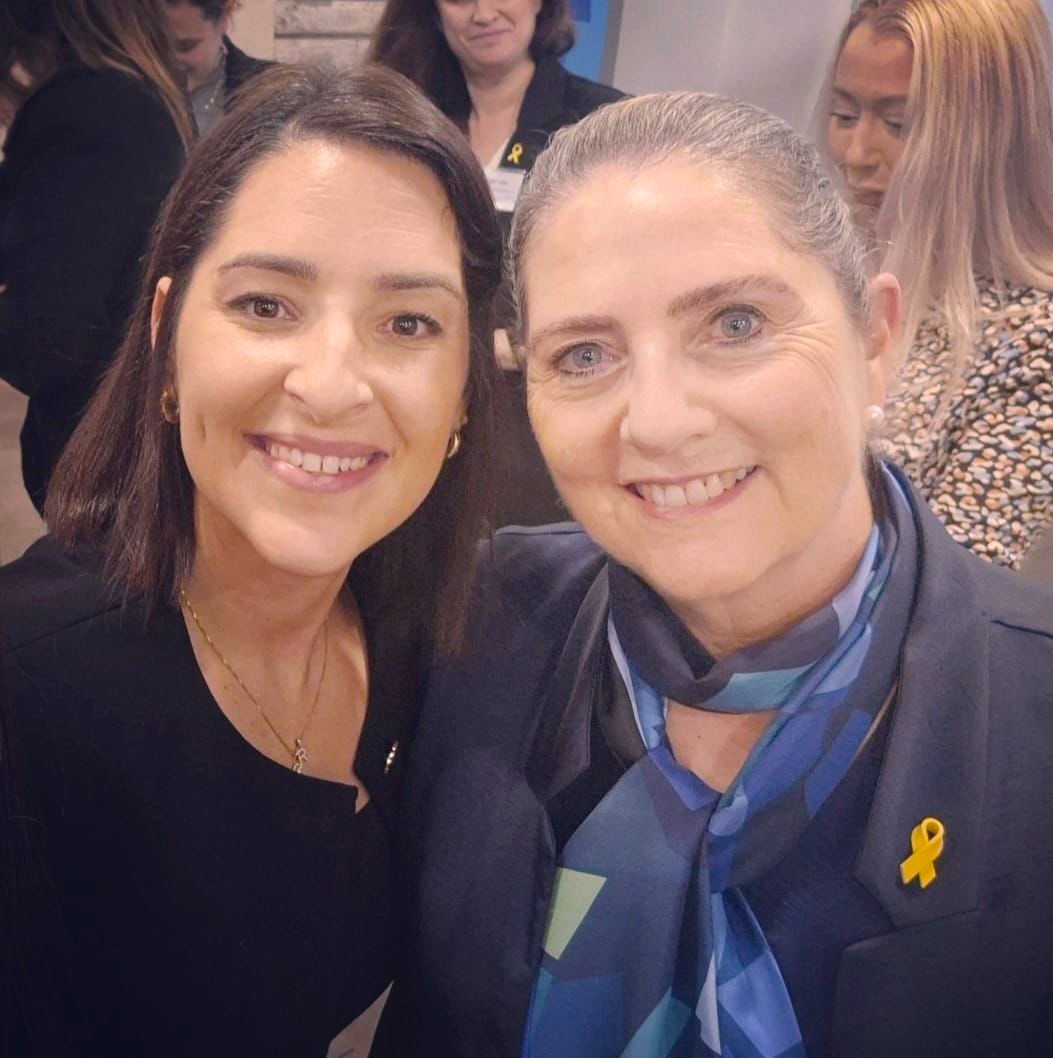
Discussed Israel’s anti-trafficking law with First Lady Michal Herzog. In 2018, JIJ persuaded the
Knesset to adopt a 5-year pilot program that treats women in the sex industry as victims of abuse, & the pimps as criminals. We’re advocating to make the law permanent!
JIJ assisted Israeli police in busting a major human trafficking ring - resulting in the arrest of 14 human traffickers, which was only possible through the testimony of our brave client.
We gave free seminars to soldiers recuperating at Ichilov & Tel Hashomer Hospitals. While private lawyers take 30-50% of a wounded soldier’s disability benefit as payment, JIJ is the only organization providing FREE legal aid to wounded Israeli soldiers, with 32 new soldier clients in 2024.
Intervened at the International Criminal Court with an amicus brief making it clear that the Court lacks jurisdiction over Israeli leaders.
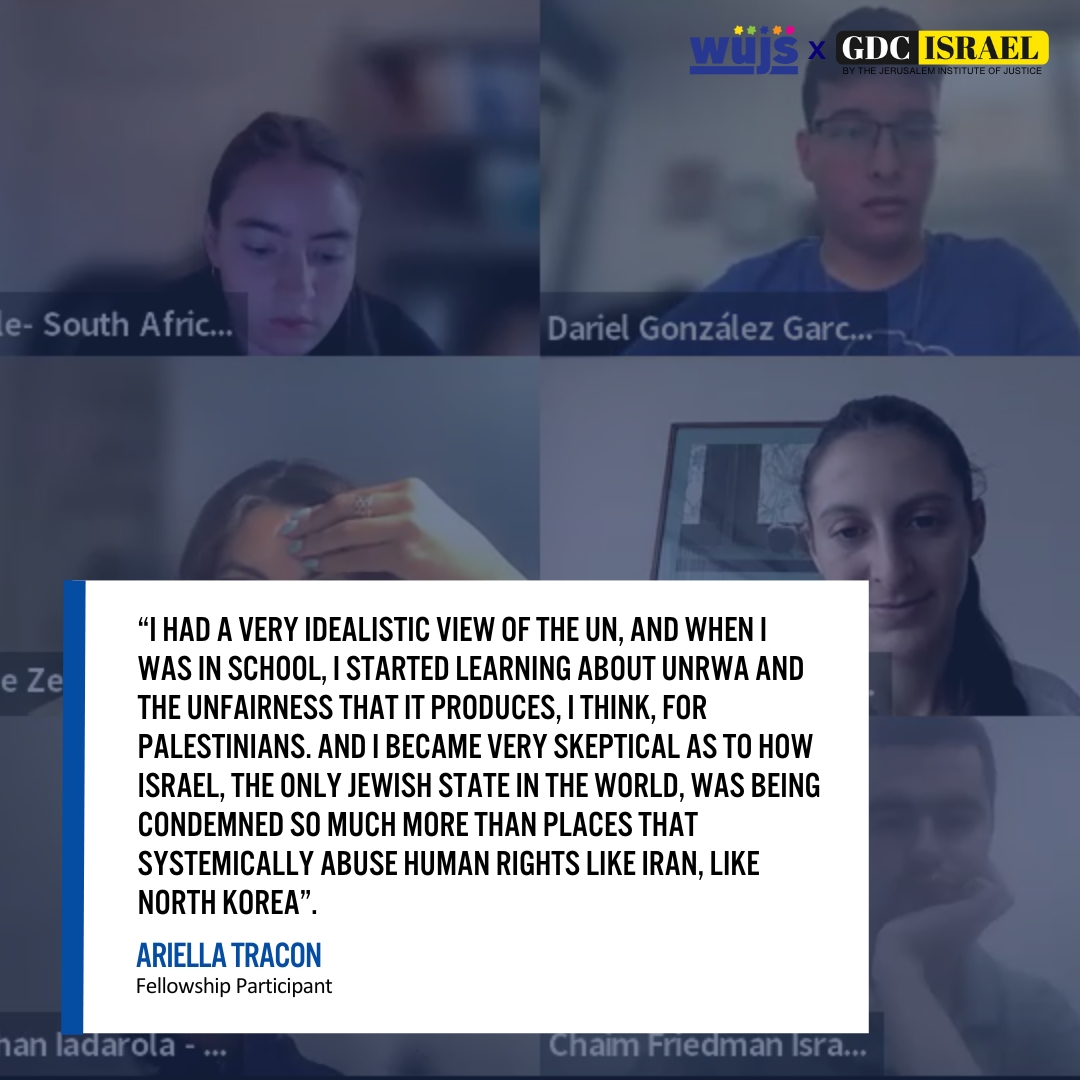
Partnered with the World Union of Jewish Students to train & empower student leaders. Over 8 weeks, we trained 23 Jewish university students from 16 countries to combat antisemitism on their campuses.
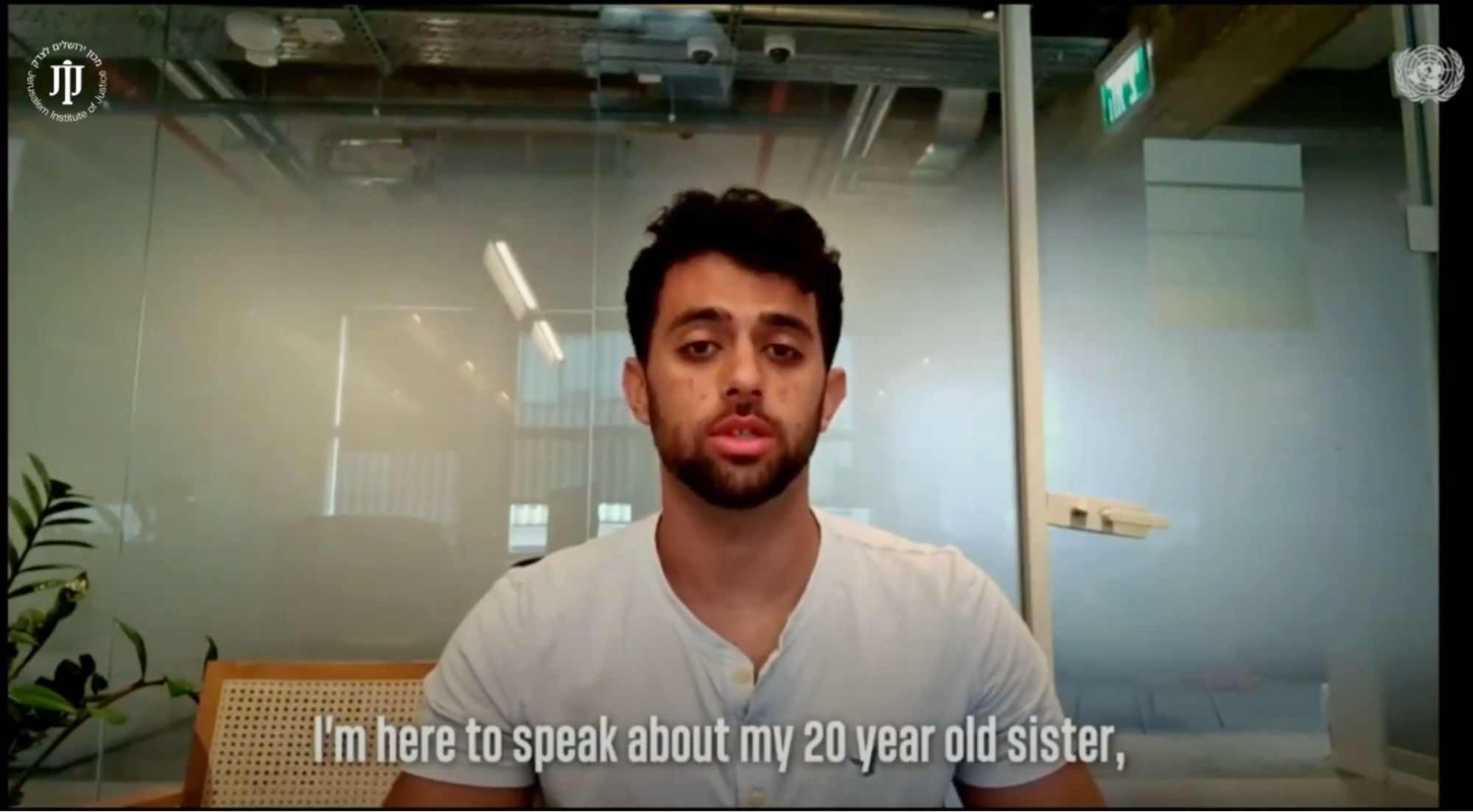
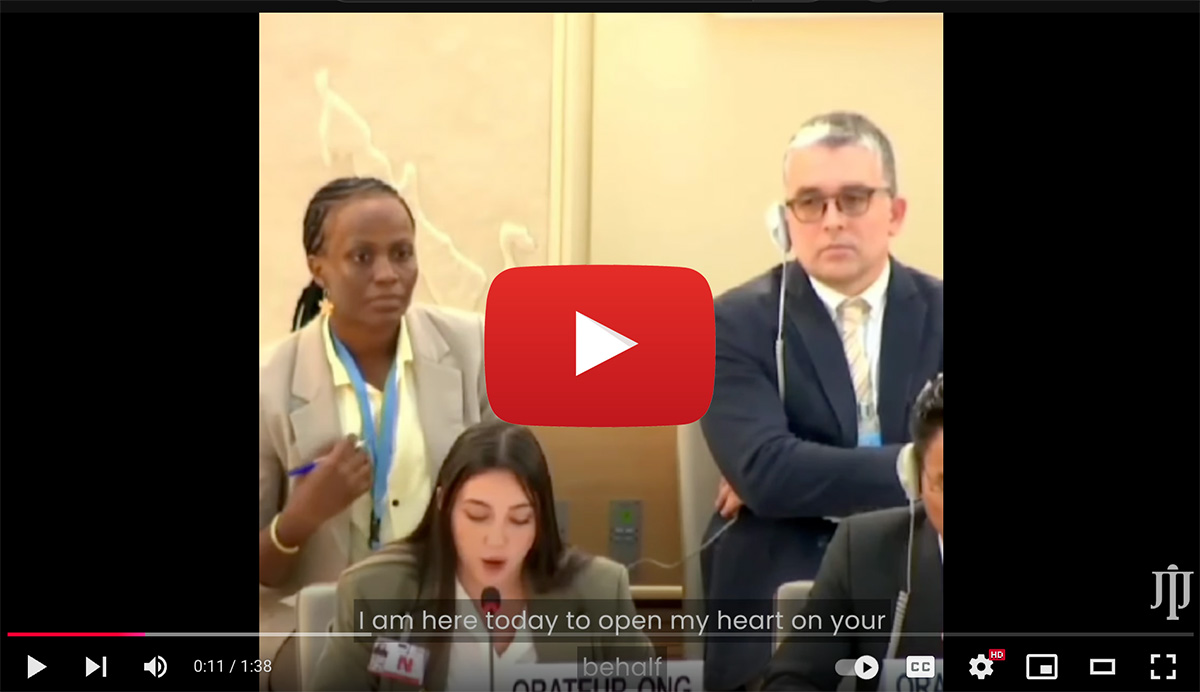
The UN Human Rights Council convened a special gathering on the Jewish New Year, to condemn Israel. The timing was intentional - to prevent opposition. In response, we gave our General Assembly floor time to Amit Levy, brother of Naama Levy, who was kidnapped by Hamas on Oct. 7th. Amit gave powerful testimony on the need to free all of the hostages.