
Palestinian Voices: Who is Silencing Them?
Palestinian Voices: Who is Silencing Them?
Every year on May 3rd we celebrate the World Press Freedom Day, as established by the UN General Assembly thirty years ago. On this day, we stress the importance of allowing individuals to communicate and access information freely. For press freedom to truly exist, information must be accessible to all, and journalists must be free from interference while exercising this freedom. On the occasion of World Press Freedom Day, it is imperative that we conduct a rigorous evaluation of the degree to which press freedom is being upheld across the globe, and raise awareness about the severe restrictions that certain populations face as a result of authoritarian regimes governing them.
Unfortunately, Palestinians, including Palestinian journalists, are often subjected to persecution and harassment by the Palestinian Authority (PA) when expressing ideas and sharing information that contradicts its interests. The PA does claim that it protects freedom of expression and press. Article 19 of the Palestinian Basic Law establishes that “every person shall have the right to express his opinion and to circulate it orally, in writing or in any form.” However, other laws also enacted by the PA clearly limit the freedom of press and opinion, such as the Press and Publications Law. Furthermore, the situation on the ground has demonstrated that the PA has repeatedly taken measures to suppress freedom of press.
Throughout the years, Palestinians who have expressed opposing interests to those of the PA have been pressured, assaulted, arrested, and even killed by the PA forces. To illustrate the extent of the issue, it is worth noting that as recently as March 2023, two Palestinian journalists, Moath Washha and Wahaj Bani Mufleh, were apprehended by the Palestinian intelligence service. Mufleh was even subjected to torture and ill-treatment after he tried to help a foreign journalist that was arrested and mistreated by the Palestinian security forces.
Moreover, the case of Nizar Banat cannot go unnoticed. Banat, a Palestinian activist and an outspoken critic of the PA was brutally beaten and detained by the Palestinian security forces. Tragically, he passed away en route to the hospital just one hour later. Thousands of people gathered to protest against the PA for Banat’s death, and even during these demonstrations, Palestinian security forces attacked the protesters and several journalists who attended the protest.
The international community has often turned a blind eye to the numerous human rights violations committed by the Palestinian Authority against Palestinians. On this important occasion of reflecting upon the significance of press freedom, it is critical to acknowledge that this is a fundamental right that is indispensable to democracy and must be safeguarded. It is our duty to ensure that those who violate this freedom, including the Palestinian Authority, are called out and held responsible for their actions.

Palestinian Voices: Who is Silencing Them?
Palestinian Voices: Who is Silencing Them?
Every year on May 3rd we celebrate the World Press Freedom Day, as established by the UN General Assembly thirty years ago. On this day, we stress the importance of allowing individuals to communicate and access information freely. For press freedom to truly exist, information must be accessible to all, and journalists must be free from interference while exercising this freedom. On the occasion of World Press Freedom Day, it is imperative that we conduct a rigorous evaluation of the degree to which press freedom is being upheld across the globe, and raise awareness about the severe restrictions that certain populations face as a result of authoritarian regimes governing them.
Unfortunately, Palestinians, including Palestinian journalists, are often subjected to persecution and harassment by the Palestinian Authority (PA) when expressing ideas and sharing information that contradicts its interests. The PA does claim that it protects freedom of expression and press. Article 19 of the Palestinian Basic Law establishes that “every person shall have the right to express his opinion and to circulate it orally, in writing or in any form.” However, other laws also enacted by the PA clearly limit the freedom of press and opinion, such as the Press and Publications Law. Furthermore, the situation on the ground has demonstrated that the PA has repeatedly taken measures to suppress freedom of press.
Throughout the years, Palestinians who have expressed opposing interests to those of the PA have been pressured, assaulted, arrested, and even killed by the PA forces. To illustrate the extent of the issue, it is worth noting that as recently as March 2023, two Palestinian journalists, Moath Washha and Wahaj Bani Mufleh, were apprehended by the Palestinian intelligence service. Mufleh was even subjected to torture and ill-treatment after he tried to help a foreign journalist that was arrested and mistreated by the Palestinian security forces.
Moreover, the case of Nizar Banat cannot go unnoticed. Banat, a Palestinian activist and an outspoken critic of the PA was brutally beaten and detained by the Palestinian security forces. Tragically, he passed away en route to the hospital just one hour later. Thousands of people gathered to protest against the PA for Banat’s death, and even during these demonstrations, Palestinian security forces attacked the protesters and several journalists who attended the protest.
The international community has often turned a blind eye to the numerous human rights violations committed by the Palestinian Authority against Palestinians. On this important occasion of reflecting upon the significance of press freedom, it is critical to acknowledge that this is a fundamental right that is indispensable to democracy and must be safeguarded. It is our duty to ensure that those who violate this freedom, including the Palestinian Authority, are called out and held responsible for their actions.
Everything you should know about the Israel Judicial Reform
Israel’s proposed judicial reform has sparked significant societal controversy, revealing the ongoing tension between the Executive and Judiciary branches. Supporters of the reform argue that it will enhance democracy in Israel. At the same time, opponents fear that it will undermine the democratic principles of checks and balances, granting too much power to the Executive branch and potentially endangering minority and human rights. The debate over the reform has created a deep divide within Israeli society.
In this lecture and the attached report, we explore the four components of the proposed reform, give you an overview of the current situation, and explain what changes the reform would like to bring about. We also examine the arguments presented by supporters and opponents of the reform.
https://www.youtube.com/watch?v=ZT129G9vgn0&t=29s
JIJs Grow, Discover, Connect Israel Program in the Local News
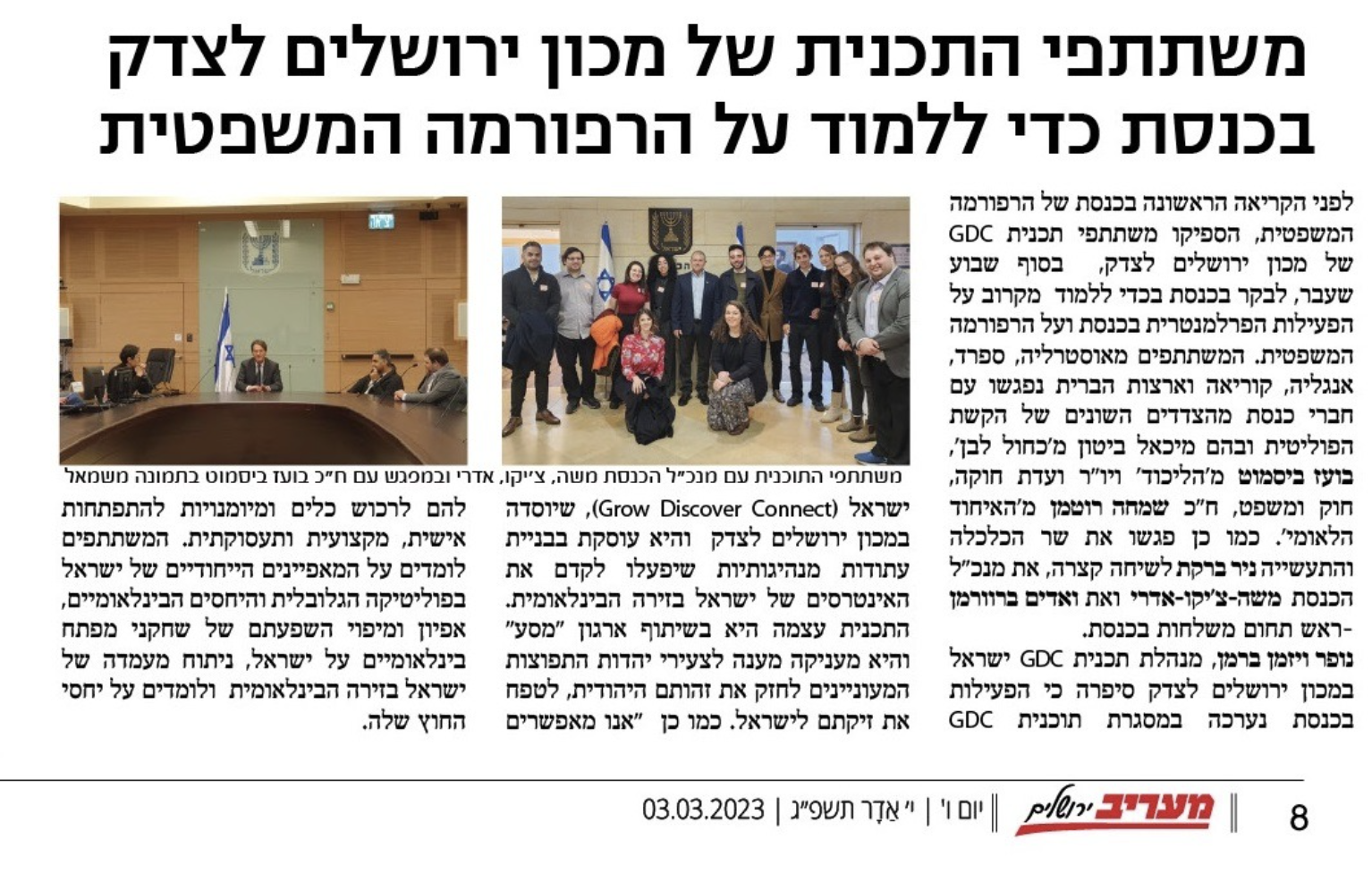
The Grow, Discover, Connect (GDC) program at the Jerusalem Institute for Justice (JIJ) attracts interns from around the world who are eager to learn about Israel's unique global political and international relations characteristics, as well as to develop their personal and professional skills.
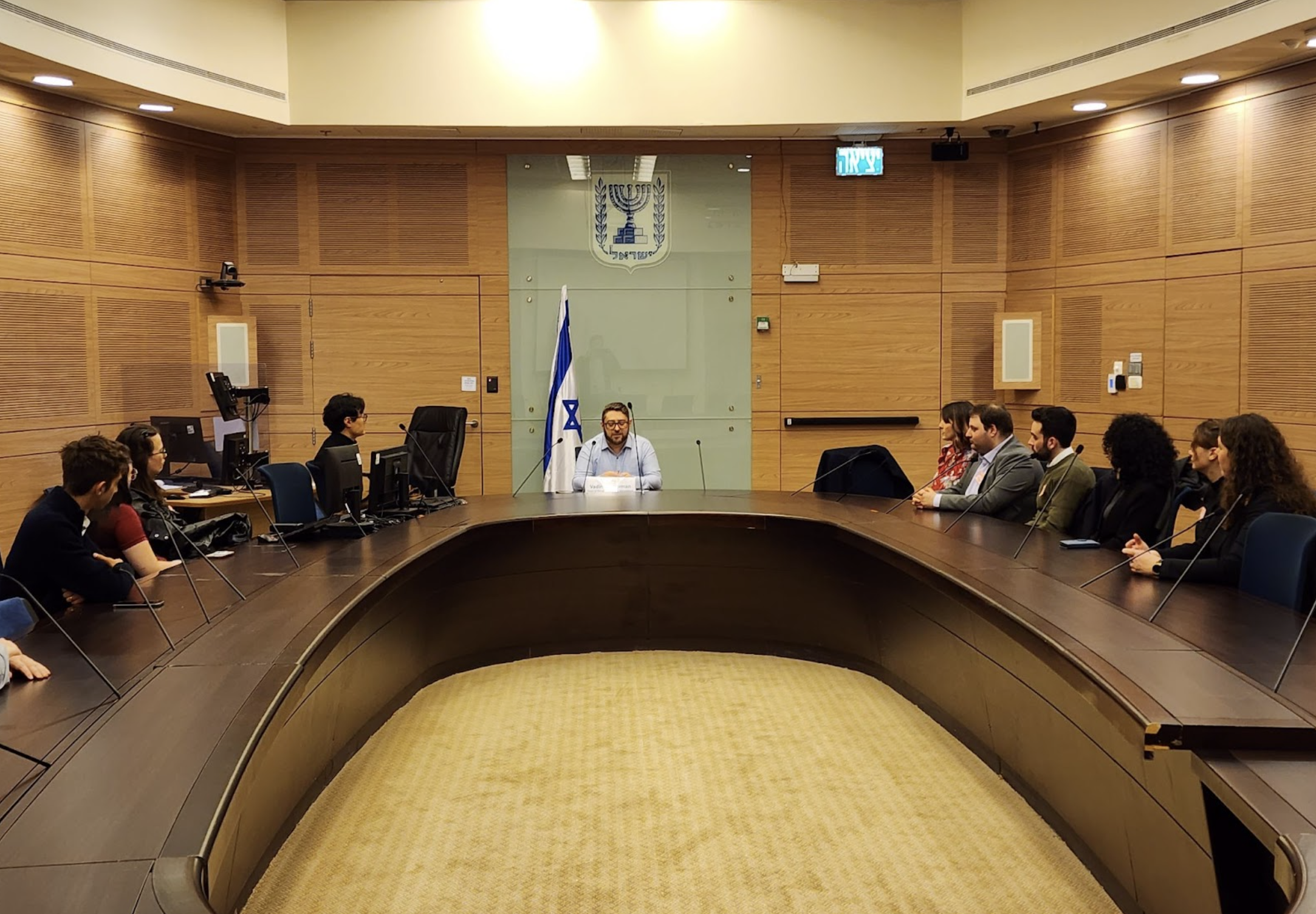
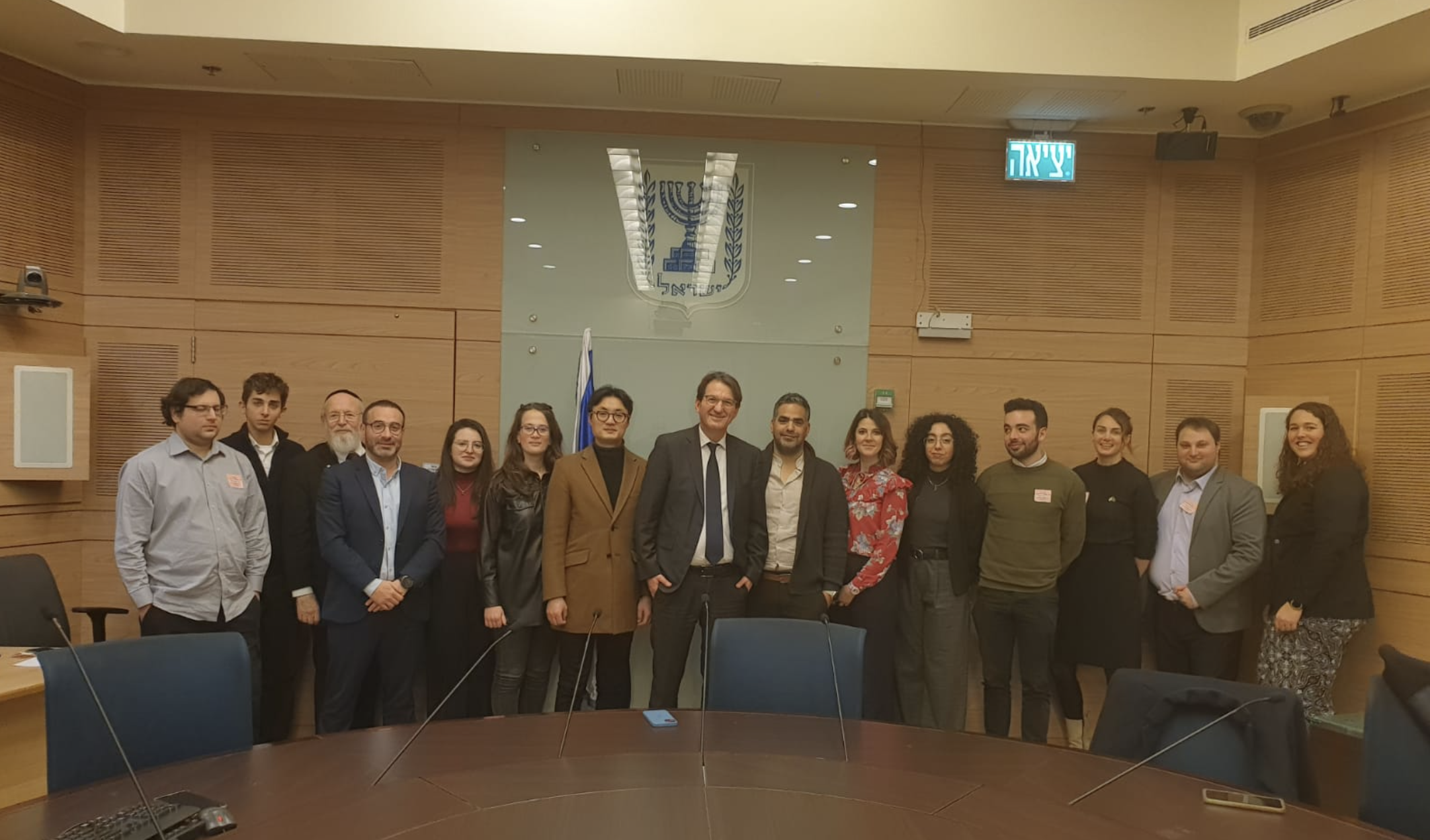
The participants visited the Knesset, Israel's parliament, during the program to learn about the proposed judicial reform before its first reading. The group included individuals from Australia, England, Korea, Spain, and the United States.
The interns had the opportunity to meet with members of the Knesset from various political affiliations, including Michael Bitton, Boaz Bismuth, and MK Simcha Rothman, as well as Nir Barkat, Moshe (Chico) Edri, and Vadim Braverman. They were able to ask questions and gain valuable insight into the political system in Israel, the legal reform, and its potential ramifications.
The GDC Israel program aims to develop future leaders and educate them. They join the Jerusalem Institute for Justice's mission to advocate for human rights, protect the rule of law, freedom of conscience, and democracy. Additionally, the participants actively participate in JIJ's efforts to defend Israel's standing and create a balanced image in media discourse while fighting against antisemitism and delegitimization towards Israel.
Overall, the visit to the Knesset was a valuable experience for the interns, who gained a newfound appreciation for Israel’s democracy and a deeper understanding of the country's challenges and how to address them.
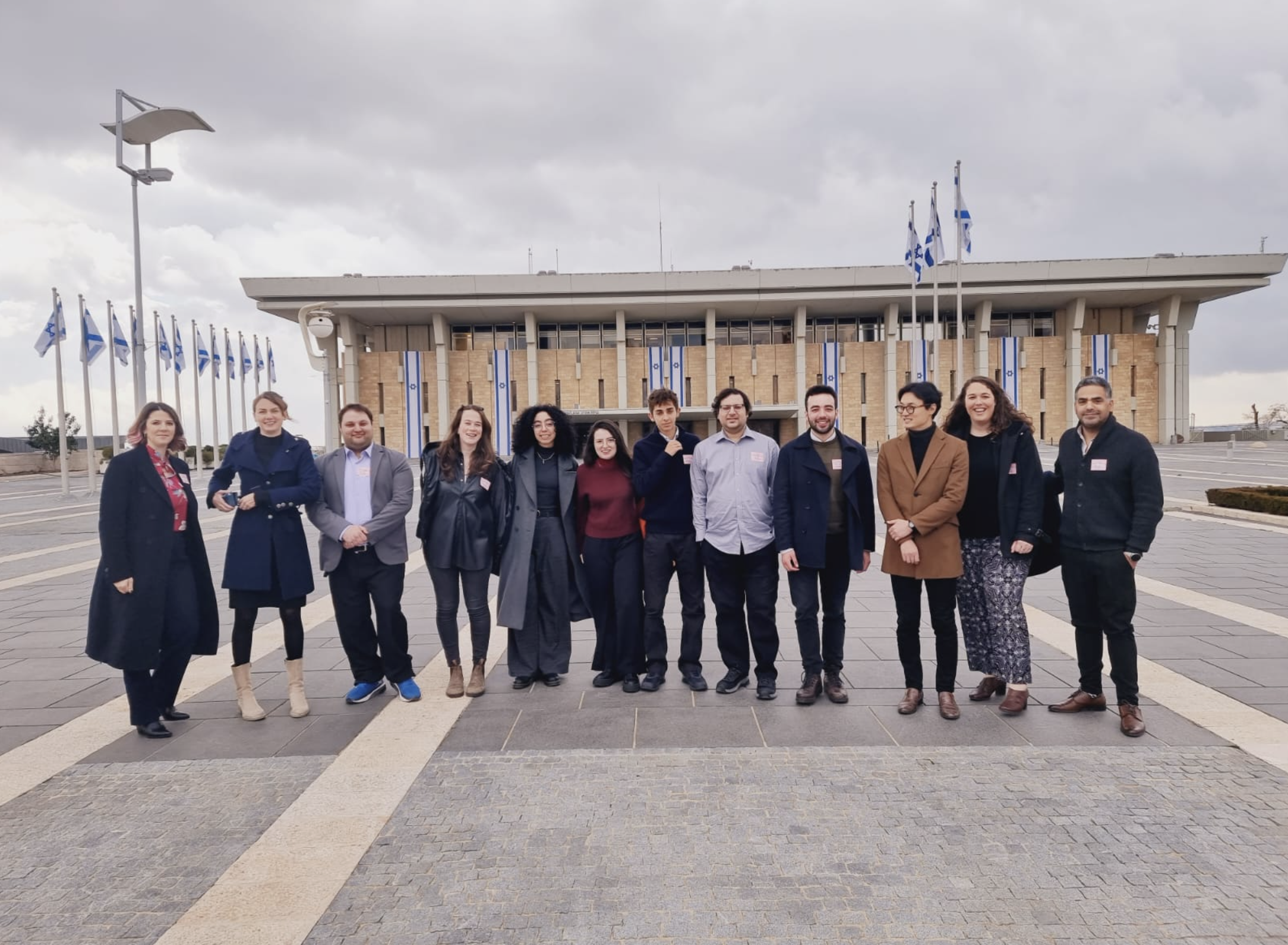
See photos of their visit below! If you want to learn more about our GDC Israel program, click here.
JIJs Grow, Discover, Connect Israel Program in the Local News
The Grow, Discover, Connect (GDC) program at the Jerusalem Institute for Justice (JIJ) attracts interns from around the world who are eager to learn about Israel's unique global political and international relations characteristics, as well as to develop their personal and professional skills.
The participants visited the Knesset, Israel's parliament, during the program to learn about the proposed judicial reform before its first reading. The group included individuals from Australia, England, Korea, Spain, and the United States.
The interns had the opportunity to meet with members of the Knesset from various political affiliations, including Michael Bitton, Boaz Bismuth, and MK Simcha Rothman, as well as Nir Barkat, Moshe (Chico) Edri, and Vadim Braverman. They were able to ask questions and gain valuable insight into the political system in Israel, the legal reform, and its potential ramifications.
The GDC Israel program aims to develop future leaders and educate them. They join the Jerusalem Institute for Justice's mission to advocate for human rights, protect the rule of law, freedom of conscience, and democracy. Additionally, the participants actively participate in JIJ's efforts to defend Israel's standing and create a balanced image in media discourse while fighting against antisemitism and delegitimization towards Israel.
Overall, the visit to the Knesset was a valuable experience for the interns, who gained a newfound appreciation for Israel’s democracy and a deeper understanding of the country's challenges and how to address them.
See photos of their visit below! If you want to learn more about our GDC Israel program, click here.
An appeal to the UN for Women's Rights
Article originally published at the Jerusalem post here
“Do not degrade your daughter by making her a prostitute, lest the land fall into prostitution and the land become full of depravity.” Leviticus 19:29
The fight for women's empowerment and equality is ongoing, and as we embrace technological advancements, we must remain vigilant of the risks that women face. The Jerusalem Institute of Justice (JIJ) calls for the United Nations Commission on the Status of Women to adopt the Nordic model in the fight against prostitution, as part of a broader strategy to tackle sex trafficking and prostitution in all its forms.
I am proud to lead an organization that for over 14 years, has been at the forefront of the battle against the sex trade in Israel. Developing policies, educating the public, and collaborating with communities and media platforms to promote the abolition of the sex trade. Our efforts have resulted in the adoption of the Nordic model in Israel, and today we urge the international community to follow suit.
As the 67th Session of the Commission on the Status of Women focuses on innovation and technological change, we must not forget the dangers that these advancements pose to women and girls. Internet prostitution has become a rising threat to their safety. Traffickers are increasingly using social media platforms like Facebook, Instagram, and Tinder as recruiting tools, driving the rise of prostitution. In Israel, Tinder is the most popular tool for finding persons engaged in the purchase and sale of sex.
Prostitution is a system that promotes violence, objectification, and degradation of women and men. The Nordic model fines those guilty of consuming prostitution, and it is classed as a civil offense. The law also provides education and support services to those in the sex trade. Decriminalizing the prostituted person acknowledges that the industry is not freely chosen, and that the prostituted person is the victim of economic and sexual exploitation at the hands of the procurer and buyer of sexual services.
This model's ultimate aim is to abolish the sex industry, and this can only be achieved by criminalizing the buyers of sex, as that will lead to a drastic reduction in demand. However, the evolution of internet prostitution requires governments to develop even more comprehensive strategy-based solutions to protect potential victims from predators. The Prohibition on Consuming Prostitution Act, passed by the Israeli Parliament in December 2018, presents a vision for a holistic approach that focuses not only on prohibiting paying for sex but also on educating the public about the dangers of the sex industry and by providing the opportunity for rehabilitation through governmental funding. The law also offers educational group sessions for the buyers aimed at changing their opinions and curbing recurrent infractions.
The Israeli law offers a blueprint for other countries to follow in the fight against prostitution. The rise of online prostitution through platforms like Onlyfans, which has emerged as the top platform worldwide for creators to sell erotic content, must be stopped. Masked as a social network that sells content and art, Onlyfans is just a simple way for sex to be sold for money on the internet. A third of users advertising explicitly sexual images on Twitter are underage.
The fight for women's rights and dignity is an ongoing battle that requires continuous effort and innovative strategies to overcome the challenges posed by technological advancements. The Jerusalem Institute of Justice's global call for the adoption of the Nordic model in the fight against prostitution and sex trafficking is a step in the right direction. It is time for governments worldwide to take action and work towards abolishing the sex industry and protecting the human rights of all individuals from violence, objectification, and exploitation.
Flavia Sevald, CEO
Jerusalem Institute of Justice

Israel's 5-Year Report on Human Trafficking
The Justice Ministry of Israel released its first report on human trafficking in Israel spanning from 2017 to 2021 and it identified 325 victims.
This post discusses a report mentioned in an article published originally on the Jerusalem Post website.
The Israel Justice Ministry's Governmental Unit for Coordinating the Fight Against Human Trafficking has published its first activity report, in which it was revealed that Israel has identified 325 victims of human trafficking in the last five years (2017-2021).
The report revealed that 71% of the 325 human trafficking victims were women, and one percent were minors. It also showed that 40% of the victims were trafficked for the sake of sexual exploitation, 44% were held under the conditions of slavery and 16% were trafficked for other reasons.
It was also reported that the Israel Police conducted 789 interrogations of suspects of human trafficking, out of which only 155 were indicted and 99 were convicted.
The report also detailed specific cases of human trafficking that were caught and dealt with, including a trafficking ring that brought women in from abroad for the sake of prostitution, a family that held minors in slavery conditions in their bakery, and a 16-year-old girl who was forced to marry a violent man and then raped and abused by another older man.
The Justice Minister, Gideon Sa'ar, stated that the war against human trafficking is at the center of the country's basic values and that the government has approved a five-year plan to address the issue.
At JIJ, one of our core missions, through our Project NOA (Not Objects Anymore) initiative is to strike the problem at the source and reduce the demand for prostitution and human trafficking. It's not an easy mission but we have had some huge wins over the last 14+ years thanks to the support of our followers, subscribers, and donors.
If you wish to learn more about the report, you can click here to view the original report in Hebrew.

JIJ Calls on Twitter to Adopt the IHRA Working Definition for AntiSemitism
The Jerusalem Institute of Justice has joined 180 non-profit organizations and civil rights organizations to write a public letter to Elon Musk and Twitter because we believe that exchanges of ideas on Twitter MUST NOT undermine the safety or well-being of users, especially those from vulnerable communities.
As mentioned in the letter, we believe that Twitter’s guidelines should afford protection to Jewish Twitter users from antisemitic content and harassment. This is particularly urgent given the record-breaking spike in antisemitic incidents over the last three years. For example, between 20-2021, antisemitic incidents surged by 78% in the United Kingdom and 75% in France, while the United States saw an all-time high with 2,717 recorded antisemitic incidents, a 34% increase from the previous year.
In order to fight antisemitism properly, it must be defined.
That is why we call on Elon Musk and Twitter’s management to update Twitter’s anti-hate policies by adopting the globally recognized IHRA Working Definition of Antisemitism as a guiding tool to stymie the spread of Jew hatred. If you wish to support this letter you can share this article and letter on your social media and use the hashtags: #AdoptIHRA #DefineItToFightIt
Click here to read the full letter.
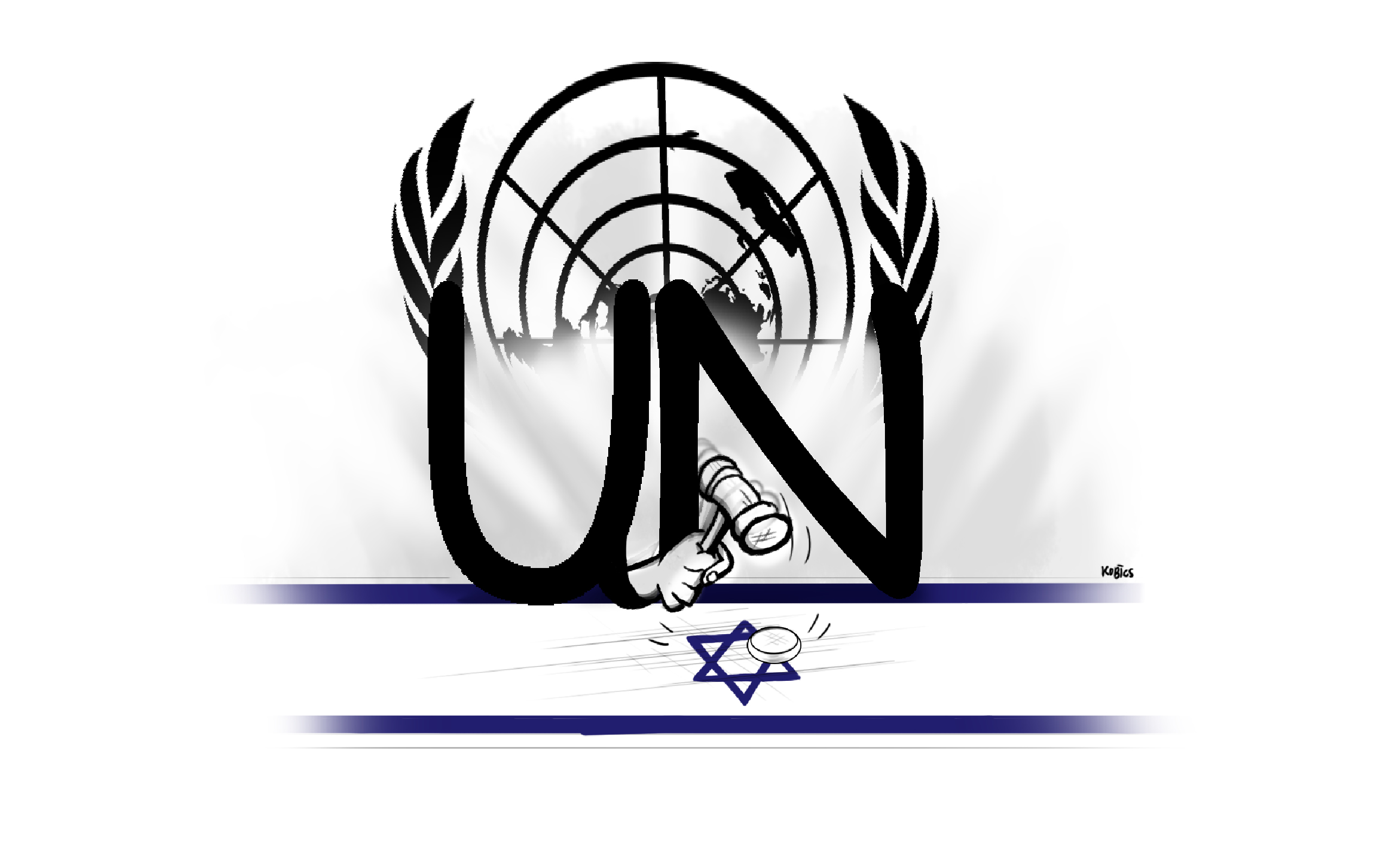
Boycotting UN Investigations
The Only Productive Boycott for Israel
In relation to the Israeli-Palestinian conflict, the UN routinely conducts investigations and releases corresponding reports. These reports, which claim to offer an overview of the situation, are often prejudiced and fail to give equal weight to the merits of each side.
After the 11-day conflict between Israel and Hamas in 2021, the Geneva–based United Nations Human Rights Council (UNHRC) created a three-person commission, to be headed by Navanethem “Navi” Pillay. Exceptionally, the most recent investigative body has taken a scope which extends beyond the 2021 conflict, urging Israel to take actions to solve the greater Israeli-Palestinian conflict.
Pillay’s multiple associations with supporters of BDS, as well as the UN’s disproportionate historical focus on Israel through constant condemnation, further take away from the report’s legitimacy. The report has rightfully been criticized as one-sided, though the Israeli Government’s decision to not cooperate with the commission will further complicate Israel’s relations with the UN as a whole, even on issues with which Israel and the UN agree on. Additionally, it will be manipulated by international critics as purported proof of Israel attempting to hide damaging information.
Despite the consequences associated with any decision to not cooperate with the UN, Israel should refuse to cooperate with investigations of this type. It should do this to take a stand against investigations made in bad faith and avoid legitimizing reports whose unfavorable findings could be easily predicted when taking the international bodies and commission which made the report into account.
The United Nations’ disproportionate focus on Israel has been documented, with a majority of resolutions criticizing the country, despite it containing a fraction of a percentage of the world’s population and land area.[1] Putting aside the attention that could be given to more rights-abusive countries, the UNHRC itself seats members such as China, Cuba, Pakistan and Venezuela, who are engaged in severe repression and human rights violations.
The report further weighs in on the sources of the Israeli-Palestinian conflict as a whole and identifies Israeli actions as the main cause. This large-scale conclusion goes beyond the usual confines of UN investigations and demonstrates the pre-existing beliefs about the nature of the conflict which the investigation sought to prove. Furthermore, the commission’s brief mentions of the Palestinian Authority and Hamas’s human rights abuses fail to meaningfully place liability on both sides in the conflict or include the threats which Israel faces. Through tone and relative content, the report emphasizes critiques of Israel above all else.
Navi Pillay’s history regarding Israel is ambiguous at best. Pillay, former UN High Commissioner for Human Rights, signed a letter to US President Joe Biden calling on Israel to withdraw entirely from the West Bank shortly before she was appointed head of the commission.[2] She further stated that “Apartheid is now being declared a crime against humanity in the Rome Statute and it means the enforced segregation of people on racial lines and that is happening in Israel.”[3]
While this does not provide any concrete blame of Israel for the violence in 2021, it should come as little surprise that Pillay later stated that "[the report] is as an indicator of the asymmetrical nature of the conflict and the reality of one state occupying the other."[4] Pillay’s colleagues, Miloon Khotari and Chris Sidoti, have similarly clear pre-existing notions about Israel. Khotari, has referred to the Second Intifada as simply a “wave of Palestinian resistance,” described Israel’s government as a theocracy and openly called for an end to military cooperation with Israel.
Similarly, Sidoti has worked with pro-BDS organizations such as the Australian Center for International Justice and the Independent Commission for Human Rights, established by Yasser Arafat himself in 1993.[5] These appointments greatly diminished the legitimacy of the commission from the beginning, and the backgrounds of its members and the UN bodies which created it give the appearance that the investigation was never a major factor behind the tone and substance of the report.
The COI investigation’s boundaries make cooperation disadvantageous, as its scope and mandate both ensure abnormal treatment. The investigation can include events going all the way back to the founding of Israel, and this COI will continue indefinitely, with more reports to follow each year even after the current report’s release. The wide scope and continuous nature demonstrate the UN’s obsession with condemning Israel, as no other COI has ever been given this kind of never-ending mandate.
Israel could cooperate with proceedings and argue that it has nothing to hide, though doing this would not lessen international blame on Israel and it would continue to be subject to both double standards and disproportionate emphasis by the UNHRC and by the international community at large. Instead, the cooperation would be taken as simply a prerequisite for the investigation itself, and there would be a report written in a similarly one-sided manner.
The significance of negative reports could prove damaging to Israel’s reputation amongst some, though importantly, these reports will continue to be released with or without Israel’s cooperation. Boycotting will allow Israel to take an active stance in fighting a report which Israel feels is unfair, as opposed to letting the UN villainize Israel and only voicing disagreement after it is done.
While some might argue that refusing to cooperate with an investigation will isolate Israel from allies and the international community as a whole, Israel’s allies understand this. The commitment between them and Israel to their alliances will remain in all likelihood no matter what conclusions the UNHRC might reach from its numerous investigations, as they have for decades. Because of this, Israel has limited benefits to cooperating with the UN on this issue and little downside for refusing to do so.
Israel should not and does not deny that many Palestinians have a poor quality of life for a variety of reasons, and accordingly has investigated reported incidents based off of investigations such as the Goldstone reports, even without cooperating during the reports’ productions.[6] In this way, while the decision to boycott the investigation does not solve the underlying problem of discrimination against Israel and can give off an appearance of concealing evidence, Israel has the standing and experience to make this decision given the nature of the investigation.
By Ethan Kanef, intern at JIJ
[1] Becker, R.N., Hillman, A.L., Potrafke, N. et al. The preoccupation of the United Nations with Israel: Evidence and theory. Rev Int Organ 10, 413–437 (2015). https://doi.org/10.1007/s11558-014-9207-3
[2] #NowistheTime. June 14, 2021, https://nowisthetimecoalition.com/.
[3] “Navi Pillay on Israel Being an Apartheid State: Short Version.” Www.youtube.com, 29 Jan. 2018, www.youtube.com/watch?v=6sIEfCf1Dhs. Accessed 12 July 2022.
[4] “Commission of Inquiry on the Occupied Palestinian Territory, Including East Jerusalem, and Israel, Issues First Report.” The Office of the High Commissioner for Human Rights, June 7, 2022. https://www.ohchr.org/en/press-releases/2022/06/commission-inquiry-occupied-palestinian-territory-including-east-jerusalem
[5] Bayefsky, Prof Anne. “The Newest Anti-Israel UN Action Must Be Challenged – Now.” Jerusalem Center for Public Affairs, jcpa.org/article/the-newest-anti-israel-un-action-must-be-challenged-now/. Accessed 11 July 2022.
[6] Goldstone, Richard. “Reconsidering the Goldstone Report on Israel and War Crimes.” The Washington Post. WP Company, April 1, 2011.

The Cynical Exploitation of Israeli Democracy
In 1990, Nelson Mandela was released from Victor Verster Prison in Cape Town after spending twenty-seven years behind bars. His only crime was that of rebelling against the white minority that subjugated his people by denying them the right to vote, to acquire land and to protest.
Similar regimes of oppression exist today in Iran, which executes political dissidents; in the West Bank, where being homosexual is a criminal offence; and in Saudi Arabia, which practices gender apartheid. As of yet, the international community has failed to put as much pressure on these regimes as it did on Pretoria, partly because it has been preoccupied with turning the nation-state of the Jewish people into a pariah. The United Nations, for example, has passed more resolutions condemning Israel than the other nations of the world combined. It is impossible to consider these figures and not come to the conclusion that the international community’s double-standard against Israel is blatant and morally bankrupt; much worse is that it has been aided in this endeavor by so-called human rights activists within Israel.
About a year ago, two members of the Israeli Knesset — Aida Touma Suleiman and Mossi Raz — hosted an event in parliament titled: “54 years - Between Occupation and Apartheid.” The event, funded by the Israeli taxpayer, quickly descended into an anti-Zionist hate festival, filled with lies about the so-called apartheid system imposed upon Palestinians in the “occupied territories and within Israel.”
Of course, Raz and Suleiman had every right to host the event. In fact, that they were able to host it serves as a testament to the health of Israel’s thriving democracy. Former Israeli Prime Minister Menachem Begin put it most succinctly: “Without an opposition, there can be no democracy; without it, the essence of human liberty is in danger.” But I also reserve the right to express what I think about those who cynically exploit the seat of Israeli democracy as a means of delegitimizing the Jewish state — and it’s not much.
The hypocrisy of the Knesset members, especially Suleiman, an Arab-Israeli representative in the Knesset, is nothing short of astonishing. She does not speak Yiddish and may not be familiar with the term ‘chutzpah’, but her behavior suggests she is full of it. Israel is a vibrant democracy where Arabs benefit from affirmative action policies, teach in Israeli universities and enjoy equal rights to their Jewish counterparts. This includes the right to serve on the Supreme Court, to vote and to elect members to the Knesset; some of whom oppose Israel’s right to exist and denounce her as an apartheid state.
To be sure, what is true of Israel is not necessarily true of the disputed territories. Israel withdrew from Gaza in 2005 and was consequently met with heavy rocket fire from Hamas militants. She maintains control over the West Bank only due to Palestinian rejectionism — that is, the inability of Palestinian leaders to accept a two-state solution that leaves Israel’s existence as a Jewish and democratic state in-tact.
In 2000, Yasser Arafat balked at a generous offer of statehood on 97% of the West Bank, with its capital in Jerusalem and a large compensation package for Palestinian refugees displaced during wars started by Israel’s neighbours. This drew opprobrium even from Arab leaders, including Prince Bandar of Saudi Arabia who described the rejection as “a crime against the Palestinian people, in fact against the entire region.” Likewise, in 2008 Olmert offered the Palestinians a deal which would have granted them sovereignty over even more territory, only to be met with no response from Arafat’s successor, Mahmoud Abbas.
Had these offers been accepted, there would be no roads restricted to Israelis or civilian settlements in the West Bank; the so-called accoutrement of Israeli apartheid. These policies are controversial, if not disagreeable. But to wage the ‘apartheid’ libel against Israel’s settlement enterprise and security precautions in the disputed territories — those which exist only due to Palestinian intransigence — is to egregiously misuse the term and minimize the horrors of the actual anti-apartheid struggles that took place in South Africa. One of the most celebrated proponents of this struggle — Martin Luther King Jr — once venerated Israel as “one of the great outposts of democracy in the world.” He would be dismayed with Suleiman exploiting his life mission to support her anti-Israel bigotry.
by Joe Beare, JIJ Intern