A Step Too Far: The UN Human Rights Council COI Report on Israel
After clashes between Israel and Hamas in May 2021, the UN Human Rights Council opened a Commission of Inquiry (COI) to investigate human rights abuses in Israel. Over the course of the past two years, the COI has produced three reports detailing one-sided, biased information about the events on the ground, falsely portraying reality for so many Israelis and Palestinians. In its latest report, the COI focused on “Israel’s attacks, restrictions, and harassment of civil society actors” and revealed numerous concerning human rights violations in the Palestinian Territories and East Jerusalem. However, the UN fell into its biased routine of disproportionate representation once again.
Although unequal treatment is expected with the UN’s long history of anti-Israel sentiment, the most recent proceedings took matters to new heights. Throughout the report and live session, the COI explicitly supported BDS and similar Israel-boycott organizations and categorized them as legitimate forms of protest. The COI also ignored terrorism enacted by both Palestinian leadership and civilians and called on UN member states to support the Palestinian resistance. These actions not only fail to uphold the COI’s mission to “establish the facts and circumstances” and “identify those responsible,” but it glorifies antisemitism in the world’s most prominent human rights organization, setting a precedent that poses a serious threat to Jews around the world (the UN Independent International COI on the OPT Mandate, 2021).
In the COI report’s section detailing Israel’s delegitimization of Palestinian civil society, the COI claims that Israel instituted various measures to limit BDS, such as removing their funding and cutting business deals. By preventing BDS from acting freely, Israeli authorities were denying their supporters the right to freedom of expression, which is considered a human rights violation. As a response, the COI asserts that:
“Everyone shall have the right to freedom of expression; this right shall include freedom to seek, receive and impart information and ideas of all kinds, regardless of frontiers, either orally, in writing or in print, in the form of art, or through any other media of his choice,” (Human Rights Council 53rd Session Report, pp 11)
Such statements blatantly support accounts of institutionalized antisemitism and violent resistance espoused by BDS leaders. There are numerous cases in which the BDS has voiced its antisemitic views. BDS co-founder and leader Omar Barghouti freely admits that BDS “opposes a Jewish state in any part of Palestine.” In another, a BDS leader in South Africa stated, “BDS [...] will help bring about the defeat of Zionist Israel and victory for Palestine.” Lastly, Barghouti claimed that “B.D.S. treats resistance to what it sees as Israeli oppression, including by armed struggle, as a legitimate right. Asked if B.D.S. condemned the violence that targeted Israeli soldiers, he declined to comment” (Halbfinger et. al, Is B.D.S. Anti-Semitic? A Closer Look at the Boycott Israel Campaign).
BDS’ opposition to a Jewish state in Israel’s borders is not hidden. They openly deny the Jewish people’s right to self-determination in the land of Israel and advocate against a peaceful solution. While every individual should have the right to criticize any institution and exercise his or her freedom of expression, there is a difference between disagreement and encouraging human rights crimes. BDS clearly legitimizes terrorism and harm to innocent Israeli civilians as a means to wipe Israel off the face of the Earth.
To add fuel to the fire, the COI commissioners have explicitly shared similar views in interviews and sessions. Navi Pillay, the chief commissioner, has spent a large portion of her career fighting Israel, from lobbying governments to boycott Israel to creating the “Sanction Apartheid Israel” petition. On numerous occasions, Pillay has affirmed her support for BDS, such as “I hope that the Palestinian struggle to end colonization gains this kind of momentum, especially in the civilian campaign of BDS, Boycott, Divestment, and Sanctions” at a conference in South Africa (November 29, 2017). Furthermore, Miloon Kothari, one of three commissioners of the COI, stated outright in the session, “States want to [...] correctly uphold the rights of the Ukrainians to resist, and we want to see the same standards applied to the case of Israel and Palestine.” In short, just as the Ukrainians use armed resistance and violence against Russia, so should the Palestinians. Violence is an encouraged response (3rd Meeting 53rd Session of Human Rights Council).
By confirming BDS as a legitimate protest organization, the UNHRC supports both human rights violations and violence as a means to an end. They support the continuation of conflict, not peace, and are actively making the world a more dangerous place for the Jewish people.
As a Jewish student studying human rights in university, I am deeply disappointed in the COI’s report and frightened by its precedent. Firstly, one of the most important lessons of higher education is to never rely on one narrative. Every conflict has multiple angles, but ignoring basic facts detracts from the truth. Highlighting the Israeli perspective is just as crucial to progress as highlighting the Palestinian one, and peace can only emerge through mutual recognition.
Secondly, this statement arrives at a dangerous time for the Jewish people, as antisemitism has slowly crept back into all sectors of our society. Many of my peers have been alienated for their assumed pro-Israel opinions after simply expressing their Jewish identities. Not only do individuals fear expressing their opinions on Israel, but the environment no longer allows them to be open about being Jewish. By giving the green light to BDS, the COI contributes to “removing [...] civil-society actors from the public space to stop their activities, silencing their voices and punishing them, and often also deterring others,” the exact environment the UNHRC claims Israeli authorities wrongfully create for Palestinians (Human Rights Council 53rd Session Report pp 20).
As a path forward, the UNHRC COI must condemn BDS for crossing the line from free speech to antisemitism. By drawing this line, the UNHRC can simultaneously protect the freedom of expression, as well as the Jewish people. Second, the UNHRC must recognize the terrorism enacted by Palestinian civilians and leadership. If they assert that Israeli violence is a human rights crime, they must at least recognize that it exists on the other side, let alone criticize it.
The only path to upholding human rights is to escape emotional narrative, present challenging issues from either side and hold both sides accountable for their actions. It is crucial to call out Israel when they commit crimes, just as criticism is warranted for any democracy, but displaying biased, one-sided evidence only inhibits progress and perpetuates the harmful, decades-long conflict. Every innocent Palestinian and Israeli equally deserves fair treatment from their governments and international institutions, and hiding the truth prevents human rights for all.
By Molly Goldstein - JIJ Intern

A Step Too Far: The UN Human Rights Council COI Report on Israel
After clashes between Israel and Hamas in May 2021, the UN Human Rights Council opened a Commission of Inquiry (COI) to investigate human rights abuses in Israel. Over the course of the past two years, the COI has produced three reports detailing one-sided, biased information about the events on the ground, falsely portraying reality for so many Israelis and Palestinians. In its latest report, the COI focused on “Israel’s attacks, restrictions, and harassment of civil society actors” and revealed numerous concerning human rights violations in the Palestinian Territories and East Jerusalem. However, the UN fell into its biased routine of disproportionate representation once again.
Although unequal treatment is expected with the UN’s long history of anti-Israel sentiment, the most recent proceedings took matters to new heights. Throughout the report and live session, the COI explicitly supported BDS and similar Israel-boycott organizations and categorized them as legitimate forms of protest. The COI also ignored terrorism enacted by both Palestinian leadership and civilians and called on UN member states to support the Palestinian resistance. These actions not only fail to uphold the COI’s mission to “establish the facts and circumstances” and “identify those responsible,” but it glorifies antisemitism in the world’s most prominent human rights organization, setting a precedent that poses a serious threat to Jews around the world (the UN Independent International COI on the OPT Mandate, 2021).
In the COI report’s section detailing Israel’s delegitimization of Palestinian civil society, the COI claims that Israel instituted various measures to limit BDS, such as removing their funding and cutting business deals. By preventing BDS from acting freely, Israeli authorities were denying their supporters the right to freedom of expression, which is considered a human rights violation. As a response, the COI asserts that:
“Everyone shall have the right to freedom of expression; this right shall include freedom to seek, receive and impart information and ideas of all kinds, regardless of frontiers, either orally, in writing or in print, in the form of art, or through any other media of his choice,” (Human Rights Council 53rd Session Report, pp 11)
Such statements blatantly support accounts of institutionalized antisemitism and violent resistance espoused by BDS leaders. There are numerous cases in which the BDS has voiced its antisemitic views. BDS co-founder and leader Omar Barghouti freely admits that BDS “opposes a Jewish state in any part of Palestine.” In another, a BDS leader in South Africa stated, “BDS [...] will help bring about the defeat of Zionist Israel and victory for Palestine.” Lastly, Barghouti claimed that “B.D.S. treats resistance to what it sees as Israeli oppression, including by armed struggle, as a legitimate right. Asked if B.D.S. condemned the violence that targeted Israeli soldiers, he declined to comment” (Halbfinger et. al, Is B.D.S. Anti-Semitic? A Closer Look at the Boycott Israel Campaign).
BDS’ opposition to a Jewish state in Israel’s borders is not hidden. They openly deny the Jewish people’s right to self-determination in the land of Israel and advocate against a peaceful solution. While every individual should have the right to criticize any institution and exercise his or her freedom of expression, there is a difference between disagreement and encouraging human rights crimes. BDS clearly legitimizes terrorism and harm to innocent Israeli civilians as a means to wipe Israel off the face of the Earth.
To add fuel to the fire, the COI commissioners have explicitly shared similar views in interviews and sessions. Navi Pillay, the chief commissioner, has spent a large portion of her career fighting Israel, from lobbying governments to boycott Israel to creating the “Sanction Apartheid Israel” petition. On numerous occasions, Pillay has affirmed her support for BDS, such as “I hope that the Palestinian struggle to end colonization gains this kind of momentum, especially in the civilian campaign of BDS, Boycott, Divestment, and Sanctions” at a conference in South Africa (November 29, 2017). Furthermore, Miloon Kothari, one of three commissioners of the COI, stated outright in the session, “States want to [...] correctly uphold the rights of the Ukrainians to resist, and we want to see the same standards applied to the case of Israel and Palestine.” In short, just as the Ukrainians use armed resistance and violence against Russia, so should the Palestinians. Violence is an encouraged response (3rd Meeting 53rd Session of Human Rights Council).
By confirming BDS as a legitimate protest organization, the UNHRC supports both human rights violations and violence as a means to an end. They support the continuation of conflict, not peace, and are actively making the world a more dangerous place for the Jewish people.
As a Jewish student studying human rights in university, I am deeply disappointed in the COI’s report and frightened by its precedent. Firstly, one of the most important lessons of higher education is to never rely on one narrative. Every conflict has multiple angles, but ignoring basic facts detracts from the truth. Highlighting the Israeli perspective is just as crucial to progress as highlighting the Palestinian one, and peace can only emerge through mutual recognition.
Secondly, this statement arrives at a dangerous time for the Jewish people, as antisemitism has slowly crept back into all sectors of our society. Many of my peers have been alienated for their assumed pro-Israel opinions after simply expressing their Jewish identities. Not only do individuals fear expressing their opinions on Israel, but the environment no longer allows them to be open about being Jewish. By giving the green light to BDS, the COI contributes to “removing [...] civil-society actors from the public space to stop their activities, silencing their voices and punishing them, and often also deterring others,” the exact environment the UNHRC claims Israeli authorities wrongfully create for Palestinians (Human Rights Council 53rd Session Report pp 20).
As a path forward, the UNHRC COI must condemn BDS for crossing the line from free speech to antisemitism. By drawing this line, the UNHRC can simultaneously protect the freedom of expression, as well as the Jewish people. Second, the UNHRC must recognize the terrorism enacted by Palestinian civilians and leadership. If they assert that Israeli violence is a human rights crime, they must at least recognize that it exists on the other side, let alone criticize it.
The only path to upholding human rights is to escape emotional narrative, present challenging issues from either side and hold both sides accountable for their actions. It is crucial to call out Israel when they commit crimes, just as criticism is warranted for any democracy, but displaying biased, one-sided evidence only inhibits progress and perpetuates the harmful, decades-long conflict. Every innocent Palestinian and Israeli equally deserves fair treatment from their governments and international institutions, and hiding the truth prevents human rights for all.
By Molly Goldstein - JIJ Intern
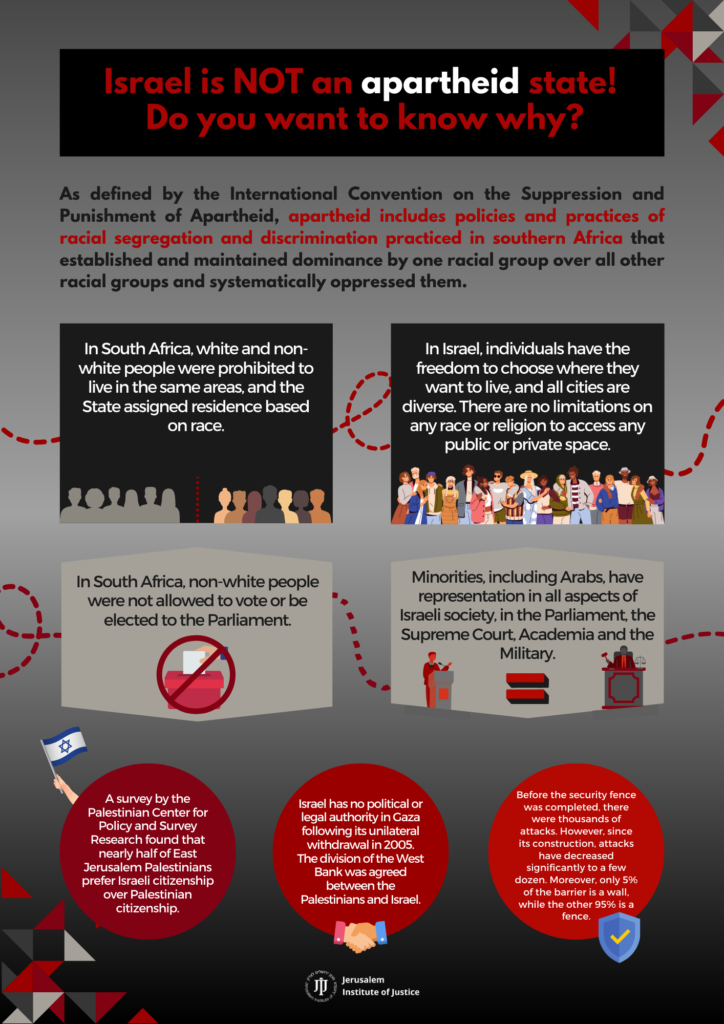
Not Apartheid
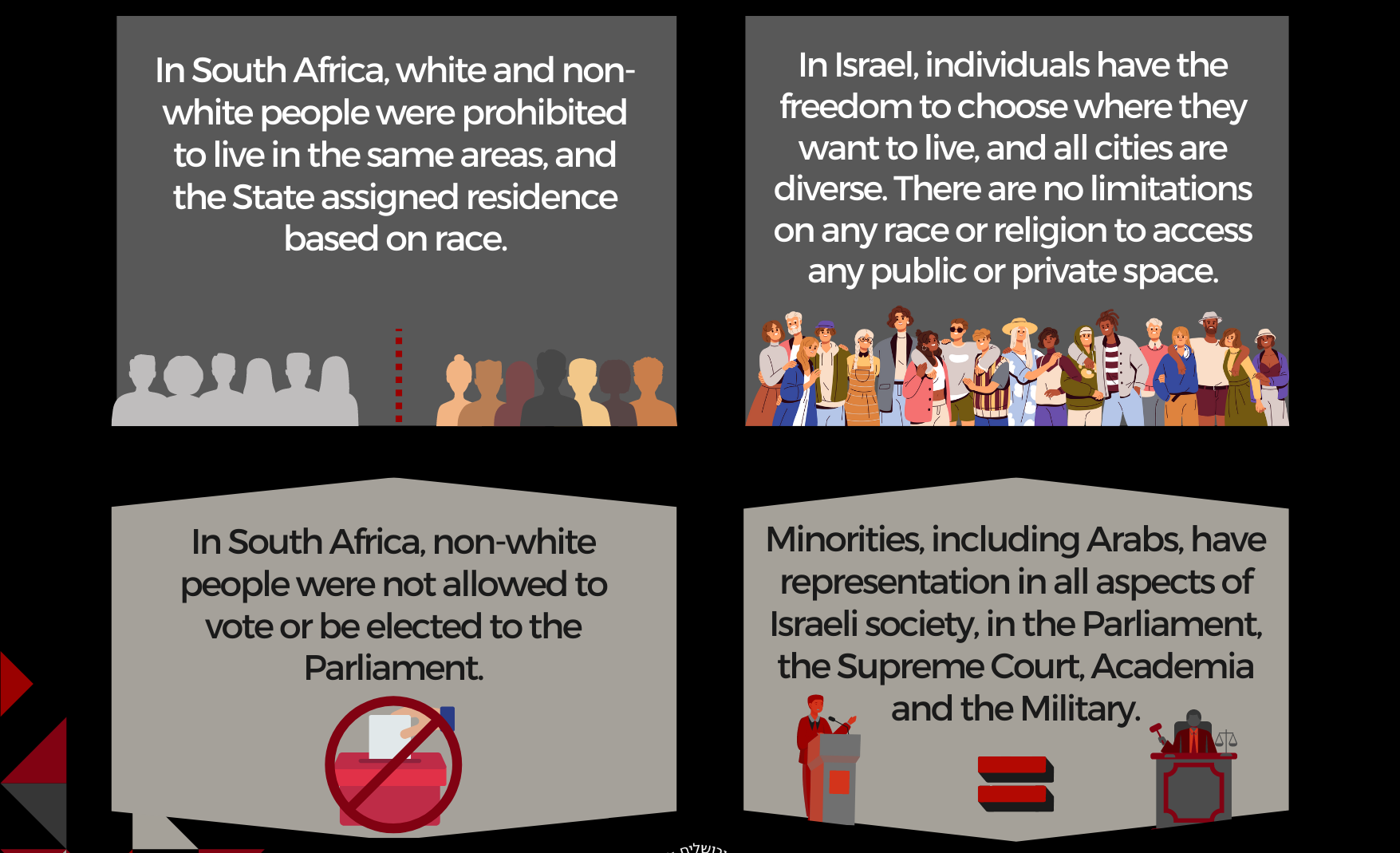
As defined by the International Convention on the Suppression and Punishment of Apartheid, apartheid includes policies and practices of racial segregation and discrimination practiced in southern Africa that established and maintained dominance by one racial group over all other racial groups and systematically oppressed them.
Download
Boycotting UN Investigations
The Only Productive Boycott for Israel
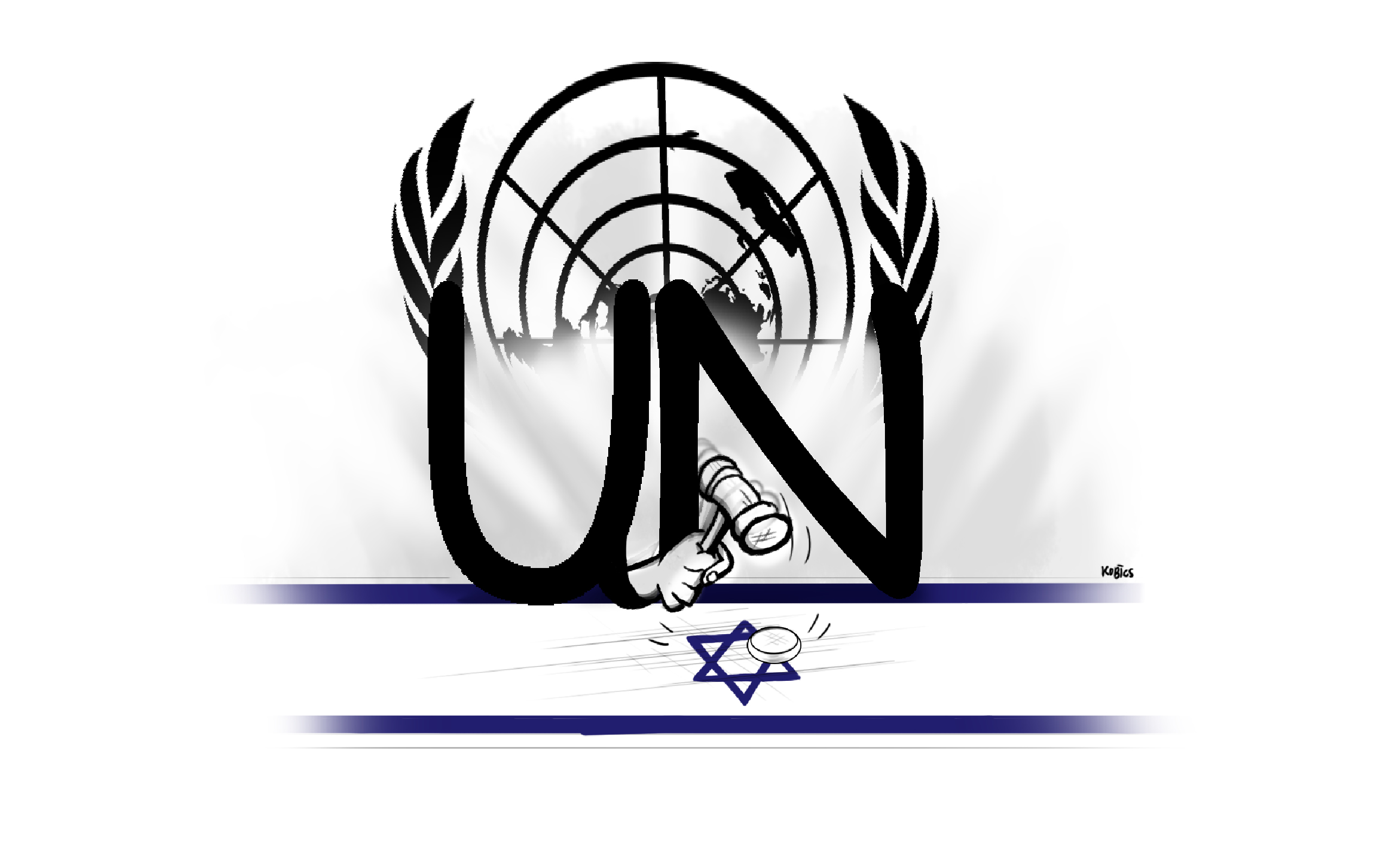
In relation to the Israeli-Palestinian conflict, the UN routinely conducts investigations and releases corresponding reports. These reports, which claim to offer an overview of the situation, are often prejudiced and fail to give equal weight to the merits of each side.
After the 11-day conflict between Israel and Hamas in 2021, the Geneva–based United Nations Human Rights Council (UNHRC) created a three-person commission, to be headed by Navanethem “Navi” Pillay. Exceptionally, the most recent investigative body has taken a scope which extends beyond the 2021 conflict, urging Israel to take actions to solve the greater Israeli-Palestinian conflict.
Pillay’s multiple associations with supporters of BDS, as well as the UN’s disproportionate historical focus on Israel through constant condemnation, further take away from the report’s legitimacy. The report has rightfully been criticized as one-sided, though the Israeli Government’s decision to not cooperate with the commission will further complicate Israel’s relations with the UN as a whole, even on issues with which Israel and the UN agree on. Additionally, it will be manipulated by international critics as purported proof of Israel attempting to hide damaging information.
Despite the consequences associated with any decision to not cooperate with the UN, Israel should refuse to cooperate with investigations of this type. It should do this to take a stand against investigations made in bad faith and avoid legitimizing reports whose unfavorable findings could be easily predicted when taking the international bodies and commission which made the report into account.
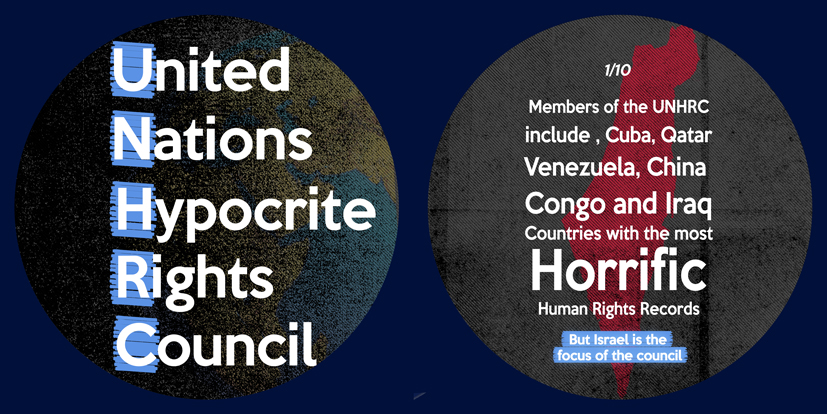
The United Nations’ disproportionate focus on Israel has been documented, with a majority of resolutions criticizing the country, despite it containing a fraction of a percentage of the world’s population and land area.[1] Putting aside the attention that could be given to more rights-abusive countries, the UNHRC itself seats members such as China, Cuba, Pakistan and Venezuela, who are engaged in severe repression and human rights violations.
The report further weighs in on the sources of the Israeli-Palestinian conflict as a whole and identifies Israeli actions as the main cause. This large-scale conclusion goes beyond the usual confines of UN investigations and demonstrates the pre-existing beliefs about the nature of the conflict which the investigation sought to prove. Furthermore, the commission’s brief mentions of the Palestinian Authority and Hamas’s human rights abuses fail to meaningfully place liability on both sides in the conflict or include the threats which Israel faces. Through tone and relative content, the report emphasizes critiques of Israel above all else.
Navi Pillay’s history regarding Israel is ambiguous at best. Pillay, former UN High Commissioner for Human Rights, signed a letter to US President Joe Biden calling on Israel to withdraw entirely from the West Bank shortly before she was appointed head of the commission.[2] She further stated that “Apartheid is now being declared a crime against humanity in the Rome Statute and it means the enforced segregation of people on racial lines and that is happening in Israel.”[3]
While this does not provide any concrete blame of Israel for the violence in 2021, it should come as little surprise that Pillay later stated that "[the report] is as an indicator of the asymmetrical nature of the conflict and the reality of one state occupying the other."[4] Pillay’s colleagues, Miloon Khotari and Chris Sidoti, have similarly clear pre-existing notions about Israel. Khotari, has referred to the Second Intifada as simply a “wave of Palestinian resistance,” described Israel’s government as a theocracy and openly called for an end to military cooperation with Israel.
Similarly, Sidoti has worked with pro-BDS organizations such as the Australian Center for International Justice and the Independent Commission for Human Rights, established by Yasser Arafat himself in 1993.[5] These appointments greatly diminished the legitimacy of the commission from the beginning, and the backgrounds of its members and the UN bodies which created it give the appearance that the investigation was never a major factor behind the tone and substance of the report.
The COI investigation’s boundaries make cooperation disadvantageous, as its scope and mandate both ensure abnormal treatment. The investigation can include events going all the way back to the founding of Israel, and this COI will continue indefinitely, with more reports to follow each year even after the current report’s release. The wide scope and continuous nature demonstrate the UN’s obsession with condemning Israel, as no other COI has ever been given this kind of never-ending mandate.
Israel could cooperate with proceedings and argue that it has nothing to hide, though doing this would not lessen international blame on Israel and it would continue to be subject to both double standards and disproportionate emphasis by the UNHRC and by the international community at large. Instead, the cooperation would be taken as simply a prerequisite for the investigation itself, and there would be a report written in a similarly one-sided manner.
The significance of negative reports could prove damaging to Israel’s reputation amongst some, though importantly, these reports will continue to be released with or without Israel’s cooperation. Boycotting will allow Israel to take an active stance in fighting a report which Israel feels is unfair, as opposed to letting the UN villainize Israel and only voicing disagreement after it is done.
While some might argue that refusing to cooperate with an investigation will isolate Israel from allies and the international community as a whole, Israel’s allies understand this. The commitment between them and Israel to their alliances will remain in all likelihood no matter what conclusions the UNHRC might reach from its numerous investigations, as they have for decades. Because of this, Israel has limited benefits to cooperating with the UN on this issue and little downside for refusing to do so.
Israel should not and does not deny that many Palestinians have a poor quality of life for a variety of reasons, and accordingly has investigated reported incidents based off of investigations such as the Goldstone reports, even without cooperating during the reports’ productions.[6] In this way, while the decision to boycott the investigation does not solve the underlying problem of discrimination against Israel and can give off an appearance of concealing evidence, Israel has the standing and experience to make this decision given the nature of the investigation.
By Ethan Kanef, intern at JIJ
[1] Becker, R.N., Hillman, A.L., Potrafke, N. et al. The preoccupation of the United Nations with Israel: Evidence and theory. Rev Int Organ 10, 413–437 (2015). https://doi.org/10.1007/s11558-014-9207-3
[2] #NowistheTime. June 14, 2021, https://nowisthetimecoalition.com/.
[3] “Navi Pillay on Israel Being an Apartheid State: Short Version.” Www.youtube.com, 29 Jan. 2018, www.youtube.com/watch?v=6sIEfCf1Dhs. Accessed 12 July 2022.
[4] “Commission of Inquiry on the Occupied Palestinian Territory, Including East Jerusalem, and Israel, Issues First Report.” The Office of the High Commissioner for Human Rights, June 7, 2022. https://www.ohchr.org/en/press-releases/2022/06/commission-inquiry-occupied-palestinian-territory-including-east-jerusalem
[5] Bayefsky, Prof Anne. “The Newest Anti-Israel UN Action Must Be Challenged – Now.” Jerusalem Center for Public Affairs, jcpa.org/article/the-newest-anti-israel-un-action-must-be-challenged-now/. Accessed 11 July 2022.
[6] Goldstone, Richard. “Reconsidering the Goldstone Report on Israel and War Crimes.” The Washington Post. WP Company, April 1, 2011.

The Tide Rises the Tide Falls
Two occurrences in the sphere of international relations between Israel and the EU caused confusion and consternation to many who follow this field.
On the one hand, on Tuesday morning, December 3rd, The European Union Court of Justice ruled that products made in Israel must be labelled as such and may not be marketed as products made in Israel. “Foodstuffs originating in the territories occupied by the State of Israel must bear the indication of their territory of origin, accompanied, where those foodstuffs come from an Israeli settlement within that territory, by the indication of that provenance”, the court (the EU’s highest legal authority) announced in a press release[1].
The decision was widely condemned by Israel and pro-Israel figures and advocacy groups, with Israel’s Foreign Ministry rejecting the ruling, Israel’s Foreign Ministry rejected the ruling, saying it set a “double standard” that unfairly singles out Israel when there are dozens of territorial disputes worldwide. “The European Court of Justice’s ruling is unacceptable both morally and in principle,” said Foreign Minister Israel Katz. “I intend to work with European foreign ministers to prevent the implementation of this gravely flawed policy.” The pro-settler Yesha Council also denounced the court ruling, as did Eugene Kontorovich, a professor of international law and the director of International Law at the Jerusalem-based Kohelet Policy Forum, and Gerald Steinberg, a political science professor and the head of NGO Monitor, a Jerusalem-based watchdog group critical of pro-Palestinian nonprofits.
Meanwhile, the Palestinian Authority and pro-Palestine groups welcomed the ruling, with Saeb Erekat releasing an official statement[2] welcoming the ruling. Hanan Ashrawi, a senior Palestinian official, welcomed the ruling as a “first step” and encouraged Europe to ban settlement products altogether. “If they do not allow these illegal products to enter European soil, then that would really serve the cause of justice,” she said. Human Rights Watch and Oxfam released similar sentiments.
Experts and diplomats started wondering on the possible effect this might have on EU-Palestinian Authority relations, and EU-Israel relations, with some seeing this as pushback against The United States’ recent declaration that Israeli settlements on the West Bank are “not inconsistent with” international law.
But mere hours later, a different tune was heard, as over a dozen countries abruptly changed their voting pattern at the United Nations in Israel’s favor, opposing an annual resolution that has passed every year since 1977 mandating a special “Division for Palestinian Rights” inside the UN Secretariat traditionally critical of the Jewish state. Of the 13 countries that changed their voting habits, 11 were from the EU – specifically Germany, the Czech Republic, Austria, Bulgaria, Denmark, Estonia, Greece, Lithuania, the Netherlands, Romania and Slovakia. 2 more EU countries (Malta and Cyprus) voted for the resolution, with 14 (among them France, the UK, Spain and Italy) continuing to abstain, as per the status quo until now.
Suddenly, Israel’s Foreign Ministry was congratulating its EU allies and itself, Foreign Minister Israel Katz stating that: “I am pleased that a significant group of countries has decided today to make heard a clear moral stance against discrimination toward Israel at the UN. This is an important step in the long struggle against the bias toward Israel at the UN. What particularly stands out is the change in the position of several European Union states, and I hope that the remaining EU members will adopt this position soon.” Yinam Cohen, the director of the UN Political Affairs Department at the Foreign Ministry, said that the voting “marks a significant first step in the long way to change the bias against Israel in the UN.”
So what is going on here? How is it that in the morning, the EU was anti-Israel and pro-Palestine, and by evening, it was pro-Israel and anti-Palestine?
The key is differentiating between the formal legal proceedings invoked by the EU Court of Justice and the diplomatic efforts of the EU attaches. If one reads the Court’s decision, it seems to be a fair legal decision based on honest interpretation of existing rules and resolutions. It’s a legal Decision based on legal standards, not necessarily affected by recent politics (specifically, it seems to depend on a notice from 2015). As such, even if all the judges were pro-Israel, they could not have come to a different legal decision. What matters, however, is how the ruling will be enforced. The real origin of the produce is not always easy to identify, experts say, and the European Commission said it is up to individual EU countries to ensure that labels are correct and that the origin of settlement produce made known in a way that is “not misleading to the consumer.” Furthermore, EU Commission Spokeswoman Mina Andreeva explicitly stated that Israel has a special trading relationship with the EU, with products originating in its internationally recognized borders benefiting from preferential tariff treatment. “This situation will remain unchanged,” she said. “The EU does not support any form of boycott or sanctions against Israel.”
In contrast, countries in the EU recognizing the implicit bias of the UN against Israel and changing their voting habits in consequence of this is diplomatically significant. Indeed, it may indicate a sea change in terms of Israel’s foreign policy. Germany’s decision in May to fight the anti-Israel bias at the UN, announced by Heiko Maas, and The Czech’s Republic working hard inside the EU forums to generate change regarding voting patterns on Israel at the UN were cited as developments leading to the change by Yinam Cohen. Furthermore, the effect of the recent decisions by the United States, both regarding West Bank Settlements and the Golan Heights cannot be discounted. It may be that the tide is beginning to turn in favor of Israel in international relations.
[1] https://curia.europa.eu/jcms/upload/docs/application/pdf/2019-11/cp190140en.pdf
[2] https://www.nad.ps/en/media-room/press-releases/dr-saeb-erekat-ruling-european-court-justice-labeling-israeli-settlement

The Cat is Out of the Bag
The Gaza Voice, a recorded podcast released on May 21st 2020 contains Boycott Divestment Sanctions (BDS) co-founder Omar Barghouti saying, “If the refugees return to their homes [in Israel] as the BDS movement calls for, if we bring an end to Israel’s apartheid regime and if we end the occupation on lands occupied in 1967, including Jerusalem, what will be left of the Zionist regime? That’s the question. Meaning, what will the two states be based on?”[1]
The organization claims to advocate for Israeli political reform and the improvement of Palestinian human rights, not the elimination of the State of Israel. But Barghouti hints here at exactly that. He reveals what could be the underlying intentions of BDS’s three official goals. [2]
We interpret Barghouti’s statement as the following: if BDS successfully achieves the goals it built its platform on, Israel will no longer exist. To answer Barghouti’s rhetorical question, not much will be left of the “Zionist regime”. Answering the three objectives essentially erases what Israel has built over the past 72 years, which includes its normalized relations with the neighboring Arab countries. This contradicts Barghouti’s reference to “two states”, as in having a two state solution. Barghouti understands this, as he reveals in this segment of the twenty-minute podcast.
It should be noted this rhetoric isn’t a shocking revelation. Barghouti has previously stated that Jews cannot have their own state in Palestine. [3] However, what is important about this recent quote is that it reminds the listener of the movement to disrespect the right to self-determination and ultimately delegitimize the state of Israel. The argument that BDS is less impactful toward Israel than it claims to be is irrelevant here; [4] the focus is on the fact that Barghouti continues to preach an unrealistic and undesirable approach when facing a country that has already solidified, built itself up, and is now thriving.
Why unrealistic and undesirable? The organization, with Barghouti as one of its international representatives, goes further than confronting politics and human rights. It questions the existence of a legitimate state and hints at its eventual downfall. It’s dangerous territory to cross into, and it’s something that individual supporters and affiliated groups (NGOs and others) of BDS should understand.
Barghouti continues by saying, “There won’t be any Zionist State like the one we are talking about (present day Israel)… and the Palestinian minority will become a Palestinian majority in the state that today is called Israel.”
Well, what would it mean if Israel did not exist? What would we lose? To name a few basic things: the lack of a Jewish home which was deemed necessary by the United Nations after an extensive history of persecution and incontestable anti-Semitism that is prevalent until this day. It would mean losing the “Start-Up Nation”; the loss of a greenhouse constantly bearing the fruit of an incredible number of innovations and developments that benefit the whole world. It would mean the loss of a home not only for Jews, but for Christians, Druze, and other Arab populations as well.
Thank you Barghouti for revealing that BDS’s end goal is to eliminate Israel.
[1] https://soundcloud.com/user-742784347/bds
[2] https://bdsmovement.net/call
[3] https://www.nytimes.com/2019/07/27/world/middleeast/bds-israel-boycott-antisemitic.html
[4] https://www.brookings.edu/blog/order-from-chaos/2018/01/26/how-much-does-bds-threaten-israels-economy/
Human Rights Council - Political Bias
The UN Human Rights Council “database” of business enterprises
On 24 March 2016, at its 31st session, the Human Rights Council (HRC) adopted resolution 31/36 entitled “Israeli settlements in the Occupied Palestinian Territory, including East Jerusalem, and in the occupied Syrian Golan”.[1] Paragraph 17 (OP 17) of this resolution requests the United Nations High Commissioner for Human Rights (OHCHR) produce a database of all business enterprises engaged in certain Israeli settlement activity in the occupied Palestinian territory, or the "Blacklist".
While local and international business activity in disputed or occupied territories is widespread, and involves some of the world’s largest companies, Resolution 31/36 represents the only known UN effort to produce a “database” of such activity in respect of one situation. The fact that such business activity is so ubiquitous and rarely criticized demonstrates that it is not viewed as raising legal or human rights issues, while the desire to establish a database only with respect to business activity in Israeli settlement communities points to the political bias of the body that initiated this process.
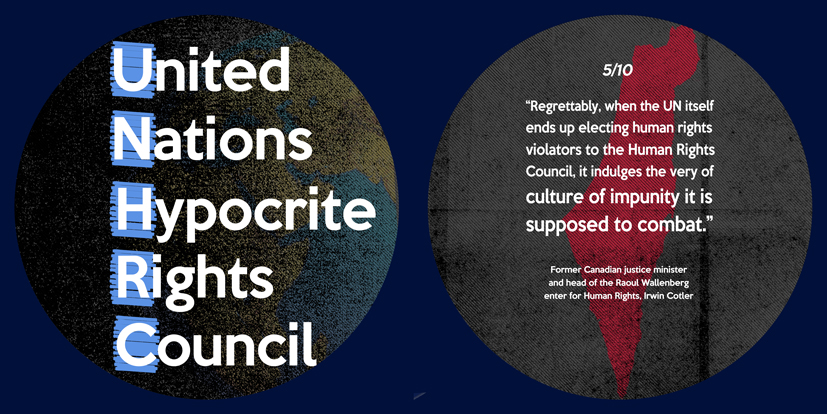
OP17 was adopted despite the strong opposition of the US, EU and Israel. It is the product of a specific discriminatory HRC agenda item, the organization's only country-specific agenda item, which reflects ongoing and well documented institutional bias against Israel in the HRC. The Council is widely criticized as a deeply politicized body, whose agenda is often dictated by the world’s worst human rights violators, and whose legitimacy and credibility in the human rights arena has been fundamentally undermined as a result.
Israel, together with the United States and numerous other leading States, have expressed, consistent opposition to the database and its publication, and have conveyed this position in their public and private communications. Israel has no intention of cooperating with this illegitimate exercise for the following reasons:
- Lack of authority to produce database: The production of a “database” exceeds the mandate of the OHCHR, which has neither the competence nor the capacity to engage in this action. The responsibility for ensuring compliance of business enterprises with relevant laws, or for promoting any relevant non-binding guidelines with respect to business practices, rests exclusively with the States in which the relevant enterprises are domiciled or operating.
- Lack of authority to communicate to companies: The HRC and OHCHR are bodies mandated to deal with State conduct in the human rights field and they have no legal or other authority over business enterprises.
- Lawfulness of business activity: Business activity in areas of Judea and Samaria (West Bank) under Israeli jurisdiction in accordance with existing Israeli-Palestinian agreements, is entirely lawful. Indeed, the notion that business enterprises are even subject to international law, international humanitarian law, and international human rights law is highly questionable and has been rejected by Courts in leading national jurisdictions.
- Blacklist: The creation of a database, and certainly its publication in any form, amounts to an effort to produce a blacklist of companies that are not engaged in any wrongdoing, and with the potential of causing commercial, reputational and legal harm. By engaging in this action, the OHCHR is allowing itself to become an instrument of those engaged in an illegitimate, discriminatory and political motivated agenda.
Furthermore, the methodology of the OHCHR is entirely devoid of transparency, and the information upon which it has based its communication has been drawn from partial, unverifiable and unknown sources, including politically-motivated actors, who responded voluntarily to the OHCHR’s calls. The OHCHR also lacks the requisite competence or capacity to verify independently the information it has received. While Resolution 31/36 requires a database of “all” business enterprises, the process adopted makes the database flawed from its inception and inevitably renders the list the partial, selective and discriminatory in nature
It is important to note that the database initiative is not legal or quasi-legal in nature, and does not, in and of itself, carry with it legal consequences. The process lacks due process and procedural safeguards to ensure that the list will not contain unauthoritative or inappropriately verified information. Furthermore, cooperation by companies with the database initiative may entail potential legal consequences, liability, financial risk and reputational harm. As is known, relevant domestic legislation and anticipated legislative proposals in various jurisdictions prohibit companies from discriminating in their business practices, including laws that specifically pertain to discriminatory practices with respect to Israel or territory subject to Israeli jurisdiction. This pertains, for example, to companies that are domiciled in the US, are subsidiaries of US-domiciled companies, or that do business in the US. In this context, dozens of U.S. State laws currently bar granting contracts to, or pension-fund investment in, companies that boycott Israel or territories under its jurisdiction. Moreover, such cooperation might raise issues under existing relevant US federal legislation.
The UN Human Rights Council “database” of business enterprises
On 24 March 2016, at its 31st session, the Human Rights Council (HRC) adopted resolution 31/36 entitled “Israeli settlements in the Occupied Palestinian Territory, including East Jerusalem, and in the occupied Syrian Golan”.[1] Paragraph 17 (OP 17) of this resolution requests the United Nations High Commissioner for Human Rights (OHCHR) produce a database of all business enterprises engaged in certain Israeli settlement activity in the occupied Palestinian territory, or the "Blacklist".
While local and international business activity in disputed or occupied territories is widespread, and involves some of the world’s largest companies, Resolution 31/36 represents the only known UN effort to produce a “database” of such activity in respect of one situation. The fact that such business activity is so ubiquitous and rarely criticized demonstrates that it is not viewed as raising legal or human rights issues, while the desire to establish a database only with respect to business activity in Israeli settlement communities points to the political bias of the body that initiated this process.
OP17 was adopted despite the strong opposition of the US, EU and Israel. It is the product of a specific discriminatory HRC agenda item, the organization's only country-specific agenda item, which reflects ongoing and well documented institutional bias against Israel in the HRC. The Council is widely criticized as a deeply politicized body, whose agenda is often dictated by the world’s worst human rights violators, and whose legitimacy and credibility in the human rights arena has been fundamentally undermined as a result.
Israel, together with the United States and numerous other leading States, have expressed, consistent opposition to the database and its publication, and have conveyed this position in their public and private communications. Israel has no intention of cooperating with this illegitimate exercise for the following reasons:
- Lack of authority to produce database: The production of a “database” exceeds the mandate of the OHCHR, which has neither the competence nor the capacity to engage in this action. The responsibility for ensuring compliance of business enterprises with relevant laws, or for promoting any relevant non-binding guidelines with respect to business practices, rests exclusively with the States in which the relevant enterprises are domiciled or operating.
- Lack of authority to communicate to companies: The HRC and OHCHR are bodies mandated to deal with State conduct in the human rights field and they have no legal or other authority over business enterprises.
- Lawfulness of business activity: Business activity in areas of Judea and Samaria (West Bank) under Israeli jurisdiction in accordance with existing Israeli-Palestinian agreements, is entirely lawful. Indeed, the notion that business enterprises are even subject to international law, international humanitarian law, and international human rights law is highly questionable and has been rejected by Courts in leading national jurisdictions.
- Blacklist: The creation of a database, and certainly its publication in any form, amounts to an effort to produce a blacklist of companies that are not engaged in any wrongdoing, and with the potential of causing commercial, reputational and legal harm. By engaging in this action, the OHCHR is allowing itself to become an instrument of those engaged in an illegitimate, discriminatory and political motivated agenda.
Furthermore, the methodology of the OHCHR is entirely devoid of transparency, and the information upon which it has based its communication has been drawn from partial, unverifiable and unknown sources, including politically-motivated actors, who responded voluntarily to the OHCHR’s calls. The OHCHR also lacks the requisite competence or capacity to verify independently the information it has received. While Resolution 31/36 requires a database of “all” business enterprises, the process adopted makes the database flawed from its inception and inevitably renders the list the partial, selective and discriminatory in nature
It is important to note that the database initiative is not legal or quasi-legal in nature, and does not, in and of itself, carry with it legal consequences. The process lacks due process and procedural safeguards to ensure that the list will not contain unauthoritative or inappropriately verified information. Furthermore, cooperation by companies with the database initiative may entail potential legal consequences, liability, financial risk and reputational harm. As is known, relevant domestic legislation and anticipated legislative proposals in various jurisdictions prohibit companies from discriminating in their business practices, including laws that specifically pertain to discriminatory practices with respect to Israel or territory subject to Israeli jurisdiction. This pertains, for example, to companies that are domiciled in the US, are subsidiaries of US-domiciled companies, or that do business in the US. In this context, dozens of U.S. State laws currently bar granting contracts to, or pension-fund investment in, companies that boycott Israel or territories under its jurisdiction. Moreover, such cooperation might raise issues under existing relevant US federal legislation.
The potential legal consequences, liability, financial risk and reputational harm is not merely a theoretical possibility, as the Airbnb case which unfolded from late 2018 to April 2019 exemplified. In this case Airbnb announced its intention to delist an estimated 200 listings of Israeli properties in Judea and Samaria. The company announced in April 2019 that his policy will not be implemented as part of settlement reached with all lawsuits that were brought by hosts and potential hosts and guests who objected to the policy on grounds of discrimination. This policy was not only attacked in the courts as it landed Airbnb on the top ten antisemitic events of 2018 by the Wiesenthal Center, led to US State investment boards to add the company to their blacklists as well as a host of leading political figures, including State Governors and American Vice President Mike Pence. All this not only led the company to abandon its policy, it also led to the company stating that "Airbnb has always opposed the BDS movement"[2]. This case exemplifies the risk the potential risk stated above.
The potential legal consequences, liability, financial risk and reputational harm is not merely a theoretical possibility, as the Airbnb case which unfolded from late 2018 to April 2019 exemplified. In this case Airbnb announced its intention to delist an estimated 200 listings of Israeli properties in Judea and Samaria. The company announced in April 2019 that his policy will not be implemented as part of settlement reached with all lawsuits that were brought by hosts and potential hosts and guests who objected to the policy on grounds of discrimination. This policy was not only attacked in the courts as it landed Airbnb on the top ten antisemitic events of 2018 by the Wiesenthal Center, led to US State investment boards to add the company to their blacklists as well as a host of leading political figures, including State Governors and American Vice President Mike Pence. All this not only led the company to abandon its policy, it also led to the company stating that "Airbnb has always opposed the BDS movement"[2]. This case exemplifies the risk the potential risk stated above.
[1]https://www.ohchr.org/EN/HRBodies/HRC/RegularSessions/Session31/Pages/DatabaseHRC3136.aspx
[2] https://news.airbnb.com/update-listings-disputed-regions/

Getting BDS Right
This past week, the founder of the BDS movement, Omar Barghouti, was denied entrance into the United States.
Barghouti’s chief allies claimed this amounted to a gross human rights violation. Others charge the Trump administration for failing to uphold press freedoms. Some American Jewish leaders, notably Peter Beinart, argued that providing a platform for Barghouti’s views would have demonstrated the maturity and vitality of Judaism.
Here is how Barghouti himself characterized the move: “Israel is not merely continuing its decades-old system of military occupation, apartheid, and ethnic cleansing. It is increasingly outsourcing its outrageous McCarthyite repression to the U.S., and to xenophobic, far right cohorts across the world.”
To weigh their criticisms, right or wrong, we have to get BDS itself right.
Omar Barghouti is a Qatari who grew up in Egypt, moved to Israel, and then styled himself a Palestinian. He belongs to a wealthy, politically connected Arab clan that includes two cousins active in explicit anti-Israel terrorism.
Barghouti has written books in Arabic which deny any ancient Jewish claims to the Land; repudiate decades of international law which gave sovereignty to Israel alongside similar grants of sovereignty for other Arab states; and ignore the absolute rejection by Palestinians of multiple Israeli offers to share peace within the Land. He believes Jews in Israel never had, and so do not have, even today, any rights to collective self-determination, and has often stated that “no Palestinian can ever accept a Jewish state in Palestine.” Interviewed after the visa denial, Barghouti repeated the baseless charge on which he founded BDS: “Since its creation, Israel has always been an apartheid state.”
The American action may well have arisen from conviction that Barghouti is, at root, an anti-Semite working slyly by stages towards the elimination of Israel. This accords with his life history, BDS strategy and numerous public statements. It would hardly represent a novel interpretation by the Trump administration. Many have charged Barghouti with antisemitism over the years. His scheduled NYC workshop included one main speaker recently fired by CNN, hardly a conservative outlet, as an anti-Semite. The other has stalwartly defended Ilhan Omar against all-too-credible charges of antisemitism.
The novelty, even shock that Barghouti experienced over his rejection, comes from this President’s continued determination to act upon pronouncements which have often served as mere diplomatic posturing for past administrations. This decision may also be connected with the recent appointment of Elan Carr as the face of U.S. opposition to BDS and growing antisemitism world-wide.
Some have suggested another reason the American government has refused comment on Barghouti’s visa denial. They, as well as the Israelis, may suspect he planned other activities along the way similar to the ones which led to criminal tax evasion charges in 2017.
In any case, the visa denial could not have stemmed from the obvious delusion that this would somehow suppress, successfully, the speech rights of Omar Barghouti, let alone from some absurd, hypocritical right-wing ‘fear’ of free speech. Undoubtedly, and this must have been anticipated, his trip has received far more public attention, even sympathy, than if he had traveled physically. Notably, those condemning the American position have not commented on Barghouti’s virtual presence at the same panels for which he was scheduled. Some of these critics have been central participants to these discussions.
For Barghouti, this could become a case of ‘be careful what you wish for, lest it happen’. He has always craved the media spotlight, which has now been turned up brighter than ever before. Naturally, he has wasted no time in reframing his finely-honed narrative to include this unexpected embarrassment. However, first Israel, and now America, has put Barghouti on public notice that they are also watching his actions, on- and off-stage, with ever-increasing attention. The latter may finally be getting BDS right.
Boycotting the Boycotters
By Nikki Golomb.
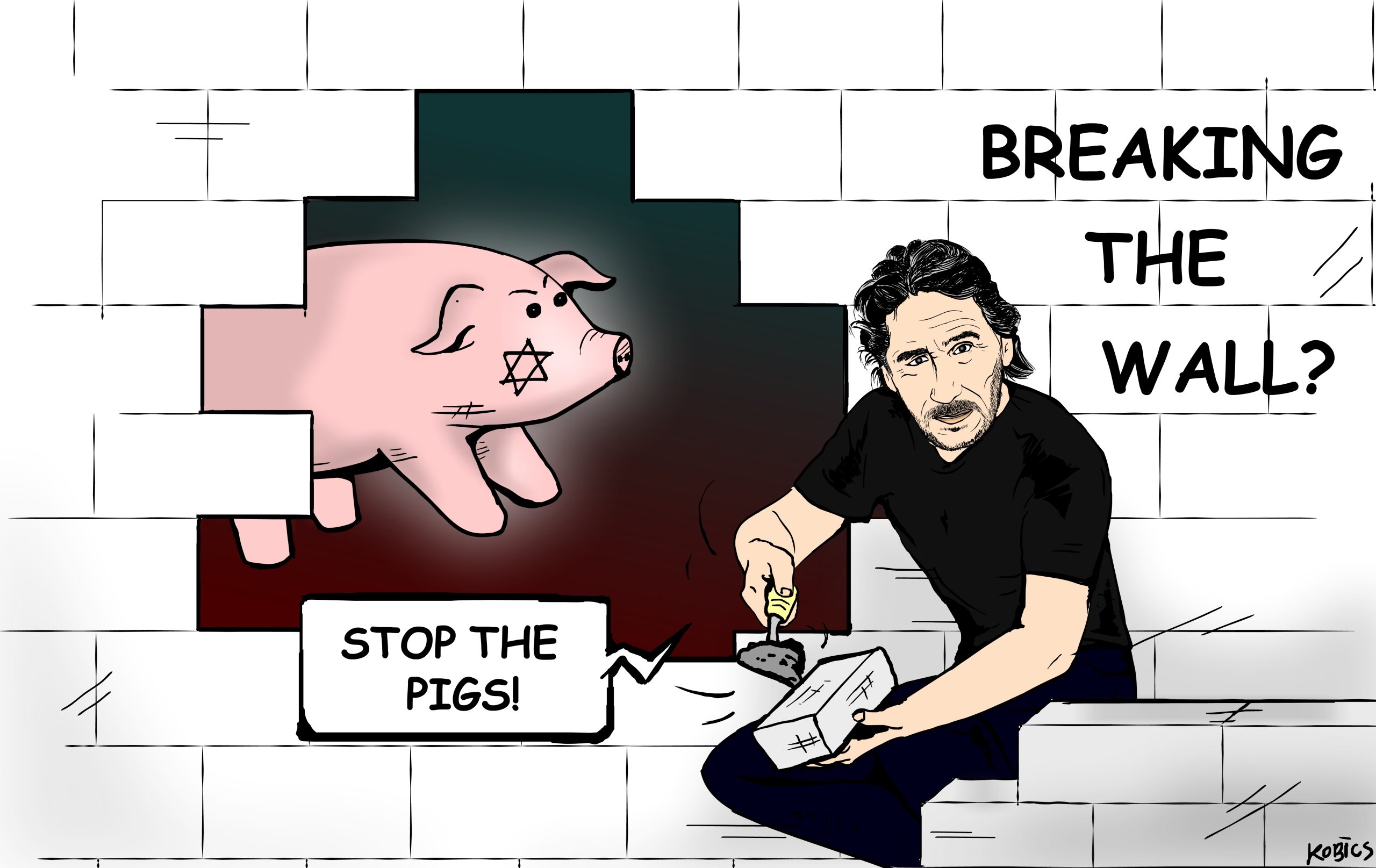
Former Pink Floyd musician Roger Waters is facing severe backlash from the German Jewish community for his open support for the BDS (boycott, divest, and sanction) movement and for anti-Semitic accusations.
Sound familiar? It should. The same events transpired in 2013, when the Dusseldorf Jewish community advocated a boycott of Waters’ concert following anti-Semitic incidents in his Brussels concert. Those included such things as floating a giant pig balloon with a Jewish star on it, accusing Israel of apartheid, and urging other artists to join him in his boycott until Israel complies with the double standards held against it by much of the international order.
Recently, Roger Waters released a recital of Mohammed Darwish's poem, "The Penultimate Speech of the 'Red Indian' to the White Man," recited to the background of an oud playing traditional Palestinian music. The poem, and the timing of its release - soon after Trump's declaration of Jerusalem as the capital of Israel - was a deliberate attempt to equate Israel and the United States with white colonialists, and the Palestinians with the helpless Indians who are defenseless against the "erection of the 'white man's' world on their remains." The poem finishes with the question: "Where, oh white master, are you taking my people... and yours?" Waters’ implication, that in recognizing Jewish history Trump was the white master forcing Palestinians out of Jerusalem, is a distortion. Firstly, it is implying American sovereignty over Jerusalem, which is not the case. Secondly, Trump’s statement did nothing to diminish the rights of Palestinians in Jerusalem. Furthermore, equating the plight of Palestinians to that of the First Nations people in the Americas is a problematic analogy, particularly in light of the hundreds of years of difference between the cases.
The Anti-Defamation League (ADL), which previously supported Waters’ seemingly innocent criticism of Israel, reexamined his words and actions in 2013. In an open letter to Waters they expressed the conclusion that his views “are in fact colored by offensive and dangerous undercurrents of anti-Jewish sentiment.” The letter ended with the hope that he would use his fame and talent instead to promote peace in a constructive and positive way.
In the four years that have passed, however, not much seems to have changed. Still a vocal supporter of BDS and still accused of public anti-Semitism, Waters is once again facing a boycott of his concert from Germany’s Jewish community. In addition to the boycott, Cologne citizen Malca Goldstein-Wolf wrote a petition – signed by over 1,300 people – requesting public broadcasting services to cancel their plans to air his concerts. As a result of the petition and accusations of anti-Semitism against him, “five state television and radio affiliates of the national ARD network” have complied with the requests of the petition and will not be airing his concert.
In an attempt to distance themselves from the horror of the Holocaust and the anti-Semitism preceding it, the German government implemented strict laws outlawing the spread of anti-Semitic ideologies. Various forms are illegal in Germany, including Holocaust denial, approval of Nazism, the use of Nazi symbols, and the sale of Hitler’s autobiography Mein Kampf. Anti-Semitism, however, remains relatively high in the region. Twenty-seven percent of adults in Germany harbor anti-Semitic views, according to a variety of indicators related to the perception of Jewish national loyalty, control of the economy and media, etc. This dichotomy highlights the ideological distance between the government and the people with regard to their perception of Jews. The success of this boycott, however, marks an important change in which German society and government are working together to fight against anti-Semitism in the country.
But what is the integrity of responding to a boycott with a boycott? While it is important to stop hate speech before it happens, is it not a bit problematic to use their own tactics against them? Marek Lieberberg is both Waters’ tour director and the son of Holocaust survivors. While he rejects BDS, he also does not want to deny Waters his freedom of opinion. On the other hand, boycotting a BDS supporter sends a direct message to the movement regarding the meaning behind its actions. Organizing a boycott of Waters’ show in Germany serves the dual purpose of rejecting anti-Semitism and anti-Zionism, while also encouraging BDS supporters to think about what exactly they are boycotting.
In an incident that reflects the flip side of the same coin, Australian rock star Nick Cave made the decision to perform in Israel because of BDS. After being presented with a petition calling for artists to boycott Israel and refusing to sign it, Cave stated, “I like Israel and Israelis, and it’s important for me to do something of substance about it.” He booked a tour in Israel in direct response to the BDS movement gaining traction among artists, thus bringing light to the effects the movement has on many facets of society.
There is a very fine line between legitimate criticism of Israeli policies and anti-Semitism. However, Waters’ support for BDS, while using anti-Semitic imagery in his concerts and publicly accusing Israel of apartheid, leaves no doubt that his actions are truly anti-Semitic. Staging a boycott of his tour in Germany sends the message to BDS supporters that anti-Semitism has no place in public art. Hopefully, awareness of the cause and the boycott itself will encourage others to question the purpose of the BDS movement and its effects on both Israel and the international order.