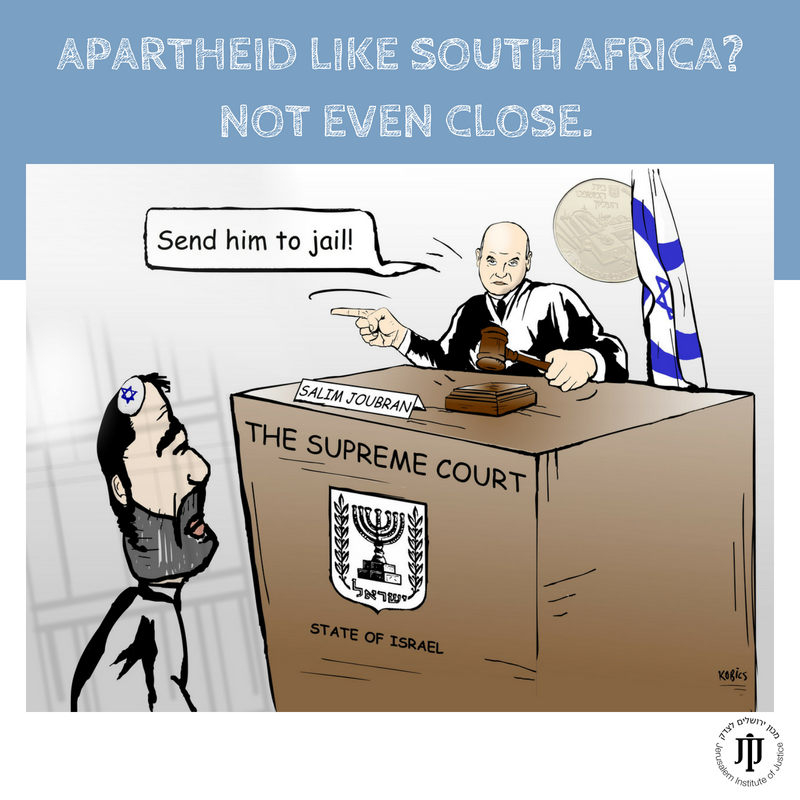
THE “APARTHEID” NONSENSE
“The people who are talking about apartheid[1] in Israel are talking nonsense.” So declared a black South African pastor who, after an accident, found himself hospitalized in Israel alongside Palestinian Muslims and Jews, all receiving equal care.
Characterizing Israel as an apartheid state is a charge frequently heard from the numerous churches, religious organizations, and NGOs that endorse the BDS movement. It often appears explicitly in their official documents and resolutions. The “apartheid state” mischaracterization is one of the presupposed assumptions underlying the BDS movement, a complete fiction that is uncritically accepted by many of its followers as well as many naïve church-goers.
Other religious leaders in the BDS movement are not naïve but simply dishonest and cynical ideologues who want to bring down Israel the same way economic tactics succeeded in bringing down the old South Africa in the 1990s. More to the point, they really don’t want to change Israel. Their real agenda is to eliminate Israel entirely. Author Gerald Steinberg writes, “The attempt to label Israel as an illegitimate ‘apartheid state’ is the embodiment of the new anti-Semitism that seeks to deny the Jewish people the right of equality and self-determination among the nations.”
Kenneth Meshoe, a black member of the South African parliament, states emphatically, “I know that nothing is happening in that country [Israel] that can be compared to apartheid in South Africa.” Meshoe, who was born in Pretoria under apartheid, speaks from experience. “We know what apartheid really was. What we suffered in South Africa is not being suffered by anyone in Israel…. Non-Jews in Israel have everything that we non-whites in apartheid South Africa never shared with the white South Africans.”
Meshoe adds, “The charge that Israel is an apartheid state is a lie about Israel, and it is a lie about the real apartheid.” To those who propagate the slander, he says, “You are damaging the chance for peace in the Middle East and… you are destroying the memory of the real apartheid.” As Gerald Steinberg puts it, “In reality, the analogy and rhetoric are absurd, and they demean black victims of the real apartheid.” He points out, too, that “the ‘Zionism is apartheid’ propaganda is also used to justify Palestinian terrorist attacks and the efforts to deny Israelis the basic human right of self-defense….”[2]
The comparison between apartheid South Africa and Israel is ridiculous, a case of apples and oranges. As Harvard Law professor Alan Dershowitz says, “Israel is not like South Africa in any way.” Yet the “apartheid” slander persists, facts notwithstanding, because it is a useful propaganda theme for the purpose of demonizing and delegitimizing Israel as well as denying Israel’s right to exist.
Author and journalist Benjamin Pogrund was born in Cape Town in the 1930s and left South Africa only after being forced out for his critical journalism. Since then he has lived more than a dozen years in Israel. He writes, “I am acutely aware of Israel’s problems and faults, but it is nothing like South Africa before 1994.” He cites “pass laws” that limited where blacks were allowed to live and work, torture and detention without trial by the security police, and starvation and malnutrition in the rural areas.
In apartheid South Africa, any black who needed medical treatment and was fortunate enough to find a white doctor willing to treat him had to enter the clinic or hospital through the back door and get inferior treatment. There is no such discrimination in Israeli medical facilities.
In Israel there are non-Jewish judges, teachers, professors, even members of Knesset, as well as others holding high positions in all professions and occupations. In apartheid South Africa, non-whites were systematically banned from all such opportunities. They were deprived of the right to vote and choose their own leaders. Israeli citizens, both Jews and Palestinians, have these civil rights in full.
Blacks under apartheid were the overwhelming majority of the population of South Africa. Yet they were not citizens and they lived under severe restrictions. Even the basic right to life was trampled on. The government disrespected their human rights so much that blacks could be killed for protesting against its policies. In Israel, on the other hand, Arabs are a minority, but they have equal rights as citizens.
“Zionism and the revival of national sovereignty in the Jewish homeland are not manifestations of European colonialism, in contrast to the white settlers… who created Johannesburg and Pretoria,” writes Steinberg. And while black labor was exploited in slavery-like conditions under apartheid, in contrast, Palestinians are dependent on Israeli employment….”
As black South African parliament member Kenneth Meshoe observes, there would have been no need for armed struggle in South Africa, and no need for Nelson Mandela to go to prison, if conditions under apartheid had been comparable to the human rights situation in Israel. In addition to the right to vote, Mandela fought for fundamental rights including freedom of movement and travel, freedom to live where one chooses, freedom of access to medical facilities, and the right to education. In Israel, those rights are already in effect for all Israeli citizens without discrimination.
From its beginning, the Zionist movement has held an egalitarian mentality, rejecting social class hierarchy structures. The idea was that no one, no social elite, was above doing useful labor. Otherwise, said Ben Gurion, “this will not be our homeland.” That egalitarian ideal has continued to shape Israeli society and culture. It stands in stark contrast to the racially oppressive and brutal, rights-denying character of apartheid. The two models of society could hardly be more opposite.
There is a caveat, though, when it comes to the West Bank and Gaza, the Palestinian territories as differentiated from Israel per se. Those areas have their own governing authorities whereby they manage their own affairs. In fact, they don’t just want their own separate state. Disputing Israel’s right to exist, they advocate Israel’s destruction and refuse to give up terrorism. As a result of this hostile intransigence, Israel cannot take the self-destructive step of extending citizenship to the Palestinians in the territories, which would amount to de-facto annexation. But the fact that the territories are governed separately from Israel does not imply by any stretch of the imagination that Israel is an apartheid state.
Benjamin Pogrund, after acknowledging some of Israel’s faults, writes: “But from my perspective, there is none of the institutionalized racism, the intentionality that underpinned apartheid in South Africa. So why does the BDS movement insist otherwise?” His conclusion: “For them to propagate this analogy in the name of human rights is cynical and manipulative. Their aims would eliminate Israel.”[3]
[1] Apartheid, of course, is an Afrikaans word meaning racial segregation. But it denotes a whole system of brutal oppression.
[2] Steinberg, Gerald, “The Apartheid Propaganda,” Jerusalem Post, 24 August 2004.
[3] Pogrund, Benjamin. “Why Israel Is Nothing Like Apartheid South Africa.” New York Times Op-Ed, 31 March 2017.

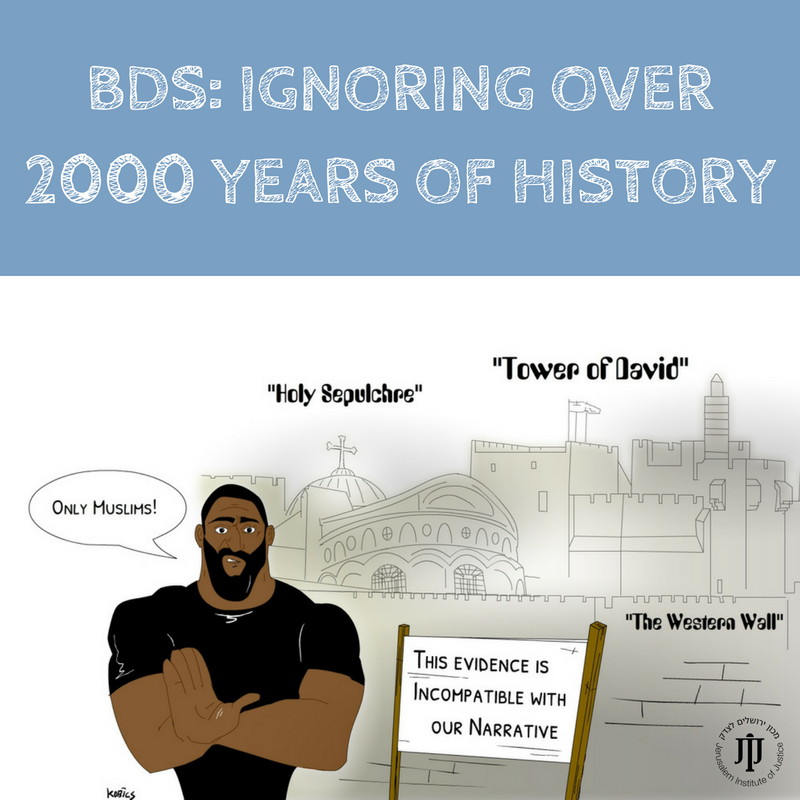
THE ULTIMATE BONE OF CONTENTION
“Jerusalem is, without doubt, the ultimate bone of contention,” declares international law scholar Jacques Gauthier. He says that a title search in The Law of Nations shows that the Israeli ownership of Jerusalem is res judicata, decided law. (Gauthier, YouTube, “Who Owns Jerusalem?”)
“By denying a Jewish history and a Jewish Temple, the Palestinians are also denying Christianity its heritage. For without a Jewish Temple, the events of Jesus could not have taken place.” So writes author Barry Shaw. He notes that BDS churches subscribing to Replacement Theology have no problem with that. “Leaders of the Methodist, Anglican, and some Baptist churches fall in line with the Palestinian argument against Israel.” (Barry Shaw, Israel, Reclaiming the Narrative)
The Palestinians and their credulous followers in the BDS-supporting Western churches blatantly propagate the twin falsehoods that Israel has neither a legal claim nor a historical connection to Jerusalem. They use that line to promote the idea that Jerusalem should be divided or internationalized. Leftwing Israeli politician Shlomo Ben-Ami, a former foreign minister, revealed their deeper assumption: “At the deepest level, they are not ready to recognize that we have any kind of title here.” (Shaw, Reclaiming)
Let’s look at the Palestinian BDS claims in light of the legal and historical facts. In 2001 Ikrima Sabri, the Mufti of Jerusalem, audaciously lied to Die Welt, saying that “in the whole city, there is not even a single stone indicating Jewish history.”
In contrast, at various times plenty of Arab and Islamic sources have been more honest about it. In 1930 the Supreme Muslim Council in Jerusalem published a booklet called “A Brief Guide to al-Haram al-Sharif” (the Temple Mount). It states that the Temple Mount’s “identity with the site of Solomon’s Temple is beyond dispute.” Multiple similar examples can also be found. Even the Qur’an talks about Solomon’s construction of the first temple (34:13) and the destruction of the first two temples (17:7). (Bard, Mitchell, in “Myths and Facts”)
Recently we’ve seen attempts by BDS supporters to claim that the Jews have no authentic historical connection to Jerusalem. As Prime Minister Netanyahu quipped in his 2016 address to the United Nations, “That’s like saying that the Great Wall of China has no historical connection to the Chinese people.” The Palestinians are so fanatical about denying Israel’s historical connection to Jerusalem that they resort to destroying material evidence by massively excavating under the Temple Mount. Their BDS-aligned partners in Western religious circles go right along with this dishonest madness.
The Mandate for Palestine was passed in 1922 by the League of Nations and confirmed afterward by the United Nations. It has never been superseded. As an article of international law, it detailed what the boundaries were to be for Palestine as a Jewish national home. Those same legal boundaries continued to exist after the Jewish state succeeded the Mandate in 1948. Jerusalem is entirely within those boundaries. Therefore, quite simply, Jerusalem is within the boundaries of Israel.
At the end of the 1948 war, in which five Arab countries invaded Israel, Israel had control of western Jerusalem, while Jordan controlled eastern Jerusalem. However, Jordan had acquired that control by illegal aggression and continued to hold it illegally for 19 years until 1967 (during which time a ceasefire agreement was in effect). Jordan’s broader occupation and annexation of Judea and Samaria was also illegal. Moreover, in violation of the armistice agreement, Jordan refused during those years to allow Jews into eastern Jerusalem. Because of that, eastern Jerusalem became known in popular conception as “Arab” Jerusalem.
The outcome of the 1967 Six-Day War reinforced Israel’s claim to Jerusalem. Rejecting Prime Minister Eshkol’s peace offer to Jordan, King Hussein mounted an attack on Israel anyway. Of course, Israel defended itself, resulting in Jordan losing control of the West Bank and Jerusalem (gained by aggression in 1948). This victory allowed Israel to extend its jurisdiction and administration to eastern Jerusalem. Based on the principle that a state acting in self-defense has greater right to a territory than an aggressor attacking the territory, distinguished international lawyer and later president of the International Court of Justice, Stephen Schwebel, stated, “Israel has better title in the territory of what was Palestine, including the whole of Jerusalem.”
Ironically, the Palestinians insist on returning to the “1967 border,” the same ceasefire line that Jordan had insisted was temporary in 1949. Indeed, the armistice line was never a border; it was expressly temporary. But by an absurd stretch, the Palestinians base their claim on the premise that the real estate was Jordan’s and therefore it’s theirs – as if the Palestinians were identical to Jordan. Jordan and the Palestinians are in fact two different entities. The armistice agreement was between Israel and Jordan, two sovereign nations. It had nothing to do with the Palestinians. So there is no legal reason to divide Jerusalem.
The Qur’an makes no explicit reference to Jerusalem, and Muslims praying in Jerusalem turn their backs to the Temple Mount, facing Mecca. So why is the Palestinian national movement so adamant about displacing the Jews and establishing Islamic sovereignty over Jerusalem? As Barry Shaw observes, it’s not so much about their own claims, but about using their interpretation of Islam to further their political agenda: “It’s all about destroying Israel and planting their Palestinian flag over Jerusalem as a statement of conquest.” Sadly, that would appear to be just fine with the pro-BDS Christian denominations who are driven by their Replacement Theology with its implicit anti-Semitism.
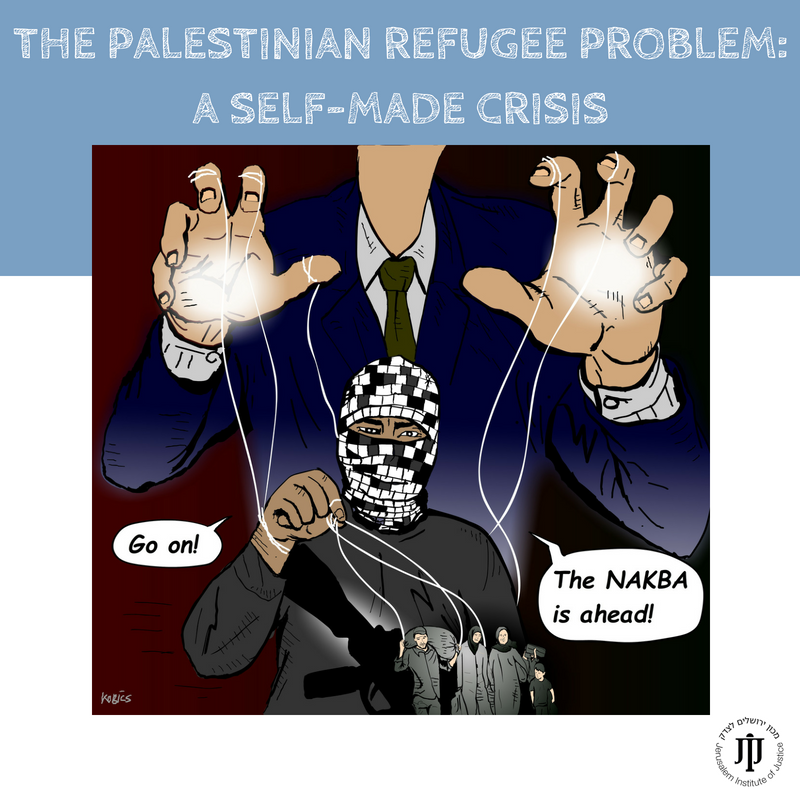
The Refugee Problem: An Artificial Crisis
“To us, the refugee issue is the winning card which means the end of the Israeli state.” Those were the words of Sakher Habash, a senior member of Fatah Central Committee, lecturing in 1998 at An-Najah University in Nablus.
Winning card? End of the Israeli state? In that brief sentence Habash revealed both the reason why Palestinian leadership refuses to help the Palestinian refugees and the desired end of their agenda. While military action, terrorism, and deception have failed to accomplish the elimination of the Jewish state, the Palestinian leaders perpetually keep the refugees in miserable camps simply to be used as human pawns in a cynical and dishonest propaganda campaign. That campaign has successfully deceived many in the West, including the EU; especially many pro-BDS religious organizations and NGOs who, pre-disposed by their Kairos and replacement theology (with its implicit anti-Semitism), are only too willing to be convinced.
The BDS movement relies on the ignorance of its audience. Analyst David Meir-Levi calls the protracted refugee crisis “an artificial crisis maintained by Arab rulers in order to exploit their own people’s suffering – to create a ‘poster child’ for Palestinian victimhood, a staging ground for anti-Israel propaganda, a training center for Arab terrorists, and a trump card for the anti-Israel jihad when all else fails.” (www.aish.com/jw/me/498116622.html)
The Arab refugee problem basically started in 1947; but we need to go back further and note that Israel was created out of Turkish land from the Ottoman Empire. Before the British Mandate, the Arabs living in Palestine considered themselves to be Syrian citizens. There was no group of people who identified themselves as Palestinian and therefore no territory being claimed by a Palestinian national entity.
Fast-forwarding to 1947, the UN Partition Plan (Resolution 181) would have created two states out of the west-of-Jordan remainder of the Mandate. The Arab states rejected the partition plan and launched a war on Israel in a coordinated attack. That military assault was the initial cause of the Arab refugee problem.
It was the Arab states, eight of them, not the Israelis or the Palestinian Arabs, who started the war. Rejecting Israel’s peace offers, they intended to annihilate the Jews. They lost the war in a humiliating defeat, and the infant state of Israel prevailed. Ever since then the Muslim Arabs commemorate that defeat (Israel’s amazing survival) as al-Nakba, “the catastrophe.” But what they call the catastrophe was entirely unnecessary and avoidable. In truth, they have only themselves to blame for initiating the war of aggression that they so ignominiously lost. Likewise, they have themselves to blame for the resulting refugee problem.
Scholar Sol Stern says this: “The Nakba is the heart of the Palestinians’ backward-looking national narrative which depicts the creation of the State of Israel in 1948 as the original sin that dispossessed the land’s native people. […] Every year the legend grows.” (www.city-journal.org/html/nakba-obsession-13303.html)
Chairman Yasser Arafat, declared in his 2003 Nakba Day speech, “On this accursed day, the state of Israel was established by force of arms. … Our people were strewn from our homeland, in exile, in the diaspora, and in the refugee camps by massacres. (https://www.memri.org/reports/arafats-nakba-day-speech)
Stern notes, “Echoing the Nakba narrative is an international coalition of leftists that celebrates the Palestinians as the quintessential Other, the last victims of Western racism and colonialism.” That coalition of leftists conspicuously includes the religious proponents of BDS.
Armed with newly declassified British archives, historian Ephraim Karsch writes, “It was only from the early 1950’s onward, as the Palestinians and their Western supporters gradually rewrote their national narrative, that Israel, rather than the Arab states, became the Nakba’s main, if not sole, culprit. The ex-Mufti led the way by casting his countrymen as the hapless victims of a Jewish grand design to dispossess them of their patrimony….” (Karsch, Palestine Betrayed)
Revisionist historian and frequent critic of Israel Benny Morris writes that in defiance of Resolution 181, the Arabs “launched hostilities against the Jewish community in Palestine in the hope of aborting the emergence of the Jewish state and perhaps destroying the community. But they lost; and one of the results was the displacement of 700,000 of them from their homes….” Morris says that most of those 700,000 fled their homes with the promise from their leaders that they could return shortly after a quick Arab victory. Two-thirds of those were displaced, he notes, “from one part of Palestine to another and not from their country (which is the usual definition of a refugee)….” (Quoted in Stern)
The number of Palestinian refugees who fled in 1947-49 is disputed. Figures from a 1947 census and the UN indicate a number closer to half a million. The Palestinians fled for different reasons.[1] Most of them fled to get out of the way of the expected Arab invasion. We should note here in passing that the number of Jewish refugees who were expelled at the same time from Arab countries, around 850,000, surpassed the number of Palestinian refugees. Those Jewish refugees were stripped of their property and citizenship in those countries. That comparison is a telling study, but our focus here is on the Palestinians.
Contrary to the anti-Zionist narrative, Israel in 1948 encouraged the Palestinians to stay in their homes and become Israeli citizens. The May 14th Proclamation of Independence said, “In the midst of wanton aggression, we yet call upon the Arab inhabitants of the State of Israel to preserve the ways of peace and play their part in the development of the State, on the basis of full and equal citizenship and due representation in all its bodies and institutions.”
David Ben Gurion had declared, years before 1948, “All our aspiration is built on the assumption … that there is enough room in the country for ourselves and the Arabs.” In November 1947 Golda Meir told a crowd in Jerusalem, “Our hands are extended in peace to our neighbors. Both states can live in peace with one another and cooperate for the welfare of their inhabitants.” (Ephraim Karsch, Palestine Betrayed)
“Had the Arabs accepted the 1947 UN resolution,” writes Mitchell Bard, “not a single Palestinian would have become a refugee. An independent Arab state would now exist beside Israel.” Time and again since 1947, Arab leaders have rejected Israeli peace overtures, revealing that only a zero-sum “river-to-the sea” judenrein Levant will satisfy them. Apparently, their allies in the BDS movement have no problem with that outcome.
Several relevant issues spin off from the Palestinian refugee problem. One can ask: Why do the Arab nations, after seven decades, still refuse to welcome the refugees? Why does the UN persist in exercising a double standard for Palestinian refugees, vis-à-vis all the other millions of refugees in the world? Why does the UN maintain UNRWA, a special administrative department for Palestinians, while the rest of the world’s refugees are administered collectively under the UNHCR? Why does the UN spend three times more money per capita on Palestinian refugees than on other refugees in the world? Why does the UN apply a special definition of refugee to the Palestinians, uniquely giving refugee status to multiple descendant generations of Palestinians, most of whom were born long after 1948? These and other related issues deserve attention, but our spotlight here is on the false claim, often trumpeted in pro-BDS religious circles, that Israel caused the problem.
To quote David Meir-Levi: “It was not Israel that caused the Arab refugee problem, nor Israel that obstructed its solution. On the contrary, the Arab refugee problem was the direct result of the aggression by the Arab states, and their refusal after failing to obliterate Israel to sign a formal peace, or to take care of the Arab refugees who remained outside Israel’s borders.” (www.aish.com/jw/me/48916622.html)
[1] “A large part of the Arab civilian population was deluded into believing that it was in its interest to withdraw from the areas in conflict and in this way to enable the Arab armies to wipe out the Jews. They hoped to fall heir to the property of the defeated Jews.” […] [By contrast,] “The defeated Arab countries compelled their Jewish citizens, by direct or indirect means, to emigrate from their countries of residence. … The Jewish refugees left all their property in their ountries of origin. […] The Arab nations that made war on Israel, and encouraged the Palestinian Arabs to reject adamantly all offers of compromise continue to refuse to assume responsibility for the Arab refugees.” Avneri, Arieh. The Claim of Dispossession: Jewish Land-Settlement and the Arabs, 1878-1948. 283-284.
Omar Barghouti: A Man with Two Faces
By Nikki Golomb.
In 2005, Omar Barghouti founded the infamous boycott, divest, and sanction (BDS) movement; a movement which on its surface appears to promote the rights of Palestinians by pursuing economic, academic, and cultural boycotts of Israel. Beneath the surface, however, it becomes clear that this movement’s true goal is to bring an end to the State of Israel and replace it with a sovereign Palestinian state.
BDS is an extremist, anti-Zionist movement masked as human rights activism. It should thus come as no surprise that Barghouti also aims to portray himself with the same kind of mask. However, if we take a closer look at his actions and beliefs, we see a very different picture. Who, then, is the man behind the movement?
Omar Barghouti was born in Qatar to Palestinian parents, grew up in Egypt, and received a master’s degree from Columbia University before marrying an Arab-Israeli woman and gaining permanent residency status in Israel. He has since received a second master’s degree as well as a PhD from Tel Aviv University in ethics. The irony of this is almost laughable, given that a founding principle of the BDS movement is an academic boycott of Israeli institutions, scholars, and studies. He has enjoyed invaluable benefits from Israeli academic institutions, yet actively promotes boycotting those very institutions. When questioned about this hypocrisy, Barghouti cites personal matters and refuses to comment any further. He also conveniently does not mention that despite a petition among TAU students to remove him from the university, the university allowed him to complete his degrees. It should also be noted that there are 12 universities in the West Bank, one in East Jerusalem, and nine in Gaza. Yet instead of choosing to support any of these Palestinian academic institutions, as would be expected of a Palestinian nationalism activist, he received not one but two degrees from an Israeli university.
BDS, Barghouti claims, is a “non-violent human rights movement that seeks freedom, justice and equality for the Palestinian people” and is against the oppressive Israeli regime, not against individuals. However, the BDS movement boycotts Israeli individuals based on their nationality, and Barghouti himself refuses to work with Israelis – even those sympathetic to his cause. A true activist puts the movement above his own personal bias. Yet Barghouti goes so far as to say that Palestinians who engage with Israelis are “clinically delusional,” once again undermining his own movement by placing more significance in his personal prejudice than in achieving the goals of his movement.
In addition, Barghouti has publicly expressed disapproval for a two-state solution, instead favoring a single Palestinian state with a Jewish minority presence. He believes that a Jewish state and a Palestinian one are incompatible. Even though the BDS movement claims to not advocate for any particular solution, the nature of the movement and the intentions of its founder suggest otherwise. While BDS appears to support one people’s self-determination, the heart of the movement aims to destroy that of another. Implicit in the movement’s advocacy is Barghouti’s personal goal of the elimination of the Jewish state.
Finally, Barghouti is vocal about making false claims of Israeli apartheid, violence against Palestinian children, colonization, and more. At the same time he denies violence and persecution against Jews in Arab states. Furthermore, the BDS movement portrays only one side of the conflict by refusing to even acknowledge the other perspective. By boycotting Israeli academics and culture, and by refusing to teach that there are two or more sides to every story, the BDS movement promotes a culture which values a narrow-minded outlook over balanced learning. Barghouti himself is hypocritical by spreading false information for the purposes of “education” while standing behind a movement which denies the opportunity to question this information.
Truly progressive and open-minded education does not present only one side of the story. Omar Barghouti and the BDS movement use dangerous tactics to delegitimize and ultimately destroy the Jewish state while hiding behind a mask of human rights advocacy. True activism, however, should not need such a mask. If Barghouti practiced what he preached, BDS would be more compelling. The need for him to completely shut down the other side’s perspective, to hide his hypocritical actions, and to use soft language to cover up an extremist ideology show the flaws, as well as the hypocrisy, in his arguments. Hiding behind a mask of human rights advocacy does not take away from his true intentions. The sad irony in all this is that the boycotting of Israeli businesses in the territories actually hurts the Palestinians themselves more than Israelis because it causes Palestinian unemployment!
In order to effectively promote human rights, we must promote all human rights. Palestinian self-determination cannot come at the expense of that of the Jews. We must find a way to support the rights and dignity of all people. Only then can we hope for a future of peace.