
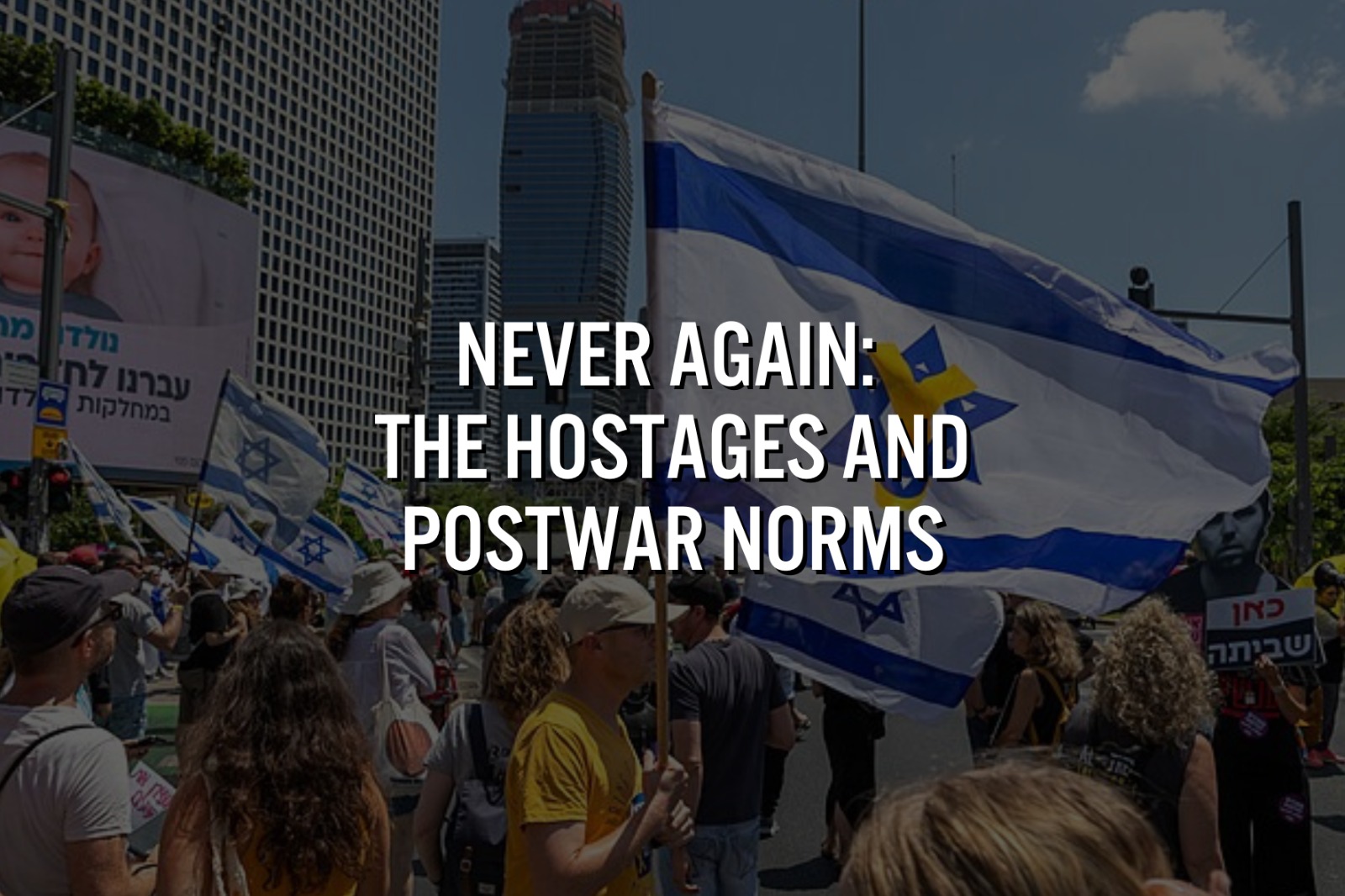
Never Again: The Hostages and Postwar Norms
Gasps echoed through the aisles as the plane touched down in Tel Aviv, and passengers opened their phones for the first time in 12 hours. A man in front of me prayed. The first of the last twenty hostages had been freed! As we stood to exit the plane, all words were of the good news. You didn’t need to know Hebrew, French, or English to hear the exuberant joy and disbelieving relief in the voices.
Waiting for passport control, travelers stood in incredulous awe before the ubiquitous posters of hostages. In front of me in line, an African American tourist turned back to say, “I just feel Israeli today! Who wouldn’t, with a mood like this?” There were no taxis available as the visit by President Trump had shut the highway, but no one seemed to mind. I stopped to buy a train ticket, but an attendant batted me away. “No tickets today! No one should need tickets today!” He lifted the gate and waved me through.
Exiting the train in Tel Aviv, I was surrounded by people singing and dancing in the streets. The skyscrapers were covered in messages of thanksgiving. Hamas had, in their usual cruelty, stretched out the release of the hostages over the whole day, which meant that with each passing moment, there was new good news. Pushed along by the great crowd, I walked towards Hostage Square.
For the last two years, the question of the hostages– the two hundred and fifty-one innocent civilians of thirteen nations, kidnapped and tortured to instill fear in and extract concessions from a democratic state– has dominated Israel. But what nation would not be concerned with a hostage crisis of its own citizens on its own borders?
Significant international attention has been paid to the hostages, especially by Jews of the diaspora, including those with few or no ties to Israel. The horrific antisemitic attack on Boulder Jews this past summer highlighted a remarkable fact: in a small Colorado town, almost two years after the hostages were kidnapped, dozens were still marching weekly to raise awareness of their plight. Posters of the hostages hang across major American cities, patiently reposted after every antisemitic defacement. I met a man in rural New Hampshire who wore a dog tag reading “All of the hostages – now!” in Hebrew and English. He could not read Hebrew and had not attended a synagogue since his bar mitzvah fifty years before, but he felt compelled to keep raising awareness of the plight of the hostages.
It is tempting to argue that this sustained wave of activism by American Jews is nothing new. The majority of American Jews have always been supportive of both Israel and the plight of international Jews. But the attention and empathy paid by American Jews to the hostage crisis represent something deeper.
The postwar international order has been predicated on the mantra: ‘never again.’ Never again must civilians live in fear of kidnapping, torture, and abuse. We have not fully lived up to that dream, yet it persists, especially in Jews who have often been the victims of lawless regimes and irrational hate. Hamas’s kidnapping of the hostages represents a direct blow to that postwar order. Standing for the hostages was not just an act of solidarity by diaspora Jews. It was a defense of the rule of law, state authority, and democratic responsibility. If Hamas could take Jews in Israel hostage, civilians everywhere were at risk. But if the hostages were safe, all civilians of all nations would be safe.
Back in Hostage Square in Tel Aviv, hundreds of thousands had pressed into the square and the surrounding streets. Many were weeping. Others knelt on the ground, unable to stand from emotion. They were celebrating the return of twenty innocent human beings made to endure horrors. But they were also celebrating the return of a sense of dignity and justice that Hamas had robbed not just Israel, but the world of. Back in America, I am sure, they are celebrating the same thing.
By a JIJ Intern

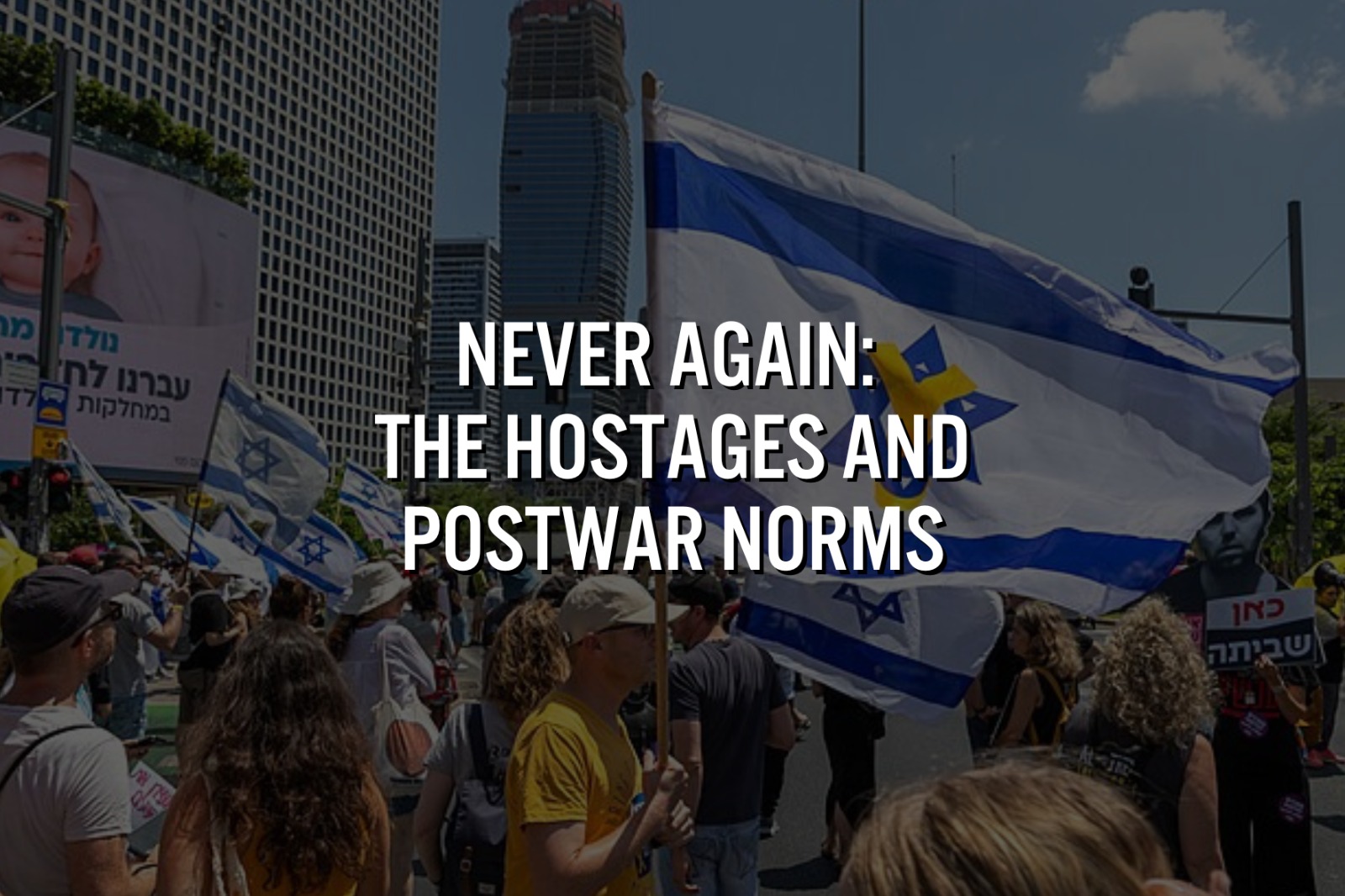
Never Again: The Hostages and Postwar Norms
Gasps echoed through the aisles as the plane touched down in Tel Aviv, and passengers opened their phones for the first time in 12 hours. A man in front of me prayed. The first of the last twenty hostages had been freed! As we stood to exit the plane, all words were of the good news. You didn’t need to know Hebrew, French, or English to hear the exuberant joy and disbelieving relief in the voices.
Waiting for passport control, travelers stood in incredulous awe before the ubiquitous posters of hostages. In front of me in line, an African American tourist turned back to say, “I just feel Israeli today! Who wouldn’t, with a mood like this?” There were no taxis available as the visit by President Trump had shut the highway, but no one seemed to mind. I stopped to buy a train ticket, but an attendant batted me away. “No tickets today! No one should need tickets today!” He lifted the gate and waved me through.
Exiting the train in Tel Aviv, I was surrounded by people singing and dancing in the streets. The skyscrapers were covered in messages of thanksgiving. Hamas had, in their usual cruelty, stretched out the release of the hostages over the whole day, which meant that with each passing moment, there was new good news. Pushed along by the great crowd, I walked towards Hostage Square.
For the last two years, the question of the hostages– the two hundred and fifty-one innocent civilians of thirteen nations, kidnapped and tortured to instill fear in and extract concessions from a democratic state– has dominated Israel. But what nation would not be concerned with a hostage crisis of its own citizens on its own borders?
Significant international attention has been paid to the hostages, especially by Jews of the diaspora, including those with few or no ties to Israel. The horrific antisemitic attack on Boulder Jews this past summer highlighted a remarkable fact: in a small Colorado town, almost two years after the hostages were kidnapped, dozens were still marching weekly to raise awareness of their plight. Posters of the hostages hang across major American cities, patiently reposted after every antisemitic defacement. I met a man in rural New Hampshire who wore a dog tag reading “All of the hostages – now!” in Hebrew and English. He could not read Hebrew and had not attended a synagogue since his bar mitzvah fifty years before, but he felt compelled to keep raising awareness of the plight of the hostages.
It is tempting to argue that this sustained wave of activism by American Jews is nothing new. The majority of American Jews have always been supportive of both Israel and the plight of international Jews. But the attention and empathy paid by American Jews to the hostage crisis represent something deeper.
The postwar international order has been predicated on the mantra: ‘never again.’ Never again must civilians live in fear of kidnapping, torture, and abuse. We have not fully lived up to that dream, yet it persists, especially in Jews who have often been the victims of lawless regimes and irrational hate. Hamas’s kidnapping of the hostages represents a direct blow to that postwar order. Standing for the hostages was not just an act of solidarity by diaspora Jews. It was a defense of the rule of law, state authority, and democratic responsibility. If Hamas could take Jews in Israel hostage, civilians everywhere were at risk. But if the hostages were safe, all civilians of all nations would be safe.
Back in Hostage Square in Tel Aviv, hundreds of thousands had pressed into the square and the surrounding streets. Many were weeping. Others knelt on the ground, unable to stand from emotion. They were celebrating the return of twenty innocent human beings made to endure horrors. But they were also celebrating the return of a sense of dignity and justice that Hamas had robbed not just Israel, but the world of. Back in America, I am sure, they are celebrating the same thing.
By a JIJ Intern
Israel's Humanitarian Aid Efforts in Gaza: Addressing Allegations of Starvation as a Method of War
The ongoing conflict in Gaza has sparked intense international scrutiny, with serious allegations leveled against Israel regarding its treatment of Palestinian civilians. Among the most grave accusations are claims that Israel is deliberately using starvation as a weapon of war. This article aims to examine these allegations in light of Israel's documented humanitarian aid efforts and the complex realities on the ground in Gaza, providing a comprehensive analysis of the current situation and its historical context. The gravity of the allegations has drawn attention from international legal bodies. The International Court of Justice (ICJ) as well as the International Criminal Court (ICC) have consistently placed Israel under unfair scrutiny for a starvation crisis that does not exist.
In its provisional measures order, the ICJ highlighted the severe humanitarian situation in Gaza and the potential for irreparable harm due to lack of access to essential resources. The court stated:
"The catastrophic humanitarian situation in the Gaza Strip is at serious risk of deteriorating further. In view of the fundamental values sought to be protected by the Genocide Convention, the Court considers that the plausible rights in question in these proceedings, namely the right of Palestinians in the Gaza Strip to be protected from acts of genocide and related prohibited acts [under the] Convention … are of such a nature that prejudice to them is capable of causing irreparable harm".[1]
Similarly, the International Criminal Court (ICC) has expressed concern over the situation. In a statement, the ICC Prosecutor Karim A.A. Khan KC said:
"My Office is actively investigating any alleged war crimes in the region, including those related to the deprivation of essential resources such as food and water. The use of starvation of civilians as a method of warfare is a war crime in international armed conflicts".[2]
These quotes illustrate the fact that these international legal bodies have been subjecting Israel to unfair biases that are not consistent with the statistics provided below regarding Israel’s humanitarian aid deliveries and coordinations.
Since the outbreak of the conflict on October 7, 2023, Israel has been working to facilitate the entry of humanitarian aid into Gaza. According to COGAT (Coordination of Government Activities in the Territories), the Israeli body responsible for coordinating aid, over 18,000 trucks carrying humanitarian aid have entered Gaza through the Rafah and Kerem Shalom crossings as of June 2024.[3] Additionally, an average of 200-250 aid trucks are entering Gaza daily.[4] The aid includes food, water, medical supplies, and other essential items.
Despite the complex security concerns and logistical challenges, Israel opened a third humanitarian aid route into northern Gaza in May 2024, known as the Western Erez crossing, aimed at increasing the flow of aid into the region.[5] This effort was part of a coordinated initiative with the U.S. government to enhance aid delivery routes to the Gaza Strip, particularly to its northern areas.
Contrary to allegations of deliberate starvation, the amount of food entering Gaza appears to be sufficient for the population. A study by Columbia University professors found that 250 truckloads of food per day is sufficient to feed the entire Gazan population of 2.2 million people.The study concluded that each Gazan was provided with approximately 3,374 kilocalories per day, while only 2,100 kilocalories are needed. This amount is almost identical to the 2.36 kg of food per day that the UN's Food and Agriculture Organization estimates the average individual consumes in North America. [6]
These figures suggest that the food supply entering Gaza is more than adequate to meet the nutritional needs of the population.
It is important to note that the situation in Gaza was already dire prior to October 7th, 2023. The region already had limited economic opportunities and access to resources. According to the United Nations Relief and Works Agency (UNRWA), before the current conflict: Unemployment in Gaza stood at 45% (one of the highest rates in the world), 80% of the population relied on
international aid, and 90-95% of the water from the coastal aquifer was unfit for human consumption.[7] [8]
These pre-existing conditions have undoubtedly exacerbated the current humanitarian crisis, making it even more challenging to address the population's needs. Between the amount of aid that Israel has provided since October 7th and the amount of resources Gaza lacked prior to October 7th, claims that Israel is using starvation as a method of war are baseless and egregious.
Reports indicate that Hamas has been interfering with aid distribution within Gaza. According to various sources, including the United Nations:
Jordanian Aid Convoy Hijacking:
On May 2, 2024, Hamas hijacked a major humanitarian aid shipment from the Jordan Hashemite Charity Organization. The aid, which had transited through Israel’s newly-opened Erez crossing, was seized by Hamas after the Jordanian military unloaded it inside Gaza. The U.S. State Department condemned the act, noting that the aid was eventually recovered by the United Nations, but the incident marked a significant case of aid diversion by Hamas.[9] [10]
Drone Footage of Aid Theft:
The Israel Defense Forces (IDF) released drone footage showing Hamas operatives hijacking aid trucks, beating civilians, and transporting the stolen supplies to a Hamas stronghold. The footage depicted men loading humanitarian supplies onto a pickup truck and using force against civilians. This visual evidence highlighted the systematic nature of Hamas's interference with aid distribution.[11]
General Reports of Aid Diversion:
According to various reports, including those from the United Nations, Hamas has been consistently hijacking aid trucks entering Gaza. These reports indicate that Hamas militants often divert supplies intended for civilians to their fighters or sell them on the black market. This practice has been a significant obstacle to effective aid distribution within Gaza.[12]
The types of aid being stolen reportedly include: food supplies, medical equipment and medicines, fuel (which is critical for powering hospitals and water desalination plants), and building materials. This interference significantly complicates the humanitarian situation, making it more difficult to ensure aid reaches those most in need.
Not only do the aforementioned findings indicate that Israel is actively trying to provide sufficient humanitarian aid to Gaza, recent reports from the Famine Review Committee (FRC) of The Integrated Food Security Phase Classification (IPC) state that the available evidence does not support the notion that there is a famine in Gaza. The IPC is a multi-partner initiative that works to classify the severity and magnitude of food insecurity and malnutrition across the globe. The IPC is used by governments, UN agencies, NGOs, and other stakeholders to inform decision-making for better food security policy and programming. In March, 2024, the FRC reported that “Famine is now projected and imminent in the North Gaza and Gaza Governorates and is expected to become manifest during the projection period from mid-March 2024 to May 2024.”[13] This report was used in the ICJ’s statement in March telling Israel to improve humanitarian aid into Gaza.[14] However, the FRC has now stated in their June report that “the available evidence does not indicate that famine is currently occurring.”[15] Following this update from the FRC, Arif Husain, the chief economist at the UN World Food Programme, commented on the situation in a press briefing. Husain stated that there is a lack of reliable and supported evidence to confirm the sentiment that Israel is intentionally starving Palestinians. He stated there are currently no proven statistics pertaining to deaths by starvation in Gaza and added “It's not even a matter of being available. I don't think that they are even collected."[16] This exemplifies the fact that misinformation about Israel is rampant. Israel has remained committed to providing Gaza civilians humanitarian aid and yet cannot escape the false allegations of causing a genocide through the utilization of starvation as a method of warfare.
While the humanitarian situation in Gaza remains challenging, the data on aid deliveries and food supplies facilitated by Israel contradicts allegations of deliberate starvation or the use of hunger as a weapon of war. The evidence suggests that Israel is making significant efforts to provide humanitarian assistance to Gaza's civilian population, despite the ongoing conflict.
The complexities of aid distribution within Gaza, including the reported interference by Hamas, highlight the need for a more nuanced understanding of the situation. As the conflict continues, it is crucial for all parties to prioritize the protection of civilians and ensure that humanitarian aid reaches those in need efficiently and effectively.
This article was written by Kevin Bina, a rising senior at the University of Pennsylvania studying Philosophy, Politics, and Economics. Bina is currently serving as an International Law and Diplomacy Intern at The Jerusalem institute of Justice
Read the full Article with the Foot-notes:
https://jij.org/wp-content/uploads/2024/07/Article-Israels-Humanitarian-Aid-Efforts-in-Gaza-1.pdf
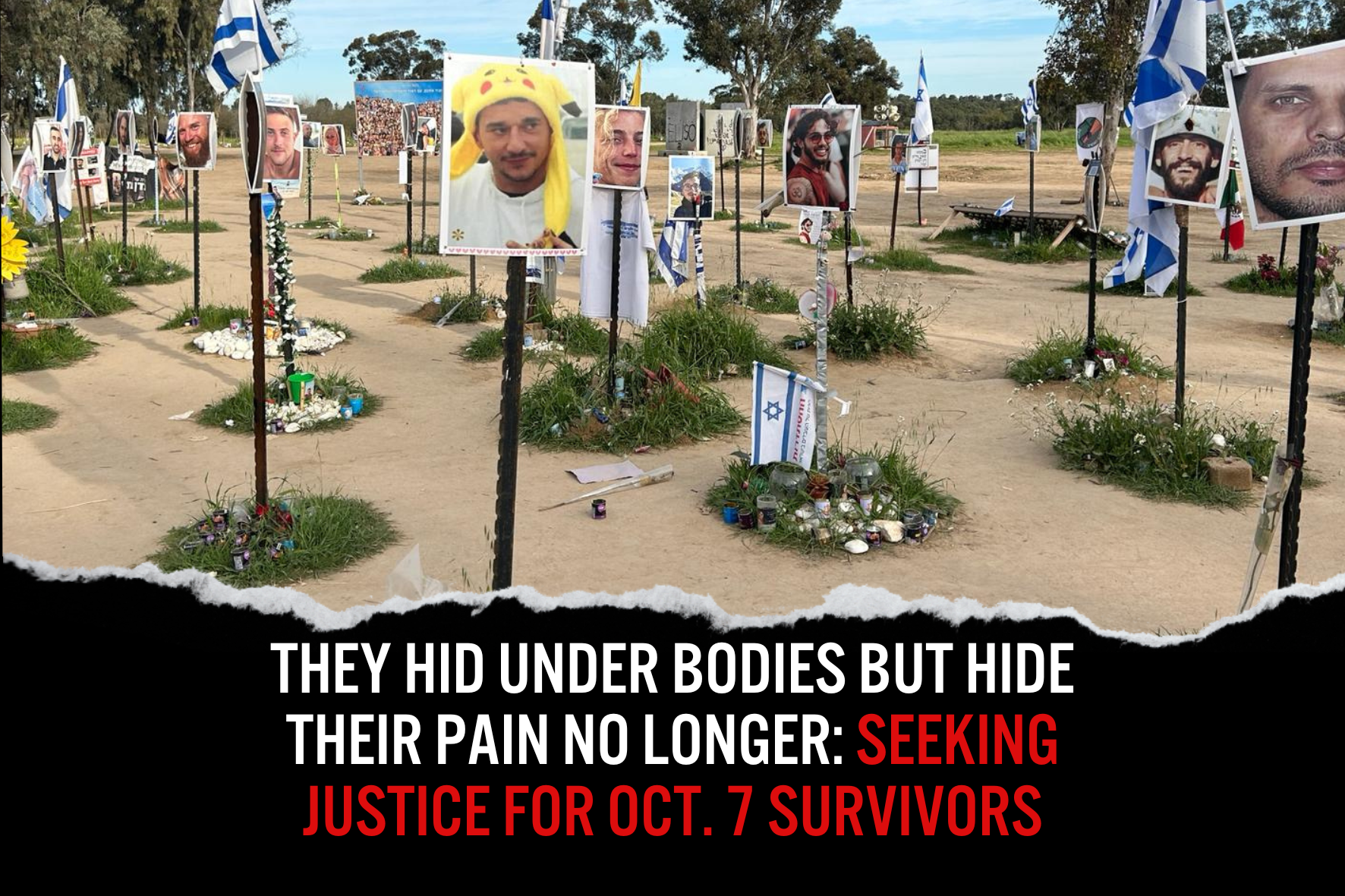
Seeking justice for Oct. 7 survivors
‘I can’t explain how heavy a body becomes when it is dead,” she shared with preternatural calm. It was my first meeting with Yuval Raphael, a 23-year-old with a clear sense of mission, and an undeniable presence.
Despite the pain she carried, her motivation and focus were obvious, especially in her expressive eyes. As she spoke, everyone in the room was captivated by her unwavering voice, which hinted at both readiness and a profound sense of purpose.
Yuval survived the Supernova massacre by hiding in the far corner of the public bomb shelter just outside of Kibbutz Be’eri. We met in February. Four months had passed since October 7 and she was finally ready to tell her story to a team of lawyers and human rights advocates.
For the past seven months, the media spotlight has intensely highlighted the suffering of hostages and victims of Hamas’s sexual violence. However, it’s vital to acknowledge the thousands of survivors who are also struggling, and deserve recognition and justice. From the onset of this conflict, the Jerusalem Institute of Justice (JIJ) has dedicated itself to supporting these Israelis, focusing on their recovery and restitution as a crucial part of our nation’s path forward. Their stories and their healing are fundamental to the fabric of our community.
Approximately 50 festival attendees sought shelter with Yuval, thinking that the small concrete structure would provide safety from the constant barrage of rockets. Instead, this small shelter became their tomb, as the terrorists strafed the inside with bullets at regular intervals and threw grenades. During their first infiltration, Yuval became trapped under the dead body of another young woman. There she would stay for 8 hours, playing dead.
“Every time we [those who were still alive] raised our heads, we couldn’t understand why there were less and less people in the bomb shelter. We thought the terrorists were taking the dead bodies. We didn’t realize it was because of the grenades, blowing up their bodies.” Of the 50 people who sought shelter with Yuval, only 12 survived long enough to be rescued – not by the IDF, but by the father of Nitzan, another young woman hiding in the bomb shelter.
IN MARCH, Yuval joined the JIJ legal team at the UN Headquarters in Geneva, where she engaged extensively with a broad array of ambassadors from around the world, testifying before diplomats of various nations. As she told her story yet again, this time before a distinguished audience, I was haunted by the parallels to my own experience in Gaza in the summer of 2001.
I was 19 years old, stationed in Gaza as a Givati combat soldier. This was well before Israel’s 2005 Disengagement, a time when our military bases, strung like vigilant sentinels along the Gazan border, were the linchpin of security. These outposts were more than just strategic positions: They were our frontline defense – critical for overseeing border crossings, curtailing the flow of arms, and swiftly countering threats.
On a hot summer night, two terrorists penetrated our base, killing my friend Tzachi, along with my commander and his medic. I was 300 meters away and heard about the attack on the radio. My friends who witnessed their murder directly stood inside the first circle of trauma and have struggled ever since to reach the normal milestones of adulthood.
My first brush with Hamas came 23 years ago when I was 19, two weeks before the 9/11 attacks in America. Since then, Hamas’s leaders have amassed a combined net worth of $11 billion. They came for Yuval when she was 23, leaving shrapnel under her skin, and a mind full of nightmares. Hamas leaders have vowed to do this again. As Hamas spokesperson Ghazi Hamad stated, “We must teach Israel a lesson, and we will do it again and again. The Al-Aqsa flood [October 7] is just the first time, and there will be a second, a third, a fourth.”
THE HARROWING experiences recounted by survivors like Yuval Raphael underscore the urgent need for accountability and justice. Initiatives such as legal action against the perpetrators of Hamas are not only crucial for providing closure and restitution to the survivors, but also for upholding the principles of international law.
At a time when the International Court of Justice draws a skewed moral equivalency between an unprovoked slaughter initiated by the leaders of a terrorist organization and the defensive actions of a democratic country, and when the chief prosecutor of the International Criminal Court announces plans to issue arrest warrants against Israeli leaders despite Israel’s strong and independent legal system, it is even more crucial that the voices of the victims are recognized and heard.
By holding accountable those responsible for heinous acts of terrorism, we not only honor the resilience of the survivors, but also send a clear message that such atrocities will not be tolerated. It is imperative that we support efforts to pursue justice, whether through domestic legal mechanisms or international institutions like the International Criminal Court in The Hague, in order to break the cycle of violence and build a safer, more just world for future generations.
The writer serves as the director of international law and public diplomacy at the Jerusalem Institute of Justice, an Israeli organization with special consultative status at the United Nations. The institute has represented survivors of terrorism, human trafficking and discrimination for 20 years. Before attending law school and joining the Israel Bar Association, the writer served as a combat soldier in the IDF.
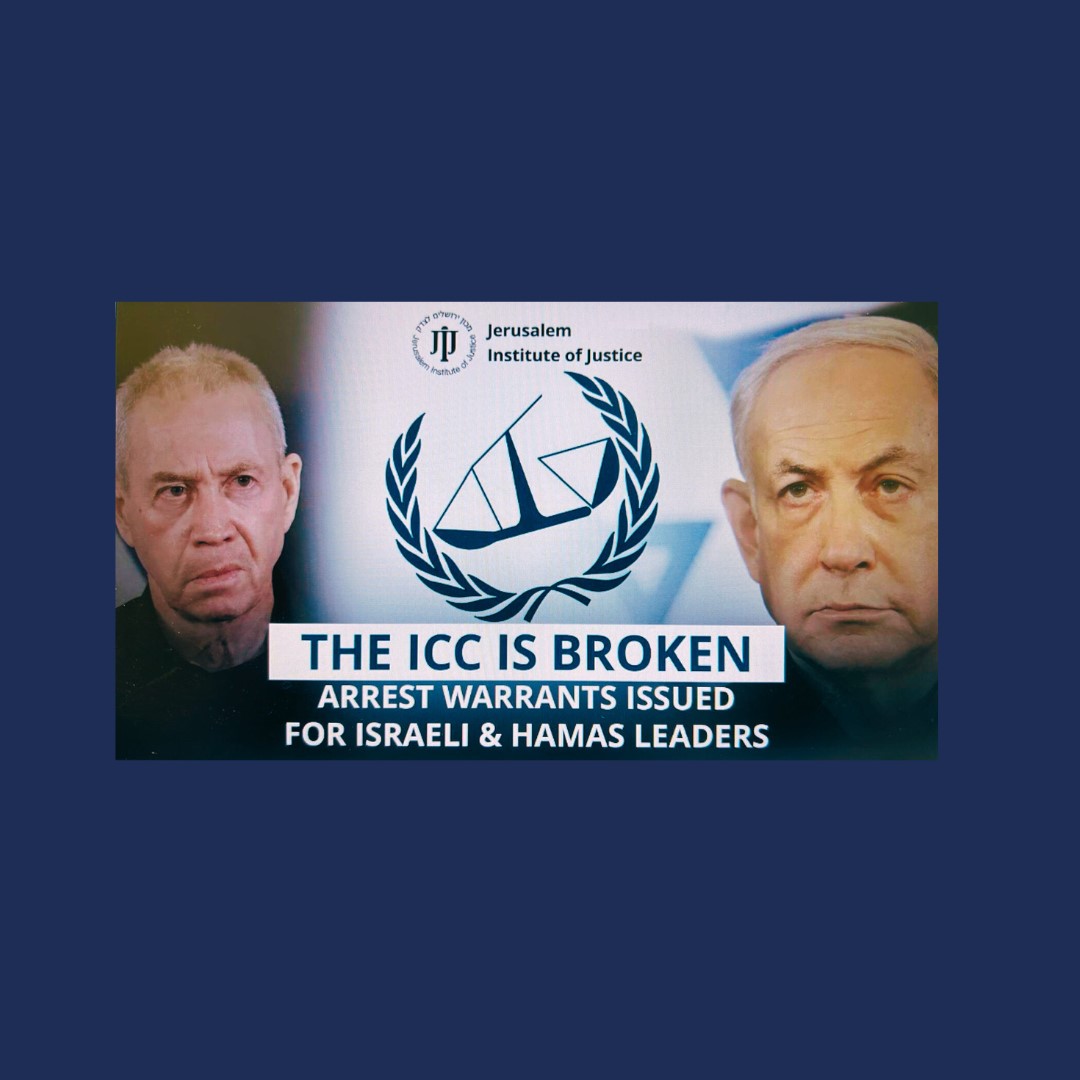
Response to ICC Prosecutor’s Request for Arrest Warrants for Hamas & Israeli Leaders
The Jerusalem Institute of Justice welcomes the ICC Prosecutor’s request for the issuance of
arrest warrants for Hamas’ leaders Yahya Sinwar, Mohamed Deif, and Ismail Haniyeh. We
are disappointed that Hamas’ leaders were not charged with the crime of genocide, despite
constantly expressing their fervent intent to exterminate all Israeli nationals and Jews, and
live streaming the evidence of how they brought this intent to action on October 7th.
We are appalled that the Prosecutor intentionally delayed this maneuver, seeking to pair it
with a request for arrest warrants for Israeli leaders Benjamin Netanyahu and Yoav Gallant.
If the Pre-Trial Chamber approves of this linkage, it will draw a false moral equivalence
between the parties to this conflict.
Since its establishment, the ICC has refrained from pursuing democratically elected officials
whose armies are engaged in wars of self-defense. It is fundamentally reckless to break from
this precedent for the first time when the democratic officials in question are the leaders of
the world’s only Jewish state, and at a time of rising global antisemitism. This development
will only serve to validate the claims of Hamas’ sympathizers across the globe, inspiring
more frequent and more violent attacks on Jewish people across the Diaspora.
The State of Israel has demonstrated that it is able and willing to investigate its own soldiers
and officials for any alleged violations of international law, including international
humanitarian law. Consequently, and in accordance with the principle of complementarity,
one of the most basic principles of the ICC, the Court should refrain from interfering.
The Prosecutor’s case against Israel rests on charges of “starvation” in seeming ignorance of
the fact that unprecedented levels of aid have entered Gaza since October 7th, including
400,000 tons of donated food.
Jerusalem Institute of Justice has sought the arrest of Hamas’ leaders through repeated
requests to the ICC’s Office of the Prosecutor since 2017, highlighting their systematic use of
torture, indoctrination of children, recruitment of child soldiers, and the abuse of civilians as
human shields. If they had been arrested for those crimes years ago, perhaps October 7th
never would have happened.
Despite today’s disappointing developments, we remain committed to pursuing justice for the
survivors and victims of Hamas’ atrocities, including through continued engagement with the
Office of the Prosecutor.
Effects and impacts on the latest UN Human Rights Council resolution
Two weeks ago, the United Nations Human Rights Council (UNHRC) adopted the resolution A/HRC/55/L.30, marking the first official position of the top UN human rights body on the war that started on October 7 atrocities. With a historical background of struggles against Israel by the Council, what does this resolution in particular say and omit? What are the direct effects and impacts on the Jewish State? Let's go deep in.
The UNHRC is the principal intergovernmental body responsible for the promotion and protection of human rights. Since its creation in 2006, the Council has worked to address and take action on human rights violations around the globe. It is composed of 47 member States who are elected by the UN General Assembly for three-year terms. Even though the UNHRC mission is relevant and necessary with the vast number of gory conflicts in the world, its exclusive 'preference' with Israel calls into question the Council's prestige and reputation.
In 2007, when the UNHRC's members were discussing the working methods of the body, they determined that Israel would be the only country whose human rights record is examined under a special agenda item (No. 7), while all other countries’ records are examined in the general debate. From the beginning of its activities, Israel has been by far the biggest target of the Council's resolutions, with 104[1] condemnatory resolutions. Next on the list is Syria with 43, North Korea with 16, and Iran with 14. Not enough, it adopted zero resolutions on gross human rights abuses perpetrated in countries like Saudi Arabia, China, Turkey or Zimbabwe. The open bias of the Council was once again proven during its previous session, which concluded on October 13, when it failed to condemn the terror attacks carried out by Hamas.
The recently approved resolution was brought forward by Pakistan on behalf of the members of the Organization of Islamic Cooperation in the 55th Regular Session of the UNHRC. It calls upon all States to cease the sale, transfer, and diversion of arms to Israel and calls all States to ensure that the United Nations Relief and Works Agency for Palestine Refugees in the Near East (UNRWA) receives predictable, sustained, and sufficient funding, and calls for an immediate ceasefire in Gaza. It was approved by 28 state members, with 13 abstentions, and only 6 countries rejected the resolution, including Argentina, Germany, and the United States.
From a long list of questionable condemnations of Israel that are part of the document, two of them draw attention. First, the call for an arms embargo certainly puts into question Israel's right to self-defense, as it is an explicit attempt to influence the Israel Defense Forces' capacity. This request not only publicly benefits Hamas but also tries to affect the balance of power in the Middle East and the bilateral economic and military relations of Israel. Once an arms embargo is put in place, it can affect major agreements and alliances that are fundamental for Israel's defense against Hamas and other enemies in the region, primarily Iran.
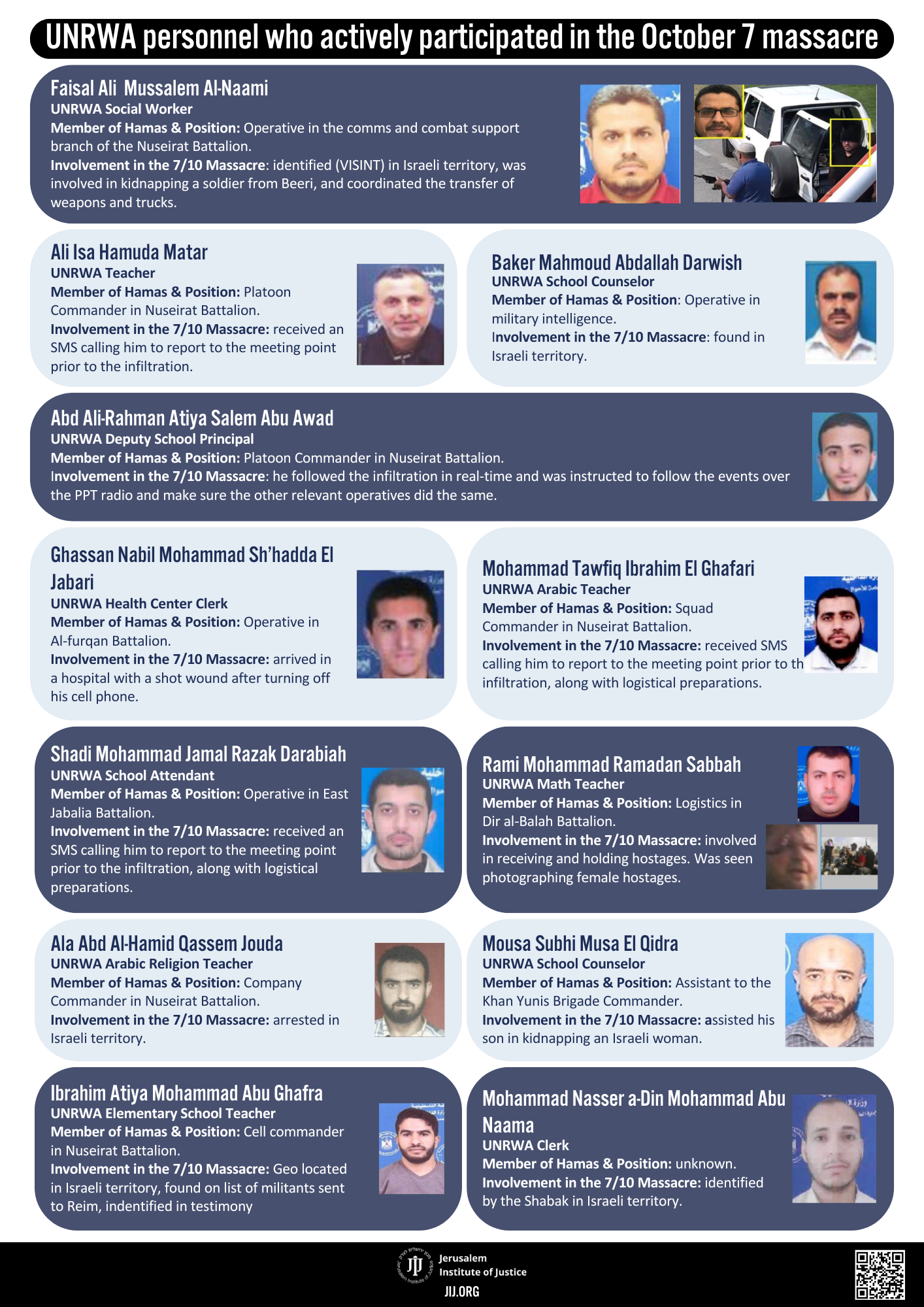
Secondly, it endorses UNRWA and urges its continued funding, despite all evidence[2] that their employees participated in the October 7 massacres and that Hamas has completely infiltrated UNRWA’s staff and exploited its facilities for terrorist purposes. Thus, an open call for the continuity of this agency is a clear message that the UNHRC is blinded about the structural failure of UNRWA, putting at risk both Israelis and Palestinian lives.
As the 'guardian' of global human rights protection, the Council drastically failed (once again) when it didn't comment on the October 7 atrocities committed by Hamas, marked as the darkest day of the Jewish People since the Holocaust with 1,200 murdered. The resolution refuses to describe Hamas’s atrocities for genocidal threats against Israeli civilians, including mass rape and sexual violence against women, or torture and sexual violence against hostages in Gaza, which is still ongoing and has already gone public.[3] Additionally, the resolution is very slight when referring to the remaining 133 hostages taken by Hamas, dedicating 2 sentences from the 8-page document to it.
Approved on the eve of the mark of 180 days of war, the text is clearly one-sided against Israel, as Hamas is not even mentioned once. Meirav Eilon Shahar, Israel’s ambassador to the UN in Geneva, accused the UNHRC of having “long abandoned the Israeli people and long defended Hamas." This resolution is a moral stain on the Council, as it fails to acknowledge Hamas' responsibilities and undermines Israel’s right to self-defense.
Does the A/HRC/55/L.30 resolution have feasible implications? Amid its possible effects and impacts, it can strengthen the political pressure of the international community on Israel or even influence the diplomatic relations with the countries who took an active part in the resolution. But its most visible effect is the symbolic value of the Council's condemnation, although it isn't the first UN institution to state on the current Israel-Gaza War[4][5][6]. The main question is if the resolution will lead the countries to join the arms embargo. Until now, Canada[7] and The Netherlands[8] have announced their intention to halt the sales of weapons to Israel, nevertheless it looks challenging that this international pressure will speak louder than the nation's military interests.
The UNHRC's recent resolution seems to have a low direct impact on Israel, but it turns on another yellow light about further implications. Yet, this resolution not only disclaims Hamas' responsibility for the horrific atrocities it committed but also denies what happened on October 7 and doesn't call in a clear and forceful way for the immediate return of the 133 hostages taken in captivity in inhuman conditions.
Moreover, in the side-event[9] promoted by the Jerusalem Institute of Justice during the 55th regular session of the UNHRC, Dr Sigall Horovitz precisely cleared out: "The Israeli-Palestinian Conflict has reached the bottom of the pit, we are in the heart of darkness. Do we want to stay there? Or do we want to finally address the causes of the violence? Without it, we will never be safe from atrocities".
Article by: Ionatan Gottfried
[1] UN Watch Database. https://unwatch.org/database/
[2] Israel reveals 12 UNRWA staffers it says took part in Oct. 7, says 30 more assisted. (2024, February 16). The Times of Israel. https://www.timesofisrael.com/israel-reveals-12-unrwa-staffers-it-says-took-part-in-oct-7-says-30-more-assisted/
[3] Israeli hostage says she was sexually assaulted and tortured in Gaza. (2024, March 26). The New York Times. https://www.nytimes.com/2024/03/26/world/middleeast/hamas-hostage-sexual-assault.html
[4] U.N. Security Council passes resolution demanding immediate Hamas-Israel war cease-fire, release of hostages. (2024, March 25). CBS News. https://www.cbsnews.com/news/israel-hamas-war-cease-fire-gaza-un-security-council-resolution-ramadan/
[5] General Assembly Adopts Resolution Demanding Immediate Humanitarian Ceasefire in Gaza, Parties’ Compliance with International Law, Release of All Hostages | Meetings Coverage and Press Releases. (2023, December 12). https://press.un.org/en/2023/ga12572.doc.htm
[6] Order of 26 January 2024 | INTERNATIONAL COURT OF JUSTICE. https://www.icj-cij.org/node/203447
[7] Lazaroff, B. T. (2024, March 20). Canada to stop arms sale to Israel, FM Joly says. The Jerusalem Post | JPost.com. https://www.jpost.com/breaking-news/article-792782
[8] Reuters, B. (2024, February 12). Dutch court orders halt to export of F-35 jet parts to Israel. The Jerusalem Post | JPost.com. https://www.jpost.com/breaking-news/article-786463
[9] Jerusalem Institute of Justice (2024, March 28). Preventing Genocide: Legal Perspectives on Oct. 7th [Video]. YouTube. https://www.youtube.com/watch?v=82TPJzTPXHM
Effects and impacts on the latest UN Human Rights Council resolution
Two weeks ago, the United Nations Human Rights Council (UNHRC) adopted the resolution A/HRC/55/L.30, marking the first official position of the top UN human rights body on the war that started on October 7 atrocities. With a historical background of struggles against Israel by the Council, what does this resolution in particular say and omit? What are the direct effects and impacts on the Jewish State? Let's go deep in.
The UNHRC is the principal intergovernmental body responsible for the promotion and protection of human rights. Since its creation in 2006, the Council has worked to address and take action on human rights violations around the globe. It is composed of 47 member States who are elected by the UN General Assembly for three-year terms. Even though the UNHRC mission is relevant and necessary with the vast number of gory conflicts in the world, its exclusive 'preference' with Israel calls into question the Council's prestige and reputation.
In 2007, when the UNHRC's members were discussing the working methods of the body, they determined that Israel would be the only country whose human rights record is examined under a special agenda item (No. 7), while all other countries’ records are examined in the general debate. From the beginning of its activities, Israel has been by far the biggest target of the Council's resolutions, with 104[1] condemnatory resolutions. Next on the list is Syria with 43, North Korea with 16, and Iran with 14. Not enough, it adopted zero resolutions on gross human rights abuses perpetrated in countries like Saudi Arabia, China, Turkey or Zimbabwe. The open bias of the Council was once again proven during its previous session, which concluded on October 13, when it failed to condemn the terror attacks carried out by Hamas.
The recently approved resolution was brought forward by Pakistan on behalf of the members of the Organization of Islamic Cooperation in the 55th Regular Session of the UNHRC. It calls upon all States to cease the sale, transfer, and diversion of arms to Israel and calls all States to ensure that the United Nations Relief and Works Agency for Palestine Refugees in the Near East (UNRWA) receives predictable, sustained, and sufficient funding, and calls for an immediate ceasefire in Gaza. It was approved by 28 state members, with 13 abstentions, and only 6 countries rejected the resolution, including Argentina, Germany, and the United States.
From a long list of questionable condemnations of Israel that are part of the document, two of them draw attention. First, the call for an arms embargo certainly puts into question Israel's right to self-defense, as it is an explicit attempt to influence the Israel Defense Forces' capacity. This request not only publicly benefits Hamas but also tries to affect the balance of power in the Middle East and the bilateral economic and military relations of Israel. Once an arms embargo is put in place, it can affect major agreements and alliances that are fundamental for Israel's defense against Hamas and other enemies in the region, primarily Iran.
Secondly, it endorses UNRWA and urges its continued funding, despite all evidence[2] that their employees participated in the October 7 massacres and that Hamas has completely infiltrated UNRWA’s staff and exploited its facilities for terrorist purposes. Thus, an open call for the continuity of this agency is a clear message that the UNHRC is blinded about the structural failure of UNRWA, putting at risk both Israelis and Palestinian lives.
As the 'guardian' of global human rights protection, the Council drastically failed (once again) when it didn't comment on the October 7 atrocities committed by Hamas, marked as the darkest day of the Jewish People since the Holocaust with 1,200 murdered. The resolution refuses to describe Hamas’s atrocities for genocidal threats against Israeli civilians, including mass rape and sexual violence against women, or torture and sexual violence against hostages in Gaza, which is still ongoing and has already gone public.[3] Additionally, the resolution is very slight when referring to the remaining 133 hostages taken by Hamas, dedicating 2 sentences from the 8-page document to it.
Approved on the eve of the mark of 180 days of war, the text is clearly one-sided against Israel, as Hamas is not even mentioned once. Meirav Eilon Shahar, Israel’s ambassador to the UN in Geneva, accused the UNHRC of having “long abandoned the Israeli people and long defended Hamas." This resolution is a moral stain on the Council, as it fails to acknowledge Hamas' responsibilities and undermines Israel’s right to self-defense.
Does the A/HRC/55/L.30 resolution have feasible implications? Amid its possible effects and impacts, it can strengthen the political pressure of the international community on Israel or even influence the diplomatic relations with the countries who took an active part in the resolution. But its most visible effect is the symbolic value of the Council's condemnation, although it isn't the first UN institution to state on the current Israel-Gaza War[4][5][6]. The main question is if the resolution will lead the countries to join the arms embargo. Until now, Canada[7] and The Netherlands[8] have announced their intention to halt the sales of weapons to Israel, nevertheless it looks challenging that this international pressure will speak louder than the nation's military interests.
The UNHRC's recent resolution seems to have a low direct impact on Israel, but it turns on another yellow light about further implications. Yet, this resolution not only disclaims Hamas' responsibility for the horrific atrocities it committed but also denies what happened on October 7 and doesn't call in a clear and forceful way for the immediate return of the 133 hostages taken in captivity in inhuman conditions.
Moreover, in the side-event[9] promoted by the Jerusalem Institute of Justice during the 55th regular session of the UNHRC, Dr Sigall Horovitz precisely cleared out: "The Israeli-Palestinian Conflict has reached the bottom of the pit, we are in the heart of darkness. Do we want to stay there? Or do we want to finally address the causes of the violence? Without it, we will never be safe from atrocities".
Article by: Ionatan Gottfried
[1] UN Watch Database. https://unwatch.org/database/
[2] Israel reveals 12 UNRWA staffers it says took part in Oct. 7, says 30 more assisted. (2024, February 16). The Times of Israel. https://www.timesofisrael.com/israel-reveals-12-unrwa-staffers-it-says-took-part-in-oct-7-says-30-more-assisted/
[3] Israeli hostage says she was sexually assaulted and tortured in Gaza. (2024, March 26). The New York Times. https://www.nytimes.com/2024/03/26/world/middleeast/hamas-hostage-sexual-assault.html
[4] U.N. Security Council passes resolution demanding immediate Hamas-Israel war cease-fire, release of hostages. (2024, March 25). CBS News. https://www.cbsnews.com/news/israel-hamas-war-cease-fire-gaza-un-security-council-resolution-ramadan/
[5] General Assembly Adopts Resolution Demanding Immediate Humanitarian Ceasefire in Gaza, Parties’ Compliance with International Law, Release of All Hostages | Meetings Coverage and Press Releases. (2023, December 12). https://press.un.org/en/2023/ga12572.doc.htm
[6] Order of 26 January 2024 | INTERNATIONAL COURT OF JUSTICE. https://www.icj-cij.org/node/203447
[7] Lazaroff, B. T. (2024, March 20). Canada to stop arms sale to Israel, FM Joly says. The Jerusalem Post | JPost.com. https://www.jpost.com/breaking-news/article-792782
[8] Reuters, B. (2024, February 12). Dutch court orders halt to export of F-35 jet parts to Israel. The Jerusalem Post | JPost.com. https://www.jpost.com/breaking-news/article-786463
[9] Jerusalem Institute of Justice (2024, March 28). Preventing Genocide: Legal Perspectives on Oct. 7th [Video]. YouTube. https://www.youtube.com/watch?v=82TPJzTPXHM
Responding to the ICC - New Reports
Watch the following interviews of JIJ's team
Interview with JIJ Director of US Policy & Diplomacy, Monique Beadle on i24 News.
Interview with JIJ Human Rights Lawyer, Carolina Gimberg on Kan En Espanol.
Interview with JIJ Attorney, Uri Morad on Radio 103FM.
Interview with JIJ Attorney, Uri Morad on Radio Kan Moreshet
UNRWA in Numbers
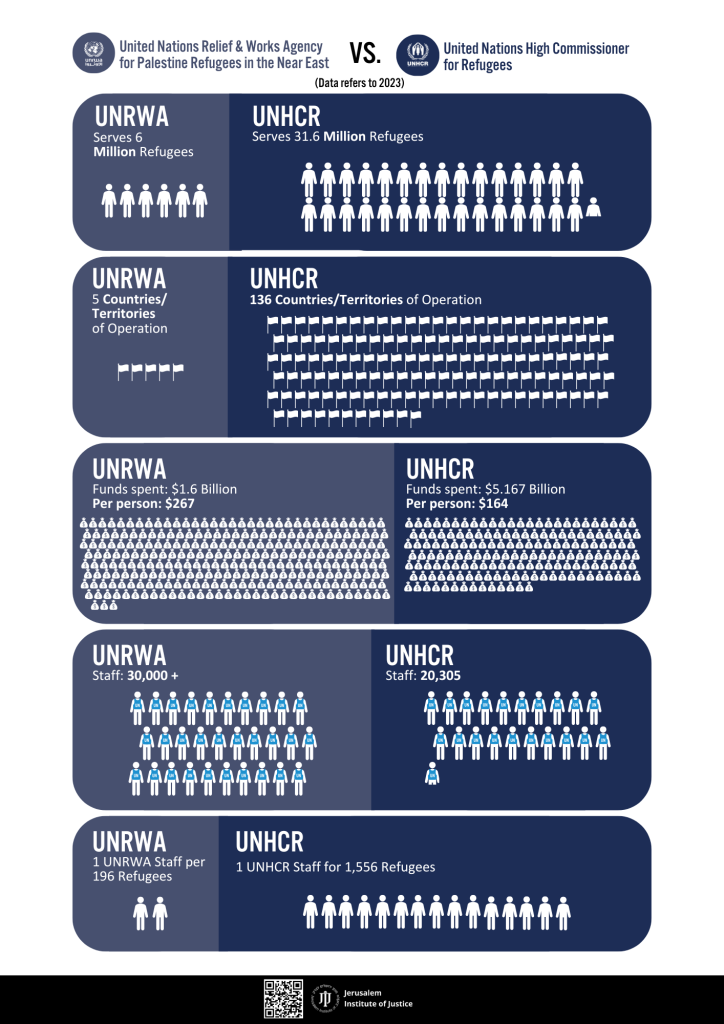
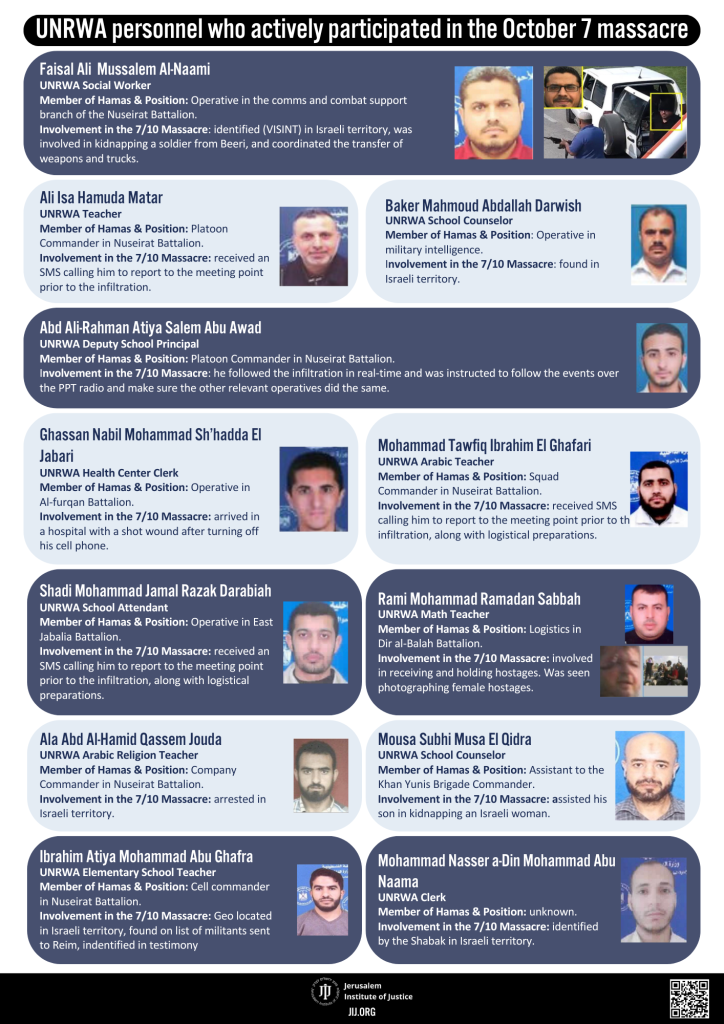
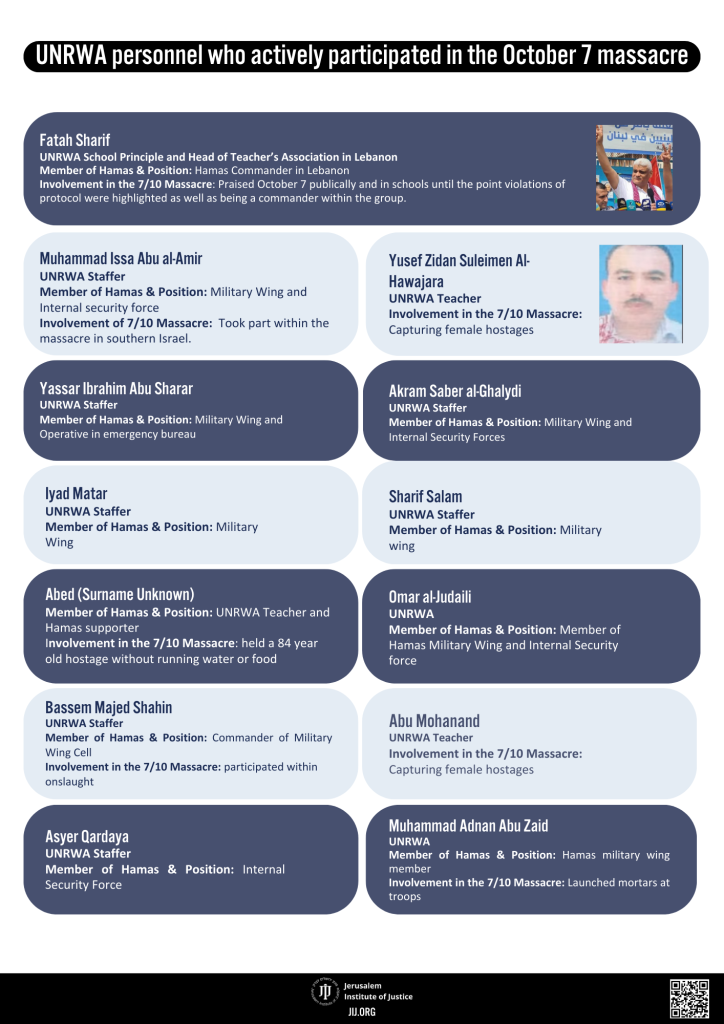
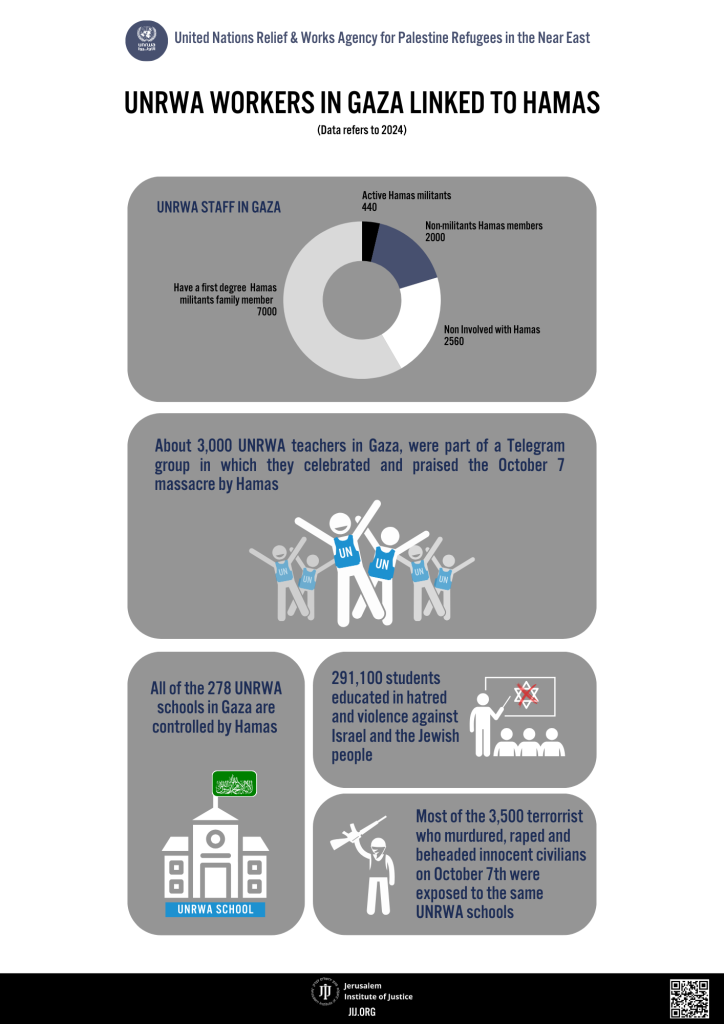
Download
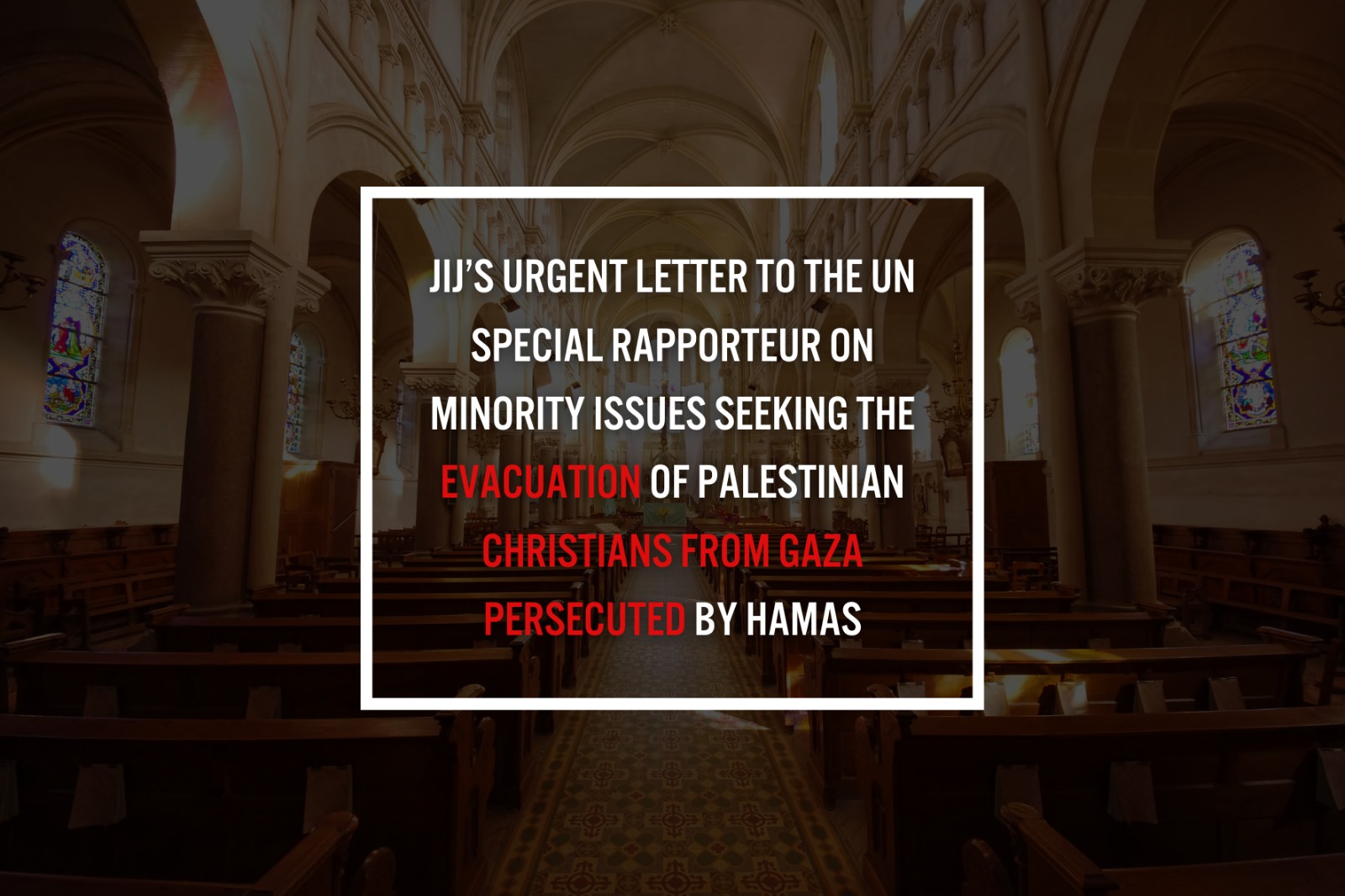
Christians from Gaza specifically threatened by Hamas
Letter to the UN Special Rapporteur on minority issues
To: Prof. Nicolas Levrat Date: November 21, 2023
UN Special Rapporteur on minority issues
8-14 Avenue de la Paix 1211 Genève 10, Switzerland
Dear Mr. Levrat,
We are writing to express our deep concern about the extremely dangerous situation of the Christian Palestinians in northern Gaza. Specifically, we urgently request your intervention to safeguard the rights and well-being of innocent individuals belonging to this minority group by facilitating their immediate evacuation to a safe haven.
The conditions of violence, segregation, and exclusion of this minority group in Gaza are not new. In 2022, the Palestinian Center for Policy and Survey Research conducted a public opinion poll among Palestinian Christians in the West Bank and the Gaza Strip. The report of the survey shows that an overwhelming majority of 69% are worried about the presence of armed Palestinian factions such as Hamas. Additionally, two-thirds said they are worried about the fact that the Palestinian Basic Law refers to the principles of the Islamic Sharia as a main source of legislation and are concerned about the rise of political Islam as represented by Hamas, Islamic Jihad, al Tahrir Party, as well as extreme and conservatives in the Palestinian society.
Amidst the ongoing Israel-Gaza conflict, reports indicate that approximately 590 Christians are seeking shelter in the Catholic Church under the Latin Patriarchate in Gaza City, around 350 are taking refuge in the Greek Orthodox church, and an additional 53 are sheltering in private houses. These 1,000 Christian Palestinians have no safe haven in Gaza.
While the Israeli Defense Forces' policy urges Palestinians in and around Gaza City to seek refuge in southern Gaza in the next two days for safety and access to essential resources, this call does not ensure the safety of this particular minority group.
Palestinian Christians fear for their lives if they relocate to southern Gaza. They believe that leaving the historic church buildings, their current safe havens in and around Gaza City, and relocating to the south would expose them to potential genocide. They are regarded as pagans, heathens, and idol-worshippers by Hamas, the Palestinian Islamic Jihad, and all Islamist terror organizations governing Gaza.
They anticipate no mercy in the south, expecting Islamist extremists to perpetrate atrocities, including mutilation, torture, rape, and burning alive. Under your mandate as the Special Rapporteur on minority issues, it is imperative to take immediate and decisive action by closely collaborating with the International Committee of the Red Cross. We urge the prompt evacuation of the 1,000 Christian Palestinians sheltered in Gaza City to a safe haven while providing them with the essential resources they need to survive, such as access to food, clean water, and medical care.
The International Committee of the Red Cross, a neutral entity established to safeguard and aid victims of armed conflicts and uphold International Humanitarian Law, operates effectively in Gaza. Its mission aligns with the Special Rapporteur's mandate to overcome existing obstacles to the full and effective realization of the rights of persons belonging to minorities in armed conflicts.
Sincerely,
Flavia Sevald Adv. Uri Morad, Director of the International
Chief Executive Officer Law & Public Diplomacy Department
CC: Mirjana Spoljaric Egger, President of the International Committee of the Red Cross.
William Schomburg, Head of Sub-Delegation for the International Committee of the Red
Cross (ICRC) in Gaza