
Everything you should know about the Israel Judicial Reform
Israel’s proposed judicial reform has sparked significant societal controversy, revealing the ongoing tension between the Executive and Judiciary branches. Supporters of the reform argue that it will enhance democracy in Israel. At the same time, opponents fear that it will undermine the democratic principles of checks and balances, granting too much power to the Executive branch and potentially endangering minority and human rights. The debate over the reform has created a deep divide within Israeli society.
In this lecture and the attached report, we explore the four components of the proposed reform, give you an overview of the current situation, and explain what changes the reform would like to bring about. We also examine the arguments presented by supporters and opponents of the reform.
https://www.youtube.com/watch?v=ZT129G9vgn0&t=29s

An Examination of Israel's Judicial Reform
Israel's proposed judicial reform has sparked significant societal controversy, revealing the ongoing tension between the Executive and Judiciary branches. Supporters of the reform argue that it will enhance democracy in Israel. At the same time, opponents fear that it will undermine the democratic principles of checks and balances, granting too much power to the Executive branch and potentially endangering minority and human rights. The debate over the reform has created a deep divide within Israeli society.
In the attached report, we explore the four components of the proposed reform, give you an overview of the current situation, and explain what changes the reform would like to bring about. We will also examine the arguments presented by supporters and opponents of the reform.
Examining the Israeli Judicial Reform
https://www.youtube.com/watch?v=ZT129G9vgn0
Israel's proposed judicial reform has sparked significant controversy within society, revealing the ongoing tension between the Executive and Judiciary branches. Supporters of the reform argue that it will enhance democracy in Israel, while opponents fear that it will undermine the democratic principles of checks and balances, granting too much power to the Executive branch and potentially endangering minority rights and human rights. The debate over the reform has created a deep divide within Israeli society. In this lecture, we explore the four components of the proposed reform, provide an overview of the current situation, and explain what changes the reform seeks to bring about. We will also examine the arguments presented by both supporters and opponents of the reform.
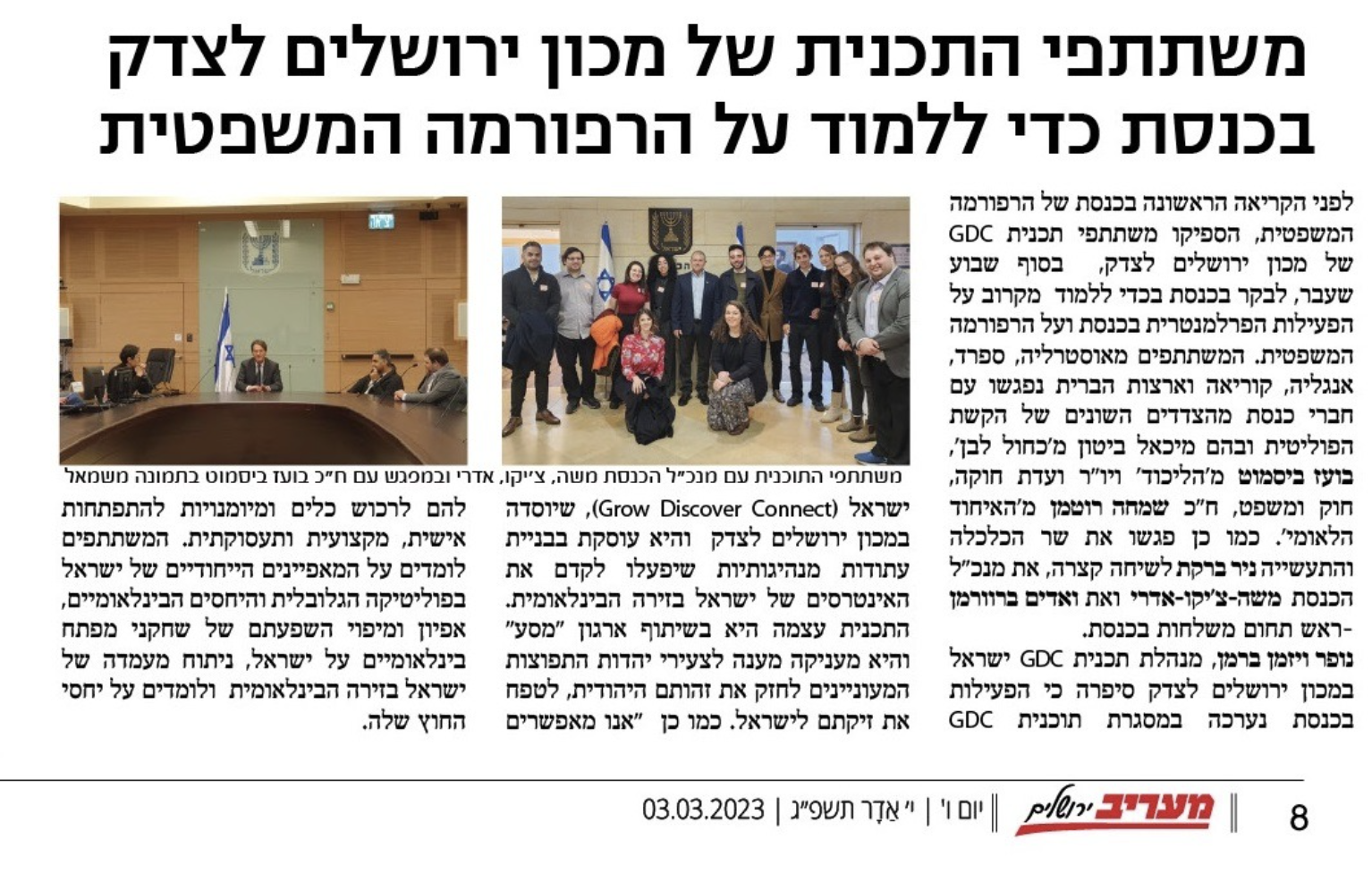
JIJs Grow, Discover, Connect Israel Program in the Local News
The Grow, Discover, Connect (GDC) program at the Jerusalem Institute for Justice (JIJ) attracts interns from around the world who are eager to learn about Israel's unique global political and international relations characteristics, as well as to develop their personal and professional skills.
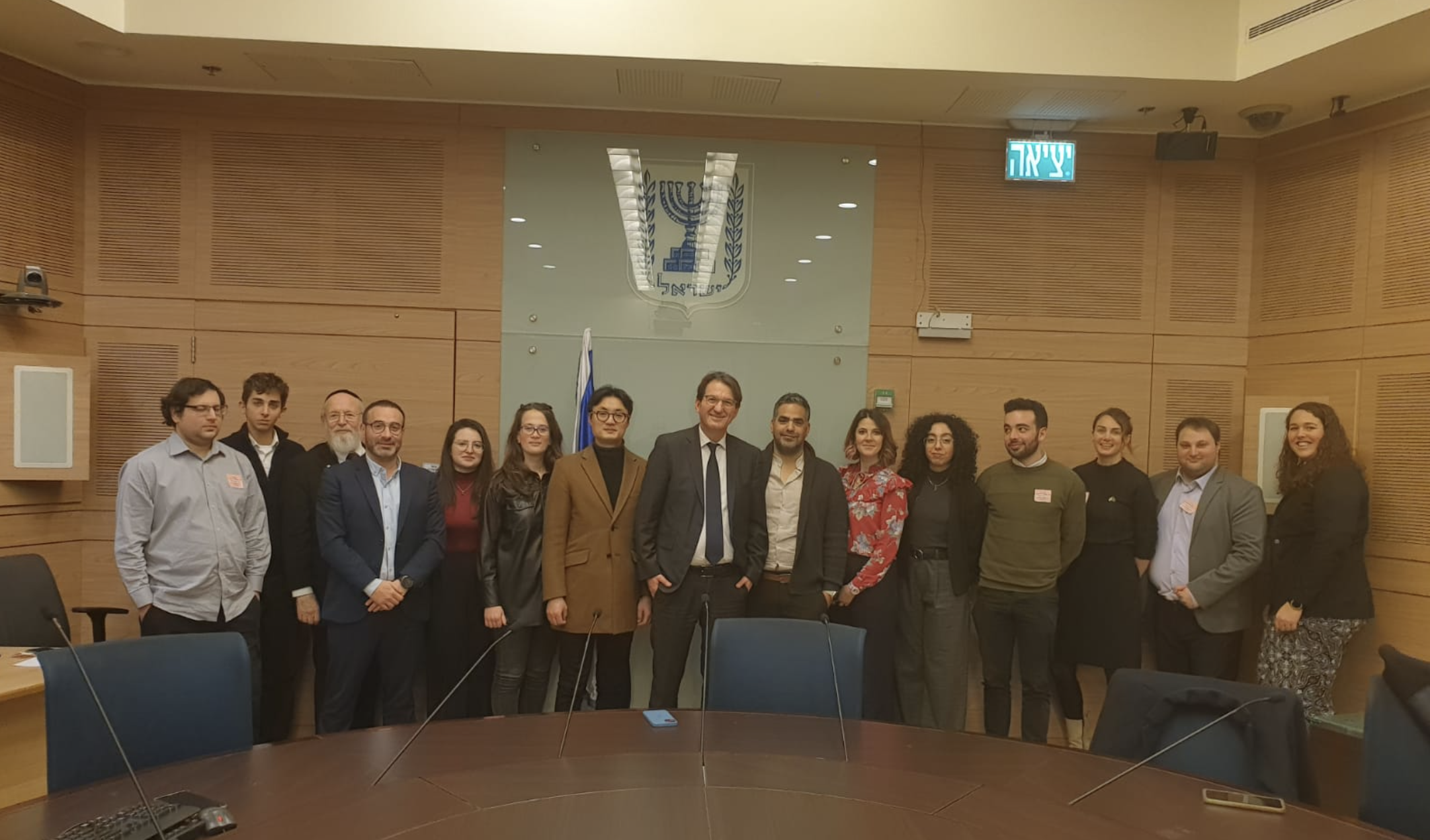
The participants visited the Knesset, Israel's parliament, during the program to learn about the proposed judicial reform before its first reading. The group included individuals from Australia, England, Korea, Spain, and the United States.
The interns had the opportunity to meet with members of the Knesset from various political affiliations, including Michael Bitton, Boaz Bismuth, and MK Simcha Rothman, as well as Nir Barkat, Moshe (Chico) Edri, and Vadim Braverman. They were able to ask questions and gain valuable insight into the political system in Israel, the legal reform, and its potential ramifications.
The GDC Israel program aims to develop future leaders and educate them. They join the Jerusalem Institute for Justice's mission to advocate for human rights, protect the rule of law, freedom of conscience, and democracy. Additionally, the participants actively participate in JIJ's efforts to defend Israel's standing and create a balanced image in media discourse while fighting against antisemitism and delegitimization towards Israel.
Overall, the visit to the Knesset was a valuable experience for the interns, who gained a newfound appreciation for Israel’s democracy and a deeper understanding of the country's challenges and how to address them.
See photos of their visit below! If you want to learn more about our GDC Israel program, click here.
JIJs Grow, Discover, Connect Israel Program in the Local News
The Grow, Discover, Connect (GDC) program at the Jerusalem Institute for Justice (JIJ) attracts interns from around the world who are eager to learn about Israel's unique global political and international relations characteristics, as well as to develop their personal and professional skills.
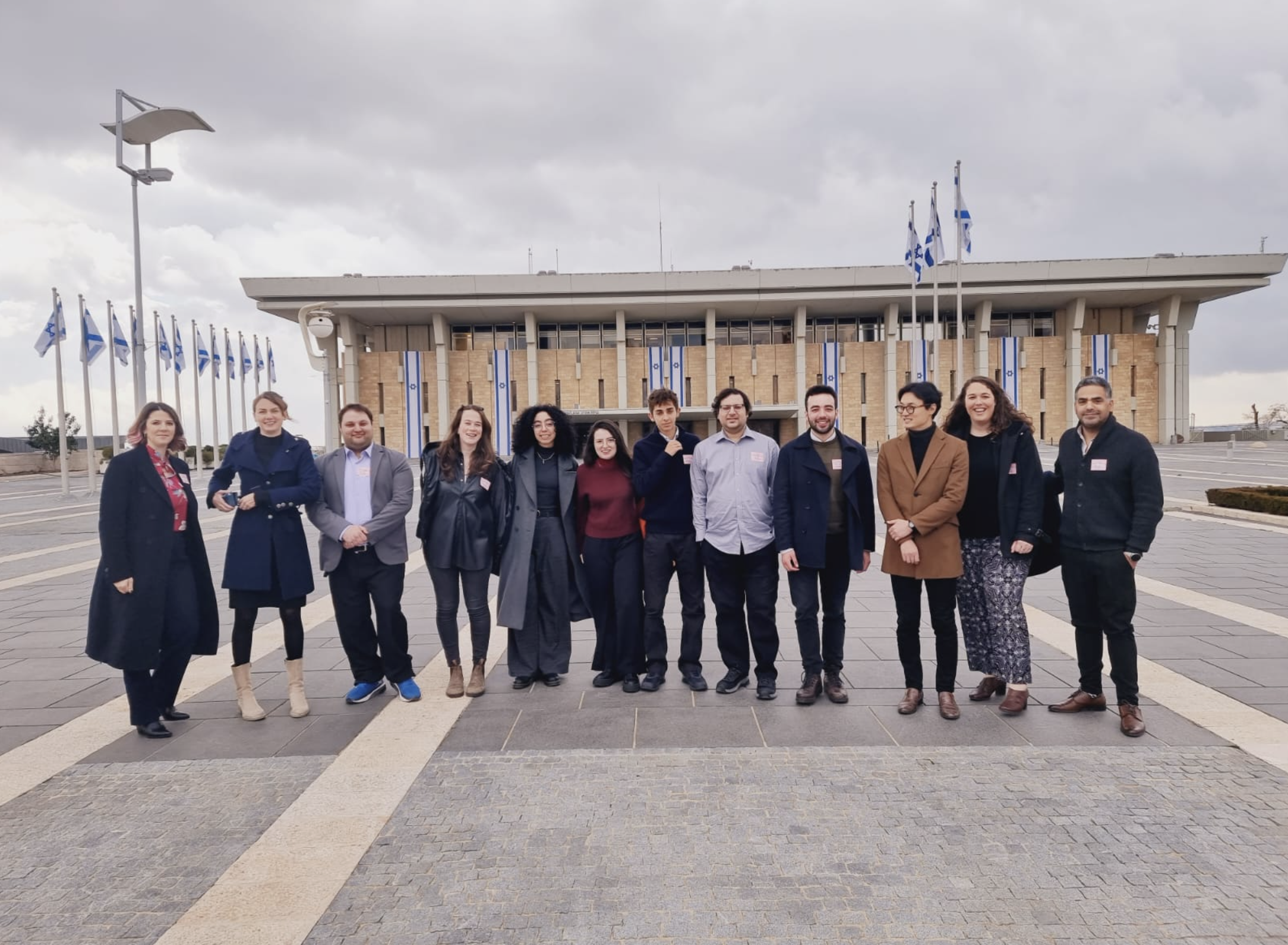
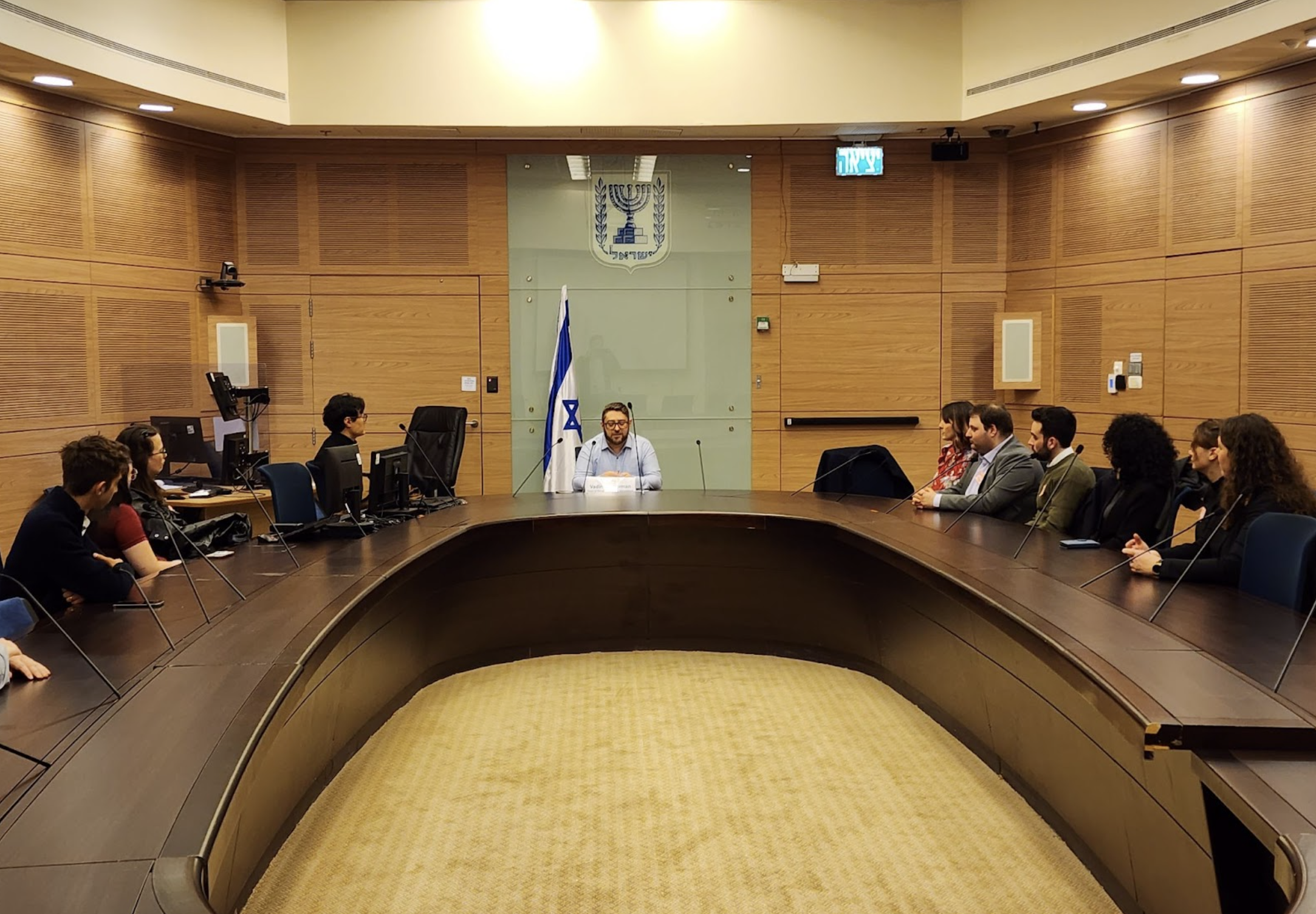
The participants visited the Knesset, Israel's parliament, during the program to learn about the proposed judicial reform before its first reading. The group included individuals from Australia, England, Korea, Spain, and the United States.
The interns had the opportunity to meet with members of the Knesset from various political affiliations, including Michael Bitton, Boaz Bismuth, and MK Simcha Rothman, as well as Nir Barkat, Moshe (Chico) Edri, and Vadim Braverman. They were able to ask questions and gain valuable insight into the political system in Israel, the legal reform, and its potential ramifications.
The GDC Israel program aims to develop future leaders and educate them. They join the Jerusalem Institute for Justice's mission to advocate for human rights, protect the rule of law, freedom of conscience, and democracy. Additionally, the participants actively participate in JIJ's efforts to defend Israel's standing and create a balanced image in media discourse while fighting against antisemitism and delegitimization towards Israel.
Overall, the visit to the Knesset was a valuable experience for the interns, who gained a newfound appreciation for Israel’s democracy and a deeper understanding of the country's challenges and how to address them.
See photos of their visit below! If you want to learn more about our GDC Israel program, click here.
Not Apartheid
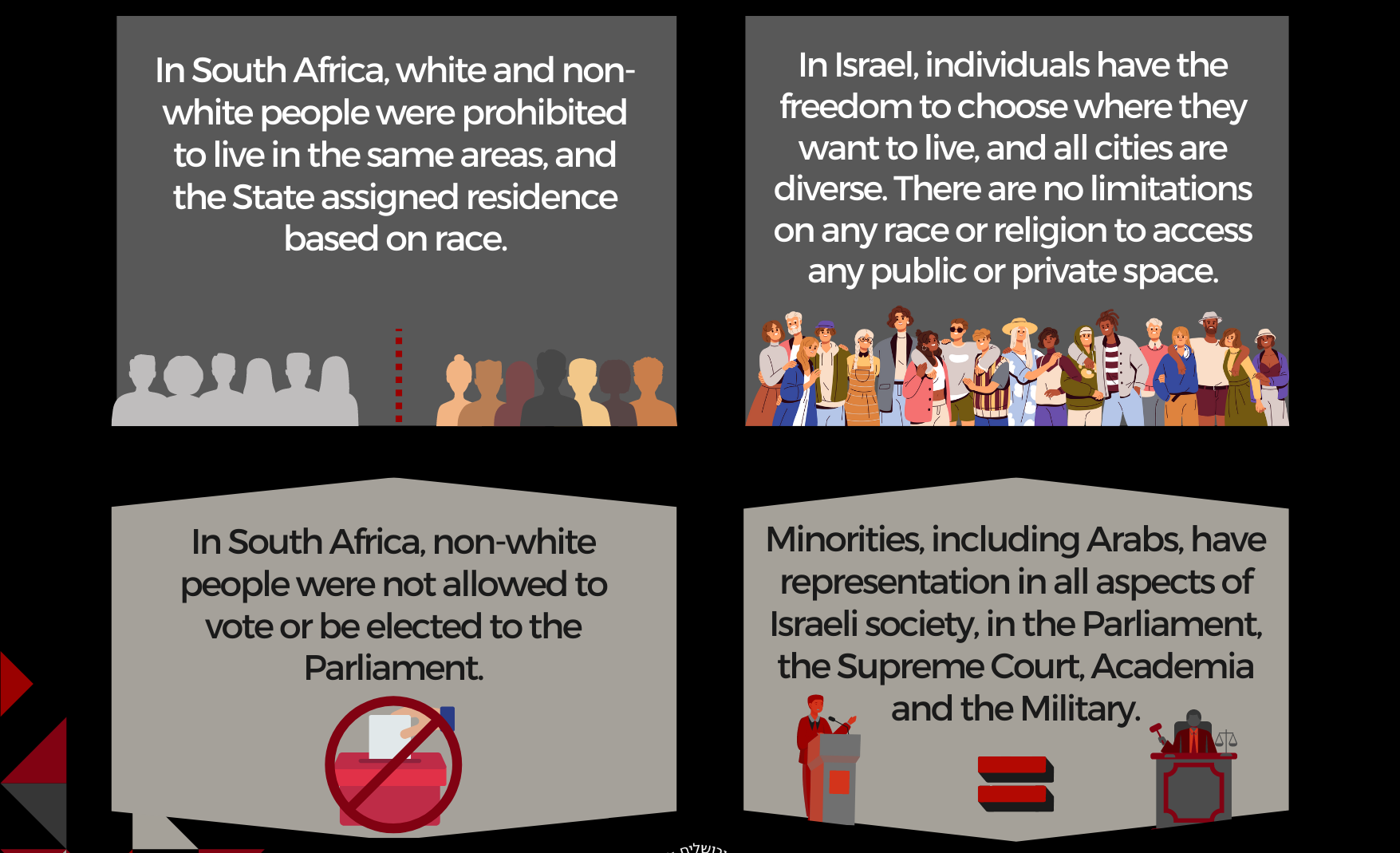
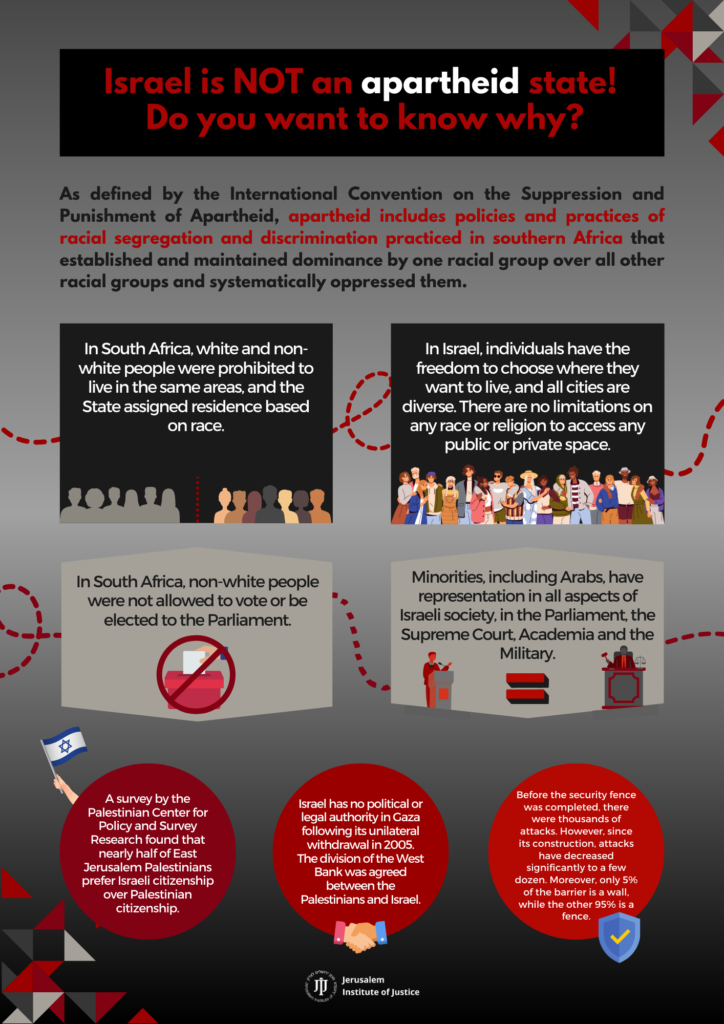
As defined by the International Convention on the Suppression and Punishment of Apartheid, apartheid includes policies and practices of racial segregation and discrimination practiced in southern Africa that established and maintained dominance by one racial group over all other racial groups and systematically oppressed them.
Download
Statement for the 67th Session of the Commission on the Status of Women
On this International Women's Day, we are proud to share an important discussion taking place today at the United Nations Commission on the Status of Women.
For over a decade, the Jerusalem Institute of Justice has worked tirelessly to end the sex trade in Israel. As part of this mission and as a member of the United Nations Economic and Social Council, we have submitted a written statement in support of the Commission's theme of "Innovation and technological change, and education in the digital age for achieving gender equality and the empowerment of all women and girls."
JIJ sees the great potential for innovation to further empower women and supports these developments. We must also acknowledge the risks posed by technological advancements, particularly the rise in prostitution facilitated by social media platforms. We are taking steps to combat this phenomenon through our "Project NOA", which promotes legislative initiatives and societal change.
We take this opportunity to appeal to the UN and nations globally to adopt the Nordic model which involves the decriminalization of prostituted people, the criminalization of purchasers and profiteers of sex, as well as education and support services for survivors. We are encouraged by the success of this model in Israel and are confident in its potential to protect vulnerable women and girls.
Please read JIJ's full statement here. Together, we can lead the fight on behalf of women and achieve true gender equality.
An appeal to the UN for Women's Rights
Article originally published at the Jerusalem post here
“Do not degrade your daughter by making her a prostitute, lest the land fall into prostitution and the land become full of depravity.” Leviticus 19:29
The fight for women's empowerment and equality is ongoing, and as we embrace technological advancements, we must remain vigilant of the risks that women face. The Jerusalem Institute of Justice (JIJ) calls for the United Nations Commission on the Status of Women to adopt the Nordic model in the fight against prostitution, as part of a broader strategy to tackle sex trafficking and prostitution in all its forms.
I am proud to lead an organization that for over 14 years, has been at the forefront of the battle against the sex trade in Israel. Developing policies, educating the public, and collaborating with communities and media platforms to promote the abolition of the sex trade. Our efforts have resulted in the adoption of the Nordic model in Israel, and today we urge the international community to follow suit.
As the 67th Session of the Commission on the Status of Women focuses on innovation and technological change, we must not forget the dangers that these advancements pose to women and girls. Internet prostitution has become a rising threat to their safety. Traffickers are increasingly using social media platforms like Facebook, Instagram, and Tinder as recruiting tools, driving the rise of prostitution. In Israel, Tinder is the most popular tool for finding persons engaged in the purchase and sale of sex.
Prostitution is a system that promotes violence, objectification, and degradation of women and men. The Nordic model fines those guilty of consuming prostitution, and it is classed as a civil offense. The law also provides education and support services to those in the sex trade. Decriminalizing the prostituted person acknowledges that the industry is not freely chosen, and that the prostituted person is the victim of economic and sexual exploitation at the hands of the procurer and buyer of sexual services.
This model's ultimate aim is to abolish the sex industry, and this can only be achieved by criminalizing the buyers of sex, as that will lead to a drastic reduction in demand. However, the evolution of internet prostitution requires governments to develop even more comprehensive strategy-based solutions to protect potential victims from predators. The Prohibition on Consuming Prostitution Act, passed by the Israeli Parliament in December 2018, presents a vision for a holistic approach that focuses not only on prohibiting paying for sex but also on educating the public about the dangers of the sex industry and by providing the opportunity for rehabilitation through governmental funding. The law also offers educational group sessions for the buyers aimed at changing their opinions and curbing recurrent infractions.
The Israeli law offers a blueprint for other countries to follow in the fight against prostitution. The rise of online prostitution through platforms like Onlyfans, which has emerged as the top platform worldwide for creators to sell erotic content, must be stopped. Masked as a social network that sells content and art, Onlyfans is just a simple way for sex to be sold for money on the internet. A third of users advertising explicitly sexual images on Twitter are underage.
The fight for women's rights and dignity is an ongoing battle that requires continuous effort and innovative strategies to overcome the challenges posed by technological advancements. The Jerusalem Institute of Justice's global call for the adoption of the Nordic model in the fight against prostitution and sex trafficking is a step in the right direction. It is time for governments worldwide to take action and work towards abolishing the sex industry and protecting the human rights of all individuals from violence, objectification, and exploitation.
Flavia Sevald, CEO
Jerusalem Institute of Justice

The Cynical Exploitation of Israeli Democracy
In 1990, Nelson Mandela was released from Victor Verster Prison in Cape Town after spending twenty-seven years behind bars. His only crime was that of rebelling against the white minority that subjugated his people by denying them the right to vote, to acquire land and to protest.
Similar regimes of oppression exist today in Iran, which executes political dissidents; in the West Bank, where being homosexual is a criminal offence; and in Saudi Arabia, which practices gender apartheid. As of yet, the international community has failed to put as much pressure on these regimes as it did on Pretoria, partly because it has been preoccupied with turning the nation-state of the Jewish people into a pariah. The United Nations, for example, has passed more resolutions condemning Israel than the other nations of the world combined. It is impossible to consider these figures and not come to the conclusion that the international community’s double-standard against Israel is blatant and morally bankrupt; much worse is that it has been aided in this endeavor by so-called human rights activists within Israel.
About a year ago, two members of the Israeli Knesset — Aida Touma Suleiman and Mossi Raz — hosted an event in parliament titled: “54 years - Between Occupation and Apartheid.” The event, funded by the Israeli taxpayer, quickly descended into an anti-Zionist hate festival, filled with lies about the so-called apartheid system imposed upon Palestinians in the “occupied territories and within Israel.”
Of course, Raz and Suleiman had every right to host the event. In fact, that they were able to host it serves as a testament to the health of Israel’s thriving democracy. Former Israeli Prime Minister Menachem Begin put it most succinctly: “Without an opposition, there can be no democracy; without it, the essence of human liberty is in danger.” But I also reserve the right to express what I think about those who cynically exploit the seat of Israeli democracy as a means of delegitimizing the Jewish state — and it’s not much.
The hypocrisy of the Knesset members, especially Suleiman, an Arab-Israeli representative in the Knesset, is nothing short of astonishing. She does not speak Yiddish and may not be familiar with the term ‘chutzpah’, but her behavior suggests she is full of it. Israel is a vibrant democracy where Arabs benefit from affirmative action policies, teach in Israeli universities and enjoy equal rights to their Jewish counterparts. This includes the right to serve on the Supreme Court, to vote and to elect members to the Knesset; some of whom oppose Israel’s right to exist and denounce her as an apartheid state.
To be sure, what is true of Israel is not necessarily true of the disputed territories. Israel withdrew from Gaza in 2005 and was consequently met with heavy rocket fire from Hamas militants. She maintains control over the West Bank only due to Palestinian rejectionism — that is, the inability of Palestinian leaders to accept a two-state solution that leaves Israel’s existence as a Jewish and democratic state in-tact.
In 2000, Yasser Arafat balked at a generous offer of statehood on 97% of the West Bank, with its capital in Jerusalem and a large compensation package for Palestinian refugees displaced during wars started by Israel’s neighbours. This drew opprobrium even from Arab leaders, including Prince Bandar of Saudi Arabia who described the rejection as “a crime against the Palestinian people, in fact against the entire region.” Likewise, in 2008 Olmert offered the Palestinians a deal which would have granted them sovereignty over even more territory, only to be met with no response from Arafat’s successor, Mahmoud Abbas.
Had these offers been accepted, there would be no roads restricted to Israelis or civilian settlements in the West Bank; the so-called accoutrement of Israeli apartheid. These policies are controversial, if not disagreeable. But to wage the ‘apartheid’ libel against Israel’s settlement enterprise and security precautions in the disputed territories — those which exist only due to Palestinian intransigence — is to egregiously misuse the term and minimize the horrors of the actual anti-apartheid struggles that took place in South Africa. One of the most celebrated proponents of this struggle — Martin Luther King Jr — once venerated Israel as “one of the great outposts of democracy in the world.” He would be dismayed with Suleiman exploiting his life mission to support her anti-Israel bigotry.
by Joe Beare, JIJ Intern
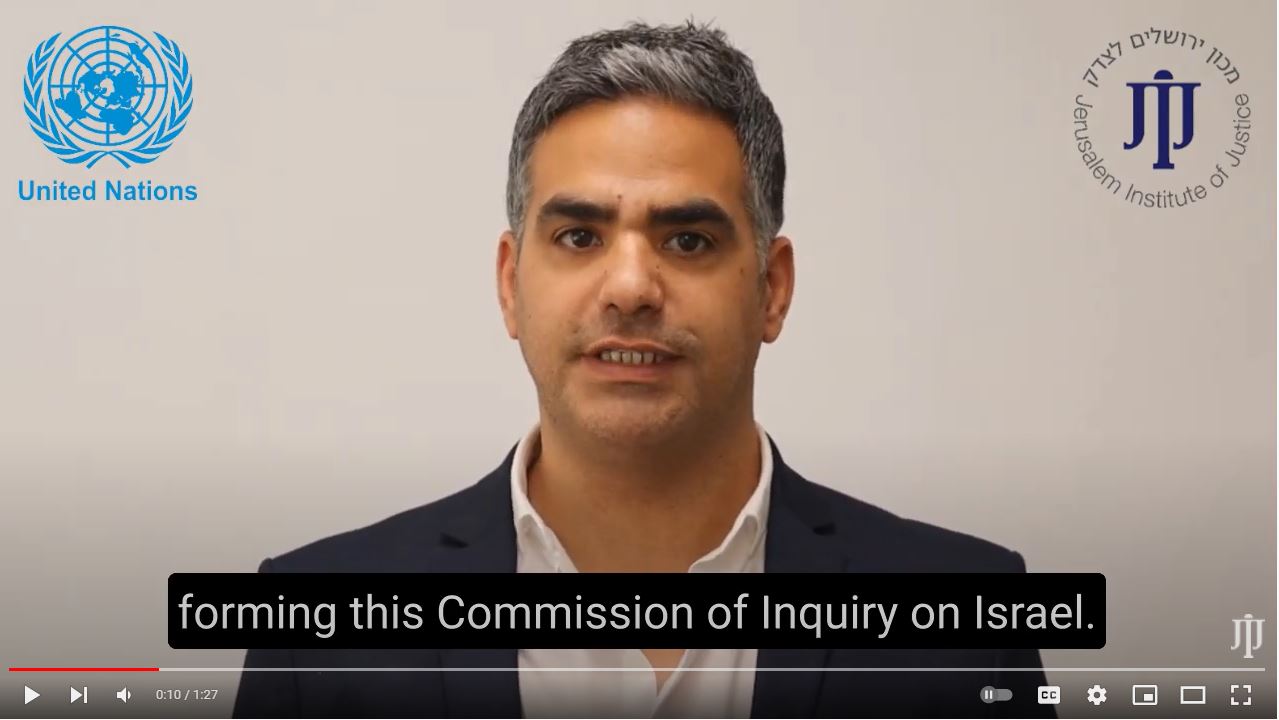
JIJ's oral statement at the 50th session of the UNHRC
https://www.youtube.com/watch?v=w8SAwlfw0D4
JIJ's Adv. Uri Morad, presented both oral and written reports at the 50th Session of the Human Rights Council. JIJ objects to the mandate of the Independent International Commission of Inquiry (COI) on the Occupied Palestinian Territory including East Jerusalem and Israel. We are standing for Israel and objecting to the vilification of the only democracy in the Middle East. We will not be silenced and we will not back down.