
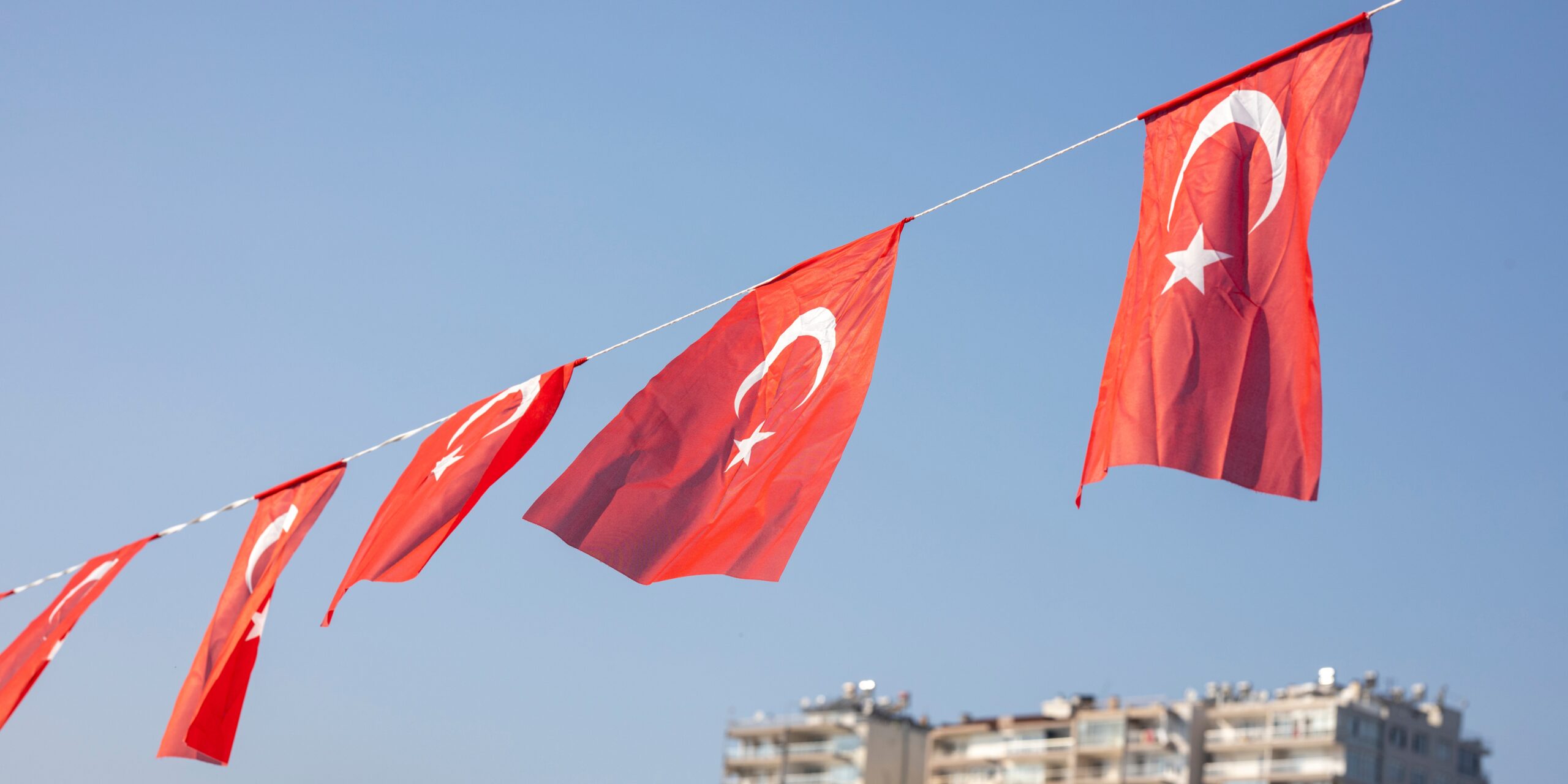
What Turkey’s Elections Mean for Israel
Turkey has elected Recep Tayyip Erdogan as their president in a runoff election. Erdogan, a member of the Justice and Development Party, or the AKP, ran on a promise to solve Turkey’s inflation problem, provide aid to those affected by the recent devastating earthquake, and solve the issue of Syrian refugees. Erdogan defeated Kemal Kılıçdaroğlu, a member of the Republican People’s Party, by 52% to 48%. Kılıçdaroğlu ran on a hardline promise to rid Turkey of the refugees.
The AKP, Erdogan’s party, describes itself as a democratic conservative party that does not adhere to any religion. It is considered right-wing, with some experts labeling it far-right recently. Despite the party’s claims that it is not Islamic, most of its support comes from conservatives and Islamic people.
Kılıçdaroğlu’s party, the Republican People’s Party, is the other large political party in Turkey and is social democratic and Kemalist. The party follows six foundational principles, represented in the six arrows on their logo: republicanism, reformism, laicism, populism, nationalism, and statism. The party is more left-leaning socially, supporting LGBT and Women’s rights, alongside being pro-European and pro-NATO.
With Erdogan winning the election, Turkey can be expected to become more nationalist, conservative, and right-wing. The Turkish people have proven loyal to Erdogan, continuing to support him despite his government’s slow reaction to the earthquake and extreme inflation. They are dedicated to the Turkish leader who makes them proud to be Turkish, even though his policies and actions may not be politically in their best interest.
Now, what does this mean for Israel? The Turkish-Israeli relationship has a rocky history, even though Turkey was the first Muslim country to formalize relations with Israel in 1949. In the 2000s, there were several moments where the relationship faltered, stemming from instability in the Middle East and because of the Israeli-Palestinian conflict. In 2017, Erdogan threatened to end its ties with Israel after the United States recognized Jerusalem as Israel’s capital. In 2022, Erdogan met with then-Israeli Prime Minister Yair Lapid, the first time the two state leaders had met in 14 years.
Even though Erdogan has been in power for many years, his stance on Israel has switched several times. Today, he has a realistic view of Israel's importance in the Middle East as a strong military and economic point. He views Israel in terms of what they can do for Turkey, and since Israel is prosperous today, he wants to maintain a good relationship with the state. Also, Erdogan may see Israel as a connection to the United States, which Turkey must keep strong.
Erdogan cannot be trusted to behave in any consistent way towards Israel. If a relationship with Israel is good for Turkey, Erdogan will continue establishing diplomatic ties. But if the tide turns and Turkey can no longer extract value from Israel, Erdogan is more than capable of cutting ties and ending the relationship.
By Ethan Wenger - JIJ Intern

High Court of Justice, Challenging the Interior Ministry
|
|
|
High Court of Justice, Challenging the Interior Ministry
|
|
|
Palestinian Voices: Who is Silencing Them?
Palestinian Voices: Who is Silencing Them?
Every year on May 3rd we celebrate the World Press Freedom Day, as established by the UN General Assembly thirty years ago. On this day, we stress the importance of allowing individuals to communicate and access information freely. For press freedom to truly exist, information must be accessible to all, and journalists must be free from interference while exercising this freedom. On the occasion of World Press Freedom Day, it is imperative that we conduct a rigorous evaluation of the degree to which press freedom is being upheld across the globe, and raise awareness about the severe restrictions that certain populations face as a result of authoritarian regimes governing them.
Unfortunately, Palestinians, including Palestinian journalists, are often subjected to persecution and harassment by the Palestinian Authority (PA) when expressing ideas and sharing information that contradicts its interests. The PA does claim that it protects freedom of expression and press. Article 19 of the Palestinian Basic Law establishes that “every person shall have the right to express his opinion and to circulate it orally, in writing or in any form.” However, other laws also enacted by the PA clearly limit the freedom of press and opinion, such as the Press and Publications Law. Furthermore, the situation on the ground has demonstrated that the PA has repeatedly taken measures to suppress freedom of press.
Throughout the years, Palestinians who have expressed opposing interests to those of the PA have been pressured, assaulted, arrested, and even killed by the PA forces. To illustrate the extent of the issue, it is worth noting that as recently as March 2023, two Palestinian journalists, Moath Washha and Wahaj Bani Mufleh, were apprehended by the Palestinian intelligence service. Mufleh was even subjected to torture and ill-treatment after he tried to help a foreign journalist that was arrested and mistreated by the Palestinian security forces.
Moreover, the case of Nizar Banat cannot go unnoticed. Banat, a Palestinian activist and an outspoken critic of the PA was brutally beaten and detained by the Palestinian security forces. Tragically, he passed away en route to the hospital just one hour later. Thousands of people gathered to protest against the PA for Banat’s death, and even during these demonstrations, Palestinian security forces attacked the protesters and several journalists who attended the protest.
The international community has often turned a blind eye to the numerous human rights violations committed by the Palestinian Authority against Palestinians. On this important occasion of reflecting upon the significance of press freedom, it is critical to acknowledge that this is a fundamental right that is indispensable to democracy and must be safeguarded. It is our duty to ensure that those who violate this freedom, including the Palestinian Authority, are called out and held responsible for their actions.
Palestinian Voices: Who is Silencing Them?
Palestinian Voices: Who is Silencing Them?
Every year on May 3rd we celebrate the World Press Freedom Day, as established by the UN General Assembly thirty years ago. On this day, we stress the importance of allowing individuals to communicate and access information freely. For press freedom to truly exist, information must be accessible to all, and journalists must be free from interference while exercising this freedom. On the occasion of World Press Freedom Day, it is imperative that we conduct a rigorous evaluation of the degree to which press freedom is being upheld across the globe, and raise awareness about the severe restrictions that certain populations face as a result of authoritarian regimes governing them.
Unfortunately, Palestinians, including Palestinian journalists, are often subjected to persecution and harassment by the Palestinian Authority (PA) when expressing ideas and sharing information that contradicts its interests. The PA does claim that it protects freedom of expression and press. Article 19 of the Palestinian Basic Law establishes that “every person shall have the right to express his opinion and to circulate it orally, in writing or in any form.” However, other laws also enacted by the PA clearly limit the freedom of press and opinion, such as the Press and Publications Law. Furthermore, the situation on the ground has demonstrated that the PA has repeatedly taken measures to suppress freedom of press.
Throughout the years, Palestinians who have expressed opposing interests to those of the PA have been pressured, assaulted, arrested, and even killed by the PA forces. To illustrate the extent of the issue, it is worth noting that as recently as March 2023, two Palestinian journalists, Moath Washha and Wahaj Bani Mufleh, were apprehended by the Palestinian intelligence service. Mufleh was even subjected to torture and ill-treatment after he tried to help a foreign journalist that was arrested and mistreated by the Palestinian security forces.
Moreover, the case of Nizar Banat cannot go unnoticed. Banat, a Palestinian activist and an outspoken critic of the PA was brutally beaten and detained by the Palestinian security forces. Tragically, he passed away en route to the hospital just one hour later. Thousands of people gathered to protest against the PA for Banat’s death, and even during these demonstrations, Palestinian security forces attacked the protesters and several journalists who attended the protest.
The international community has often turned a blind eye to the numerous human rights violations committed by the Palestinian Authority against Palestinians. On this important occasion of reflecting upon the significance of press freedom, it is critical to acknowledge that this is a fundamental right that is indispensable to democracy and must be safeguarded. It is our duty to ensure that those who violate this freedom, including the Palestinian Authority, are called out and held responsible for their actions.
Everything you should know about the Israel Judicial Reform
Israel’s proposed judicial reform has sparked significant societal controversy, revealing the ongoing tension between the Executive and Judiciary branches. Supporters of the reform argue that it will enhance democracy in Israel. At the same time, opponents fear that it will undermine the democratic principles of checks and balances, granting too much power to the Executive branch and potentially endangering minority and human rights. The debate over the reform has created a deep divide within Israeli society.
In this lecture and the attached report, we explore the four components of the proposed reform, give you an overview of the current situation, and explain what changes the reform would like to bring about. We also examine the arguments presented by supporters and opponents of the reform.
https://www.youtube.com/watch?v=ZT129G9vgn0&t=29s
An Examination of Israel's Judicial Reform
Israel's proposed judicial reform has sparked significant societal controversy, revealing the ongoing tension between the Executive and Judiciary branches. Supporters of the reform argue that it will enhance democracy in Israel. At the same time, opponents fear that it will undermine the democratic principles of checks and balances, granting too much power to the Executive branch and potentially endangering minority and human rights. The debate over the reform has created a deep divide within Israeli society.
In the attached report, we explore the four components of the proposed reform, give you an overview of the current situation, and explain what changes the reform would like to bring about. We will also examine the arguments presented by supporters and opponents of the reform.
Examining the Israeli Judicial Reform
https://www.youtube.com/watch?v=ZT129G9vgn0
Israel's proposed judicial reform has sparked significant controversy within society, revealing the ongoing tension between the Executive and Judiciary branches. Supporters of the reform argue that it will enhance democracy in Israel, while opponents fear that it will undermine the democratic principles of checks and balances, granting too much power to the Executive branch and potentially endangering minority rights and human rights. The debate over the reform has created a deep divide within Israeli society. In this lecture, we explore the four components of the proposed reform, provide an overview of the current situation, and explain what changes the reform seeks to bring about. We will also examine the arguments presented by both supporters and opponents of the reform.
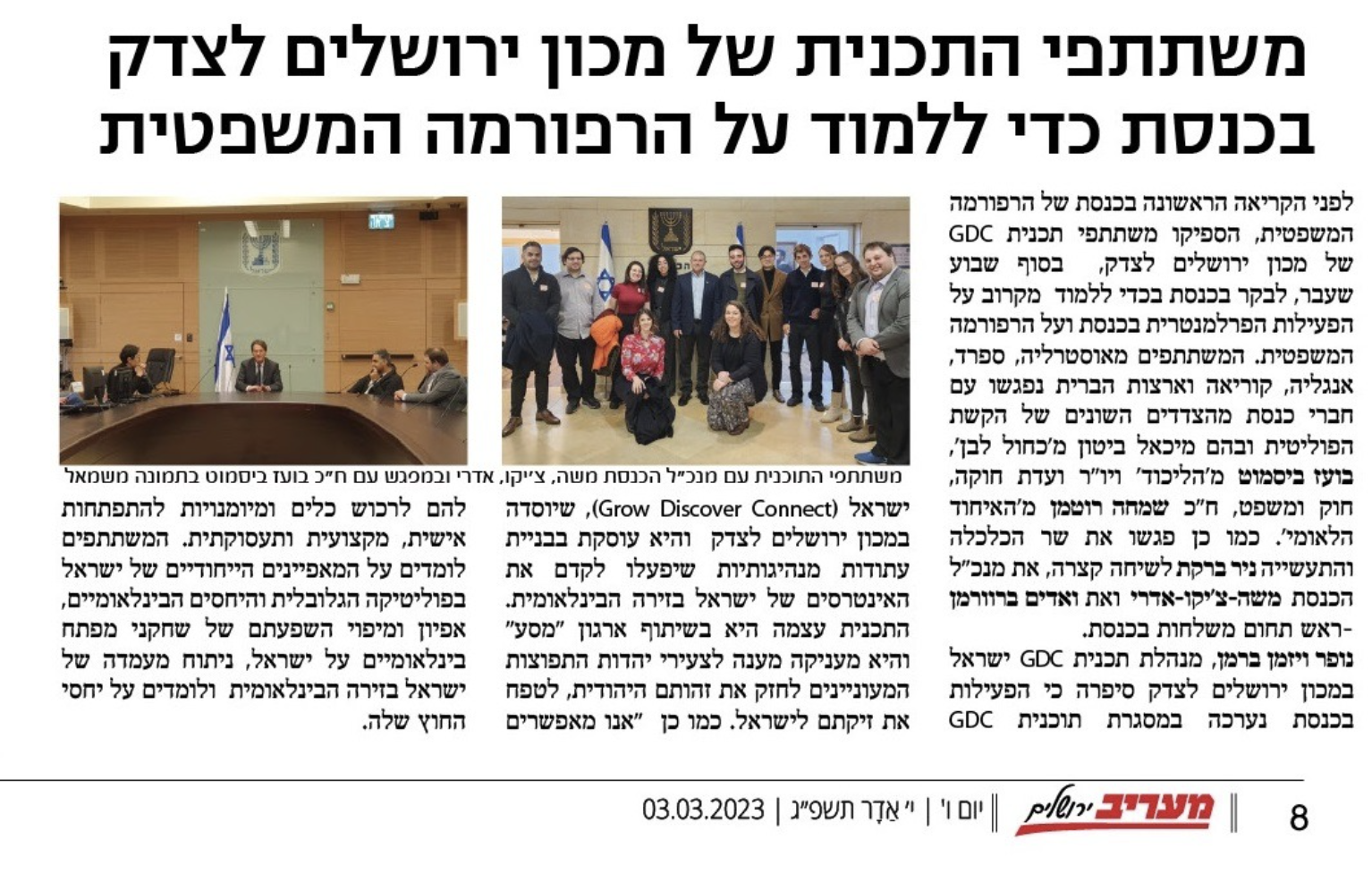
JIJs Grow, Discover, Connect Israel Program in the Local News
The Grow, Discover, Connect (GDC) program at the Jerusalem Institute for Justice (JIJ) attracts interns from around the world who are eager to learn about Israel's unique global political and international relations characteristics, as well as to develop their personal and professional skills.
The participants visited the Knesset, Israel's parliament, during the program to learn about the proposed judicial reform before its first reading. The group included individuals from Australia, England, Korea, Spain, and the United States.
The interns had the opportunity to meet with members of the Knesset from various political affiliations, including Michael Bitton, Boaz Bismuth, and MK Simcha Rothman, as well as Nir Barkat, Moshe (Chico) Edri, and Vadim Braverman. They were able to ask questions and gain valuable insight into the political system in Israel, the legal reform, and its potential ramifications.
The GDC Israel program aims to develop future leaders and educate them. They join the Jerusalem Institute for Justice's mission to advocate for human rights, protect the rule of law, freedom of conscience, and democracy. Additionally, the participants actively participate in JIJ's efforts to defend Israel's standing and create a balanced image in media discourse while fighting against antisemitism and delegitimization towards Israel.
Overall, the visit to the Knesset was a valuable experience for the interns, who gained a newfound appreciation for Israel’s democracy and a deeper understanding of the country's challenges and how to address them.
See photos of their visit below! If you want to learn more about our GDC Israel program, click here.
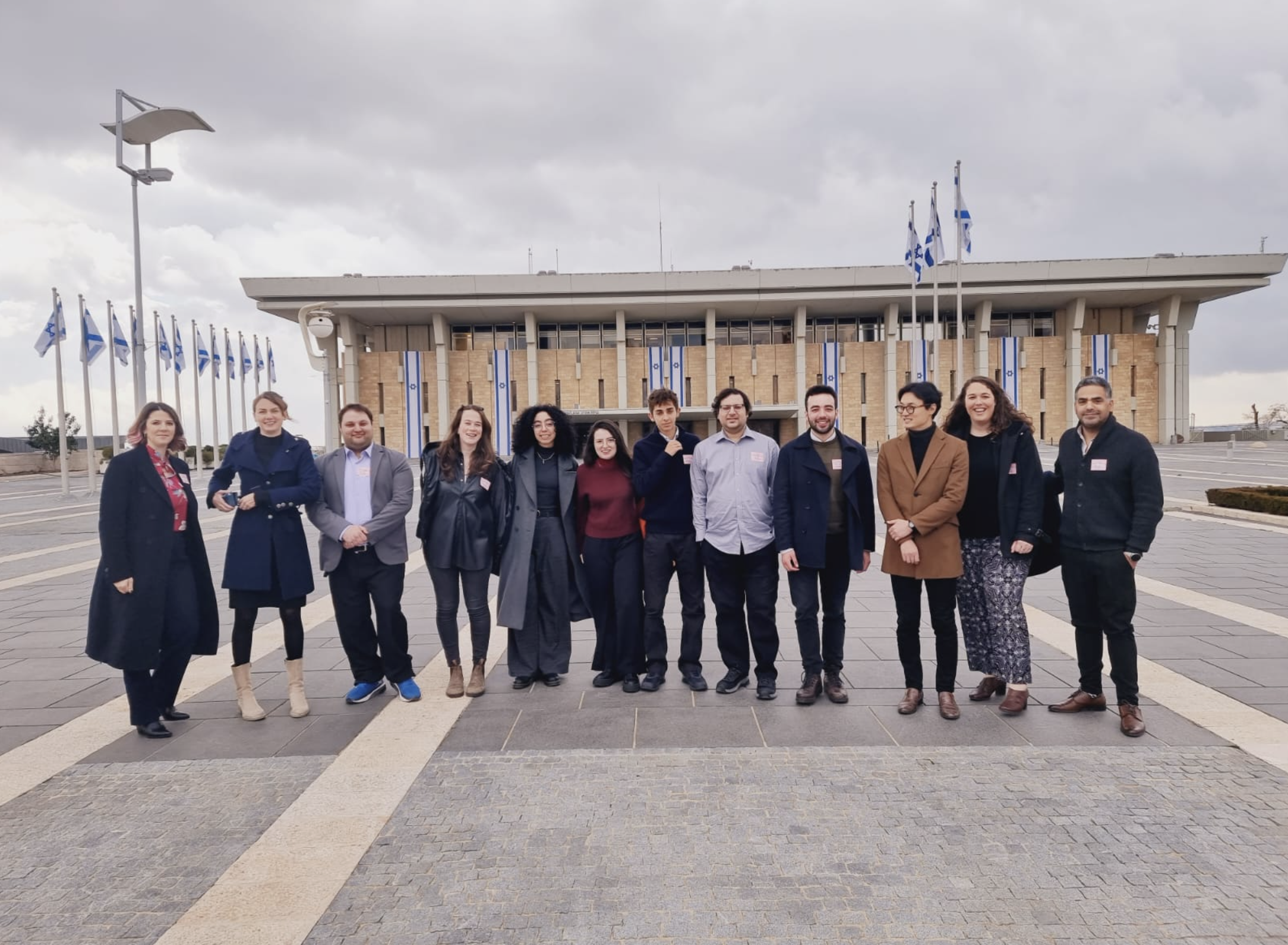
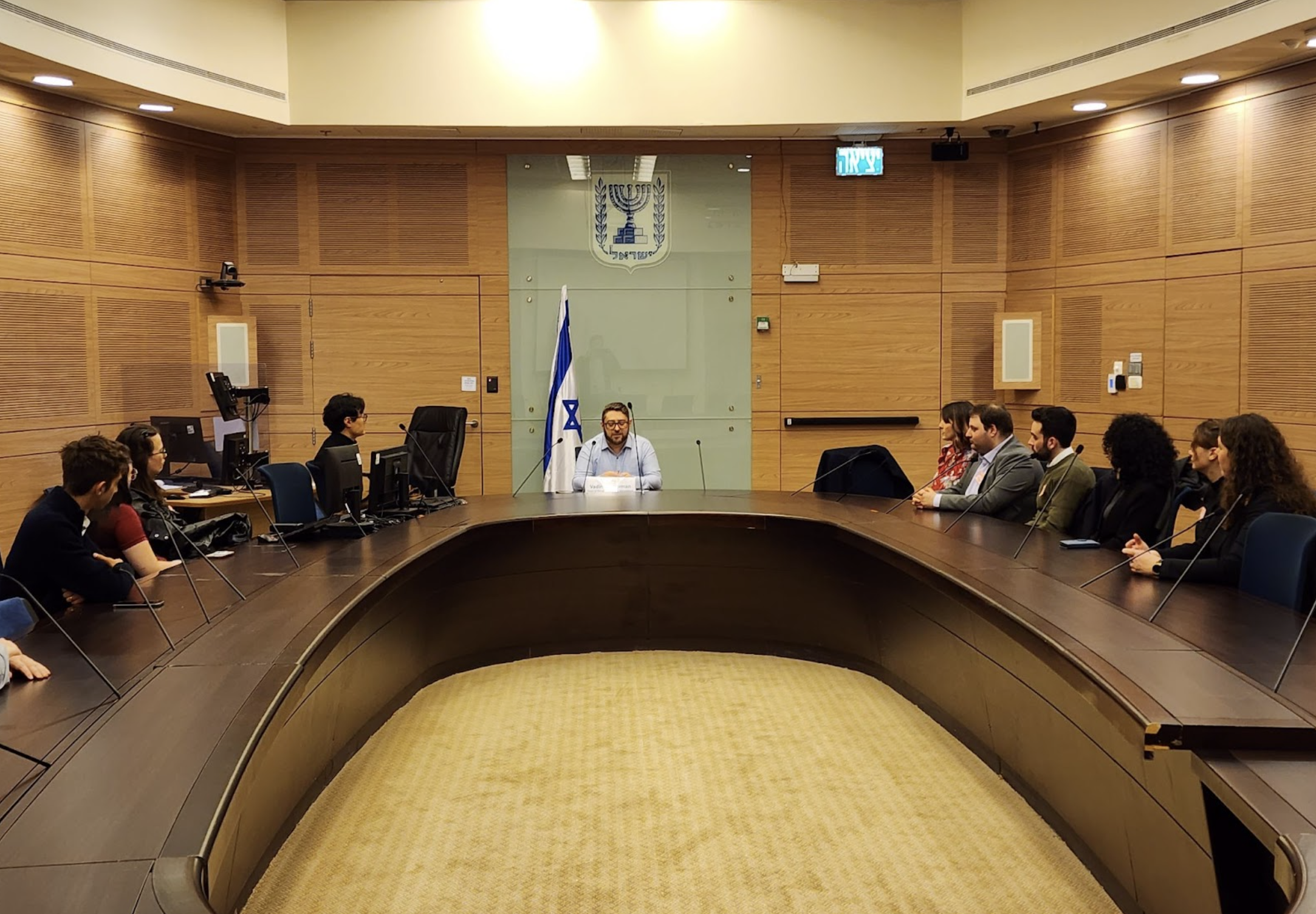
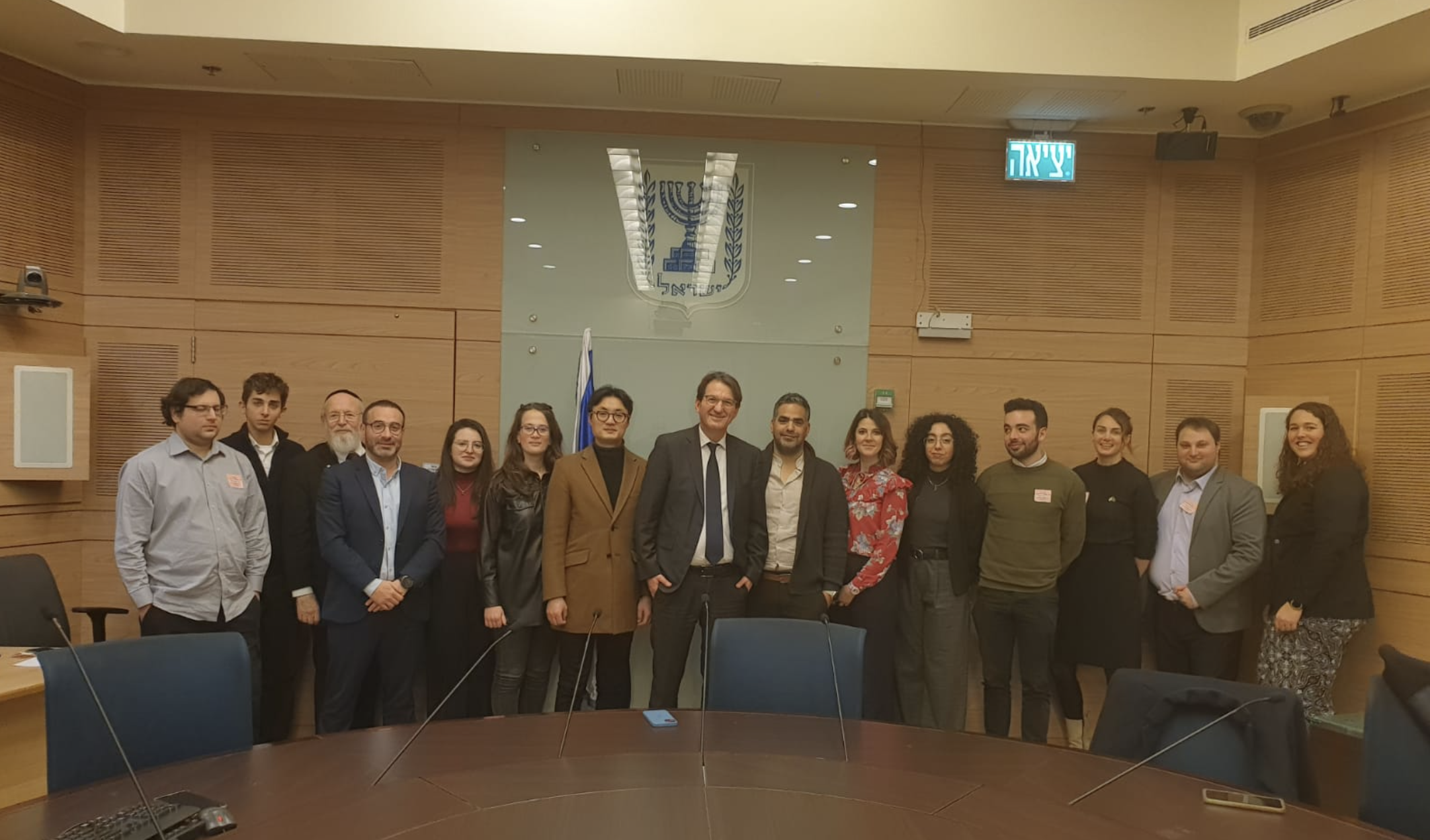
JIJs Grow, Discover, Connect Israel Program in the Local News
The Grow, Discover, Connect (GDC) program at the Jerusalem Institute for Justice (JIJ) attracts interns from around the world who are eager to learn about Israel's unique global political and international relations characteristics, as well as to develop their personal and professional skills.
The participants visited the Knesset, Israel's parliament, during the program to learn about the proposed judicial reform before its first reading. The group included individuals from Australia, England, Korea, Spain, and the United States.
The interns had the opportunity to meet with members of the Knesset from various political affiliations, including Michael Bitton, Boaz Bismuth, and MK Simcha Rothman, as well as Nir Barkat, Moshe (Chico) Edri, and Vadim Braverman. They were able to ask questions and gain valuable insight into the political system in Israel, the legal reform, and its potential ramifications.
The GDC Israel program aims to develop future leaders and educate them. They join the Jerusalem Institute for Justice's mission to advocate for human rights, protect the rule of law, freedom of conscience, and democracy. Additionally, the participants actively participate in JIJ's efforts to defend Israel's standing and create a balanced image in media discourse while fighting against antisemitism and delegitimization towards Israel.
Overall, the visit to the Knesset was a valuable experience for the interns, who gained a newfound appreciation for Israel’s democracy and a deeper understanding of the country's challenges and how to address them.
See photos of their visit below! If you want to learn more about our GDC Israel program, click here.