


THE CITY OF THE FUTURE
By Nikki Golomb.
Palestinian-American businessman and entrepreneur Bashar al-Masri is making history – by building the first modern Palestinian city. Rawabi, the name of the city and the Arabic word for “hills”, is envisioned to become a modern, hi-tech, and comfortable city in a region devastated by poverty and poor infrastructure. Though the city is still in the process of being built, the first residents moved to Rawabi in August 2015. Despite political and economic challenges, it has already created 6,000 new jobs in construction and engineering, and estimated to produce another 5,000 in retail, health, and more.
Al-Masri has worked closely with Israeli contractors, advisers, and companies to import necessary materials. Furthermore, Rawabi is modeled off of Israeli city Modi’in, an Israeli city which was also meticulously planned. Al-Masri continues to visit Modi’in for ideas, and draws inspiration from Israel’s modern and hi-tech atmosphere. His work with Israelis is groundbreaking, and the unique partnerships he has created inspire optimism with regards to Israeli-Palestinian business relations and the future of intercultural cooperation.
Surprisingly, al-Masri wasn’t always open to working with Israelis. He was jailed eight times as a teenager for throwing rocks and organizing demonstrations, was involved in the first intifada, and was a close acquaintance of Yasser Arafat. Although he still refuses to work with Israeli settlers in the West Bank, he has had positive experiences working with Israeli businessmen and women and has only kind things to say. Israeli workers and companies have worked with al-Masri to help him create the new city and, despite political and economic challenges, continue to provide technology and other material supplies in addition to advisement and consultation.
Despite this great success and the promising new Palestinian city, however, al-Masri has faced substantial backlash from Palestinians. They accuse him of supporting Israel’s “occupation, colonization and apartheid against the Palestinian people,” and even go so far as to say that creating a modern, comfortable Palestinian city undermines the daily struggles they are facing. The Boycott Divestment and Sanctions National Committee (BNC), the leading organization of the BDS movement, has condemned Rawabi as “normalization” of anti-Palestinian Israeli policies and claims that it undermines the Palestinian fight for freedom and justice. Al-Masri disagrees, instead arguing that building Rawabi will not only improve the lives of Palestinians, but also prevent Israelis from settling there. (It should be noted, however, that Rawabi is located in Area A and is thus under Arab control where Israelis are not allowed to live.) He also points out that the Palestinian Authority has provided no funding towards the establishment of Rawabi; the PA, he believes, should view it as a priority and invest in Rawabi by building a school, clinic, or other public infrastructure, yet he has not received any financial support from them whatsoever.
Bashar al-Masri’s project is groundbreaking in two endeavors: first, by creating the first Palestinian city to be planned from the very beginning, and second, by establishing significant business ties between Palestinians and Israelis. Israel has helped in nearly every stage of the creation of Rawabi, despite it being an entirely Palestinian city. Instead of viewing this as a hand outstretched for peace, however, the anti-Israel movement has just added this Palestinian city to its list of projects presumed to revoke the rights of Palestinians. Yet this could not be further from the truth. Rawabi is creating jobs exclusively for Palestinians, providing a comfortable and affordable living situation, and improving the overall quality of life for Palestinians. Modernization does not equal Westernization, nor does working with Israelis equate to denying Palestinians their rights. When the PA and critics realize this, we can expect to see a positive change in Israeli-Palestinian relations, as well as better lives for Palestinians who are struggling.

JESSICA MEMORIAL SERVICE
In August 2016, Jessica, a slave of the sex-industry, took her life in room 5 of the brothel on 98 HaYarkon Street, Tel Aviv. She was only 36 years old. She died where she had lived and had been abused by dozens of men every day for more than 15 years. Jessica is only one of the hundreds of women who have died as a result of a prostitution in Israel in the last 5 years.
On August 18th, 2016, the first anniversary of Jessica’s death, a memorial assembly was held at Kikar Atarim Square in Tel Aviv; this assembly was dedicated to her memory and the memory of the victims of prostitution in Israel. It was well attended by the public and member of Knesset Shuli Mualem. Every year we continue to commemorate the loss of lives of women in the sex trade.
Want to know when is the next memorial event? Like us on Facebook to get our activity updates – Click here.
When Does Criticism of Israel Become Anti-Semitism?
By Nikki Golomb.
As a Jewish-American university student, I have been faced with the impossible task of determining when a professor, a student group, or an event has gone too far in criticism of Israel as a Jewish democracy. Is this legitimate criticism of Israel as an imperfect state, or is it holding Israel to an unfair standard of perfection? Is this criticism of Israel as a Jewish nation, or a political state? Is this anti-Semitism masked as anti-Zionism, a more “acceptable” form of criticism? And if so, where do we draw the line?
Anti-Israel rhetoric is often referred to as the “new anti-Semitism.” Classical anti-Semitism – such as the blood libel, Nazi symbolism and graffiti, and destruction of Jewish tombstones – are easy to identify, illegal, and largely socially unacceptable. Anti-Israel speech, on the other hand, is much more palatable to the public. However, anti-Israel rhetoric is often used as a more “acceptable” form of anti-Jewish sentiment, as the only Jewish state is held to a higher standard than any other country in the world.
There is a very fine line between legitimate political criticism of Israel and anti-Semitism. Many of us know all too well that recognizing the line is not only very difficult, but also vital in order to not infringe upon free speech while also condemning hate speech. However, Israel is not perfect, and thus denouncing any criticism of Israel as anti-Semitism ignores the political challenges faced within Israel and also holds Israel to a different standard than other countries. So how do we know when to speak up against anti-Semitism?
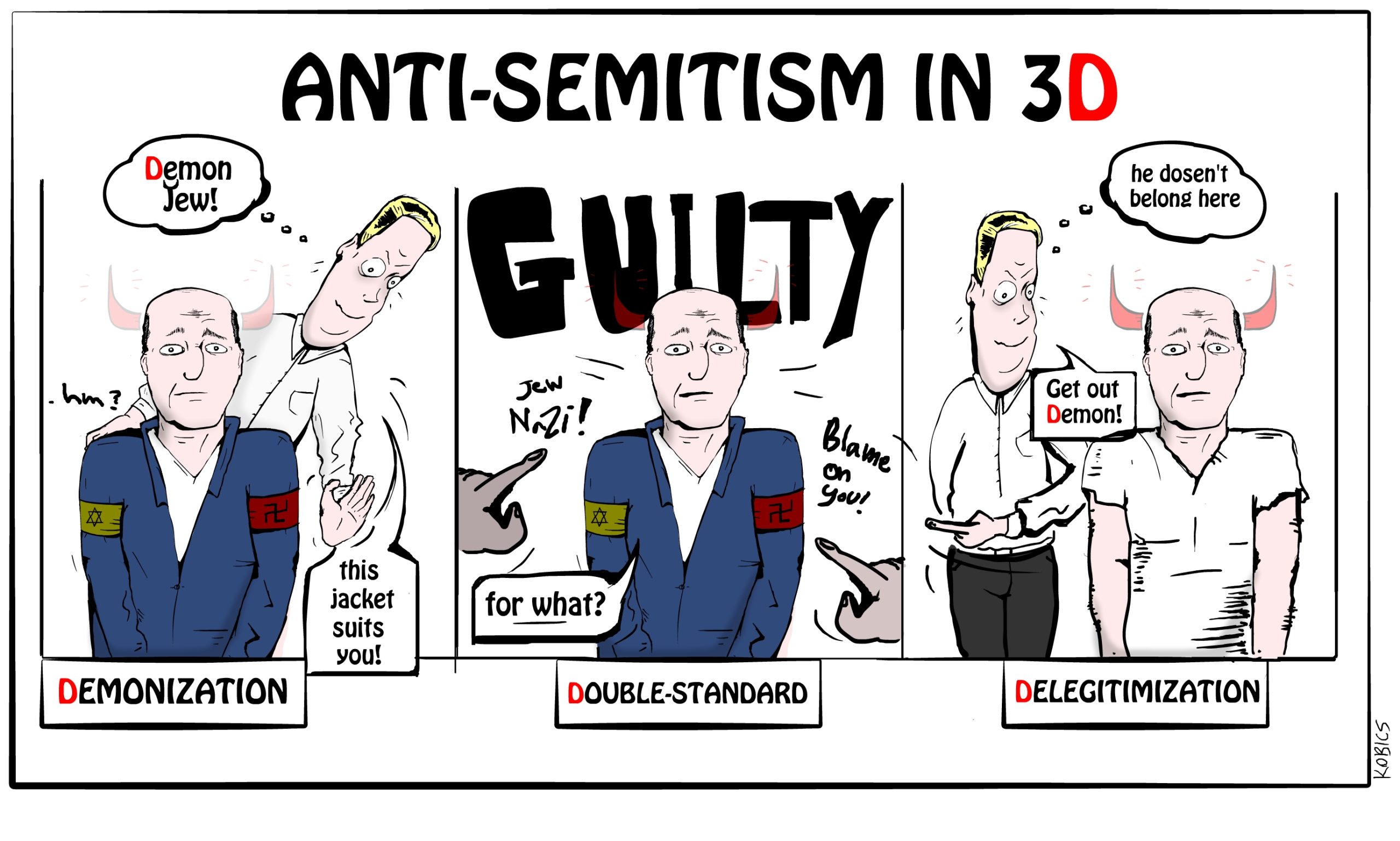
Natan Sharansky, Chairman of the Executive for the Jewish Agency for Israel and human rights activist, proposed what he calls the “3-D test” to differentiate between legitimate criticism of Israel and anti-Semitism. This test dictates that if a statement or action demonizes Israel, holds Israel to a double standard, or delegitimizes Israel (the “3 Ds”), it is in fact anti-Semitic.
Demonization
Demonization, the first of the 3 Ds, is relatively easy to identify as it has been a marker of anti-Semitism for centuries. Depicting Jews as the embodiment of evil (i.e. “Jews have horns” or “Jews are the devil”) is one of the oldest forms of anti-Semitism. Today, demonization of Israel includes comparing Israel to Nazi Germany, equating Palestinian refugee camps with concentration camps, or depicting Israeli political leaders as the devil.
Demonization of Israel is clear anti-Semitism, with a shift of focus from Jews as individuals to the Jewish nation. When criticism of Israel is focused on its nature as a Jewish state, when its policies are blown out of proportion, and when criticism reflects anti-Jewish sentiment that has persisted for centuries, anti-Semitism is the culprit.
Double Standard
Discriminatory laws holding Jews to a different standard than other citizens have also existed for centuries. From empires imposing additional taxes on Jews, to outright denying the right to Jewish practice, to more recent ghettoization, Jews have been subject to different laws than their neighbors.
The same is happening today, at the international level. Of the 2017-2018 UNGA resolutions condemning countries, 20 of the resolutions were against Israel – and six against the rest of the world combined. Furthermore, since the establishment of the UN Human Rights Council, about 50% of its resolutions concerning specific countries have been against Israel. No other country has received such treatment. Singling out Israel for condemnation while ignoring massive human rights abuses in other parts of the world is holding Israel to a double standard. Expecting Israel and Israeli organizations to adhere to a higher standard of human rights singles out Israel as the only Jewish state, and is thus an expression of anti-Semitism.
Delegitimization
Delegitimization is slightly harder to identify, but just as important. It refers to any action or comment delegitimizing Israel as a Jewish democracy, or denying Israel’s right to exist as one. It can be accusing Israel of colonialism, ethnic cleansing, and apartheid; or it can be claiming that Israel was established illegally and on lands that it has no right to own, thus delegitimizing Israel’s very right to exist at all.
Dozens of Muslim states and Christian states exist, yet there is only one Jewish state. Denying its right to exist is inherently anti-Semitic because it discriminates against Israel based on its nature as a Jewish state. Making false claims of ethnic cleansing or apartheid delegitimizes Israel by implying that it is founded on racism and discrimination and thus has no right to sovereignty. The same argument can be made of the claim that Israel has no legal, historical, or cultural right to the land; however, making these claims is anti-Semitic because it nullifies Jewish history, nationalism, and right to self-determination.
Discussion and Conclusion
Expressing disapproval for specific Israeli policies is a legitimate form of criticism. Arguing against political action, the way one does with regards to other countries, is not only acceptable but also healthy – no positive progress can be made without open dialogue and political discussion. However, when one (or more) of the “3 Ds” become present and that criticism crosses the line into anti-Semitism, nothing productive can happen. No positive change can happen when the criticism is based on anti-Jewish arguments. When someone demonizes Israel, holds it to a double standard, or delegitimizes it, their tactics must be called out for what they are. This is the only way to ensure that anti-Semitism is recognized and stopped, and legitimate criticism is taken seriously so as to promote progress.

Israel is Leaving UNESCO
Following President Trumps announcement to leave UNESCO, Israel took into consideration their stance in the matter.
Download
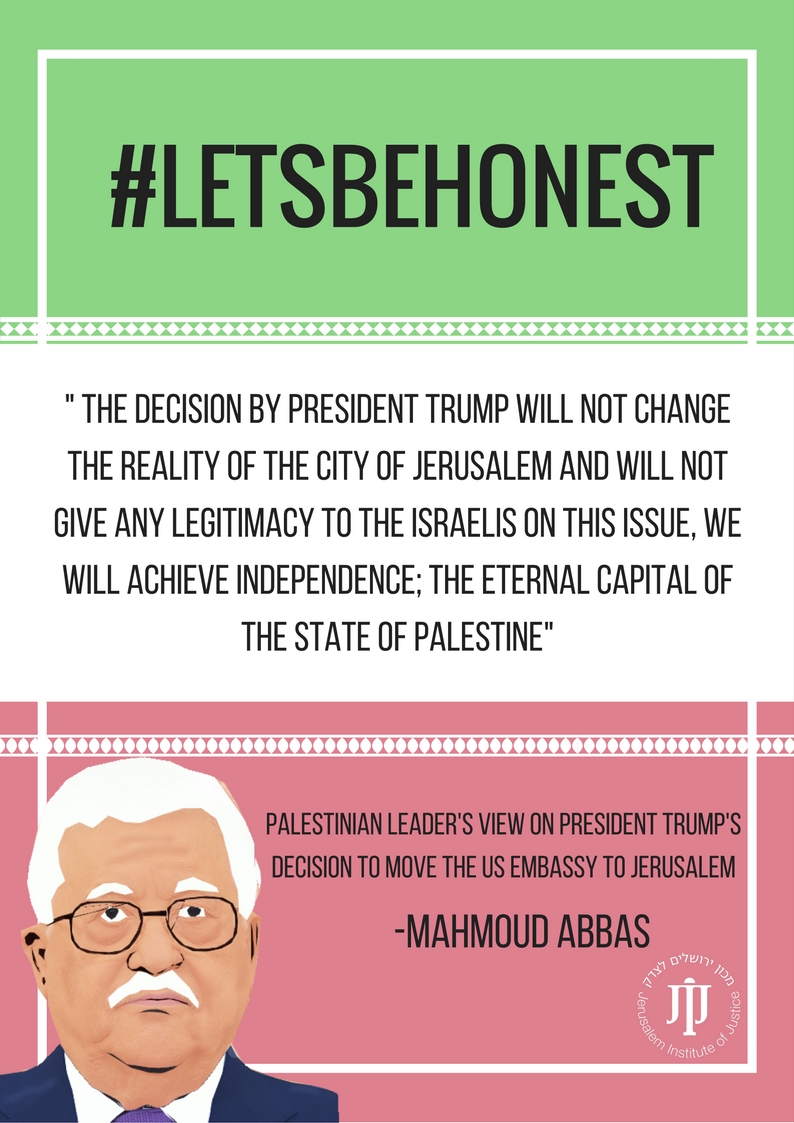
Quotes form Abbas: Following Trump's Declaration
LetsBeHonest attempts to bring truth into our world of cluttered reality. What's the truth in the Middle East? Following Trump's declaration we see outrage and threats coming from our neighboring nations.
Download
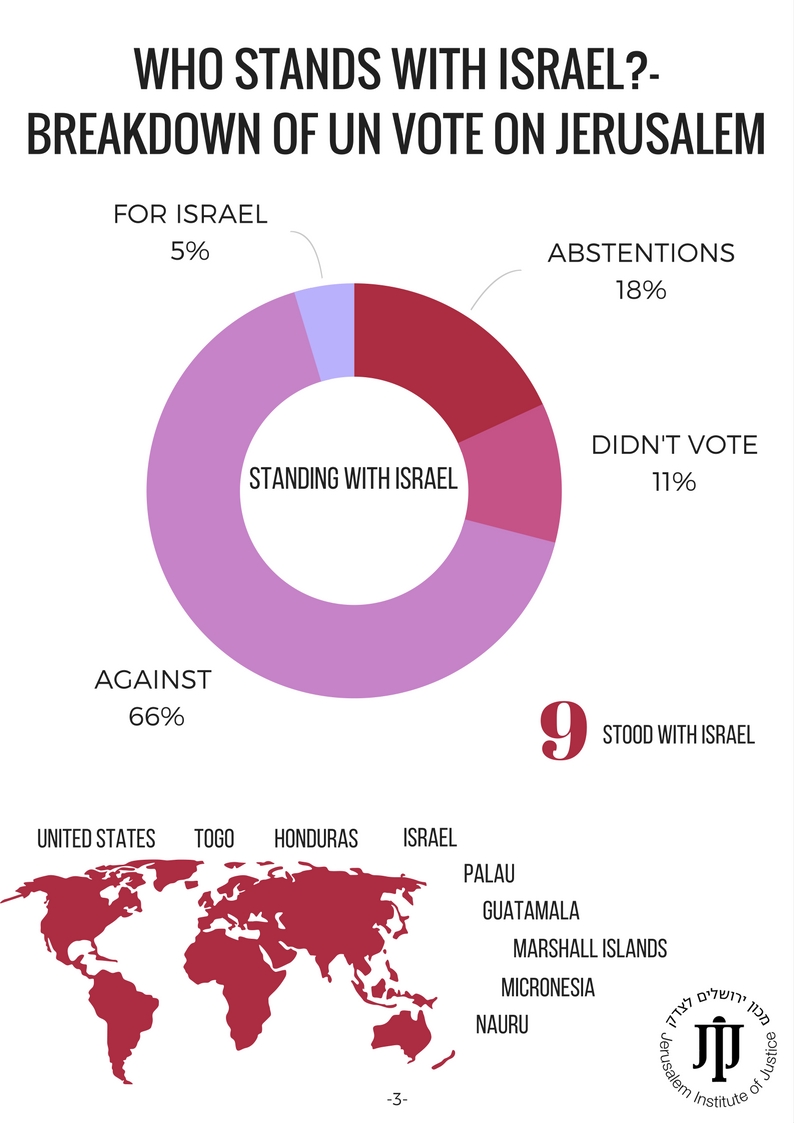
Who Stands with Israel?
Let's break down the numbers by looking at the UN vote that recently took place regarding Jerusalem. Sadly, the numbers point to a not-so-encouraging outcome.
Download
United Nations and Genocide
By Nikki Golomb.
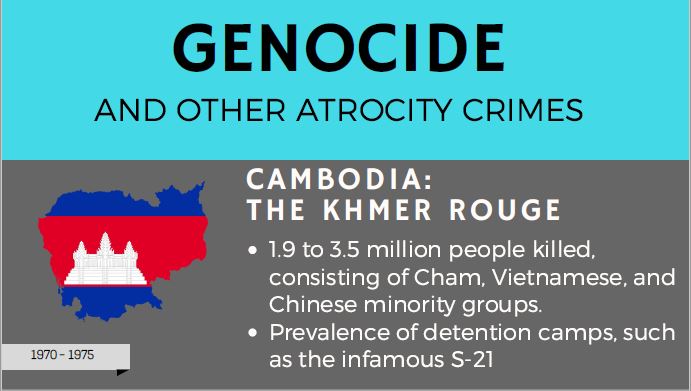
The Jerusalem Institute of Justice conducted a report assessing the ability of the United Nations to protect populations from genocide. The document analyzes the legal obligations of the international order to protect populations from genocide, as well as the success the UN has had in doing so. The report is split into three sections: historical background, current assessment, and discussion and recommendations. JIJ took into consideration six case studies total, three historical instances of genocide and three current events. From these analyses, the report then draws a conclusion on whether the UN successfully protects populations from genocide. Finally, JIJ provides several recommendations for the UN and other intergovernmental organizations to improve the protection provided to vulnerable populations.
Historical Background
After providing the UN definition of genocide and the methodology used to conduct the report, JIJ explores in the document the significance of the Holocaust in the establishment of the United Nations and the creation of a body meant to protect vulnerable populations. The historical uniqueness of the Holocaust and the inability of the world to prevent it sparked the need for an international body to prevent and punish such crimes against humanity – and thus, the United Nations was born.
However, incidents of genocide that followed the establishment of the UN exposed the flaws in the organization’s ability to enforce preventative or protective measures. In fact, although the Convention on the Prevention and Punishment of the Crime of Genocide mandates that contracting parties make an effort “to prevent and to punish” genocide, there is no mention of counteracting it. Cambodia, Rwanda, and Yugoslavia – three countries which experienced a genocide after the establishment of the UN – were all addressed by the UN and had a peacekeeping force (PKF) sent before the tensions escalated into genocide. The PKF, however, were clearly unsuccessful. This was due partially to the narrow parameters the PKF were given to work, and partially to a lack of political will to engage. Because of complex regional and interstate conflicts, the UN was unable to gather a consensus to form a mandate strong enough to keep the violence from escalating. In other words, politics got in the way of protection of human rights and lives – all three times.
Current Assessment
Several current conflicts have been identified by the UN as either crimes against humanity or genocide. The conflicts analyzed in this report are Darfur, the Rohingya people in Myanmar, and ISIS and Syria. Once again, the UN has failed to label any of these as a genocide (except for ISIS’s violence against the Yazidi people), further demonstrating the lack of a political will to intercede, as labeling them as a genocide would obligate the UN to act. Instead, by recognizing the crimes against humanity, the international order is able to enforce weak mandates and sanctions that do not complicate international relations among permanent member-states of the United Nations, but also do nothing to stem the tide of violence in the regions. Furthermore, no action can be taken without a unanimous decision made by the permanent member-states of the UN. Because of the complicated relations among these states, unanimity is rare. History appears to be repeating itself, as politics are once again impeding the international order’s ability to protect populations from genocide.
Discussion and Recommendations
The report concludes with an analysis of the problems affecting the UN’s ability to protect from genocide. These problems include politicization and lack of political will. Politicization refers to the tendency of the UN to become so consumed in interstate politics that human rights abuses become a secondary issue. Despite the founding assumption that the global community has a responsibility to protect, the UN has struggled to achieve a collective will to intervene in genocide and other crimes against humanity due to politics. Lack of political will is related in that states do not believe intervention to be in their national interest, and as a result have no incentive to intervene. This again implies that politics, specifically domestic politics, supersede international human rights.
JIJ then offers a series of recommendations to the UN to better protect vulnerable populations. These recommendations, designed to address the problems analyzed in the report, cover a wide variety of possible solutions, from adding “counteracting” genocide to the language of the Convention to enforcing stricter human rights requirements of member-states. The recommendations also include demanding better accountability and challenging the notion that international human rights abuses are not of national interest, thus addressing the problem of politicization.
Should the UN (or other IGOs and human rights activists) adopt these recommendations, the international community would be better equipped to prevent, counteract, and punish genocide. Minimizing politicization, enforcing stronger mandates, encouraging states to intervene, and providing incentives for states to maintain a certain human rights standard are basic yet vital changes that can be made to improve the global response to genocide. Once we are able to look at the past and recognize where we went wrong, we will be able to address the problems that still exist today and, hopefully, work together towards a future of human rights and dignity for all.
None Of Whose Business?
By John Hyrcanus.
Trying to decide who is ‘up’ and who is ‘down’ after the U.N’s recent condemnation of America’s decision to move its embassy from Tel Aviv to Jerusalem seems a futile exercise. A more consequential issue may be emerging with long-term implications for America, the United Nations and the Middle East - “when does a sovereign nation’s independent action become the legitimate business (that is, concern) of the U.N.?”
To be specific, “is it the rightful business of the U.N. to pass institutional judgment on America’s sovereign decision about her own embassy?”
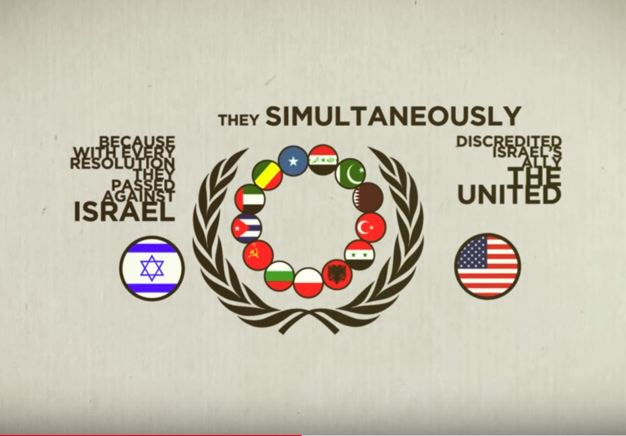
By a 128-9 vote, the General Assembly condemned America’s embassy decision. This followed almost immediately upon America’s veto of an otherwise unanimous Security Council resolution last week to the same effect. These votes certainly reveal long-held convictions of the United Nations.
The U.N. has never claimed formal, supra-sovereign authority to oversee the internal affairs of Israel, but has frequently spoken and, where allowed, acted as though it is entitled to do so - especially where Jerusalem is concerned. Typically, the U.N. appeals to its self-proclaimed responsibility to serve as an ‘unbiased’ trustee of the city’s sacred religious sites.
A parallel position had remained largely hidden until now. This holds that Jerusalem’s status as Israel’s capital is somehow ‘open’, even though the city’s status has been legally, politically and militarily resolved on Israel’s behalf, repeatedly, for more than a century.
These unwarranted U.N. assertions show how last week’s vote of condemnation was a wholly political, not legal, event. This may be why Prime Minister Netanyahu, using the harshest possible language, described the United Nations itself as a “house of lies” in advance of the vote.
U.N. ambassador Nikki Haley had warned Assembly members in advance that any intrusion into United States sovereignty would provoke a specific and individually-tailored American response. Member nations either judged this an empty threat or reasoned that any consequences would be less serious than appearing to ratify, by implication, this statement of historic fact: “Jerusalem has always been the national capital of the Jewish people.”
The Administration has already matched actions to words. The U.S. will reduce its contribution to the U.N. budget next year by 285 million dollars. Reductions of direct aid to other nations who joined the vote will be weighed separately.
America’s embassy policy in Israel falls far outside any legitimate ‘business’ oversight of the United Nations. America’s recognition of Jerusalem as Israel’s capital neither contradicts nor repudiates any U.N. statute. If America’s decision implies rogue rejection of a tacit U.N. insistence on keeping Jerusalem’s status open, then an open airing of ‘rights’ is long overdue.
In accord with international law, history and tradition, the location of Israel’s capital does not come under the determination of America or the U.N. The United States will move its embassy from Tel Aviv to Jerusalem for the sufficient reason that Israel has always declared Jerusalem to be her national capital.