

UNITED NATIONS AND GENOCIDE
A Comparative Historical Assessment on the Ability of the UN
to Protect Populations from Genocide
The Jerusalem Institute of Justice conducted a report assessing the ability of the United Nations to protect populations from genocide. The document analyzes the legal obligations of the international order to protect populations from genocide, as well as the success the UN has had in doing so. The report is split into three sections: historical background, current assessment, and discussion and recommendations. JIJ took into consideration six case studies total, three historical instances of genocide and three current events. From these analyses, the report then draws a conclusion on whether the UN successfully protects populations from genocide. Finally, JIJ provides several recommendations for the UN and other intergovernmental organizations to improve the protection provided to vulnerable populations.
Historical Background
After providing the UN definition of genocide and the methodology used to conduct the report, JIJ explores in the document the significance of the Holocaust in the establishment of the United Nations and the creation of a body meant to protect vulnerable populations. The historical uniqueness of the Holocaust and the inability of the world to prevent it sparked the need for an international body to prevent and punish such crimes against humanity – and thus, the United Nations was born.
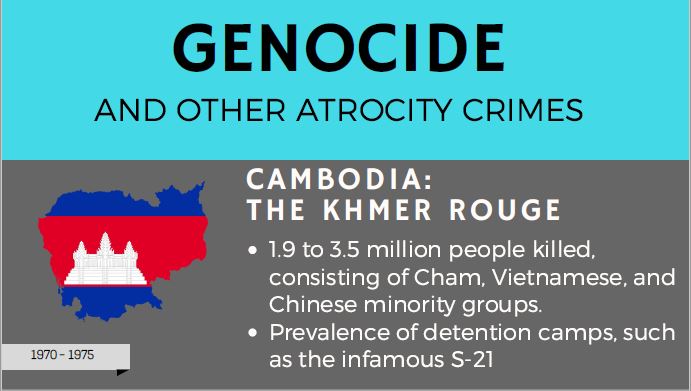
However, incidents of genocide that followed the establishment of the UN exposed the flaws in the organization’s ability to enforce preventative or protective measures. In fact, although the Convention on the Prevention and Punishment of the Crime of Genocide mandates that contracting parties make an effort “to prevent and to punish” genocide, there is no mention of counteracting it. Cambodia, Rwanda, and Yugoslavia – three countries which experienced a genocide after the establishment of the UN – were all addressed by the UN and had a peacekeeping force (PKF) sent before the tensions escalated into genocide. The PKF, however, were clearly unsuccessful. This was due partially to the narrow parameters the PKF were given to work, and partially to a lack of political will to engage. Because of complex regional and interstate conflicts, the UN was unable to gather a consensus to form a mandate strong enough to keep the violence from escalating. In other words, politics got in the way of protection of human rights and lives – all three times.
Current Assessment
Several current conflicts have been identified by the UN as either crimes against humanity or genocide. The conflicts analyzed in this report are Darfur, the Rohingya people in Myanmar, and ISIS and Syria. Once again, the UN has failed to label any of these as a genocide (except for ISIS’s violence against the Yazidi people), further demonstrating the lack of a political will to intercede, as labeling them as a genocide would obligate the UN to act. Instead, by recognizing the crimes against humanity, the international order is able to enforce weak mandates and sanctions that do not complicate international relations among permanent member-states of the United Nations, but also do nothing to stem the tide of violence in the regions. Furthermore, no action can be taken without a unanimous decision made by the permanent member-states of the UN. Because of the complicated relations among these states, unanimity is rare. History appears to be repeating itself, as politics are once again impeding the international order’s ability to protect populations from genocide.
Discussion and Recommendations
The report concludes with an analysis of the problems affecting the UN’s ability to protect from genocide. These problems include politicization and lack of political will. Politicization refers to the tendency of the UN to become so consumed in interstate politics that human rights abuses become a secondary issue. Despite the founding assumption that the global community has a responsibility to protect, the UN has struggled to achieve a collective will to intervene in genocide and other crimes against humanity due to politics. Lack of political will is related in that states do not believe intervention to be in their national interest, and as a result have no incentive to intervene. This again implies that politics, specifically domestic politics, supersede international human rights.
JIJ then offers a series of recommendations to the UN to better protect vulnerable populations. These recommendations, designed to address the problems analyzed in the report, cover a wide variety of possible solutions, from adding “counteracting” genocide to the language of the Convention to enforcing stricter human rights requirements of member-states. The recommendations also include demanding better accountability and challenging the notion that international human rights abuses are not of national interest, thus addressing the problem of politicization.
Should the UN (or other IGOs and human rights activists) adopt these recommendations, the international community would be better equipped to prevent, counteract, and punish genocide. Minimizing politicization, enforcing stronger mandates, encouraging states to intervene, and providing incentives for states to maintain a certain human rights standard are basic yet vital changes that can be made to improve the global response to genocide. Once we are able to look at the past and recognize where we went wrong, we will be able to address the problems that still exist today and, hopefully, work together towards a future of human rights and dignity for all.
Download
Jerusalem of Gold – and the US Embassy
By Nikki Golomb.
Throughout his presidential campaign, President Trump promised that when elected, he would move the US embassy from Tel Aviv to Jerusalem despite both international pressure and domestic precedent opposed to such a move. Since being elected, his stance has changed several times on the issue; this week, however, he made the official announcement that the United States a) recognizes Jerusalem as the capital city of Israel, and b) will move the embassy from Tel Aviv (where it is currently located) to Jerusalem.
Why is the move controversial? What are the immediate reactions? And what does this announcement mean for future international relations, particularly within the Middle East?
The Past
Jerusalem is probably one of the most, if not the most, contested lands in the world. It is a holy city for Judaism, Islam, and Christianity, and thus control over the land has been the cause of conflict and war for millennia. The Jewish people have considered it to be the spiritual capital for 3000 years and, more recently, the political capital of the Jewish State for several decades. Yet although Israel declared Jerusalem as its capital city in a 1950 Knesset vote, many countries – as well as IGOs such as the United Nations and the European Union – decline to recognize Jerusalem as the de jure capital. This has clear implications on the international legitimacy of Israel, as its jurisdiction over its own self-proclaimed capital is disputed. It is a very unique situation that a country declares a city to be its capital city and other countries deny this fact; one might question why foreign states have a say in what the capital of Israel is, yet this is the reality in which we are living.
In 1995, the United States Congress passed the Jerusalem Embassy Act in order to begin “initiating and funding the relocation of the Embassy of the United States in Israel from Tel Aviv to Jerusalem, no later than May 31, 1999,” as well as recognize Jerusalem as the capital of Israel. However, each US president (including Trump) has signed a waiver declining to implement it on the grounds that the Act is a “Congressional infringement on the executive branch’s constitutional authority over foreign policy.” As a result, the US has effectively refrained from making a definitive statement on Israel’s jurisdiction over Jerusalem – until today.
The Present
Both Israelis and Palestinians want Jerusalem as the capital of their respective sovereign nation. As such, the issue of jurisdiction over the holy city is one of the most contentious negotiation topics in Israeli-Palestinian peace talks. Refusing to acknowledge Israel’s right to Jerusalem as its capital allows states to remain “neutral” and thus maintain relations with both Israel and the Palestinian Authority.
Even those countries which do recognize Jerusalem as the capital of Israel have their embassies in Tel Aviv in order to avoid conflict. Though this may seem trivial, the symbolic meaning is anything but. All around the world, foreign embassies are located in the respective country’s capital city. Recognizing Jerusalem as Israel’s capital without treating it as such is only a surface-level show of solidarity, and does not truly support Israel’s right to self-determination. However, due to the tensions surrounding Jerusalem, no country chooses to house its embassy there. Doing so would send the message that control over Jerusalem, one of the major points of conflict in Israeli-Palestinian negotiations, is undeniably and nonnegotiably Israel’s.
Even before Washington made the official announcement to recognize Jerusalem as Israel’s capital and move its embassy, the United States faced both domestic and international backlash. Now that President Trump has publicly declared the intended policy change, opponents accuse him of upending decades-long political precedent in the US and throwing the Middle East into unknown turmoil, while supporters are saying, “Well, it’s about time.”
The Future
The United States historically has been one of the main mediators in Arab-Israeli negotiations (for example, the Camp David Accords, Oslo Accords, Camp David Summit, and Israeli-Jordanian peace treaty were all either mediated by or signed in Washington). Publicly recognizing Jerusalem as the capital of the State of Israel necessarily establishes a bias in favor of Israel in the event of future negotiations, should the US continue to mediate these talks. As a result, many Palestinians, Arabs, and other supporters of Palestinian self-determination oppose Trump’s recent announcement as it could create further challenges in the peace process to come.
Most of these challenges stem from the United States’ reputation in the region. Washington may no longer be viewed as a neutral party, causing possibly irreparable damage to relations in the region. Furthermore, it perpetuates the narrative that “the US is at war with Islam and has no respect for Muslim and Arab perspectives.” In a region already experiencing backlash to globalization and Western cultural imperialism, the implications of Trump’s announcement may damage cultural relations in addition to political ones.
The announcement additionally is expected to increase violence and extremism in the region. Senior Palestinian Authority advisor Mahmoud Al-Habbash announced, with PA President Mahmoud Abbas by his side, that Trump’s announcement “would mean total destruction of the peace process... The whole world will pay a price for any change or harm to the political reality of Jerusalem." Hamas additionally called for a revival of the intifada should Washington follow through on its plans.
Yet many Jews – both in Israel and the diaspora – do not see the significance of this announcement. Jerusalem has been the capital of the Jewish people for 3000 years; Washington’s decision to declare its support changes nothing, and nor does the refusal of other states to make the same recognition. Jerusalem always has been and always will be the spiritual capital of the Jewish nation, and no government has the ability to take this away. However, we cannot ignore the inevitable political implications, both short-term and long-term, that the United States’ policy change will have. It is only a matter of time before we begin to see what these effects will be.

Never use the phrase “your mother”
“This July, Gazan journalist and activist Amer Balousha published a post on Facebook in which he wondered whether his leaders' mothers also have to sleep on the floor in order to cool themselves down in the unbearable summer heat.“
Granted, a Palestinian journalist as experienced as Amer Balousha should never have used the phrase “your mother” in connection with the actions of Hamas or PA leaders. That way, trouble lies. Precisely. Neither Balousha’s words, nor the reason for his words, were lightly chosen.
Balousha’s purported crime, “Misuse of Technology,” doesn’t exist within Palestinian law, but why be picky? Suppression of free speech by either Hamas or the PA would be merely a boring ‘dog bites man’ story, except that Balousha belongs to a grassroots, bottom-up, youth-centered political movement that is demanding organizational reconciliation and political reforms from both Hamas and the PA. Al-Monitor, an Arab publication, termed these so-called “Patriots to End the Split” a “first-of-its-kind popular movement in Palestine”.
Balousha, with other Gazans, smashed through an earlier tipping point amidst the drastically curtailed electrical service triggered by PA pressure on Hamas earlier this year. Desperate Gazans had flooded the streets, risking their lives to vote their anger against the regime. Significantly, Hamas hadn’t dared crush the rebellion. Instead, they began ratcheting up the pressure on free speech to play for time, while reaching out to former enemies, including the PA, to craft a new political arrangement. Meanwhile, the heat has continued to rise month-by-month, not only in the homes of Gazan mothers, but far more so in the power corridors of Gaza and Ramallah.
Meanwhile, in parallel, the PA has also been concocting absurd laws to cover the unjust arrests of political activists and journalists.
Most notably, Issa Amro, an intense proponent of (mostly) non-violent resistance against Israel, was arrested this summer for criticizing the arrest of a PA journalist, Ayman Quwasme, who had himself called for Abbas to resign. Quwasme, director of Hebron’s Freedom Radio, had posted this to Facebook, stripping away the fiction that blamed Israel for the PA’s direct suppression of speech: “This media network is in an area that is under the complete control of the Palestinian Authority, yet, they remain silent, and cannot protect us. We have nothing to do with incitement. We try to deliver the message of the simple people in need, to the officials. We try to be the voice of the voiceless, and that is why we keep getting attacked and harassed.”
Why, though, was Abbas incensed with Quwasme, and willing to endure near-universal condemnation over the arrest of Amro? Because the PA, like Hamas, has reached the end of its perceived legitimacy in the eyes of its own people. The regime, like its spiritual brothers elsewhere, now suppresses free speech in a manner that “is not much different than that (experienced) under Bashar Assad’s Syria or even North Korea.” Even an Israeli General’s son petitioned Abbas for Amro’s freedom. This demonstrates why organizations like JIJ defend the free speech rights of all. Something more truly human than the typical enmity between Israel and the Palestinians has come into play here.
The Balousha incident would be just another forgettable statistic in the battle over speech, except for Amer Balousha’s formal, active connection to the group of “Patriots”. Even so, mainstream media reports have missed it.
His arrest suggests a fresh way for us to ‘read’ the relative progress of the reconciliation process between Hamas and the Palestinian Authority ‒ keep a record of which dissenters are allowed to speak up, and whether those speakers include those whose lives have been devastated by the corrupt, venal and pointless war between Hamas and the PA since 2006.
Balousha was freed fairly soon after his arrest, pledging not to speak about the incident on social (or traditional) media. Notably, neither he nor the “Patriots” have silenced themselves when it comes to a host of other flashpoints.
Since this grassroots youth movement seeks the inclusion of all Palestinian political groups in a multi-party internal reconciliation ‒ 13 parties, to be precise ‒ we may expect free-speech suppression by both Hamas and the PA to increase, not decrease, in the short-term. They disagree about much else, but form a perfectly united front against free-speech.
Unfortunately for their shared kleptocracy, an entire generation of disenfranchised Palestinians have nothing to lose in their struggle for human rights because they have grown up learning, bitterly, that they surely have nothing to gain by silence.
When 500 young Gazans are willing, as they were this month, to be photographed and surveilled in public for the cause of speech and justice, even Hamas can feel the earth move beneath its feet. Israel has become the least of this younger Palestinian generation’s problems or adversaries. Ask Issa Amro about that. Regional peace may depend, in decades to come, upon this group of young Palestinian leaders who are, today, well-known only to the security forces in Gaza and Ramallah. Alas, many of these 500 may come to be remembered as martyrs to the cause of free speech at that same future date.

Is “Jewish Democracy” an Oxymoron?
By Nikki Golomb.
There’s a phrase I have heard over and over again throughout my life: “Put two Jews in a room and you’ll get three opinions.” Once, however, I heard an amended version: “Put two Israelis in a room and you’ll get three opinions, a new political party, and probably an invitation to Shabbat dinner.” The more I’m learning about Israeli politics, however, the more I’m realizing it is less of a joke and more of a commentary on the complexity of Israeli politics and social life.
Israel prides itself as being both the only true democracy in the Middle East, as well as the only Jewish state in the world. Some people, however, do not believe that Israel can be both Jewish and democratic; they say that mixing religion with politics inherently makes it undemocratic. However, this argument ignores the many other democracies with a state religion; for example, nobody questions the democratic integrity of Christian states such as the UK, Greece, Costa Rica, or Denmark (among others). Other countries additionally have religiously-affiliated political parties, even though the country itself does not have a national religion. Despite the mixing of religion and politics, these countries remain internationally recognized democratic states.
Taking this into consideration, the question thus becomes whether Judaism in particular is incompatible with democracy. In order to answer this, one must look at the Torah and Jewish values. The Torah states that an acceptable political system must be “rooted in popular consent and involving the people in governance,” a significant characteristic of democracy. It additionally documents the creation of a modern justice system under Moses, who established a multi-tiered court system after the Exodus from Egypt. Although there are no direct references to democracy in the Torah, values such as equality, justice, and rule of the people which are vital to democratic institutions are emphasized, meaning Judaism and the nature of democracy are not inherently incompatible. Jewish values additionally tell us that all people are created b’tzelem Elokim – in the image of G-d. This belief equalizes all people, regardless of religion, ethnicity, nationality, etc. and demands that everyone is treated with the same respect and dignity. The value of tzedek, or justice, also has clear implications on democratic life by further emphasizing the importance of establishing a just society.
Others argue that while Judaism and democracy are not inherently contradictory, the ways they manifest themselves in Israel do not represent true democracy. According to the Jerusalem Center for Public Affairs, there are two vital aspects of democracy: 1) self-governance, or the meaningful participation of citizens in the political system, and 2) plurality, or the ability of everybody to live according to their own beliefs and coexist in society. Both of these features are represented in the Israeli political system. Israel has a parliamentary system of government, called the Knesset; Members of Knesset are voted upon by the people, and all citizens have the right to vote regardless of religion, ethnicity, or any other identity. All citizens are also eligible to run for government, or create their own political party; both Arabs and Haredi Jews, for instance, have their own political parties and are also represented in other parties. In terms of pluralism, it is no question that various ethnic and religious groups coexist in Israel. Jews and Arabs alike have the right to vote; receive state-funded education; and are represented as Members of Knesset, judges, and other high-power positions. Many organizations exist, including JIJ, which work to promote pluralism in Israeli society. This would not be possible in a nondemocratic country or exclusively ethnic nation-state.
It is true that Israel, like every other country, is not perfect. Discrimination exists, representation can and should be improved, and conflict between religion and government remain a hot political topic. The “perfect” balance has not yet been found. However, this does not take away from the Jewishness or democracy of the state. Christian democracies exist with little to no questioning of whether they can be both religious and democratic. Those who claim that a “Jewish democracy,” on the other hand, is an oxymoron either do not have a complete understanding of Jewish and/or democratic values, or do not know how Israel’s political system works. Jewish values influence the political environment, yet Israel meets every requirement of a democratic nation. Once we accept that Israel is both Jewish and democratic, we can better understand the political nature of the government and work within the system to create positive political and social change.

Start-Up Nation
By Nikki Golomb.
From everyday technological advances such as Waze and the USB flash drive, to medical technology like the PillCam and ReWalk (a wearable exoskeleton that enables paralyzed people to walk), and everything in between, Israel is constantly releasing new hi-tech inventions. In fact, in terms of innovations, Israel is second in the world only to Silicon Valley; fourth in the world in the number of patents per person; and first worldwide in the quality of scientific research institutions. But what makes Israel, a small country with constant security concerns and limited natural resources, so tech-savvy that it has been gifted with this flashy nickname?
In a book that explores the unique and somewhat surprising culture from such a small and young state, authors Saul Singer and Dan Senor attempt to answer this question.
Part of this entrepreneurial spirit can be attributed to the Israeli Defense Forces (IDF). Military R&D, Singer and Senor explain, inspires innovations that impact daily life. It establishes a culture that promotes innovation, creativity, and boldness. IDF culture, born of the compulsory military service in Israel, additionally creates generations of young citizens with unparalleled experience in leadership, teamwork, risk-taking, national pride, and, of course, technology. Following their military service, many Israelis spend months or even years traveling the world, exploring other cultures and ways of life. And what better way is there to come up with new ideas than to leave one’s comfort zone and see how things work around the world?
Furthermore, as a country of immigrants Israel is already full of people who are risk-takers by nature. Common stereotypes of Israelis, olim and sabras alike, include words like brazen, independent, adventure-seeking, and confident. Traits such as these are vital to not only the technology sector, but to professionalism and organizational structure in general. Israeli business culture reflects the overall society, in that it can be perceived as one giant family. This encourages direct and honest communication styles, which may not be acceptable business etiquette in other countries. However, this informal professional culture inspires a respectable level of deviation from the norm. It is not considered rude or unacceptable to ask difficult questions, challenge the traditional way of doing things, or propose new and out-of-the-box ideas; in fact, it is highly encouraged.
Israeli culture additionally cannot be totally separated from Jewish values, such as a strong focus on learning and the tendency to question everything. Exploring new possibilities, asking questions, and the continued drive to learn are vital to the kind of start-up culture found in Israel. Innovations – regardless of whether or not they are technology-related – are born from those who are not afraid to take risks, those who are confident in their abilities and want to make a difference. While ideas are an important part of innovation, it’s the following through on the ideas that really counts.
Interestingly, the country of Israel itself is a “start-up” in many ways. A country that strongly encourages immigration, the only Jewish state in the world, and the prevalence of dozens of political parties are only some of the things that make Israel so unique. The idea to establish Israel was a bold proposal, first in the late 19th century when Theodor Herzl popularized the idea with his theatrical and assertive personality, in a time when the Jews were seen as a small and weak community living under constant threat of antisemitism; then again when David Ben-Gurion advocated for socialism and the expansion of the working class, and his will to “make the desert bloom”. Bold ideas combined with the willpower and audacity to follow through with them is what makes a start-up what it is, whether it be a small hi-tech company or an entire country.
Today, kibbutzim and farms decorate the desert land; palm trees grow next to WeWork buildings, where entrepreneurship and professional creativity flourish. Israel is a “start-up nation” in many senses; not only is the country itself a start-up, but her culture promotes prosperity of ideas, innovations, and modernity. Assertiveness, lack of conformity to the norm, and the desire to be a “light unto the nations” pervade the Israeli consciousness in a way that stimulates cutting-edge thinking and action.
In short, the explanation for Israel’s success as a tech hub, innovation center and “start-up nation” can be boiled down to one word: chutzpah.
Hamas, the PA and Groundhog Day
…. why doesn’t anyone in Cairo look happy on the historic occasion of signing a reconciliation deal in October, 2017?
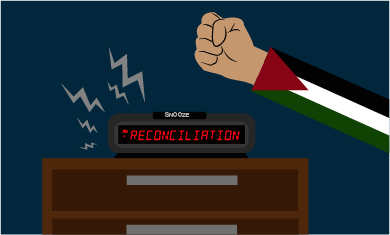
Like the classic Bill Murray movie, Groundhog Day, Hamas and the Palestinian Authority hear their clock alarms go off only to discover they are repeating the same events over-and-over. In their case, these events are their fantasy reconciliation, first tried in 2007, 2008, 2011, 2012, 2014 and now yet again in 2017. These words about the ‘historic’ 2014 effort could have been written today. Still, could the seventh time be the charm?
Just. Possibly. What has changed?
In a region where movements are the extension of leaders, more than states, three major Palestinian players have chained themselves together and then, no doubt unintentionally, lost the disentanglement key.
The first player, Yehya Al-Sinwar, famed architect of Hamas terrorism, took a governmental leadership role early in 2017. Facing the unexpected rebellion of thousands in Gaza this spring who were driven into the streets by a desperation greater even than fear of their own leaders, Sinwar began reaching out, remarkably, to a childhood friend but longer-time enemy, Mohammed Dahlan.
Dahlan, a former Fatah security chief in Gaza, was long a bitter political and military foe of Hamas. However, Dahlan has been engaged in a multi-year internal war with PA leader, Mahmoud Abbas, over the latter’s determined refusal to open any path for a successor, and Dahlan above all.
Al-Sinwar, with Dahlan’s help, began searching for ways to pressure the PA, as well as secure direct aid for Gaza from Dahlan’s own sponsors in the UAE.
If Sinwar and Dahlan believed the old man in Ramallah would buckle, they miscalculated badly. Abbas immediately cut PA distribution of electricity to Hamas by 40% and added a series of other punishing actions. He even fired 6,000 of the PA’s own employees in Gaza. Money (especially the lack of it) talks.
Now, even more desperate, Hamas reached out to another enemy, President Abdel Fattah el-Sisi of Egypt. Hamas agreed to halt its long-successful attrition of Egyptian security across a broad swath of the Sinai in return for Gaza infrastructure aid. Sisi agreed, providing that Hamas also signed on for reconciliation with Abbas, as well as broader Egyptian leadership of regional peace efforts. This converges with Egypt’s own ambitions and need to be seen again as a Sunni power broker across the Middle East and counter-poise to Iran. Good luck with that.
Fast-forward: the (now) four-fold tag team of mutual despisers crafted a marvelous reconciliation agreement that called for the Palestinian Authority to resume direct governance of the Gaza Strip while Hamas disarms. Anwar Sadat himself could hardly have done better, and all this without apparent pressure from Israel, nor obvious involvement from the remarkably invisible American President.
Lest it all seem entirely fictional, Hamas leaked the signed agreement and entertained the PA in Gaza for the first time in a decade. All players professed, in unison, that the play must certainly go on, according to plan.
Yes, but whose plan?
Yehya Al-Sinwa had promised to break the headof anyone who stood in the way of the agreement, which sounded promising. Alas, he then proclaimed with still greater insistence that “The discussion is no longer about recognizing Israel but about wiping Israel out,” adding for good measure, that Hamas would disarm when “Satan enters paradise.” Oops.
Neither Israel nor the famed Quartet has greeted this with, shall we say, enthusiasm.
So, recalling Groundhog Day, isn’t this latest reconciliation much ado about less-than-nothing at all?
Possibly. Not. This has become the first act in a new, highly consequential drama to determine who will take control of Palestinianism in the near-future, given the shared failures of Hamas and PA to deliver either victory-over or peace-with Israel. Like its kissing cousin, the interminable Palestinian-Israeli peace process, this latest intra-Palestinian reconciliation process may now be an unstoppable public-relations fixture.
Meanwhile, the three main players are glued together. Abbas will go, but he will most likely refuse to disappear until Dahlan has been denied the throne in Ramallah. For their part, Sinwar and Hamas need the PA as a foil for their military ambitions, and would prefer a compromised and dependent Dahlan at its head over someone who owes them nothing. Dahlan, of course, foresees Hamas dependence upon him. Meanwhile, Sisi loses nothing if reconciliation collapses, but stands to gain much even from a modest, positive result.
Of the main players, who has been the winner to-date?
Conventional wisdom, as always, claims to know: it’s Abbas, followed closely by el-Sisi. Even if Hamas reneges on demilitarization, the PA seems to have gained the upper-hand in Gaza. But there are a few who believe that Hamas has enticed both Abbas and Sisi into a cunning trap, aided as usual by Iran.
As for the losers, sadly, it remains the Palestinian people, as usual. Even those Palestinians who blame Israel recognize internal failures as the critical cause for current events: “Both Hamas and Fatah are out of options. Their regional politicking was a failure, and their political program ceased to impress Palestinians who are feeling orphaned and abandoned.”
If our analysis proves right, this latest reconciliation ‘process’ must provide a second and third act to follow the first. We will devote future posts, as needed, to analyze relationships between the major players over the coming months, as well as the curious invisibility of America’s President Trump and the veiled visibility of Israel during these seemingly crucial days of negotiation.
Meanwhile, set your alarm and keep an eye out for groundhogs.