
Turkey’s Authoritarian Slide
On October 29, 1923, a young Turkish statesman named Mustafa Kemal Ataturk proclaimed the birth of the Republic of Turkey and became its inaugural President. Following the aggression and regional hegemony of the Ottoman Empire up until the end of the Great War, the Turks’ new state was envisaged to fulfil their self-determination without the imperialist and theocratic proclivities of the Sultanate.
To a large degree, this has been the case for most the last century. Apart from its occupation of Northern Cyprus and its intermittent crackdowns on Kurdish communities, it bore little resemblance to the empire of old. Defined more by its secular constitution and burgeoning economy, Turkey relinquished its former role as Islam’s political authority.
However, under the Presidency of Recep Tayyip Erdoğan, the Republic has begun a gradual, creeping recession into authoritarianism.
The first signs of this slide appeared in relation to the media. Following the anti-Erdoğan Gezi Park protests of 2013, the government responded with sweeping new laws aimed at stifling the media. Incidents involving restrictions on the media included:
- Journalists from Cihan News Agency and the Zaman newspaper were repeatedly barred from attending government press conferences or asking questions.
- The Radio and Television Supreme Council issued fines to pro-opposition news channels such as Halk TV and Ulusal Kanal for their coverage of the protests, alleging that the images were likely to frighten and destabilize the wellbeing of children who could be potentially watching.
- After the protests had subsided, President Erdoğan tightened controls on the internet and blocked Twitter and YouTube.
Alarmingly, according to the Committee to Protect Journalists, Turkey has 81 journalists incarcerated as of December 1 2016. This is the highest of any other country, including all the journalists currently jailed in North Korea, Cuba, Russia and China combined.
The undermining of Turkey’s separation of powers is also concerning. The governing powers and functions in Turkey are divided between the executive, the legislative and an independent judiciary. By design, the religious inclinations of Erdoğan’s Justice and Freedom Party (AKP) are at odds with the historically-secular judiciary. In January 2014, the President purged the judiciary of several officials either for their secularist credentials or those whom he thought to be aligned with his rival Fetullah Gülen. Many of these sacked judicial officers were later replaced by AKP supporters. This was followed by another purge of the judiciary in July 2016, where 2,745 Turkish judges (36% of all judges in Turkey at the time) were removed from duty and ordered to be detained.
Turkey again made international headlines when it held a constitutional referendum in April of this year. The referendum, which succeeded with a ‘yes’ vote of 51.41% to a ‘no’ vote of 48.59%, essentially undermined the liberal founding principles of the Republic and the constitutional constraints on the Presidency. Opposition leader Mithat Sancar stated that a successful ‘yes’ vote and its corresponding amendments would cause the country to ‘quickly become an autocracy’ and eventually a ‘pure dictatorship’. These amendments included:
- Removing the requirement that the judiciary be neutral
- Widely expanding the responsibilities and powers of the Presidency
- Enhancing the President’s powers during a state of emergency
- Dissolving the position of Prime Minister
Following a coup attempt in late 2016, the government initiated a crackdown to purge the military, judiciary, government and civil service of not only those who were implicated in the coup attempt, but also those deemed to be disloyal or dissenting to President Erdoğan. Over 100,000 officials have been dismissed or suspended, including 28,000 teachers. At least 2,200 judges were jailed pending investigation, with 3,400 permanently dismissed. The government also temporarily derogated from many of the key provisions of the European Convention on Human Rights and the International Convention on Civil and Political Rights. The state of emergency also weakened the safeguards against abuse in detention, leading to increased reports of torture and ill-treatment in police detention such as the beating and stripping of detainees as well as threats of rape.
Furthermore, the Turkish government has intensified actions that intimidate and target the country’s Kurdish minority. Curfews have been enforced in Southern Kurdish towns and cities and, as estimated by Amnesty International, up to half a million people have been forced out of their homes because of security operations by Turkish authorities. Many homes and historic buildings of cultural significance to the Kurds, such as in the city of Diyarbakir, have been shelled or demolished. A report by the Office of the United Nations High Commissioner for Human Rights released in February 2017 accused Turkish authorities of killing hundreds of Kurdish people between July 2015 and the end of 2016.
Importantly, Turkey is bound by a wide range of human rights obligations under international law. Among other treaties, they are a party to the International Convention on Civil and Political Rights, the International Covenant on Economic, Social and Cultural Rights and the United Nations Convention Against Torture. Thus, it is increasingly alarming that the government is engaging in such flagrant violations of their international legal commitments. Although faced with the undeniable threats from terrorism, military mutinies and corruption, President Erdoğan has exaggerated these threats to justify the suppression of free speech, freedom of assembly and the required impartiality of Turkey’s judicial branch of government. Along with his government, he should be subject to extensive further inquiry into these human rights abuses.

Standing up for European Principles On Human Rights
Now More Than Ever:
Summary: Decision Action Still Needed
Four years ago, an audit by the European Court of Auditors (ECA) noted serious irregularities in funds distributed to the Palestinian Authority, especially aid grants remitted to ‘workers’ in Gaza who could not show evidence of employment. Transparency International reported widespread irregularities and likely corruption throughout the payment system in a 2016 report.
Overall, while some modest improvements have been noted, decisive EU action to mandate adequate accounting checks and, where necessary, impose appropriate penalties for non-compliance remains essential.
The 2012 ECA Report on Aid to Workers in Gaza
In late 2012, the European Court of Auditors conducted an on-site study in Israel to verify the aid distribution mechanism from the EU through PEGASE to the Palestinian Authority (PA). PEGASE describes itself as:
"… the European Union’s mechanism to support the Palestinian people through implementation of … the PA’s own Single Treasury Account (STA) or via direct payments to eligible companies and individuals in full transparency, co-operation and agreement with the PA."
This illustration from the 2013 ECA report depicted the steps to be carried out by the PEGASE process:
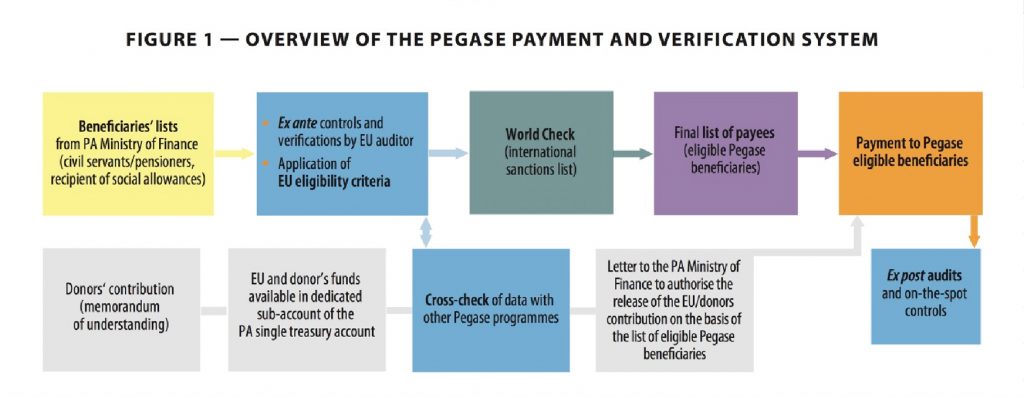
In a key finding, the ECA report stated that:
"Pegase DFS has contributed to essential public services, but the audit found that in Gaza a considerable number of civil servants were being paid without going to work and providing a public service due to the political situation in Gaza. The Commission and the EEAS have not sufficiently addressed this problem."
Consequently, the ECA advised the EU to forge an agreement with the PA to cease civil servant payments in Gaza and transfer these to the West Bank, as well as to “apply conditionality to the future Pegase DFS, specifically by linking it to concrete progress by the PA on civil service reform.”
The EU Commission agreed to the latter recommendation on conditionality. However, the EU did not then accept the proposal to sever payments to civil service workers in Gaza. Nevertheless, in February 2017, the decision was taken to shift funding of Gaza public employees in favor of direct aid to poor families. The Communication officer of the EU Commission, Shadi Othman, positioned this to the Palestinian media as a minor change in procedure. In a separate interview, Othman opposed the conditionality provisions of the ECA recommendations as a form of ‘blackmail’ against the Palestinian people.
The 2016 Transparency International Report
On Illicit Enrichment of Palestinian Public Officials
Transparency International is a global NGO leading the fight against governmental corruption. Sweden sponsored, though it did not necessarily concur with the conclusions reached in their report titled “Asset Declarations in Palestine: Illicit Enrichment and Conflicts of Interest of Public Officials.”
The report observed that more than US$160 billon is believed to have been stolen by regime officials over the years in Egypt, Libya, Tunisia and Yemen alone. Subsequently, international standards for declaring and tracking asset accumulation by public officials have been defined and, sometimes, adopted by affected countries. This has included organizations like the Palestinian Authority. Even so, the report contains scathing criticism of the gulf between formal adoption and on-the-ground practices.
Not a single standard of the ten outlined below have been implemented effectively - some not at all - by the PA:
- Creation of a legal basis for detecting illegal enrichment and conflicts of interest (a law passed in 2002 was later revised to exclude many government officials, including judges).
- Declaration of all income, gifts, loans and sales of property by those entering public service (the current regulations are ambiguous, creating the potential for hiding illicit funds in non-reportable categories).
- All officials should be required to declare assets (judiciary officials, at high risk of illicit activities, are excluded; family members are included but do not, in practice, declare).
- Asset declarations must be submitted when assuming office (no statistics on compliance, but it is believed the majority of required declarations are never submitted; the provision seems to be “toothless”).
- Asset declaration must be verified (no law in place, no evidence that even a single case has been brought against an official in non-compliance).
- An oversight body will conduct asset verification, with access to public databases (created, without dedicated staff, training or procedures).
- Formal operation will occur between the oversight body and prosecution, police and finance intelligence (not established).
- Asset declarations will be visible and accessible to the public (not implemented).
This table illustrates the categorization of assets subject to declaration, showing which items must be declared. As mentioned above, some categories are ambiguous and can be flexibly ‘interpreted’ by those making asset declarations:
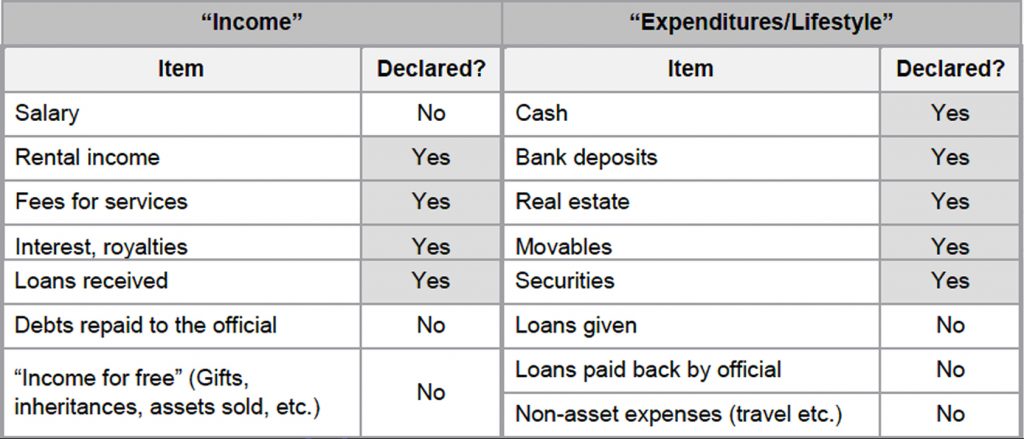
The 2016 Transparency International report concluded by stating that “Palestine has fallen behind international standards on asset declaration” and by offering a series of reform proposals.
Conclusion: The More Things Change …
A proverbial French expression notes that ‘the more things change, the more they remain the same.’ Regrettably, this applies to EU funding of PA activities. While we commend the efforts of the ECA and Transparency International to shed continued light on the lack of substantive accountability by the PA, it falls to the EU to take the decisive action required for permanent reform.
Conditionality - the formal linkage between change in PA behavior and aid distribution to Palestinians - must include measurable criteria for each standard of financial accountability. Enforcement, including sanctions where needed, must be applied without reference to PA complaints. The EU can, through this method alone, offer genuine help to the Palestinian people who are the hoped-for recipients of financial aid that today, as in the past, too often finds its ways into the private bank accounts of a corrupt political and legal class.

Incitement: The Low-Hanging Fruit to Achieving a Peace Deal
One of our interns recently sat down for an interview with former Israeli Ambassador to Canada Alan Baker of the Jerusalem Center for Public Affairs. In line with his role as the organization’s international law expert and Director at the Institute for Contemporary Affairs, the Ambassador has amassed a wealth of experience in dealing with the international legal implications of incitement.
The protracted conflict between Israel, the Palestinians and the wider Arab world has endured for over six decades. One reason for this is that many of the issues up for negotiation in a final peace agreement - refugees, borders, demilitarization and settlements - are notoriously complex. However, the issue of incitement is one point of difference between the two parties that could and should be easily resolved.
Within the context of Israeli-Palestinian relations, incitement refers to either:
- The act of encouraging or urging another person to commit violence, or
- Knowingly disseminating false information about a particular group of people with the aim of provoking a violent reaction
When asked about the issue’s centrality in resolving the conflict, Ambassador Baker pointed out that incitement is specifically addressed in the interim agreement of the Oslo Accords. He notes “a committee was set up – the Palestinians, the Israelis, and the Americans, to handle incitement by everyone”. Interestingly, the inclusion within the agreement framework was borrowed from Israel’s peace treaties with Israel and Jordan. Again, the Ambassador points out that “there are specific provisions there calling upon each side to do whatever is necessary – from the point of view of education and one thing or another – to encourage good neighbourliness and prevent incitement”.
The strategic use of incitement has permeated Palestinian leadership since before the inception of the Israeli state. Most infamously, it was employed to horrific effect in the Hebron Massacre of 1929, where between 67-69 Jewish people were killed by Arab mobs who were told of supposed Jewish plans to storm the Al-Aqsa mosque in Jerusalem. In contemporary times, we have seen a rapid resurgence of these accusations from the upper echelons of the Palestinian Authority. In September 2015, at the height of a wave of car-ramming and stabbing attacks, PA President Mahmoud Abbas alleged Jewish interference at the Muslim holy site. “Al-Aqsa is ours and so is the Church of the Holy Sepulchre”, he proclaimed. “They have no right to desecrate them with their filthy feet. We won’t allow them to do so and we will do whatever we can to defend Jerusalem.” As foreign governments - particularly the Obama administration - were urging parties to calm tensions and combat incitement, Abbas continued “each drop of blood that was spilled in Jerusalem is pure blood as long as it’s for the sake of Allah. Every martyr will be in heaven and every wounded person will be rewarded, by Allah’s will”. As recently as July 2017, PA Parliament Member for Fatah, Hatem Abd Al-Qader, stated “we are moving towards an escalation. The Israelis are moving towards an escalation, and we have no problem on our part that there will also be an escalation from the Palestinian side. Escalation is answered with escalation, and violence is answered with violence”.
As it currently stands, access to the site is governed by an arrangement achieved immediately after Israel’s unification of Jerusalem in the Six Day War of 1967. More commonly known as the ‘status quo’, the site is administered by a Jordanian trust known as the waqf and grants access to Muslims, Christians and Jews but forbids prayer by the latter two groups. Apart from the periodic unsubstantiated allegations from Palestinian leaders, no evidence exists suggesting any current or planned changes to the status quo. Member of Knesset Yehuda Glick, who currently serves in the governing Likud party, can attest to this. Prior to his ascension to the Knesset, Glick was a prominent campaigner for Jewish prayer rights at the Temple Mount and, therefore, alterations to the status quo. During that time, he survived an assassination attempt by a man who believed Glick to be “an enemy of Al-Aqsa”. Ironically, he serves in a governing party that enforces an arrangement to which he is diametrically opposed.
Importantly, the phenomenon of incitement is not limited to perceived incursions on the Temple Mount. Religious clergy play a significant role in shaping their followers’ attitudes to violence. For example, in October 2015, Rafah cleric Sheikh Muhammad Sallah "Abu Rajab" brandished a knife while exclaiming “Form stabbing quads. We don't want just a single stabber. Oh young men of the West Bank: Attack in threes and fours. Some should restrain the victim, while others attack him with axes and butcher knives…Oh men of the West Bank, next time, attack in a group of three, four, or five. Attack them in groups. Cut them into body parts”.
Ambassador Baker became well-known in the international legal community for authoring the Draft International Convention for the Prevention of Incitement to Terror, which borrowed language and preambular paragraphs from other U.N. Conventions addressing terrorism. However, the dissonance between the recognition of the problem and the collective will to act ultimately torpedoed the document’s success. “Everybody admits and accepts the fact that incitement is a central component of terror today but nobody’s prepared to act against it”, argues Baker. “There’s a resolution every year in the General Assembly condemning international terrorism and this includes advocating, inciting… but it’s not a legal document - it’s a political thing accepted by a political majority but it has no teeth.”
Similarly, the Ambassador laments the lack of collective will to combat incitement on the international stage. He was disappointed that his efforts to prosecute former Iranian President Mahmoud Ahmadinejad for inciting genocide against Jews and Israelis - in contravention of Article 3(c) of the Convention on the Prevention and Punishment of the Crime of Genocide - were unsuccessful. “Not only is Ahmadinejad violating provisions of the ICC Statute, it doesn’t matter because he’s also violating the Convention Against Genocide by advocating genocide and therefore he’s bound, he’s violating international law.” He added that, together with the Canadian B’nei Brith, he even drafted a charge sheet detailing which international crimes he committed.
The elusive peace between Israelis and Palestinians will neither be achieved easily nor overnight. Although we may not know the exact nature of any final agreement, we can say which actions will torpedo any progress. It won’t include conspiracies of Jewish hordes swarming Islamic holy sites, nor calls to arms aimed at instigating a religious war. Palestinian leaders and clerics owe it to their children to spread a message of nonviolence. They must reject – not just publicly – the idea of mukawama (armed resistance) and champion the idea that there is no glory in the afterlife for stabbing innocent people or car ramming children. Words matter – particularly with impressionable youth and the age of technology. As such, incitement in all its forms is a disaster for coexistence.

The Protocols of the Elders of Zion
A Case Study in Bigotry
Often referenced by those who are paranoid of a global cabal of Jewish bankers, the Protocols of the Elders of Zion remains the most important text in the arsenal of anti-Semitism. How did such a book emerge? How did its prejudices and conspiracy theories garner traction in societies around the world? And how does it inform opinion today?
Much like the conspiracy itself, the history of the book is based upon plagiarism and a patch-work of anti-revolutionary angst. Its conceptual inspiration can be traced back to the time of the French Revolution at the end of the 18th Century. Seizing upon the paranoia of reactionary elements who were opposed to the revolution, a French Jesuit priest named Abbe Barruel published a dossier in 1797 which attributed the revolution to the actions of the Freemason Order[1]. In 1806, he elaborated on his earlier work by circulating a forged letter by the state police alleging Jewish involvement in the conspiracy of the Masons.
Although making no mention of the Jews, the theme of clandestine meetings reappeared in 1864 with French satirist Maurice Joly. Joly published a pamphlet named Dialogues in Hell Between Machiavelli and Montesquieu which jokingly accused the emperor Napoleon III of convening a meeting in Hell[2]. Although made in jest to prove a political point, the theme was recycled by a German author named Hermann Goedsche – a man known both for his strident anti-Semitism and fraudulence. He routinely forged letters and documents that discredited left-wing politicians[3], which eventually cost him his job in the German postal service[4]. Goedsche adapted Joly’s satirical work into a series titled Biarritz, although the theme of this work was Jewish conspiracy rather than allegations against Napoleon.
In the late 19th and early 20th Century, the Russian Empire was gripped by a strong wave of antisemitism. Economic hardships created space for a scapegoat and growing dissatisfaction with the Imperial government created fissures between loyalists and revolutionaries. When Goedsche’s work found its way to Russia, it was not critically examined for its accuracy or objectivity. Rather, it was translated into Russian in 1872, and enabled the Okhrana (Russian secret police) to strengthen the position of the unpopular Czar and discredit the liberals who were more hospitable to the Jews. Events such as the Dreyfus Affair that began in 1894 and the first Zionist Congress in Basel in 1897 exacerbated the anti-Semitic sentiment of the time and fueled the myth of Jewish attempts to subvert the culture and authority of European states. Evidence suggests that the book as we know it today, The Protocols of the Elders of Zion, was cobbled together from pre-existing sources by agents of the Okhrana working in Paris during the years of the Dreyfus Affair[5]. Published by the mystic Russian priest Sergei Nilus in 1905, they helped inspire the pogroms of 1905 with the help of the Okhrana. Furthermore, in the midst of an attempted revolution by communist revolutionaries that same year, the Russian ultra-nationalist Black Hundreds organization used the book as a precursor to blame the Jews for the installation of a new constitution and the Duma (parliament)[6].
After its emergence in Imperial times, the document has been used extensively by fascist movements and governments around the world. Most infamously, it was propagated by Adolf Hitler to justify the persecution and genocide of Europe’s Jewish community. In his manifesto Mein Kampf, he wrote:
‘[The Protocols] are based on a forgery, the Frankfurter Zeitung moans [ ] every week . . . [which is] the best proof that they are authentic. ... the important thing is that with positively terrifying certainty they reveal the nature and activity of the Jewish people and expose their inner contexts as well as their ultimate final aims’[7].
In the contemporary world, the document continues to inform opinion among people who do not question its authenticity. It remains available in some book stores in countries such as Egypt, Iraq and Saudi Arabia. Furthermore, the Charter of Hamas makes reference to the document in what it says is the embodiment of Jewish and Zionist aspirations:
‘When they [the Zionists] will have digested the region they overtook, they will aspire to further expansion, and so on. Their plan is embodied in the “Protocols of the Elders of Zion”, and their present conduct is the best proof of what we are saying[8]’.
Aside from people’s ignorance to the document’s fraudulence, its success and reach is derived from well-established stereotypes and myths about Jewish people. Historian Daniel Pipes notes that it effectively reinforces the recurring themes of conspiratorial anti-Semitism:
- Jews always scheme
- Jews are everywhere
- Jews are behind every institution
- Jews obey a central authority, the shadowy ‘Elders’
- Jews are close to success
These perceptions of Jews still exist today in some circles. They are understood to be a highly-organized, secretive sect – more reminiscent of a satanic cult than an ethnic or religious group. They resemble people concerned only with control and resource accumulation, rather than engaging in tikun olam (repairing the world) or adhering to a covenant with an omniscient Creator. Thus, the next time one encounters vilification of Jewish people or the Jewish State, it behooves us to analyze the criticism. If it is based upon an assumption of a well-financed effort to exert global influence, the propagators may be – either knowingly or subconsciously – paying homage to the famous fraudulent manifesto.
[1] Jewish Virtual Library, ‘Anti-Semitism: History of the “Protocols of the Elders of Zion”’, viewed 9 April 2017, http://www.jewishvirtuallibrary.org/the-ldquo-protocols-of-the-elders-of-zion-rdquo
[2] Ibid.
[3] McLeod, K. 2014, Pranksters: Making Mischief in the Modern World’, New York University Press, United States of America, p. 105
[4] Jewish Virtual Library . op. cit.
[5] Webman, E. 2011, The Global Impact of the Protocols of the Elders of Zion: A Century-Old Myth, Routledge, New York, p. 2
[6] Jewish Virtual Library, op. cit.
[7] Hitler, A. 1933, ‘XI: Nation and Race’, in Mein Kampf, Eher Verlag, Germany, pp. 307-308
[8] Yale Law School, ‘Hamas Covenant 1988’, viewed 9 April 2017, http://avalon.law.yale.edu/20th_century/hamas.asp
[1] Jewish Virtual Library, ‘Anti-Semitism: History of the “Protocols of the Elders of Zion”’, viewed 9 April 2017, http://www.jewishvirtuallibrary.org/the-ldquo-protocols-of-the-elders-of-zion-rdquo
[1] Ibid.
[1] McLeod, K. 2014, Pranksters: Making Mischief in the Modern World’, New York University Press, United States of America, p. 105
[1] Jewish Virtual Library . op. cit.
[1] Webman, E. 2011, The Global Impact of the Protocols of the Elders of Zion: A Century-Old Myth, Routledge, New York, p. 2
[1] Jewish Virtual Library, op. cit.
[1] Hitler, A. 1933, ‘XI: Nation and Race’, in Mein Kampf, Eher Verlag, Germany, pp. 307-308
[1] Yale Law School, ‘Hamas Covenant 1988’, viewed 9 April 2017, http://avalon.law.yale.edu/20th_century/hamas.asp
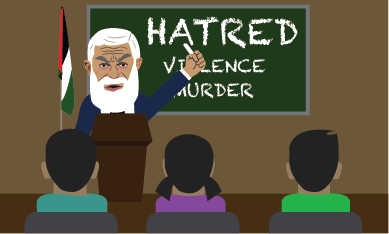
And what about incitment?
If we learned anything from the wave of terror in 2015-2016, it is that words matter. In an environment where Palestinian unemployment remains staggeringly high, disenfranchised youth become more impressionable and susceptible to the pronouncements of charismatic leaders. Hence, when President Abbas decries Jews visiting the Temple Mount as having ‘no right to defile it with their filthy feet’, its legitimacy is only accentuated for young Palestinian men. The recourse to martyrdom then becomes a logical response because, as Abbas describes, ‘we bless every drop of blood that has been spilled for Jerusalem, which is clean and pure blood’.
In cases like these, the line between Zionism and Jews becomes ever more blurred. A disagreement over religious access to a holy site becomes an aspersion on the humanity, or lack thereof, of Jewish people. Coupled with the reverence of Palestinian officials for mukawama (armed resistance), it is a recipe for disaster in coexistence.
Importantly, this incitement does not occur within a vacuum. It also coincides with an extensive period of classroom indoctrination. From a young age, children are not simply taught to resent encroachment on their land or commit themselves to non-violent resistance. Rather, they are taught to detest Jews and to sacrifice themselves in martyrdom to bring about their demise.
As reported by the Times of Israel in March 2016, one particular ninth-grade textbook was none-too subtle in its advocacy for armed resistance and martyrdom. One page began with a Quranic verse which instructs Muslims to kill or imprison non-believers.
If nothing else, the great crime here is the systematic hijacking of children’s minds. Young children are not yet able to discern what is right from wrong, and they are the victims of efforts to train a generation of young people in hate and animosity. This cycle is then repeated for future generations, when the children mature and circulate the material to the next cohort.
In recent years, the Palestinians have pursued efforts to join the community of nations and the system that binds them together. This includes receiving non-member observer status at the UN in 2012, as well as their ratification of the Rome Statute of the International Criminal Court in 2015. However, accessions such as these also carry responsibilities. It is, at best, disingenuous join an international legal system aimed at preventing large-scale violence whilst sowing the seeds for such calamity among one’s own people.
Given the albeit delayed moves toward free and fair elections in the Palestinian territories, the ball is now in the court of Palestinian officials and candidates. They can propagate insidious blood libels (as Hamas spokesman Osama Hamdan did on Lebanese TV in 2014) or they can reject the nihilism of centuries-old folklore by countering incitement and championing non-violence.

4 times too much
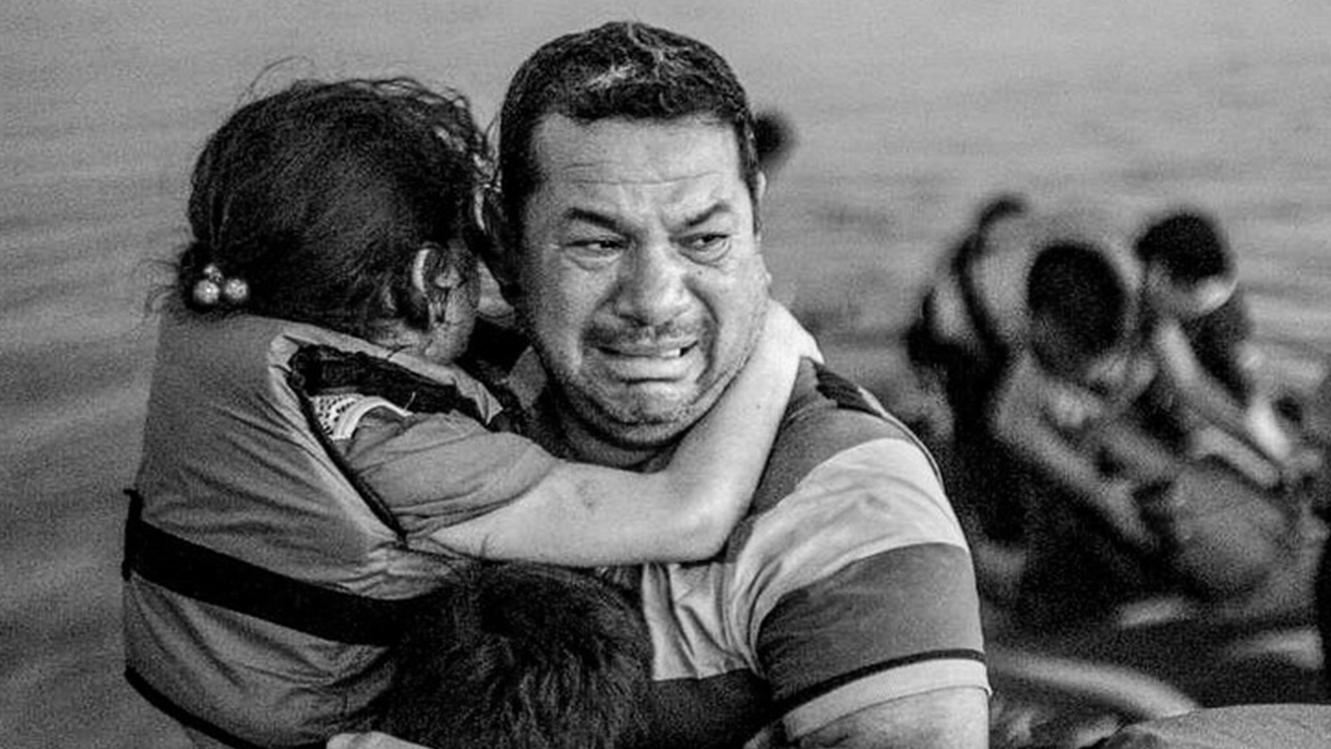
The U.N. faces the largest refugee crisis in its history. Sixty-eight million people need help. Why, then, does the U.N. give four times as much aid, annually, to each Palestinian refugee as it gives to refugees anywhere else in the world?
Here is another question.
Why does UNRWA, the agency that handles five million Palestinians, employ 30,000 people while the World Refugee Agency (UNHCR), which serves sixty-three million refugees, employs 10,000 people?
The answers: politics. And politics.
To make matters even worse, the two agencies duplicate efforts in the same regions. UNRWA clinics refuse to treat Syrian or Lebanese refugees, but will only treat Palestinians. So, UNHCR must maintain redundant clinics in the same places, while the desperate health needs of refugees in other world regions take the hit.
Ron Prosor, former Israeli ambassador to the U.N. and currently the head of the Abba Eban Institute for Diplomacy, will shortly present the U.N. a plan to consolidate the resources of both agencies. What could possibly prevent the long-overdue adoption of such a common-sense proposal?
Nothing but politics as practiced within the as-if world of UNRWA whose work, unlike UNHCR, expects and requires the number of Palestinian refugees to “expand without limit”.
How can such a political miracle take place?
Conveniently, it turns out that Palestinian refugees aren’t really refugees at all and never have been.
Refugees, by definition, are refugees from somewhere. Palestinians are not, as you may imagine, refugees from Israel because they would then be eligible to apply for asylum in countries like Egypt, Syria and Jordan. But those countries have refused to accept and resettle Palestinians within their own lands for more than seven decades, blaming Israel for their own hostility.
Nor, however, can Palestinians return, legally, to Israel. They are not refugees from that land. Besides, U.N. statutes stipulated Israel’s own sovereignty, which she confirmed by a heroic war of Independence, and completed by generous assimilation of mistreated Jewish refugees.
Until the Orwellian treatment of Palestinians ends, normalization of relations between them, Israel and even other Arab nations is impossible. Not Israel, but rather fellow-Arabs and a complicit UNRWA trap the Palestinian people within impossible legal and political contradictions.
Prosor’s plan will end the UNRWA fantasy. Unfortunately, this makes it all too likely that the consolidation of UNRWA and UNHCR will fail to pass muster at today’s United Fantasyland, a.k.a. the United Nations.
International Borders and Human Trafficking in Israel and Texas
Israel and Texas may not seem to have much in common upon initial thought. After all, the State of Texas is approximately 33 times the size of Israel, yet, both lands face human trafficking concerns due to their international borders. The Trafficking Victims Protection Act (TVPA) defines “severe human trafficking” as:
“sex trafficking in which a commercial sex act is induced by force, fraud, or coercion, or in which the person ... has not attained 18 years of age; or the recruitment, harboring, transportation, provision, or obtaining of a person for labor or services, through the use of force, fraud, or coercion ... A victim need not be physically transported from one location to another for the crime to fall within this definition.”
In Texas, the border with Mexico spans 1254 miles (2018 km) comprising the longest stretch of border with Mexico when compared to any other state. In comparison, Israel has 664 miles (1068 km) of border with 6 different border countries. Specifically, the Israel-Egypt border has a long history of human trafficking. This article explores both governments’ approaches to human trafficking and border security.
Texas
The State of Texas has battled with human trafficking across the Mexico border for decades. In fact, the U.S. Department of Justice estimates as many as one-quarter of all human trafficking victims pass through Texas. A University of Texas study found that there are 313,000 victims of human trafficking in Texas. Texas also houses the metroplex of Houston, which the Department of Justice has called the “most intense jurisdiction for trafficking in the U.S.”.
There are two primary factors that contribute to the issue of trafficking in Texas. The Mexico border, along with the major thoroughfares in Houston, the 4th largest city in the U.S., creates a prime environment for traffickers to smuggle humans into the United States. However, Texas has proven to be proactive in seeking to prosecute, prevent, and punish the crime of human trafficking. The U.S. Attorney Office for the Southern District of Texas, encompassing 44,000 square miles and 8.3 million people, “prosecutes more cases against defendants than any other United States Attorney Office nationwide.” Additionally, Texas has received a score of 94 and an “A” from Shared Hope International’s Protected Innocence Project report in 2016. Not surprisingly, Texas is not the only land faced with human trafficking concerns due to an international border.
Israel
Israel also experienced a major problem with human trafficking, especially in the 1990s when sex trafficking was rampant. Most victims of the sex trafficking epidemic were women from the Former Soviet Union who were exploited because of their poverty. A wake-up call came when the U.S. State Department placed Israel alongside Pakistan and Bahrain in Tier 3 of the annual Trafficking in Persons (TIP) Report in 2001. Tier 3 is the lowest possible level in the TIP Report and is an indication that a country is doing close to nothing to combat human trafficking within its borders. This spurred the Israeli authorities, along with anti-trafficking NGOs and advocates, to begin addressing the problem of trafficking. Between 2003 and 2005, Israel amended several laws to provide more support for trafficking victims, including legal representation and access to shelters. Israeli authorities also began to crack down on traffickers. As a result of their significant efforts to prevent and prosecute human trafficking, Israel was moved to Tier 2 of the TIP Report in 2002. The Knesset subcommittee on Combatting Human Trafficking and Prostitution chairwoman, Aliza Lavie, celebrated the improvements in the fight against modern-day slavery, however she noted that the progress “does not mean we can stop fighting.” Accordingly, a breakthrough in the fight against trafficking came with the construction of the southern border fence with Egypt.
Border Security by The Numbers
In 2013, Israel completed construction of a 150-mile (245 km) fence along its border with Egypt. The number of illegal crossers on the Israel-Egypt border dropped 99 percent after the construction of the fence, from more than 16,000 in 2011 to less than 20 in 2016. Israel spent $415 million ($2.9 million per mile) to construct the southern border fence and spends approximately $8.3 million annually ($58,000 per mile) to maintain the fence. For every 1.2 miles of fencing, Israel stations one person along its border with Egypt.
Although the United States does not have a complete border fence with Mexico, the U.S. has spent $2.3 billion to construct 654 miles of pedestrian and vehicle barrier fencing along the U.S.-Mexico border. Further, it costs the U.S. $50 to $55 million annually ($77,000 per mile) to maintain its 650 miles of fencing along the border with Mexico. This cost of maintenance is 33 percent more than Israel. Manpower is not neglected either, with approximately one person stationed for every 2.2 miles of the Mexico border. With these numbers in mind, a comparison of human trafficking in Texas and Israel is more easily understood.
Human Trafficking Today in Texas and Israel
In 2017, both the United States and Israel received a Tier 1 ranking in the U.S. Department of State’s TIP Report. Although Tier 1 is the highest level on the tier system, it does not mean there is no human trafficking in that country. Unfortunately, according to the Texas Department of Public Safety, the issue of trafficking is not going away any time soon. Notably, in the 2017 Texas Public Safety Threat Overview, trafficking is the fastest growing organized crime in Texas. Although Israel may no longer be a haven for sex traffickers, trafficking still exists. With the closed borders, traffickers now bring victims into Israel through the Ben Gurion International Airport in Tel Aviv. According to the Border Control Commissioner, over the past year and a half, 372 women have been stopped from entering through Ben Gurion Airport. Michal Yusupov, head of the Population Control Division, noted that the number of women attempting to enter Israel has increased in the past year. Even though all 372 women were prohibited from entering, it is likely that others have entered under the guise of tourism without being stopped. Even still, the 2017 TIP Report noted Israel’s “serious and sustained” efforts to eliminate trafficking. Some countries are now looking to Israel’s successful fight against trafficking to learn what strategies are most effective.
What Can Texas Learn From Israel
Reports supporting the building of a fence on the United States-Mexico border often use Israel’s success with the Israel-Egypt border fence as an example. Although the U.S., and especially Texas, can learn many important border security lessons from Israel due to the similarities in human trafficking, there are complications that are often forgotten in these reports. Take, for example, the sheer length of the U.S.-Mexico border which is drastic in comparison to the Israel-Egypt border. As previously mentioned, Israel’s border stretches approximately 150 miles, while just the Texas-Mexico border is over 1200 miles. Another complication arises from the fact that the U.S.-Mexico border runs alongside four states, all with varying opinions on border security. The bordering states of New Mexico and California both have laws that limit how local police interact with federal immigration agents—also known as sanctuary cities. The two other border states, Arizona and Texas, do not have such laws. This discrepancy makes a unified plan for border security difficult to draft and implement.
Despite the challenges, much progress can be made in U.S. border security based on Israel’s success when the beforementioned nuances are taken into consideration. For instance, technology has proven to be key in monitoring and capturing traffickers in Israel. Israel uses an array of technology including seismic sensors, radars, and balloons with cameras to reinforce its southern border fence. The Port Authority of Texas has taken note of Israel’s use of technology. In 2014, Texas contracted with an Israeli company, RADWIN, to use advanced cameras to monitor ports-of-entry into the United States. The modern tactic to combat human trafficking is combined governmental efforts and advanced technology. Texas may not be able to copy-cat Israel’s border fence; however, this does not mean the U.S. cannot use Israel as an example to find the most effective border security strategy unique to the Texas-Mexico border.
Petition to the International Association of Prosecutors
Petition to the International Association of Prosecutors
The Hague, September 2017
Dear members of the IAP Executive Committee and the Senate, dear members of the IAP,
In the run-up to the annual conference and general meeting of the International Association of Prosecutors (IAP) in Beijing, China, the undersigned civil society organisations urge the IAP to live up to its vision and bolster its efforts to preserve the integrity of the profession.
Increasingly, in many regions of the world, in clear breach of professional integrity and fair trial standards, public prosecutors use their powers to suppress critical voices.
In China, over the last two years, dozens of prominent lawyers, labour rights advocates and activists have been targeted by the prosecution service[1]. Many remain behind bars, convicted or in prolonged detention for legal and peaceful activities protected by international human rights standards, including the Universal Declaration of Human Rights. Azerbaijan is in the midst of a major crackdown on civil rights defenders, bloggers and journalists, imposing hefty sentences on fabricated charges in trials that make a mockery of justice[2]. In Kazakhstan, Russia and Turkey many prosecutors play an active role in the repression of human rights defenders, and in committing, covering up or condoning other grave human rights abuses[3].
Patterns of abusive practices by prosecutors in these and other countries ought to be of grave concern to the professional associations they belong to, such as the IAP. Upholding the rule of law and human rights is a key aspect of the profession of a prosecutor, as is certified by the IAP’s Standards of Professional Responsibility and Statement of the Essential Duties and Rights of Prosecutors, that explicitly refer to the importance of observing and protecting the right to a fair trial and other human rights at all stages of work[4].
Maintaining the credibility of the profession should be a key concern for the IAP. This requires explicit steps by the IAP to introduce a meaningful human rights policy. Such steps will help to counter devaluation of ethical standards in the profession, revamp public trust in justice professionals and protect the organisation and its members from damaging reputational impact and allegations of whitewashing or complicity in human rights abuses.
For the second year in a row, civil society appeals to the IAP to honour its human rights responsibilities by introducing a tangible human rights policy. In particular:
We urge the IAP Executive Committee and the Senate to:
- introduce human rights due diligence and compliance procedures for new and current members, including scope for complaint mechanisms with respect to institutional and individual members, making information public about its institutional members and creating openings for stakeholder engagement from the side of civil society and victims of human rights abuses[5].
We call on individual members of the IAP to:
- raise the problem of a lack of human rights compliance mechanisms at the IAP and thoroughly discuss the human rights implications before making decisions about hosting IAP meetings;
- identify relevant human rights concerns before travelling to IAP conferences and meetings and raise these issues with their counterparts from countries where politically-motivated prosecution and human rights abuses by prosecution authorities are reported by intergovernmental organisations and internationally renowned human rights groups.
Supporting organisations:
Africa Network for Environment and Economic Justice, Benin
Anti-Corruption Trust of Southern Africa, Kwekwe
Asian Forum for Human Rights and Development (FORUM-ASIA)
Asia Justice and Rights, Jakarta
Asia Indigenous Peoples Pact, Chiang Mai
Asian Human Rights Commission, Hong Kong SAR
Asia Monitor Resource Centre, Hong Kong SAR
Association for Legal Intervention, Warsaw
Association Humanrights.ch, Bern
Association Malienne des Droits de l'Homme, Bamako
Association of Ukrainian Human Rights Monitors on Law Enforcement, Kyiv
Associazione Antigone, Rome
Barys Zvozskau Belarusian Human Rights House in exile, Vilnius
Belarusian Helsinki Committee, Minsk
Bulgarian Helsinki Committee, Sofia
Canadian Human Rights International Organisation, Toronto
Center for Civil Liberties, Kyiv
Centre for Development and Democratization of Institutions, Tirana
Centre for the Development of Democracy and Human Rights, Moscow
Center for the Judiciary Watch of the People’s Solidarity for Participatory Democracy (PSPD), Seoul
China Human Rights Lawyers Concern Group, Hong Kong SAR
Civil Rights Defenders, Stockholm
Civil Society Institute, Yerevan
Citizen Watch, St. Petersburg
Collective Human Rights Defenders “Laura Acosta” International Organization COHURIDELA, Toronto
Comunidad de Derechos Humanos, La Paz
Coordinadora Nacional de Derechos Humanos, Lima
Destination Justice, Phnom Penh
East and Horn of Africa Human Rights Defenders Project, Kampala
Equality Myanmar, Yangon
Faculty of Law - University of Indonesia, Depok
Fair Trials, London
Federation of Equal Journalists, Almaty
Former Vietnamese Prisoners of Conscience, Hanoi
Free Press Unlimited, Amsterdam
Front Line Defenders, Dublin
Foundation ADRA Poland, Wroclaw
German-Russian Exchange, Berlin
Gram Bharati Samiti, Jaipur
Helsinki Citizens' Assembly Vanadzor, Yerevan
Helsinki Association of Armenia, Yerevan
Helsinki Foundation for Human Rights, Warsaw
Human Rights Center Azerbaijan, Baku
Human Rights Center Georgia, Tbilisi
Human Rights Embassy, Chisinau
Human Rights House Foundation, Oslo
Human Rights Information Center, Kyiv
Human Rights Matter, Berlin
Human Rights Monitoring Institute, Vilnius
Human Rights Now, Tokyo
Human Rights Without Frontiers International, Brussels
Hungarian Civil Liberties Union, Budapest
IDP Women Association "Consent", Tbilisi
IMPARSIAL, the Indonesian Human Rights Monitor, Jakarta
Index on Censorship, London
Indonesian Legal Roundtable, Jakarta
Institute for Criminal Justice Reform, Jakarta
Institute for Democracy and Mediation, Tirana
Institute for Development of Freedom of Information, Tbilisi
International Federation for Human Rights (FIDH)
International Partnership for Human Rights, Brussels
International Service for Human Rights, Geneva
International Youth Human Rights Movement
Jerusalem Institute of Justice, Jerusalem
Jordan Transparency Center, Amman
Justiça Global, Rio de Janeiro
Justice and Peace Netherlands, The Hague
Kazakhstan International Bureau for Human Rights and Rule of Law, Almaty
Kharkiv Regional Foundation Public Alternative, Kharkiv
Kosovo Center for Transparency, Accountability and Anti-Corruption - KUND 16, Prishtina
Kosova Rehabilitation Center for Torture Victims, Prishtina
Lawyers for Lawyers, Amsterdam
Lawyers for Liberty, Kuala Lumpur
League of Human Rights, Brno
Macedonian Helsinki Committee, Skopje
Masyarakat Pemantau Peradilan Indonesia (Mappi FH-UI), Depok
National Coalition of Human Rights Defenders, Kampala
Netherlands Helsinki Committee, The Hague
Netherlands Institute of Human Rights (SIM), Utrecht University, Utrecht
NGO "Aru ana", Aktobe
Pakistan Rural Workers Social Welfare Organization (PRWSWO), Bahawalpur
Pen International, London
Philippine Human Rights Advocates (PAHRA), Manila
Promo-LEX Association, Chisinau
Protection International, Brussels
Protection of Rights Without Borders, Yerevan
Public Association Dignity, Astana
Public Association "Our Right", Kokshetau
Public Fund "Ar.Ruh.Hak", Almaty
Public Fund "Ulagatty Zhanaya", Almaty
Public Verdict Foundation, Moscow
Regional Center for Strategic Studies, Baku/ Tbilisi
Socio-Economic Rights and Accountability Project (SERAP), Lagos
Stefan Batory Foundation, Warsaw
Suara Rakyat Malaysia (SUARAM), Petaling Jaya
Swiss Helsinki Association, Lenzburg
Transparency International Anti-corruption Center, Yerevan
Transparency International Austrian chapter, Vienna
Transparency International Česká republika, Prague
Transparency International Deutschland, Berlin
Transparency International EU Office, Brussels
Transparency International France, Paris
Transparency International Greece, Athens
Transparency International Greenland, Nuuk
Transparency International Hungary, Budapest
Transparency International Ireland, Dublin
Transparency International Italia, Milan
Transparency International Moldova, Chisinau
Transparency International Nederland, Amsterdam
Transparency International Norway, Oslo
Transparency International Portugal, Lisbon
Transparency International Romania, Bucharest
Transparency International Secretariat, Berlin
Transparency International Slovenia, Ljubljana
Transparency International España, Madrid
Transparency International Sverige, Stockholm
Transparency International Switzerland, Bern
Transparency International UK, London
UNITED for Intercultural Action the European network against nationalism, racism, fascism and in support of migrants, refugees and minorities, Budapest
United Nations Convention against Corruption Civil Society Coalition
Villa Decius Association, Krakow
Vietnam's Defend the Defenders, Hanoi
Vietnamese Women for Human Rights, Saigon
World Organisation Against Torture (OMCT)
Zimbabwe Lawyers for Human Rights, Harare
[1] As documented by a number of internationally renowned human rights organisations, including Human Rights Watch and the ICJ. See, for example, the HRW World Report 2017, China and Tibet, available at: https://www.hrw.org/world-report/2017/country-chapters/china-and-tibet; China: call for action at UN on lawyers and other human rights defenders, available at: https://www.icj.org/wp-content/uploads/2017/02/UN-HRC34-China-JointLetter-Advocacy-2017.pdf
[2] The Functioning of the Judicial System in Azerbaijan and its Impact on the Fair Trial of Human Rights Defenders, Helsinki Foundation for Human Rights and Netherlands Helsinki Committee 2016, available at: http://www.defendersorviolators.info/judiciary-in-azerbaijan.
[3] See, for example: Human Rights and the Professional Responsibility of Judges and Prosecutors in the Work of CCJE and CCPE. Observations to the CCJE-CCPE Joint Report on “Challenges for Judicial Independence and Impartiality in the Member States of the Council of Europe”, Netherlands Helsinki Committee and Helsinki Foundation for Human Rights 2017, available at: https://www.nhc.nl/assets/uploads/2017/06/20170331-Observations-to-CCJE-CCPE-Report.pdf
[4] Standards of Professional Responsibility and Statement of the Essential Duties and Rights of Prosecutors adopted by the International Association of Prosecutors on 23 April 1999.
[5] See, for example, Options for Promoting Human Rights Compliance by the International Association of Prosecutors, policy brief, October 2016.

Nikki Haley's for Human Rights!
How Nikki Haley’s Background and Beliefs Helped Foster Her Zionist Spirit
In the midst of the continuous storm of anti-Semitism and anti-Israel resolutions that have been produced by the United Nations over the last few decades, there is a light that is shining more brightly now than ever before. Nimrata “Nikki” Haley, the 29th US Ambassador to the UN, is the strong voice advocating for Israel and demanding the bias and hatred towards Israel from other countries must stop immediately. Born to Sikh Indian parents in South Carolina, Haley credits them with first instilling in her a sense of pride and gratitude about living in America. “Well, I am the daughter of Indian parents who reminded my brothers, my sister and me every day how blessed we were to live in this country,” said Haley in an interview at the 2017 AIPAC Convention.
After graduating Clemson University with a BA in Accounting, Haley went to work for her mother’s clothing company, Exotica International. After being involved in numerous executive boards in her community and town, Haley was elected to the South Carolina House of Representatives in January of 2005. She continued this role until January 2011, where she was elected the first female governor of South Carolina. In November of 2016, she was appointed by president-elect Donald Trump to be the 29th United States Ambassador to the UN; she was confirmed in January 2017.
During her career in politics, Haley’s strong Zionistic and pro-Israel stance have been a major focus of hers. While Haley was governor of South Carolina, she signed into law a bill to stop efforts of the Boycott, Divestment and Sanctions (BDS) movement. This legislation was the first of its kind on a statewide level. Haley also stated during the announcement of that bill, that "nowhere has the UN’s failure been more consistent and more outrageous than in its bias against our close ally Israel". As Ambassador, Haley has been extremely outspoken about the UN’s blatant bias against Israel and has been extremely vocal in her personal support and her representing the United States supporting Israel. This is a welcome change for many from the stance of former US Ambassador, Samantha Power, and the US’ decision to abstain from the voting of Resolution 2334.
Samantha Power, who was the 28th US Ambassador under the Obama administration, famously abstained from voting on Resolution 2334 in December 2016, which declared that the Israeli settlement building in the West Bank and East Jerusalem was illegal and violated international law. Power told the 15-member U.N. Security Council, “Israeli settlement activity in territories occupied in 1967 undermines Israel’s security, harms the viability of a negotiated two-state outcome, and erodes prospects for peace and stability in the region." It came as a surprise to many that the US would seemingly go against an ally by refusing to vote against the resolution, especially coming from the woman who said “I will stand up for Israel and work tirelessly to defend it” in her Senate confirmation hearing; the resolution passed with 14 votes for and one abstention, the US. Haley later called the decision to abstain “one of the lowest points in our country….when [Power] abstained, the entire Security Council, and the entire audience, got up and applauded, and Israel was sitting there….watching that. Think about what we just did to a friend. You don’t ever applaud in the Security Council. That never happens. It happened that day.”
Haley has unequivocally and steadfastly supported Israel as the voice of the United States to the UN; she has called the UN out on their bias towards Israel dozens of times, especially when the UN named Israel the country with the most human rights violations in March 2017, beating out Iran, Syria, Libya and North Korea. “You know, basically what it comes down to is I'm not there to play,” said Haley during the 2017 AIPAC Conference. “And what I wanted to make sure of was that the United States started leading again. And leading isn't saying and doing things when it's comfortable. Leading is saying and doing things when it's not comfortable.”
When pressed about how she came to have such a strong stance on Israel and how she became so outspoken about defending Israel, Haley said, “[T]he truth is, I have seen so many similarities between the Israeli culture and the Indian culture. We're very close-knit. We love our families. We have a strong work ethic. We believe in professionalism and philanthropy and giving back. It's very true. So that's all the good things.” India and Israel have shared many similarities in values and members of each country frequently visit the other. Around 40,000 Israelis, many of whom have just finished their required military service visit India annually and around 34,000 Indians visit Israel annually. According to a 2009 international study commissioned by the Israeli Foreign Ministry, the greatest level of sympathy towards Israel from a member of the international community can be found in India, with 58% of Indian respondents showing sympathy towards Israel. In 2015, opinion polls showed 70% of Indians had favorable views of Israel.
Others wonder if perhaps Haley’s conversion to Christianity helped further foster her Zionist feelings. When Haley wed her husband, Michael Haley, who was a Christian, they did both a Sikh and Christian ceremony. Haley said about her choice to convert to Christianity, “We chose Christianity because of the way we wanted to live our life and raise our children — it had nothing to do with me thinking there was anything wrong with the way I was raised, and everything to do with the fact that I am moving forward in my life and had to find a path I felt was right for me.” Many Christians do believe in Israel’s right to exist; these Christians are called “Christian Zionists.” Some Christian Zionists believe that the gathering of the Jews in Israel is a prerequisite for the Second Coming of Jesus. Christian Zionists interpret the prophetic texts as describing inevitable future events, and these events primarily involve Israel, meaning the descendants of Jacob, which are the Jewish people. These prophecies are seen as requiring the presence of Jewish people in the Holy Land; this requirement is sometimes interpreted as being fulfilled by the contemporary state of Israel.
Haley has not made a public comment on whether her Christian views have helped cultivate her support for Israel even more, but whatever Haley’s reasoning, there is no doubt Israel and the American Jews are thankful for Haley’s voice and for tossing her hat into the UN’s ring. “For anyone that says you can't get anything done at the U.N.,” Haley says, “they need to know there's a new sheriff in town.”