

Peticion de Apoyo a 7 de octubre
POR LA MEMORIA DEL 7 DE OCTUBRE, CONTRA EL ODIO Y EL TERRORISMO
Petición dirigida al Secretario General de las Naciones Unidas, António Guterres. A tres años de los ataques terroristas del 7 de octubre de 2023 perpetrados por Hamas, alzamos nuestra voz para preservar la memoria y la dignidad de las víctimas y sobrevivientes, enfrentar el antisemitismo y rechazar toda forma de negación, banalización o justificación de las atrocidades cometidas aquel día.
PETICIÓN POR LA MEMORIA DEL 7 DE OCTUBRE, CONTRA EL ODIO Y EL TERRORISMO
Petición al Secretario General de las Naciones Unidas, António Guterres
Nosotros, miembros de comunidades latinoamericanas unidos por el compromiso de preservar la memoria y la dignidad de las víctimas y sobrevivientes de los ataques del 7 de octubre de 2023, elevamos esta petición al Secretario General de las Naciones Unidas.
Ese fatídico 7 de octubre, Hamas y otros grupos terroristas palestinos llevaron a cabo un brutal ataque contra Israel. Civiles inocentes fueron asesinados, torturados y víctimas de actos de violencia sexual. Entre las víctimas había mujeres, niños, bebés y adultos mayores. Ese mismo día, 251 personas fueron secuestradas y llevadas como rehenes a Gaza. Muchos permanecieron allí durante más de dos años. Solo después de 843 días fue recuperado y devuelto a Israel el último rehén que permanecía en Gaza. Muchos de los secuestrados, lamentablemente, no regresaron con vida.
Tres años después, frente a la persistencia del antisemitismo y de narrativas que niegan, banalizan o buscan justificar la violencia cometida por Hamas, creemos que recordar no es suficiente. La memoria exige también responsabilidad y acción.
Por ello, solicitamos al Secretario General que, antes de concluir su mandato:
- condene de manera inequívoca el terrorismo de Hamas y la toma de rehenes, sin justificaciones ni relativizaciones;
- garantice que, en el marco de las Naciones Unidas, se otorguen de manera efectiva la prioridad, los espacios, la atención y los recursos necesarios para combatir el antisemitismo, la negación y banalización de los ataques del 7 de octubre y toda forma de incitación al odio contra el pueblo judío;
- vele para que los órganos y mecanismos de las Naciones Unidas actúen conforme a los principios de imparcialidad, universalidad y no selectividad, y aseguren que sus espacios no sean utilizados para legitimar discursos de odio, incitación o deshumanización dirigidos contra el Estado de Israel;
- brinde los espacios institucionales y simbólicos correspondientes para preservar y amplificar las voces de las víctimas y sobrevivientes del 7 de octubre, de modo que sus historias formen parte de la memoria colectiva internacional.
Al firmar esta petición, reafirmamos nuestro compromiso con la memoria de quienes fueron asesinados, con quienes sobrevivieron y continúan recuperándose de heridas visibles e invisibles, y con las familias que cargan hasta hoy con las consecuencias del 7 de octubre.
Reafirmamos también nuestro compromiso con el derecho del Estado de Israel a existir, con el derecho del pueblo judío a vivir con seguridad y autodeterminación, y con el derecho de todas las personas de la región a vivir en paz, seguridad y dignidad.
Alzamos nuestra voz por quienes ya no pueden hacerlo.
Recordar es también actuar.
Una iniciativa de

PETICIÓN POR LA MEMORIA DEL 7 DE OCTUBRE, CONTRA EL ODIO Y EL TERRORISMO

Hamas Charter 1988 vs 2017: Why Rhetoric Has Never Meant Reform
Originally published 2017 | Updated January 2026
For many years, Hamas' Charter of 1988 has undermined their legitimacy within the international community. Many advocates in favor of Palestinian independence have found themselves unable to endorse the violence, antisemitism, and calls for genocide contained within the document.
In 2017, Hamas released a revised document titled "General Principles and Policies" in an attempt to rebrand their public image. It served as an affirmation of their ideologies and positions on issues relating to Israel.
Nearly a decade later, and in the shadow of the October 7 massacre, this effort at rebranding can be assessed with greater clarity. From a legal perspective, the revised document did not constitute ideological reform. It was a strategic exercise in linguistic moderation that left Hamas' core objectives intact and legally indefensible.
The Contradiction at the Heart of Hamas' Position
The 2017 document provides insight into Hamas' willingness, or lack thereof, to coexist with an Israeli state:
"Hamas rejects any alternative to the full and complete liberation of Palestine, from the river to the sea. However, without compromising its rejection of the Zionist entity and without relinquishing any Palestinian rights, Hamas considers the establishment of a fully sovereign and independent Palestinian state, with Jerusalem as its capital along the lines of the 4th of June 1967, with the return of the refugees and the displaced to their homes from which they were expelled, to be a formula of national consensus." [i]
This is an oxymoron of a policy, requiring intellectual gymnastics to understand both its consistency and logic. Acceptance of a state along the pre-1967 armistice lines denotes a willingness or reluctant acceptance to live alongside an Israeli state, rather than a "full and complete liberation of Palestine, from the river to the sea." The two positions are incompatible.
Their so-called "acceptance" of a state is essentially an acceptance of a starting point from which to appropriate modern-day Israel. This was admitted by senior Hamas leader Mahmoud al-Zahhar in 2011, who referred to the acceptance of the pre-1967 lines as "just a phase" until Hamas has a chance to "regain the land, even if we [Hamas] have to do so inch by inch." [ii]
Following this logic, Brazil could hypothetically accept a state in Rio de Janeiro yet maintain the entire territorial integrity of modern-day Brazil. Or, more appropriately, the Islamic State could accept a state in Raqqa, Syria, yet maintain its ambitions to establish a Caliphate from Spain to Afghanistan.
Under international law, recognition is not symbolic. It is a prerequisite for durable sovereignty, stable borders, and peaceful relations between states. Hamas' position reduces the concept of statehood to a tactical waypoint rather than a terminal political solution. From a legal standpoint, such a posture fails the minimum threshold of good faith required for participation in any peace process.
Antisemitism in the 1988 Hamas Charter
The 1988 Charter contains conspiratorial antisemitic accusations of Jewish and Zionist domination of global institutions, as well as insinuations about the malevolence of Jewish people:
"Writers, intellectuals, media people, orators, educators and teachers, and all the various sectors in the Arab and Islamic world - all of them are called upon to perform their role, and to fulfil their duty, because of the ferocity of the Zionist offensive and the Zionist influence in many countries exercised through financial and media control, as well as the consequences that all this lead to in the greater part of the world." [iii]
"The Zionist plan is limitless. After Palestine, the Zionists aspire to expand from the Nile to the Euphrates. When they will have digested the region they overtook, they will aspire to further expansion, and so on. Their plan is embodied in the "Protocols of the Elders of Zion", and their present conduct is the best proof of what we are saying." [iv]
"Israel, Judaism and Jews challenge Islam and the Moslem people. "May the cowards never sleep." [v]
"The Jews made no exception for women or children. Their policy of striking fear in the heart is meant for all. They attack people where their breadwinning is concerned, extorting their money and threatening their honour." [vi]
Calls for Violence and Genocide in the Original Charter
The original 1988 Charter did not just draw attention to the supposed true aspirations of world Jewry. It openly advocated for violence and genocide against Jewish people:
"We should not forget to remind every Moslem that when the Jews conquered the Holy City in 1967, they stood on the threshold of the Aqsa Mosque and proclaimed that "Mohammed is dead, and his descendants are all women." [vii]
However, the original 1988 Charter did not just draw attention to the supposed true aspirations of world Jewry. Rather, they openly advocated for violence and genocide against Jewish people:
"In face of the Jews' usurpation of Palestine, it is compulsory that the banner of Jihad be raised" [viii]
"Arab and Islamic Peoples should augment by further steps on their part; Islamic groupings all over the Arab world should also do the same, since all of these are the best-equipped for the future role in the fight with the warmongering Jews" [ix]
"Our struggle against the Jews is very great and very serious" [x]
"The Day of Judgement will not come about until Moslems fight the Jews (killing the Jews), when the Jew will hide behind stones and trees. The stones and trees will say O Moslems, O Abdulla, there is a Jew behind me, come and kill him. Only the Gharkad tree, (evidently a certain kind of tree) would not do that because it is one of the trees of the Jews." (related by al-Bukhari and Moslem) [xi]
The 2017 Document: Antisemitism by Substitution
The revised document is careful to adopt a more palatable tone regarding Jewish people:
"Hamas affirms that its conflict is with the Zionist project not with the Jews because of their religion. Hamas does not wage a struggle against the Jews because they are Jewish but wages a struggle against the Zionists who occupy Palestine. Yet, it is the Zionists who constantly identify Judaism and the Jews with their own colonial project and illegal entity." [xii]
The term "Jews" has been euphemistically replaced with the term "Zionists." This semantic shift does not withstand legal scrutiny.
When "Zionists" are portrayed as a monolithic global force, accused of controlling international institutions, denied historical or cultural ties to the land, and stripped of the right to national self-determination, the distinction collapses. Contemporary international standards, including those adopted by the U.S. State Department, the EU, and numerous international bodies, recognize that denying the Jewish people the right to self-determination or the legitimacy of Israel's existence constitutes modern antisemitism.
The revised language does not abandon antisemitic tropes; it repackages them in terms more palatable to diplomatic audiences.
The Muslim Brotherhood Connection
The revised document presents a major shift in Hamas' public acknowledgement of its ideological and political affiliation. It makes no mention of The Muslim Brotherhood, the Islamist movement designated as a terrorist organization in Russia, Egypt, Bahrain, and Saudi Arabia. This is despite the fact that Hamas emerged as an offshoot of the Egyptian Muslim Brotherhood and is referenced in the original 1988 Charter:
"The Islamic Resistance Movement is one of the wings of Moslem Brotherhood in Palestine. Moslem Brotherhood Movement is a universal organization which constitutes the largest Islamic movement in modern times." [xv]
Although Hamas has not commented on the Brotherhood's omission from its new document, it is likely an attempt to garner favor with regional players such as Egypt and Saudi Arabia who have designated the group as a terrorist organization.
Yet omission is not disavowal. There is no evidence of ideological severance, operational distancing, or repudiation of the Brotherhood's core worldview. The silence reflects a tactical calculation aimed at diplomatic maneuvering rather than genuine transformation.
The Persistence of Violent Doctrine
Crucially, Hamas has never renounced violence against civilians. The 2017 document does not repudiate the 1988 Charter's endorsement of armed struggle, nor does it disavow the religious framing of violence as an obligation.
This is not merely a rhetorical omission. In international humanitarian law, intent matters, but conduct matters more. The systematic targeting of civilians, hostage-taking, sexual violence, and indiscriminate attacks are prohibited per se, regardless of political grievance. These acts constitute war crimes and, in certain contexts, crimes against humanity.
The events of October 7, 2023, eliminated any residual ambiguity about Hamas' operational doctrine. They demonstrated continuity, not rupture, between ideology and action.
Hamas Leaders Confirm: The Charter Remains
For those who viewed the revised document as a step in the right direction, senior Hamas leader Mahmoud al-Zahhar clarified in May 2017 that its revised document did not contradict its founding Charter of 1988:
"The pledge Hamas made before God was to liberate all of Palestine…The Charter is the core of [Hamas’] position and the mechanism of this position is the document…We have reaffirmed the unchanging constant principles that we do not recognize Israel; we do not recognize the land occupied in 1948 as belonging to Israel and we do not recognize that the people who came here (Jews) own this land." [xvii]
Law, Not Language, Determines Legitimacy
Under international law, legitimacy is not conferred by revised phrasing or selective omissions. It is earned through demonstrable compliance with legal norms: recognition of existing states, renunciation of violence against civilians, adherence to humanitarian law, and acceptance of peaceful dispute resolution.
Hamas has met none of these criteria.
The lesson of the past decade is clear: rhetoric cannot substitute for responsibility. Hamas' revised language did not signal ideological evolution; it signaled strategic adaptation.
International law is not deceived by euphemism. It judges actors by their objectives, conduct, and adherence to binding norms. On all three counts, Hamas remains in fundamental violation of the principles that govern lawful political participation and the protection of human rights.
Rebranding does not erase responsibility. And moderation in words, when contradicted by violence in practice, carries no legal weight.
The Jerusalem Institute of Justice provides free legal aid to survivors of terrorism, human trafficking, and discrimination. We fight against antisemitism around the world and stand up for Israel on the world stage by being the only pro-Israel non-profit with ECOSOC status at the United Nations. Your donations can help make a difference against antisemitism as well as provide free legal aid to those who need it most in Israel.
References
- [i] Hamas 2017, A Document of General Principles & Policies, May 1, viewed 11 May 2017, http://hamas.ps/en/post/678/
- [ii] Middle East Media Research Institute (MEMRI) 2011, ‘Hamas Leader Mahmoud Al-Zahhar Slams PA President for “Aimless Kangaroo-Like” Political Gymnastics and Says: We Will Not Relinquish Any Piece of Palestinian Land’ (Transcript of Excerpts from Television Interview with Hamas Leader Mahmoud al-Zahhar on Dream 1 TV), July 20, viewed 11 May 2017, https://www.memri.org/tv/hamas-leader-mahmoud-al-zahhar-slams-pa-president-abbas-aimless-kangaroo-political-gymnastics-and/transcript
- [iii] Hamas 1988, ‘The Covenant of the Islamic Resistance Movement’, Yale Law School Lillian Goldman Library: The Avalon Project, viewed 11 May 2017, http://avalon.law.yale.edu/20th_century/hamas.asp
- [iv] ibid
- [v] ibid
- [vi] ibid
- [vii] ibid
- [viii] ibid
- [ix] ibid
- [x] ibid
- [xi] ibid
- [xii] Hamas 1988, op. cit.
- [xiii] U.S. Department of State 2017, ‘Defining Anti-Semitism’, January 20, viewed 14 May 2017, https://www.state.gov/s/rga/resources/267538.htm
- [xiv] Abu-Amr, Z. 1994, Islamic Fundamentalism in the West Bank and Gaza: Muslim Brotherhood and Islamic Jihad, India University Press, United States of America, p. 16
- [xv] Hamas 1988, op. cit.
- [xvi] Middle East Media Research Institute (MEMRI) 2010, ‘Morsi in 2010: No to Negotiations with the Blood-Sucking Warmongering “Descendants of Apes and Pigs”; Calls to Boycott U.S. Products’ (Transcript of Excerpts from Archival Interviews with Mohammed Morsi, September 23, viewed 14 May 2017, https://www.memri.org/tv/morsi-2010-no-negotiations-blood-sucking-warmongering-descendants-apes-and-pigs-calls-boycott-us/transcript
- [xvii] Jerusalem Post 2017, ‘Hamas Says New Document ‘Not a Substitute for Founding Charter’, May 11, viewed 14 May 2017
Hamas Charter 1988 vs 2017: Why Rhetoric Has Never Meant Reform
Originally published 2017 | Updated January 2026
For many years, Hamas' Charter of 1988 has undermined their legitimacy within the international community. Many advocates in favor of Palestinian independence have found themselves unable to endorse the violence, antisemitism, and calls for genocide contained within the document.
In 2017, Hamas released a revised document titled "General Principles and Policies" in an attempt to rebrand their public image. It served as an affirmation of their ideologies and positions on issues relating to Israel.
Nearly a decade later, and in the shadow of the October 7 massacre, this effort at rebranding can be assessed with greater clarity. From a legal perspective, the revised document did not constitute ideological reform. It was a strategic exercise in linguistic moderation that left Hamas' core objectives intact and legally indefensible.
The Contradiction at the Heart of Hamas' Position
The 2017 document provides insight into Hamas' willingness, or lack thereof, to coexist with an Israeli state:
"Hamas rejects any alternative to the full and complete liberation of Palestine, from the river to the sea. However, without compromising its rejection of the Zionist entity and without relinquishing any Palestinian rights, Hamas considers the establishment of a fully sovereign and independent Palestinian state, with Jerusalem as its capital along the lines of the 4th of June 1967, with the return of the refugees and the displaced to their homes from which they were expelled, to be a formula of national consensus." [i]
This is an oxymoron of a policy, requiring intellectual gymnastics to understand both its consistency and logic. Acceptance of a state along the pre-1967 armistice lines denotes a willingness or reluctant acceptance to live alongside an Israeli state, rather than a "full and complete liberation of Palestine, from the river to the sea." The two positions are incompatible.
Their so-called "acceptance" of a state is essentially an acceptance of a starting point from which to appropriate modern-day Israel. This was admitted by senior Hamas leader Mahmoud al-Zahhar in 2011, who referred to the acceptance of the pre-1967 lines as "just a phase" until Hamas has a chance to "regain the land, even if we [Hamas] have to do so inch by inch." [ii]
Following this logic, Brazil could hypothetically accept a state in Rio de Janeiro yet maintain the entire territorial integrity of modern-day Brazil. Or, more appropriately, the Islamic State could accept a state in Raqqa, Syria, yet maintain its ambitions to establish a Caliphate from Spain to Afghanistan.
Under international law, recognition is not symbolic. It is a prerequisite for durable sovereignty, stable borders, and peaceful relations between states. Hamas' position reduces the concept of statehood to a tactical waypoint rather than a terminal political solution. From a legal standpoint, such a posture fails the minimum threshold of good faith required for participation in any peace process.
Antisemitism in the 1988 Hamas Charter
The 1988 Charter contains conspiratorial antisemitic accusations of Jewish and Zionist domination of global institutions, as well as insinuations about the malevolence of Jewish people:
"Writers, intellectuals, media people, orators, educators and teachers, and all the various sectors in the Arab and Islamic world - all of them are called upon to perform their role, and to fulfil their duty, because of the ferocity of the Zionist offensive and the Zionist influence in many countries exercised through financial and media control, as well as the consequences that all this lead to in the greater part of the world." [iii]
"The Zionist plan is limitless. After Palestine, the Zionists aspire to expand from the Nile to the Euphrates. When they will have digested the region they overtook, they will aspire to further expansion, and so on. Their plan is embodied in the "Protocols of the Elders of Zion", and their present conduct is the best proof of what we are saying." [iv]
"Israel, Judaism and Jews challenge Islam and the Moslem people. "May the cowards never sleep." [v]
"The Jews made no exception for women or children. Their policy of striking fear in the heart is meant for all. They attack people where their breadwinning is concerned, extorting their money and threatening their honour." [vi]
Calls for Violence and Genocide in the Original Charter
The original 1988 Charter did not just draw attention to the supposed true aspirations of world Jewry. It openly advocated for violence and genocide against Jewish people:
"We should not forget to remind every Moslem that when the Jews conquered the Holy City in 1967, they stood on the threshold of the Aqsa Mosque and proclaimed that "Mohammed is dead, and his descendants are all women." [vii]
However, the original 1988 Charter did not just draw attention to the supposed true aspirations of world Jewry. Rather, they openly advocated for violence and genocide against Jewish people:
"In face of the Jews' usurpation of Palestine, it is compulsory that the banner of Jihad be raised" [viii]
"Arab and Islamic Peoples should augment by further steps on their part; Islamic groupings all over the Arab world should also do the same, since all of these are the best-equipped for the future role in the fight with the warmongering Jews" [ix]
"Our struggle against the Jews is very great and very serious" [x]
"The Day of Judgement will not come about until Moslems fight the Jews (killing the Jews), when the Jew will hide behind stones and trees. The stones and trees will say O Moslems, O Abdulla, there is a Jew behind me, come and kill him. Only the Gharkad tree, (evidently a certain kind of tree) would not do that because it is one of the trees of the Jews." (related by al-Bukhari and Moslem) [xi]
The 2017 Document: Antisemitism by Substitution
The revised document is careful to adopt a more palatable tone regarding Jewish people:
"Hamas affirms that its conflict is with the Zionist project not with the Jews because of their religion. Hamas does not wage a struggle against the Jews because they are Jewish but wages a struggle against the Zionists who occupy Palestine. Yet, it is the Zionists who constantly identify Judaism and the Jews with their own colonial project and illegal entity." [xii]
The term "Jews" has been euphemistically replaced with the term "Zionists." This semantic shift does not withstand legal scrutiny.
When "Zionists" are portrayed as a monolithic global force, accused of controlling international institutions, denied historical or cultural ties to the land, and stripped of the right to national self-determination, the distinction collapses. Contemporary international standards, including those adopted by the U.S. State Department, the EU, and numerous international bodies, recognize that denying the Jewish people the right to self-determination or the legitimacy of Israel's existence constitutes modern antisemitism.
The revised language does not abandon antisemitic tropes; it repackages them in terms more palatable to diplomatic audiences.
The Muslim Brotherhood Connection
The revised document presents a major shift in Hamas' public acknowledgement of its ideological and political affiliation. It makes no mention of The Muslim Brotherhood, the Islamist movement designated as a terrorist organization in Russia, Egypt, Bahrain, and Saudi Arabia. This is despite the fact that Hamas emerged as an offshoot of the Egyptian Muslim Brotherhood and is referenced in the original 1988 Charter:
"The Islamic Resistance Movement is one of the wings of Moslem Brotherhood in Palestine. Moslem Brotherhood Movement is a universal organization which constitutes the largest Islamic movement in modern times." [xv]
Although Hamas has not commented on the Brotherhood's omission from its new document, it is likely an attempt to garner favor with regional players such as Egypt and Saudi Arabia who have designated the group as a terrorist organization.
Yet omission is not disavowal. There is no evidence of ideological severance, operational distancing, or repudiation of the Brotherhood's core worldview. The silence reflects a tactical calculation aimed at diplomatic maneuvering rather than genuine transformation.
The Persistence of Violent Doctrine
Crucially, Hamas has never renounced violence against civilians. The 2017 document does not repudiate the 1988 Charter's endorsement of armed struggle, nor does it disavow the religious framing of violence as an obligation.
This is not merely a rhetorical omission. In international humanitarian law, intent matters, but conduct matters more. The systematic targeting of civilians, hostage-taking, sexual violence, and indiscriminate attacks are prohibited per se, regardless of political grievance. These acts constitute war crimes and, in certain contexts, crimes against humanity.
The events of October 7, 2023, eliminated any residual ambiguity about Hamas' operational doctrine. They demonstrated continuity, not rupture, between ideology and action.
Hamas Leaders Confirm: The Charter Remains
For those who viewed the revised document as a step in the right direction, senior Hamas leader Mahmoud al-Zahhar clarified in May 2017 that its revised document did not contradict its founding Charter of 1988:
"The pledge Hamas made before God was to liberate all of Palestine…The Charter is the core of [Hamas’] position and the mechanism of this position is the document…We have reaffirmed the unchanging constant principles that we do not recognize Israel; we do not recognize the land occupied in 1948 as belonging to Israel and we do not recognize that the people who came here (Jews) own this land." [xvii]
Law, Not Language, Determines Legitimacy
Under international law, legitimacy is not conferred by revised phrasing or selective omissions. It is earned through demonstrable compliance with legal norms: recognition of existing states, renunciation of violence against civilians, adherence to humanitarian law, and acceptance of peaceful dispute resolution.
Hamas has met none of these criteria.
The lesson of the past decade is clear: rhetoric cannot substitute for responsibility. Hamas' revised language did not signal ideological evolution; it signaled strategic adaptation.
International law is not deceived by euphemism. It judges actors by their objectives, conduct, and adherence to binding norms. On all three counts, Hamas remains in fundamental violation of the principles that govern lawful political participation and the protection of human rights.
Rebranding does not erase responsibility. And moderation in words, when contradicted by violence in practice, carries no legal weight.
The Jerusalem Institute of Justice provides free legal aid to survivors of terrorism, human trafficking, and discrimination. We fight against antisemitism around the world and stand up for Israel on the world stage by being the only pro-Israel non-profit with ECOSOC status at the United Nations. Your donations can help make a difference against antisemitism as well as provide free legal aid to those who need it most in Israel.
References
- [i] Hamas 2017, A Document of General Principles & Policies, May 1, viewed 11 May 2017, http://hamas.ps/en/post/678/
- [ii] Middle East Media Research Institute (MEMRI) 2011, ‘Hamas Leader Mahmoud Al-Zahhar Slams PA President for “Aimless Kangaroo-Like” Political Gymnastics and Says: We Will Not Relinquish Any Piece of Palestinian Land’ (Transcript of Excerpts from Television Interview with Hamas Leader Mahmoud al-Zahhar on Dream 1 TV), July 20, viewed 11 May 2017, https://www.memri.org/tv/hamas-leader-mahmoud-al-zahhar-slams-pa-president-abbas-aimless-kangaroo-political-gymnastics-and/transcript
- [iii] Hamas 1988, ‘The Covenant of the Islamic Resistance Movement’, Yale Law School Lillian Goldman Library: The Avalon Project, viewed 11 May 2017, http://avalon.law.yale.edu/20th_century/hamas.asp
- [iv] ibid
- [v] ibid
- [vi] ibid
- [vii] ibid
- [viii] ibid
- [ix] ibid
- [x] ibid
- [xi] ibid
- [xii] Hamas 1988, op. cit.
- [xiii] U.S. Department of State 2017, ‘Defining Anti-Semitism’, January 20, viewed 14 May 2017, https://www.state.gov/s/rga/resources/267538.htm
- [xiv] Abu-Amr, Z. 1994, Islamic Fundamentalism in the West Bank and Gaza: Muslim Brotherhood and Islamic Jihad, India University Press, United States of America, p. 16
- [xv] Hamas 1988, op. cit.
- [xvi] Middle East Media Research Institute (MEMRI) 2010, ‘Morsi in 2010: No to Negotiations with the Blood-Sucking Warmongering “Descendants of Apes and Pigs”; Calls to Boycott U.S. Products’ (Transcript of Excerpts from Archival Interviews with Mohammed Morsi, September 23, viewed 14 May 2017, https://www.memri.org/tv/morsi-2010-no-negotiations-blood-sucking-warmongering-descendants-apes-and-pigs-calls-boycott-us/transcript
- [xvii] Jerusalem Post 2017, ‘Hamas Says New Document ‘Not a Substitute for Founding Charter’, May 11, viewed 14 May 2017
Never Again: The Hostages and Postwar Norms
Gasps echoed through the aisles as the plane touched down in Tel Aviv, and passengers opened their phones for the first time in 12 hours. A man in front of me prayed. The first of the last twenty hostages had been freed! As we stood to exit the plane, all words were of the good news. You didn’t need to know Hebrew, French, or English to hear the exuberant joy and disbelieving relief in the voices.
Waiting for passport control, travelers stood in incredulous awe before the ubiquitous posters of hostages. In front of me in line, an African American tourist turned back to say, “I just feel Israeli today! Who wouldn’t, with a mood like this?” There were no taxis available as the visit by President Trump had shut the highway, but no one seemed to mind. I stopped to buy a train ticket, but an attendant batted me away. “No tickets today! No one should need tickets today!” He lifted the gate and waved me through.
Exiting the train in Tel Aviv, I was surrounded by people singing and dancing in the streets. The skyscrapers were covered in messages of thanksgiving. Hamas had, in their usual cruelty, stretched out the release of the hostages over the whole day, which meant that with each passing moment, there was new good news. Pushed along by the great crowd, I walked towards Hostage Square.
For the last two years, the question of the hostages– the two hundred and fifty-one innocent civilians of thirteen nations, kidnapped and tortured to instill fear in and extract concessions from a democratic state– has dominated Israel. But what nation would not be concerned with a hostage crisis of its own citizens on its own borders?
Significant international attention has been paid to the hostages, especially by Jews of the diaspora, including those with few or no ties to Israel. The horrific antisemitic attack on Boulder Jews this past summer highlighted a remarkable fact: in a small Colorado town, almost two years after the hostages were kidnapped, dozens were still marching weekly to raise awareness of their plight. Posters of the hostages hang across major American cities, patiently reposted after every antisemitic defacement. I met a man in rural New Hampshire who wore a dog tag reading “All of the hostages – now!” in Hebrew and English. He could not read Hebrew and had not attended a synagogue since his bar mitzvah fifty years before, but he felt compelled to keep raising awareness of the plight of the hostages.
It is tempting to argue that this sustained wave of activism by American Jews is nothing new. The majority of American Jews have always been supportive of both Israel and the plight of international Jews. But the attention and empathy paid by American Jews to the hostage crisis represent something deeper.
The postwar international order has been predicated on the mantra: ‘never again.’ Never again must civilians live in fear of kidnapping, torture, and abuse. We have not fully lived up to that dream, yet it persists, especially in Jews who have often been the victims of lawless regimes and irrational hate. Hamas’s kidnapping of the hostages represents a direct blow to that postwar order. Standing for the hostages was not just an act of solidarity by diaspora Jews. It was a defense of the rule of law, state authority, and democratic responsibility. If Hamas could take Jews in Israel hostage, civilians everywhere were at risk. But if the hostages were safe, all civilians of all nations would be safe.
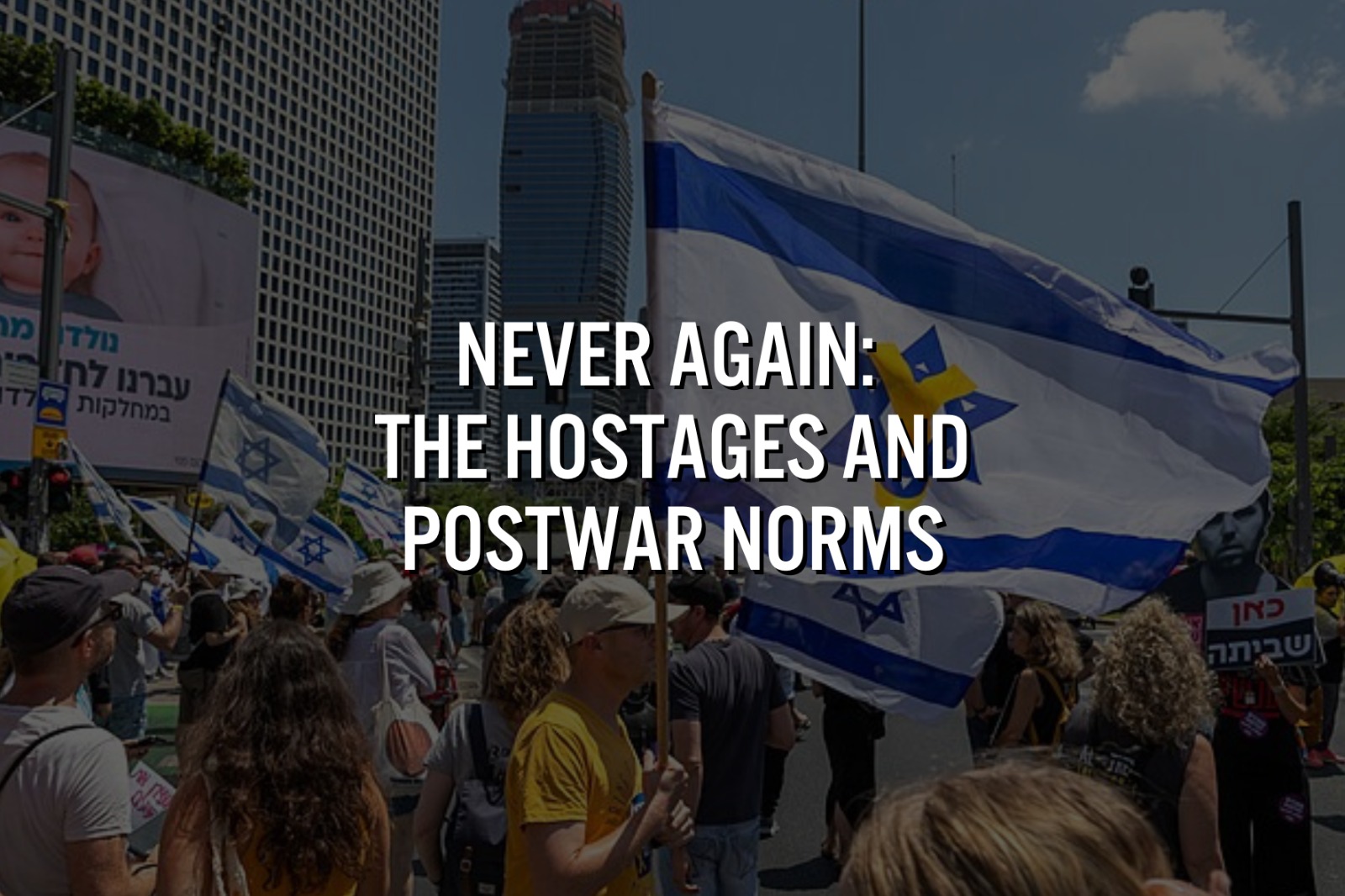
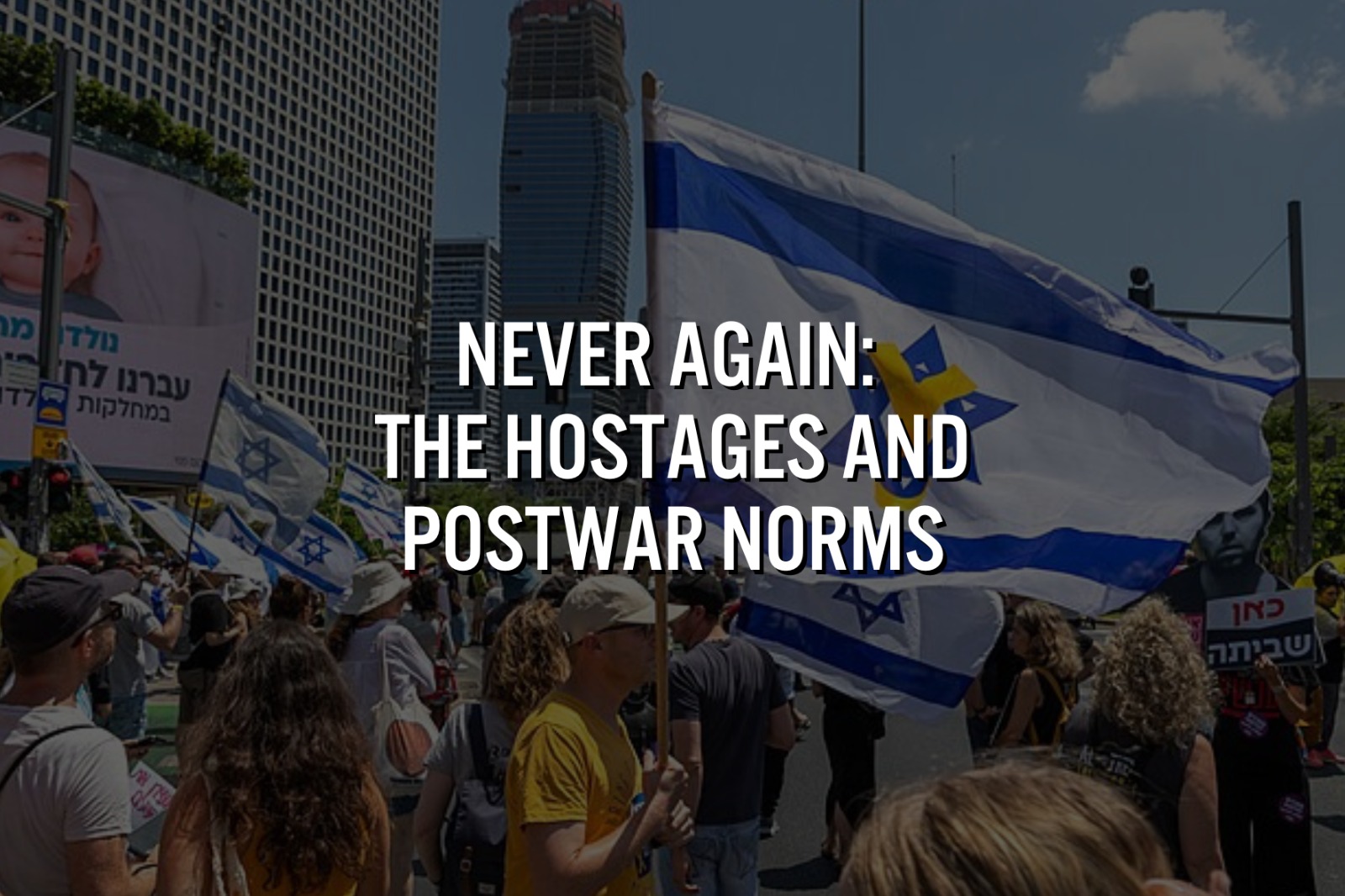
Back in Hostage Square in Tel Aviv, hundreds of thousands had pressed into the square and the surrounding streets. Many were weeping. Others knelt on the ground, unable to stand from emotion. They were celebrating the return of twenty innocent human beings made to endure horrors. But they were also celebrating the return of a sense of dignity and justice that Hamas had robbed not just Israel, but the world of. Back in America, I am sure, they are celebrating the same thing.
By a JIJ Intern
Never Again: The Hostages and Postwar Norms
Gasps echoed through the aisles as the plane touched down in Tel Aviv, and passengers opened their phones for the first time in 12 hours. A man in front of me prayed. The first of the last twenty hostages had been freed! As we stood to exit the plane, all words were of the good news. You didn’t need to know Hebrew, French, or English to hear the exuberant joy and disbelieving relief in the voices.
Waiting for passport control, travelers stood in incredulous awe before the ubiquitous posters of hostages. In front of me in line, an African American tourist turned back to say, “I just feel Israeli today! Who wouldn’t, with a mood like this?” There were no taxis available as the visit by President Trump had shut the highway, but no one seemed to mind. I stopped to buy a train ticket, but an attendant batted me away. “No tickets today! No one should need tickets today!” He lifted the gate and waved me through.
Exiting the train in Tel Aviv, I was surrounded by people singing and dancing in the streets. The skyscrapers were covered in messages of thanksgiving. Hamas had, in their usual cruelty, stretched out the release of the hostages over the whole day, which meant that with each passing moment, there was new good news. Pushed along by the great crowd, I walked towards Hostage Square.
For the last two years, the question of the hostages– the two hundred and fifty-one innocent civilians of thirteen nations, kidnapped and tortured to instill fear in and extract concessions from a democratic state– has dominated Israel. But what nation would not be concerned with a hostage crisis of its own citizens on its own borders?
Significant international attention has been paid to the hostages, especially by Jews of the diaspora, including those with few or no ties to Israel. The horrific antisemitic attack on Boulder Jews this past summer highlighted a remarkable fact: in a small Colorado town, almost two years after the hostages were kidnapped, dozens were still marching weekly to raise awareness of their plight. Posters of the hostages hang across major American cities, patiently reposted after every antisemitic defacement. I met a man in rural New Hampshire who wore a dog tag reading “All of the hostages – now!” in Hebrew and English. He could not read Hebrew and had not attended a synagogue since his bar mitzvah fifty years before, but he felt compelled to keep raising awareness of the plight of the hostages.
It is tempting to argue that this sustained wave of activism by American Jews is nothing new. The majority of American Jews have always been supportive of both Israel and the plight of international Jews. But the attention and empathy paid by American Jews to the hostage crisis represent something deeper.
The postwar international order has been predicated on the mantra: ‘never again.’ Never again must civilians live in fear of kidnapping, torture, and abuse. We have not fully lived up to that dream, yet it persists, especially in Jews who have often been the victims of lawless regimes and irrational hate. Hamas’s kidnapping of the hostages represents a direct blow to that postwar order. Standing for the hostages was not just an act of solidarity by diaspora Jews. It was a defense of the rule of law, state authority, and democratic responsibility. If Hamas could take Jews in Israel hostage, civilians everywhere were at risk. But if the hostages were safe, all civilians of all nations would be safe.
Back in Hostage Square in Tel Aviv, hundreds of thousands had pressed into the square and the surrounding streets. Many were weeping. Others knelt on the ground, unable to stand from emotion. They were celebrating the return of twenty innocent human beings made to endure horrors. But they were also celebrating the return of a sense of dignity and justice that Hamas had robbed not just Israel, but the world of. Back in America, I am sure, they are celebrating the same thing.
By a JIJ Intern
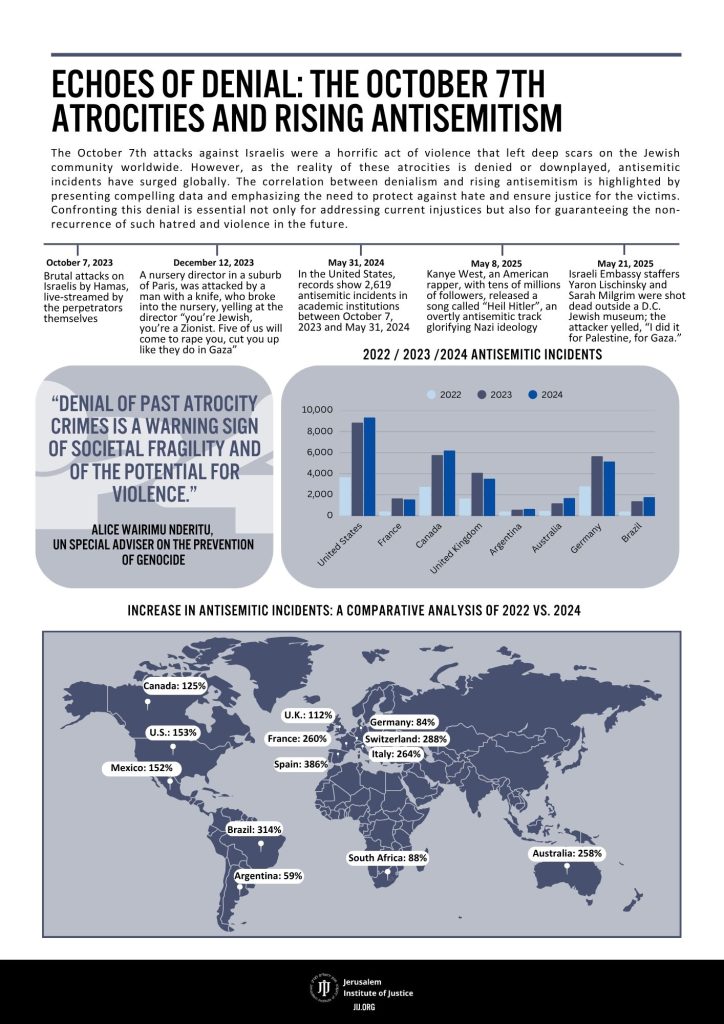
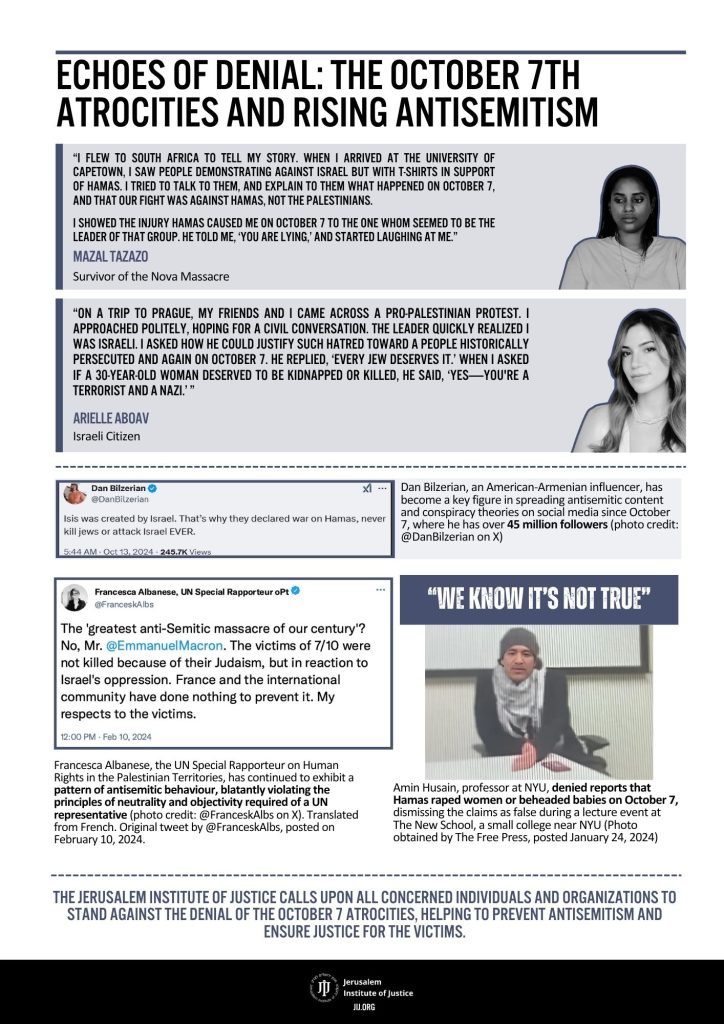
2025 - Echoes of Denial - FactSheet
The October 7th Atrocities and Rising Antisemitism
The October 7th attacks against Israelis were a horrific act of violence that left deep scars on the Jewish community worldwide. However, as the reality of these atrocities is denied or downplayed, antisemitic incidents have surged globally. The correlation between denialism and rising antisemitism is highlighted by presenting compelling data and advocating for legislation and resolutions that prohibit the denial of such events to protect against hate and ensure justice for the victims. Enacting such laws is vital not only for addressing current injustices but also for guaranteeing the non-recurrence of such hatred and violence in the future. Download factsheet here.
Download
2025 Report - ECHOES OF DENIAL - OCT. 7TH ATROCITIES & RISING ANTISEMITISM
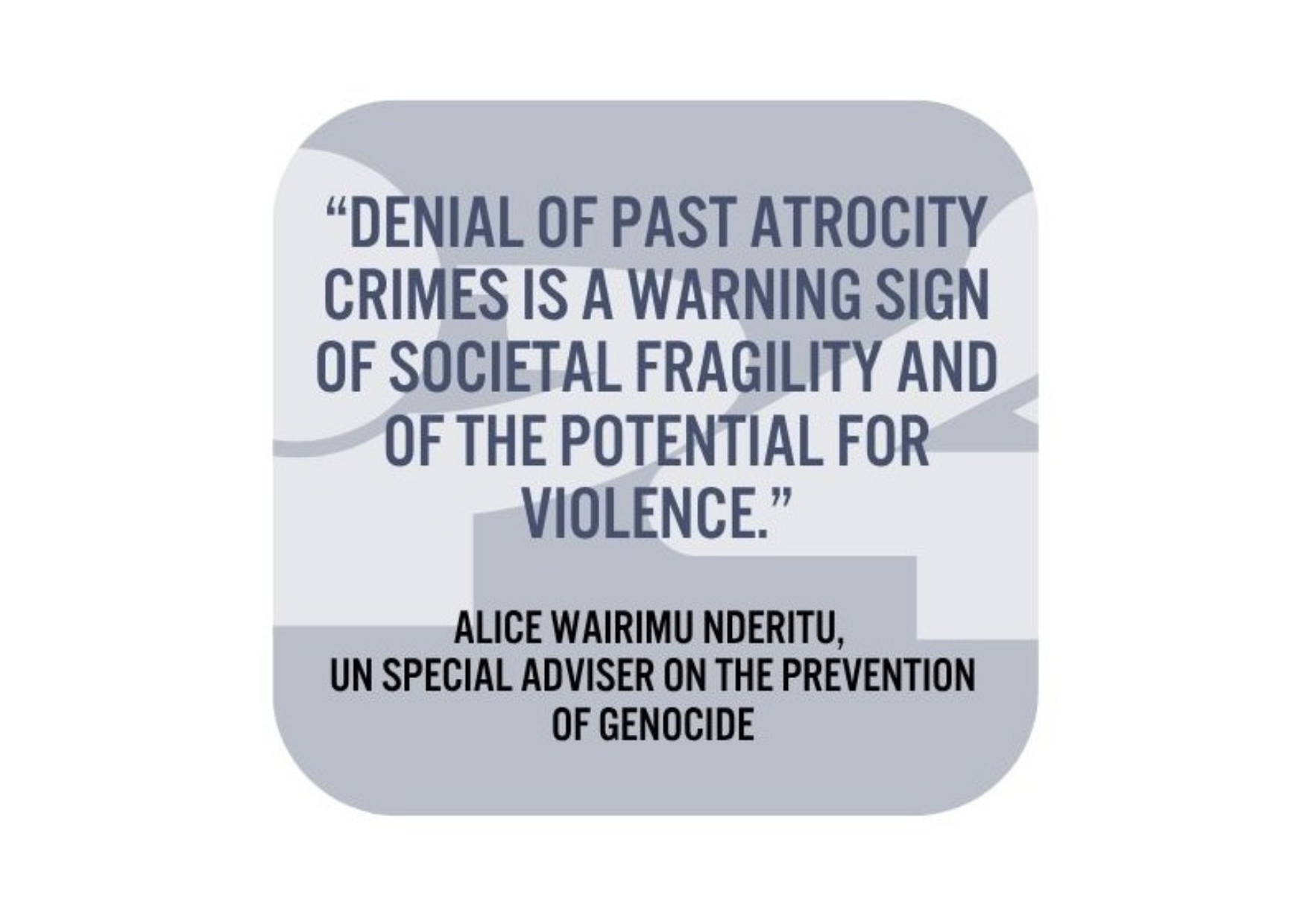
“Denial of atrocity crimes is a warning sign of societal fragility and the enduring presence of
the conditions that allowed this large-scale hatred and violence to erupt in the past.”
Alice Wairimu Nderitu, Under-Secretary General and Special
Adviser on Prevention of Genocide to the United Nations
Secretary General
The October 7, 2023, atrocities committed by Hamas against Israeli civilians were among the most documented terror attacks in history. Despite overwhelming evidence, including livestreamed videos and numerous survivor testimonies, a disturbing pattern of distortion and denial of these events has emerged. This report examines the denial of the October 7 atrocities, links such denial to rising antisemitism, and reviews the current legal frameworks addressing atrocity denial. It also discusses the necessity and promotes the adoption of new legislation against such denial and provides recommendations for international cooperation to combat this dangerous phenomenon.
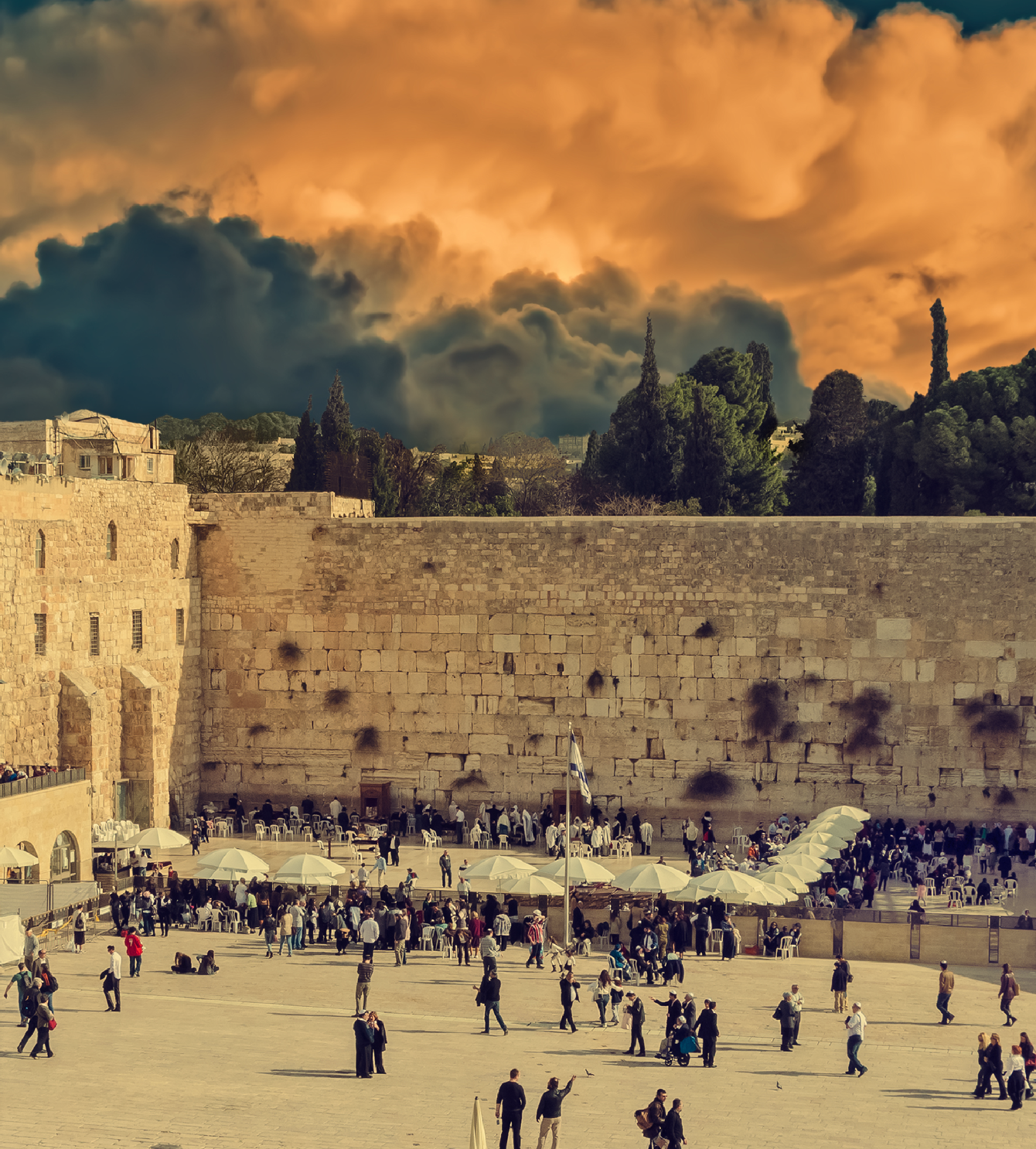
What can JIJ do in a year?
2024 was our busiest and most impactful year since our founding 20 years ago
With your help, in 2024, JIJ provided FREE legal aid to 2,733 survivors of terrorism, human trafficking, and discrimination, including:
- 32 wounded Israeli soldiers
- 40 survivors of human trafficking
- 17 survivors of the October 7th massacre
- 68 families seeking Israeli citizenship or residency
- 112 refugees from Ukraine, Russia, and Eritrea
- 120 Israeli families displaced from their homes on the Gaza & Lebanon borders
How does JIJ do all of this in one year? With you, our amazing supporters. Thank you!
Our media presence grew & our team appeared on:




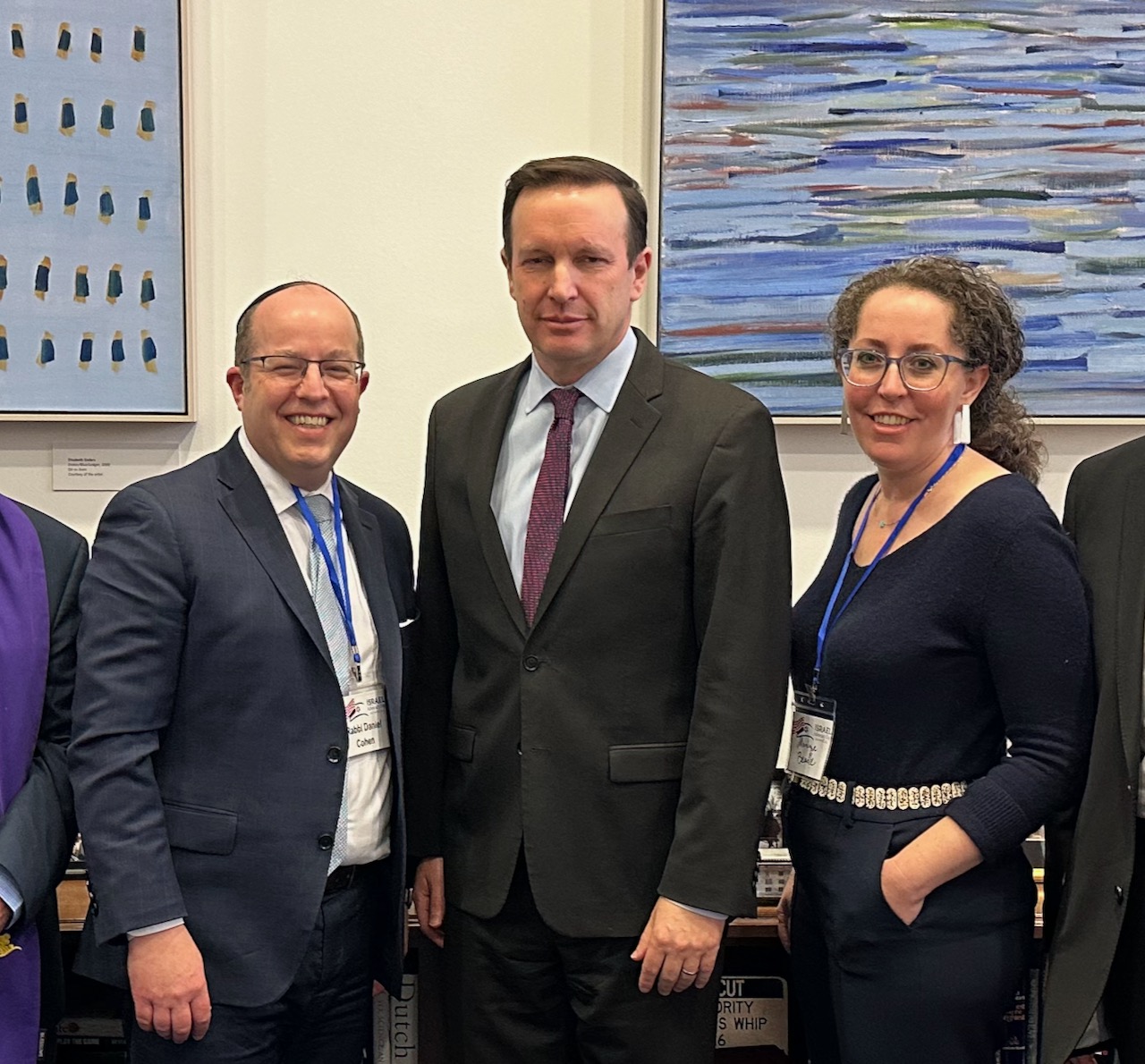
We met personally with dozens of global leaders, including Israel’s First Lady Michal Herzog, United Nations SRSG Pramila Patten, & US Senators Chris Murphy, Richard Blumenthal, & John Fetterman.
We shared our research, forensic evidence, and legal analysis with diplomats from 30 countries.
January - June
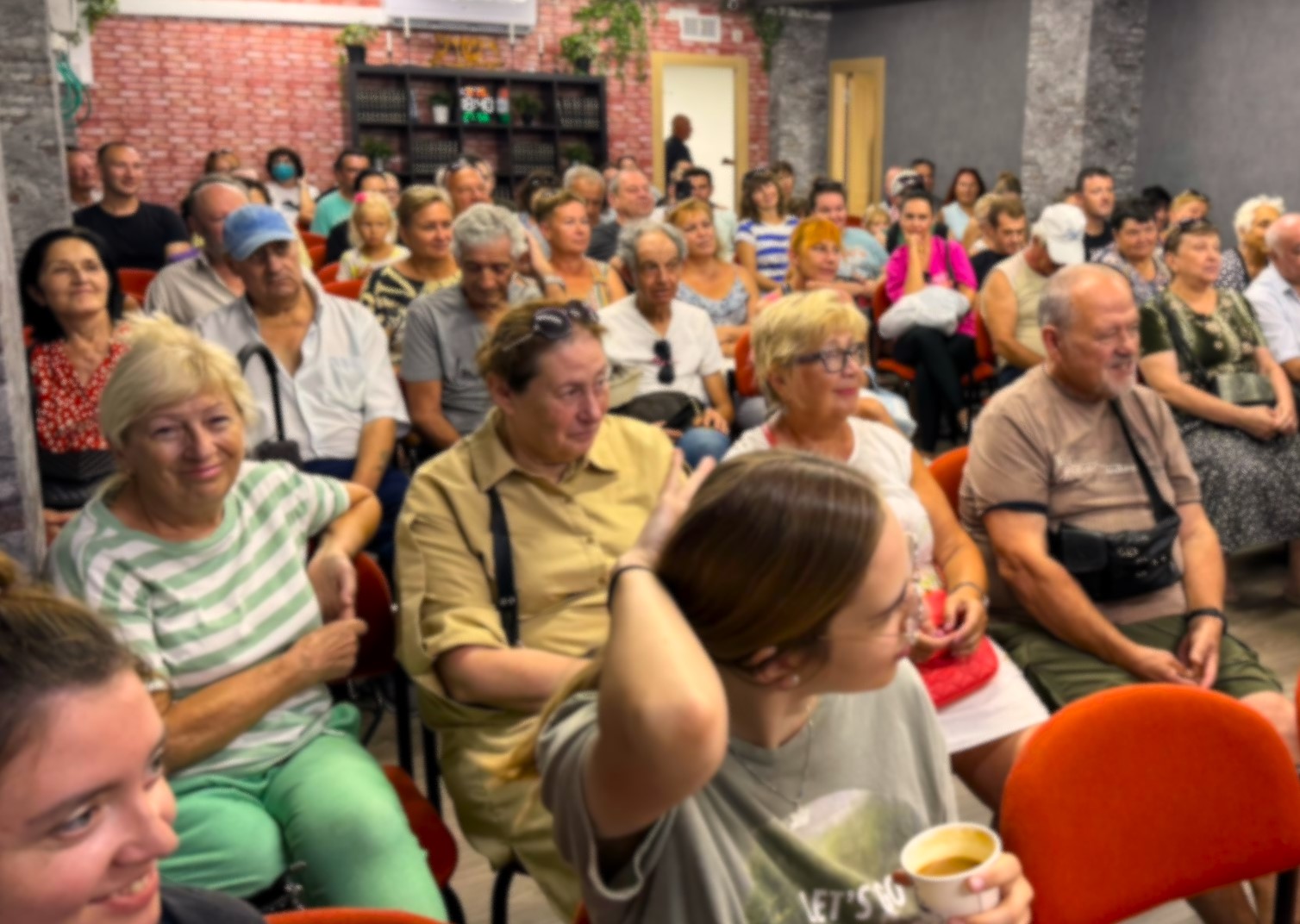
JIJ held a series of free “ Know Your Rights” seminars for:
- 120 Israeli families who became suddenly homeless, unemployed, or disabled as a result of the war
- 57 Ukrainian & Russian refugee families
- 9 of these families receive Israeli citizenship through the Law of Return
- 500 wounded soldiers
Gathered 84 political & religious leaders in the U.S. for a private screening of unedited, uncensored footage of the October 7th massacre recovered from the bodies of Hamas terrorists and compiled by the IDF.
Drafted an urgent petition to Stop Funding UNRWA & persuaded key members of the Senate Foreign Relations Committees to enact a 1-year ban on US funding to UNRWA.
Hosted UN diplomats from 18 countries to hear testimony from Yuval Raphael a survivor of the Oct. 7th massacre. Yuval went to the Nova Festival to dance all night with her friends. At dawn, Hamas invaded, and she sought refuge in a roadside bomb shelter, which became a tomb when terrorists found them.
Launched the Survivors Seeking Justice project, and filmed detailed video testimonies of 17 survivors of the Oct. 7th massacre.
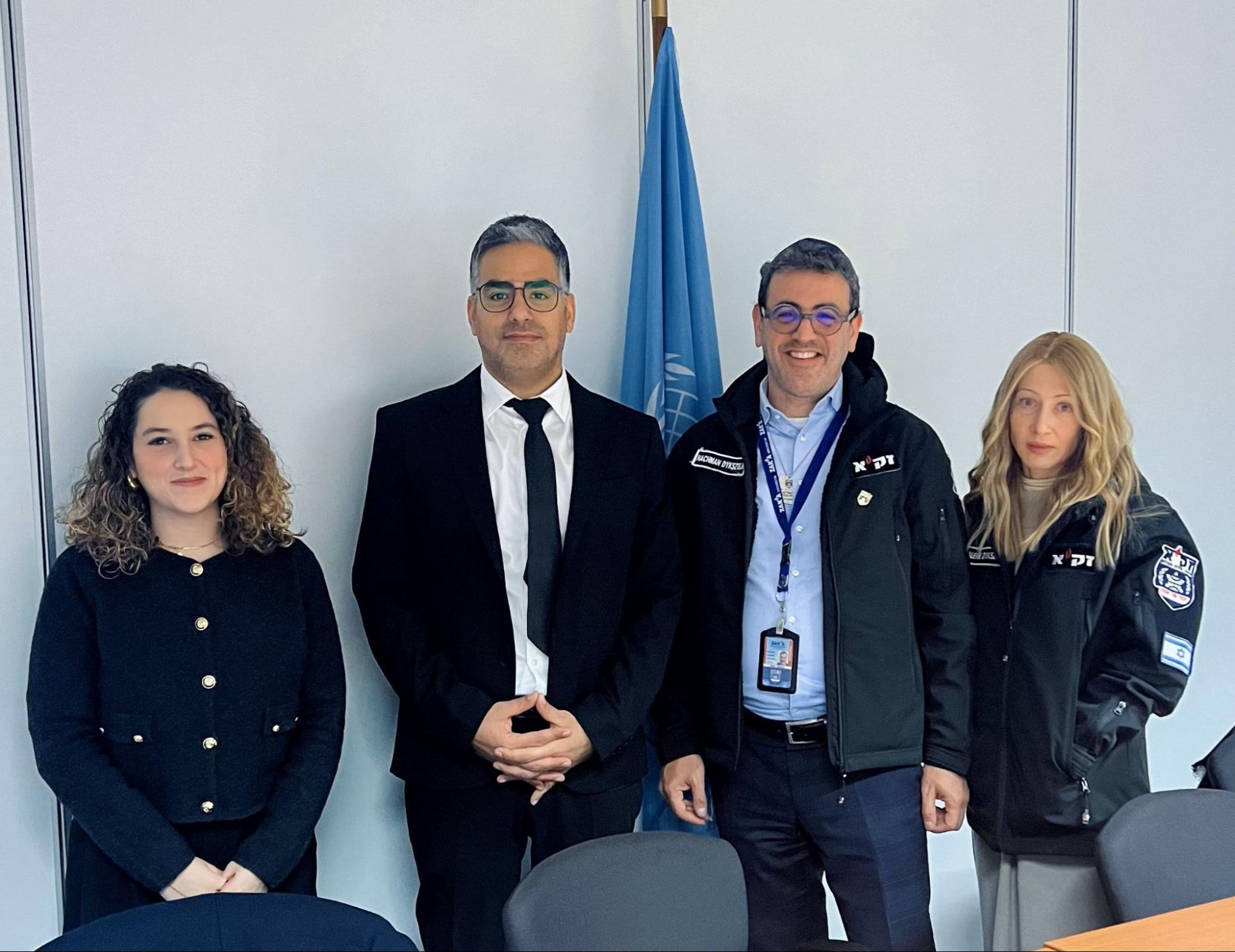
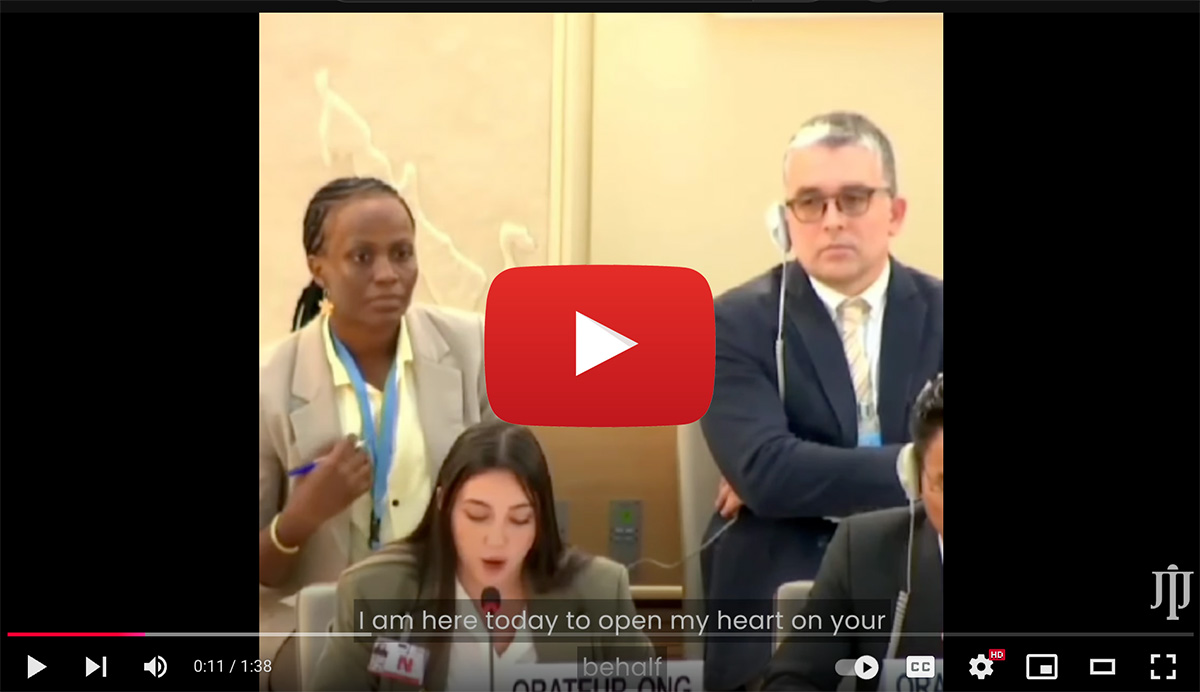
JIJ lawyers presented forensic evidence & first responder testimony to senior UN officials. This proof confirmed a pattern of sexual violence perpetrated by Hamas on Oct. 7th and stopped the rape deniers in their tracks.
July-December
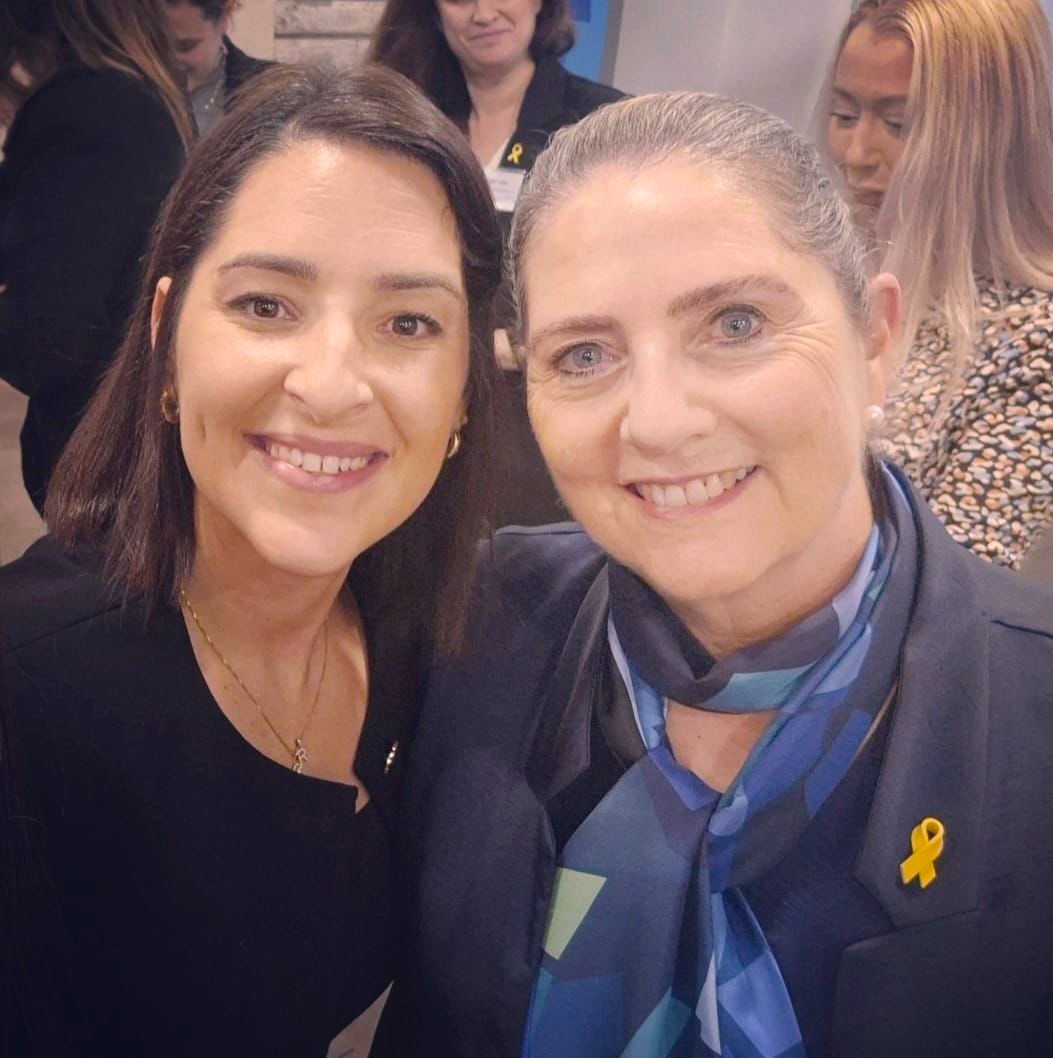
Discussed Israel’s anti-trafficking law with First Lady Michal Herzog. In 2018, JIJ persuaded the
Knesset to adopt a 5-year pilot program that treats women in the sex industry as victims of abuse, & the pimps as criminals. We’re advocating to make the law permanent!
JIJ assisted Israeli police in busting a major human trafficking ring - resulting in the arrest of 14 human traffickers, which was only possible through the testimony of our brave client.
We gave free seminars to soldiers recuperating at Ichilov & Tel Hashomer Hospitals. While private lawyers take 30-50% of a wounded soldier’s disability benefit as payment, JIJ is the only organization providing FREE legal aid to wounded Israeli soldiers, with 32 new soldier clients in 2024.
Intervened at the International Criminal Court with an amicus brief making it clear that the Court lacks jurisdiction over Israeli leaders.
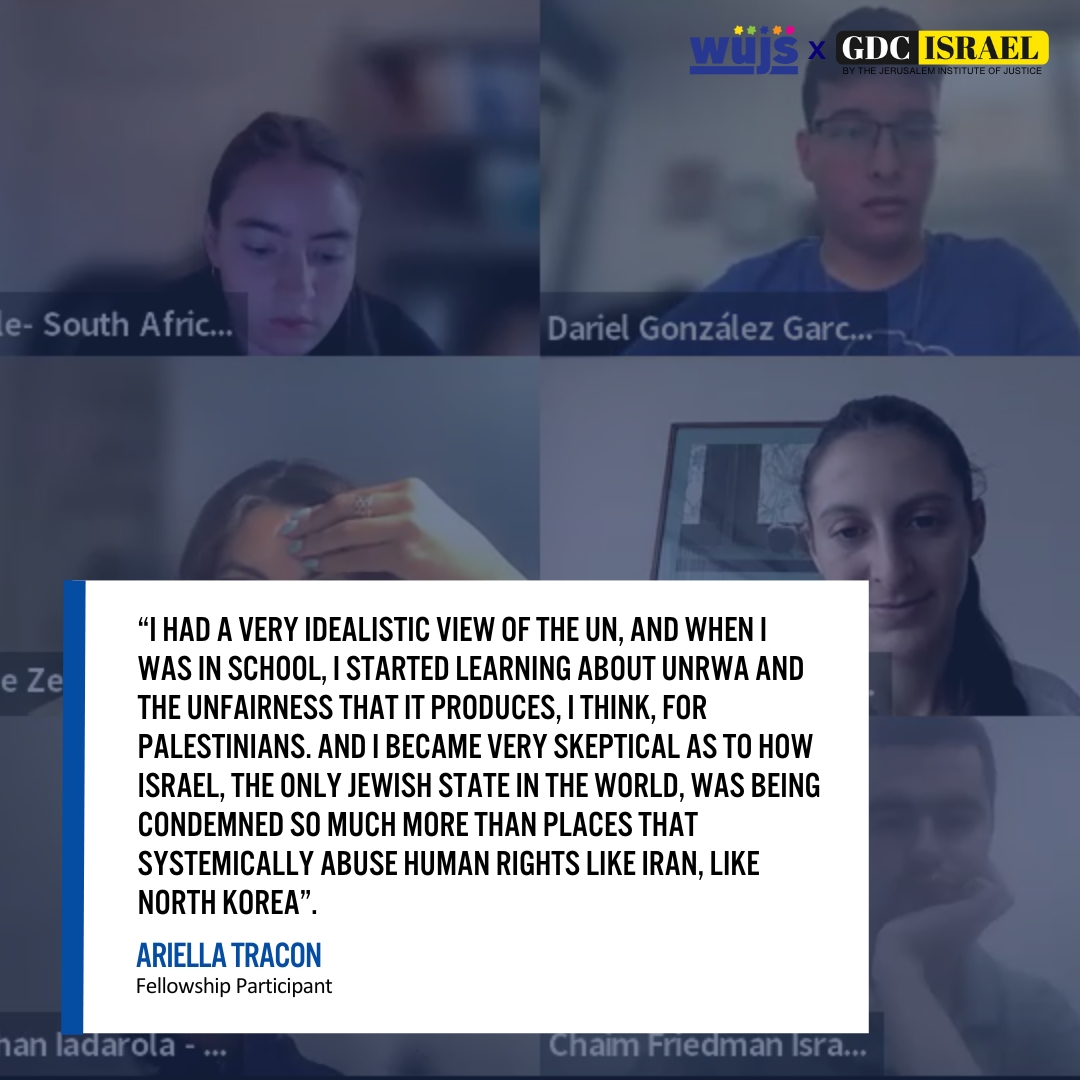
Partnered with the World Union of Jewish Students to train & empower student leaders. Over 8 weeks, we trained 23 Jewish university students from 16 countries to combat antisemitism on their campuses.
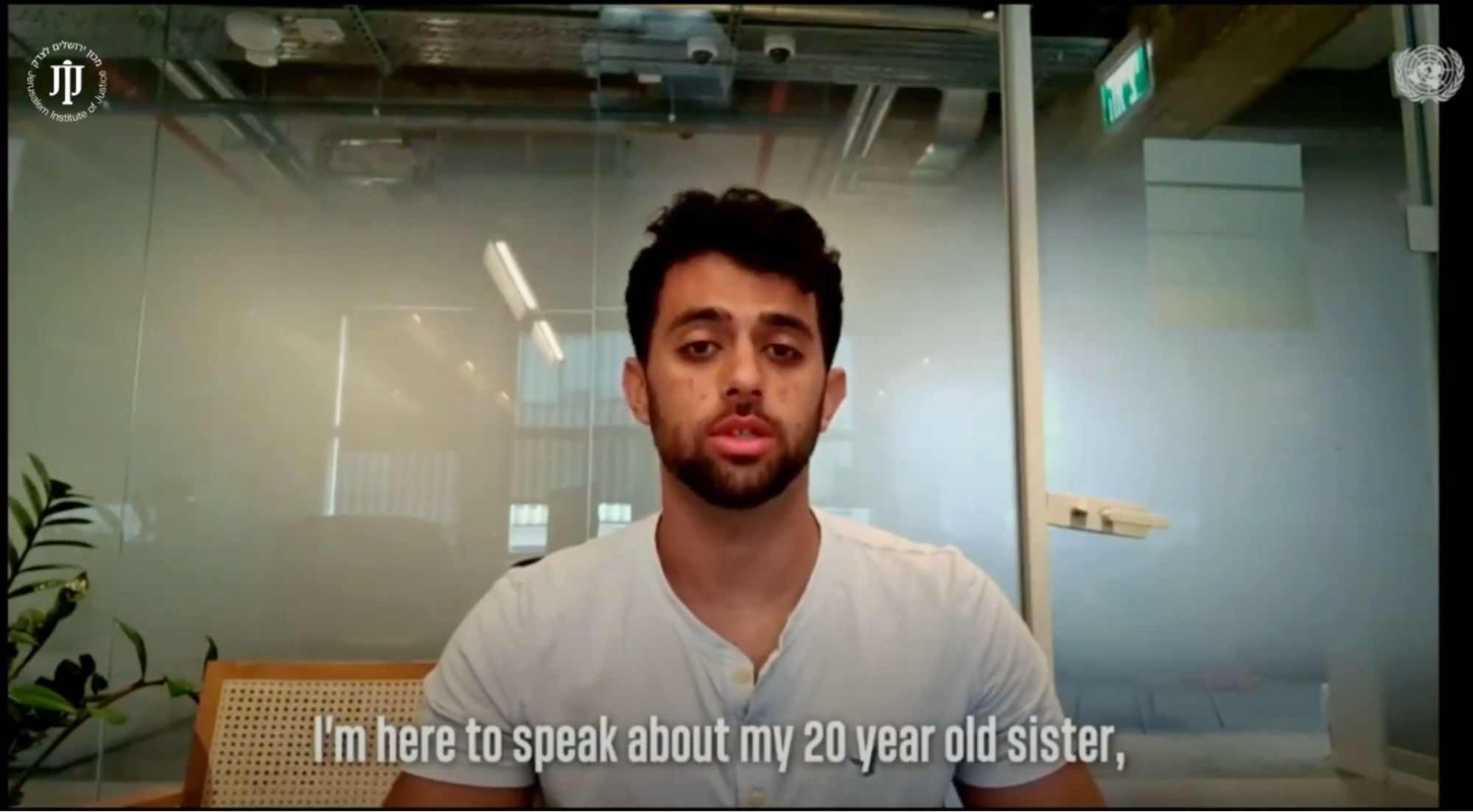
The UN Human Rights Council convened a special gathering on the Jewish New Year, to condemn Israel. The timing was intentional - to prevent opposition. In response, we gave our General Assembly floor time to Amit Levy, brother of Naama Levy, who was kidnapped by Hamas on Oct. 7th. Amit gave powerful testimony on the need to free all of the hostages.
Every single donation you give, whether it’s $1000 or $10, changes lives!
What can JIJ do in a year?
2024 was our busiest and most impactful year since our founding 20 years ago
With your help, in 2024, JIJ provided FREE legal aid to 2,733 survivors of terrorism, human trafficking, and discrimination, including:
- 32 wounded Israeli soldiers
- 40 survivors of human trafficking
- 17 survivors of the October 7th massacre
- 68 families seeking Israeli citizenship or residency
- 112 refugees from Ukraine, Russia, and Eritrea
- 120 Israeli families displaced from their homes on the Gaza & Lebanon borders
How does JIJ do all of this in one year? With you, our amazing supporters. Thank you!
Our media presence grew & our team appeared on:
We met personally with dozens of global leaders, including Israel’s First Lady Michal Herzog, United Nations SRSG Pramila Patten, & US Senators Chris Murphy, Richard Blumenthal, & John Fetterman.
We shared our research, forensic evidence, and legal analysis with diplomats from 30 countries.
January - June
JIJ held a series of free “ Know Your Rights” seminars for:
- 120 Israeli families who became suddenly homeless, unemployed, or disabled as a result of the war
- 57 Ukrainian & Russian refugee families
- 9 of these families receive Israeli citizenship through the Law of Return
- 500 wounded soldiers
Gathered 84 political & religious leaders in the U.S. for a private screening of unedited, uncensored footage of the October 7th massacre recovered from the bodies of Hamas terrorists and compiled by the IDF.
Drafted an urgent petition to Stop Funding UNRWA & persuaded key members of the Senate Foreign Relations Committees to enact a 1-year ban on US funding to UNRWA.
Hosted UN diplomats from 18 countries to hear testimony from Yuval Raphael a survivor of the Oct. 7th massacre. Yuval went to the Nova Festival to dance all night with her friends. At dawn, Hamas invaded, and she sought refuge in a roadside bomb shelter, which became a tomb when terrorists found them.
Launched the Survivors Seeking Justice project, and filmed detailed video testimonies of 17 survivors of the Oct. 7th massacre.
JIJ lawyers presented forensic evidence & first responder testimony to senior UN officials. This proof confirmed a pattern of sexual violence perpetrated by Hamas on Oct. 7th and stopped the rape deniers in their tracks.
July-December
Discussed Israel’s anti-trafficking law with First Lady Michal Herzog. In 2018, JIJ persuaded the
Knesset to adopt a 5-year pilot program that treats women in the sex industry as victims of abuse, & the pimps as criminals. We’re advocating to make the law permanent!
JIJ assisted Israeli police in busting a major human trafficking ring - resulting in the arrest of 14 human traffickers, which was only possible through the testimony of our brave client.
We gave free seminars to soldiers recuperating at Ichilov & Tel Hashomer Hospitals. While private lawyers take 30-50% of a wounded soldier’s disability benefit as payment, JIJ is the only organization providing FREE legal aid to wounded Israeli soldiers, with 32 new soldier clients in 2024.
Intervened at the International Criminal Court with an amicus brief making it clear that the Court lacks jurisdiction over Israeli leaders.
Partnered with the World Union of Jewish Students to train & empower student leaders. Over 8 weeks, we trained 23 Jewish university students from 16 countries to combat antisemitism on their campuses.
The UN Human Rights Council convened a special gathering on the Jewish New Year, to condemn Israel. The timing was intentional - to prevent opposition. In response, we gave our General Assembly floor time to Amit Levy, brother of Naama Levy, who was kidnapped by Hamas on Oct. 7th. Amit gave powerful testimony on the need to free all of the hostages.
Every single donation you give, whether it’s $1000 or $10, changes lives!
ECHOES OF DENIAL - OCT. 7TH ATROCITIES & RISING ANTISEMITISM- Report
The October 7, 2023, atrocities committed by Hamas against Israeli civilians were among the most documented terror attacks in history. Despite overwhelming evidence, including livestreamed videos and numerous survivor testimonies, a disturbing p.attern of distortion and denial of these events has emerged. This report examines the denial of the October 7 atrocities, links such denial to rising antisemitism, and reviews the current legal frameworks addressing atrocity denial. It also discusses the necessity and promotes the adoption of new legislation against such denial and provides recommendations for international cooperation to combat this dangerous phenomenon