Hamas Charter 1988 vs 2017: Why Rhetoric Has Never Meant Reform
Originally published 2017 | Updated January 2026
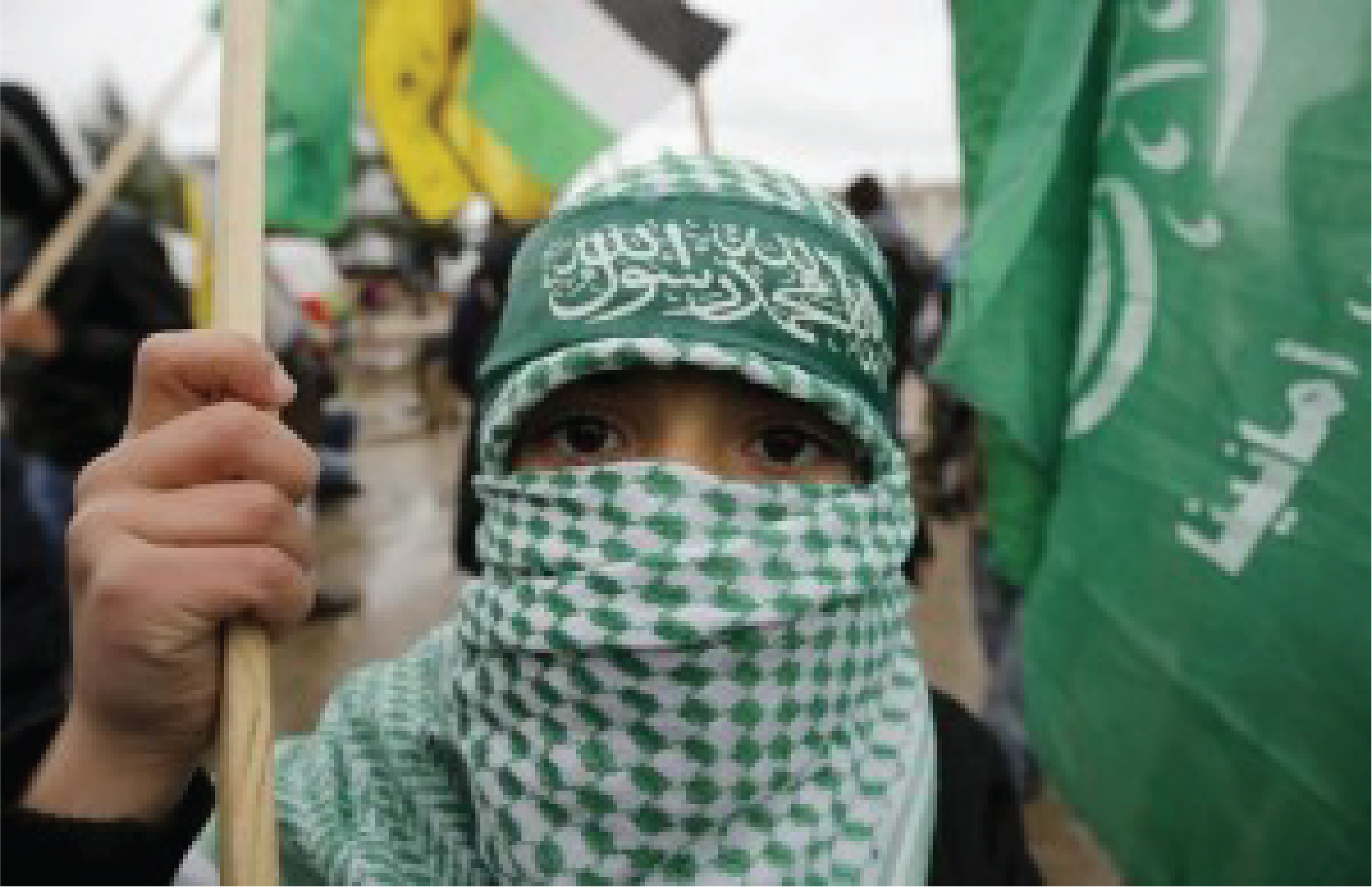
For many years, Hamas' Charter of 1988 has undermined their legitimacy within the international community. Many advocates in favor of Palestinian independence have found themselves unable to endorse the violence, antisemitism, and calls for genocide contained within the document.
In 2017, Hamas released a revised document titled "General Principles and Policies" in an attempt to rebrand their public image. It served as an affirmation of their ideologies and positions on issues relating to Israel.
Nearly a decade later, and in the shadow of the October 7 massacre, this effort at rebranding can be assessed with greater clarity. From a legal perspective, the revised document did not constitute ideological reform. It was a strategic exercise in linguistic moderation that left Hamas' core objectives intact and legally indefensible.
The Contradiction at the Heart of Hamas' Position
The 2017 document provides insight into Hamas' willingness, or lack thereof, to coexist with an Israeli state:
"Hamas rejects any alternative to the full and complete liberation of Palestine, from the river to the sea. However, without compromising its rejection of the Zionist entity and without relinquishing any Palestinian rights, Hamas considers the establishment of a fully sovereign and independent Palestinian state, with Jerusalem as its capital along the lines of the 4th of June 1967, with the return of the refugees and the displaced to their homes from which they were expelled, to be a formula of national consensus." [i]
This is an oxymoron of a policy, requiring intellectual gymnastics to understand both its consistency and logic. Acceptance of a state along the pre-1967 armistice lines denotes a willingness or reluctant acceptance to live alongside an Israeli state, rather than a "full and complete liberation of Palestine, from the river to the sea." The two positions are incompatible.
Their so-called "acceptance" of a state is essentially an acceptance of a starting point from which to appropriate modern-day Israel. This was admitted by senior Hamas leader Mahmoud al-Zahhar in 2011, who referred to the acceptance of the pre-1967 lines as "just a phase" until Hamas has a chance to "regain the land, even if we [Hamas] have to do so inch by inch." [ii]
Following this logic, Brazil could hypothetically accept a state in Rio de Janeiro yet maintain the entire territorial integrity of modern-day Brazil. Or, more appropriately, the Islamic State could accept a state in Raqqa, Syria, yet maintain its ambitions to establish a Caliphate from Spain to Afghanistan.
Under international law, recognition is not symbolic. It is a prerequisite for durable sovereignty, stable borders, and peaceful relations between states. Hamas' position reduces the concept of statehood to a tactical waypoint rather than a terminal political solution. From a legal standpoint, such a posture fails the minimum threshold of good faith required for participation in any peace process.
Antisemitism in the 1988 Hamas Charter
The 1988 Charter contains conspiratorial antisemitic accusations of Jewish and Zionist domination of global institutions, as well as insinuations about the malevolence of Jewish people:
"Writers, intellectuals, media people, orators, educators and teachers, and all the various sectors in the Arab and Islamic world - all of them are called upon to perform their role, and to fulfil their duty, because of the ferocity of the Zionist offensive and the Zionist influence in many countries exercised through financial and media control, as well as the consequences that all this lead to in the greater part of the world." [iii]
"The Zionist plan is limitless. After Palestine, the Zionists aspire to expand from the Nile to the Euphrates. When they will have digested the region they overtook, they will aspire to further expansion, and so on. Their plan is embodied in the "Protocols of the Elders of Zion", and their present conduct is the best proof of what we are saying." [iv]
"Israel, Judaism and Jews challenge Islam and the Moslem people. "May the cowards never sleep." [v]
"The Jews made no exception for women or children. Their policy of striking fear in the heart is meant for all. They attack people where their breadwinning is concerned, extorting their money and threatening their honour." [vi]
Calls for Violence and Genocide in the Original Charter
The original 1988 Charter did not just draw attention to the supposed true aspirations of world Jewry. It openly advocated for violence and genocide against Jewish people:
"We should not forget to remind every Moslem that when the Jews conquered the Holy City in 1967, they stood on the threshold of the Aqsa Mosque and proclaimed that "Mohammed is dead, and his descendants are all women." [vii]
However, the original 1988 Charter did not just draw attention to the supposed true aspirations of world Jewry. Rather, they openly advocated for violence and genocide against Jewish people:
"In face of the Jews' usurpation of Palestine, it is compulsory that the banner of Jihad be raised" [viii]
"Arab and Islamic Peoples should augment by further steps on their part; Islamic groupings all over the Arab world should also do the same, since all of these are the best-equipped for the future role in the fight with the warmongering Jews" [ix]
"Our struggle against the Jews is very great and very serious" [x]
"The Day of Judgement will not come about until Moslems fight the Jews (killing the Jews), when the Jew will hide behind stones and trees. The stones and trees will say O Moslems, O Abdulla, there is a Jew behind me, come and kill him. Only the Gharkad tree, (evidently a certain kind of tree) would not do that because it is one of the trees of the Jews." (related by al-Bukhari and Moslem) [xi]
The 2017 Document: Antisemitism by Substitution
The revised document is careful to adopt a more palatable tone regarding Jewish people:
"Hamas affirms that its conflict is with the Zionist project not with the Jews because of their religion. Hamas does not wage a struggle against the Jews because they are Jewish but wages a struggle against the Zionists who occupy Palestine. Yet, it is the Zionists who constantly identify Judaism and the Jews with their own colonial project and illegal entity." [xii]
The term "Jews" has been euphemistically replaced with the term "Zionists." This semantic shift does not withstand legal scrutiny.
When "Zionists" are portrayed as a monolithic global force, accused of controlling international institutions, denied historical or cultural ties to the land, and stripped of the right to national self-determination, the distinction collapses. Contemporary international standards, including those adopted by the U.S. State Department, the EU, and numerous international bodies, recognize that denying the Jewish people the right to self-determination or the legitimacy of Israel's existence constitutes modern antisemitism.
The revised language does not abandon antisemitic tropes; it repackages them in terms more palatable to diplomatic audiences.
The Muslim Brotherhood Connection
The revised document presents a major shift in Hamas' public acknowledgement of its ideological and political affiliation. It makes no mention of The Muslim Brotherhood, the Islamist movement designated as a terrorist organization in Russia, Egypt, Bahrain, and Saudi Arabia. This is despite the fact that Hamas emerged as an offshoot of the Egyptian Muslim Brotherhood and is referenced in the original 1988 Charter:
"The Islamic Resistance Movement is one of the wings of Moslem Brotherhood in Palestine. Moslem Brotherhood Movement is a universal organization which constitutes the largest Islamic movement in modern times." [xv]
Although Hamas has not commented on the Brotherhood's omission from its new document, it is likely an attempt to garner favor with regional players such as Egypt and Saudi Arabia who have designated the group as a terrorist organization.
Yet omission is not disavowal. There is no evidence of ideological severance, operational distancing, or repudiation of the Brotherhood's core worldview. The silence reflects a tactical calculation aimed at diplomatic maneuvering rather than genuine transformation.
The Persistence of Violent Doctrine
Crucially, Hamas has never renounced violence against civilians. The 2017 document does not repudiate the 1988 Charter's endorsement of armed struggle, nor does it disavow the religious framing of violence as an obligation.
This is not merely a rhetorical omission. In international humanitarian law, intent matters, but conduct matters more. The systematic targeting of civilians, hostage-taking, sexual violence, and indiscriminate attacks are prohibited per se, regardless of political grievance. These acts constitute war crimes and, in certain contexts, crimes against humanity.
The events of October 7, 2023, eliminated any residual ambiguity about Hamas' operational doctrine. They demonstrated continuity, not rupture, between ideology and action.
Hamas Leaders Confirm: The Charter Remains
For those who viewed the revised document as a step in the right direction, senior Hamas leader Mahmoud al-Zahhar clarified in May 2017 that its revised document did not contradict its founding Charter of 1988:
"The pledge Hamas made before God was to liberate all of Palestine…The Charter is the core of [Hamas’] position and the mechanism of this position is the document…We have reaffirmed the unchanging constant principles that we do not recognize Israel; we do not recognize the land occupied in 1948 as belonging to Israel and we do not recognize that the people who came here (Jews) own this land." [xvii]
Law, Not Language, Determines Legitimacy
Under international law, legitimacy is not conferred by revised phrasing or selective omissions. It is earned through demonstrable compliance with legal norms: recognition of existing states, renunciation of violence against civilians, adherence to humanitarian law, and acceptance of peaceful dispute resolution.
Hamas has met none of these criteria.
The lesson of the past decade is clear: rhetoric cannot substitute for responsibility. Hamas' revised language did not signal ideological evolution; it signaled strategic adaptation.
International law is not deceived by euphemism. It judges actors by their objectives, conduct, and adherence to binding norms. On all three counts, Hamas remains in fundamental violation of the principles that govern lawful political participation and the protection of human rights.
Rebranding does not erase responsibility. And moderation in words, when contradicted by violence in practice, carries no legal weight.
The Jerusalem Institute of Justice provides free legal aid to survivors of terrorism, human trafficking, and discrimination. We fight against antisemitism around the world and stand up for Israel on the world stage by being the only pro-Israel non-profit with ECOSOC status at the United Nations. Your donations can help make a difference against antisemitism as well as provide free legal aid to those who need it most in Israel.
References
- [i] Hamas 2017, A Document of General Principles & Policies, May 1, viewed 11 May 2017, http://hamas.ps/en/post/678/
- [ii] Middle East Media Research Institute (MEMRI) 2011, ‘Hamas Leader Mahmoud Al-Zahhar Slams PA President for “Aimless Kangaroo-Like” Political Gymnastics and Says: We Will Not Relinquish Any Piece of Palestinian Land’ (Transcript of Excerpts from Television Interview with Hamas Leader Mahmoud al-Zahhar on Dream 1 TV), July 20, viewed 11 May 2017, https://www.memri.org/tv/hamas-leader-mahmoud-al-zahhar-slams-pa-president-abbas-aimless-kangaroo-political-gymnastics-and/transcript
- [iii] Hamas 1988, ‘The Covenant of the Islamic Resistance Movement’, Yale Law School Lillian Goldman Library: The Avalon Project, viewed 11 May 2017, http://avalon.law.yale.edu/20th_century/hamas.asp
- [iv] ibid
- [v] ibid
- [vi] ibid
- [vii] ibid
- [viii] ibid
- [ix] ibid
- [x] ibid
- [xi] ibid
- [xii] Hamas 1988, op. cit.
- [xiii] U.S. Department of State 2017, ‘Defining Anti-Semitism’, January 20, viewed 14 May 2017, https://www.state.gov/s/rga/resources/267538.htm
- [xiv] Abu-Amr, Z. 1994, Islamic Fundamentalism in the West Bank and Gaza: Muslim Brotherhood and Islamic Jihad, India University Press, United States of America, p. 16
- [xv] Hamas 1988, op. cit.
- [xvi] Middle East Media Research Institute (MEMRI) 2010, ‘Morsi in 2010: No to Negotiations with the Blood-Sucking Warmongering “Descendants of Apes and Pigs”; Calls to Boycott U.S. Products’ (Transcript of Excerpts from Archival Interviews with Mohammed Morsi, September 23, viewed 14 May 2017, https://www.memri.org/tv/morsi-2010-no-negotiations-blood-sucking-warmongering-descendants-apes-and-pigs-calls-boycott-us/transcript
- [xvii] Jerusalem Post 2017, ‘Hamas Says New Document ‘Not a Substitute for Founding Charter’, May 11, viewed 14 May 2017

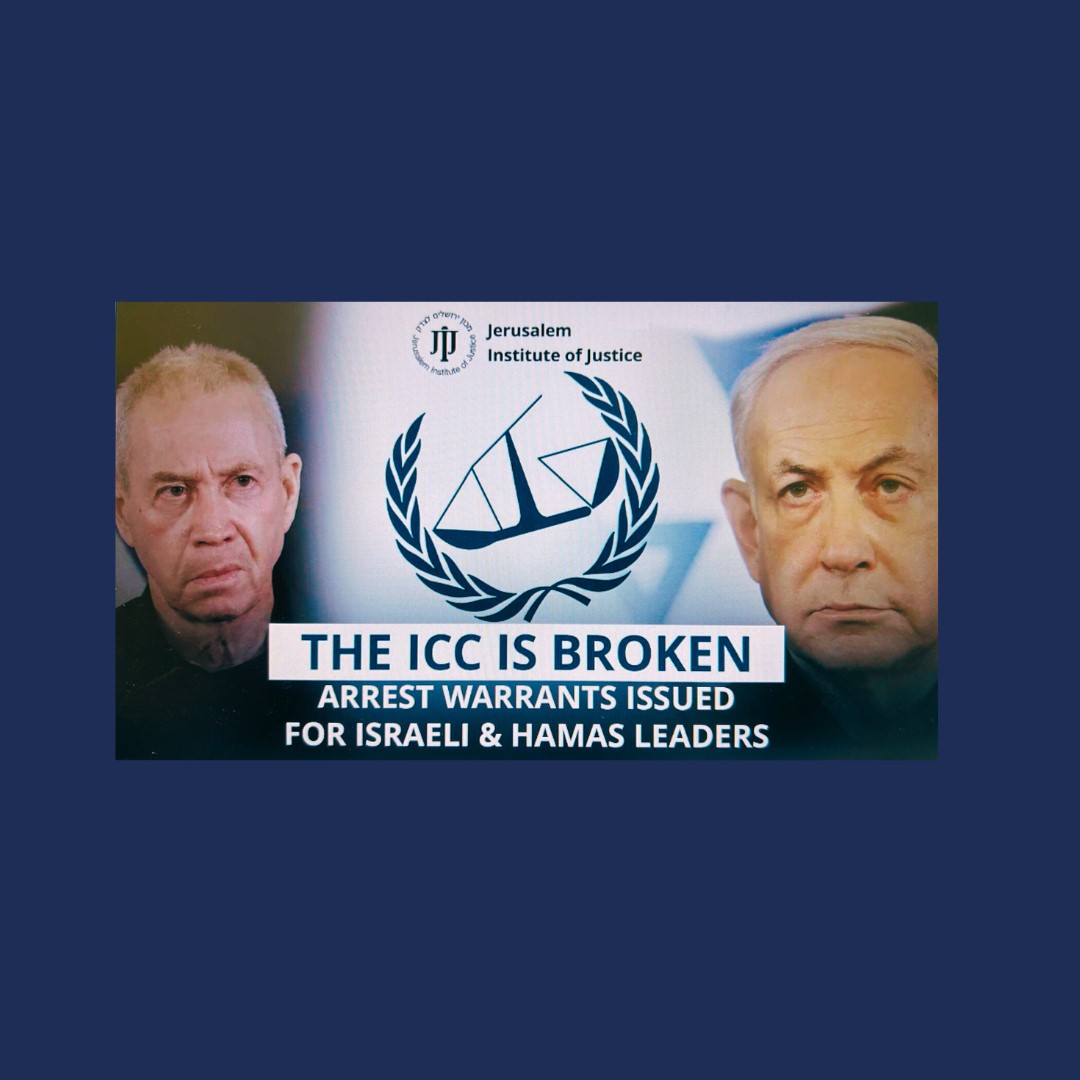
Response to ICC Prosecutor’s Request for Arrest Warrants for Hamas & Israeli Leaders
The Jerusalem Institute of Justice welcomes the ICC Prosecutor’s request for the issuance of
arrest warrants for Hamas’ leaders Yahya Sinwar, Mohamed Deif, and Ismail Haniyeh. We
are disappointed that Hamas’ leaders were not charged with the crime of genocide, despite
constantly expressing their fervent intent to exterminate all Israeli nationals and Jews, and
live streaming the evidence of how they brought this intent to action on October 7th.
We are appalled that the Prosecutor intentionally delayed this maneuver, seeking to pair it
with a request for arrest warrants for Israeli leaders Benjamin Netanyahu and Yoav Gallant.
If the Pre-Trial Chamber approves of this linkage, it will draw a false moral equivalence
between the parties to this conflict.
Since its establishment, the ICC has refrained from pursuing democratically elected officials
whose armies are engaged in wars of self-defense. It is fundamentally reckless to break from
this precedent for the first time when the democratic officials in question are the leaders of
the world’s only Jewish state, and at a time of rising global antisemitism. This development
will only serve to validate the claims of Hamas’ sympathizers across the globe, inspiring
more frequent and more violent attacks on Jewish people across the Diaspora.
The State of Israel has demonstrated that it is able and willing to investigate its own soldiers
and officials for any alleged violations of international law, including international
humanitarian law. Consequently, and in accordance with the principle of complementarity,
one of the most basic principles of the ICC, the Court should refrain from interfering.
The Prosecutor’s case against Israel rests on charges of “starvation” in seeming ignorance of
the fact that unprecedented levels of aid have entered Gaza since October 7th, including
400,000 tons of donated food.
Jerusalem Institute of Justice has sought the arrest of Hamas’ leaders through repeated
requests to the ICC’s Office of the Prosecutor since 2017, highlighting their systematic use of
torture, indoctrination of children, recruitment of child soldiers, and the abuse of civilians as
human shields. If they had been arrested for those crimes years ago, perhaps October 7th
never would have happened.
Despite today’s disappointing developments, we remain committed to pursuing justice for the
survivors and victims of Hamas’ atrocities, including through continued engagement with the
Office of the Prosecutor.
A War for Human Rights
Following the many atrocities that have been committed against Israeli civilians in an unprecedented terrorist attack to the south of the country, the JIJ submitted a letter to the United Nations Office of the High Commissioner for Human Rights. We urge them to take immediate action to address the grave human rights violations taking place by Hamas and other terrorist organizations.
ADDRESSED TO 09.10.2023
Office of the United Nations High Commissioner for Human Rights
Palais Wilson
52 rue des Pâquis
CH-1201 Geneva, Switzerland
Dear Sir/Madam,
I am writing on behalf of the Jerusalem Institute of Justice (JIJ) in consultative status, an Israeli
legal and research institute advocating for human rights in Israel and the Middle East.
We call upon the United Nations Human Rights Council (HRC) to fulfil its responsibility of
promoting and protecting human rights by condemning the horrific acts of terrorism
perpetrated by the terrorist Palestinian organization Hamas against the Israeli population.
While we appreciate today’s act of solidarity of standing in silence in memory of those who
were brutally murdered, the scale of this past days’ atrocities demands further action.
As outlined in General Assembly Resolution 60/251, the Human Rights Council has the
mandate and responsibility to promote and protect human rights worldwide. The inhuman
actions carried out by Hamas, including the kidnapping of innocent civilians and infiltrations
into Israeli territory to perpetrate acts of terror via land, sea and air, should have already
garnered the immediate attention and condemnation of this Council.
The information regarding the ongoing conflict is both stark and undeniable. It has resulted in
the loss of over 1,000 innocent lives and the kidnapping of more than 150 Israelis and foreign
nationals, including women, children, and elderly people who were abducted violently from
their homes. Additionally, more than 2,500 individuals have been injured. Furthermore, it is
worth noting that more than 5,000 rockets have been launched towards Israeli citizens.
Evidence is also emerging of a pattern of gross human rights violations including torture,
dismemberment, beheadings, the use of rape as a weapon of war, and the desecration of victims'
dead bodies. This only serves to demonstrate the terrorist groups' genocidal intentions to
continue perpetrating mass atrocities on Israeli civilians, while recklessly endangering
Palestinian civilians.
There can be no excuse for the silence of this Council in the face of such atrocities, which
constitutes the most destructive pogrom against Jewish people since the Holocaust.
We implore this Council to take this opportunity to fulfill its mandate and stand on the right
side of history concerning human rights. As the world is watching, we expect this Council to
rise above past biases and act in accordance with its stated principles.
The pursuit of peace and the protection of human rights should always transcend political
considerations, and it is our sincere belief that the Council can play a crucial role in promoting
justice and safeguarding the rights of all individuals affected by this conflict.
We urge the United Nations Human Rights Council to take immediate and meaningful action
to address the grave human rights violations taking place and to condemn, with intentional
force, the horrifying acts committed by the Palestinian terrorist organization Hamas. Only
through such actions can the Council uphold its commitment to the principles of human rights,
justice, and peace.
Sincerely,
Flavia Sevald Adv. Uri Morad, Director of the International
Chief Executive Officer Law & Public Diplomacy Department
Lydia Morgan, COO
REPORT OF THE “STATE OF PALESTINE”
Jerusalem Institute of Justice written submission
TO THE UN HUMAN RIGHTS COMMITTEE
ON THE REPORT OF THE “STATE OF PALESTINE”
Executive Summary
Press this link for the full report
The Jerusalem Institute of Justice (JIJ) submitted a report to the Human Rights Committee of the UN regarding Palestinian adherence to the International Covenant on Civil and Political Rights (ICCPR). JIJ’s report exposes inadequate law enforcement, incitement to violence, and acts of torture and inhumane treatment by the Palestinian government, directly contradicting Palestinian claims of compliance with international law.
The Human Rights Committee is a United Nations treaty body comprised of 18 international law experts tasked with ensuring that countries adhere to the International Covenant on Civil and Political Rights (ICCPR). Countries self-report their adherence to the treaty to legitimize their sovereignty and prove their benevolence. The State of Palestine used its report to deceive the international community and attack the State of Israel while claiming they uphold International Law.
Article 2 of the ICCPR prohibits discrimination. However, the Palestinian educational curriculum promotes violence, excludes peace education, and fosters a biased narrative. Palestinian textbooks legitimize violence, glorify terrorists, erase Israel from maps, and demonize Israelis. This indoctrination of violence among children has long-lasting effects and obstructs peace initiatives, and it can manifest itself in acts of terror perpetrated by children and adults. In the State of Palestine, terrorists are rewarded with glory. Their families receive a payment if the terrorist dies or is arrested; the price increases corresponding to the severity of the crimes. Alongside monetary incentives, terrorists are treated like martyrs. Summer camps where Palestinian children are trained to fight Israel through acts of violence are named after killed terrorists.
Article 6 of the ICCPR safeguards the right to life. The use of human shields by the Palestinian authorities is a grave violation of international humanitarian law and breaches Article 6. This concerning practice has been observed in various conflicts, including Operation Protective Edge and the March of Return protests. Moreover, evidence suggests the concealment of rocket production facilities, armories, and combatants in or near residential areas, further jeopardizing civilians and disregarding international norms.
Article 7 of the ICCPR prohibits torture and cruel treatment. However, the Palestinian authorities have a significant gap between their legal framework and practical enforcement in preventing such acts. The Committee Against Torture (CAT) has expressed concerns over incidents of torture and mistreatment in custody, including the lack of confidentiality in complaint handling and the insufficient independence of investigation bodies. Former detainees’ testimonies provide clear evidence of inhumane treatment, torture, denial of rights, and various forms of abuse. Arbitrary arrests and torture are used against Palestinians exercising their fundamental rights, like peaceful protests or criticizing the regime. These abuses appear to stem from higher authorities’ directives. From 2016 to 2021, the Palestinian Independent Commission for Human Rights received 4,279 claims. Palestinians commit these acts of torture onto Palestinians.
Article 20 prohibits war propaganda and advocacy for hatred; JIJ’s report highlights the notable discrepancy between the legal measures established by the Palestinian authorities and their practical enforcement. Despite legal restrictions, instances of incitement and hate speech persist. Palestinian television broadcasts content, such as the series “The Path of Sacrifice,” glorifying terrorists and their acts of terror. Social media platforms like TikTok and Telegram are also utilized to spread messages of hate and incitement, including simulated attacks by young children against Israeli soldiers. Palestinian leaders publicly encourage lone-wolf attacks and the procurement of weapons, fostering hatred instead of promoting peace. School textbooks and cultural events are utilized to propagate hate, as seen in a musical production featuring dancers in military attire glorifying combat against the perceived “enemy.”
Lastly, Article 24 safeguards the rights of children. Despite international laws protecting children’s vulnerability, Palestinian children continue to be recruited and involved in violent acts, including clashes, shootings, and stabbings. Organizations like Hamas run summer camps that promote aggression and hostility, jeopardizing these children’s safety, rights, and development. This perpetuates a culture of violence with far-reaching consequences for individuals and society.
Based on the information provided, JIJ recommends that the Human Rights Committee issue the following calls to the “State of Palestine”: expunge textbooks advocating violence and terrorism, adopt an internationally accepted definition of terrorism, cease financial support to terrorism, refrain from using human shields or concealing military targets in civilian areas, end the use of torture and ensure thorough investigations, discontinue the promotion of hatred and violence through media and social media platforms, and take measures to prevent the recruitment of children in hostilities and protect their rights. These recommendations aim to promote peace, tolerance, and the protection of human rights.
Report of the “State of Palestine”
Jerusalem Institute of Justice written submission
to the UN Human Rights Committee
on the Report of the “State of Palestine”
Executive Summary
Press this link for the full report
The Jerusalem Institute of Justice (JIJ) submitted a report to the Human Rights Committee of the UN regarding Palestinian adherence to the International Covenant on Civil and Political Rights (ICCPR). JIJ's report exposes inadequate law enforcement, incitement to violence, and acts of torture and inhumane treatment by the Palestinian government, directly contradicting Palestinian claims of compliance with international law.
The Human Rights Committee is a United Nations treaty body comprised of 18 international law experts tasked with ensuring that countries adhere to the International Covenant on Civil and Political Rights (ICCPR). Countries self-report their adherence to the treaty to legitimize their sovereignty and prove their benevolence. The State of Palestine used its report to deceive the international community and attack the State of Israel while claiming they uphold International Law.
Article 2 of the ICCPR prohibits discrimination. However, the Palestinian educational curriculum promotes violence, excludes peace education, and fosters a biased narrative. Palestinian textbooks legitimize violence, glorify terrorists, erase Israel from maps, and demonize Israelis. This indoctrination of violence among children has long-lasting effects and obstructs peace initiatives, and it can manifest itself in acts of terror perpetrated by children and adults. In the State of Palestine, terrorists are rewarded with glory. Their families receive a payment if the terrorist dies or is arrested; the price increases corresponding to the severity of the crimes. Alongside monetary incentives, terrorists are treated like martyrs. Summer camps where Palestinian children are trained to fight Israel through acts of violence are named after killed terrorists.
Article 6 of the ICCPR safeguards the right to life. The use of human shields by the Palestinian authorities is a grave violation of international humanitarian law and breaches Article 6. This concerning practice has been observed in various conflicts, including Operation Protective Edge and the March of Return protests. Moreover, evidence suggests the concealment of rocket production facilities, armories, and combatants in or near residential areas, further jeopardizing civilians and disregarding international norms.
Article 7 of the ICCPR prohibits torture and cruel treatment. However, the Palestinian authorities have a significant gap between their legal framework and practical enforcement in preventing such acts. The Committee Against Torture (CAT) has expressed concerns over incidents of torture and mistreatment in custody, including the lack of confidentiality in complaint handling and the insufficient independence of investigation bodies. Former detainees' testimonies provide clear evidence of inhumane treatment, torture, denial of rights, and various forms of abuse. Arbitrary arrests and torture are used against Palestinians exercising their fundamental rights, like peaceful protests or criticizing the regime. These abuses appear to stem from higher authorities' directives. From 2016 to 2021, the Palestinian Independent Commission for Human Rights received 4,279 claims. Palestinians commit these acts of torture onto Palestinians.
Article 20 prohibits war propaganda and advocacy for hatred; JIJ's report highlights the notable discrepancy between the legal measures established by the Palestinian authorities and their practical enforcement. Despite legal restrictions, instances of incitement and hate speech persist. Palestinian television broadcasts content, such as the series "The Path of Sacrifice," glorifying terrorists and their acts of terror. Social media platforms like TikTok and Telegram are also utilized to spread messages of hate and incitement, including simulated attacks by young children against Israeli soldiers. Palestinian leaders publicly encourage lone-wolf attacks and the procurement of weapons, fostering hatred instead of promoting peace. School textbooks and cultural events are utilized to propagate hate, as seen in a musical production featuring dancers in military attire glorifying combat against the perceived "enemy."
Lastly, Article 24 safeguards the rights of children. Despite international laws protecting children's vulnerability, Palestinian children continue to be recruited and involved in violent acts, including clashes, shootings, and stabbings. Organizations like Hamas run summer camps that promote aggression and hostility, jeopardizing these children's safety, rights, and development. This perpetuates a culture of violence with far-reaching consequences for individuals and society.
Based on the information provided, JIJ recommends that the Human Rights Committee issue the following calls to the “State of Palestine”: expunge textbooks advocating violence and terrorism, adopt an internationally accepted definition of terrorism, cease financial support to terrorism, refrain from using human shields or concealing military targets in civilian areas, end the use of torture and ensure thorough investigations, discontinue the promotion of hatred and violence through media and social media platforms, and take measures to prevent the recruitment of children in hostilities and protect their rights. These recommendations aim to promote peace, tolerance, and the protection of human rights.

The Tide Rises the Tide Falls
Two occurrences in the sphere of international relations between Israel and the EU caused confusion and consternation to many who follow this field.
On the one hand, on Tuesday morning, December 3rd, The European Union Court of Justice ruled that products made in Israel must be labelled as such and may not be marketed as products made in Israel. “Foodstuffs originating in the territories occupied by the State of Israel must bear the indication of their territory of origin, accompanied, where those foodstuffs come from an Israeli settlement within that territory, by the indication of that provenance”, the court (the EU’s highest legal authority) announced in a press release[1].
The decision was widely condemned by Israel and pro-Israel figures and advocacy groups, with Israel’s Foreign Ministry rejecting the ruling, Israel’s Foreign Ministry rejected the ruling, saying it set a “double standard” that unfairly singles out Israel when there are dozens of territorial disputes worldwide. “The European Court of Justice’s ruling is unacceptable both morally and in principle,” said Foreign Minister Israel Katz. “I intend to work with European foreign ministers to prevent the implementation of this gravely flawed policy.” The pro-settler Yesha Council also denounced the court ruling, as did Eugene Kontorovich, a professor of international law and the director of International Law at the Jerusalem-based Kohelet Policy Forum, and Gerald Steinberg, a political science professor and the head of NGO Monitor, a Jerusalem-based watchdog group critical of pro-Palestinian nonprofits.
Meanwhile, the Palestinian Authority and pro-Palestine groups welcomed the ruling, with Saeb Erekat releasing an official statement[2] welcoming the ruling. Hanan Ashrawi, a senior Palestinian official, welcomed the ruling as a “first step” and encouraged Europe to ban settlement products altogether. “If they do not allow these illegal products to enter European soil, then that would really serve the cause of justice,” she said. Human Rights Watch and Oxfam released similar sentiments.
Experts and diplomats started wondering on the possible effect this might have on EU-Palestinian Authority relations, and EU-Israel relations, with some seeing this as pushback against The United States’ recent declaration that Israeli settlements on the West Bank are “not inconsistent with” international law.
But mere hours later, a different tune was heard, as over a dozen countries abruptly changed their voting pattern at the United Nations in Israel’s favor, opposing an annual resolution that has passed every year since 1977 mandating a special “Division for Palestinian Rights” inside the UN Secretariat traditionally critical of the Jewish state. Of the 13 countries that changed their voting habits, 11 were from the EU – specifically Germany, the Czech Republic, Austria, Bulgaria, Denmark, Estonia, Greece, Lithuania, the Netherlands, Romania and Slovakia. 2 more EU countries (Malta and Cyprus) voted for the resolution, with 14 (among them France, the UK, Spain and Italy) continuing to abstain, as per the status quo until now.
Suddenly, Israel’s Foreign Ministry was congratulating its EU allies and itself, Foreign Minister Israel Katz stating that: “I am pleased that a significant group of countries has decided today to make heard a clear moral stance against discrimination toward Israel at the UN. This is an important step in the long struggle against the bias toward Israel at the UN. What particularly stands out is the change in the position of several European Union states, and I hope that the remaining EU members will adopt this position soon.” Yinam Cohen, the director of the UN Political Affairs Department at the Foreign Ministry, said that the voting “marks a significant first step in the long way to change the bias against Israel in the UN.”
So what is going on here? How is it that in the morning, the EU was anti-Israel and pro-Palestine, and by evening, it was pro-Israel and anti-Palestine?
The key is differentiating between the formal legal proceedings invoked by the EU Court of Justice and the diplomatic efforts of the EU attaches. If one reads the Court’s decision, it seems to be a fair legal decision based on honest interpretation of existing rules and resolutions. It’s a legal Decision based on legal standards, not necessarily affected by recent politics (specifically, it seems to depend on a notice from 2015). As such, even if all the judges were pro-Israel, they could not have come to a different legal decision. What matters, however, is how the ruling will be enforced. The real origin of the produce is not always easy to identify, experts say, and the European Commission said it is up to individual EU countries to ensure that labels are correct and that the origin of settlement produce made known in a way that is “not misleading to the consumer.” Furthermore, EU Commission Spokeswoman Mina Andreeva explicitly stated that Israel has a special trading relationship with the EU, with products originating in its internationally recognized borders benefiting from preferential tariff treatment. “This situation will remain unchanged,” she said. “The EU does not support any form of boycott or sanctions against Israel.”
In contrast, countries in the EU recognizing the implicit bias of the UN against Israel and changing their voting habits in consequence of this is diplomatically significant. Indeed, it may indicate a sea change in terms of Israel’s foreign policy. Germany’s decision in May to fight the anti-Israel bias at the UN, announced by Heiko Maas, and The Czech’s Republic working hard inside the EU forums to generate change regarding voting patterns on Israel at the UN were cited as developments leading to the change by Yinam Cohen. Furthermore, the effect of the recent decisions by the United States, both regarding West Bank Settlements and the Golan Heights cannot be discounted. It may be that the tide is beginning to turn in favor of Israel in international relations.
[1] https://curia.europa.eu/jcms/upload/docs/application/pdf/2019-11/cp190140en.pdf
[2] https://www.nad.ps/en/media-room/press-releases/dr-saeb-erekat-ruling-european-court-justice-labeling-israeli-settlement

The Cat is Out of the Bag
The Gaza Voice, a recorded podcast released on May 21st 2020 contains Boycott Divestment Sanctions (BDS) co-founder Omar Barghouti saying, “If the refugees return to their homes [in Israel] as the BDS movement calls for, if we bring an end to Israel’s apartheid regime and if we end the occupation on lands occupied in 1967, including Jerusalem, what will be left of the Zionist regime? That’s the question. Meaning, what will the two states be based on?”[1]
The organization claims to advocate for Israeli political reform and the improvement of Palestinian human rights, not the elimination of the State of Israel. But Barghouti hints here at exactly that. He reveals what could be the underlying intentions of BDS’s three official goals. [2]
We interpret Barghouti’s statement as the following: if BDS successfully achieves the goals it built its platform on, Israel will no longer exist. To answer Barghouti’s rhetorical question, not much will be left of the “Zionist regime”. Answering the three objectives essentially erases what Israel has built over the past 72 years, which includes its normalized relations with the neighboring Arab countries. This contradicts Barghouti’s reference to “two states”, as in having a two state solution. Barghouti understands this, as he reveals in this segment of the twenty-minute podcast.
It should be noted this rhetoric isn’t a shocking revelation. Barghouti has previously stated that Jews cannot have their own state in Palestine. [3] However, what is important about this recent quote is that it reminds the listener of the movement to disrespect the right to self-determination and ultimately delegitimize the state of Israel. The argument that BDS is less impactful toward Israel than it claims to be is irrelevant here; [4] the focus is on the fact that Barghouti continues to preach an unrealistic and undesirable approach when facing a country that has already solidified, built itself up, and is now thriving.
Why unrealistic and undesirable? The organization, with Barghouti as one of its international representatives, goes further than confronting politics and human rights. It questions the existence of a legitimate state and hints at its eventual downfall. It’s dangerous territory to cross into, and it’s something that individual supporters and affiliated groups (NGOs and others) of BDS should understand.
Barghouti continues by saying, “There won’t be any Zionist State like the one we are talking about (present day Israel)… and the Palestinian minority will become a Palestinian majority in the state that today is called Israel.”
Well, what would it mean if Israel did not exist? What would we lose? To name a few basic things: the lack of a Jewish home which was deemed necessary by the United Nations after an extensive history of persecution and incontestable anti-Semitism that is prevalent until this day. It would mean losing the “Start-Up Nation”; the loss of a greenhouse constantly bearing the fruit of an incredible number of innovations and developments that benefit the whole world. It would mean the loss of a home not only for Jews, but for Christians, Druze, and other Arab populations as well.
Thank you Barghouti for revealing that BDS’s end goal is to eliminate Israel.
[1] https://soundcloud.com/user-742784347/bds
[2] https://bdsmovement.net/call
[3] https://www.nytimes.com/2019/07/27/world/middleeast/bds-israel-boycott-antisemitic.html
[4] https://www.brookings.edu/blog/order-from-chaos/2018/01/26/how-much-does-bds-threaten-israels-economy/
Torture of Palestinians - Revealing the Truth
https://www.youtube.com/watch?v=W_rhMEGWy-I
Torture and other inhuman treatment is a daily phenomenon in Palestinian prisons.
Be a voice for the voiceless! Share this video!
LEGAL ACTION IN THE INTERNATIONAL ARENA
The Jerusalem Institute of Justice has been actively engaged in legal proceedings before the International Criminal Court (ICC), particularly focusing on the actions of Hamas and other terrorist organizations. In response to the October 7, 2023, attacks, JIJ has intensified its efforts to hold these groups accountable, arguing that these acts meet the criteria for genocide under international law. The legal documents submitted by JIJ underscore the historical context of the Genocide Convention of 1948 and emphasize the legal definition of genocide as codified in the Rome Statute of the ICC.
In past years, JIJ has filed extensive legal complaints and memos to both national and international bodies, highlighting human rights violations in the region. Their goal is to bring perpetrators, who have enjoyed impunity, to justice. Notably, JIJ has filed lawsuits against Hamas leader Ismail Haniyeh for war crimes committed against the Palestinian people in Gaza and against Chairman Mahmoud Abbas for crimes against Palestinian civilians in the West Bank.
In addition to these efforts, JIJ has submitted fifty-two Palestinian testimonies to the ICC in The Hague, revealing severe abuses committed by the Palestinian Authority against their own citizens. These testimonies detail brutal acts, including murder, kidnapping, imprisonment, torture, and rape of Palestinian and Israeli citizens residing in the West Bank. A landmark 1,800-page verdict by Judge Moshe Drori of the Jerusalem District Court has also held the Palestinian Authority accountable for these severe abuses.
Omar Barghouti: A Man with Two Faces
By Nikki Golomb.
In 2005, Omar Barghouti founded the infamous boycott, divest, and sanction (BDS) movement; a movement which on its surface appears to promote the rights of Palestinians by pursuing economic, academic, and cultural boycotts of Israel. Beneath the surface, however, it becomes clear that this movement’s true goal is to bring an end to the State of Israel and replace it with a sovereign Palestinian state.
BDS is an extremist, anti-Zionist movement masked as human rights activism. It should thus come as no surprise that Barghouti also aims to portray himself with the same kind of mask. However, if we take a closer look at his actions and beliefs, we see a very different picture. Who, then, is the man behind the movement?
Omar Barghouti was born in Qatar to Palestinian parents, grew up in Egypt, and received a master’s degree from Columbia University before marrying an Arab-Israeli woman and gaining permanent residency status in Israel. He has since received a second master’s degree as well as a PhD from Tel Aviv University in ethics. The irony of this is almost laughable, given that a founding principle of the BDS movement is an academic boycott of Israeli institutions, scholars, and studies. He has enjoyed invaluable benefits from Israeli academic institutions, yet actively promotes boycotting those very institutions. When questioned about this hypocrisy, Barghouti cites personal matters and refuses to comment any further. He also conveniently does not mention that despite a petition among TAU students to remove him from the university, the university allowed him to complete his degrees. It should also be noted that there are 12 universities in the West Bank, one in East Jerusalem, and nine in Gaza. Yet instead of choosing to support any of these Palestinian academic institutions, as would be expected of a Palestinian nationalism activist, he received not one but two degrees from an Israeli university.
BDS, Barghouti claims, is a “non-violent human rights movement that seeks freedom, justice and equality for the Palestinian people” and is against the oppressive Israeli regime, not against individuals. However, the BDS movement boycotts Israeli individuals based on their nationality, and Barghouti himself refuses to work with Israelis – even those sympathetic to his cause. A true activist puts the movement above his own personal bias. Yet Barghouti goes so far as to say that Palestinians who engage with Israelis are “clinically delusional,” once again undermining his own movement by placing more significance in his personal prejudice than in achieving the goals of his movement.
In addition, Barghouti has publicly expressed disapproval for a two-state solution, instead favoring a single Palestinian state with a Jewish minority presence. He believes that a Jewish state and a Palestinian one are incompatible. Even though the BDS movement claims to not advocate for any particular solution, the nature of the movement and the intentions of its founder suggest otherwise. While BDS appears to support one people’s self-determination, the heart of the movement aims to destroy that of another. Implicit in the movement’s advocacy is Barghouti’s personal goal of the elimination of the Jewish state.
Finally, Barghouti is vocal about making false claims of Israeli apartheid, violence against Palestinian children, colonization, and more. At the same time he denies violence and persecution against Jews in Arab states. Furthermore, the BDS movement portrays only one side of the conflict by refusing to even acknowledge the other perspective. By boycotting Israeli academics and culture, and by refusing to teach that there are two or more sides to every story, the BDS movement promotes a culture which values a narrow-minded outlook over balanced learning. Barghouti himself is hypocritical by spreading false information for the purposes of “education” while standing behind a movement which denies the opportunity to question this information.
Truly progressive and open-minded education does not present only one side of the story. Omar Barghouti and the BDS movement use dangerous tactics to delegitimize and ultimately destroy the Jewish state while hiding behind a mask of human rights advocacy. True activism, however, should not need such a mask. If Barghouti practiced what he preached, BDS would be more compelling. The need for him to completely shut down the other side’s perspective, to hide his hypocritical actions, and to use soft language to cover up an extremist ideology show the flaws, as well as the hypocrisy, in his arguments. Hiding behind a mask of human rights advocacy does not take away from his true intentions. The sad irony in all this is that the boycotting of Israeli businesses in the territories actually hurts the Palestinians themselves more than Israelis because it causes Palestinian unemployment!
In order to effectively promote human rights, we must promote all human rights. Palestinian self-determination cannot come at the expense of that of the Jews. We must find a way to support the rights and dignity of all people. Only then can we hope for a future of peace.