

The Cat is Out of the Bag
The Gaza Voice, a recorded podcast released on May 21st 2020 contains Boycott Divestment Sanctions (BDS) co-founder Omar Barghouti saying, “If the refugees return to their homes [in Israel] as the BDS movement calls for, if we bring an end to Israel’s apartheid regime and if we end the occupation on lands occupied in 1967, including Jerusalem, what will be left of the Zionist regime? That’s the question. Meaning, what will the two states be based on?”[1]
The organization claims to advocate for Israeli political reform and the improvement of Palestinian human rights, not the elimination of the State of Israel. But Barghouti hints here at exactly that. He reveals what could be the underlying intentions of BDS’s three official goals. [2]
We interpret Barghouti’s statement as the following: if BDS successfully achieves the goals it built its platform on, Israel will no longer exist. To answer Barghouti’s rhetorical question, not much will be left of the “Zionist regime”. Answering the three objectives essentially erases what Israel has built over the past 72 years, which includes its normalized relations with the neighboring Arab countries. This contradicts Barghouti’s reference to “two states”, as in having a two state solution. Barghouti understands this, as he reveals in this segment of the twenty-minute podcast.
It should be noted this rhetoric isn’t a shocking revelation. Barghouti has previously stated that Jews cannot have their own state in Palestine. [3] However, what is important about this recent quote is that it reminds the listener of the movement to disrespect the right to self-determination and ultimately delegitimize the state of Israel. The argument that BDS is less impactful toward Israel than it claims to be is irrelevant here; [4] the focus is on the fact that Barghouti continues to preach an unrealistic and undesirable approach when facing a country that has already solidified, built itself up, and is now thriving.
Why unrealistic and undesirable? The organization, with Barghouti as one of its international representatives, goes further than confronting politics and human rights. It questions the existence of a legitimate state and hints at its eventual downfall. It’s dangerous territory to cross into, and it’s something that individual supporters and affiliated groups (NGOs and others) of BDS should understand.
Barghouti continues by saying, “There won’t be any Zionist State like the one we are talking about (present day Israel)… and the Palestinian minority will become a Palestinian majority in the state that today is called Israel.”
Well, what would it mean if Israel did not exist? What would we lose? To name a few basic things: the lack of a Jewish home which was deemed necessary by the United Nations after an extensive history of persecution and incontestable anti-Semitism that is prevalent until this day. It would mean losing the “Start-Up Nation”; the loss of a greenhouse constantly bearing the fruit of an incredible number of innovations and developments that benefit the whole world. It would mean the loss of a home not only for Jews, but for Christians, Druze, and other Arab populations as well.
Thank you Barghouti for revealing that BDS’s end goal is to eliminate Israel.
[1] https://soundcloud.com/user-742784347/bds
[2] https://bdsmovement.net/call
[3] https://www.nytimes.com/2019/07/27/world/middleeast/bds-israel-boycott-antisemitic.html
[4] https://www.brookings.edu/blog/order-from-chaos/2018/01/26/how-much-does-bds-threaten-israels-economy/

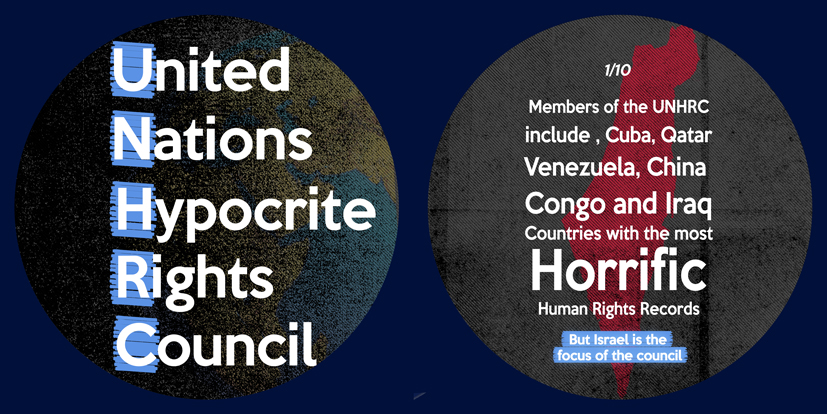
Human Rights Council - Political Bias
The UN Human Rights Council “database” of business enterprises
On 24 March 2016, at its 31st session, the Human Rights Council (HRC) adopted resolution 31/36 entitled “Israeli settlements in the Occupied Palestinian Territory, including East Jerusalem, and in the occupied Syrian Golan”.[1] Paragraph 17 (OP 17) of this resolution requests the United Nations High Commissioner for Human Rights (OHCHR) produce a database of all business enterprises engaged in certain Israeli settlement activity in the occupied Palestinian territory, or the "Blacklist".
While local and international business activity in disputed or occupied territories is widespread, and involves some of the world’s largest companies, Resolution 31/36 represents the only known UN effort to produce a “database” of such activity in respect of one situation. The fact that such business activity is so ubiquitous and rarely criticized demonstrates that it is not viewed as raising legal or human rights issues, while the desire to establish a database only with respect to business activity in Israeli settlement communities points to the political bias of the body that initiated this process.
OP17 was adopted despite the strong opposition of the US, EU and Israel. It is the product of a specific discriminatory HRC agenda item, the organization's only country-specific agenda item, which reflects ongoing and well documented institutional bias against Israel in the HRC. The Council is widely criticized as a deeply politicized body, whose agenda is often dictated by the world’s worst human rights violators, and whose legitimacy and credibility in the human rights arena has been fundamentally undermined as a result.
Israel, together with the United States and numerous other leading States, have expressed, consistent opposition to the database and its publication, and have conveyed this position in their public and private communications. Israel has no intention of cooperating with this illegitimate exercise for the following reasons:
- Lack of authority to produce database: The production of a “database” exceeds the mandate of the OHCHR, which has neither the competence nor the capacity to engage in this action. The responsibility for ensuring compliance of business enterprises with relevant laws, or for promoting any relevant non-binding guidelines with respect to business practices, rests exclusively with the States in which the relevant enterprises are domiciled or operating.
- Lack of authority to communicate to companies: The HRC and OHCHR are bodies mandated to deal with State conduct in the human rights field and they have no legal or other authority over business enterprises.
- Lawfulness of business activity: Business activity in areas of Judea and Samaria (West Bank) under Israeli jurisdiction in accordance with existing Israeli-Palestinian agreements, is entirely lawful. Indeed, the notion that business enterprises are even subject to international law, international humanitarian law, and international human rights law is highly questionable and has been rejected by Courts in leading national jurisdictions.
- Blacklist: The creation of a database, and certainly its publication in any form, amounts to an effort to produce a blacklist of companies that are not engaged in any wrongdoing, and with the potential of causing commercial, reputational and legal harm. By engaging in this action, the OHCHR is allowing itself to become an instrument of those engaged in an illegitimate, discriminatory and political motivated agenda.
Furthermore, the methodology of the OHCHR is entirely devoid of transparency, and the information upon which it has based its communication has been drawn from partial, unverifiable and unknown sources, including politically-motivated actors, who responded voluntarily to the OHCHR’s calls. The OHCHR also lacks the requisite competence or capacity to verify independently the information it has received. While Resolution 31/36 requires a database of “all” business enterprises, the process adopted makes the database flawed from its inception and inevitably renders the list the partial, selective and discriminatory in nature
It is important to note that the database initiative is not legal or quasi-legal in nature, and does not, in and of itself, carry with it legal consequences. The process lacks due process and procedural safeguards to ensure that the list will not contain unauthoritative or inappropriately verified information. Furthermore, cooperation by companies with the database initiative may entail potential legal consequences, liability, financial risk and reputational harm. As is known, relevant domestic legislation and anticipated legislative proposals in various jurisdictions prohibit companies from discriminating in their business practices, including laws that specifically pertain to discriminatory practices with respect to Israel or territory subject to Israeli jurisdiction. This pertains, for example, to companies that are domiciled in the US, are subsidiaries of US-domiciled companies, or that do business in the US. In this context, dozens of U.S. State laws currently bar granting contracts to, or pension-fund investment in, companies that boycott Israel or territories under its jurisdiction. Moreover, such cooperation might raise issues under existing relevant US federal legislation.
The UN Human Rights Council “database” of business enterprises
On 24 March 2016, at its 31st session, the Human Rights Council (HRC) adopted resolution 31/36 entitled “Israeli settlements in the Occupied Palestinian Territory, including East Jerusalem, and in the occupied Syrian Golan”.[1] Paragraph 17 (OP 17) of this resolution requests the United Nations High Commissioner for Human Rights (OHCHR) produce a database of all business enterprises engaged in certain Israeli settlement activity in the occupied Palestinian territory, or the "Blacklist".
While local and international business activity in disputed or occupied territories is widespread, and involves some of the world’s largest companies, Resolution 31/36 represents the only known UN effort to produce a “database” of such activity in respect of one situation. The fact that such business activity is so ubiquitous and rarely criticized demonstrates that it is not viewed as raising legal or human rights issues, while the desire to establish a database only with respect to business activity in Israeli settlement communities points to the political bias of the body that initiated this process.
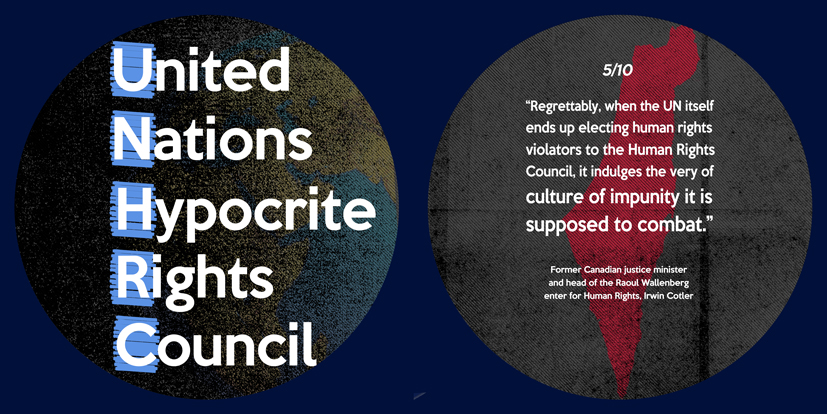
OP17 was adopted despite the strong opposition of the US, EU and Israel. It is the product of a specific discriminatory HRC agenda item, the organization's only country-specific agenda item, which reflects ongoing and well documented institutional bias against Israel in the HRC. The Council is widely criticized as a deeply politicized body, whose agenda is often dictated by the world’s worst human rights violators, and whose legitimacy and credibility in the human rights arena has been fundamentally undermined as a result.
Israel, together with the United States and numerous other leading States, have expressed, consistent opposition to the database and its publication, and have conveyed this position in their public and private communications. Israel has no intention of cooperating with this illegitimate exercise for the following reasons:
- Lack of authority to produce database: The production of a “database” exceeds the mandate of the OHCHR, which has neither the competence nor the capacity to engage in this action. The responsibility for ensuring compliance of business enterprises with relevant laws, or for promoting any relevant non-binding guidelines with respect to business practices, rests exclusively with the States in which the relevant enterprises are domiciled or operating.
- Lack of authority to communicate to companies: The HRC and OHCHR are bodies mandated to deal with State conduct in the human rights field and they have no legal or other authority over business enterprises.
- Lawfulness of business activity: Business activity in areas of Judea and Samaria (West Bank) under Israeli jurisdiction in accordance with existing Israeli-Palestinian agreements, is entirely lawful. Indeed, the notion that business enterprises are even subject to international law, international humanitarian law, and international human rights law is highly questionable and has been rejected by Courts in leading national jurisdictions.
- Blacklist: The creation of a database, and certainly its publication in any form, amounts to an effort to produce a blacklist of companies that are not engaged in any wrongdoing, and with the potential of causing commercial, reputational and legal harm. By engaging in this action, the OHCHR is allowing itself to become an instrument of those engaged in an illegitimate, discriminatory and political motivated agenda.
Furthermore, the methodology of the OHCHR is entirely devoid of transparency, and the information upon which it has based its communication has been drawn from partial, unverifiable and unknown sources, including politically-motivated actors, who responded voluntarily to the OHCHR’s calls. The OHCHR also lacks the requisite competence or capacity to verify independently the information it has received. While Resolution 31/36 requires a database of “all” business enterprises, the process adopted makes the database flawed from its inception and inevitably renders the list the partial, selective and discriminatory in nature
It is important to note that the database initiative is not legal or quasi-legal in nature, and does not, in and of itself, carry with it legal consequences. The process lacks due process and procedural safeguards to ensure that the list will not contain unauthoritative or inappropriately verified information. Furthermore, cooperation by companies with the database initiative may entail potential legal consequences, liability, financial risk and reputational harm. As is known, relevant domestic legislation and anticipated legislative proposals in various jurisdictions prohibit companies from discriminating in their business practices, including laws that specifically pertain to discriminatory practices with respect to Israel or territory subject to Israeli jurisdiction. This pertains, for example, to companies that are domiciled in the US, are subsidiaries of US-domiciled companies, or that do business in the US. In this context, dozens of U.S. State laws currently bar granting contracts to, or pension-fund investment in, companies that boycott Israel or territories under its jurisdiction. Moreover, such cooperation might raise issues under existing relevant US federal legislation.
The potential legal consequences, liability, financial risk and reputational harm is not merely a theoretical possibility, as the Airbnb case which unfolded from late 2018 to April 2019 exemplified. In this case Airbnb announced its intention to delist an estimated 200 listings of Israeli properties in Judea and Samaria. The company announced in April 2019 that his policy will not be implemented as part of settlement reached with all lawsuits that were brought by hosts and potential hosts and guests who objected to the policy on grounds of discrimination. This policy was not only attacked in the courts as it landed Airbnb on the top ten antisemitic events of 2018 by the Wiesenthal Center, led to US State investment boards to add the company to their blacklists as well as a host of leading political figures, including State Governors and American Vice President Mike Pence. All this not only led the company to abandon its policy, it also led to the company stating that "Airbnb has always opposed the BDS movement"[2]. This case exemplifies the risk the potential risk stated above.
The potential legal consequences, liability, financial risk and reputational harm is not merely a theoretical possibility, as the Airbnb case which unfolded from late 2018 to April 2019 exemplified. In this case Airbnb announced its intention to delist an estimated 200 listings of Israeli properties in Judea and Samaria. The company announced in April 2019 that his policy will not be implemented as part of settlement reached with all lawsuits that were brought by hosts and potential hosts and guests who objected to the policy on grounds of discrimination. This policy was not only attacked in the courts as it landed Airbnb on the top ten antisemitic events of 2018 by the Wiesenthal Center, led to US State investment boards to add the company to their blacklists as well as a host of leading political figures, including State Governors and American Vice President Mike Pence. All this not only led the company to abandon its policy, it also led to the company stating that "Airbnb has always opposed the BDS movement"[2]. This case exemplifies the risk the potential risk stated above.
[1]https://www.ohchr.org/EN/HRBodies/HRC/RegularSessions/Session31/Pages/DatabaseHRC3136.aspx
[2] https://news.airbnb.com/update-listings-disputed-regions/

Chronicle of a Predetermined Decision
The decision of the Chief Prosecutor of the International Criminal Court in The Hague to launch a “comprehensive criminal investigation” of “alleged war crimes” committed in what has been named the "situation in Palestine" is dramatic but not surprising. The writing was on the wall, written in large Gothic font. The decision was made somewhere in 2015, when the Chief Prosecutor, Ms. Fatou Bensouda, accepted Palestine's request to join as a member state of the court.
The motives for Bensouda’s decision were probably political and as a result, answers from the political field are now needed. Let us not be mistaken, Israel has a long list of weighty legal arguments in her defense, but unfortunately, these will not rescue her from the current situation. Any attempt to fend off political interests with legal arguments, however strong, is doomed to fail.
At this time, it is essential for Israel to have political backing from the US and to encourage the positive winds blowing from England, as this is an hour for politics and diplomacy.
This kind of pressure was recently exerted with great success by the United States, where a series of resolute statements and decisions from the former National Security Adviser John Bolton and Secretary of State Mike Pompeo were able to thwart the ICC’s intention to investigate war crimes that US forces allegedly committed on Afghanistan's soil. Incidentally, the ICC's decision to reject the motion to investigate the alleged war crimes came immediately after the denial of entry into the United States of the Chief Prosecutor and an explicit threat to use the American Service-Members' Protection Act, better known as the "The Hague Invasion Law," which gives the president a free hand to take all necessary measures in order to release American soldiers, if the ICC decides to order their imprisonment. In addition, the law prohibits any cooperation or transfer of evidentiary materials to the ICC.
The broad American defense umbrella was kindly offered to Israel as well. The sand in Israel’s hourglass started draining on Friday and will last for several months. Within this time, the Chief Prosecutor, Ms. Fatou Bensouda, will receive the opinion of the pre-trial court regarding its legal position on the issue of the court's jurisdiction to investigate the “situation in Palestine”. The court's legal position does not oblige by law, but it can outline the limits and scope of the investigation, since these arise from a determination regarding the territory in which the court may exercise its authority.
The Jerusalem Institute of Justice, a legal research institute operating in the international legal arena, has recognized and anticipated the decision of the ICC and has worked hard to ensure that the ICC investigates the real criminals who are directly responsible for committing war crimes in our region, the Hamas terrorist organization. Our efforts have borne fruit. The ICC accepted the legal and evidentiary infrastructure we presented to it and stated that it intends to investigate, inter alia, the criminal use of the Palestinian civilian population as human shields, as well as victims of murder and torture.
It is important to clarify that the ICC in its decision to investigate Israel, clearly deviates from its given mandate. This mandate does not involve the criminal investigation of leaders from countries with a self-reliant, independent, and reliable judicial mechanism. Past experience shows that Israel and specifically the IDF are able to conduct self-examination and critique of their actions. Wherever Israel recognizes a potential deviation from the morality and values that characterize the IDF in its activity (in the myriad of complex challenges that it faces), it is still able to ask and answer tough questions when needed.
Adv Uri Morad,
Director of the of International Law & Public Diplomacy Department
6 Moral Teachings from Assad and other Criminals
Written by Yarden Biyalistok Cohen
Before addressing our topic, I would like to thank you readers, for not letting hate and prejudice guide your life, and for your willingness to establish your perspective on facts and on more than one point of view.
The topic we are about to discuss is regarding the resolutions made by the UN General Assembly on November 29, also known as "Palestine Day". I won't try to argue against the very existence of such a day, although trying to promote an "Israel Day" at the UN would be a better joke than having a day dedicated to bicycles, or the full moon (both are real by the way and take place at the 30th of April and June 3rd respectively, or even better "Tuna day" which occurs on the 2nd of May).
Six resolutions were made on "Palestine Day", and were signed by countries that are almost the dictionary definition of an oppressive tyranny, and human rights violators, such as Sudan, Venezuela, Saudi Arabia, and Yemen. The resolutions of the General Assembly all addressed Israel, and were aimed at undermining its legitimacy and sovereignty. On that day, the Chair of the Committee on the Exercise of the Inalienable Rights of the Palestinian People Cheikh Niang (Senegal), wore a scarf that revealed his “objectivity”, and his willingness to let the discussion be “impartial”. On the scarf, of course, was the flag of the Palestinian Authority (maybe on May 2nd he will show up in a scarf showing solidarity with the tuna fish).
In most cases, we would simply continue by stating that the demonization of Israel and the Jewish people is not news. Unfortunately Anti-Semitism was around way before the establishment of the UN and most likely to stay here after it. Nevertheless, the first of the 6 resolutions calls for the deliberation on "fifty years of occupation" and to express solidarity and support to the Palestinians. The second resolution asks to continue the collaboration with the Palestinian people and their leaders, widen the scope of documentation and expand the Question of Palestine’s website. The third resolution asks to continue investigations into the legal ramifications of the "Israeli West Bank Barrier". The Security Fence is exactly that, a fence that was built to stop the entrance of suicide bombers and other terrorists into Israel, and the last part of it was finished back in 2006. The Security Fence was under meticulous scrutiny by the Israeli Justice system. This General Assembly resolution only emphasizes its real goals, to undermine Israeli sovereignty. As proof the committee asks to investigate within Israel's territory, not just the areas where the Security Fence is located. I wonder if the final report would state that the proof that the Fence is unnecessary is that the investigating operatives were not actually killed by suicide bombers.
The fourth and fifth resolutions express concern regarding the provocation that took place at Jerusalem's Holy Sites, during Tisha B'av which is a Jewish day of grief, remembering the desolation of both Temples. The Jewish people in Israel requested to pray at the Temple Mount, which is inside Israel's borders. The Jordanian press published bombastic headlines like "The Jews are storming al-Aqsa", which painted the act of praying with false war-like colors, aiming to harm Israel's legitimacy. Apparently you deserve freedom to worship only if you are not Jewish.
The last resolution sheds an even brighter light upon the infamous UN bias against Israel. The resolution calls for Israel to give back the Israeli Golan Heights to Syria (that is also a signatory of the resolution). Israel annexed the Golan Heights after Syria attacked in 1973; the attack took place on the Jewish holy day of Yom Kippur, a day of fasting for the Jewish people. The Syrian forces rushed into the Israeli cities aiming to annihilate them. After Israel repelled the attack, the government decided to annex the Israeli Golan as a natural security border. A portion of the mountain ridge stayed in Syrian hands, thus serving as a natural boundary for both countries.
Since then, that front has been quiet, showing how Israel has managed to use a mountain as a peace resource. The people of the Golan Heights (almost all are Druze) have established good and ongoing relations with the Israeli people and the Israeli government. They enjoy freedom, equality, economic development and of course human rights. Their brothers and sisters that are unfortunately not on the Israeli side of the border, have suffered oppression from the Syrian regime, the Syrian civil war, and have also fallen victim of extermination attempts by ISIS.
During the Syrian civil war Israel has done its best to relieve civilians from as much suffering as possible, by using its military to provide to countless Syrian civilians with medical assistance. The very existence of Israel serves as protection to Syrian citizens who flee to the border. Israel has cared for the wellbeing of the Syrian people far more than the Syrian regime, who has slaughtered hundreds of thousands of their own people.
This resolution asks to cede Israeli territory to Syria and by doing that further increase the body count. Israel of course cannot accept this resolution since it jeopardizes the safety and security of its citizens, Jews, Arabs and Druze. In addition, I want to ask you, if you can help me find the connection between this resolution and the Palestinian people’s suffering?
As Israelis, we lost our trust in the UN long ago. From here it seems as if it serves as an international Anti-Semitic arm, which promotes the exact opposite ideals than the ones it was founded upon. I urge you to help reclaim truth and reason! Help us protect our Druze brothers, our freedom of worship, and the purity of intentions in the UN.

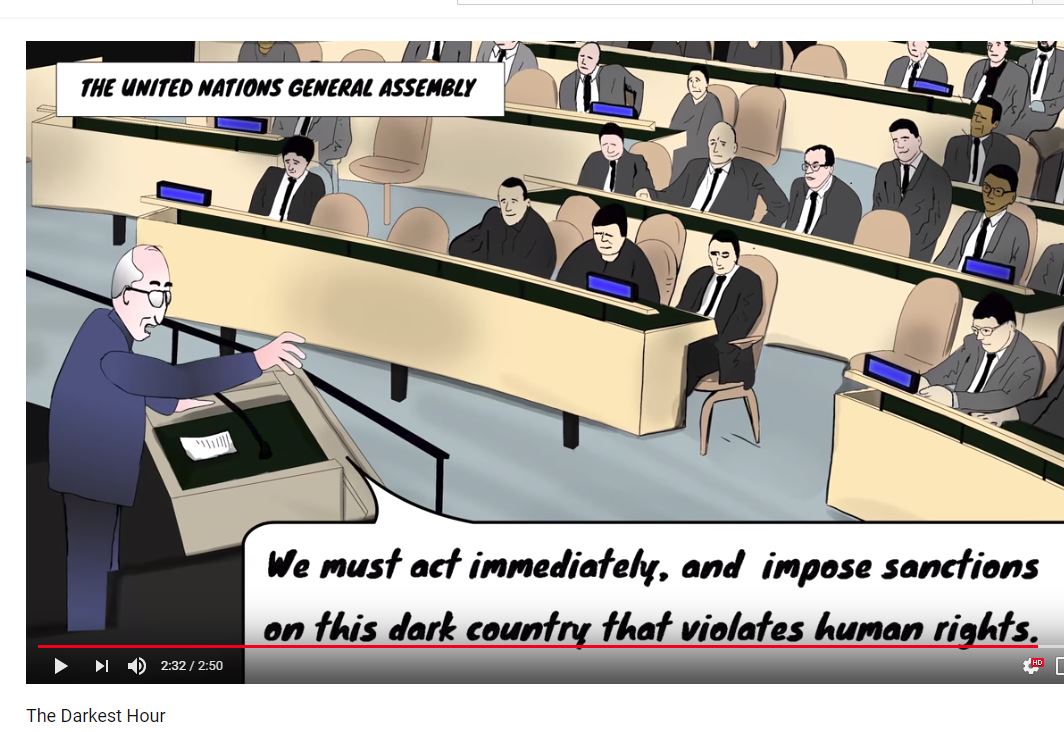
The Darkest Hour
https://www.youtube.com/watch?v=_Rnhmu3H_DI
We don't have to go far to receive a clear picture of human injustices. And yet some of us choose not to see. The UN should open it's eyes, it has the opportunity to change lives.

The UNknown Truth
https://www.youtube.com/watch?v=-o5Aweqc4Ns
The UNknown Truth. UN General Assembly resolutions against Israel vs. the rest of the world. Is it balanced?

Israel in the Past 70 Years
View Israel's past agreements, war involvements, disputes and activities- as well as it's place within the United Nations. In 2018, we will view the outcome of Trump's declaration of Jerusalem being Israel's capital city.
Download
When Sanctions Fail
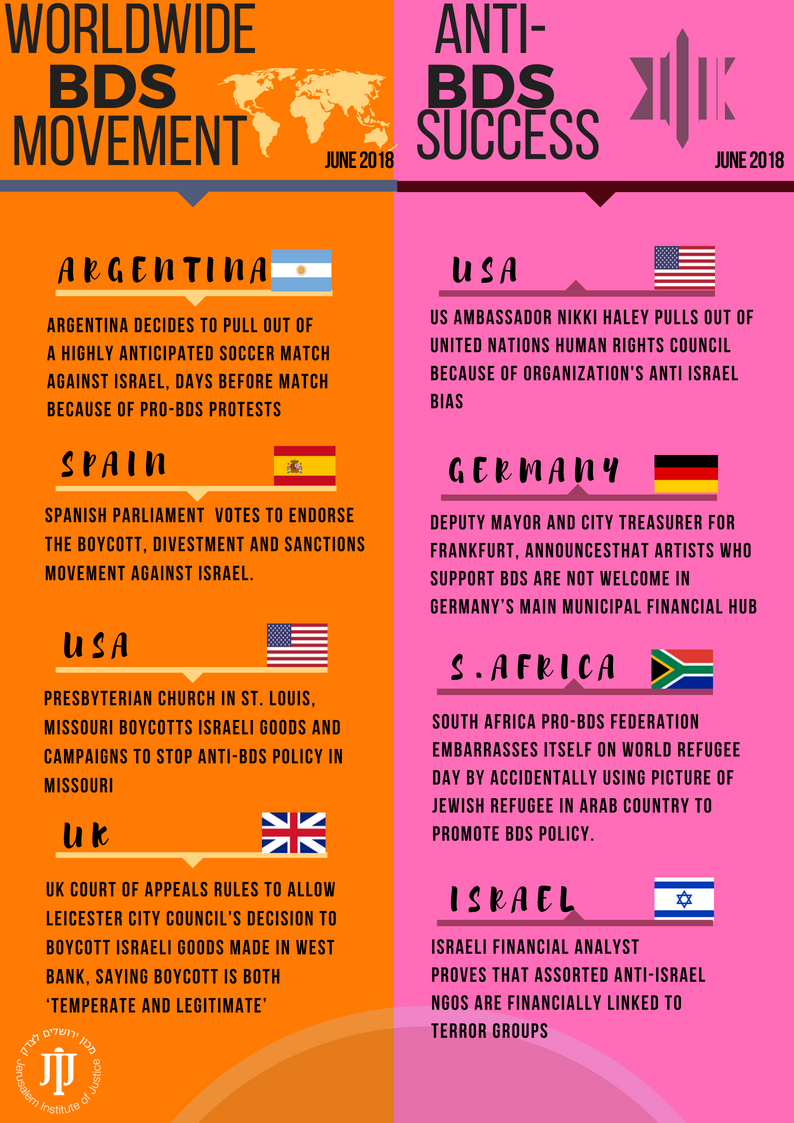
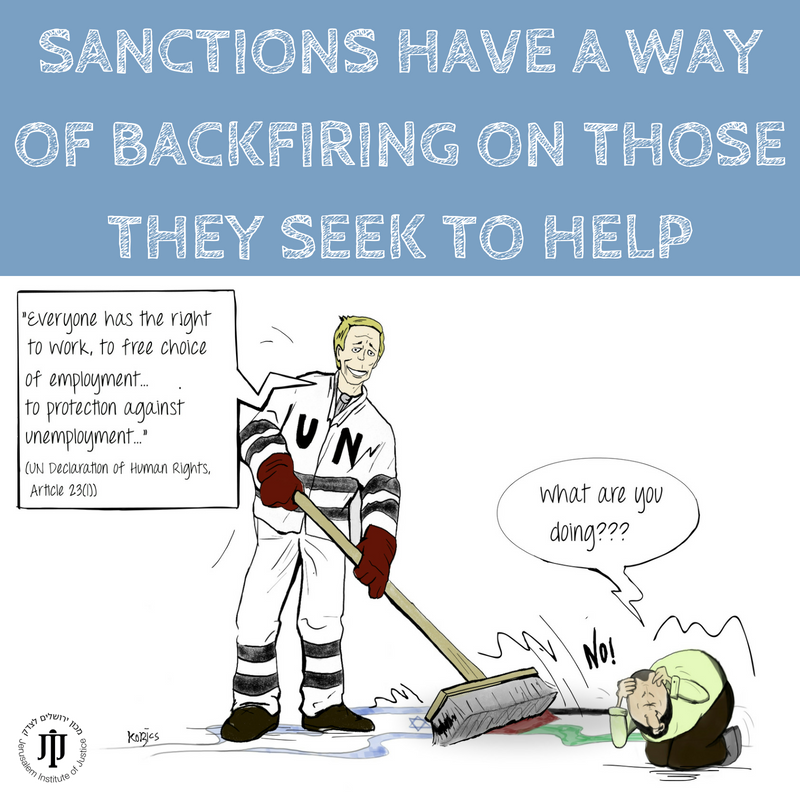
The United Nations Human Rights Council announced its intention to publish a blacklist of 150 private companies, including those who do business in the disputed territories beyond the Green Line in Israel. In doing so, the Council plans to condemn the companies for acting against international law. This condemnation is supposed to tarnish the companies’ reputations politically in order to force them out of these territories. This move is said to help the Palestinians in the area; but according to numerous studies on the effects of sanctions, it is more likely to harm them economically.
A recent study of 68 cases where sanctions were imposed shows that in the end there is an expansion of inequality with a damaging impact on the sanctioned economies. For example, Yemen, which was sanctioned for ten years, experienced an increase both in poverty and in polarization due to inequality. The results can still be seen today in the sewage that runs through its streets.
Another case study of sanctions, done between the years 1982-2011, also reveals their negative effects on poverty. The research shows that the poverty gap widened from 5.89% before sanctions to 13.26% afterwards – an increase of 7.37%! Furthermore, there was a 22.39% increase in death rates. Poverty spreads as sanctions intensify.
This data clearly shows the potential for devastating economic damage to Palestinians as the result of applying sanctions to Israeli companies in the disputed territories, and the effects of sanctions are long-term.
Over the years, the economy of the Palestinian Authority (PA) has developed a high dependency on international aid. Prior to the first Intifada (1987) there was a level of only 5% unemployment, with many Palestinians able to find work. Today, that percentage has dramatically risen to approximately 43%, with 58% unemployment among the young people of Gaza. Even amongst the employed there is a high percentage living under the poverty line. The political conflict has caused a worsening of economic conditions, which has led to increased dependency of the PA on foreign aid.
The World Bank recommends the development of the private sector in order to boost Palestinian economic growth. However, this strategy contradicts the interests of the PA, which receives most of its funding from international aid. The funding is given to the leaders of the PA, who use it for terrorism, anti-Zionist propaganda and for fattening the stomachs of the elite (there is a wide gap between rich and poor). In contrast, Palestinians who work for Israeli private-sector companies are able to make a comfortable living without dependency on foreign aid. Clearly, sanctions on Israeli companies prevent this by leading to an increase in Palestinian unemployment.
The consequence of all this is unnecessary human suffering. Sanctions cause a deepening of inequality, a widening of the poverty gap, an increase of social polarity, and more. Furthermore, these effects are long-term. Considering the political reality for individuals in these areas, it is reasonable to believe that massive harm has already been caused. It may well be that the economic reality of poverty and unemployment in everyday life has been contributing to the worsening of the conflict. Considering this perspective, it becomes apparent that the sanctions are targeted not at stabilizing the area, but rather at delegitimizing Israel.
FACTS ON THE GROUND
As a Jewish millennial, I considered myself very informed on the situation in the Middle East, specifically with regards to Israel. After studying the conflict in college and receiving a degree in Middle Eastern Studies, I believed that I had developed a nuanced perspective from what I believed to be a diverse set of sources. However, when I began working at the Jerusalem Institute of Justice, I realized just how much of the picture I was missing and how much I still had to learn. The anti-Israel bias in the Western media became clear both in terms of how they portrayed the different sides in the conflict and especially on the information that they withheld from the public.
The BDS movement attempts to use this flow of information to its advantage. BDS leaders would have you believe that the only way to end the suffering of the people in the region is to boycott Israel. The movement conveniently leaves out any information that negatively portrays the Palestinians and their government as well as any information that reflects positively on Israel. It is due time for information to flow more freely and honestly so that people might truly understand the situation on the ground. With distorted facts come distorted opinions that do nothing to further dialogue or peace.
One of my first projects required me to research the difference in standards of living between that of Arab-Israeli women and those in Arab countries throughout the region. My research taught me a number of things. For example, while one can walk through the streets of Israel and see Arab women doing as they please, women are forbidden from many things in Gaza, like smoking hookah in public or running the Gaza marathon. Certainly more alarming, while Israel has a law making rape - including spousal rape - a felony punishable by 16 years in prison, a man in the Palestinian Authority could avoid prosecution for rape or sexual assault if he marries his victim due to a “marry-your-rapist” law.
I am shocked by the world’s silence regarding these laws targeting women in the Arab world. Yet, the United Nations dedicates extensive time towards chastising Israel for its treatment of women. With an increased focus on women’s rights, it is now time that the women under the control of the Palestinian Authority and Hamas receive the same attention and support from the international community.
My next projects focused on the BDS movement, something I fortunately had little interaction with on my college campus. There were stories circulating about the movement and its successes in convincing people of Israel’s supposed evils. BDS makes claims that Israel discriminates against the Arabs living in the country and highlights the harsh restrictions that Israel imposes on the movement of Palestinians. In reality, Arab-Israelis are an integral part of society, both academically and professionally. Arab-Israelis serve as Knesset members in both Arab and non-Arab parties and make up 16.1% of students in Israeli universities. Additionally, Arab citizens of Israel enjoy equal rights under the law, the same as their Jewish counterparts. In terms of the supposed “restriction of movement,” people blamed the security fence, which was built for and succeeded in preventing terror attacks. And even with this fence, over 100,000 Palestinians enter Israel every day for work. All this proves that these claims of discrimination are drastically exaggerated in service of a clearly dishonest agenda.
When reading about the region in the United States, it seemed that every little incident in Israel would be front-page news. The media loves pointing out Israel’s flaws, highlighting any instance that could be portrayed as an example of Israeli maltreatment of the Palestinians or its own Arab citizens. What was lacking was a comparable scrutiny of the governing bodies of the Palestinians. When the media does report on Hamas’ mistreatment of its citizens in Gaza, albeit infrequently, the Palestinian Authority does not receive any condemnation but is ignored for its corruption and the abuse of its people. In reality, Hamas steals electricity from its citizens while encouraging them to kill family members suspected of aiding Israel. At the same time, The Palestinian Authority works hard to silence any dissent, torturing journalists and others who attempt to speak out about the government’s abuses. In addition, rarely does one hear about the Palestinian Authority paying monthly salaries to families of terrorists. These are just some of the many abuses of power occurring in the Gaza Strip and West Bank that the Western media fail to adequately report. But why are these things not common knowledge among my peers? Where is the outrage from people who claim to care about human rights?
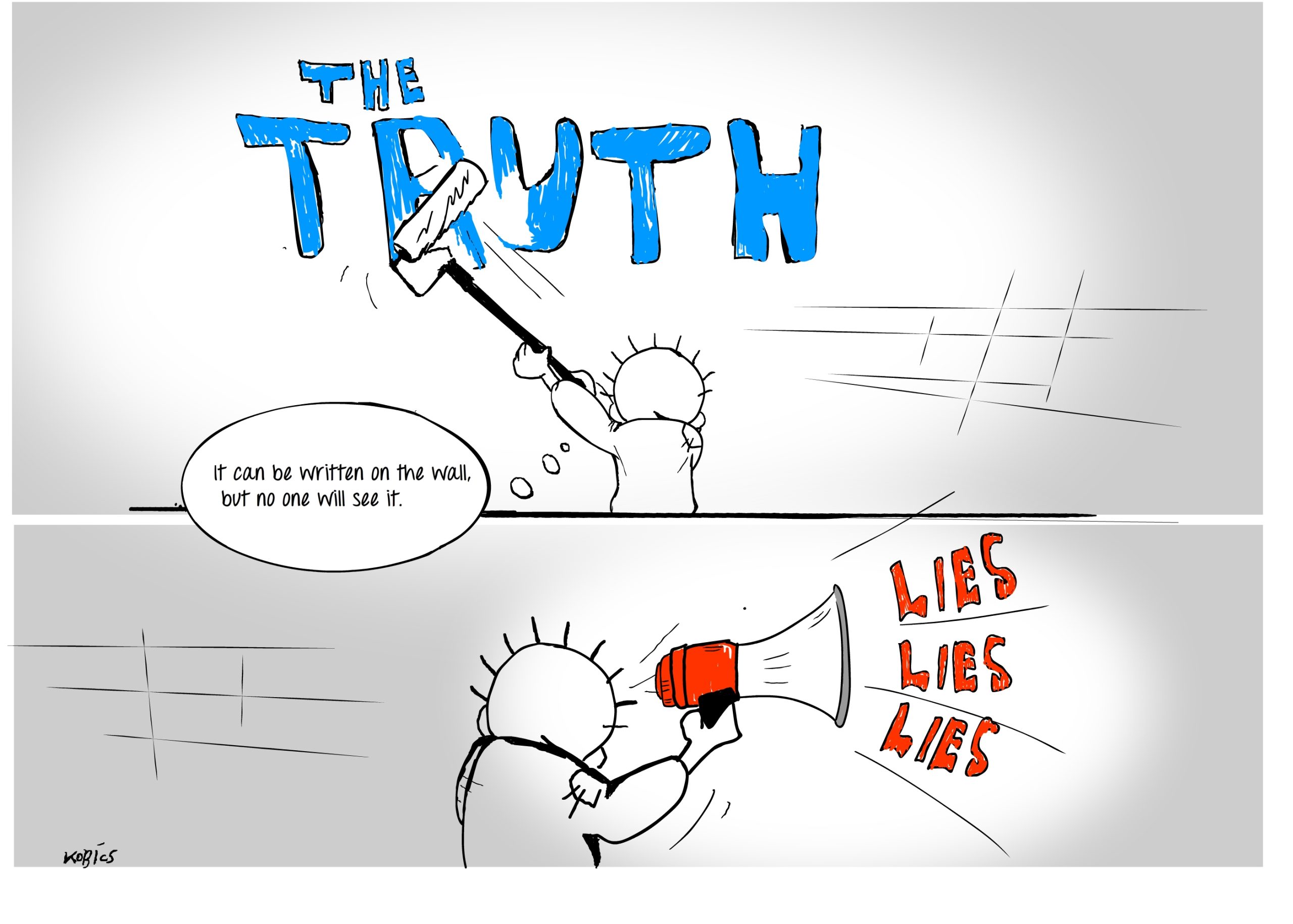
The BDS movement tries to change the narrative and distort the facts on the ground. It hopes that the incomplete and false media coverage of the situation will influence people to have a negative perception of Israel and to blame it for the conflict. This requires us to do our own research and learn the truth so that we do not let the BDS movement dictate the narrative and forge it as one of hate and lies.