

When Does Criticism of Israel Become Anti-Semitism?
By Nikki Golomb.
As a Jewish-American university student, I have been faced with the impossible task of determining when a professor, a student group, or an event has gone too far in criticism of Israel as a Jewish democracy. Is this legitimate criticism of Israel as an imperfect state, or is it holding Israel to an unfair standard of perfection? Is this criticism of Israel as a Jewish nation, or a political state? Is this anti-Semitism masked as anti-Zionism, a more “acceptable” form of criticism? And if so, where do we draw the line?
Anti-Israel rhetoric is often referred to as the “new anti-Semitism.” Classical anti-Semitism – such as the blood libel, Nazi symbolism and graffiti, and destruction of Jewish tombstones – are easy to identify, illegal, and largely socially unacceptable. Anti-Israel speech, on the other hand, is much more palatable to the public. However, anti-Israel rhetoric is often used as a more “acceptable” form of anti-Jewish sentiment, as the only Jewish state is held to a higher standard than any other country in the world.
There is a very fine line between legitimate political criticism of Israel and anti-Semitism. Many of us know all too well that recognizing the line is not only very difficult, but also vital in order to not infringe upon free speech while also condemning hate speech. However, Israel is not perfect, and thus denouncing any criticism of Israel as anti-Semitism ignores the political challenges faced within Israel and also holds Israel to a different standard than other countries. So how do we know when to speak up against anti-Semitism?
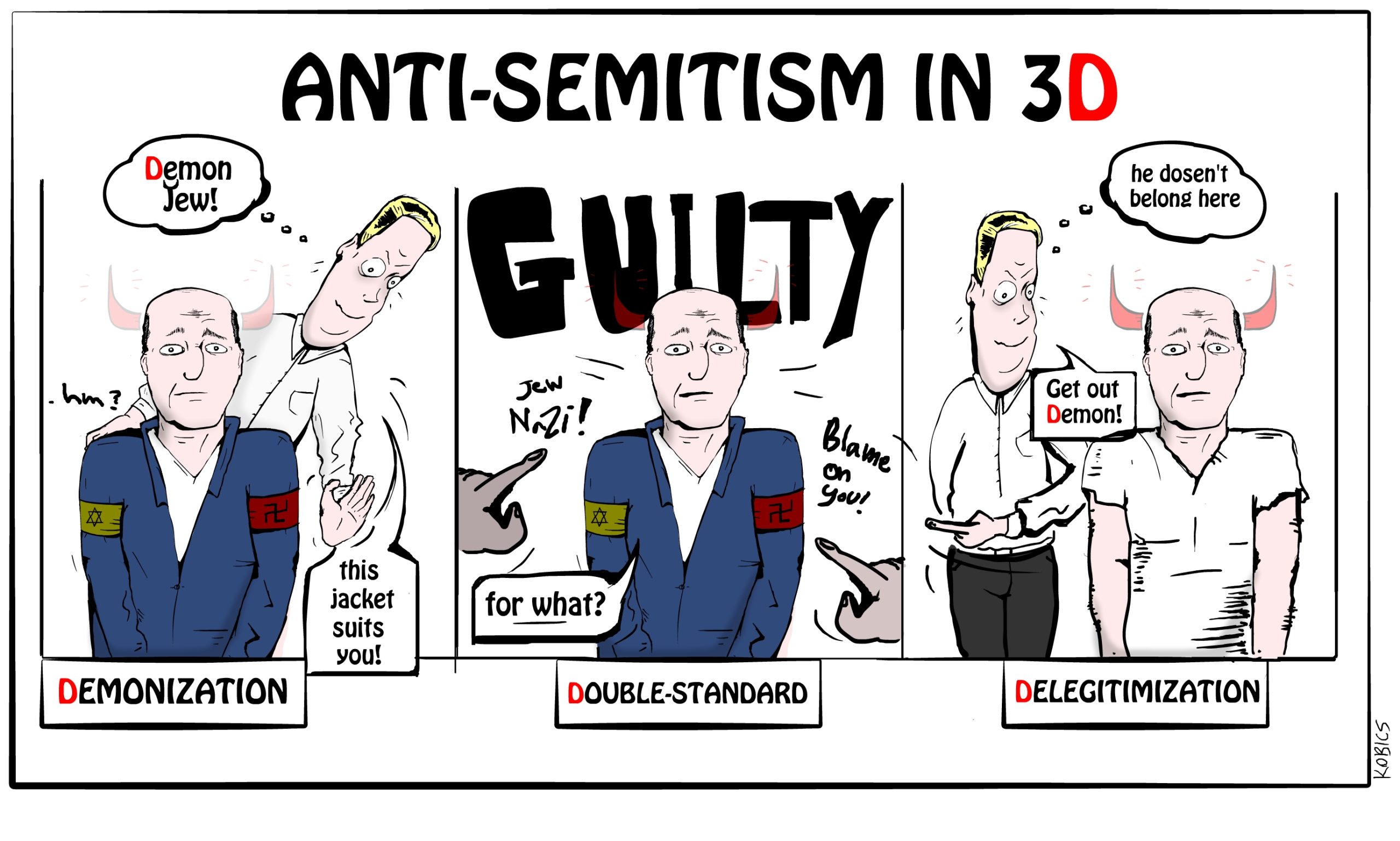
Natan Sharansky, Chairman of the Executive for the Jewish Agency for Israel and human rights activist, proposed what he calls the “3-D test” to differentiate between legitimate criticism of Israel and anti-Semitism. This test dictates that if a statement or action demonizes Israel, holds Israel to a double standard, or delegitimizes Israel (the “3 Ds”), it is in fact anti-Semitic.
Demonization
Demonization, the first of the 3 Ds, is relatively easy to identify as it has been a marker of anti-Semitism for centuries. Depicting Jews as the embodiment of evil (i.e. “Jews have horns” or “Jews are the devil”) is one of the oldest forms of anti-Semitism. Today, demonization of Israel includes comparing Israel to Nazi Germany, equating Palestinian refugee camps with concentration camps, or depicting Israeli political leaders as the devil.
Demonization of Israel is clear anti-Semitism, with a shift of focus from Jews as individuals to the Jewish nation. When criticism of Israel is focused on its nature as a Jewish state, when its policies are blown out of proportion, and when criticism reflects anti-Jewish sentiment that has persisted for centuries, anti-Semitism is the culprit.
Double Standard
Discriminatory laws holding Jews to a different standard than other citizens have also existed for centuries. From empires imposing additional taxes on Jews, to outright denying the right to Jewish practice, to more recent ghettoization, Jews have been subject to different laws than their neighbors.
The same is happening today, at the international level. Of the 2017-2018 UNGA resolutions condemning countries, 20 of the resolutions were against Israel – and six against the rest of the world combined. Furthermore, since the establishment of the UN Human Rights Council, about 50% of its resolutions concerning specific countries have been against Israel. No other country has received such treatment. Singling out Israel for condemnation while ignoring massive human rights abuses in other parts of the world is holding Israel to a double standard. Expecting Israel and Israeli organizations to adhere to a higher standard of human rights singles out Israel as the only Jewish state, and is thus an expression of anti-Semitism.
Delegitimization
Delegitimization is slightly harder to identify, but just as important. It refers to any action or comment delegitimizing Israel as a Jewish democracy, or denying Israel’s right to exist as one. It can be accusing Israel of colonialism, ethnic cleansing, and apartheid; or it can be claiming that Israel was established illegally and on lands that it has no right to own, thus delegitimizing Israel’s very right to exist at all.
Dozens of Muslim states and Christian states exist, yet there is only one Jewish state. Denying its right to exist is inherently anti-Semitic because it discriminates against Israel based on its nature as a Jewish state. Making false claims of ethnic cleansing or apartheid delegitimizes Israel by implying that it is founded on racism and discrimination and thus has no right to sovereignty. The same argument can be made of the claim that Israel has no legal, historical, or cultural right to the land; however, making these claims is anti-Semitic because it nullifies Jewish history, nationalism, and right to self-determination.
Discussion and Conclusion
Expressing disapproval for specific Israeli policies is a legitimate form of criticism. Arguing against political action, the way one does with regards to other countries, is not only acceptable but also healthy – no positive progress can be made without open dialogue and political discussion. However, when one (or more) of the “3 Ds” become present and that criticism crosses the line into anti-Semitism, nothing productive can happen. No positive change can happen when the criticism is based on anti-Jewish arguments. When someone demonizes Israel, holds it to a double standard, or delegitimizes it, their tactics must be called out for what they are. This is the only way to ensure that anti-Semitism is recognized and stopped, and legitimate criticism is taken seriously so as to promote progress.

Israel is Leaving UNESCO
Following President Trumps announcement to leave UNESCO, Israel took into consideration their stance in the matter.
Download
Who Stands with Israel?
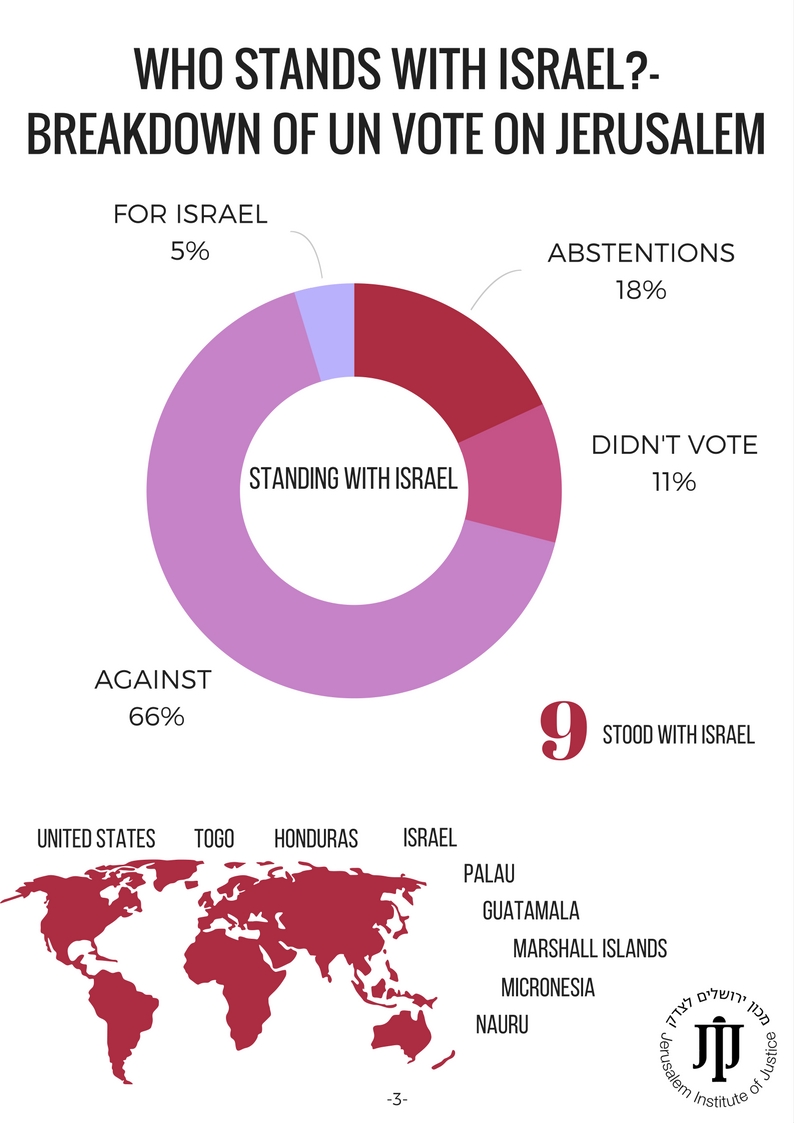
Let's break down the numbers by looking at the UN vote that recently took place regarding Jerusalem. Sadly, the numbers point to a not-so-encouraging outcome.
Download


Jerusalem of Gold – and the US Embassy
By Nikki Golomb.
Throughout his presidential campaign, President Trump promised that when elected, he would move the US embassy from Tel Aviv to Jerusalem despite both international pressure and domestic precedent opposed to such a move. Since being elected, his stance has changed several times on the issue; this week, however, he made the official announcement that the United States a) recognizes Jerusalem as the capital city of Israel, and b) will move the embassy from Tel Aviv (where it is currently located) to Jerusalem.
Why is the move controversial? What are the immediate reactions? And what does this announcement mean for future international relations, particularly within the Middle East?
The Past
Jerusalem is probably one of the most, if not the most, contested lands in the world. It is a holy city for Judaism, Islam, and Christianity, and thus control over the land has been the cause of conflict and war for millennia. The Jewish people have considered it to be the spiritual capital for 3000 years and, more recently, the political capital of the Jewish State for several decades. Yet although Israel declared Jerusalem as its capital city in a 1950 Knesset vote, many countries – as well as IGOs such as the United Nations and the European Union – decline to recognize Jerusalem as the de jure capital. This has clear implications on the international legitimacy of Israel, as its jurisdiction over its own self-proclaimed capital is disputed. It is a very unique situation that a country declares a city to be its capital city and other countries deny this fact; one might question why foreign states have a say in what the capital of Israel is, yet this is the reality in which we are living.
In 1995, the United States Congress passed the Jerusalem Embassy Act in order to begin “initiating and funding the relocation of the Embassy of the United States in Israel from Tel Aviv to Jerusalem, no later than May 31, 1999,” as well as recognize Jerusalem as the capital of Israel. However, each US president (including Trump) has signed a waiver declining to implement it on the grounds that the Act is a “Congressional infringement on the executive branch’s constitutional authority over foreign policy.” As a result, the US has effectively refrained from making a definitive statement on Israel’s jurisdiction over Jerusalem – until today.
The Present
Both Israelis and Palestinians want Jerusalem as the capital of their respective sovereign nation. As such, the issue of jurisdiction over the holy city is one of the most contentious negotiation topics in Israeli-Palestinian peace talks. Refusing to acknowledge Israel’s right to Jerusalem as its capital allows states to remain “neutral” and thus maintain relations with both Israel and the Palestinian Authority.
Even those countries which do recognize Jerusalem as the capital of Israel have their embassies in Tel Aviv in order to avoid conflict. Though this may seem trivial, the symbolic meaning is anything but. All around the world, foreign embassies are located in the respective country’s capital city. Recognizing Jerusalem as Israel’s capital without treating it as such is only a surface-level show of solidarity, and does not truly support Israel’s right to self-determination. However, due to the tensions surrounding Jerusalem, no country chooses to house its embassy there. Doing so would send the message that control over Jerusalem, one of the major points of conflict in Israeli-Palestinian negotiations, is undeniably and nonnegotiably Israel’s.
Even before Washington made the official announcement to recognize Jerusalem as Israel’s capital and move its embassy, the United States faced both domestic and international backlash. Now that President Trump has publicly declared the intended policy change, opponents accuse him of upending decades-long political precedent in the US and throwing the Middle East into unknown turmoil, while supporters are saying, “Well, it’s about time.”
The Future
The United States historically has been one of the main mediators in Arab-Israeli negotiations (for example, the Camp David Accords, Oslo Accords, Camp David Summit, and Israeli-Jordanian peace treaty were all either mediated by or signed in Washington). Publicly recognizing Jerusalem as the capital of the State of Israel necessarily establishes a bias in favor of Israel in the event of future negotiations, should the US continue to mediate these talks. As a result, many Palestinians, Arabs, and other supporters of Palestinian self-determination oppose Trump’s recent announcement as it could create further challenges in the peace process to come.
Most of these challenges stem from the United States’ reputation in the region. Washington may no longer be viewed as a neutral party, causing possibly irreparable damage to relations in the region. Furthermore, it perpetuates the narrative that “the US is at war with Islam and has no respect for Muslim and Arab perspectives.” In a region already experiencing backlash to globalization and Western cultural imperialism, the implications of Trump’s announcement may damage cultural relations in addition to political ones.
The announcement additionally is expected to increase violence and extremism in the region. Senior Palestinian Authority advisor Mahmoud Al-Habbash announced, with PA President Mahmoud Abbas by his side, that Trump’s announcement “would mean total destruction of the peace process... The whole world will pay a price for any change or harm to the political reality of Jerusalem." Hamas additionally called for a revival of the intifada should Washington follow through on its plans.
Yet many Jews – both in Israel and the diaspora – do not see the significance of this announcement. Jerusalem has been the capital of the Jewish people for 3000 years; Washington’s decision to declare its support changes nothing, and nor does the refusal of other states to make the same recognition. Jerusalem always has been and always will be the spiritual capital of the Jewish nation, and no government has the ability to take this away. However, we cannot ignore the inevitable political implications, both short-term and long-term, that the United States’ policy change will have. It is only a matter of time before we begin to see what these effects will be.