
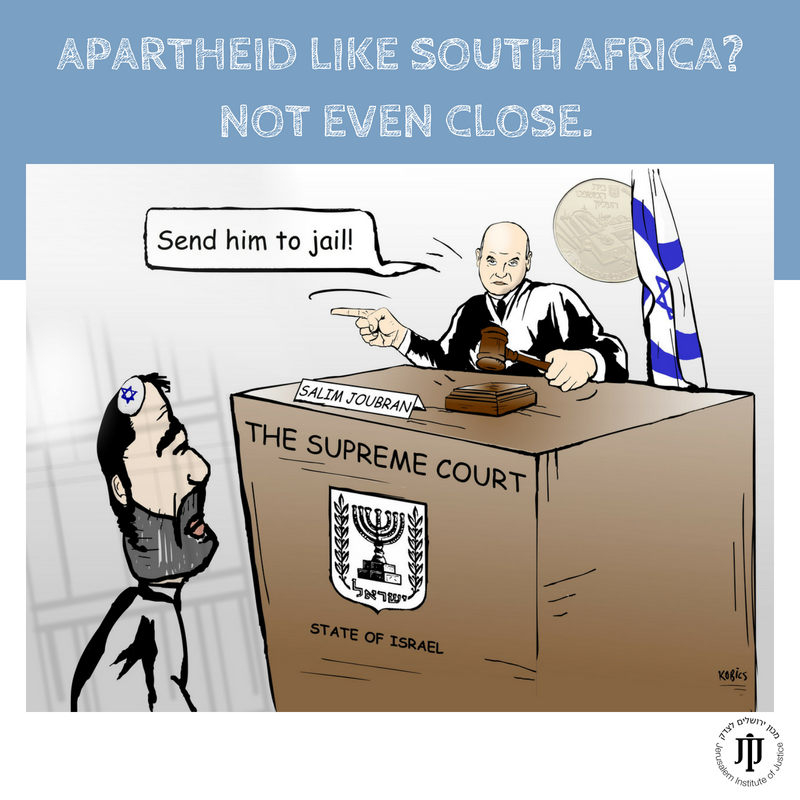
THE “APARTHEID” NONSENSE
“The people who are talking about apartheid[1] in Israel are talking nonsense.” So declared a black South African pastor who, after an accident, found himself hospitalized in Israel alongside Palestinian Muslims and Jews, all receiving equal care.
Characterizing Israel as an apartheid state is a charge frequently heard from the numerous churches, religious organizations, and NGOs that endorse the BDS movement. It often appears explicitly in their official documents and resolutions. The “apartheid state” mischaracterization is one of the presupposed assumptions underlying the BDS movement, a complete fiction that is uncritically accepted by many of its followers as well as many naïve church-goers.
Other religious leaders in the BDS movement are not naïve but simply dishonest and cynical ideologues who want to bring down Israel the same way economic tactics succeeded in bringing down the old South Africa in the 1990s. More to the point, they really don’t want to change Israel. Their real agenda is to eliminate Israel entirely. Author Gerald Steinberg writes, “The attempt to label Israel as an illegitimate ‘apartheid state’ is the embodiment of the new anti-Semitism that seeks to deny the Jewish people the right of equality and self-determination among the nations.”
Kenneth Meshoe, a black member of the South African parliament, states emphatically, “I know that nothing is happening in that country [Israel] that can be compared to apartheid in South Africa.” Meshoe, who was born in Pretoria under apartheid, speaks from experience. “We know what apartheid really was. What we suffered in South Africa is not being suffered by anyone in Israel…. Non-Jews in Israel have everything that we non-whites in apartheid South Africa never shared with the white South Africans.”
Meshoe adds, “The charge that Israel is an apartheid state is a lie about Israel, and it is a lie about the real apartheid.” To those who propagate the slander, he says, “You are damaging the chance for peace in the Middle East and… you are destroying the memory of the real apartheid.” As Gerald Steinberg puts it, “In reality, the analogy and rhetoric are absurd, and they demean black victims of the real apartheid.” He points out, too, that “the ‘Zionism is apartheid’ propaganda is also used to justify Palestinian terrorist attacks and the efforts to deny Israelis the basic human right of self-defense….”[2]
The comparison between apartheid South Africa and Israel is ridiculous, a case of apples and oranges. As Harvard Law professor Alan Dershowitz says, “Israel is not like South Africa in any way.” Yet the “apartheid” slander persists, facts notwithstanding, because it is a useful propaganda theme for the purpose of demonizing and delegitimizing Israel as well as denying Israel’s right to exist.
Author and journalist Benjamin Pogrund was born in Cape Town in the 1930s and left South Africa only after being forced out for his critical journalism. Since then he has lived more than a dozen years in Israel. He writes, “I am acutely aware of Israel’s problems and faults, but it is nothing like South Africa before 1994.” He cites “pass laws” that limited where blacks were allowed to live and work, torture and detention without trial by the security police, and starvation and malnutrition in the rural areas.
In apartheid South Africa, any black who needed medical treatment and was fortunate enough to find a white doctor willing to treat him had to enter the clinic or hospital through the back door and get inferior treatment. There is no such discrimination in Israeli medical facilities.
In Israel there are non-Jewish judges, teachers, professors, even members of Knesset, as well as others holding high positions in all professions and occupations. In apartheid South Africa, non-whites were systematically banned from all such opportunities. They were deprived of the right to vote and choose their own leaders. Israeli citizens, both Jews and Palestinians, have these civil rights in full.
Blacks under apartheid were the overwhelming majority of the population of South Africa. Yet they were not citizens and they lived under severe restrictions. Even the basic right to life was trampled on. The government disrespected their human rights so much that blacks could be killed for protesting against its policies. In Israel, on the other hand, Arabs are a minority, but they have equal rights as citizens.
“Zionism and the revival of national sovereignty in the Jewish homeland are not manifestations of European colonialism, in contrast to the white settlers… who created Johannesburg and Pretoria,” writes Steinberg. And while black labor was exploited in slavery-like conditions under apartheid, in contrast, Palestinians are dependent on Israeli employment….”
As black South African parliament member Kenneth Meshoe observes, there would have been no need for armed struggle in South Africa, and no need for Nelson Mandela to go to prison, if conditions under apartheid had been comparable to the human rights situation in Israel. In addition to the right to vote, Mandela fought for fundamental rights including freedom of movement and travel, freedom to live where one chooses, freedom of access to medical facilities, and the right to education. In Israel, those rights are already in effect for all Israeli citizens without discrimination.
From its beginning, the Zionist movement has held an egalitarian mentality, rejecting social class hierarchy structures. The idea was that no one, no social elite, was above doing useful labor. Otherwise, said Ben Gurion, “this will not be our homeland.” That egalitarian ideal has continued to shape Israeli society and culture. It stands in stark contrast to the racially oppressive and brutal, rights-denying character of apartheid. The two models of society could hardly be more opposite.
There is a caveat, though, when it comes to the West Bank and Gaza, the Palestinian territories as differentiated from Israel per se. Those areas have their own governing authorities whereby they manage their own affairs. In fact, they don’t just want their own separate state. Disputing Israel’s right to exist, they advocate Israel’s destruction and refuse to give up terrorism. As a result of this hostile intransigence, Israel cannot take the self-destructive step of extending citizenship to the Palestinians in the territories, which would amount to de-facto annexation. But the fact that the territories are governed separately from Israel does not imply by any stretch of the imagination that Israel is an apartheid state.
Benjamin Pogrund, after acknowledging some of Israel’s faults, writes: “But from my perspective, there is none of the institutionalized racism, the intentionality that underpinned apartheid in South Africa. So why does the BDS movement insist otherwise?” His conclusion: “For them to propagate this analogy in the name of human rights is cynical and manipulative. Their aims would eliminate Israel.”[3]
[1] Apartheid, of course, is an Afrikaans word meaning racial segregation. But it denotes a whole system of brutal oppression.
[2] Steinberg, Gerald, “The Apartheid Propaganda,” Jerusalem Post, 24 August 2004.
[3] Pogrund, Benjamin. “Why Israel Is Nothing Like Apartheid South Africa.” New York Times Op-Ed, 31 March 2017.

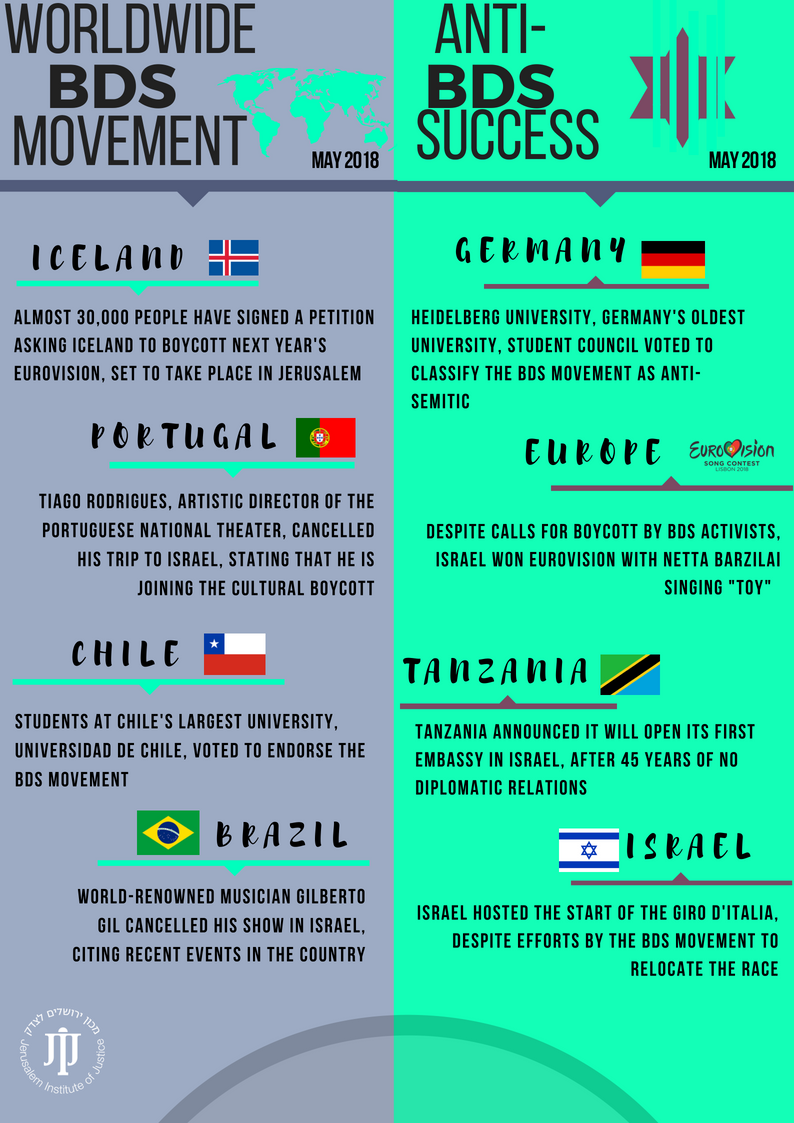
Omar Barghouti: A Man with Two Faces
By Nikki Golomb.
In 2005, Omar Barghouti founded the infamous boycott, divest, and sanction (BDS) movement; a movement which on its surface appears to promote the rights of Palestinians by pursuing economic, academic, and cultural boycotts of Israel. Beneath the surface, however, it becomes clear that this movement’s true goal is to bring an end to the State of Israel and replace it with a sovereign Palestinian state.
BDS is an extremist, anti-Zionist movement masked as human rights activism. It should thus come as no surprise that Barghouti also aims to portray himself with the same kind of mask. However, if we take a closer look at his actions and beliefs, we see a very different picture. Who, then, is the man behind the movement?
Omar Barghouti was born in Qatar to Palestinian parents, grew up in Egypt, and received a master’s degree from Columbia University before marrying an Arab-Israeli woman and gaining permanent residency status in Israel. He has since received a second master’s degree as well as a PhD from Tel Aviv University in ethics. The irony of this is almost laughable, given that a founding principle of the BDS movement is an academic boycott of Israeli institutions, scholars, and studies. He has enjoyed invaluable benefits from Israeli academic institutions, yet actively promotes boycotting those very institutions. When questioned about this hypocrisy, Barghouti cites personal matters and refuses to comment any further. He also conveniently does not mention that despite a petition among TAU students to remove him from the university, the university allowed him to complete his degrees. It should also be noted that there are 12 universities in the West Bank, one in East Jerusalem, and nine in Gaza. Yet instead of choosing to support any of these Palestinian academic institutions, as would be expected of a Palestinian nationalism activist, he received not one but two degrees from an Israeli university.
BDS, Barghouti claims, is a “non-violent human rights movement that seeks freedom, justice and equality for the Palestinian people” and is against the oppressive Israeli regime, not against individuals. However, the BDS movement boycotts Israeli individuals based on their nationality, and Barghouti himself refuses to work with Israelis – even those sympathetic to his cause. A true activist puts the movement above his own personal bias. Yet Barghouti goes so far as to say that Palestinians who engage with Israelis are “clinically delusional,” once again undermining his own movement by placing more significance in his personal prejudice than in achieving the goals of his movement.
In addition, Barghouti has publicly expressed disapproval for a two-state solution, instead favoring a single Palestinian state with a Jewish minority presence. He believes that a Jewish state and a Palestinian one are incompatible. Even though the BDS movement claims to not advocate for any particular solution, the nature of the movement and the intentions of its founder suggest otherwise. While BDS appears to support one people’s self-determination, the heart of the movement aims to destroy that of another. Implicit in the movement’s advocacy is Barghouti’s personal goal of the elimination of the Jewish state.
Finally, Barghouti is vocal about making false claims of Israeli apartheid, violence against Palestinian children, colonization, and more. At the same time he denies violence and persecution against Jews in Arab states. Furthermore, the BDS movement portrays only one side of the conflict by refusing to even acknowledge the other perspective. By boycotting Israeli academics and culture, and by refusing to teach that there are two or more sides to every story, the BDS movement promotes a culture which values a narrow-minded outlook over balanced learning. Barghouti himself is hypocritical by spreading false information for the purposes of “education” while standing behind a movement which denies the opportunity to question this information.
Truly progressive and open-minded education does not present only one side of the story. Omar Barghouti and the BDS movement use dangerous tactics to delegitimize and ultimately destroy the Jewish state while hiding behind a mask of human rights advocacy. True activism, however, should not need such a mask. If Barghouti practiced what he preached, BDS would be more compelling. The need for him to completely shut down the other side’s perspective, to hide his hypocritical actions, and to use soft language to cover up an extremist ideology show the flaws, as well as the hypocrisy, in his arguments. Hiding behind a mask of human rights advocacy does not take away from his true intentions. The sad irony in all this is that the boycotting of Israeli businesses in the territories actually hurts the Palestinians themselves more than Israelis because it causes Palestinian unemployment!
In order to effectively promote human rights, we must promote all human rights. Palestinian self-determination cannot come at the expense of that of the Jews. We must find a way to support the rights and dignity of all people. Only then can we hope for a future of peace.
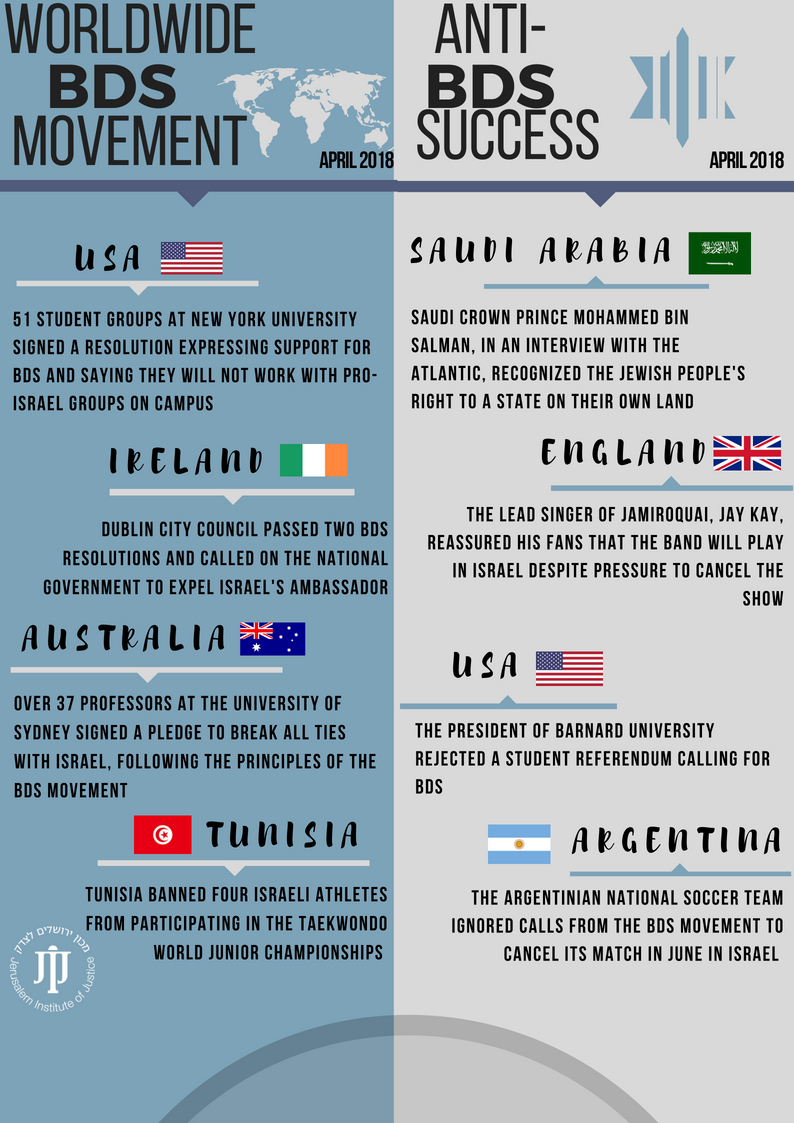
Yom Yerushalayim: Significance for Freedom of Religion
On May 13, Israelis and Jews will celebrate Jerusalem Day, commemorating the reunification of Jerusalem under Israeli sovereignty during the Six Day War of 1967. For some, the day is a celebration of renewed access to the Western Wall and the rest of the Jewish Quarter of the Old City. For others, it is a more general celebration of success in the face of overwhelming odds.
However, one of the most underappreciated outcomes of a united Jerusalem relates to freedom of religion. Throughout the historical periods of Jewish, Christian and Muslim rule, the great faiths erected monuments and places of worship unrivalled by other cities. The Hurva and Ohel Yitzhak Synagogues are a window into the city’s Jewish history, in the same way that the Churches of the Holy Sepulchre and St. Anne are to the city’s Christian heritage. Similarly, the Al-Aqsa Mosque and the Dome of the Rock are revered by Muslims worldwide and are a core component of the city’s Islamic heritage.
It is for this reason that the 1947 UN Partition Plan originally designated Jerusalem as corpus separatum (separated body), to be an international city that guaranteed access to adherents of the three Abrahamic faiths.
However, the cosmopolitan nature of the city today is very different to the atmosphere between 1948-1967.
Prior to 1967, Jordanian authorities severely limited freedom of religion in the city. Upon capturing the Jewish Quarter in 1948’s War of Independence, Transjordanian Arab Legion Major Abdullah el-Tell is said to have told his superiors: ‘For the first time in 1,000 years not a single Jew remains in the Jewish Quarter. Not a single building remains intact. This makes the Jews' return here impossible[1].’
Contrast this to the pronouncements of Prime Minister David Ben Gurion in 1948. When it appeared the Jewish forces were on the cusp of capturing the Old City of Jerusalem, he famously ordered the commander of Jerusalem, David Shaltiel, to ‘prepare a special force - loyal and obedient - …that will mercilessly use machine guns against every Jew – and especially against every Jewish soldier - who will attempt to rob or desecrate a Christian or Muslim holy place[2]’.
Between 1948 and 1967, the city was characterized by the repression of religious freedom and the destruction of minorities’ places of worship. All but two of the Old City’s 58 synagogues were destroyed under Jordanian rule[3]. Furthermore, Jordan’s King Hussein permitted the uprooting of thousands of tombstones at the Mount of Olives Cemetery for the construction of roads through the complex and even latrines for the Jordanian soldiers stationed there.
Even in recent decades, we can again see questionable respect for religious sites. The Solomon’s Stables structure existed under the Southeast corner of the Temple Mount and contained artefacts from eras as the First and Second Temple, Roman, Byzantine and Muslim periods[4]. However, the Israeli Islamic Movement decided in 1995-1996 to renovate the complex with the aim of converting it to a mosque[5]. With careless demolition procedures and without the official approval from relevant authorities, substantial irreversible damage was done to the Southern Wall of the city. As early as 2001, the Antiquities Authority discovered considerable swelling on the Wall, leading to the possibility that, along with the Eastern Wall, it could collapse[6].
The Temple Mount/Haram al-Sharif is another area that relies heavily on the guarantee of freedom of religion. Currently administered by the Jordanian funded waqf (Islamic trust), the complex is important in both historical and religious terms. Rather than infringe upon the right of access to Muslim adherents, the status quo agreement guarantees their access at the expense of Jewish adherents. While Jews have the right to enter the compound, they are forbidden from praying or carrying religious artefacts such as siddurim or kippot out of sensitivity for the Muslim sites there.
These Jerusalem-specific arrangements complement an extensive legislative regime aimed at protecting freedom of religion. The Protection of Holy Places Law of 1967 guarantees freedom of access to sacred places, protection against their desecration and even protection against violations of adherents’ feelings toward these places[7]. Furthermore, Israeli law does not prohibit changing one’s religion nor does it prohibit proselytizing (missionizing).
Thus, in celebrating Jerusalem Day, focus should not only be upon the unexpected victory of Israel’s military in 1967. It should be on the underlying heritage that unites the three Abrahamic religions, and the way in which Israel’s sovereignty over Jerusalem has safeguarded religious freedom.
[1] Zilhka, A. (1992), ‘History of the Israeli-Palestinian Conflict’ in E. W. Fernea and M. E. Hocking (eds.), The Struggle for Peace: Israelis and Palestinians, University of Texas Press, United States, p. 53
[2] Ankori, G. (2006), Palestinian Art, Reaktion Books, London, p. 26
[3] Jewish Telegraphic Agency Daily News Bulletin (1967), ‘Cabinet Report Says Jordan Destroyed 56 Old City Synagogues, Desecrated Cemetery’, November 2, p. 2, accessed March 7 2017, http://pdfs.jta.org/1967/1967-11-02_212.pdf
[4] Gonen, R. (2003), Contested Holiness: Jewish, Muslim and Christian Perspectives on the Temple Mount in Jerusalem, KTAV Publishing, United States, p. 167-169
[5] Shragai, N. (2012), ‘The Danger to Al-Aksa from Muslim Building Activity in Solomon’s Stables’, in Jerusalem Center for Public Affairs, The “Al-Aksa Is in Danger” Libel: The History of a Lie, accessed March 7 2017, http://jcpa.org/danger-to-al-aksa-from-muslim-building-in-solomons-stables/
[6] ibid
[7] The Israeli Knesset, Protection of Holy Places Law 5727 (1967), accessed March 7 2017, https://www.knesset.gov.il/laws/special/eng/HolyPlaces.htm
A Difficult Quest For Peace
A History of Public Opinion from 1967-2017
Fifty years ago, confronted with clear evidence of an impending Egyptian-led invasion, Israel's leaders gambled its national survival by launching a pre-emptive assault. What became known as the "Six Day War" has since become a signal historical event in the nation's history, and still shapes the collective consciousness of the Israeli people. Within less than a week, the tiny country's territory tripled.
The unsought Israeli control of East Jerusalem, the West Bank, the Golan Heights, the Gaza Strip, and the Sinai Desert brought urgent questions before the nation. Should Israel permanently annex one-or-more of these regions? Might they serve, instead, as critical bargaining pieces in a quest to persuade her enemies to abandon their dreams of Israel's destruction? What legal and ethical principles should guide the national debate?
Fifty years later, East Jerusalem has been integrated into Jerusalem's municipal borders. To meet critical security needs, the Golan Heights has been annexed into Israel. The Sinai Desert was returned to Egypt. Although Israel withdrew voluntarily from Gaza, the final status of Gaza and the West Bank remain undetermined. In other words, the questions posed by the miraculous outcome of the Six Day War remain unanswered.
The opinions of the Israeli people about these complex legal, ethical, political, and security issues have been measured, repeatedly, for five decades. Polling data makes up an overlooked, but vital, vector of national feedback during several crucial phases of the post-1967 era. Changing national convictions have influenced the decisions of political leaders, even as those leaders have, in turn, shaped public views.
This paper tracks the public's evolving response to the continuing conflict and, especially, to the indeterminate status of the territories. We conclude that the public showed a surprisingly sophisticated, if intuitive, grasp of the substantial risks tied to the most sweeping proposals and initiatives spanning 1967 to 2017. Our analysis will help anticipate, to some extent, the pathway which still lies ahead for the nation.
Download
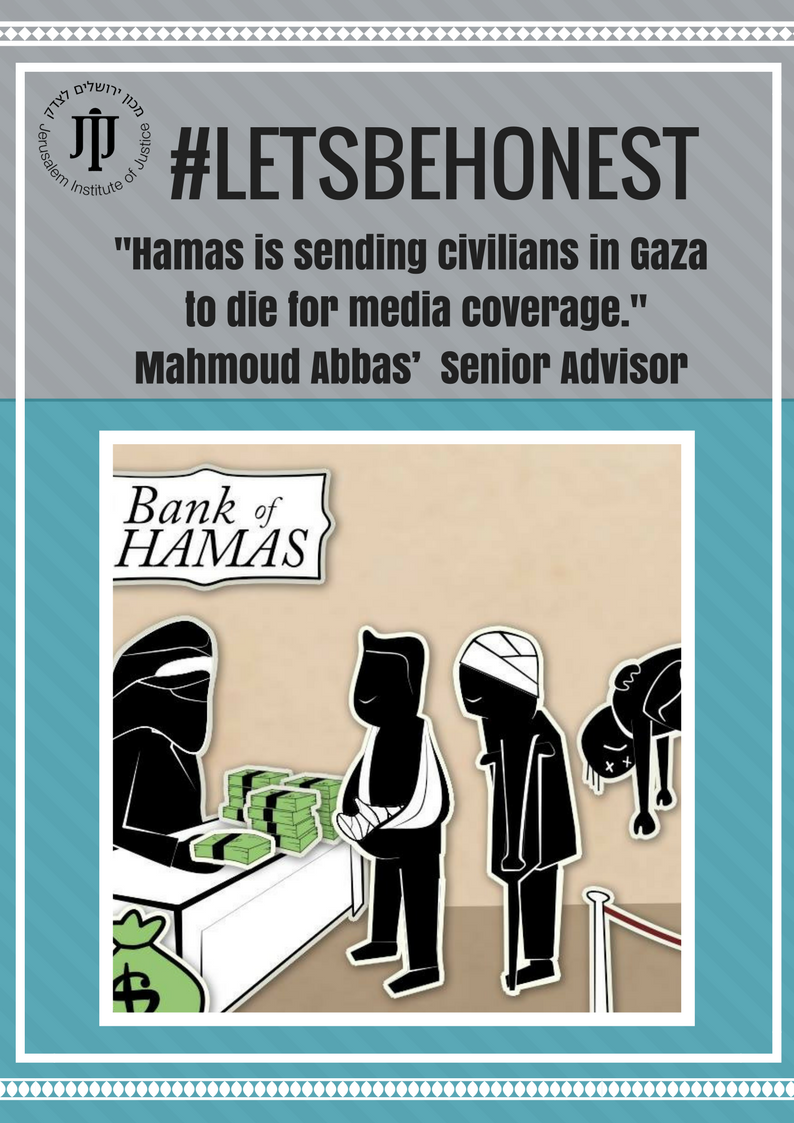
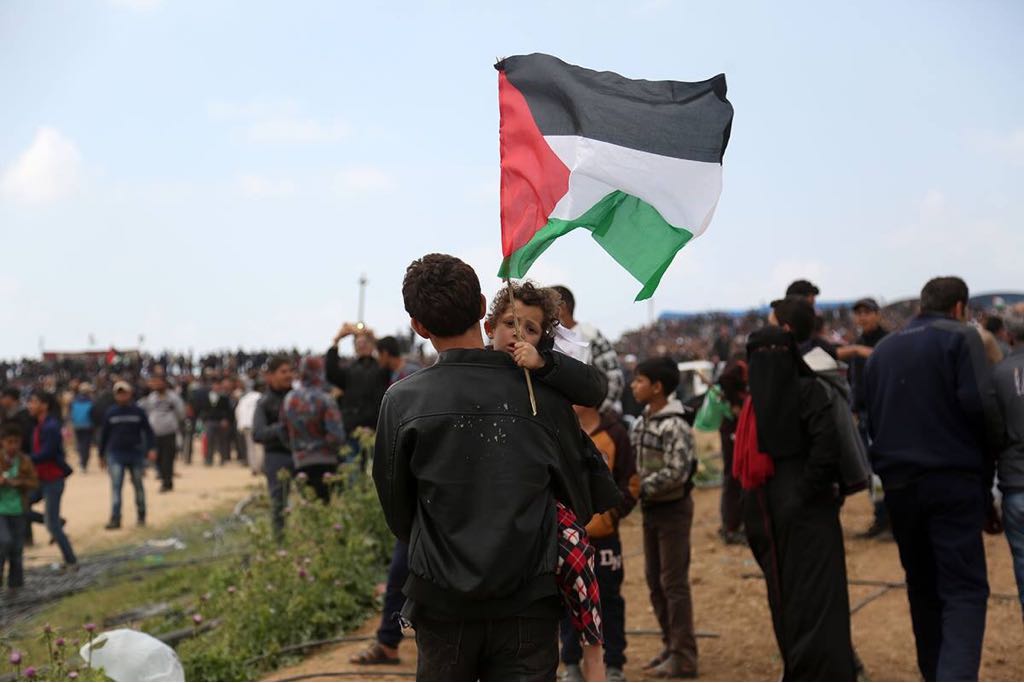
Hamas' True Face Exposed
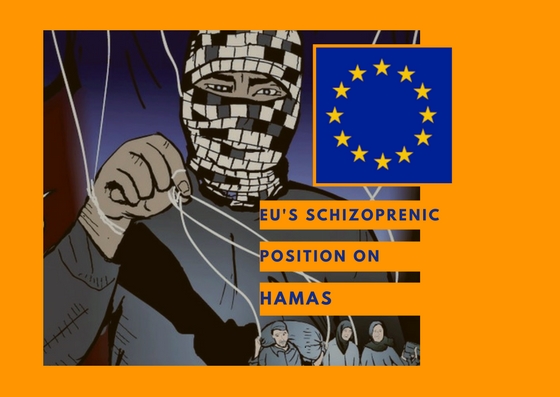
The EU’s Schizophrenic Position on Hamas
An Evaluation of European Policy towards Hamas
Read Full Report
In July 2017, the European Court of Justice (ECJ) ruled that Hamas was rightly put on the list of terror organizations between July 2011 and July 2014. This judgment was a response to the appeal of the European Council against a decision by the General Court, which had ruled that Hamas should not have been on the list during that time. Even though the Advocate General had provided an advisory opinion stating the ECJ should take the same position as the General Court, the ECJ eventually decided in favor of the European Council. While these deliberations were taking place, there was another case pending concerning Hamas' request to be removed from the list from March 26, 2015. This report will analyze the practical implications of the listing of Hamas as a terror organization and present it in perspective to the broader European policy towards the Gaza Strip.
In 2017, the European Court of Justice ruled on an appeal by the European Council and set forth that Hamas will remain on the list of terror organizations. This appears to indicate that the European Union (EU) is convinced of the terrorist nature of Hamas, de-legitimizes the organization and tries to prevent its funding. However, this report shows that the EU's position concerning Hamas is not so clear-cut. Firstly, the EU faces challenges implementing the prevention of funding to Hamas due to its own provision of humanitarian aid to the Gaza Strip, which often implicitly benefits Hamas who maintain effective control over the area. More interestingly, the EU's political response is often highly critical of Israel when addressing the blockade of the Gaza Strip and the hostilities there.
This latest report shows that this criticism is an attempt to transfer responsibility from Hamas to Israel. It is important to understand that these political responses by the EU implicitly consolidate Hamas' rule and in a sense, they become a source of legitimacy for the organization. Moreover, the report shows that the EU's response should be understood in a broader framework, in which it legitimizes Hamas as an organization fighting a legitimate struggle for the Palestinian people, without condemning its methods and practices of terrorism. This report will counter this underlying assumption and urges the EU to acknowledge the responsibility Hamas has in creating the humanitarian crisis in the Gaza Strip. The main argument is that the rule of a terrorist organization over the Gaza Strip is problematic, both for the local population and for Israel. Therefore, it proposes that the EU should problematize the rule of Hamas, and implement measures that will either put pressure on Hamas to abandon its terrorist identity, or that will lead to the complete removal of Hamas from control over the Gaza Strip.