


Terror Tunnels: An International Legal Perspective
Perhaps the most significant feature of 2014’s Operation Protective Edge was the emergence of the terror tunnel phenomenon. Unlike Hamas’ traditional modus operandi of rocket attacks from Gaza, the tunnel phenomenon showcased the alarming ability of Hamas militants to burrow behind enemy lines into Israeli territory and launch attacks on towns and kibbutzim.
Amid reports that Israel might need to consider a threat of Hezbollah tunnels in northern Israel, we analyze the applicability of international law to these tunnels.
Given the recent emergence of the tunnels, their limited use around the world, and their ineffectiveness to state actors, international law does not specifically outline prohibitions on their use. Such is the view of Israeli international legal expert Professor Daphne Richemond-Barak, who noted ‘there is no legal literature’ on the issue and even ‘very little military theory and strategy’. Instead, we are forced to rely on relevant international humanitarian treaty and customary law.
The most obvious contravention of international law relates to the tunnels’ ability to assist in aggression against both Israeli targets and its territorial integrity. Although self-defense is guaranteed to member states of the United Nations by Article 51 of the UN Charter, Hamas’ claims of the tunnel’s ‘defensive’ nature are dubious at best. Many of the now-destroyed tunnels extended into areas of Israel without military targets, such as those with exit points close to the kibbutzim of Kerem Shalom, Holit and Nir Oz. Thus, the tunnels are understood to pose an intentional threat toward civilian targets within Israeli territory – well beyond the pretext of self-defense.
The exit points of these tunnels are not the only areas in violation of international law. The positioning of these tunnels’ entry points is also of significance, particularly as it relates to the Geneva Convention Relative to the Protection of Civilian Persons in Time of War (IV). The central theme of this treaty is the separation of civilians from military personnel to safeguard the wellbeing of non-combatants. Alarmingly, many of the tunnels’ entry points emanate from civilian areas and infrastructure such as mosques, schools and apartment blocks. This is in contravention of the following international laws:
- Article 28 of the 1949 Geneva Convention IV
- Articles 12(4) and 51(7) of the 1977 Additional Protocol 1 to the Geneva Conventions
- Article 8(2)(b)(xxiii) of the 1998 International Criminal Court Statute
- Customary International Law
Richemond-Barak also notes the significant risk posed to children in the construction of the tunnels. As argued in a Journal of Palestine Studies article of 2012, by Hamas’ own admission at least 160 individuals had died in constructing the tunnels at the time of the article’s publishing. Alarmingly, an extremely high number of these are believed to be children as they are ‘prized for their nimble bodies’.
Furthermore, the way in which these tunnels must be eliminated also makes Hamas liable for violations of international law. The aforementioned access points of the tunnels (in mosques, schools, apartment blocks etc.) inevitably means that their dismantlement will result in damage to civilian infrastructure and endanger the lives of civilians themselves. Mapping the paths and structural integrity of the tunnels is extremely difficult and rarely accurate. For those tasked with destroying the tunnels, there is a substantial element of ‘unknown’ in doing so; increasing the likelihood of unforeseen damage to Gazan civilians and their infrastructure.
Thus, in the absence of international law that deals specifically with the phenomenon of terror tunnels, one must apply existing relevant international humanitarian laws and norms to the issue. In doing so, one can establish that the use of underground terror tunnels is undeniably contrary to international law and a war crime.
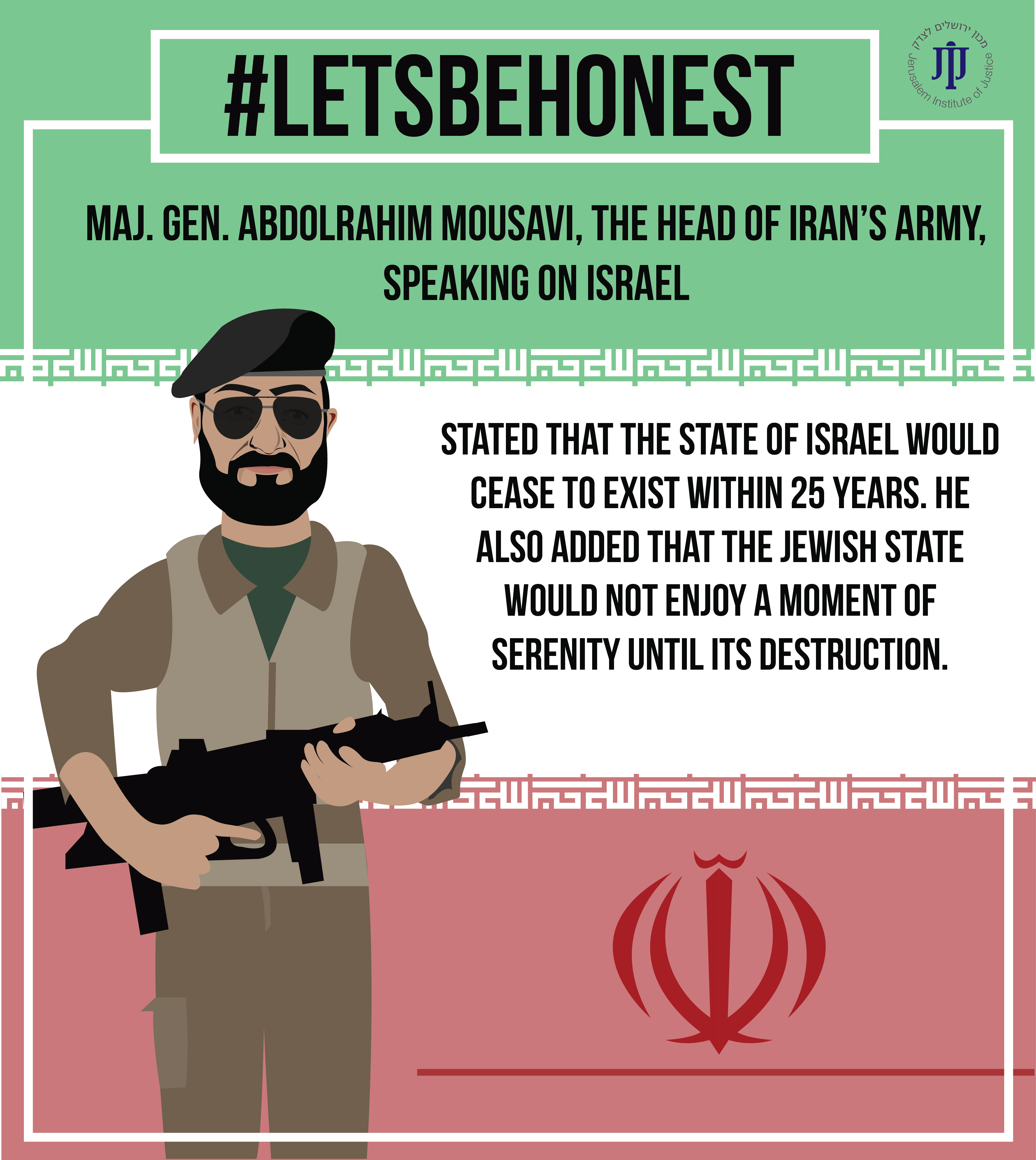
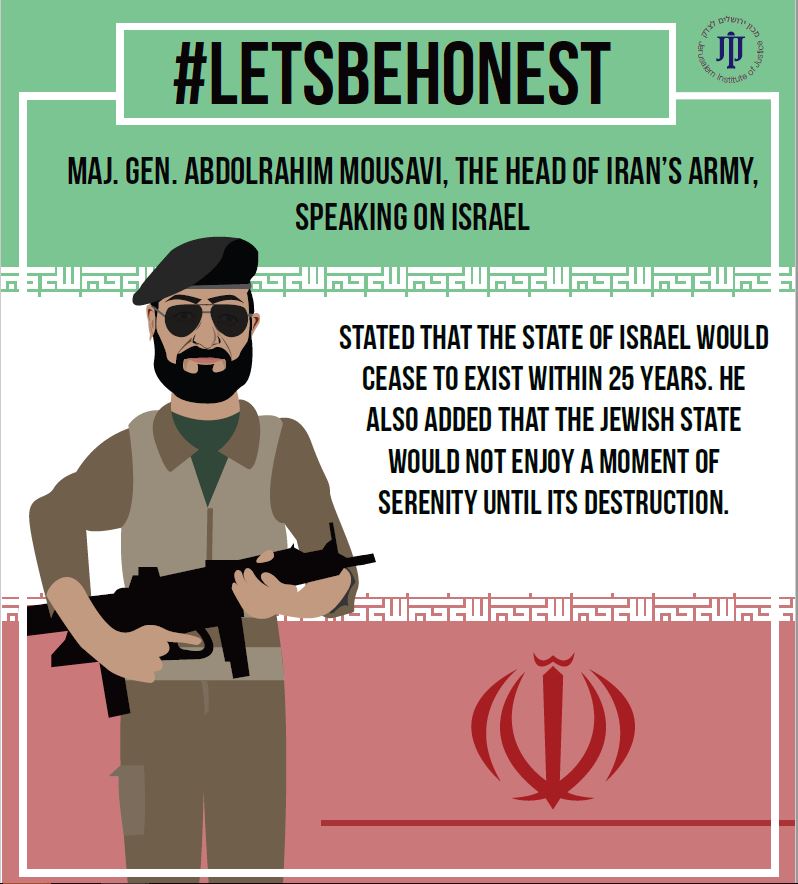
Israel would cease to exist within 25 years
This visual displays the hatefull rhetoric that the leader of Iran's military espouses to the world regarding the State of Israel's continuity, safety, and peace.
Download


Incitement: The Low-Hanging Fruit to Achieving a Peace Deal
One of our interns recently sat down for an interview with former Israeli Ambassador to Canada Alan Baker of the Jerusalem Center for Public Affairs. In line with his role as the organization’s international law expert and Director at the Institute for Contemporary Affairs, the Ambassador has amassed a wealth of experience in dealing with the international legal implications of incitement.
The protracted conflict between Israel, the Palestinians and the wider Arab world has endured for over six decades. One reason for this is that many of the issues up for negotiation in a final peace agreement - refugees, borders, demilitarization and settlements - are notoriously complex. However, the issue of incitement is one point of difference between the two parties that could and should be easily resolved.
Within the context of Israeli-Palestinian relations, incitement refers to either:
- The act of encouraging or urging another person to commit violence, or
- Knowingly disseminating false information about a particular group of people with the aim of provoking a violent reaction
When asked about the issue’s centrality in resolving the conflict, Ambassador Baker pointed out that incitement is specifically addressed in the interim agreement of the Oslo Accords. He notes “a committee was set up – the Palestinians, the Israelis, and the Americans, to handle incitement by everyone”. Interestingly, the inclusion within the agreement framework was borrowed from Israel’s peace treaties with Israel and Jordan. Again, the Ambassador points out that “there are specific provisions there calling upon each side to do whatever is necessary – from the point of view of education and one thing or another – to encourage good neighbourliness and prevent incitement”.
The strategic use of incitement has permeated Palestinian leadership since before the inception of the Israeli state. Most infamously, it was employed to horrific effect in the Hebron Massacre of 1929, where between 67-69 Jewish people were killed by Arab mobs who were told of supposed Jewish plans to storm the Al-Aqsa mosque in Jerusalem. In contemporary times, we have seen a rapid resurgence of these accusations from the upper echelons of the Palestinian Authority. In September 2015, at the height of a wave of car-ramming and stabbing attacks, PA President Mahmoud Abbas alleged Jewish interference at the Muslim holy site. “Al-Aqsa is ours and so is the Church of the Holy Sepulchre”, he proclaimed. “They have no right to desecrate them with their filthy feet. We won’t allow them to do so and we will do whatever we can to defend Jerusalem.” As foreign governments - particularly the Obama administration - were urging parties to calm tensions and combat incitement, Abbas continued “each drop of blood that was spilled in Jerusalem is pure blood as long as it’s for the sake of Allah. Every martyr will be in heaven and every wounded person will be rewarded, by Allah’s will”. As recently as July 2017, PA Parliament Member for Fatah, Hatem Abd Al-Qader, stated “we are moving towards an escalation. The Israelis are moving towards an escalation, and we have no problem on our part that there will also be an escalation from the Palestinian side. Escalation is answered with escalation, and violence is answered with violence”.
As it currently stands, access to the site is governed by an arrangement achieved immediately after Israel’s unification of Jerusalem in the Six Day War of 1967. More commonly known as the ‘status quo’, the site is administered by a Jordanian trust known as the waqf and grants access to Muslims, Christians and Jews but forbids prayer by the latter two groups. Apart from the periodic unsubstantiated allegations from Palestinian leaders, no evidence exists suggesting any current or planned changes to the status quo. Member of Knesset Yehuda Glick, who currently serves in the governing Likud party, can attest to this. Prior to his ascension to the Knesset, Glick was a prominent campaigner for Jewish prayer rights at the Temple Mount and, therefore, alterations to the status quo. During that time, he survived an assassination attempt by a man who believed Glick to be “an enemy of Al-Aqsa”. Ironically, he serves in a governing party that enforces an arrangement to which he is diametrically opposed.
Importantly, the phenomenon of incitement is not limited to perceived incursions on the Temple Mount. Religious clergy play a significant role in shaping their followers’ attitudes to violence. For example, in October 2015, Rafah cleric Sheikh Muhammad Sallah "Abu Rajab" brandished a knife while exclaiming “Form stabbing quads. We don't want just a single stabber. Oh young men of the West Bank: Attack in threes and fours. Some should restrain the victim, while others attack him with axes and butcher knives…Oh men of the West Bank, next time, attack in a group of three, four, or five. Attack them in groups. Cut them into body parts”.
Ambassador Baker became well-known in the international legal community for authoring the Draft International Convention for the Prevention of Incitement to Terror, which borrowed language and preambular paragraphs from other U.N. Conventions addressing terrorism. However, the dissonance between the recognition of the problem and the collective will to act ultimately torpedoed the document’s success. “Everybody admits and accepts the fact that incitement is a central component of terror today but nobody’s prepared to act against it”, argues Baker. “There’s a resolution every year in the General Assembly condemning international terrorism and this includes advocating, inciting… but it’s not a legal document - it’s a political thing accepted by a political majority but it has no teeth.”
Similarly, the Ambassador laments the lack of collective will to combat incitement on the international stage. He was disappointed that his efforts to prosecute former Iranian President Mahmoud Ahmadinejad for inciting genocide against Jews and Israelis - in contravention of Article 3(c) of the Convention on the Prevention and Punishment of the Crime of Genocide - were unsuccessful. “Not only is Ahmadinejad violating provisions of the ICC Statute, it doesn’t matter because he’s also violating the Convention Against Genocide by advocating genocide and therefore he’s bound, he’s violating international law.” He added that, together with the Canadian B’nei Brith, he even drafted a charge sheet detailing which international crimes he committed.
The elusive peace between Israelis and Palestinians will neither be achieved easily nor overnight. Although we may not know the exact nature of any final agreement, we can say which actions will torpedo any progress. It won’t include conspiracies of Jewish hordes swarming Islamic holy sites, nor calls to arms aimed at instigating a religious war. Palestinian leaders and clerics owe it to their children to spread a message of nonviolence. They must reject – not just publicly – the idea of mukawama (armed resistance) and champion the idea that there is no glory in the afterlife for stabbing innocent people or car ramming children. Words matter – particularly with impressionable youth and the age of technology. As such, incitement in all its forms is a disaster for coexistence.
And what about incitment?
If we learned anything from the wave of terror in 2015-2016, it is that words matter. In an environment where Palestinian unemployment remains staggeringly high, disenfranchised youth become more impressionable and susceptible to the pronouncements of charismatic leaders. Hence, when President Abbas decries Jews visiting the Temple Mount as having ‘no right to defile it with their filthy feet’, its legitimacy is only accentuated for young Palestinian men. The recourse to martyrdom then becomes a logical response because, as Abbas describes, ‘we bless every drop of blood that has been spilled for Jerusalem, which is clean and pure blood’.
In cases like these, the line between Zionism and Jews becomes ever more blurred. A disagreement over religious access to a holy site becomes an aspersion on the humanity, or lack thereof, of Jewish people. Coupled with the reverence of Palestinian officials for mukawama (armed resistance), it is a recipe for disaster in coexistence.
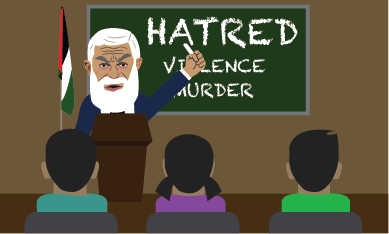
Importantly, this incitement does not occur within a vacuum. It also coincides with an extensive period of classroom indoctrination. From a young age, children are not simply taught to resent encroachment on their land or commit themselves to non-violent resistance. Rather, they are taught to detest Jews and to sacrifice themselves in martyrdom to bring about their demise.
As reported by the Times of Israel in March 2016, one particular ninth-grade textbook was none-too subtle in its advocacy for armed resistance and martyrdom. One page began with a Quranic verse which instructs Muslims to kill or imprison non-believers.
If nothing else, the great crime here is the systematic hijacking of children’s minds. Young children are not yet able to discern what is right from wrong, and they are the victims of efforts to train a generation of young people in hate and animosity. This cycle is then repeated for future generations, when the children mature and circulate the material to the next cohort.
In recent years, the Palestinians have pursued efforts to join the community of nations and the system that binds them together. This includes receiving non-member observer status at the UN in 2012, as well as their ratification of the Rome Statute of the International Criminal Court in 2015. However, accessions such as these also carry responsibilities. It is, at best, disingenuous join an international legal system aimed at preventing large-scale violence whilst sowing the seeds for such calamity among one’s own people.
Given the albeit delayed moves toward free and fair elections in the Palestinian territories, the ball is now in the court of Palestinian officials and candidates. They can propagate insidious blood libels (as Hamas spokesman Osama Hamdan did on Lebanese TV in 2014) or they can reject the nihilism of centuries-old folklore by countering incitement and championing non-violence.